Alcohol & Substance Abuse

AG Barr says ‘everything is on the table’ to solve Alaska’s public safety crisis

U.S. Attorney General William Barr heard concerns from Alaska Native leaders about the lack of law enforcement and high rates of sexual assault and domestic violence in rural Alaska. (Photo by Joey Mendolia/Alaska Public Media)

Late last month, U.S. Attorney General William Barr spent three days touring Alaska with the congressional delegation to hear about and see for himself the lack of public safety in rural Alaska. He spent a day in Bethel and the nearby village of Napaskiak.

Barr’s security detail outnumbered the number of village public safety officers in the Yukon-Kuskokwim Delta, a region roughly the geographic size of Oregon.

Western Alaska has a public safety crisis, one that’s been there for decades.

A recent Anchorage Daily News article highlighted just how bad it is: At one point this year, at least 1 in 3 rural Alaska villages had no law enforcement. Western Alaska also has some of the highest rates of domestic violence and sexual assault in the nation, and ranks high in the number of murdered and missing Indigenous women.

With U.S. Sen. Lisa Murkowski, R-Alaska, by his side, the attorney general made his first visit to the Yukon-Kuskokwim Delta.

“You have to see it to understand it,” Barr said.

Barr said that it’s hard for him to imagine a “more vulnerable population.” And he said that even the bare minimum of basic safety standards is lacking in the Y-K Delta.

Barr and Murkowski first visited Bethel’s Tundra Women’s Coalition, one of two women’s shelters in the region. Staff there told them that they were over capacity and struggling to make room for families coming in. Ina Marie Chaney, a shelter manager, said that a case has to be pretty serious before the shelter can even consider it.

“Right now we’re screening on lethality cases,” Chaney told Murkowski and Barr.

And then Barr heard from the Association of Village Council Presidents about the public safety crisis and their ideas about fixing it. Reporters were not allowed in that meeting.

AVCP CEO Vivian Korthuis told KYUK later that they presented Barr with a plan to build seven public safety centers in the region, and she hopes that they will get the resources they need to build them.

Then it was time to visit Napaskiak. People lined the banks as the boats carrying Barr and Murkowski pulled up to shore.

Their first stop was the jail. Inside the large red building are cells made of wood, with wooden doors.

Napaskiak has two tribal police officers and two village police officers. All of them are working part-time; they work one week on and one week off. Napaskiak used to have two state-trained village public safety officers, but they left.

Barr also visited the school. There, Native Village of Napaskiak President Stephen Maxie Jr. begged him to declare an emergency because of how many alcohol-related deaths happened in the village over the past two years.

“The poor suffer the most, and they don’t got the most. They’re hurt the most because we’re always overlooked and always put aside,” Maxie said.

Barr said that he sees that the criminal justice system isn’t working for Alaska Native tribes. And as for the types of solutions, he said “everything is on the table.”

Meanwhile, another tribal police officer is set to leave after only a couple of months on the job: Harry Williams said that he plans to go to building maintenance. The reason? Better pay and benefits.

Barr has said he plans to return to the Y-K Delta. At an Anchorage meeting, he told leaders that he would schedule a followup meeting. So far, no date has been set.

Senate sends criminal justice bill to Dunleavy’s desk

Rep. Adam Wool, D-Fairbanks, speaks during a House floor session on March 11. Wool was one of two representatives who voted against a revised bill dealing with criminal justice, House Bill 49. The House passed it on May 20, and the Senate passed it Tuesday. (Photo by Skip Gray/360 North)

The Alaska Senate agreed Tuesday to changes to a major crime bill worked out by Senate and House negotiators. The House had agreed to the changes on May 20, so the Senate action sends the bill to Gov. Mike Dunleavy.

Dunleavy said he’ll sign House Bill 49.

“This was a significant move on their part,” he said. “This is great for Alaska. This is great for Alaskans. This is something that we’ve been talking about for some time, and this goes a long way in making Alaska safer.”

The bill repeals much of the controversial three-year-old law known as Senate Bill 91. While that law reduced criminal sentencing, the new measure increases sentencing.
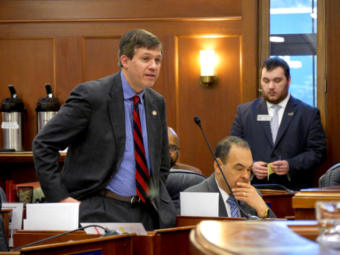
The only legislators who voted against the changes were Fairbanks Democratic Reps. Adam Wool and Grier Hopkins. They both said giving more jail time will increase the risk of offenders committing new crimes when they’re released.


Watch the latest legislative coverage from Gavel Alaska:

Senate committee goes further than House in repealing controversial crime law

Sen. Bill Wielechowski, D-Anchorage, speaks during a Senate floor session, March 13, 2019.
Sen. Bill Wielechowski, D-Anchorage, speaks during a Senate floor session on March 13. On Sunday, Wielechowski successfully proposed an amendment to House Bill 49 that would keep first-time drug possession offenses as misdemeanors. (Photo by Skip Gray/360 North)

A criminal justice bill advancing in the Alaska Senate would go further than the House version in repealing parts of a controversial three-year-old law.

The Senate Finance Committee passed House Bill 49 on Sunday after adding elements of a criminal justice package proposed by Gov. Mike Dunleavy.

The Senate bill would make second-time drug possession offenses into felony crimes.

Anchorage Democratic Sen. Bill Wielechowski successfully proposed an amendment that would keep first-time drug possession offenses as misdemeanors. But they would be punishable by up to a year in jail.

Wielechowski said this will allow some first-time offenders to keep their jobs.

“This is an attempt to try to find a middle ground and say, ‘One time.’ You make one mistake, we’re going to say, ‘You can go to jail for up to 365 days.’ And then the second time is a felony,” Wielechowski said. “I think that’s a fair result.”

Under the 2016 law known as Senate Bill 91, first- and second-time drug possession charges are misdemeanors that do not lead to jail time.

Sen. Mike Shower, R-Wasilla, questions Assistant Attorney General William Milks in the Senate Judiciary Committee in Juneau on March 22, 2019. Milks was testifying on Senate Bills 23 and 24, which would compensate Alaskans for past cuts to the Alaska Permanent Fund dividend.
Sen. Mike Shower, R-Wasilla.(Photo by Skip Gray/360 North)

Wasilla Republican Sen. Mike Shower supports repealing many of the elements of SB 91. He voted for Wielechowski’s amendment. He said the bill gives prosecutors more tools.

“We can always change it,” Shower said. “If we find it’s not working, we can modify it again and go back harder.”

The Senate bill also would repeal a legal defense that spouses can use against charges of sexual assault of a spouse who is incapacitated.

The entire Senate could vote on the bill as soon as Monday. The legislative session is scheduled to end on Wednesday.

Alaska House passes sweeping crime bill

Rep. Tammie Wilson, R-North Pole, and Rep. Matt Claman, D-Anchorage, attend a House majority press availability, May 8, 2019. Wilson and Claman were among 24 House members who voted to pass House Bill 49, shortly before the availability. (Photo by Andrew Kitchenman/KTOO and Alaska Public Media)
Rep. Tammie Wilson, R-North Pole, and Rep. Matt Claman, D-Anchorage, attend a House majority press availability on Wednesday, May 8. Wilson and Claman were among 24 House members who voted to pass House Bill 49, shortly before the press availability. (Photo by Andrew Kitchenman/KTOO and Alaska Public Media)

The Alaska House of Representatives passed a wide-ranging revision to the state’s criminal justice laws on Wednesday.

House Bill 49 would mark the third time the Legislature changed major provisions of the controversial law known as Senate Bill 91.

Rep. Tammie Wilson, a North Pole Republican, supported the bill.

“What you have before you is a bill that repeals and replaces the harmful provisions of SB 91,” she said. “We’ve heard from Alaskans, from our constituents, that they’ve had enough.”

The bill would increase sentences for some sex and drug offenses. It also would ensure more rape kits are tested. And it would require that people who move to Alaska be registered as sex offenders if they’re registered in other states.

All but one minority-caucus Republican opposed the bill: Minority leader Rep. Lance Pruitt voted against it. He said it wouldn’t go far enough to repeal SB 91.

“The people did not ask us to come back here and to try to give them the image that we cared and we had heard,” he said. “They asked us to come back here and fix the problem.”

But overall, the legislation had support from the majority caucus, which has 15 Democrats, seven Republicans and two independents.

Anchorage Democratic Rep. Matt Claman said the bill is balanced, by increasing penalties but leaving funding for drug offenders to get treatment.

“This bill, I believe, strikes the very kind of balance that the public has asked us to do when we come down here — to find a balance between getting tougher on sentences, but not getting so tough that we take out the potential resources to help people who really need treatment for their addictions,” Claman said.

The House passed the bill by a 24-14 vote. One majority caucus member, Fairbanks Democrat Grier Hopkins, voted against it. One minority caucus member, Nikiski Republican Ben Carpenter, voted for it. Anchorage Republican Gabrielle LeDoux, who recently left the House majority, also voted for it. Big Lake Republican Mark Neuman and Anchorage Democrat Chris Tuck were absent.

Dunleavy said Monday the bill points the state in the right direction. He expressed concern that amendments would “water this bill down.”

The House amended the bill to reduce some of the increased penalties in the bill. But amendment sponsors said Dunleavy’s administration cooperated on the changes.

The bill now heads to the Senate.


Watch the latest legislative coverage from Gavel Alaska:

Emmonak votes to keep alcohol and remain ‘damp’

Emmonak in July 2013. (Photo by Adam DuBrowa/FEMA)

Voters in the Western Alaska community of Emmonak have narrowly decided to continue restricted alcohol sales and remain a so-called “damp” community under local option laws.

Certified results from the recent election were 122 votes in favor of keeping alcohol in Emmonak and 103 votes against. The community has a total of 502 eligible voters, according to local officials.

Emmonak is a community of more than 700 near the mouth of the Yukon River and had a long history of prohibiting alcohol. But voters in 2016 – also by a slim margin – approved alcohol sales at a facility run by the local government.

Emmonak’s City Clerk, Mona Andrews, has worked for the community during its last two local option elections.

“The first outcome, I thought it would pass, it was so close,” Andrews said. “The second round I was disappointed again. This time I had put signs everywhere in Emmonak to make sure people knew. I’m just sad that the results turned out for Emmonak to still be damp.”

Andrews says Emmonak is working on ways to remove bootleggers and address regional concerns over alcohol in the community. She says surrounding villages have complained about the negative effects alcohol from Emmonak is having on their residents.

Emmonak’s tribal leaders and other stakeholders plan on holding community discussions regarding alcohol.

Andrews expects continued efforts to restrict alcohol in the community. According to Alaska Statutes, Emmonak can start a new petition to hold another election as soon as the past results have been certified.

House committees take different approach on crime bills

Rep. Chuck Kopp, R-Anchorage, speaks during a House floor session in Juneau on April 11, 2019.
Rep. Chuck Kopp, R-Anchorage, speaks during a House floor session in Juneau on April 11. Kopp said Saturday that the House Judiciary Committee’s version of House Bill 49 is a good starting point for making changes to criminal sentencing. (Photo by Skip Gray/360 North)

Competing crime bills are advancing in the Alaska Legislature.

Four major bills proposed by Gov. Mike Dunleavy have advanced to the Senate Finance Committee. Senate Bill 35 would increase penalties for sex offenses. Senate Bill 32 would reverse reductions to sentences from the 2016 law known as Senate Bill 91, and introduce a new category of crime called terroristic threatening.  Senate Bill 33 would increase bail and give judges more discretion in how people charged with crimes are released before trials. And Senate Bill 34 would reduce the use of parole, so that prisoners will spend more time in jail.

But House members have brought different ideas on addressing crime to the House Judiciary and House Finance committees.

The House Judiciary Committee moved House Bill 49 and House Bill 145, both of which include some elements of the different crime bills that have advanced in the Senate.

Anchorage Republican Rep. Chuck Kopp said Saturday that the Judiciary Committee’s version of HB 49 is a good starting point for making changes to criminal sentencing.

“This has incorporated numerous specific requests from the law enforcement community over — I think a dozen different sections came directly from (the Alaska Department of) Public Safety,” said Kopp, the House Rules Committee chairman. “And more than that came directly from the governor’s bill. It gives us a working document. There will be more amendments. We know we need a vehicle to improve crime, and this gives us a good starting point.”

Rep. David Eastman, R-Wasilla, speaks during a House floor session, March 11, 2019. (Photo by Skip Gray/360 North)

But Wasilla Republican Rep. David Eastman said the bills moved by the Judiciary Committee are too complex.

“I had thought we had learned a lesson from what happened with SB 91 and all of the subsequent fallout,” he said. “Even those who supported it had to support continual bills of revision because it was just so big.”

The House Finance Committee has taken yet another approach. It has amended House Bill 20, which was originally intended to improve the reporting and timeliness of rape kit testing.

The committee added provisions that are closer to Dunleavy’s proposals to reverse the SB 91 sentencing reductions than the bills moved by the Judiciary Committee.

Members of the House majority caucus planned to meet late Tuesday to discuss what crime legislation will advance to the House floor.


Watch the latest legislative coverage from Gavel Alaska:

Site notifications
Update notification options
Subscribe to notifications