Alcohol & Substance Abuse

Capital City Fire/Rescue considers taking over hospital sleep-off program

(Photo by Heather Bryant/KTOO)
The concept for the sleep-off program came about during discussions of where Juneau’s primary sobering center could be sited if it left the hospital campus. (Photo by Heather Bryant/KTOO)

Changes may be in store for the sleep-off program at Bartlett Regional Hospital.

The program provides a place for inebriated people to sleep until they sober up, but the hospital doesn’t view this as a medical service.

That’s why Juneau officials have been looking to move the program off campus. And Capital City Fire/Rescue is thinking about taking it on.

According to Alaska state law, throwing intoxicated people in jail for the night is the option of last resort for local authorities.

Fire Chief Rich Etheridge said that’s why many communities provide an alternative.

“The first priority is to take them home or to a safe place where a friend or family member can care for them,” Etheridge said. “If that’s not available, then we take them to a sleep-off center like we currently have.”

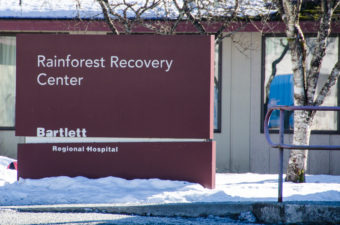
Right now, the program is run by the hospital’s addiction treatment unit, Rainforest Recovery Center. It’s staffed by EMTs who use a van to pick up and evaluate intoxicated people.

If they can’t take them home, they bring them to the sleep-off center.

Capital City Fire/Rescue has offered to take over the program, moving it to a space owned by St. Vincent de Paul near the airport.

The new sleep-off center would only be available for 12 hours overnight, rather than the current 24-hour service.

At a committee meeting last week, the Juneau Assembly voted to continue exploring the proposal, despite some concerns over the cost.

But Assembly member Loren Jones voted against it, saying he’s adamantly opposed to seeing sleep-off moved off Bartlett’s campus.

Jones spent several decades working in alcohol and drug abuse services. He wants to make sure people have access to substance abuse treatment beyond sleep-off.

“They can bring a counselor in from the treatment program. They can bring a staff person from detox to talk to this person,” Jones said. “You can’t do that if they’re seven miles away at St. Vincent de Paul, as opposed to being on the campus. It’s not as efficient. It doesn’t work as well.”

The sleep-off facility at Rainforest Recovery Center. (Photo courtesy Bartlett Regional Hospital)

Bradley Grigg has been the hospital’s chief behavioral health officer since 2017. He said Rainforest Recovery staff offer treatment information and paperwork to sleep-off users when they wake up, but it’s rare to see someone go straight into the detox unit.

He said they’re more likely to return later when they’re ready.

“We just haven’t seen a single individual go straight from sleep-off into Rainforest in the 20 months I’ve been at Bartlett,” Grigg said.

Grigg said moving sleep-off has been a discussion at the hospital for years. They want to focus more on recovery programs and have plans for a drug treatment unit soon.

“It’s just a matter of when, and part of the reason that this kind of escalated to this point with the sleep-off program is, currently, where the sleep-off program is physically located on the facility is where the detox program will be,” Grigg said.

Grigg also said they’ve seen a big drop-off in the number of people using sleep-off over the last year-and-a-half. They now serve on average 24 individuals a month and go some days without any users at all.

He credits that to the opening of the Housing First complex in 2017, which brought 32 formerly homeless people off the street.

While that means more empty beds in sleep-off, EMTs on staff are now spending more time transporting intoxicated people back to Housing First.

And shifting that responsibility to the fire department could mean tying up staff that would rather be responding to emergencies than shuttling people who are drunk.

Travis Wolfe is president of the union representing local firefighters. He’s been following the proposal and said the union is confident that the decision-makers are evaluating all pros and cons.

“We will support, as the firefighters of this community, anything that will help improve and maintain the Rainforest program in whatever iteration that it may become,” Wolfe said.

Another goal of the proposal is to create a pipeline for Capital City Fire/Rescue to recruit more career staff. The department has struggled with recruitment and staffing amid an increase in calls the last few years.

Etheridge said it takes several hundred hours to become a firefighter or a paramedic, but offering entry-level emergency trauma technician, or ETT, positions in sleep-off would help people work toward that while getting paid.

“We can get a student right out of high school with their ETT certification and plug them right into a career where they’re making $50,000, $60,000 a year without having to go through college,” Etheridge said.

The proposal adds six new positions for the department. Etheridge said the team could also serve as a backup ambulance crew in disaster situations.

The Assembly will consider the proposal again at a future meeting.

Transforming perspectives on trauma through paintings of hope

The Solutions Desk looks beyond Alaska’s problems and reports on its solutions — the people and programs working to make Alaska communities stronger. Listen to more solutions journalism stories and conversations, and share your own ideas here.

Tarah Hargrove stands before a massive painting. One side is dominated by gray cinder blocks and stencils of guns, the other by a yellow sky filled with birds. And in the center is a giant portrait of Hargrove herself. Her chin is lifted, and she looks defiantly at the viewer, magenta radiating from her hair.

“So my inner narcissist was like, ‘Yay! My face!” Hargrove said, laughing about her first impression of the four-panel mural painted by University of Alaska Anchorage students. Though she’s lighthearted, she knows that sharing her story — her truth — through the artwork is essential.

Last fall she was invited by a professor, Steve Gordon, to tell a group of beginning art students about her life. She started with her unstable childhood: Her abusive stepfather had substance misuse problems, she was raped and she attempted suicide. Despite that, as a young adult she did well in school, started her own business and helped raise her younger sister.

Tarah Hargrove poses in front of the mural depicting her story created by students at University of Alaska Anchorage.
Tarah Hargrove poses in front of the mural depicting her story created by students at the University of Alaska Anchorage. (Photo by Joey Mendolia/Alaska Public Media)

Things got rocky again in her early 20s, and eventually she started using and selling street drugs and ended up in prison. Hargrove said she feels like being open and honest about her decisions, both good and bad, has ripple effects.

“When we’re being honest, and we’re being vulnerable, and we’re being intimate — intimacy is the key to having connection,” she said. And through those connections, people are more likely to care about others and take time to stop and help people. To engage with them.

Hargrove wasn’t always so willing to engage with others or with herself. She said her turning point is illustrated on the mural with the overlapping, seemingly endless images of guns. Before going to prison, she was violently beaten by her ex-boyfriend.

“Like, I got my ass beat so bad it changed my life,” she explained. “And my gun was involved. It was my gun that they used on me, on my head. So it was, I mean, it’s kind of pinnacle (for me).”

She permanently lost hearing in one ear and realized she needed a dramatic change in her life. When she went to prison, she participated in different programs that helped her deconstruct the way she looked at the world and start her path to recovery. She said she started removing the layers of dishonesty and bitterness she used to justify her actions. She wanted to be candid and straightforward.

A mural created by students at University of Alaska Anchorage about Adverse Childhood Experiences.
A mural created by students at the University of Alaska Anchorage about adverse childhood experiences. (Photo by Joey Mendolia/Alaska Public Media)

And those are some of the traits that struck Arlitia Jones when the two women first met for the mural project. Jones is a playwright who took the nighttime art class at UAA because she wanted to learn to paint. She thought she’d be painting flowers and still lifes, not someone’s intimate story of trauma. It made her nervous because she wasn’t sure someone could be truly open about their difficult past.

Jones said Hargrove was not what she expected. “My first reaction to Tarah was when she walked in and I saw this woman, I was like, ‘Wow. That woman doesn’t look like she’s had anything happen. She’s very physically beautiful, and so strong.’”

And then Hargrove opened up about her story and laid out all of the details.

Meeting Hargrove made Jones re-evaluate some of the assumptions she makes about people and their life experiences.

“Now walking around, I’m not going to say that, ‘Oh, I never judge people anymore,’ because I do. Every day,” Jones said. “But just there’s this little voice in the back like, ‘Wait a minute, you know, you don’t know that whole story and how we cover up.’”

Jones said she hopes that when people see the mural, they’ll see Hargrove’s strength and determination. That she has to work hard every day to keep her relationships strong and to care for her daughter, but that she’s doing it. Her story, like the painting, has moved from dark to light.

A mural created by students at the University of Alaska Anchorage about adverse childhood experiences.
A mural created by students at the University of Alaska Anchorage about adverse childhood experiences. (Photo by Joey Mendolia/Alaska Public Media)

Hargrove wants people who see the piece to think about all of the young people they meet.

“So you’re going to Christmas and there’s like that one kid who acts like an a˗˗˗˗˗˗, and you’re like, ‘What’s wrong with you?’ There’s probably something really wrong with them,” Hargrove said.

She asks that people don’t just write the kid off — like adults did with her.

Hargrove never says her life was hard. She likens her experiences to special access to extra information about the world that helps her connect with others.

“I’m not trying to be like, ‘The quality of my life is better than other people’s,’ but the quality of my life is better than other people’s,” she said matter-of-factly. “Because I’m aware, and I get to love people for real. I have no qualms about that.” She said she’ll take extra steps to help people, even if others judge her for it.

The two women hope this mural and the six others that will be on display around town will change perceptions about the effects of childhood trauma. Because if people receive love and support, their stories don’t have to end with more pain. They can begin again — with hope.

The murals will be on display from Feb. 8 to March 8 by the Downtown Transit Center in Anchorage. In April, they’ll be at the Loussac Library before moving to the Mat-Su Health Foundation in May.

Southeast students explore careers to meet Alaska’s behavioral health needs

Holli Davis came to a behavioral health camp in Juneau the week of of Jan. 28, 2019 hoping to get "more of a clear vision" of a career in social work. (Photo by Zoe Grueskin/KTOO)
Holli Davis came to a behavioral health camp in Juneau the week of of Jan. 28, 2019, hoping to get “more of a clear vision” of a career in social work. (Photo by Zoe Grueskin/KTOO)

High school students from around Southeast Alaska met in Juneau last week to explore careers in behavioral health. The state has a shortage of workers in these fields, and there’s a push to recruit Alaskans to come back after college and do those jobs in their home communities.

Holli Davis is a senior at Petersburg High School. She’s been thinking a lot about what she’d like to do in the future, and right now she’s considering social work. She wants to work with kids.

“Being in Petersburg, you know a lot about kids and their upbringing in life,” she said. “And sometimes you know know they didn’t have a good upbringing, and I kind of just want to help them out.”

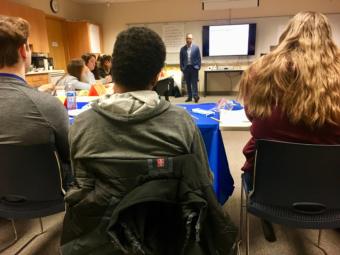
Along with 18 other teens from the region, Davis spent a week in Juneau for Behavioral Health Career Connections, a program for students to learn more about careers in behavioral health. The field includes jobs like counselors, psychiatrists, social workers — anyone who works with mental health or addiction.

The students took field trips and got to talk with professionals during their time in the state capital. They also did an eight-hour, hands-on training to get certified in mental health first aid, so they’re now better-equipped to help someone struggling with anything from a panic attack or suicidal thoughts to substance withdrawal. Thanks to a federal grant through the Carl D. Perkins Act, the whole program was free.

Sahara Kilic hoped the behavioral health camp that began Jan. 28, 2019 in Juneau would help her turn her interest in post traumatic stress disorder into a career plan. (Photo by Zoe Grueskin/KTOO)
Sahara Kilic hoped the behavioral health camp that began Jan. 28, 2019 in Juneau would help her turn her interest in post-traumatic stress disorder into a career plan. (Photo by Zoe Grueskin/KTOO)

Joan Pardes is the director of the Southeast Alaska Area Health Education Center, which organized the week-long event.

“The goal of this program is to really pull back the curtain of behavioral health careers,” said Pardes, adding she hoped it would show students that these are achievable — and often well-paid — career options.

It’s part of a larger mission to support more health care workers in Alaska — especially in rural and underserved areas, where there aren’t enough providers to meet communities’ needs. According to the Alaska Division of Public Health, that’s true in most of the state.

Sahara Kilic has seen it firsthand in Skagway. She plans to attend college out-of-state in the fall, but she said she can see herself coming home.

“You can definitely see the deficit that we have. We barely have any health care workers here in the state,” Kilic said, “and I feel like helping my community is a good thing, so I’d wanna come back and help them.”

Andy Jones, director of the state’s Office of Substance Misuse and Addiction Prevention, said it’s encouraging to see the students so engaged. He talked to the group about the opioid epidemic.

Jones said he loves working with students because they’re not afraid to ask tough questions, like how does someone getting out of prison find a place in a small community? And how should the community respond?

“These are big questions that professionals are asking,” Jones said. “So by them asking that at such a young age, I have a lot of hope for the future.”

The students have a lot of hope, too. But right now, first thing’s first: figuring out college. Both Davis and Kilic came to the program in Juneau with questions about scholarships and what to study.

Davis is also planning to leave Alaska for school. But she said she loves Petersburg, and she has a feeling she’ll be back.

Andy Jones, director of the state of Alaska's office of substance misuse and addiction prevention, talked about the opioid epidemic with teens at a behavioral health camp in Juneau on Jan. 29, 2019. (Photo by Zoe Grueskin/KTOO)
Andy Jones, director of the state of Alaska’s Office of Substance Misuse and Addiction Prevention, talked about the opioid epidemic with teens at a behavioral health camp in Juneau on Jan. 29, 2019. (Photo by Zoe Grueskin/KTOO)

State of Alaska sues second opioid manufacturer

Bottles of opioid pills, drugs
Opioids (Creative Commons photo (cropped from original) by K-State Research and Extension)

The Alaska Department of Law is suing a second opioid manufacturer, alleging deception around the addictiveness of painkillers that contributed to Alaska’s opioid epidemic.

It’s part of the state’s effort to hold drug companies accountable and recoup costs associated with widespread opioid misuse and addiction.

State attorneys announced Monday a lawsuit against Mallinckrodt, manufacturer of several opioid medications. The lawsuit alleges Mallinckrodt downplayed the risks of its products while exaggerating the benefits and using deception in marketing the drugs to doctors and other prescribers.

“Because these companies were so eager to expand usage, and therefore expand their profit, they need to help us make it right,” said Assistant Attorney General Cynthia Franklin.

The Mallinckrodt lawsuit represents the third opioid-related suit Alaska has filed. The state sued Purdue Pharma, maker of the drug Oxycontin, in 2017 and sued distributors McKesson Corporation, Cardinal Health Inc. and AmerisourceBergen Drug Company in 2018.

Dozens of other states, cities and tribal organizations have filed similar suits in state and federal courts.

The lawsuits are aimed at preventing negligence, but the state is also seeking money to deal with a public health crisis, Franklin said.

“Part of it is recouping money that the state has spent through its health care programs,” Franklin said. “But more than that, part of the lawsuits that Alaska has filed so far are seeking remediation costs. There are a lot of treatments that we have not been able to afford.”

The case against Purdue is working its way through Alaska Superior Court. A judge last summer denied Purdue’s motion to dismiss the case.

Franklin said there’s a good chance the lawsuit against Mallinckrodt filed Monday will not be the last.

Public health data shows 13 percent rise in Alaska suicides

new report by state public health officials shows an increase in the number of suicides across Alaska.

Researchers also looked into the role of drugs and alcohol in such incidents, information they hope will give clinicians and behavioral health providers better data for treatment.

From 2012 to 2017, Alaska has alternated in having either the first- or second-highest rates of suicide nationwide.

“We had a 13 percent increase in the rate,” said Deborah Hull-Jilly, an epidemiologist with the state who worked on the study. That rise is measured against a similar time period assessed by researchers from 2007 to 2011.

According to the latest report, suicide “was the leading cause of death” among Alaskans aged 10 to 64 years old. The rates are highest in rural southwestern and northern communities, but the largest upticks during the last few years were along parts of the Railbelt. The region encompassing Anchorage and Matanuska-Susitna Borough saw a 61 percent increase in the suicide rate over the previous five-year period.

What the data does not explain is why the number of self-inflicted deaths in Alaska is climbing after several years of gradual declines. Hull-Jilly and other researchers with the state are beginning a 12-month project to try to answer that question. One major area of examination is substance abuse. The new state report was accompanied by a separate document outlining toxicology reports conducted after individuals killed themselves. Those examinations only started in 2015, but 70 percent of the individuals tested positive for one or more substances — most commonly alcohol.

“That is a question that we’re going to have to answer: Are we seeing substance misuse impacting persons that are already at risk for self harm?” Hull-Jilly posed.

More granular data on how drugs and alcohol contribute to suicides can help clinicians, behavioral health specialists and therapy providers offer better treatment, Hull-Jilly explained. She believes toxicology results can ultimately become a tool for prevention strategies.

“We need to track those a little bit better so that we can understand how these drugs might be influencing people who are either contemplating self-harm, or something is occurring in their lives and it’s a very impulsive act,” Hull-Jilly said.

If you or someone you know is in crisis, you can:

  • Call the National Suicide Prevention Lifeline at 1-800-273-TALK (8255).
  • Text 741-741.
  • Find more resources here.

Report: Arrest rates for most drug crimes down for last three decades

A needle on the sidewalk.
(Creative Commons photo by JohnnyMrNinja)

Arrest rates for most drug crimes in Alaska have fallen over the past three decades. That’s according to a recent fact sheet released by the Alaska Justice Information Center.

The report, published earlier this month, examines drug sale and manufacture arrest data reported through Alaska law enforcement agencies between 1986 and 2017.

It shows that narcotics sale and manufacture arrest rates for both men and women have decreased.

The female arrest rate reached its lowest-recorded rate in 2017, while the arrest rate for males reached its second-lowest recorded rate the same year.

Marijuana sale and manufacture arrest rates also decreased over the same 32-year period.

But synthetic narcotics are a different story: While the arrest rates for the sale and manufacture of synthetic narcotics peaked in 1998, they’ve also seen a general increase over the past 32 years, according to the Alaska Justice Information Center.

Site notifications
Update notification options
Subscribe to notifications