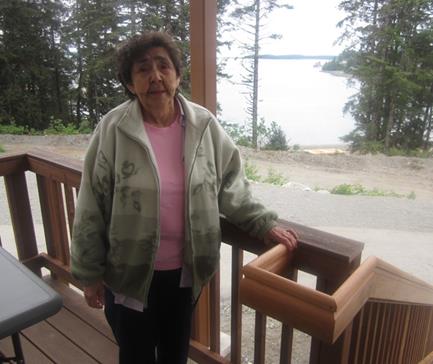
A Sitka seafood processor has recalled two-year’s worth of product, after a state inspection revealed that monitoring equipment had failed.
The US Food and Drug Administration announced the recall by Big Blue Fisheries on September 30. It covers all vacuum-packed smoked fish produced by Big Blue — for the last two years.
Greg Johnstone, the Environmental Health Officer with the state Department of Environmental Conservation, inspected Big Blue on September 20 and discovered that a recording graph on Big Blue’s smoker was not working.
Mike Keating, with Big Blue, says his company cooperated with the DEC and the FDA, which distributed the recall notice nationwide. Keating says he destroyed about $20,000-worth of product with the DEC standing by. He’s used his invoicing records to notify customers of the recall directly.
Keating stresses that no dangerous bacteria was discovered in any of his company’s product. And, given the two-year extent of the recall, it’s likely that much of the product is not around anyway.
For the past five years, the housing authority has received federal funds for an elder service coordinator on Prince of Wales Island. This year, two new communities will be included in the program, which helps seniors access things like health care, financial information, events and activities.
“Programs like gardening, language classes, storytelling, or cultural events,” says Ricardo Worl, the housing authority’s chief executive officer.
He says additional grant money will be used to hire coordinators in Yakutat and Saxman, where Tlingit and Haida recently opened new senior centers.
“A lot of our tenants in these senior housing facilities have spent their entire lives in that community, and they want to remain there. Their family lives there, their grandchildren live there,” Worl says.
The housing authority contracts with Catholic Community Service to run the program. Marianne Mills is director of Southeast Senior Services for CCS, which operates similar programs in Juneau and the entire region.
“The main thing is to keep them active, healthy, and connected with other people,” Mills says. “Not just staying in their place by themselves.”
Mills says the elder service coordinators in Yakutat and Saxman will tailor programs and activities to the needs of their community. She says the program on Prince of Wales has benefited from partnerships with other agencies.
“For example, with the SEARHC clinic, they did a sit and be fit class, got some exercise equipment in the senior apartments there, and arranged for doctor and physical therapy visits on a regular basis,” she says. “Just made a variety of different health promotion activities available.”
Tlingit and Haida this year received a total of $246,000 for elder service coordinators from the U.S. Department of Housing and Urban Development. The money is part of HUD’s Resident Opportunities and Self Sufficiency grant program. Despite the federal shutdown and sequestration budget cuts, Worl says he’s fairly confident the money will continue to be available.
“If they don’t have programs that allow our elders to age in place, in the rural communities, it’s going to be even more expensive to bring them to our urban centers, where it’s a lot more competitive,” says Worl. “The wait lists to get into these senior housing and health care programs are tremendous.”
He says the housing authority will just need to remain diligent in communicating to Alaska’s Congressional delegation the importance of such programs.
A popular medevac insurer is back in business after a several-month shutdown.
Fairbanks-based Apollo Medi Trans failed to renew its license to operate in Alaska earlier this year. That meant it could not continue expiring policies or issue new ones.
A company official called it “an administrative mistake.”
Apollo was issued a state license in late August. But it needed to be reapproved by a larger company that provides the actual insurance.
That has happened. Apollo is again selling and renewing policies.
Meanwhile, Apollo has changed its rates.
It used to charge $125 a year for nationwide air and ground medical evacuation insurance. The rate is now $100 for a household. It’s limited to Alaska residents.
It also sells a three-week travelers’ policy for $45 for one person needing a medevac in Alaska, the Yukon Territory and Northern British Columbia.
Seattle-based Airlift Northwest, a medevac provider, sells a household policy for $99 a year. It covers Alaska, the Pacific Northwest, California and a few other states.
Medevac insurance is popular in Alaska because an air ambulance flight can cost tens of thousands of dollars. Some general health-insurance policies do not cover medevacs, or have high deductibles.
Harborview students used PVC or other plastic pipe to make their hula hoops. Photo by Casey Kelly/KTOO.
Students had to bend the pipe into a hoop shape. Photo by Casey Kelly/KTOO.
Parent Marna Schwartz and Counselor Annie Caulfield hand out hula hoops to Harborview Elementary students at the school's World Hoop Off day event. Photo by Casey Kelly/KTOO.
Harborview students await the World Hoop Day Hoop Off. Photo by Casey Kelly/KTOO.
Students show off their self-made hula hoops at Harborview Elementary's World Hoop Day event. Photo by Casey Kelly/KTOO.
Fifth grader Max McHenry wore a horse mask for the World Hoop Day Hoop Off. Photo by Casey Kelly/KTOO.
Third grader Florian Wade (foreground) was a finalist in Harborview's Hoop Off. Photo by Casey Kelly/KTOO.
Gym teacher Zach Stenson and Counselor Annie Caulfield survey Harborview Elementary's World Hoop Day Hoop Off. Photo by Casey Kelly/KTOO.
When it comes to hula hooping, 11-year-old Caden Derick says he’s just okay.
“I practice sometimes,” he says. “But usually my dog eats up my hula hoops.”
Caden’s dog would’ve been in hoop heaven at Juneau’s Harborview Elementary School this past month. Students there got to make their own hula hoops out of PVC pipe and other material, all leading up to Saturday’s World Hoop Day.
Caden says he’s not sure what the hype’s all about, but it’s exciting nonetheless.
“Yeah, I think it’s cool that people do it,” he says. “I mean, I don’t know why they have a Hoop Day. But it’s cool that they do it.”
A few dedicated New York City hoopers started World Hoop Day in 2005 as a way of celebrating hoop culture. The exact date has changed every year since, but the idea is pretty simple: Get a bunch of people around the world hula hooping on the same day.
Harborview Gym Teacher Zach Stenson says one of his friends has taken part in past World Hoop Days.
“She gave me the idea a couple years ago, and said ‘Oh, what a neat thing if you could have all the kids do something at the same time that kids all over the world are doing a similar activity,'” he says.
Harborview teachers started a Humanities program this year, and Stenson says they decided to make the hula hoop project their kickoff activity. They hope to hold similar events every month or so, focused on building community.
“Bringing our school a little bit more together,” Stenson says. “Helping the kids make friends, that sort of thing.”
One lesson Stenson hopes the kids take from the hula hoop project is that they don’t always have to buy their toys. With the right materials, they can make them at home.
While teachers and parents use hair dryers to heat up roughly 10-foot sections of plastic pipe, the kids bend them into a circular shape.
Ten-year-old Kiana Potter made the project’s first hula hoop.
“When Mr. Stenson first started talking about it, he asked me to make an example hoop,” she says. “So, I could show the other kids what it was going to be.”
Kiana’s not sure why she was chosen to make the example hoop, but says maybe it’s because she has a lot of hula hooping experience.
“I can do a lot of tricks with a hula hoop,” she says. “I can do it around my neck and my hands and my arms, and I recently figured out how to do it around one foot while hopping up and down.”
Local businesses donated money or materials, and many parents volunteered to help with the project. Harborview PTA President Bruce Franklin says the kids at first have no idea how plastic pipe will turn into a hula hoop. But that changes once they see it start taking shape.
“Then they can’t keep their hands off it, and everybody wants to hula hoop,” Franklin says. “So, it’s kind of a rapid particle accelerator machine of excitement, because they just get super psyched up. And then, you know, we have to kind of keep them from hula hooping each other to death out here.”
Friday afternoon, the entire school except kindergarten files into the gym at the Marie Drake building for the project’s culmination, a school-wide hoop off.
Each class holds a competition to see who will represent them. Then Mr. Stenson explains how the hoop off will work.
“We have ten minutes for our hoop off,” he says. “That means, be careful not to bump into anybody, and see how long you can hula hoop.”
By the end of ten minutes several kids are still hula hooping, with no sign of letting up. Third grader Florian Wade says he had fun, but he’s exhausted.
“Yeah it was hard,” he says. “My belly hurts.”
Stenson says it’ll be tough to decide who deserves a prize for best hula hooper.
“I think the idea is they all are winners here as a group. They all did a great job. I don’t think we could pick one person.”
Enrollingalaska.com goes live today. If you enroll by December 14, the federal insurance will start January 1, 2014.
Assistance will be available in several places in Juneau to help individuals, families, and small businesses sign up for federal health insurance.
Starting October 7, a navigator will be located at the NAMI office at 9000 Glacier Hwy, Suite 201. Appointments can be made by calling 463-4251.
NAMI stands for National Alliance on Mental Illness. The organization also will hold a community forum on the new Alaska Healthcare Exchange next month.
Enroll Alaska agents will be located at Bartlett Regional Hospital beginning next week, to help Juneau residents find health care that works for them. (Photo by Lisa Phu/KTOO)
Next week, Enroll Alaska agents will be at Bartlett Regional Hospital and Walmart to help people understand the options, the cost and help them enroll.
Southeast Alaska Natives will continue to receive medical benefits through Indian Health Care, but the Southeast Alaska Regional Health Consortium, or SEARHC, has two people on staff to answer questions on ACA.
On October 1st, the federal government will launch its health insurance marketplace in Alaska. Several groups in the state are starting to get the word out about how residents can sign up for health plans under the law.
If you lived in Oregon, hipster musicians would be trying to convince you to sign up for health insurance. In Washington, the state would be angling for your attention with a more traditional advertising approach. In Alaska though, Governor Sean Parnell is a big critic of the health reform law and the state isn’t doing anything to advertise the federally run health insurance exchange. But other organizations are eager to help fill the gap.
“People are going to have questions about federal health care reform, we’re there to provide answers via website or phone.”
Navigators will be in Juneau to help individuals, families, and small businesses sign up for federal health insurance. One will be located in the National Alliance on Mental Illness (NAMI) office at 9000 Glacier Hwy, Suite #201 starting October 7. Call 463-4251 to sign up for an appointment. Enroll Alaska agents will also be at Bartlett Regional Hospital and Wal-mart starting next week. To enroll online, go to healthcare.gov or enrollingalaska.com. People have until December 14 to enroll for federal insurance to start January 1.
Eric Earling is a spokesperson for Premera Blue Cross Blue Shield of Alaska. Premera is one of two companies that will offer health insurance plans in the marketplace. The company recently launched an advertising campaign with a TV spot.
Premera also sells health insurance in Oregon and Washington. Those states are running their own marketplaces. Earling says because of that, they are far ahead of Alaska in getting the word out about what a health insurance marketplace is and how it works. So he says Premera’s ads in Alaska had to focus more on the basics:
“We simply want to make sure there is a straightforward approach to raise awareness levels of information about federal health care reform and where people, most importantly, can go to get answers.”
Earling is, of course, hoping Alaskans go to Premera for answers and then buy insurance from the company. Another ad campaign on the marketplace launch isn’t steering residents toward a specific insurer. It’s from Enroll Alaska, a division of Northrim Benefits Group, that sees a business opportunity in helping people sign up for insurance under the new law.
United Way of Anchorage is making information available via the 211 Alaska information referral line.
Tyann Boling is heading up Enroll Alaska. She says the group is hiring 35 insurance agents who will be based in Walmarts, Sam’s Clubs and hospitals in Anchorage, Fairbanks, Juneau, Sitka, Ketchikan, Kodiak and Soldotna. Boling says the ad campaign includes print, web, radio and tv:
“There was not anybody else out there that was going launch a major marketing outreach and education campaign for individuals to get the information about the benefit that many of them will receive due to the Affordable Care Act.”
Enroll Alaska’s insurance agents will earn a commission when they sign consumers up for a health plan, but it won’t cost consumers any more to buy insurance through an agent. A much smaller number of so-called navigators will be doing similar work. The federal government gave the United Way of Anchorage $300,000 to hire four navigators who will be based in Anchorage, Juneau and Fairbanks. Joan Fisher is the lead navigator. She’ll be working out of Providence hospital in Anchorage:
“We listen to their story, find out where they are, then we will go online and we can assist them on making a comparison between the marketplace plans.”
The Alaska Native Tribal Health Consortium has its own navigator and outreach program. You can also navigate the new insurance options on your own at healthcare.gov starting October 1st. A report released recently shows Alaskans will be paying some of the highest insurance premiums in the country in the marketplaces. But that was also true long before health reform became law.
Close
Update notification options
Subscribe to notifications
Subscribe
Get notifications about news related to the topics you care about. You can unsubscribe anytime.