Sexual Abuse & Domestic Violence

Alaska AG tries to force feds’ hand in stalled human trafficking case against Bill Allen

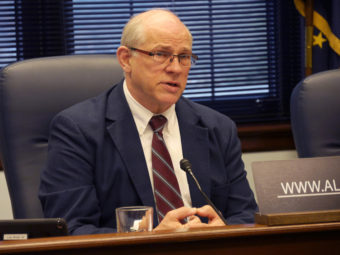
Craig Richards, Ak. Attorney General, at a governor’s press conference, January 22, 2016. (Photo by Skip Gray/360 North.)
Alaska Attorney General Craig Richards at a press conference in January. (Photo by Skip Gray/360 North)

Alaska Attorney General Craig Richards wants the state authority to pursue charges against former VECO boss Bill Allen for allegedly transporting a young woman across state lines for sex. The state has tried before, but in a letter Friday to U.S. Attorney General Loretta Lynch, Richards cites a new law that requires her to allow the state’s pursuit of the federal case, or provide a detailed explanation why she won’t.

Richards, the state’s top lawyer, said the explanation would matter.

“Because, of course, there has been a longstanding supposition … that maybe an immunity deal was cut with Mr. Allen that basically allowed him to not be prosecuted for the crimes committed to his minor victims in return for his testimony against U.S. Sen. Ted Stevens in his political corruption trial in 2008,” Richards said.

Allen, once a powerful Alaska businessman and political kingmaker, was the key witness against Stevens. Allen has also been accused in a civil lawsuit of having paid sex with a teenager, starting, she said, when she was 15 and continuing after she moved out of state.

Defenders of the late Sen. Stevens allege Allen lied on the stand in the Stevens trial to avoid charges he victimized the girl.

If the state had reliable evidence Allen had sex with a girl younger than 16, it could bring a child sexual abuse case under state law. John Skidmore, the head of the criminal division at the state Department of Law, said both Anchorage Police and the FBI investigated.

“We did review the information in that investigation and came to the conclusion that we would not be able to file any state charges against Mr. Allen for anything found in that investigation,” Skidmore said. “However, our review did suggest there were potential Mann Act violations.”

The Mann Act is a federal law making it a crime to transport a person over state lines for prostitution or human trafficking. For the Mann Act, the victim’s age doesn’t matter. But that’s a federal law, and Skidmore said the feds have refused to prosecute the case, or to turn over their investigative files.

“We want to know the rest of the information that the Department of Justice has so that we can determine if there are appropriate Mann Act violations, then we’d like to pursue those,” he said.

The feds can “cross-designate” state attorneys to prosecute federal cases, but they’ve refused to do that, too.

U.S. Sen. Dan Sullivan says the Justice Department has been ignoring the state’s requests for information about Allen for years, dating back to Sullivan’s turn as state attorney general.

Dan Sullivan.
Dan Sullivan in 2013.

“Well, that ends today,” Sullivan said, speaking at the state’s press conference.

The state has new leverage in federal law. Sullivan last year added an amendment to a human trafficking bill that requires the U.S. Attorney General to cross-designate states to prosecute Mann Act violations, or explain why that would undermine the administration of justice.

Sullivan said the state’s use of the new law sends a message of deterrence.

“That if you’re a perpetrator of these kinds of crimes – sexual abuse of minors, human trafficking – that the State of Alaska, state officials, federal officials working together are not going to rest until you are brought to justice,” Sullivan said.

Paul Stockler, an attorney representing Allen in the civil case, says Allen didn’t violate the Mann Act.

“He wasn’t transporting girls to Alaska for sex,” he said.

Also, Stockler said, his client didn’t knowingly have sex with a minor.

“She held herself out to be of age, and we believe her to have been of age,” he said.

Allen, former owner of oil field services company VECO, served a jail sentence for bribing state legislators. His testimony helped convict Sen. Stevens, but that conviction was later thrown out for prosecutorial misconduct.

Cosby Sexual Assault Case Is Cleared To Proceed

Bill Cosby arrives for a court appearance Wednesday in Norristown, Pa. The judge has ruled that the case against him will proceed, despite a claim that he was promised immunity a decade ago. Ed Hille/AP
Bill Cosby arrives for a court appearance Wednesday in Norristown, Pa. The judge has ruled that the case against him will proceed, despite a claim that he was promised immunity a decade ago.
Ed Hille/AP

A Pennsylvania judge has ruled that a sexual assault case against Bill Cosby, in which the comedian is accused of drugging and assaulting former Temple University employee Andrea Constand in 2004, will go to trial.

Judge Steven O’Neill refused to throw out the case, rejecting a former district attorney’s claim that he granted the comedian immunity from prosecution a decade ago.

The decision largely hinged on the judge’s view of former Montgomery County District Attorney Bruce Castor’s statements about whether Cosby should face charges, according to The Associated Press. Castor had said that he gave an unwritten promise of immunity for Cosby to his now-deceased lawyer, contending that Constand’s lawyers wanted the agreement so Cosby would be free to testify in her civil suit.

Now the case moves to a preliminary hearing to determine whether prosecutors have enough evidence to prove Cosby assaulted Constand.

Copyright 2016 NPR. To see more, visit http://www.npr.org/.
Read original article – February 3, 2016 6:37 PM ET

Mongolia looks to Alaska for help handling domestic violence

Efforts to end domestic violence brought a delegation from Mongolia to Nome Monday. The group — made up of social workers, shelter managers, police officers, and more — was there to learn how Alaska is addressing high rates of sexual assault and domestic violence. Mongolian delegates and local leaders discussed the hard issues affecting both communities over lunch.

It’s noon at Nome’s United Methodist Church, and the Iñupiaq choir welcomes over a dozen Mongolian delegates with a performance of “Praise Ye the Lord.”

The music kicks off a meeting hosted by members of the Bering Sea Women’s Group, the Nome Social Justice Task Force, and other community leaders. Beyond forming new friendships and sharing homemade salmon patties, the goal is to give their Mongolian counterparts an idea of how Alaska responds to domestic violence.

When it comes to this issue, the two places have a lot in common. That’s according to Tuvshinjargal Gantumur, a psychologist and manager at the National Center Against Violence in Mongolia. Through a translator, she said the similarities between Alaska and Mongolia are what made the delegation eager to take this “study trip.”

“There are some similar statistics and rates. Like the rates of domestic violence and sexual assault cases — they’re relatively high right now. And in terms of geography, we also have rural areas — where people are scattered — in Mongolia. So all the experiences that Alaskan people have already achieved will be interesting for us.”

The delegates heard all about those experiences from their first stops in Juneau and Anchorage to their final visit in Nome, where they toured the Anvil Mountain Correctional Center, Norton Sound Regional Hospital, and the district attorney’s office before learning about specific Nome initiatives against domestic violence.

Ultimately, though, the Monday lunch meeting wasn’t really about statistics or hands-on training. Instead, the main message from Nome leaders was that no community can address domestic violence with getting at the cause. And for many places, including Alaska and Mongolia, that means understanding how colonization and racism have inflicted lasting trauma on Native people — and how that trauma manifests in domestic violence and other social issues that aren’t easily solved.

With that attitude in mind, Gantumur said the delegation is excited to get back home and continue their work, with new insight from — and an ongoing relationship with — their new connections in Alaska.

“We have a lot planned when we go back. We will do advocacy towards changing the legislation implementation process and also prevention activities. We are also planning to have consultants from Alaska come over to Mongolia, so they will also teach us in the field.”

Returning the favor, the Mongolian delegates wrapped up the meeting with some music of their own. Performed in the Mongolian language, they said their song was about a mother’s unconditional love.

‘Our Voices Will Be Heard’ brings child sexual abuse to the forefront

"Our Voices Will Be Heard" playwright Vera Starbard (right) and Perseverance Theatre Executive Artistic Director Art Rotch. (Photo by Jennifer Canfield/KTOO)
“Our Voices Will Be Heard” playwright Vera Starbard (right) and Perseverance Theatre Executive Artistic Director Art Rotch. (Photo by Jennifer Canfield/KTOO)

Set in a fictional Tlingit village in the late 19th century, “Our Voices Will Be Heard” is Vera Starbard’s semi-autobiographical story of a mother whose daughter is sexually abused by a relative. The show premiered Friday at Perseverance Theatre in Juneau and will play in Anchorage in February.

The play actually began as a short story Starbard wrote when she was 18 years old. It came together at an all-night diner. She began writing at 10 p.m. and didn’t stop until 4 a.m.

“I sat there and the waitress kept bringing me diet sodas, and it was done,” Starbard said. “While I did a few revisions to it, the whole story was finally told. And it was a huge kind of healing moment in my life and I never really did anything with it.”

About 10 years later, she heard about the Alaska Native Playwrights Project and decided to apply. She got in and during the process began to understand the story she wanted to tell was more than just her own.

One of the most difficult experiences she had when writing the play came about halfway through the yearlong project.

“I had a relative, a cousin, who I grew up with like a brother, who became an abuser himself.”

It hit her hard. Here she was, trying to artfully make sense of the sexual abuse she had experienced as a child and she learns her cousin was an abuser. Then she finds out he’d been abused by the same uncle who had hurt her.

“It was surprising to me that I still loved him,” Starbard said. “I loved him like a brother and that didn’t change because of these things he had done. (I struggled within) myself to come to terms with not wanting that person to be around children anymore and … still caring about him and caring about what happened to him. I really took that into the play.”

The play is quite different from the story Starbard wrote when she was 18. That version, she said, was from the perspective of a child. The younger Vera saw her abuser as a “boogeyman,” an evil figure to be despised, not pitied or missed.

“There’s a scene in there where the mother is talking to Raven and sort of going through these emotions herself where she does confess that she misses this family who turned against her and hurt her child,” she said. “That would not have been in there when I was 18.”

A promotional image for "Our Voices Will Be Heard" by Vera Starbard. (Image courtesy of Perseverance Theatre)
A promotional image for “Our Voices Will Be Heard” by Vera Starbard. (Image courtesy of Perseverance Theatre)

In the years since her all-nighter at the diner, Starbard came to understand what her own mother endured. She saw the toll it took on her to report her own brother. She realized how lucky she was to have a mother who steadfastly supported her despite being ostracized by family members who preferred the abuse go unaddressed.

Three days before the first reading of the play in Anchorage, Starbard told her mother what it was about.

“She actually thanked me at the end of the reading,” Starbard said. “It doesn’t show mother being perfect but it shows a mother never giving up. That’s what I really wanted to talk about; that was important to me and my life that I had a mother who never gave up even though she was struggling herself.”

Starbard’s story is not unique. Alaska consistently has one of the highest rates of child sexual abuse, and child abuse in general, in the nation. Despite that, state lawmakers spent two years debating a bill to require K-12 students receive age-appropriate education on sexual abuse and teen dating violence. Starbard wrote letters and testified at the capitol in favor of Erin’s Law, which eventually was adopted as the Alaska Safe Children’s Act.

As Starbard went through the process of writing, revising and holding readings for the play, she saw signs that more education about child abuse is sorely needed.

“Since this has come out, a lot of people have come up and some of them have said, ‘Well, I’ve never been abused, but –’ and then they tell some story and I realize — no. That’s abuse. That really is abuse. And they genuinely don’t see it that way because it’s been minimalized in their own life.”

Starbard said she hopes people who see the play leave feeling hopeful and energized.

“I think it’s a pretty light-giving play, a play that gives healing,” Starbard said. “It’s not something that they’re going to walk away from and wonder what to do. … They’re actually (going to) be motivated to do something, to act, to find some hope.”

In Juneau, the play runs through Feb. 7. A representative from SEARHC or AWARE will be available after each showing. Volunteers from Standing Together Against Rape will be present when the play shows in Anchorage.

England And Wales Expand The Meaning Of Domestic Abuse

A new law in that takes effect in England and Wales this week makes illegal all sorts of controlling and coercive behavior in a relationship. Ben Pruchnie/Getty Images
A new law in that takes effect in England and Wales this week makes illegal all sorts of controlling and coercive behavior in a relationship.
Ben Pruchnie/Getty Images

A groundbreaking law on domestic abuse took effect Wednesday in England and Wales. It expands the meaning of domestic violence to include psychological and emotional torment. So it is now a crime there to control your spouse, say, through social media or online stalking. Experts in domestic violence say it represents a new way to look at the whole issue of abuse.

Until recently, the only way police there could arrest someone for domestic violence was if the person assaulted or threatened their spouse. After a lot of research with victims, authorities realized that abuse often starts earlier and is more pervasive than they thought.

The new law makes illegal all sorts of controlling and coercive behavior in a relationship. This can include stealing money from a spouse, limiting financial freedom, Internet stalking or restricting access to friends and family. Prosecutors will have to show a pattern of abuse and that it has real impact on a victim’s life.

Police around England and Wales are now being trained to spot signs of controlling behavior and enforce the law. Violators could face a sentence of up to five years behind bars.

Domestic violence advocates say the law is a real shift in the way that the legal system thinks about abuse. No longer do authorities need to wait for an abuser to cross some line of physical violence. They can look for other forms of domination.

Rutgers professor Evan Stark says the new law better reflects the reality of abusive relationships. “When a woman is being controlled, she can’t effectively resist or escape when she is threatened with violence. So what we’re really coming to appreciate about this is that if we want to prevent homicides we need to prevent control.”

In the U.S., Stark says, only a few states have put in place laws that recognize these patterns. In most parts of the country, police wait until the first serious physical assault. Sometimes, that’s too late.

Charlotte Kneer, who left her husband after years of emotional and physical abuse, now runs a shelter in southern England. She says she doesn’t know if the new law will lead to many prosecutions, but that all the attention will help.

She says, “This will get people to understand what domestic abuse is, because right now, people just think, ‘Oh she got hit once in a while.’ ”

Copyright 2015 NPR. To see more, visit http://www.npr.org/.
Read Original Article –  December 29, 2015 5:27 PM ET

Bill Cosby Is Charged With Felony Sex Crime Over 2004 Case

Bill Cosby arrives Wednesday at the Courthouse in Elkins Park, Pa., to face charges of aggravated indecent assault. Cosby was arraigned over an incident from 2004 --€” the first criminal charge filed against the actor after dozens of women claimed abuse. Kena Betancur/AFP/Getty Images
Bill Cosby arrives Wednesday at the Courthouse in Elkins Park, Pa., to face charges of aggravated indecent assault. Cosby was arraigned over an incident from 2004 –€” the first criminal charge filed against the actor after dozens of women claimed abuse.
Kena Betancur/AFP/Getty Images

Narrowly beating a statute of limitations deadline to file charges, prosecutors in Pennsylvania announced felony sexual assault charges against comedian Bill Cosby on Wednesday. A former Temple University employee says Cosby drugged and assaulted her in January of 2004.

Montgomery County, Pa., prosecutors have charged Cosby with three counts of aggravated indecent assault. The charges against him are second-degree felonies, carrying a maximum sentence of 10 years in prison.

“These charges stem from a sexual assault,” according to prosecutor Kevin Steele, who said the assault occurred at Cosby’s house in Cheltenham, a Montgomery County township that’s just outside Philadelphia.

Steele urged any other victims to contact his office.

Update at 2:40 p.m. ET: Victim’s Lawyer Issues Statement

Attorneys for the woman who says she was abused have issued a statement thanking the district attorney’s office and police, adding that because the case is ongoing, they won’t comment further.

Update at 2:50 p.m. ET: Cosby’s Bail Set At $1 Million

Cosby was arraigned on the sex assault charge Wednesday afternoon, and his bail set at $1 million.

Bobby Allyn, from member station WHYY, reports that Cosby has been ordered to turn over his passport and to have no contact with his accuser. The preliminary hearing has been scheduled for January.

Our original post continues:

Over the past year, Cosby has been accused of sexually abusing dozens of women. Cosby has denied those charges, and earlier this month, he filed lawsuits against seven of his accusers, saying they had made up the claims to extract money from him.

When NPR’s Scott Simon asked Cosby about the allegations against him during a November 2014 interview, the comedian refused to respond, shaking his head in silence.

Pennsylvania has a 12-year statute of limitations on felony sex crimes, meaning prosecutors had until January to bring charges against Cosby, 78.

Under state law, aggravated indecent assault has a range of definitions, from having sexual contact with a person without their consent to doing so after an attacker has “substantially impaired the complainant’s power to appraise or control his or her conduct by administering or employing, without the knowledge of the complainant, drugs, intoxicants or other means for the purpose of preventing resistance.”

After the Temple employee, Andrea Constand, accused Cosby of sexually assaulting her in 2004, a Montgomery County prosecutor decided in 2005 that charges weren’t warranted in the case. But that prosecutor lost his re-election bid last month to Steele, who made pursuing charges against Cosby an issue in his campaign.

On Wednesday, Steele outlined a timeline of events in 2004, saying Cosby established a friendship with the victim and then made sexual advances that were rejected. After that, Cosby urged her to take pills and drink wine, Steele said.

According to the criminal complaint filed Wednesday, Constand “considered Cosby, thirty-seven years her senior, to be a mentor, and described instances in which he invited her to his home for dinner, invited her to restaurants, invited her to events, introduced her to people, and provided her with guidance and career advice.”

The 2005 investigation into Cosby led to a deposition in which Cosby admitted that he had, as the Two-Way reported, “obtained the sedative Quaalude with the intent of giving the drug to women with whom he wanted to have sex, and he acknowledged giving it to at least one woman.”

That testimony became public this past summer, prompting new calls for charges against Cosby. Announcing the charges Wednesday, Steele said the decision was made after “new information” came to light in July.

Cosby gave his deposition in the course of a civil trial, before he and Constand reached a settlement over her lawsuit against him.

As part of their deal, the two sides signed a confidentiality agreement — but the records were unsealed at the request of the Associated Press, in part because the judge in the case said he regarded Cosby as something of a public servant who can be expected to forfeit some privacy protections, as Eyder reported for the Two-Way.

We’ll note that while NPR doesn’t usually identify people who say they’re the victims of sexual assault, we’ve done so in this case, because Constand has taken a public stand on the case.

Copyright 2015 NPR. To see more, visit http://www.npr.org/.
Read Original Article –  December 30, 2015 10:18 AM ET
Site notifications
Update notification options
Subscribe to notifications