Sexual Abuse & Domestic Violence

Report: Systemic failures contributed to UAF’s mishandling of sexual assault cases

An independent report on the University of Alaska Fairbanks failed handling of sexual assault cases was released Friday.

The review done by Anchorage attorney Jeff Feldman confirms that UAF failed to pursue policy dictated disciplinary action against perpetrators in five cases from 2011 into 2014.

The review attributes the lapse to three things, starting with former UAF Dean of Students Donald Foley, who’s criticized for neglecting discipline while focusing on victim safety and support.

Speaking at a Friday news conference, University of Alaska President Jim Johnsen also pointed to two other areas of blame identified in the review.

“An initial lack of understanding and response to the 2011 Title IX guidance from the federal department of education,” Johnsen said. “And a lack of oversight by top UAF administrators as well as inadequate resources for Title IX and student discipline.”

Former Dean Foley retired and Johnsen says there have been other retirements and resignations as a result of the disciplinary failings, which initially arose three years after a federal Title IX compliance order was issued to universities nationwide.

“Under the Title IX guidance that we got from the department of education in 2011, it is no longer adequate for a university simply to refer cases to the criminal process, which of course, did occur in all of these cases,” Johnsen said. “But since 2011, we’re obligated to investigate, adjudicate and discipline.”

Johnsen says the five improperly handled sexual assault cases in which disciplinary policy was not adhered to, have been re-opened for proper action, noting that discipline can range from suspension to expulsion top retroactive revocation of university degrees.

The review lists numerous other steps the university has taken to ensure there are no additional lapses.

“Going forward, people are crystal clear of their responsibilities,” Johnsen said.

Johnsen says that includes keeping him in the loop.

“Requiring the campuses to report every sexual assault to me,” he said.

Johnsen and UAF interim Chancellor Mike Powers stressed that besides process and staffing changes made to properly address sexual assault response, the university is also undergoing a cultural change to prevent assaults from happening.

“Here in particular at UAF, 98 percent of our employees have completed Title IX training,” Powers said. “Over 500 student leaders have been trained in active bystander training, and that is engagement in the process – if you see something, say something, do something.”

Powers says there have been increased reports of sexual offenses since the issue came to light at UAF, noting that’s likely because victims are becoming less afraid to come forward.

Feds refuse state request to prosecute former VECO chief Bill Allen

U.S. Attorney General Loretta Lynch
U.S. Attorney General Loretta Lynch. (Public domain photo)

U.S. Attorney General Loretta Lynch has declined to let the Alaska Department of Law act as federal prosecutors to pursue former VECO CEO Bill Allen.

Lynch, in a letter to her state counterpart, said the Department of Justice spent two years investigating Allen for allegedly exploiting an Alaska teen before it decided it couldn’t bring charges. She also said the feds had no immunity deal with Allen. Rather, Lynch said the Justice Department declined to prosecute due to the weakness of admissible evidence.

Allen was once a powerful figure in Alaska business and politics, and he was the key witness in the public corruption case against U.S. Sen. Ted Stevens. Defenders of the late senator allege Allen lied on the stand in Stevens’ trial to avoid federal charges of child exploitation.

Because the feds decided the child exploitation case did not meet their standards for prosecution, Lynch said it would be inappropriate to let the state prosecute the same case on its behalf.

U.S. Sen. Dan Sullivan called that circular reasoning.

Sen. Dan Sullivan. (Public Domain photo)
Sen. Dan Sullivan

Sullivan pursued the Allen case when he was state attorney general and now has Stevens’ old Senate seat. He claimed there’s ample evidence against Allen, and he changed federal law to help states act as federal prosecutors in sex trafficking cases. The new law, though, said the Justice Department can refuse the transfer of power if it would undermine the administration of justice, and Lynch cited that language in her denial of Alaska’s request.

An attorney representing Allen has denied the former businessman knowingly had sex with an underage girl or transported girls for sexual purposes.

The state previously decided it lacks evidence to prosecute Allen for child sexual abuse under state law.

Criminal justice bill amended to reduce benefits to sex offenders

Senators have amended a bill that would overhaul Alaska’s criminal justice system, taking steps to make it more difficult for those convicted of sex crimes to benefit from the bill’s provisions.

Senate Bill 91 is aimed at reducing recidivism, as well as the state’s prison costs. It would divert people charged with nonviolent offenses into alternatives to jail. And it would create a re-entry program to improve prisoners’ chances of success.

But victims’ rights advocates had raised concerns. The Senate Finance Committee amended the bill to make it harder for sex offenders to benefit. They wouldn’t be eligible for some of the reduced sentences available to other offenders.

Bill sponsor Sen. John Coghill, a North Pole Republican, said he understood why the changes were made.

Sen. John Coghill, R-North Pole, at a Senate Majority press availability, March 21, 2016. (Photo by Skip Gray/360 North)

“The Department of Law, the public defenders, the victims’ advocates group have all had a huge say in it,” Coghill said. “The police, who have to hold people accountable in a very, very dangerous circumstance — the way we deal with drugs — all came to the table, and I think, hammered out a better way of doing it than we’re doing it now.”

He added that he’s hopeful that the bill will make Alaska safer.

One amendment removed people found guilty of criminally negligent homicide from the group who would have their sentencing guidelines reduced. Some deaths resulting from drunk driving are examples of criminally negligent homicides.

But the committee voted 5-2 to drop another amendment that would require drug tests to receive public assistance.

Coghill said he believes the amendments increase the likelihood that the bill will become law, by addressing the concerns of its critics. He says alternative programs to jail will prove their value over time.

“Jail time is thought more highly of than some of the programs. And I think we just have to prove that – time over time – it’s going to show that programs can change some people’s behavior,” Coghill said. “But it’s also going to show that jail time is the way the public condemns certain issues. And I think that came very, very clear through the process.”

The Finance Committee could vote to send the bill to the full Senate as soon as Wednesday.

UAF’s Title IX efforts difficult to translate in Nome

UAF’s Northwest Campus in Nome. (KNOM photo)

In the past few years, the issue of sexual assault has been a major focus for universities around the nation. The University of Alaska Fairbanks is no exception.

University officials recently visited UAF’s Northwest Campus in Nome to discuss the issue, but campus dynamics and the communitywide struggle with sexual assault and domestic violence made it hard to draw connections between efforts in Fairbanks and actions in Nome.

To spark discussion on the issue of sexual assault, UAF’s Northwest Campus recently screened the documentary “The Hunting Ground.” The film opens with a rolling orchestral soundtrack that calls to mind university quads and collegiate culture.

In the opening sequence, home videos show students react to hearing they’ve been accepted to their top choice schools. Most of the students are young women and most schools are big-name universities like Notre Dame or Harvard.

It’s inspiring, but not at all familiar. In Nome, university culture couldn’t be more different. UAF’s Northwest Campus is a community college that mainly serves nontraditional students. It offers mostly one-credit courses like kuspuk sewing and caribou hide tanning. And those courses aren’t just offered in Nome.

“We have a sled-building class in Shaktoolik.” explained Bob Metcalf, the Director of UAF’s Northwest Campus.

Metcalf says every campus employee is trained in Title IX, a federal law that guarantees gender equity in all federally funded schools. Sexual assault is considered a form of discrimination since it creates a hostile environment for the victim and prevents him or her from benefiting from the school’s education program.

UAF’s interim Chancellor Mike Powers made the trip from Fairbanks to screen the film. After the closing credits, he opened the room up for public discussion.

“What we can do to help support the community, the Northwest Campus, on prevention?” Powers asked. He asked the room for suggestions on what UAF should be aware of regarding sexual assault.

But the room remained silent. The issue of sexual assault is huge in Alaska.

Thirty-seven percent of women in Alaska have been sexually assaulted in their lifetime. That’s according to the Alaska Victimization Survey conducted by UAA’s Justice Center. In the Nome census area, from Shishmaref over to Savoonga and down to Stebbins, 31 percent of women are victims of sexual assault.

Mae Marsh, UAF’s Title IX Coordinator, said the University can encourage a stronger stance against sexual assault.

“If the university can’t do something to change this mindset, who can?” Marsh asked.

“If you come to the university and there’s a standard that says ‘This is not acceptable behavior, and if you demonstrate this type of behavior, you will be expelled from our community, or you will be suspended,’ it sets a new standard,” Marsh said.

But the push for the University to lead the way doesn’t quite translate at UAF’s Northwest Campus in Nome. The campus’s transient and nontraditional student body makes sweeping changes harder to carry out.

Instead, Bob Metcalf said the campus is following in the footsteps of the community.

“They’re ahead of the campus with Green Dot, and equity and social justice. We see our role as supporting [the community],” said Metcalf.

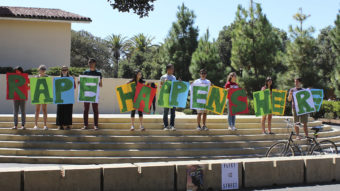
Green Dot is just one of the ways the community is confronting sexual assault. The statewide initiative encourages people to speak out against violence. It’s already been introduced at Nome Public Schools. Local parent Dana Handeland has two children in college. She says talking about sexual assault before students leave for college is a good thing.

“Most children grow up with all the children they go to school with,” Handeland explained. “They’re almost siblings by the time they graduate.”

Despite having both children out of the house, Handeland was at the screening of “The Hunting Ground,” to educate herself. She said for children who grow up in bush communities, the transition to college can be traumatic.

“Rural communities need to start this much sooner than just, ‘OK, let’s make sure you watch this as orientation in college,’ ” Handeland urged. “They’re already bombarded with ‘How am I going to find my class,’ [and] ‘where’s this building?’”

UAF’s interim Chancellor Mike Powers and Title IX Coordinator Mae Marsh offered updates and answered questions for locals in the audience like Handeland. But there was a clear disconnect.

The differences between battles being fought on campus in Fairbanks and throughout the community in Nome highlighted their different priorities. Without an action plan in place, UAF officials boarded a plane out of Nome that same evening, leaving the community to continue its uphill battle against sexual assault.

White Mountain students examine healthy relationships for ‘NativeLove Project’

The community of White Mountain. (Photo by Laura Kraegel/KNOM)

The Bering Strait School District has joined a nationwide effort to encourage healthy relationships and end dating violence among Native youth.

The NativeLove Project raises awareness through social media and school programs. Students in White Mountain are producing a video with local interviews to add to the conversation.

More than 40 percent of Native children experience multiple acts of violence by age 18. That’s according to the National Indigenous Women’s Resource Center in Montana. The organization launched the NativeLove Project to get young, indigenous people talking about healthy relationships.

Kelly Rae Martin is a teacher in White Mountain. She said it’s important her students join the discussion, given Alaska’s high rate of domestic violence.

“It doesn’t get talked about very much,” said Martin. “It doesn’t get shared or discussed, so I think it’s really important people start seeing that it is OK to talk about it. It is OK to address it and try to work through it, so that some healing can happen.”

To promote that healing, her students are producing a video. Anna Prentice is a high school senior, and she interviewed classmates and community members for the project.

“We asked a lot of questions like: What to you is Native love? How do you know that people are showing you love? And then, what do you think an ideal world would be?” said Prentice.

For the young students she interviewed, Prentice said love means helping clean up around the house or taking their siblings out four-wheeling. For elders, she said cooking and sharing food is a favorite way to express their love.

“Everyone thinks it’s happiness, respect for one other, and just family things to do with love,” she said.

Prentice also participated on the other side of the camera. She said she was happy to share her experience with dating violence, even though it was hard.

“For me, the topic is personal,” she said. “I feel like everybody needs to know how we can prevent that from happening, especially with the younger generation. I’ve been through it all, I’ve seen it and to me, it’s very important they know what love is and what isn’t.”

With interviews complete, Prentice and her classmates are now editing footage for the video. They’ll screen the final product soon for the White Mountain community. Other BSSD schools are also joining the NativeLove Project. Students around the district are creating a quilt with artwork centered on healthy relationships.

Gene Tagaban leads Dillingham training on stopping cycle of violence

Gene Tagaban helped conduct the Compass training in Dillingham in mid-March. (Photo courtesy of Gene Tagaban)

The Alaska Network on Domestic Violence and Sexual Assault helped organize the training, which was taught by Gene Tagaban, a Tacoma, Washington resident originally from Juneau.

Tagaban said the class is meant to help stop the cycles of violence that are prevalent in many Alaska communities.

“It’s about teaching men to be mentors, and getting men involved to stop the violence, domestic abuse, the suicides, the hurts, the pain,” he said. “For so many years, women have been at the forefront of this movement, of wellness, of health. And as men, we need to be standing right beside the women together, to stop the violence, to stop this epidemic that’s going through Alaska.”

Compass is part of the Alaska Men Choose Respect effort. Participants talked about how to start conversations and lead healthy lives, both in their own homes and in the community.

Tagaban said the group discussed several topics, including respect for self and others, communication and conflict resolution.

“Ultimately, what does it mean to become a man, but even higher than that: what does it mean to become a human being,” he said. “… it’s about learning how to express ourselves in that way and share our stories, tell our stories, learning about where our stories came from. And learning about even, not only our empowerment but the pains, the hurts, the trauma and healing from that. It is about healing. But it’s about men working together to bring that healing together.”

Throughout the gathering, participants shared their own stories and learned how to facilitate those sorts of discussions. After the training, Tagaban hopes they’ll take what they’ve learned back out into the community, whether that’s doing presentations in schools or living a good life and leading by example.

“And I hope that they’ll go out and live a good life, a life of awareness, a life of empowerment, so that in their circles that they can influence those in a good way,” he said. “And maybe some of them will use it to start making presentations, talking about these things, and starting the conversations… that they’ll maybe go to schools and start talking about things, or just in the neighborhoods, in the stores that people would just see them living that powerful life that good life, and then passing it on in their own families, and teaching in their own families, or the schools.”

Site notifications
Update notification options
Subscribe to notifications