History

After 146 Years, Ringling Bros. And Barnum & Bailey Circus To Shut Down

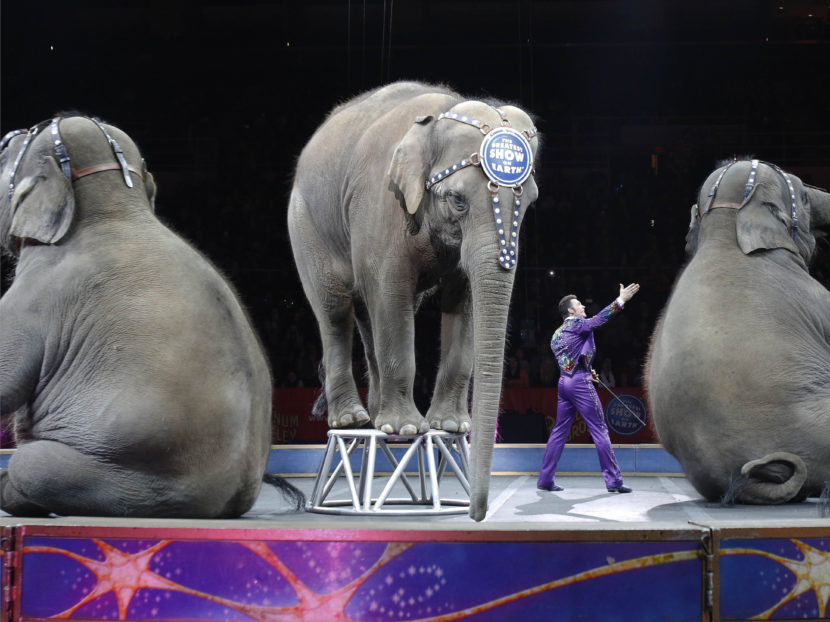
Asian elephants perform for the final time in the Ringling Bros. and Barnum & Bailey Circus last May, in Providence, R.I. After its controversial use of the animals for its shows, the company retired the elephants to its 200-acre Center for Elephant Conservation in Florida.
Bill Sikes/AP

After its nearly century and a half run, Ringling Bros. and Barnum & Bailey Circus plans to shut down “The Greatest Show On Earth.”

The historic American spectacle will deliver its final show in May, says Kenneth Feld, the chairman and CEO of Feld Entertainment, the producer of Ringling.

Feld announced the news on the company website Saturday night, citing declining ticket sales — which dipped even lower as the company retired its touring elephants.

“This, coupled with high operating costs, made the circus an unsustainable business for the company,” Feld says.

Ringling has been phasing out elephants as a result of shifting public tastes and criticism from animal rights groups over the well-being of the animals.

The company held its last show featuring elephants in May, before completely retiring the animals to its 200-acre conservation center in Polk City, Fla., established by Feld Entertainment in 1995.

Elephants had been a circus mainstay almost as long as the circus itself has been a staple of American entertainment, since Phineas Taylor Barnum introduced Jumbo, an Asian elephant in 1882.

But before the traveling exhibition evolved into a regular destination for wholesome family fun, Barnum “made a traveling spectacle of animals and human oddities popular, while the five Ringling brothers performed juggling acts and skits from their home base in Wisconsin,” reports the AP. “Eventually, they merged and the modern circus was born. The sprawling troupes traveled around America by train, wowing audiences with the sheer scale of entertainment and exotic animals.”

The Feld family bought Ringling in 1967 and employs about 500 people for both touring shows “Circus Extreme” and “Out of This World.” Those employees were told about the closure after shows in Orlando and Miami, on Saturday night.

“The Felds say their existing animals — lions, tigers, camels, donkeys, alpacas, kangaroos and llamas — will go to suitable homes,” adds the AP. “Juliette Feld says the company will continue operating the Center for Elephant Conservation.”

In addition to the circus, Feld Entertainment also runs a number of high-profile traveling shows, from Monster Jam and Supercross to Marvel Universe Live and Disney on Ice.

Each year, Feld Entertainment’s live shows draw some 30 million attendees.

Before it draws the curtain, the two touring circuses will perform a total of 30 shows over the next four months, in major cities including Atlanta, Washington, Philadelphia, Boston and Brooklyn.

Copyright 2017 NPR. To see more, visit http://www.npr.org/.

40 years later, John McPhee’s book still brings fans to Eagle, Alaska

Post Office building in Eagle during spring ice break-up. John Borg was the postmaster and mayor of Eagle when author John McPhee came through in 1976. (Photo courtesy of Brad Snow & Lilly Allen Collection. Alaska and Polar Regions Collections, University of Alaska Fairbanks)

John Borg was the mayor and postmaster of Eagle, Alaska, in the late 1970s when author John McPhee came through to research for his best-selling book “Coming into the Country.” For 40 years now, readers come into Eagle every summer without fail asking about the characters they met in the book. John Borg shared his thoughts with Alaska’s Energy Desk about what it’s like to host these literary tourists.

Alutiiq Museum director of operations to take job in Minnesota

The Alutiiq Museum’s director of operations is moving on.

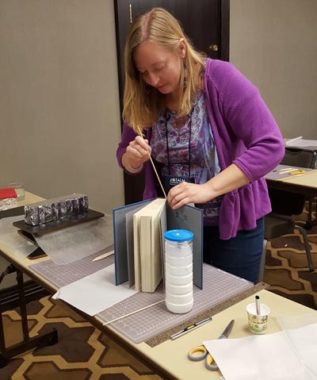
Alutiiq Museum Director of Operations Marnie Leist is movnig to Minnesota to take a position as executive director of the Brown County Historical Society. (Photo courtesy of the Alutiiq Museum)
Alutiiq Museum Director of Operations
Marnie Leist is movnig to Minnesota to take a position as executive director of the Brown County Historical Society. (Photo courtesy of the Alutiiq Museum)

Marnie Leist has been in Kodiak for 11 years, and looks back to when she first arrived to the island.

She said she got a master’s degree in art history and museum studies, and the only position she applied to following graduation was one at the museum.

When she moved here, it was the first time she’d been to Kodiak, she said.

“I’d come from a city, and so I wasn’t used to the pile of nets and all the things that people reuse, but then I learned to appreciate it,” she said. “Like, it’s there because people do reuse, and they do repurpose things, and they are resourceful, and you do have to save your extra plywood sheets for a rainy day, and I’ve grown to really appreciate that aspect of the community.”

She said she stayed for the community.

“Because I can go to the repository and see 7,500 years of history, I can study how people hunted marine mammals and things like that, but to have the people – their resiliency I think is amazing, and I think that’s really kept me here.”

She said Alaska – and Kodiak – is special because it’s one of the few places where people still rely on their environment for food and entertainment.

She says she’ll be sad to leave, but she’s ready for the new challenges that await her.

Her next professional home will be the Brown County Historical Society in Minnesota, where she’s stepping into the position of executive director.

Museum of the Aleutians names new director

The Museum of the Aleutians has wrapped up the year by hiring a new executive director.

Virginia Hatfield will step into her new position Jan. 3.

Hatfield, an archaeologist, moves up from her role as collections manager.

She replaces Neal Hitch who reopened the museum this summer.

It had been closed for nearly a year, following the resignation of the previous director when items from the collection were found in her home.

Letter from Kodiak’s past found in wall during kitchen remodel

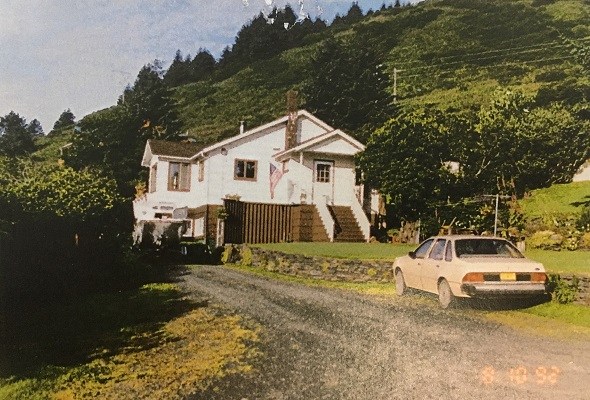
The Sundberg house in 1992. (Photo courtesy of Kodiak Island Borough Assessing Department)

Houses can be historic in many senses – for instance, the history that families create.

Recently, the owner of one house on a hill found a little of that family history while renovating.

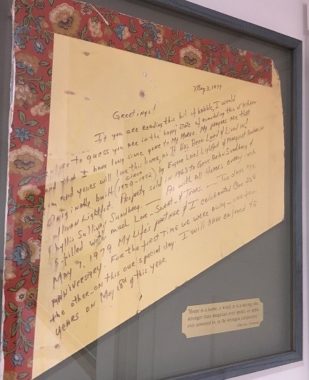
Letter written on the wall by Phyllis Sundberg, framed in the house in which it was found. (Photo by Kayla Desroches/KMXT)
A letter written on the wall by Phyllis Sundberg, framed in the house in which it was found. (Photo by Kayla Desroches/KMXT)

Dave Wilmot and his girlfriend, Ella, live in the house at the house on a steep side street near McDonalds with Ella’s sons, Leo and Zeke, and their cat, Stewart. Stewart is an old cat, the kind of old cat who can’t wait for an interview to end before demanding to be let outside.

Wilmot said his girlfriend bought the house in 2012 and they began renovation in April 2016.

Wilmot, who’s a firefighter on the Coast Guard base, said he came home from his shift and their contractor had left a sheet of sheetrock on a work bench.

It’d been cut from the wall behind a cabinet in the kitchen, and there was a letter on that yellow surface.

The words slant down to the left and although smudged, are still legible. The letter is dated to May 3, 1979. Here’s an excerpt:

Greetings,

If you are reading this bit of babble, I would venture to guess you are in the happy state of remodeling this old kitchen, and that I have long since gone to my maker. My prayers are that you and yours will love this home as it has been loved and lived in.

As with all homes, every inch is filled with much love, sweat, and tears. Two days ago, May 1, 1979, my life’s partner and I celebrated our 25th anniversary. For the first time we were away from the other on this special day. I have enjoyed 45 years on May 10 of this year.

Those are the words of Phyllis Sundberg, who passed away in 2012 a couple of years after her husband Gene.

Her close friend and neighbor, Ruth Dawson was in the kitchen that day in 1979 when the Sundbergs were replacing their cabinets with newer models.

“Phyllis gets out a marker and writes this beautiful story on the wall. She said, ‘Oh, won’t that be grand someday when new people in the house read this?’ And I said, ‘Oh, we’re gonna always be here, you know.’ And she says, ‘No, this will be fun.’ Well, it was put there and we forgot about it and went on with life.”

And just as the letter started with Sundberg, the wall she wrote it on started with her family.

Dawson said Phyllis Sundberg was originally from Idaho and moved to Kodiak was she was a pre-teen and her stepfather, Eugene Lightfoot, built the house.

“Phyllis’s stepdad and her mother lived in the basement when they came here,” she said. “They lived in the basement while he built the rest of the house, so that house meant a lot to her, and then she had the row named after him.”

Phyllis spent most of her life there, and it’s where she raised her three sons with her husband, Gene, who she met in high school.

Gene, who was born in Kodiak, held a few jobs throughout his lifetime, including land manager for the Koniag Incorporated and purchasing supervisor for Kodiak Island Borough School District.

Phyllis worked in a bank and was a stay-at-home mom.

While their sons have since moved from the house, the Sundberg era has had an impact in the community’s history.

Wilmot found as much when speaking with contractors who might do their home renovation.

“I want to say just about every single one had a story about this house,” he said. “Like, they either played with the Sundberg kids, or they hung out in the neighborhood here. The old city reservoir is just up through the canyon there. They’d go swimming up there and come walking through the yard. So, everything reiterated the story of the house.”

Wilmot has since framed the sheetrock with the letter, and included a plaque with a quote by Charles Dickens.

“Home is a name, a word, it is a strong one; stronger than magician ever spoke, or spirit ever answered to, in the strongest conjuration.”

Native Americans in Oregon say Kennewick Man is one of them

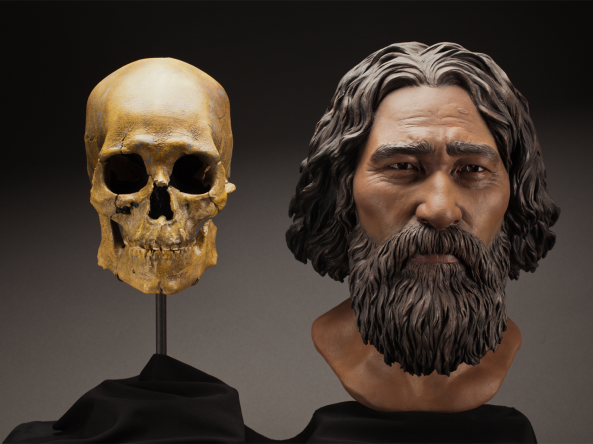
A reconstruction of Kennewick Man sculpted to resemble the Ainu people of Japan, considered by some at the time to be his closest living relatives. Now, a link to Native Americans has been confirmed. Brittney Tatchell/Smithsonian Institute
A reconstruction of Kennewick Man sculpted to resemble the Ainu people of Japan, considered by some at the time to be his closest living relatives. Now, a link to Native Americans has been confirmed. (Photo by Brittney Tatchell/Smithsonian Institute)

Kennewick Man is an ancient skeleton found along the banks of the Columbia River by students in 1996. The discovery caused a legal battle between Northwest tribes and scientists.

But now, President Barack Obama has signed a bill that requires the 9,000-year-old remains be returned to tribes within 90 days.

Washington Sen. Patty Murray, a Democrat, championed the bill that gives the ancient bones to the tribes.

Several Northwest tribes are meeting this week with the U.S. Army Corps of Engineers and with the Washington state Department of Archaeology and Historic Preservation to discuss the imminent reburial of the Ancient One, or Kennewick Man.

People have continuously lived in north central Oregon for thousands of years. So Rob Begay, whose family is from Celilo Village on the Columbia River, said the scientists can’t tell him much about a story he already knows about Kennewick Man and his own people.

“Maybe they read too many books or something,” Begay said. “Because all of those things about the Native Americans, of how supposedly we were, are really not true. A lot of those are their own theories of why they think we are from somewhere else.”

“But as for me, my parents and my grandparents and down the generations back thousands upon thousands of years — that was our oral traditions, stories — that we were created here from time immemorial.”

Begay said it’s important to respect the Earth. In the origin stories, that’s where his people come from. In fact, he points to a long strip of exposed earth in the center of this longhouse.

“This floor, Mother Earth, that’s where we come from,” Begay said. “This is our altar here. To us this is altar. That’s why this right here, why we stand on both sides of it.”

It’s important for Begay and others here to see Kennewick Man — or the Ancient One — returned to that sacred earth.

A language leader for the Plateau tribes, Thomas Morning Owl, said sometimes people like to think of the tribes as something that happened in the past. Disconnected from Kennewick Man so long ago.

“Our traditions our life, our culture isn’t relegated to the past and frozen in time,” Morning Owl said. “We are a vibrant community. Our culture is more than uggs and shrugs or stones and bones. We live our culture on a daily basis.”

Seeing Kennewick Man returned will be good. He said it has been 20 long years.

“We’ve up to now have been pushed aside as fundamentalist crackpots in the native way that our religion and our practices are of no consequence to anything in science,” Morning Owl said. “But then we as a people know what we were charged with.”

Morning Owl said each new generation has that same great responsibility to make sure their ancestors are taken care of, honored and are at rest in the earth.

The transfer of Kennewick Man could take up to three months, but tribal officials are hoping to rebury the bones as soon as they can. Murray said she met with the Northwest tribes about 18 months ago.

“The compelling piece of their story, that this was one of their own, the tears in their eyes, the long years — just really said to me it’s time to get this done,” she said.

When it happens, the burial won’t be open to the public or the press.

Site notifications
Update notification options
Subscribe to notifications