History

Descendants gather to welcome Chirikof ancestors home

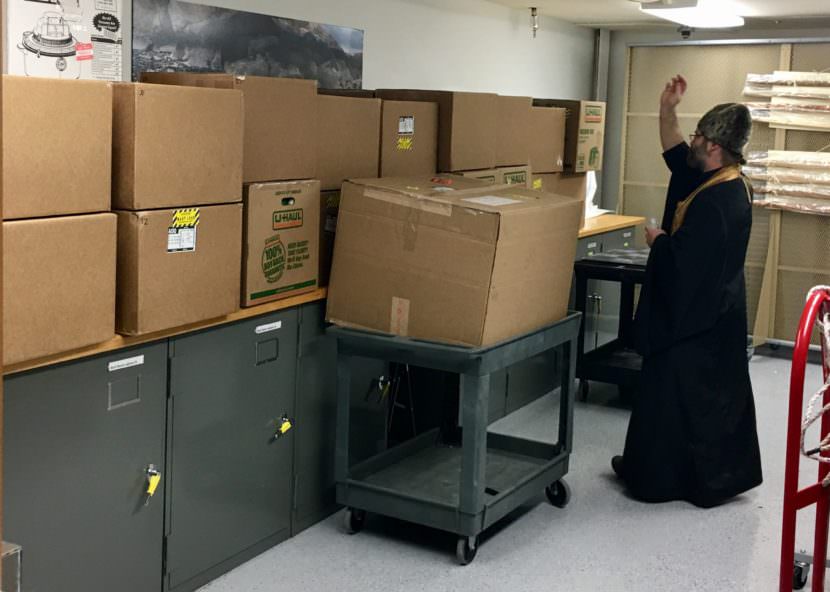
Father Innocent Dresdow performs service on the remains in the room where they’re being kept, in a lower level of the Alutiiq Museum. (Photo by April Laktonen Counceller/Alutiiq Museum)

After years of work, ancestral remains from a 19th century settlement on Chirikof Island have returned home.

In the 1960s, archaeologists removed the bones from Chirikof, which is located southwest of Kodiak Island, and since then the majority of the bones have been stored and studied at Indiana University Bloomington.

Representatives from the Alutiiq Museum and the U.S. Fish and Wildlife Service – the organization that manages the Chirikof land – have struggled long and hard to convince the university to release the remains.

They finally found success through persistence and the legal backing of the Native American Graves Protection and Repatriation Act.

Now, almost a year since they won that battle, the remains have finally landed in Kodiak.

Museum staff went to Kodiak Benny Benson State Airport to welcome the ancestors back home.

A group of people hug in the airport foyer.

Outside, Alutiiq Museum staff is looking forward to another kind of reunion. They’re waiting for the arrival of the 51 boxes that contain the Chirikof ancestral remains.

Everyone’s a little nervous. In the hours before, Museum Executive Director April Laktonen Counceller admits she broke out in hives.

And at the moment, she’s trying to locate the remains.

She’s has been working to get the remains back to the island since she took the position in 2015, but the museum’s repatriation efforts began in the early 2000s.

At last, the boxes arrive and museum staff, baggage handlers, and volunteers from the U.S. Fish and Wildlife Service put the boxes into two vans.

“As I was helping load the boxes in the van, I was just kind of thinking about what’s inside the boxes, so it’s emotional knowing that we’ve got humans in our hands right now as we’re loading ‘em and transporting ‘em to the museum,” Counceller said. “It’s really positive even though I’m emotional. It’s just very real now that we’re actually seeing the boxes and moving forward.”

The Alutiiq Museum planned a Russian Orthodox ceremony for the Chirikof ancestors, who were Christian.

“We felt that it would be the most honorable thing to do to have a Russian Orthodox priest bless the remains when they arrive to sort of signify that they are back in their homeland, they’re in their home region,” she said. “Although we’re not on Chirikof Island, this is part of the same parish and so the descendants of the Chirikof people are mostly living here on Kodiak today.”

Some of those descendants gathered for the service in the lower level of the museum. Staff set up coffee and cookies in a small room, and people talked quietly while they wait for attendees to arrive.

Elder Nick Alokli is one of those whose surname can be found among the records of the Chirikof ancestors.

“(I’m) really excited. I’m just happy they’re finally coming home,” he said. “Their real home is up in paradise, but their temporary home was Kodiak Island, so I’m glad they’re here now. It’s really surprised me because I never thought this would ever happen.”

Chirikof descendent Frank Peterson has worked for both the Sun’aq Tribe and the Alutiiq Museum, and is now the chair of Sun’aq tribal council.

He first heard about NAGPRA when he was working as director of operations for the museum, and it’s surreal to see the remains finally back in Kodiak.

“It’s amazing. Even before I knew that I was related to anybody, it was still an awesome responsibility for me,” he said. “It’s something that I’ve taken to heart since learning about this process and that there are remains that are unclaimed, so it’s very, very important for me.”

When everyone wass ready, they filed into the hall and stood outside the room where the remains were being kept.

Father Innocent Dresdow sung a prayer as part of the memorial service, or panakita.

It’s a somber event. When the ceremony ends, the environment relaxes, and the attendees – around 15 people – turn to each other.

Descendent Susan Malutin said the service was meaningful and long overdue.

“We can just relish in the fact that they’re here now, and that’s the important thing, and it’s not just this group here, but others who have the relatives, they too can find comfort in that now. They too. And that’s important.”

The repatriation process isn’t over yet.

Counceller said the U.S. Fish and Wildlife Service still needs to publish the official notice in the federal register, which will allow the Sun’aq Tribe to make an official claim on the remains, fill out the paperwork and complete the repatriation.

They will then re-inter the remains.

Trump will be first president in 36 years to skip White House Correspondents Dinner

President Trump announced Saturday afternoon that he would break from a decades-old tradition and skip the annual White House Correspondents’ Association Dinner scheduled for April 29.

“I will not be attending the White House Correspondents’ Association Dinner this year. Please wish everyone well and have a great evening!” Trump tweeted.

The annual dinner, sometimes referred to — affectionately and derisively — in Washington as “Nerd Prom,” honors journalism with awards and scholarships. The president is a major a draw to help in those efforts. What began in 1921 as a simple awards dinner evolved into a highly glamorized affair that attracted Hollywood stars.

The last president to not attend the dinner was Ronald Reagan in 1981. But he had a pretty good reason — he was recovering from being shot in an assassination attempt. Reagan did phone into the event and even joked about the shooting. “If I could give you just one little bit of advice,” Reagan said from Camp David, the presidential retreat, “when somebody tells you to get in a car quick, do it.”

He signed off with a light ribbing of the news media. “Well, I’m looking forward to the next news conference,” he said. “I have so many questions to ask you all.”

The last president to outright skip the event was Richard Nixon in 1972. Nixon warned the press he’d do so and followed through. Trump called the press the “enemy of the American people,” in a tweet recently. That echoes Nixon, who told the chairman of the Joint Chiefs of Staff, “The press is your enemy.”

Trump’s announcement comes at a moment of high tension between the White House and many news organizations. Trump has made attacking mainstream news organizations a staple of his public remarks. Trump and his White House have accused the New York Times, CNN and others of being an “opposition party” with which he is at war.

In response to Trump’s tweet, the White House Correspondents’ Association President Jeff Mason issued the following statement:

“The White House Correspondents’ Association looks forward to having its annual dinner on April 29. The WHCA takes note of President Donald Trump’s announcement on Twitter that he does not plan to attend the dinner, which has been and will continue to be a celebration of the First Amendment and the important role played by an independent news media in a healthy republic. We look forward to shining a spotlight at the dinner on some of the best political journalism of the past year and recognizing the promising students who represent the next generation of our profession.”

White House Chief Strategist Steve Bannon on Thursday reiterated that the press was the “opposition party” at the Conservative Political Action Conference; Trump himself devoted a significant portion of his CPAC speech Friday to attacking the “fake news” media; and White House Press Secretary Sean Spicer gave access for a briefing to a group of mostly conservative-leaning news organizations that same day while shutting out some mainstream organizations.

The correspondents’ dinner has been a place where the inevitable tension between the president and press is mostly put aside after a roasting. The president usually takes on the press corps in a light-hearted way before acknowledging its important role in a democracy — and the president in turn takes a ribbing from a famous comedian who headlines the night.

But in recent weeks, as relations between the White House and the news media has grown more strained, several news organizations have announced plans to not attend this year’s dinner. Buzzfeed reported that CNN, which Trump has been pointedly attacking, might boycott, and Bloomberg canceled hosting a planned after party, a longtime feature of the event in collaboration with Vanity Fair. Vanity Fair had pulled out earlier.

NPR and most other news organizations are still planning to attend.

Some news outlets, like The New York Times, have been skipping the event for years because, in part, of charges of the event depicting journalists as being too chummy with the president.

CBS’s Major Garrett, the network’s chief White House correspondent and a former board member of the correspondents’ association, penned an op-ed in the Washington Post, in which he said he thought it was a bad idea for the press to skip the event. He concluded:

“If Trump represents a genuine threat to press freedoms, then foregoing the dinner doesn’t change a thing. The right response, instead, is for reporters and news organizations to redouble their commitment to a WHCA dinner built around the journalism of the present and of the future.”

According to WHCA website, the dinner has been held every year since 1921.

“The 50 men who gathered in the Arlington Hotel at Vermont Avenue and L Street on the north side of McPherson Square that evening could not have known that they were initiating a Washington tradition, one that would annually draw 2,600 people and a national audience a century later. It was Saturday, May 7, 1921 and this was the first White House Correspondents’ Association Dinner.”

There have been plenty of controversies surrounding presidents, yet they still attended, from the Iran-Contra weapons scandal in the 1980s during the Reagan administration to the Clinton impeachment. Bill Clinton attended all eight years, including before and after his 1998 impeachment following the Monica Lewinsky scandal.

The first president to attend was Calvin Coolidge in 1924. For years, the dinner had been headlined by cabaret singers and entertainers. The comedic roast didn’t become a staple until 1983, but it has grown in popularity since, drawing together the odd couple of celebrities and the political news media.

Copyright 2017 NPR. To see more, visit http://www.npr.org/.

Lucille Horn, who was nursed to health in a Coney Island sideshow, dies at 96

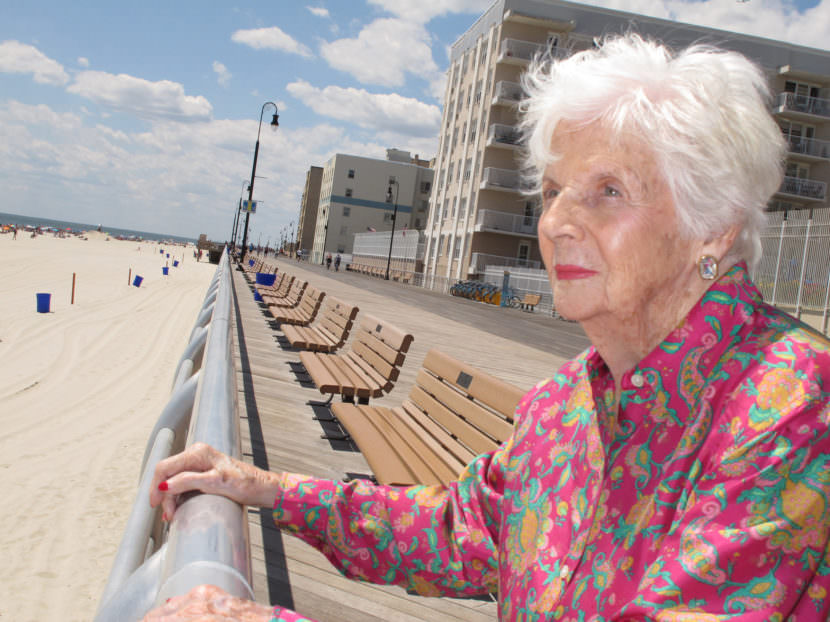
In this 2015 photograph, Lucille Horn stands on the boardwalk outside her home in Long Beach, N.Y.
Frank Eltman/AP

When Lucille Horn was born in 1920, the odds of her managing to live out the year were long. A premature infant, Horn was just 2 pounds — small enough to be held in her father’s hand. Her twin had died at birth, and at that point it looked for all the world as if she would soon, too.

Instead, with the help of an enterprising doctor and a rather odd sideshow at New York’s Coney Island, Horn would go on to live another 96 years. She died on Feb. 11, according to Hungerford & Clark Funeral Home, nearly a century after nearly every expert told her parents she would.

“They didn’t have any help for me at all,” Horn told her daughter Barbara in a 2015 StoryCorps interview. At that time, the state of medicine was such that babies born as prematurely as Horn had very little chance of surviving. “It was just: You die because you didn’t belong in the world.”

Except one doctor, in particular, did not accept that assessment.

For four decades, Martin Couney pioneered the use of incubators to keep infants like Horn alive — but these incubators were so widely rejected by the medical establishment, he resorted to funding his work in a very unconventional way: by displaying the babies in a Coney Island sideshow, charging viewers 25 cents to see the show.

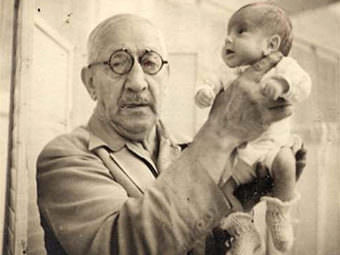
Dr. Martin Couney holds Beth Allen, one of his incubator babies, at Luna Park in Coney Island. This photo was taken in 1941.
Courtesy of Beth Allen

Upon her father’s insistence, Horn was accepted as one of Couney’s patient-attractions at no charge to her parents, just as he did with thousands of other babies he treated at Coney Island. About six months later, Horn was healthy enough to go home.

As we reported, Couney himself died in 1950, after incubators like his were finally being adopted in hospitals.

Horn, who went on to have five children of her own, worked as a crossing guard and then as a legal secretary for her husband, according to The Associated Press.

Years after her treatment in Couney’s incubator, she said she returned to the exhibit as a visitor and introduced herself to the doctor who saved her life.

“And there was a man standing in front of one of the incubators looking at his baby,” Horn told her daughter in 2015, “and Dr. Couney went over to him and he tapped him on the shoulder.

“He said, ‘Look at this young lady. She’s one of our babies. And that’s how your baby’s gonna grow up.’ ”

Copyright 2017 NPR. To see more, visit http://www.npr.org/.

New holiday would honor contributions of black soldiers to Alaska Highway

The Alaska Highway was constructed during World War II after the bombing of Pearl Harbor, but it remains vitally important to Alaskans.

Yet, many are unaware of its unique history.

State lawmakers are considering making a new holiday to honor the contributions of black soldiers who helped build what is still the only road connecting Alaska to the Lower 48.

Reginald Beverly turned 102 two weeks ago. He is one of over 4,000 black soldiers who helped build the Alaska Highway.

On Feb. 14, Beverly called Juneau from his home in Virginia to say a few words to legislators who are considering commemorating his and his comrades’ efforts.

“I would like to say thank you for honoring the soldiers who worked on the Alcan Highway,” he said.

Jean Pollard has been in touch with Beverly for the last few years as part of the Alaska Highway Memorial Project, a group that wants to see the highway’s unique history honored.

“I’m a retired educator, and I had graduated from high school here and college here and never had heard that story this way,” she said. “Because of what these soldiers did in 1942 in Alaska in all the harsh conditions, on July the 26th, 1948, then President Truman declared all military would be integrated.”

In addition to this milestone in civil rights history, 1948 was also the year that the Alaska Highway opened to the public.

Pollard first learned about the contributions of black soldiers through a journalist named Lael Morgan. Morgan wanted to write about the highway 25 years ago when she worked for National Geographic, but things didn’t go as planned.

“When I discovered that the bulk of the troops who built the part in Alaska were black, and discovered what they had gone through to do that job, I wanted to focus on it and that’s not the kind of story that National Geographic wanted to do,” she said.

The story cost Morgan her job, but she didn’t give up.

She put together a museum exhibit that toured the country and hosted a reunion for the black soldiers that she was able to contact.

“The black soldiers who I found and located were on ‘Good Morning America’ and we got a write-up in the New York Times. And so, and then, people just sort of kind of forgot … It’s time to remind people again who built our highway,” she said.

The legislation is sponsored by Sen. David Wilson, and it would make Oct. 25 African American Soldiers’ Contribution to Building the Alaska Highway Day. It’s quite a mouthful, but it definitely gets the point across.

It was Oct. 25, 1942, that black troops building south met white troops building north.

One of the few photographs of the black soldiers depicts their meeting. Gary Zepp, staff to Sen. Wilson, explained the picture to legislators Feb. 14.

“This is a picture of Cpl. Refines Sims Jr., an African-American from Philadelphia. He was driving his bulldozer south when he saw trees starting to topple over him,” he said, pointing to the picture. “He slammed his vehicle into reverse and they backed out just as another bulldozer, driven by Pvt. Alfred Jalufka of Kennedy, Texas, broke through the underbrush. A wire service photographer captured this image, standing on their respective bulldozers, and this occurred 20 miles east of the Alaska-Yukon border.”

Both men are beaming as they shake hands.

The Alaska Highway Memorial Project’s website refers to the highway as the “Road to Civil Rights.” They hope to turn Oct. 25 into a day reminding all Alaskans of how their highway paved the way for desegregation in the United States.

So far 16 senators have signed on to co-sponsor the bill.

75 years later, Americans still bear scars of internment order

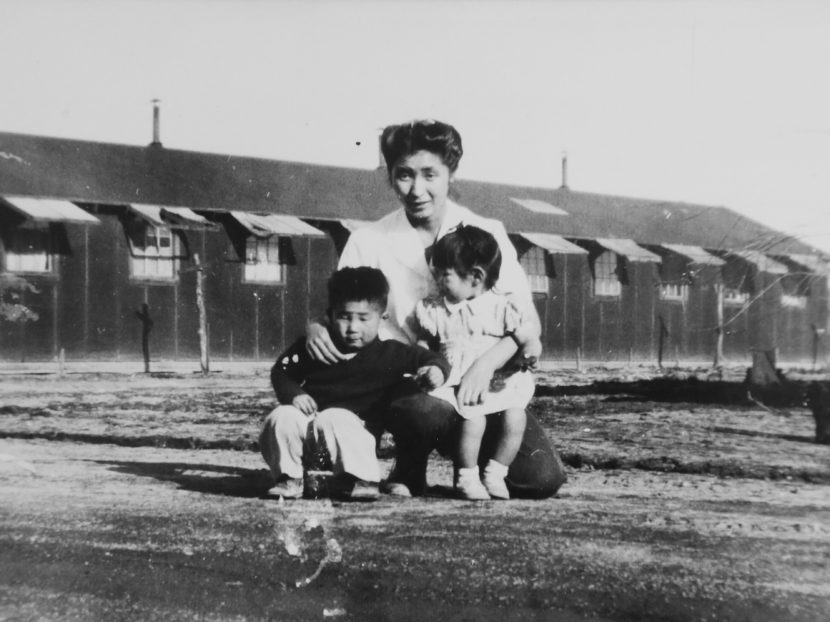
This 1945 photo provided by the family shows Shizuko Ina, with her son Kiyoshi (left) and daughter Satsuki in an internment camp in Tule Lake, Calif. This photograph was taken by a family friend who was a soldier at the time, since cameras were considered contraband at the camp. Satsuki was born at the camp. Courtesy of the Ina family/AP
This 1945 photo provided by the family shows Shizuko Ina, with her son Kiyoshi (left) and daughter Satsuki in an internment camp in Tule Lake, Calif. This photograph was taken by a family friend who was a soldier at the time, since cameras were considered contraband at the camp. Satsuki was born at the camp.
Courtesy of the Ina family/AP

It has been three-quarters of a century since President Franklin Delano Roosevelt signed Executive Order 9066. The order, issued just over two months after Japan’s surprise attack at Pearl Harbor, gave the U.S. military the ability to designate areas “from which any or all persons may be excluded.”

There was no mention of any particular ethnic or racial group anywhere in the order. Nevertheless, the implications were quickly quite clear: Not even a week passed before people of Japanese descent were being ordered to leave their homes in California. Soon, the forced relocation applied to the whole state, as well as much of the rest of the West Coast.

Roosevelt signed another order the next month, creating an agency to usher these people — mostly U.S. citizens — to camps set up expressly to incarcerate them as potential threats.

By the time the last internment camp closed in 1946, roughly 120,000 Japanese-Americans had been held in 10 camps, tar-paper barracks set up in a handful of states.

Beacons In A ‘Dark Chapter’

Before an Oregon Senate committee, George Nakata, who was no more than 8 years old when the Roosevelt’s order was signed, spoke earlier this week of a “dark chapter in American history … not found in many school textbooks,” according to The Associated Press.

“I can never forget, upon entering the building [where I was incarcerated], the smell of livestock urine, the pungent odor of manure underneath the wooden floors,” Nakata told lawmakers, who are considering a bill to establish a Day of Remembrance of the internment. The AP notes that California and Washington have passed similar resolutions.

In their commemorations, many have turned to the courage of a few as a beacon in that “dark chapter” — especially Fred Korematsu, who as a young man refused to be relocated in 1942. Korematsu, a U.S. citizen, took his case all the way to the Supreme Court, which ultimately ruled against him.

“The majority of justices claimed the detentions were not based on racial discrimination but rather on suspicions that Japanese-Americans were acting as spies,” as NPR has reported.

Though in his dissent, Justice Robert Jackson wrote the decision “has validated the principle of racial discrimination in criminal procedure and of transplanting American citizens.”

He added: “The principle then lies about like a loaded weapon, ready for the hand of any authority that can bring forward a plausible claim of an urgent need.”

That conviction was eventually vacated in 1983 by a U.S. District Court in San Francisco. But “if anyone should do any pardoning,” Korematsu said at the time, “I should be the one pardoning the government for what they did to the Japanese-American people.”

Japanese-Americans across the country still harbor memories of childhood years spent behind barbed wire.

That includes Roy Ebihara, who recently spoke with StoryCorps.

“I really didn’t understand what this all meant and how it would affect our family. I guess I felt we were guilty of something but what, I didn’t know,” he told his wife Aiko during the interview.

“I just feel that I want to go back and accept that pride, that pride of who we are.”

Regret And Reflection In LA

At the time Roosevelt’s order was signed, The Los Angeles Times defended the internment — a decision the Times editorial board on Sunday called “our lasting shame.”

“The time has come to realize that the rigors of war demand proper detention of Japanese and their immediate removal from the most acute danger spots,” the paper wrote in 1942. “It is not a pleasant task. But it must be done and done now. There is no safe alternative.”

A year later, the paper pinned their rationale on the idea that “as a race, the Japanese have made for themselves a record for conscienceless treachery unsurpassed in history.”

In this respect, the paper was in lockstep with the mayor of its home city at the time, Fletcher Bowron. On member station KPCC, Michael Holland and John Rabe point to Bowron’s archived speeches, which referred to citizens of Japanese descent as a threat to the homeland.

Some of his addresses drew on legal trappings for credibility:

“I have merely pointed out a legal theory that native-born Japanese never were citizens under a proper construction of the provisions of the United States Constitution. If they never were citizens, nothing could be taken from them and their position is different. … [They] are in a class by themselves.”

Bowron later “made several public apologies for the treatment of the Japanese citizens of Los Angeles,” Holland and Rabe write.

The Times of 2017, for its part, condemned the claims of its forebears.

The anniversary marks a time “to exercise some humility and to reflect on how we reach our positions on the passionate issues of the day,” the paper’s editorial board wrote Sunday. “Here’s one obvious conclusion: Even in times of stress and fear, we need to keep a firm grip on our core values and bedrock principles.”

Others in the U.S. also treated Sunday as a time for reflection — and as an opportunity to cast an eye on the present.

“Curators at the Japanese American National Museum say they see parallels between how Japanese-Americans were treated during World War II and how Muslim Americans are treated today,” NPR’s Hansi Lo Wang reports for our Newscast unit.

Starting this weekend, the Los Angeles museum is displaying two pages of Roosevelt’s original executive order.

“They say they hope younger visitors will have a chance to see firsthand the document that scarred the lives of generations of Japanese-Americans.”

Copyright 2017 NPR. To see more, visit http://www.npr.org/.

After a massive evacuation, Greek city defuses a World War II bomb

After an unexploded World War II-era bomb was discovered buried next to a gas station in Thessaloniki, authorities in Greece’s second-largest city had to figure out how to get it out of there.

They determined that tens of thousands of people would have to be removed from their homes as well.

By Sunday morning, all could breathe a sigh of relief.

After an evacuation of more than 70,000 people — one of Greece’s largest-ever peacetime evacuations — Greek officials have confirmed that the 500-pound weapon has been deactivated by specialists. Reuters reports the bomb was removed from its resting place and taken to a military shooting range, where it will be destroyed.

“Phase two of the bomb removal operation was successfully completed,” Central Macedonia Gov. Apostolos Tzitzikostas tweeted Sunday, according to the news service. “Citizens can safely return to their homes.”

The weapon, which is about the size of a typical air-dropped bomb during World War II, was discovered about two weeks ago by a crew that had been working on underground pipes extending from the gas station. A Greek army spokesman said the bomb’s exterior had so degraded they weren’t sure whether it was a German or Allied bomb — but one 86-year-old resident says he remembers it quite well.

“The bombing was done by English and American planes on Sept. 17, 1944. It was Sunday lunchtime,” Giorgos Gerasimou, whose home is half a mile from the bomb, told The Associated Press. “We could see the planes coming.”

Residents who were within 1.2 miles of the bomb were told to leave their homes and businesses for a period of several hours, during which time many of them were taken to local gymnasiums, cafes and stadiums. The BBC notes that law enforcement went house to house in the affected areas, which were placed under a state of emergency.

Not everyone was put out by the hours-long evacuation. A group of refugees, many of them Syrian, took it as an opportunity for a day trip to the Archaeological Museum of Thessaloniki, Reuters says. They’re among the roughly 450 people living in a refugee camp based at a former toilet paper factory near the city — a government-run camp where women and children have been sexually assaulted, according to The Guardian.

Reuters reports that the field trip, which had been requested by the refugees, includes a trip to the White Tower, a monument often considered a symbol of Thessaloniki.

Copyright 2017 NPR. To see more, visit http://www.npr.org/.
Site notifications
Update notification options
Subscribe to notifications