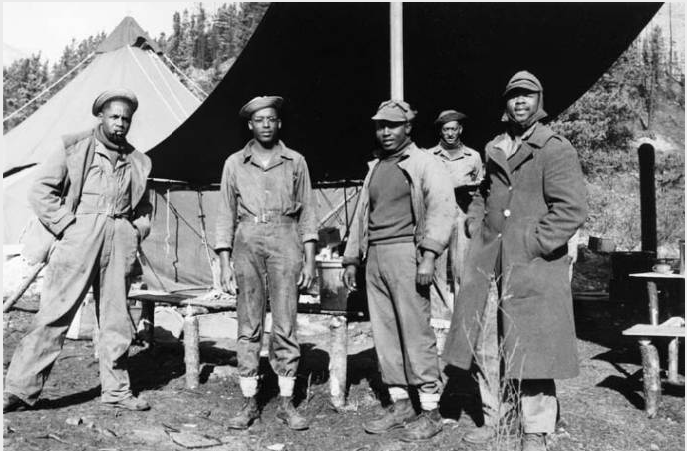
Historian Lael Morgan said the 10,000 U.S. soldiers who built the Alaska Highway included about 3,500 African-American troops, who mainly worked from Alaska southward into Canada. (Photo by U.S. Army/University of Alaska archives)
All but one lawmaker voted to back new legislation that names Oct. 25as African American Soldiers’ Contribution to Building the Alaska Highway Day.
Rep. David Eastman, R-Wasilla, left, speaks during a House Minority press availability on Thursday. Eastman defended his vote against African American Soldiers’ Contribution to Building the Alaska Highway Day. (Photo by Skip Gray/360 North)
Wasilla Republican Rep. David Eastman on Wednesday was the only lawmaker to vote no.
He said the state shouldn’t single out black soldiers.
“To create a new state law before there’s been an opportunity to recognize all Alaskan veterans who gave their lives building the highway – I think it’s premature,” Eastman said.
Researchers found that many black soldiers helped build the highway in 1942, six years before the military was integrated.
Palmer Republican Rep. DeLena Johnson said the bill recognizes that African-Americans were singled out for unfair treatment.
“We should recognize mistakes that we’ve made in the past and to ignore them would be a mistake,” she said.
Johnson noted that many black soldiers who wanted to fight in World War II weren’t allowed to do so. She added that those who built the highway contributed to Alaska’s history.
“The racial division was already made,” she said. “The government made that racial division.”
Eastman said two wrongs don’t make a right. He replied to a question from a reporter about his views on race by citing his service in the Army and Army Reserve.
“I wore a green uniform for 12 years and green was what we looked at,” he said. “The rest we didn’t, and it worked very well.”
The bill now heads to Gov. Bill Walker’s desk for his signature.
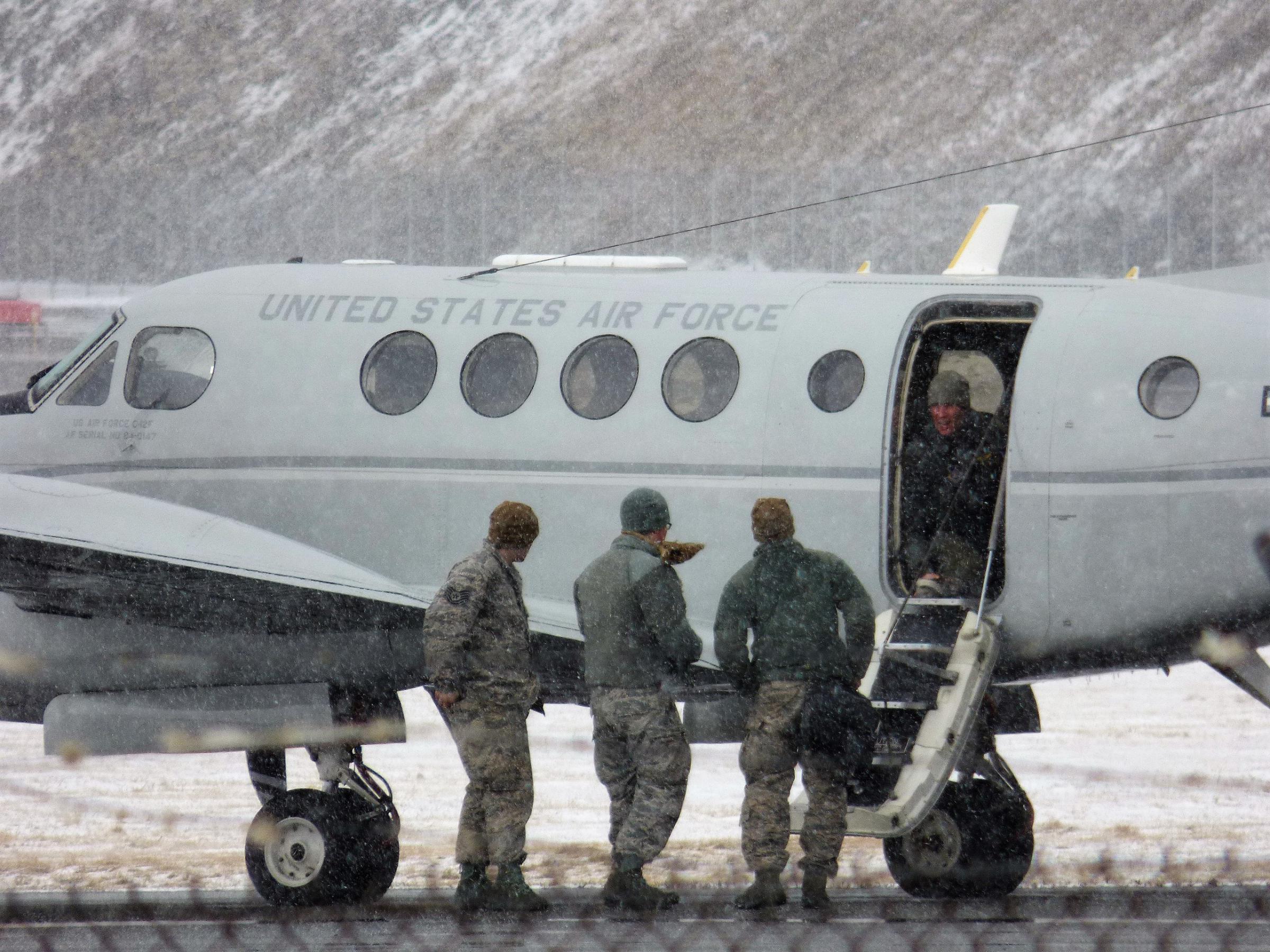
Explosive specialists with the U.S. Air Force return to their plane Tuesday after destroying World War II-era ordnance found in Unalaska. (Photo by Laura Kraegel/KUCB)
The U.S. Air Force made a special visit to Unalaska Tuesday after a hiker found unexploded ordnance from World War II. A bomb squad destroyed the artillery shell in a controlled explosion.
During the war, hundreds of soldiers were stationed atop Mount Ballyhoo, one of the tallest peaks in Unalaska.
Last week, a local hiker found an explosive reminder of that wartime past, tucked away in the tundra at the base of the mountain.
“The Air Force came out and we blew it up,” City Investigator Chris Honan said.
Honan hosted the Explosive Ordnance Disposal team that flew in from Anchorage to deal with the shell.
“It was old WWII,” he said. “It looked maybe 120 millimeters. It’s usually fired from howitzer-type cannons.”
Some 75 years after the war, Honan isn’t sure why road maintenance turned up enough earth to reveal this piece of ordnance at this spot.
But he has an idea.
“It was a good-sized round, probably from training,” he said. “They had, what? Fifty thousand soldiers on the entire island? So they probably did some training, firing rounds here and there. It was wartime, so people were always rushing around and throwing stuff around.”
Back in the present day, Honan said the disposal squad didn’t rush the controlled explosion that disposed of the shell.
The three-man team studied the ordnance carefully before driving it to the secluded gun range on the far side of the mountain and blowing it up.
Civilians weren’t allowed within sight of the explosion, and the team didn’t take questions afterward. Honan said it was fun to watch the blast from his spot, 500 feet away from detonation.
“It wasn’t bad,” he said. “I would say it had a couple pounds of C4. You could feel it. A little shake.”
In his seven years on the job, Honan said the military has come to the island four or five times to dispose of WWII ordnance.
“It’s not too common, but it’s good to be on the lookout for it,” he said.
Honan reminds Unalaskans to call the police if they come across ordnance on the island.
Civilians should not handle explosives for their own safety, He said.
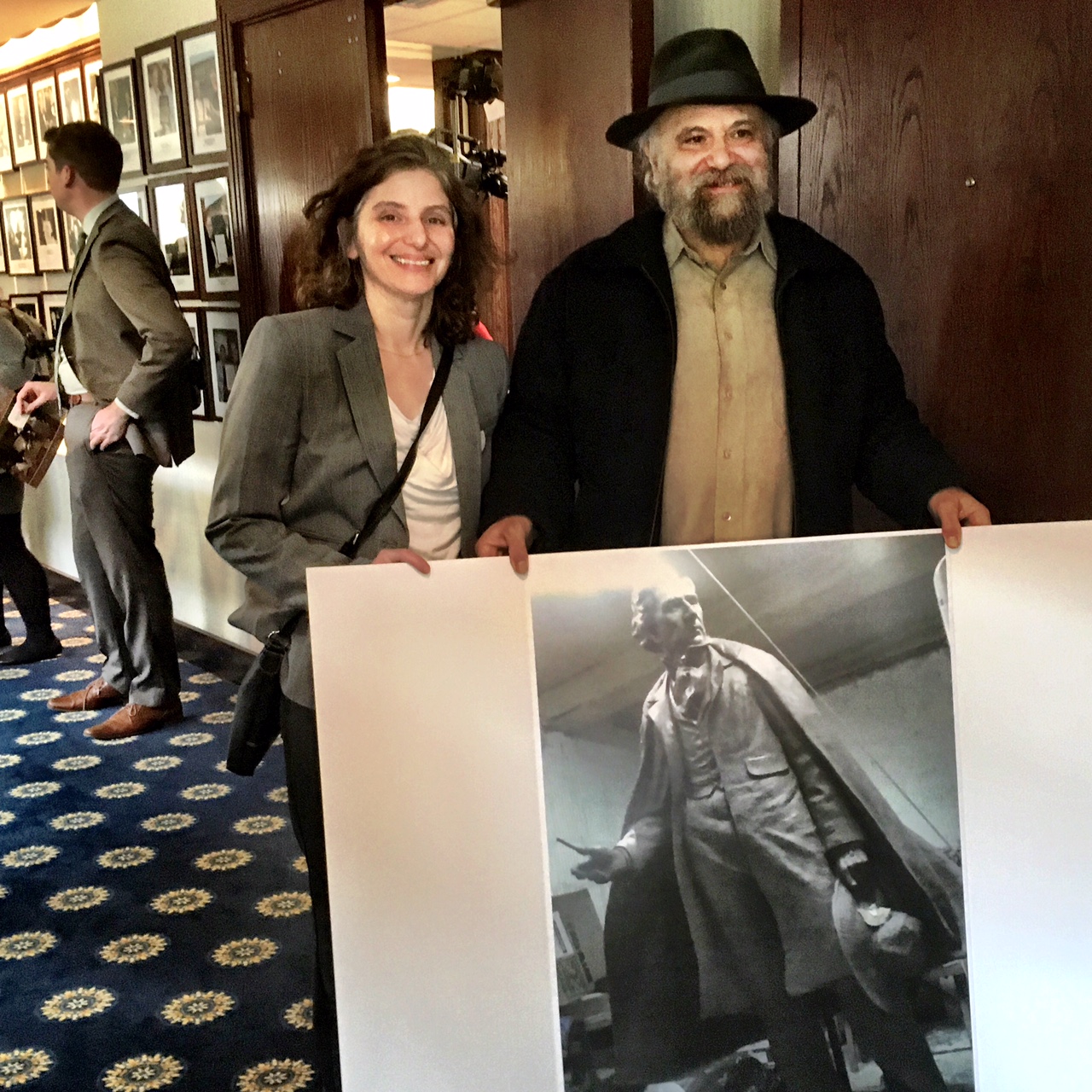
Judith Rubin and her brother, David, show a poster of their statue at a luncheon at the National Press Club. (Photos by Liz Ruskin/Alaska Public Media)
On the anniversary of the treaty with Russia to buy Alaska, a Ketchikan artist went on a mission in Washington, D.C., to find the spot where William Seward signed the Treaty of Cession, exactly 150 years prior.
David Rubin looks something like an Alaskan prospector, all gray and whiskery, in a felt brimmed hat.
He moved to Alaska decades ago.
But lately, he and his sister Judith have spent a lot of time in their mother’s basement in New York state, sculpting a life-size statue of William Seward, a bronze that will stand in Juneau.
It’s at a foundry now on the East Coast. But the artists and a small group of supporters brought an 8-pound hunk of the statue out for a walk in downtown Washington last week.
The bronze chunk was wrapped in bubble wrap, carried in a tote bag. David says it’s a special part of the statue.
It’s a “replication of the Treaty of Cession. It’s going to go in the statue of Seward hand,” Rubin said.
Rubin hoped bringing it to the spot where the real treaty was signed would impart a touch of authenticity to the replica, a thread tying his work to history.
His friend Lorelei LaFleur offered to schlep it.
“Wow! Holy smokes!” she said, when the full weight of the bronze was in her hands.
First stop: Seward’s home, on Lafayette Square, steps from the White House.
At that house, a man working in league with John Wilkes Booth arrived to assassinate Seward on the same night Lincoln was shot.
Rubin said Seward’s son confronted the would-be killer on the staircase. The man turned to leave, then spun around with a gun in his hand.
“The gun misfired. It jammed,” Rubin said. “And that was Alaskan history – not yet made but that was key.”
The intruder, though, had a knife. He made it into the bedroom where Seward lay in a neck brace, recovering from a carriage accident.
“He’s attacking him with a Bowie knife. The metal brace from the accident saved his life,” Rubin said.
Seward was forever disfigured.
Rubin said they decided to sculpt his face with scars, in part because they learned the Tlinglits, who met Seward when he visited Alaska in 1869, were impressed by his injuries.
Rubin said it was a tough artistic choice.
“Yeah, he didn’t like his picture being taken after that,” Rubin said, “We were worried he’d be upset, but we said. ‘No, no. They see you as a great warrior.’”
Seward’s house, the Alaskans found, is gone. Wayne Jensen, of Juneau, searched a street bordering Lafayette Square for a plaque to mark where the house was. No such luck.
“It might’ve been where that brick building is,” Jensen said. “That new brick building, which is a federal building, it looks like.”
Jensen is a member of Alaska Historical Commission and he co-chairs the committee that picked Rubin to make the statue.
Jensen said a key moment for the Treaty of Cession happened at Seward’s house, the night before the treaty signing.
“On the 29th, Seward and his family were playing whist, which is a form of bridge I understand,” Jensen said. “About 10 o’clock at night, and Edouard de Stoeckl came to the house.”
De Stoeckl was the Russian ambassador. Jensen said he came bearing news that the czar had agreed to sell Alaska.
“He said ‘I can meet in your office tomorrow morning, and we’ll finalize the negotiations,’” Jensen said. “Seward, who knew that the Congress was about to adjourn, said ‘why wait until tomorrow? … Let’s just do the treaty tonight!’”
The men met at midnight, at the State Department, a mile away. So that’s where the artists and their entourage walked with the bronze treaty.
Along the way, Rubin said he’d learned Seward was short and disheveled. Many people found him annoying, Rubin said, but he changed world history.
“He was a kind-hearted person. I know that,” Rubin said. “I know that there’s a lot of controversy about him being the face of Manifest Destiny. But he was a total abolitionist.”
In 1869, when Seward was in Sitka, he spoke disdainfully about Alaska Natives, and many first Alaskans see the treaty as a tool of their colonization.
Rubin, though, points to Seward’s active opposition to slavery.
Seward’s home in New York was a stop on the Underground Railroad. He supported Frederick Douglass and had a long association with Harriet Tubman.
As the small party of Alaskans walked north, downtown gave way to a gentrifying neighborhood. Liquor stores and vacant storefronts mixed with trendy new shops.
Eventually, the crew reached an unlovely intersection. It was the site of a 19th century orphanage that, for several years, was leased to the State Department.
“Is this the corner?” Rubin asked. “This is it? Oh my God.”
Lafleur set down the bronze burden to double check on her phone.
“OK, ‘Orphans Asylum and State Department. Vacated by both. And then razed,’” Lafleur said, reading from the small screen. She looked up to get her bearings.
“So that was the gas station that was used for storage,” Lafleur said, pointing to one corner. Then she turned to face the nearest building. “So we’re looking at the State Department. It’s beautiful!”
It is not. It’s now a block of 1970’s era housing.
Rubin wasn’t disappointed.
He and his sister walked past the security fence and took a spot on the small lawn. They unwrapped the bronze replica treaty.
Rubin giggled as he posed for photos. His sister encouraged him to read the engraved words from the bronze.
“Read it? ‘Whereas a treaty, between the United States of America and his majesty the emperor … ‘”
Judith Rubin holds the bronze treaty. She says it will go back to the foundry to get the patina applied, which will change the color.
The scene attracted a curious guy from a nearby bus stop.
“Did this happen at this particular spot?” the man inquired. “What year was that?”
Lafleur filled him in. She told him it was the 150th anniversary of the treaty.
“What came of it? … Oh right. Seward’s Folly,” he said.
Rubin wrapped up the chunk of bronze to leave.
“We’re now going to take it and place it in Seward’s hand, in the statue’s hand, and weld it there forever,” Rubin said. “But it was here! Where it was actually signed! This is it!” he said, breaking into a giggle. “This is it! We did it!”
Rubin’s statue of Seward will be erected in Juneau, across from the Capitol, in July.
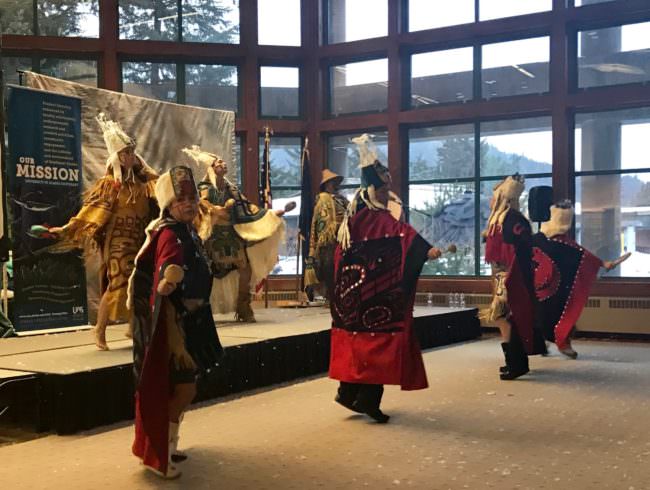
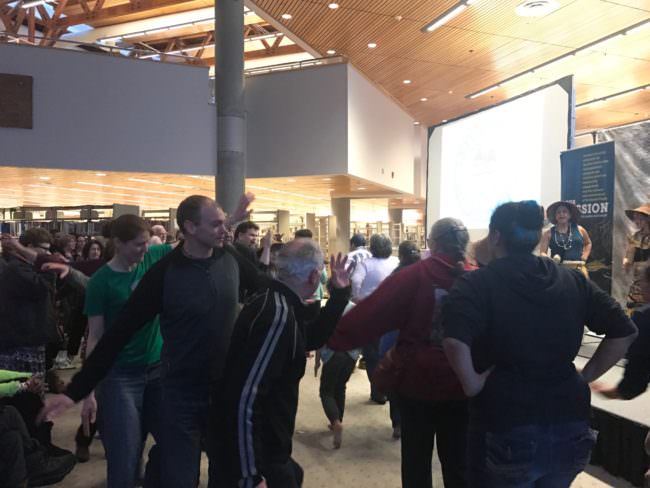
Git Hayetsk dancers perform their chief’s headdress dance honoring Smgyigyet (chiefs) and Sigidmhana̱’a̱x (matriarchs) on March 25 at University of Alaska Southeast in Juneau. (Photo by Caroline Halter/KTOO)
If you’re a longtime resident of Southeast Alaska, you may have heard the story of the founding of Metlakatla, a community in the Annette Islands Reserve, Alaska’s only reservation.
It’s usually told like this: in the wake of a growing rift with the Anglican Church, missionary William Duncan led more than 800 Tsimshian people on a canoe voyage from British Columbia to establish their own devout community in Alaska.
University of Alaska assistant professor Mique’l Dangeli tells a very different version of that history.
The dancers of Git Hayetsk share a common ancestry to the Sm’algyak speaking peoples of the Nisga’a, Tsimshian, and Gitxsan nations.
The dancers recently traveled from British Columbia to perform at University of Alaska’s Juneau campus. It’s a journey similar to one their ancestors made in the late 1800s.
Dangeli leads the group with her husband, Mike, and uses the performance to tell the version of Metlakatla’s founding told to her by prominent oral historians in the Tsimshian community.
Dangeli put it bluntly: “We didn’t follow William Duncan, William Duncan followed us.”
“It was our people’s decision to come back to Alaska and to argue for land rights with the U.S. government,” she continued. “We’d been denied by the Canadian government (and) it led to our decision to move.”
The song that tells the story is called “Paddle to Metlakatla.” It describes a particular moment on the canoe journey when one woman stood to rally the group who was grieving the choice to leave home.
“The words in that song are ‘Wha! T’iina tleexgn!” which is one way of saying ‘stop crying,'” Dangeli said.
From there, the dynamic of the dance changes.
The drum starts beating faster.
The dancers look up, and they start paddling harder.
“They let go of their fear of starting all over again,” Dangeli said.
As for William Duncan, well, Dangeli said he wasn’t even present on that journey.
“We celebrate our founder’s day in Metlakatla on August 7th. Our people started coming over in March, so the day that we celebrate as our founders day is the day that William Duncan finally arrived,” Dangeli said. “He came on a steamer.”
That’s one piece of what Dangeli calls a counter narrative, in contrast to the story that has come to represent the Tsimshian, even within parts of their own community.
“William Duncan, he’s always portrayed as this pied piper and we were just these rats scurrying along behind him,” she said. “Unfortunately, some of our people have internalized this colonial narrative.”
Git Hayetsk invited audience members to participate. (Photo by Caroline Halter/KTOO)
According to Dangeli, the idea that the Tsimshian people completely converted to Christianity, abandoning their own customs, also is false.
She explained that while most history books focus on the Tsimshian’s conversion to Christianity, her people continued their cultural practices “under the guise of Christian practices like Christmas parties and Easter parties.”
Some of those cultural practices have been absorbed into Tsimshian culture, but Dangeli said the cultural survival story was strategically hidden by Duncan.
He tightly controlled the flow of information in and out of Metlakatla to preserve his reputation as a missionary that had complete control over the community. He even went so far as to burn books that documented their ongoing cultural practices.
Toward the end of the Git Hayetsk performance, the group performs a victory song belonging to Dangeli’s husband.
“After war, they would line the beach and they would laugh and taunt their enemies because they had survived,” she said. “Now we use that song to talk about survival … in a much larger way.”
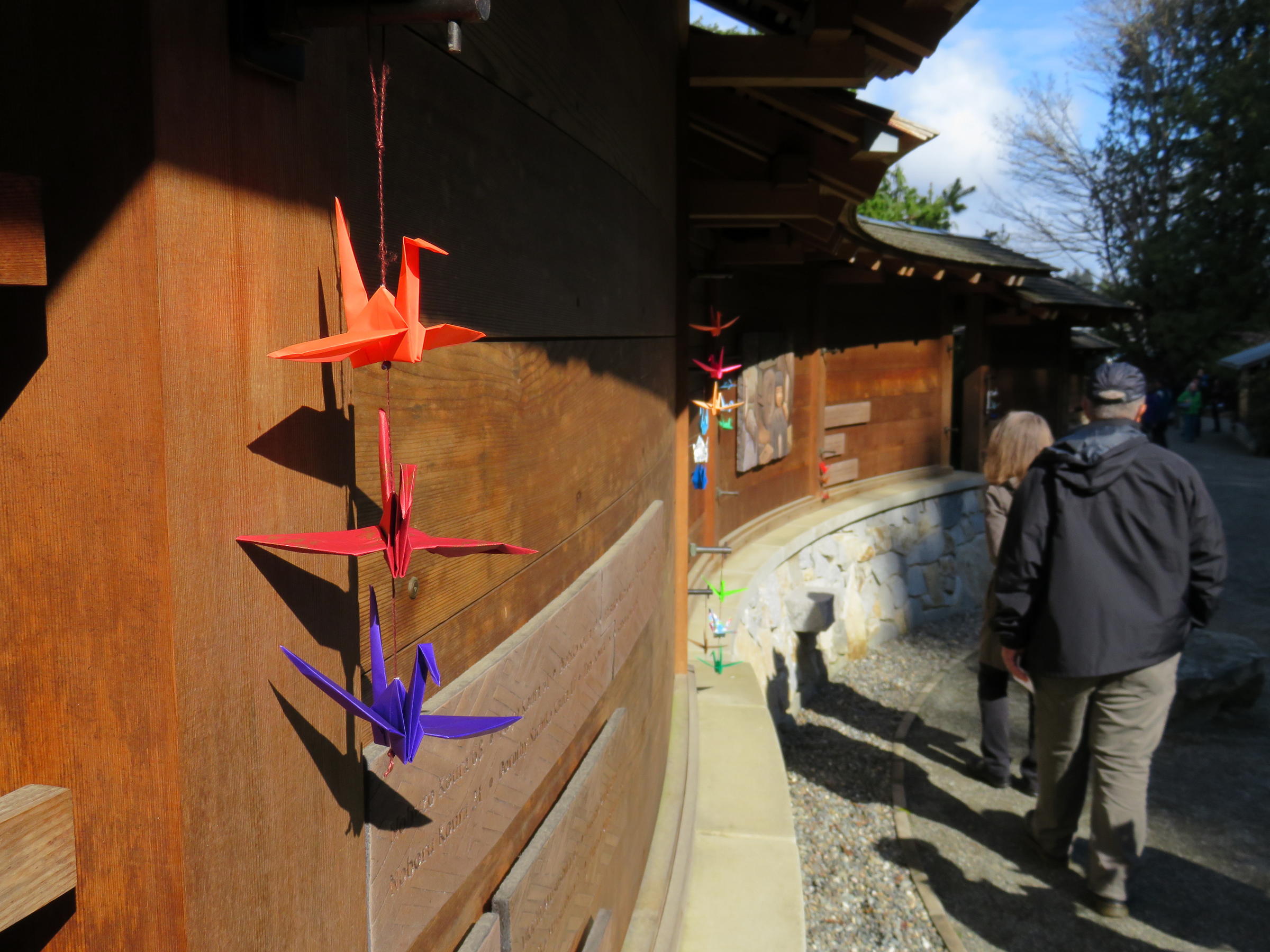
Origami cranes adorn the memorial wall at the Bainbridge Island, Washington, Japanese American Exclusion Memorial. (Photo by Tom Banse/Northwest News Network)
Echoes from Northwest history rang loudly for people in the present at a memorial ceremony last week to mark 75 years since the U.S. government forcibly removed the first Japanese Americans from their West Coast homes and sent them to internment camps. This happened in the wake of the Japanese attack on Pearl Harbor in World War II.
One of the first groups rounded up came from Bainbridge Island, Washington, due to its proximity to the Puget Sound Naval Shipyard. The 75th anniversary commemoration of the internment took place at the Bainbridge Island Japanese American Exclusion Memorial, a relatively new unit of the National Park System at the location of the island’s former ferry landing.
“It was very sad and scary because we were never told where we were going or how long we were going to be gone,” she recalled on Thursday. “They didn’t explain anything; just take what you could carry.”
Nakao, now 97, was one of many speakers who invoked the memory of the Japanese internment to urge people to stand up against targeting of Muslims, Jews or immigrants in the present day.
“We don’t want something like this to happen ever again. The way the country is going you never know,” she said.
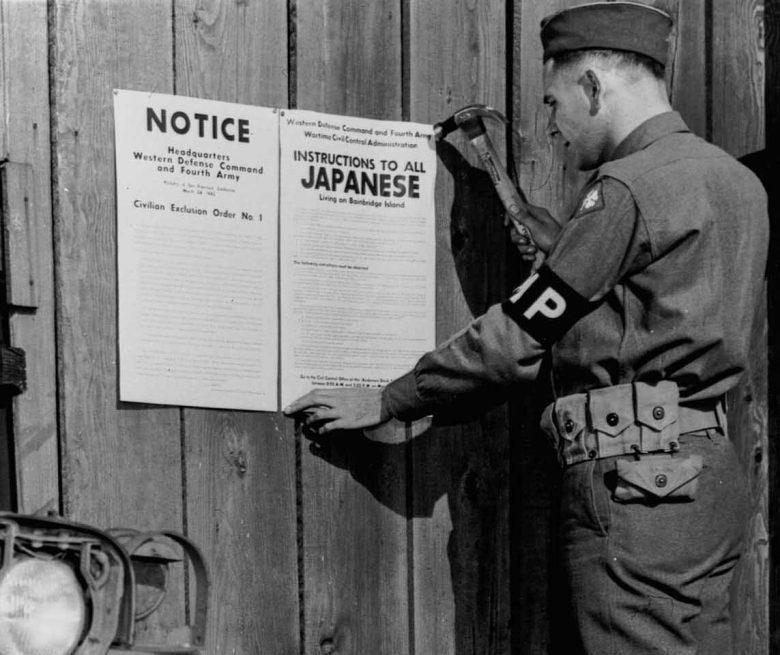
A military police officer posts Civilian Exclusion Order No. 1, requiring “evacuation” of Japanese living on Bainbridge Island, Washington. (Photo courtesy Bainbridge Island Japanese American Exclusion Memorial)
The Japanese ambassador to the United States, Washington’s Democratic governor, a tribal chairman and religious leaders also spoke to the crowd of more than 200 people gathered for the anniversary ceremony. Besides Nakao, more than a dozen other Japanese-Americans who spent time confined in inland internment camps attended.
In his remarks, Gov. Jay Inslee drew a line from the World War II internment history, to what he called real “fear” harbored by some in the public today and Washington state’s court challenges to President Donald Trump’s executive orders limiting travel from certain majority-Muslim countries.
“We stand on federal ground as part of the national park system to say that we will never let fear overcome us,” Inslee said. “We will never succumb to fear again and we will always stand up for the rights of everyone who lives in this blessed land.”
“Our motto is a motto of hope and action: ‘Nidoto Nai Yoni – Let it not happen again,'” said Master of Ceremonies Clarence Moriwaki, president of the Bainbridge Island Japanese American Community. “We’re falling down on it because it is happening again. It makes me feel sad. But it makes me feel empowered because so many people came out. Everybody spoke with such conviction and belief, that hope is there.”
In total, 120,000 thousand people of Japanese descent were confined for about three and a half years in hastily-built internment camps including Minidoka, Idaho, and Manzanar, California. It wasn’t until decades later that the U.S. government apologized for what was by then deemed an unconstitutional mass detention brought on by war hysteria.
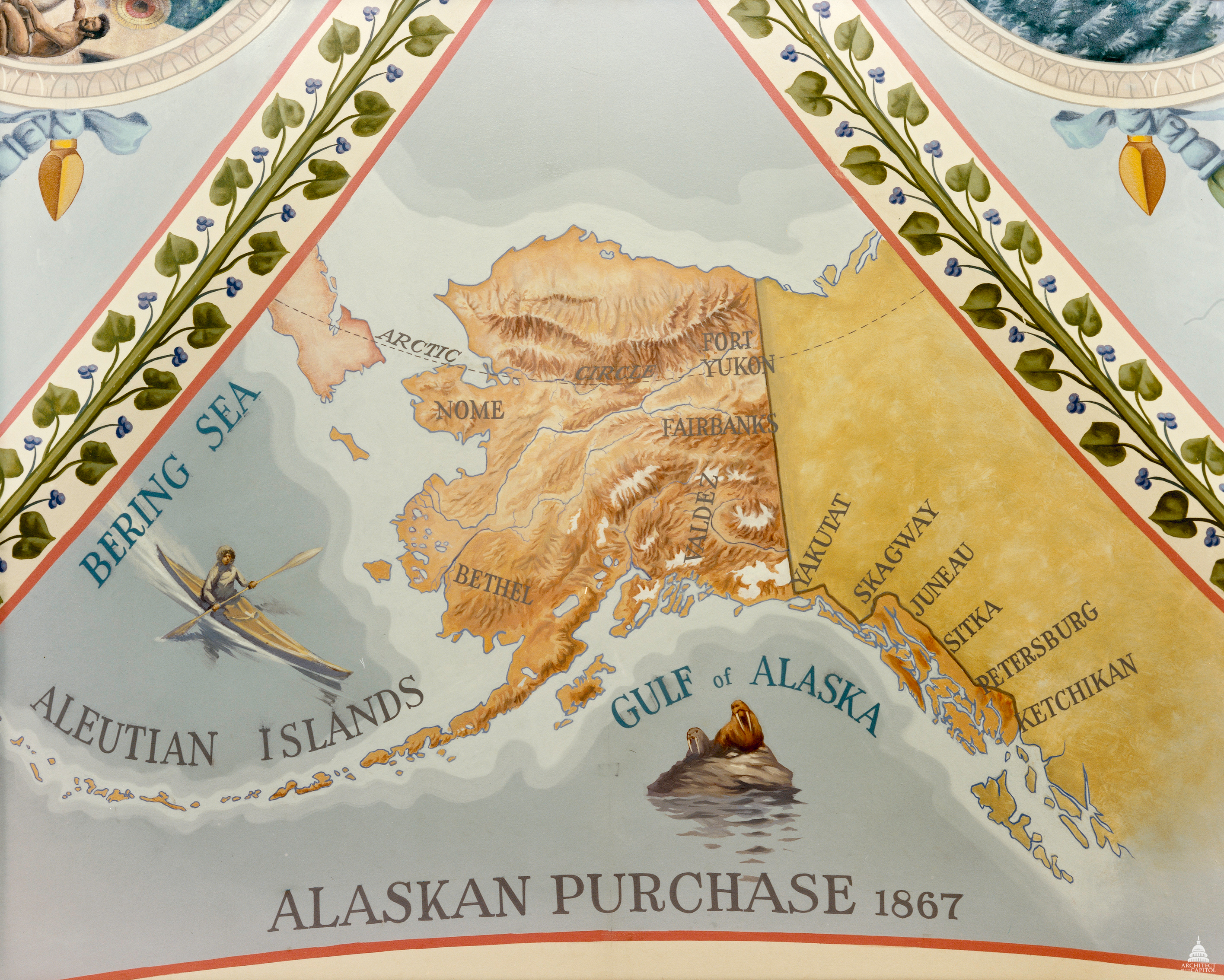
This mural on a vaulted ceiling in the U.S. Capitol was painted by Jeffrey Greene. It’s part of what’s known as the Westward Expansion Corridor. (Public domain photo courtesy Architect of the Capitol)
It’s the 150th anniversary today of the United States signing a treaty to buy Alaska from Russia. Or, since many Alaskans dispute the land was “owned” by either country, bought Russia’s claim on Alaska.
In Washington, D.C., the occasion is being marked with ceremony at the State Department and a concert at the National Archives. But did the treaty that shaped modern Alaska leave any mark on the city where it was signed?
Washington is a city of national monuments, none of which honor William Seward. There’s no marker on the spot where the secretary of State signed the purchase treaty with Russia. A few miles away, near the Capitol, There is a Seward Square. It’s not easily recognized, even when you’re standing on it.
The “square” is criss-crossed by streets, creating a collection of grassy patches, cut up by eight lanes of traffic.
Walk a few block to the Capitol and go inside, walk all the way to the end of a certain hallway. Right by the elevator, look up, and there it is, on a vaulted ceiling,
“Alaskan Purchase 1867.”
It turns out there’s a reason this mural is at the very end of the hallway.
“Well, I would describe it as a figurative style,” said Michele Cohen, curator in the office of the Architect of the Capitol.
She said the Alaska mural was painted by artist Jeffrey Greene, but he had several constraints.
“He’s trying to be very consistent with the style that defines Allyn Cox, which would be called sort of an academic, figurative style,” she said.
Allyn Cox was the artist first hired to decorate this side of the Capitol. He planned a series of murals depicting the nation’s history. Cohen says Cox wanted his halls to fit in with the 19th century murals elsewhere in the building. The Cox murals look something like old botanical illustrations, or Audubon prints, but showing people and places rather than plants and birds.
“We’re standing in one of the corridors that constitute really the Cox Corridors. And it’s known as the Westward Expansion Corridor,” Cohen said.
Cohen points out that the murals are chronological: Exploration, Daniel Boone, the Louisiana Purchase. And at the very end, the acquisitions of Alaska and Hawaii.
Cox, though, died before he could paint this corridor. Years later, Greene took it on. Only by then, it was the 1990s and ideas about Western expansion and Manifest Destiny had evolved. Cohen said Greene wanted his work to reflect the understanding that the West wasn’t empty land before the settlers arrived.
“He thought about the iconography and the content that was part of the original design and he wanted to make it a more inclusive mural, and a more nuanced historical narrative about westward expansion,” Cohen said.
It’s subtle, but it’s there. Greene painted Lewis and Clark gazing out over a Native American village, rather than untrammeled wilderness.
For Alaska, Greene added a person in a kayak to the map. The guy’s boat is nearly as large as the Aleutian Chain. Greene also included the names of Alaska towns and cities. As the curator tells it, that’s how the artist met the challenge of honoring 19th century concepts from a modern perspective on history.
Close
Update notification options
Subscribe to notifications
Subscribe
Get notifications about news related to the topics you care about. You can unsubscribe anytime.