History

Alaska’s income tax fight is only latest skirmish in decades-long conflict

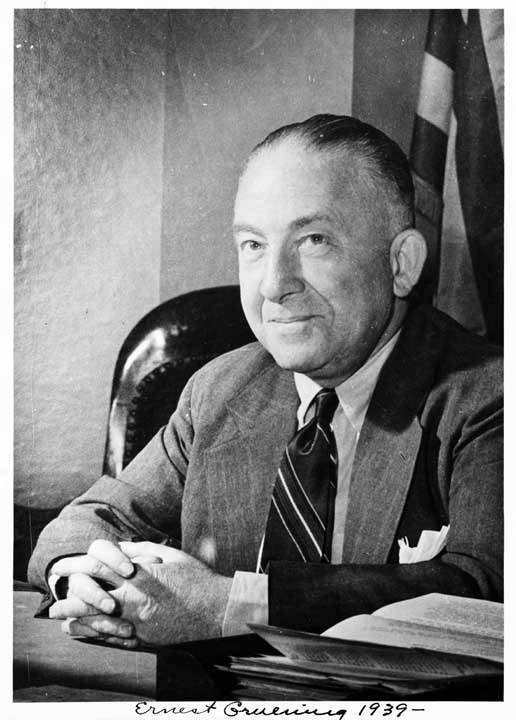
Ernest Gruening was Alaska's governor from 1939 to 1953. He signed the income tax into law in 1949. (Photo courtesy of the Alaska State Library Historical Collections)
Ernest Gruening was Alaska’s territorial governor from 1939 to 1953. He signed the income tax into law in 1949. (Photo courtesy Alaska State Library Historical Collections)

The Senate plans to vote Friday on a House proposal to bring an income tax to Alaska. Senate majority leaders oppose the tax, and it will likely go down in defeat. But this isn’t the first time Alaska has debated this tax — and it may not be the last.

Alaska’s government spending far outpaced the tax dollars coming in. The governor proposed an income tax to help close the gap. And lawmakers resisted.

This scenario played out last year. But it also happened 70 years ago. Terrence Cole, a University of Alaska historian, looked at this time period while studying history of the income tax in Alaska.

“With the Second World War, Alaska had a massive increase in population (and) large construction projects,” Cole said. “None of that economic activity was returned in revenue to the territorial government.”

Federal spending in Alaska fell after the war. And the salmon industry and alcohol taxes the territory relied on weren’t enough to cover the demand for services.

In January 1947, Gov. Ernest Gruening said the territory should start an income tax.

“Individuals and businesses deriving substantial livelihoods from the territory pay nothing at all. This is not as it should be,” he said.

The Territorial Legislature resisted. It refused to pass the tax. When it met again two years later, the territory was essentially bankrupt and the feds said they wouldn’t subsidize government services.

“By 1949, there was no choice but to put the income tax in,” Cole said. “And even then, it was a struggle.”

Cole said the tax had another major benefit, in addition to balancing the territory’s budget: It helped pave the way for Alaska becoming a state.

“It demonstrated to the federal government that Alaska was mature enough to become a state – that they would support themselves,” he said. “Because, frankly, that had been the big part of the argument against statehood.”

For the next three decades, the tax continued.

“It was like the wind in Juneau,” Cole said. “You may not like it, but it’s there.”

But in 1979, a hostage crisis in Iran caused oil prices to soar. The state had more than enough money to pay for government. And Libertarian Rep. Dick Randolph led an effort to repeal the income tax.

“My attitude always has been and is, that the government should tax when it needs money,” Randolph said. “But if it doesn’t need money, it shouldn’t tax.”

The income tax was abolished in 1981. Every time state revenue has fallen since then, oil prices picked up within a few years. This has killed talk of the income tax’s return.

Independent Gov. Bill Walker proposed an income tax last year, as part of package of taxes that the Legislature didn’t enact. The mostly Democratic House majority passed an income tax this year, calling it an “education tax.” While they say the tax would be designated to fund schools, the state Constitution bars the state from dedicating funds for specific purposes.

Randolph remains opposed the tax. He wants deeper spending cuts.

“Since oil, we’ve never had a revenue problem,” Randolph said. “What we have had is a huge, irresponsible spending problem.”

While Randolph is hopeful that the Senate will defeat the income tax, he isn’t happy with the Senate’s vote in favor of reducing Permanent Fund dividends.

Cole is concerned that the Legislature will continue to cut dividends further – and dip deeper into Permanent Fund earnings – without an income tax. He said a benefit of having the income tax is that residents have a direct stake in how tax dollars are spent.

“We’ve put ourselves back in the situation we were pre-1949, where everyone wants somebody else to pay the freight,” Cole said. “And they don’t want to contribute anything out of their own pocket.”

The Senate majority says it supports $750 million in spending cuts over the next three years. But if those cuts don’t materialize, observers like Cole say the income tax proposal will return.
Alutiiq community seeks city-owned property for memorial park

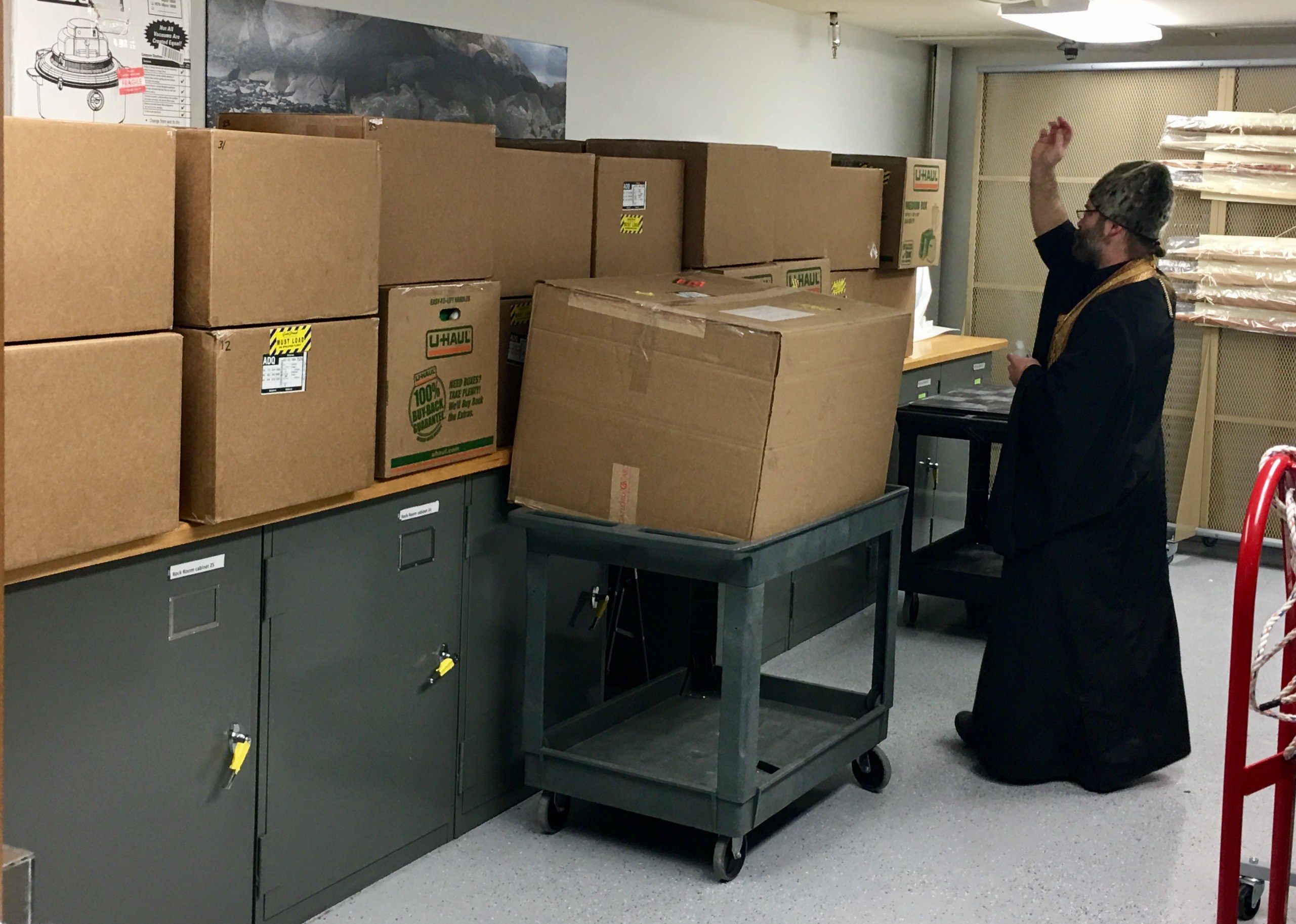
Father Innocent Dresdow performs service on the remains in the room where they’re being kept, in a lower level of the Alutiiq Museum. (Photo by April Laktonen Counceller/Alutiiq Museum)

The Alutiiq Museum is scoping out a site to bury ancestral remains that returned to the island in February.

The internment would be the end of the ancestors’ long journey.

Archaeologists in the 1960s removed the remains from a grave site on Chirikof Island and took them out of state. The majority of the remains ended up at Indiana University Bloomington.

That’s where they stayed until the Alutiiq Museum was finally able to reclaim them.

The repatriation process is now complete.

Last week, the U.S. Fish and Wildlife Service signed over legal control of the remains to the Sun’aq Tribe of Kodiak.

Burial is the next step.

The City Council will consider the museum’s request to create an Alutiiq Memorial Park where the community can rebury repatriated ancestors.

Alutiiq Museum staff has pinpointed an undeveloped, city-owned parcel behind the museum for the park.

Museum executive director April Laktonen Counceller said the memorial itself would be at the center of the property.

“For practical purposes, we’re probably gonna do something simple and natural,” she said. “Maybe a circle of stones, maybe some other sort of arrangement. We haven’t really decided.”

“There would be some trails going through it,” Counceller said There already are a few trails that pedestrians use to cut across that lot, and we’re hoping to preserve those.”

The staff thinks it could begin landscaping next winter according to a timeline in the meeting packet.

Also on the work session agenda will be the Salmon Work Group’s request for funding.

Kodiak fishermen are re-establishing the group in order to defend against any possible claims by Cook Inlet fishermen on Kodiak-area salmon.

The call-to-arms comes after a recent Alaska Department Fish and Game genetic study found that many Kodiak salmon may have originated in Cook Inlet streams.

The work group explains its need for help in a letter to the council. It points out that the community and economy benefit from salmon fishermen’s taxes and profits and any attacks on the fishing community impact Kodiak too.

The letter also states that the work group is only loosely organized so far and needs the funds now rather than later in order to hire expert assistance before the next Alaska Board of Fisheries meeting in October.

The Kodiak Island Borough Assembly, meanwhile, has already agreed to direct $7,500 toward funding the work group.

Walker signs bill recognizing black Americans who helped build Alaska Highway

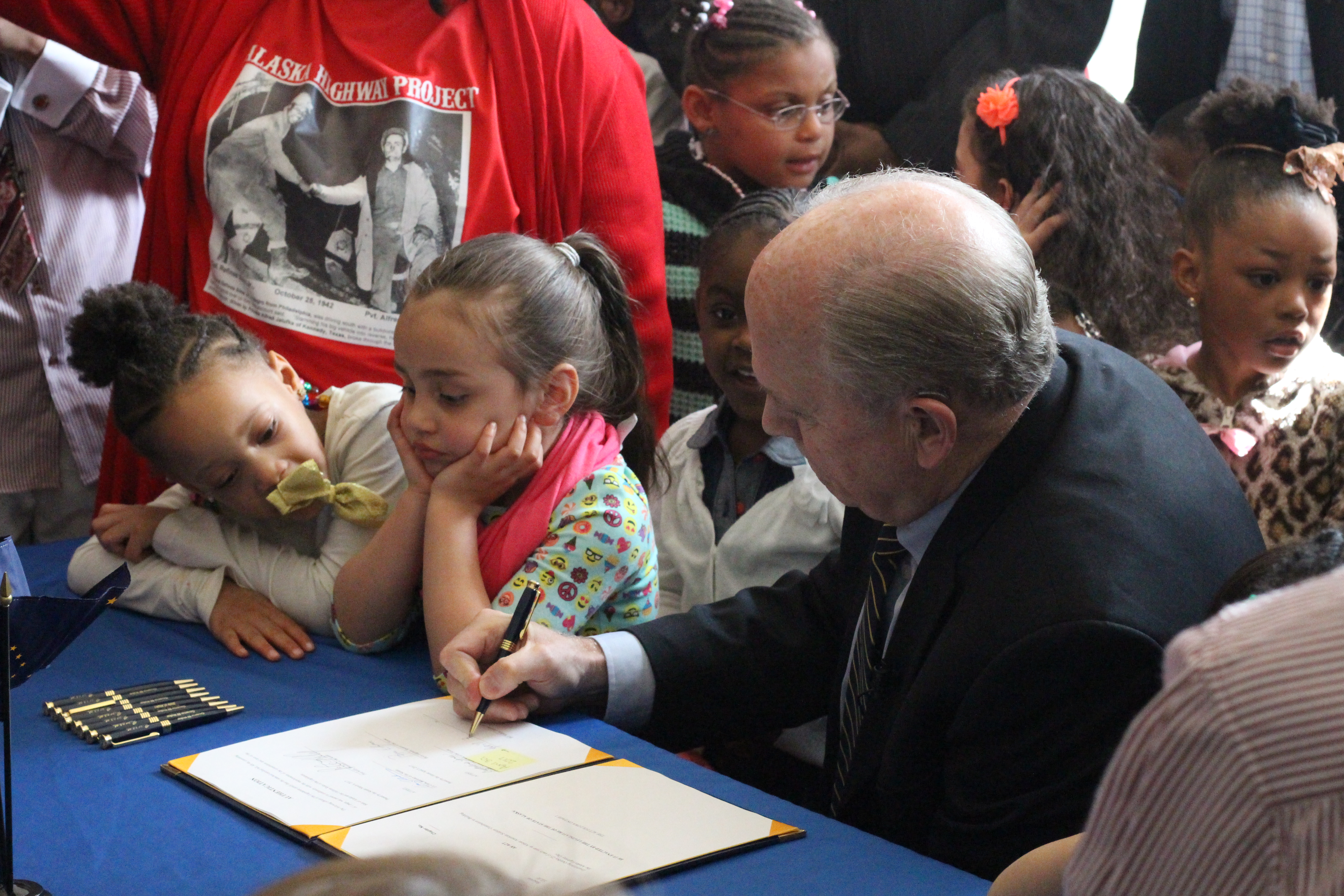
Gov. Bill Walker signs the first half of his name on SB 46 on Sunday at Shiolh Baptist Church in Anchorage, (Photo by Wesley Early/Alaska Public Media)
Gov. Bill Walker signs the first half of his name on SB 46 on Sunday at Shiloh Baptist Church in Anchorage. He signed his last name at the veterans memorial in the Delaney Park Strip of Downtown Anchorage. (Photo by Wesley Early/Alaska Public Media)

On Sunday, Gov. Bill Walker signed Senate Bill 46 into law, establishing October 25 as “African American Soldiers’ Contribution to Building the Alaska Highway Day.”

The signing of the bill began at the Shiloh Baptist Church in Anchorage.

Sunday’s church service was fairly typical, with the exception of some of the guests in attendance. Walker, his wife, Donna, as well as Sen. David Wilson and his wife, Aleta, were sitting in the second row as Pastor Alonzo Patterson spoke about how the Bible teaches that change will come to those who wait.

“Waiting can be problematic sometimes,” Patterson said. “It’s hard to wait till change comes when the Bible says I can do all things through Christ, which strengthens me.”

It was a fitting message considering that Walker was at the church to sign legislation that advocates argued was 75 years overdue.

Senate Bill 46 was introduced to commemorate the black soldiers with the Army Corps of Engineers who, in 1942, came up to build the Alaska half of the Alaska Highway.

A lot of them came from Southern states and most had never seen snow before.

The Army was segregated at the time and the white soldiers built the half of the Highway that led through Canada. The army wouldn’t be desegregated until 1948.

However, many people believe that the building of the highway was a major factor in desegregating the military.

“It’s not my words. It’s the federal government’s words that this highway really was the road to civil rights,” Walker said. “It took that question mark and turned it into an exclamation mark. And so it was no more a question of ‘Can they do it?’ The question was ‘Can we keep up?’ because they were an incredible, incredible workforce that made that happen.”

The bill was introduced to the legislature by Wilson, a Wasilla Republican, and pushed through the House by Representative Geran Tarr, an Anchorage Democrat.

The bill pushed through unanimously through the Senate and only one representative, Wasilla Republican David Eastman, voted against it in the House.

Once it reached the governor’s desk, Walker decided to sign the bill in two parts.

His first name would be signed at the church in front of all of the community advocates who’d helped raise awareness for the bill and his last name would be signed at the veterans memorial in the Delaney Park Strip of Downtown Anchorage.

Walker signed the first half of his name in front of a large group of children as well as advocates from the Alaska Highway Project, an advocacy group that had been pushing for the contributions of the black soldiers to be recognized.

Walker then proceeded to go downtown to sign the second half of his name. The scene at the memorial was also celebratory in nature with drummers performing for those in attendance.

Wilson addressed the crowd about the holiday.

“This doesn’t quite make it right, but it does acknowledge the hard work, doing something that’s a nearly impossible feat, and I doubt it could be redone today,” Wilson said. “It was that first road to civil rights that helped desegregate the army and later the U.S.”

Tarr gave acknowledgement to the advocates who helped push for the bill.

“I’m so glad that we’re getting this done today,” Tarr said. “Sometimes it takes a little longer than it should, but today’s a really important day to acknowledge that work. The story is so significant and I just have to say I’m just the number one fan of Jean Pollard.”

Pollard is a teacher and one of the main organizers of the Alaska Highway Project, who’s main goal was educating people of the historical significance of the highway.

She first learned about it in a PBS program.

“Lael Morgan was telling the story six years ago and I never had heard that side of the story before,” Pollard said. “I heard that soldiers built the highway, that’s all I knew. But when she began to talk about black soldiers here, white soldiers there, I didn’t know that at all.”

Pollard consulted with other teachers to see whether anyone knew more about the black soldiers. When they didn’t know, Pollard ended up communicating with Morgan to help get the story more attention.

“As an educator, I really felt, ‘OK, we gotta get this done,’” Pollard said.

Getting the holiday recognized was the first of three steps Pollard and her group wanted to get done.

She began to work with the Anchorage school district to get the story into Alaska studies curriculums. She ended up corresponding with Pamela Orme, the coordinator for social studies course in the district.

“We’re working together on a one-credit class for the teachers of the Anchorage school district,” Orme said. “They’re gonna come and learn about this and dig in just like Jean did, so they can write lesson plans. And then we’re gonna synthesize those lesson plans and make the best possible ones and then share them statewide.”

The third step is getting a memorial erected in Centennial park for people to visit and learn about the story while looking at historical photos of the black and white soldiers.

Shayla Dobson and her husband, Jim, will be in charge of creating it.

“The memorial is going to be a place where people can go (for) educational field trips,” Dobson said. “It will have on one of the granite panels the iconic photograph. It will also have other photographs that people can see what’s going on. It will be a place where people can go if they don’t know about the history. If they didn’t get to take Alaska history class, the information will be there.”

During her remarks, Pollard made reference to the 2016 film “Hidden Figures,” a movie about black women who worked for NASA and were mostly unknown to history.

She said the building of the Highway was “Alaska’s Hidden Figures.”

Ancient speartip leads to recognition for Round Island

Round Island
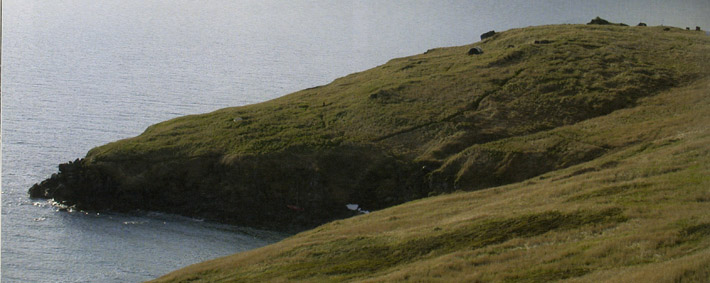
Round Island. (Photo courtesy U.S. National Park Service)

Round Island is one of the craggy coastal islands that make up the Walrus Islands State Game Sanctuary near Togiak. In 2004, a small spear-tip found on the island was tested and found to be over 6,000 years old.

Prior to this discovery, it was thought that human habitation on the islands dated back only 2,500 years. The available evidence showed that hunters were drawn there by the summer haul out of walrus, but also for the seals, sea lions, seabirds, and saltwater fish available to harvest.

Jeanne Schaaf, now retired, was the chief of cultural resources at Lake Clark National Park in 2004. At that time, the U.S. National Park Service and the Alaska Department of Fish and Game were working together to identify and protect cultural resources in the state. During a trip to Round Island as part of that collaboration, Schaaf uncovered the very old spear tip, which was a “significant” find from the excavations.

“Up until that time we knew that villages started to appear 2,500 years ago on that island,” she said. “We had no idea that people were there before that.”

This significant finding led Schaaf to co-author a proposal for the sanctuary to be declared a National Historic Landmark (NHL), a proposal that was approved in January of this year. The sanctuary had already been declared a National Natural Landmark (NNL) in the late 1960s, recognizing the unique biodiversity of the islands. It is one of only a handful of places to be awarded dual NHL and NNL status.

“Being named a National Historic Landmark site means that it is the best of the best, not just in Alaska but across the USA,” said archaeologist Rhea Hood with the National Register of Historic Landmarks in Anchorage.

The finding raised a lot of questions about the type of people who lived on the islands all those centuries ago.

“Did they follow walrus and is that what brought them to these islands?” Schaaf asked.

Schaaf believes it is possible that there were earlier occupations at Round Island when the island stood at the edge of the exposed Bering Land Bridge plain.

“I think we know that people traveled quite a bit and people were good mariners. Around 2500 years ago people definitely had semi- subterranean winter houses and we might find out that people wintered there even earlier,” she said.

Schaaf hopes future collaborative research will shed light on the occupants of Round Island. She also hopes that the new designation will prevent vandalism and unauthorized excavations that have damaged other sites.

For her part, Hood thinks the discovery is just another layer on the rich tapestry of Bristol Bay history.

“Everything that has happened in Bristol Bay, from the arrival of the Russians to the recent history of the United States, is all a continuation of the archaeological record,” she said.

“It is part of the story of how we got here today and the context of our current events. We should always be aware that we are walking in the land of our ancestors and should try and honor that.”

Awarding NHL status should make it easier for research grants to be given out to promote further research into the islands, according to Hood.


Franklin Street named after early prospector who later settled in Interior

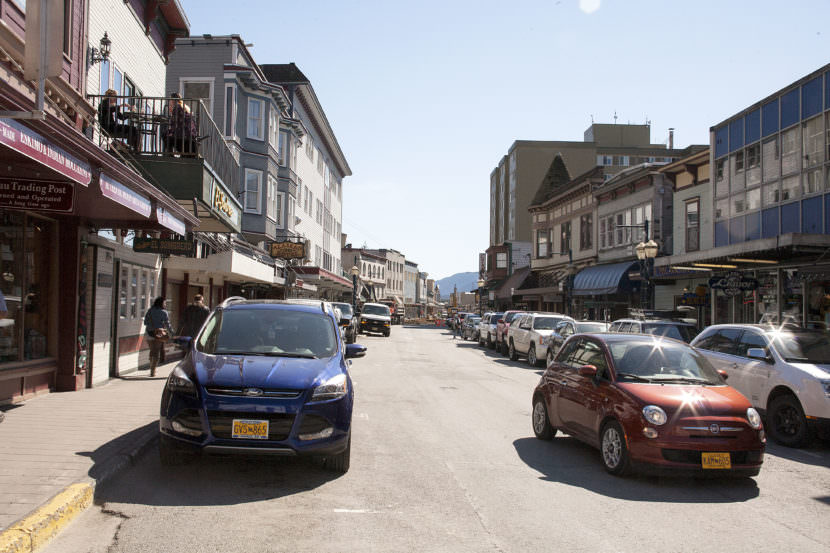
Franklin Street is one of the oldest streets in Juneau, but how it got its name is a mystery to many. (Photo by Tripp J Crouse/KTOO)

A street in Juneau is a popular locale for residents and tourists alike. South Franklin Street particularly is home to several bars, shops and a rich history.

For many, Franklin is iconic. But where the street gets its name is a bit of a mystery that one resident asked us to look into.

“I walk up and down it every day,” said Allison Eddins, who moved to Juneau 2½ years ago and works as a city planner. “It’s the heart of the historic district.” 

“I feel like I know a fair amount about Juneau’s history,” Eddins said, “but where some of these streets got their names has always been a little bit of a mystery to me. So, I decided it would be a good question to pose to you guys, specifically about Franklin Street,” she said.

We asked Jody DeBruyne, curator of collections and exhibits for the Juneau-Douglas City Museum.

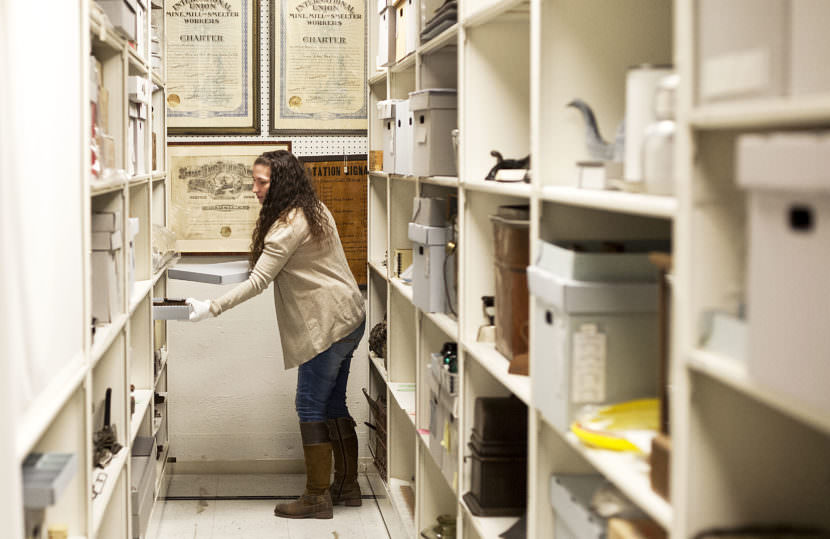
Jodi DeBruyne, curator of collections and exhibits for Juneau-Douglas City Museum, pulls items from the museums collections on April 14, 2017. (Photo by Tripp J Crouse/KTOO)
Jodi DeBruyne, curator of collections and exhibits for Juneau-Douglas City Museum, pulls items from the museum’s collections on April 14, 2017. (Photo by Tripp J Crouse/KTOO)

“Franklin Street was named after Howard Franklin,” DeBruyne said, consulting The Centennial Gazetteer’s “A Guide to Juneau Alaska Place Names.” “He was a chairman of a committee appointed at the miners meeting on March 21, 1881, to lay out the city’s streets and lots.”


Curious Juneau stars you and your questions. Every episode we help you find an answer. Catch up on past episodes, or ask your own question on the Curious Juneau page.

Listen to the podcast version here:

Franklin first appears in Juneau records on Feb. 24, 1881, when he and five other men staked a group of placer claims on Specimen Gulch in the Gold Creek Valley.

Franklin the man came to Juneau from British Columbia, and engaged in mining in the Silverbow Basin for several years.

According to Robert DeArmond’s book “The Founding of Juneau,” J.M. Cooper and Frank McMahon also were named to the committee. That committee laid out Main, Seward and Franklin streets, the cross streets and established the blocks at 200 square feet.

The Franklin Street name first appeared in local records on April 4, 1881.

“He later went to the Interior and he was reported to have been the first man to discover gold in the Fortymile country, where the Franklin Gulch is also named after him.”

It’s a mystery why Franklin’s name was chosen for one of the streets, and not one of the other men.

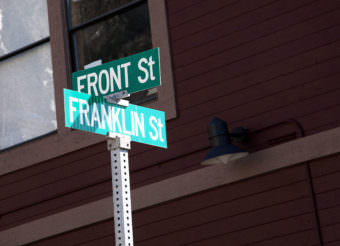
DeBruyne says the downtown Juneau then would have looked vastly different from today: Front and Franklin streets bordered the waterfront. Today that area has been filled in and built upon.

But in 1881, one property owner almost derailed the committee’s plan for plotting out downtown Juneau.

“When they were looking at lots and things, a man named N.A. Fuller’s lot was squarely what was to become Franklin Street at its present intersection with Front Street and refused to vacate,” DeBruyne read from DeArmond’s book. “As a result that portion of Franklin was not cut through to the waterfront until the mid-1890s, the last five lots were along what is now South Franklin.”

In its early days, Franklin Street almost ended at Front Street because one person refused to give up a lot, so the thoroughfare could be extended to the waterfront. (Photo by Tripp J Crouse/KTOO)
In its early days, Franklin Street almost ended at Front Street because one person refused to give up a plot of land, so that the thoroughfare could be extended to the waterfront. (Photo by Tripp J Crouse/KTOO)

Franklin almost ended at Front Street. Because of one guy.

“So it wasn’t until a few years after Franklin Street got named that it actually reached all the way down to the waterfront, because somebody refused to give up his spot,” DeBruyne said.

According to The State of Alaska Guide, Fuller was from Sitka, and in spring 1880, he urged Joe Juneau and Richard Harris to investigate a prospect around what’s now known as Gold Creek.

Those miners, of course, went on to found Harrisburg, which was later renamed Juneau.

Franklin Street’s past is just as storied.

“It was the prostitution district. I think probably most people know that but it’s one of those kind of fun facts,” DeBruyne said. “Right there where the cruise ships dock and we greet people with jewelry stories today was a different kind of greeting back in the day.”

According to the Dawson Daily News, Franklin died of heart failure in 1904. He was 65. Franklin was buried in Dawson, Yukon.

Two buildings along South Franklin Street are on the National Register of Historic Places: the Alaskan Hotel and the Alaska Steam Laundry building.

Who was Calhoun Avenue named for?

Our next question takes us about a half-mile northwest, up the hill. Another question-asker pondered the origins of another somewhat famous street: Calhoun Avenue.

He wanted to know if the street was named after John C. Calhoun, the statesman and political theorist in the early 1800s.

Juneau’s Calhoun Avenue is named after a different Calhoun altogether.

Jody DeBruyne is the curator of collections and exhibits for the Juneau-Douglas City Museum. (Photo by Tripp J Crouse/KTOO)

DeBruyne helped me dig into that street’s history.

The road was a narrow cart track carved out of the steep western slope of Bonanza Ridge, according to a 1988 article by Robert DeArmond on Juneau Public Libraries website. It gave early residents easy access to the Evergreen Cemetery.

“It was renamed for Mary V. Calhoun, an early resident of the area,” she said. “Her and her husband, John, arrived in Juneau from Wisconsin in 1888, and they established a dairy that was on Calhoun Avenue, right around where the governor’s mansion is.”

Their cows grazed along Gold Creek, the south bank of which was sometimes-called Calhoun Flats.

“They were there until they moved south in 1902 and sold their dairy,” she said. “There’s not much that I could find on either Mary or John, but one of the references that I found said that she was so well liked that they renamed the street for her.”

John died in Seattle in 1906. Mary died in Nanaimo, British Columbia, in 1912.

City museum gets reprieve from Juneau Assembly

Throngs packed the Juneau Assembly chambers on Wednesday to testify against proposed closures including the Juneau-Douglas City Museum. (Photo by Quinton Chandler/KTOO)

The Juneau-Douglas City Museum is off the chopping block — for now. The City and Borough of Juneau had been considering shuttering the local history museum in an effort to help close a $1.9 million shortfall.

Mayor Ken Koelsch moved to remove the museum from the list of possible cuts after more than a dozen people spoke against the cuts.

“We had very compelling testimony in written and in oral form on this,” Koelsch said, “and I think it would allow the Assembly and the public to focus on the remainder of the cuts.”

The motion passed 8-1.

Deputy Mayor Jerry Nankervis, who cast the dissenting vote, argued that removing the museum from the list of possible cuts was “premature.”

Fans of the museum were visibly relieved. The possibility of losing the 41-year-old institution had raised questions over the fate of its unique collection.

Still facing closure is the Mt. Jumbo Gym in Douglas, Eagle Valley Center in Amalga Meadows and the Jensen-Olson Arboretum. The Juneau Assembly is slated to pass its final budget on June 5.

Site notifications
Update notification options
Subscribe to notifications