Actress Zsa Zsa Gabor played Jane Avril, star of the famous Paris Dance Hall, in the 1952 film Moulin Rouge.
Gabor gets a kiss from her husband, actor George Sanders, at the Rome Ciampino Airport on Feb. 16, 1953.
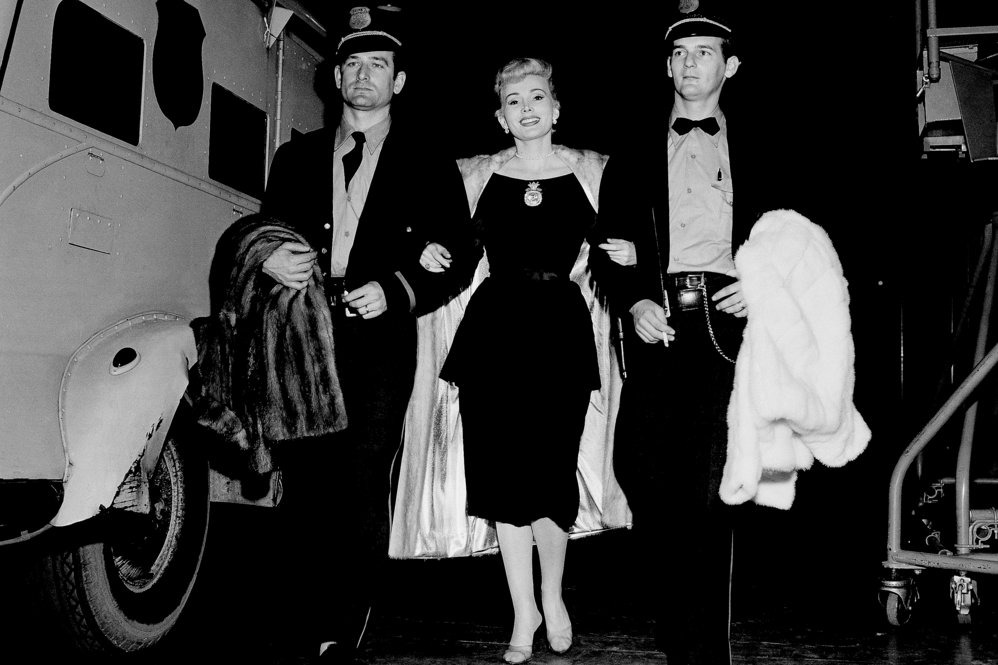
Traveling with three fur coats and a $950,000 diamond known as the "Shah of Persia," Gabor is escorted by two Brinks guards as she arrives at CBS' Television City in Hollywood on Dec. 1, 1955.
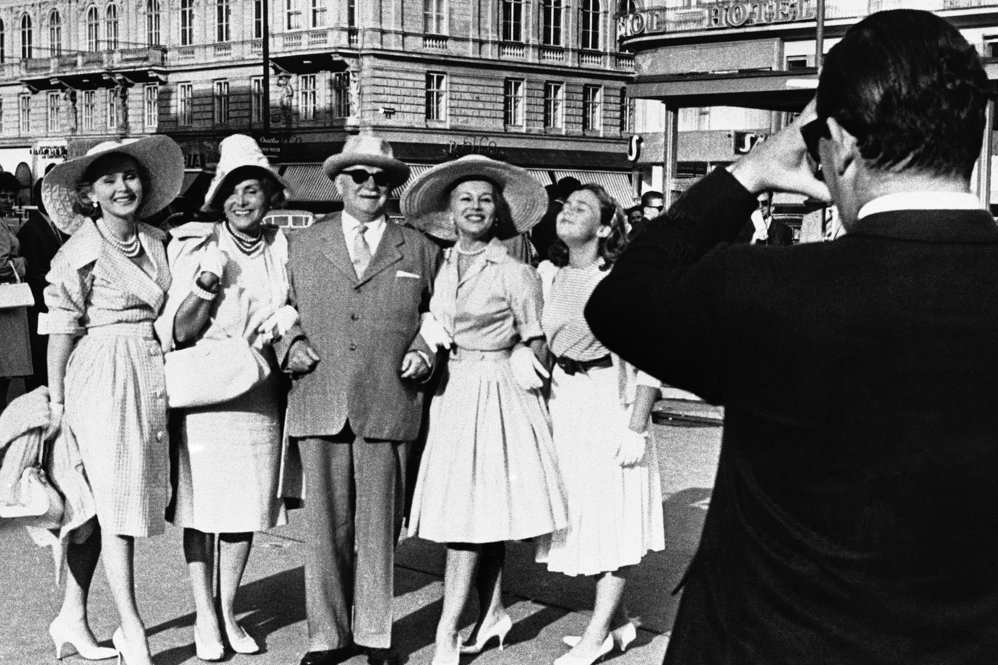
Gabor (left) and her daughter Francesca Hilton (right) flank Gabor's parents, Vilmos and Jolie, and sister Eva as they pose for a photo during a 1960 family reunion in Vienna.
Gabor (right), her fourth husband, Herbert Hutner, and her daughter, Francesca Hilton, cling to a floating lounge chair at Monte Carlo beach in Monaco on July 20, 1964.
Gabor appears with her eighth husband, Frédéric Prinz von Anhalt of Munich, in Los Angeles on Aug. 15, 1986, their wedding day.
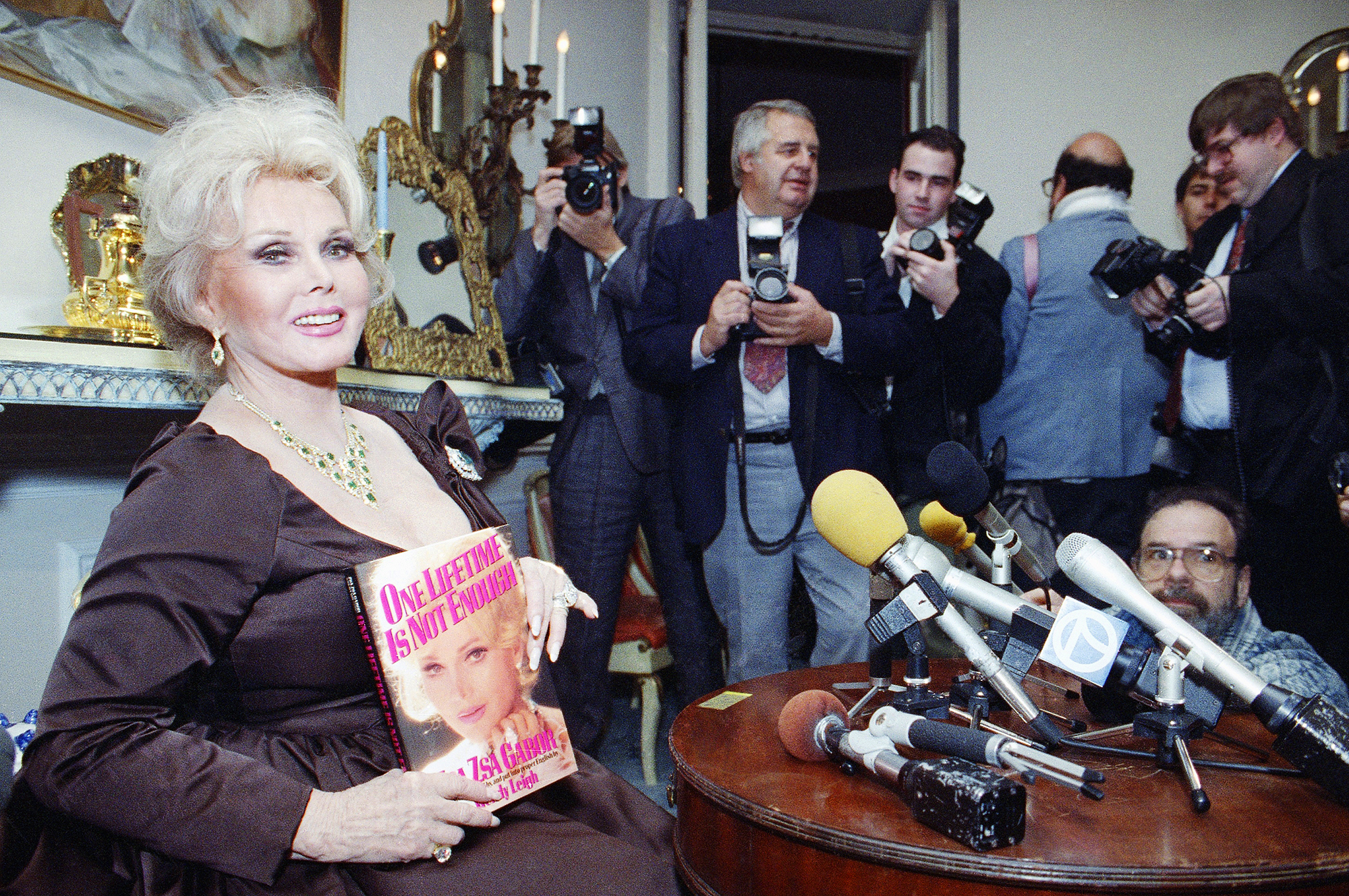
Gabor appears at a press event for her autobiography, One Lifetime is Not Enough on Nov. 19, 1991.
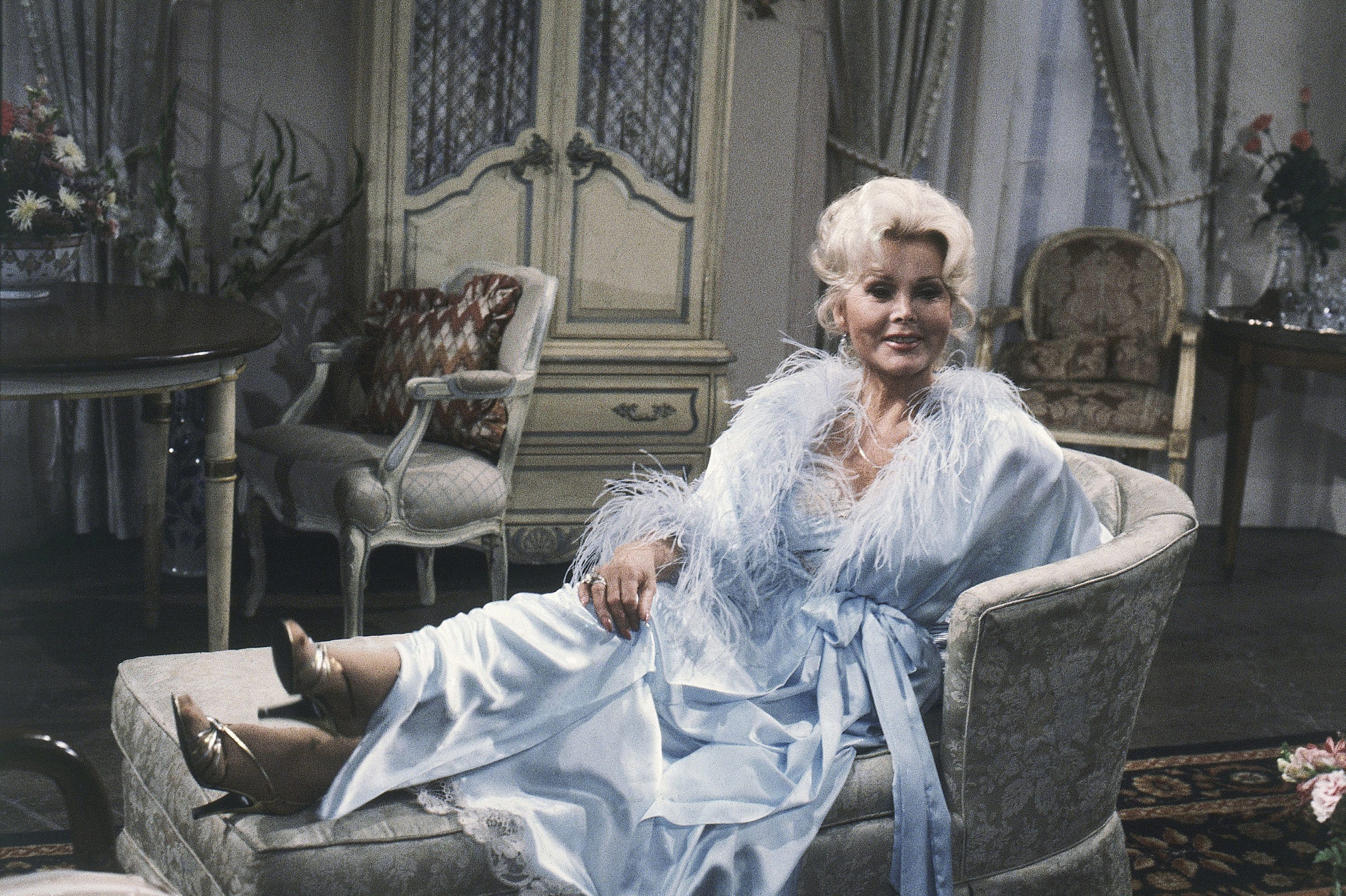
Zsa Zsa Gabor strikes a glamorous pose during a rehearsal for CBS's As The World Turns in 1981. Mary Lederhandler/AP
Updated at 11:41 p.m. ET
Zsa Zsa Gabor — the woman who probably inspired the term “famous for being famous” — died on Sunday, according to multiple media outlets. She was 99 years old, just two months shy of her 100th birthday.
NPR confirmed Gabor’s death with her publicist, Edward Lozzi, who issued the following statement:
Zsa Zsa Gabor in 1954. Hulton Archive/Getty Images
“Zsa Zsa Gabor has died. I am pleased that she is finally out of her misery. For the past five years, Zsa Zsa has suffered chronic dementia, locked away in her mansion laying in a hospital bed being fed through tubes in her naval, not able to speak, see, write or hear. Nor knowing who she was or how famous she was. Being her publicist during the famous Beverly Hills cop slacking incident and providing those services for her daughter Francesca Hilton were highlights of my PR career.
Zsa Zsa did not suffer fools well. That fact, along with her European post-war survival techniques inspired by her mother, Zsa Zsa Gabor was one tough cookie. Her beautiful lips and mouth would be her worst enemy when and if she turned on the verbal machine gun. Most of her problems resulted from that beautiful mouth.
Despite the people who came into her life these past years, and the controversy they have caused with their behavior, many that are still around who worked with her, knew her, from the 1950s, 1960s, 1970s, 1980’s know that Zsa Zsa Gabor is an American icon and the key link in the Gabor/Hilton Dynasty which will still exist for generations to come.
Zsa Zsa and her daughter Francesca Hilton are together again. Always remembered.”
Buxom and blond, vampy and campy, the Hungarian-born screen siren mainly contributed to cultural touchstones such as The Love Boat, The Naked Gun 2 1/2 and Hollywood Squares — where she answered (or, more accurately, couldn’t answer) questions about Cheez Whiz.
Zsa Zsa Gabor strikes a glamorous pose during a rehearsal for CBS’s As The World Turns in 1981. Mary Lederhandler/AP
But it would be a grave mistake to trivialize Gabor’s achievements.
“She is one of the most important figures of the late 20th century in terms of thinking about celebrity, thinking about women,” says Kirsten Pullen, a professor at Texas A&M University.
Pullen is not joking. As far back as the 1950s, when women were expected to be decorous, Gabor sought and got constant press for her juicy hookups, her fabulous bling and her public antics. She could dominate a newsreel about a movie premiere — for a movie she wasn’t even in — just by showing up in a diaphanous gown. She was arguably the prototype for today’s Kim Kardashians and Paris Hiltons.
(In fact, Gabor and Hilton had family ties: Gabor was once married to Conrad Hilton, who is Paris Hilton’s great-grandfather.)
“You can’t make this stuff up,” Pullen says wryly. “Whether or not we think it’s great to be famous for being famous, she is the one who really set the template for that.”
Gabor followed her sister Eva from Hungary to Hollywood in the 1940s. Zsa Zsa scored some small movie parts from big movie directors — Orson Welles and John Huston among them — and was also featured in some movies probably best forgotten, such as Queen of Outer Space.
But if she wasn’t known for her skilled acting, dancing or singing, Gabor was an irrepressible performer — and she excelled at playing herself, once endless rounds of Hollywood gossip and publicity made her own persona larger than any character.
She had charm, which made her jokes about marrying for money rather than romance more palatable right when women were starting to demand more financial control. Her oft-stated fondness for sex dented traditional expectations of passive femininity, Pullen says: “She paved the way for the sexual revolution.”
And when Gabor slapped a policeman who pulled her over in 1989, she parlayed the incident into a full-blown comeback, without any apparent help from mangers or publicists. The incident put her back on the talk show circuit, where she chattered merrily about the challenges of maintaining a beauty regimen in the slammer.
Even as an older woman, Gabor tended her image as the glamorous starlet who married something like 10 times. She threw out lines like, “I am a marvelous housekeeper. Every time I leave a man, I keep his house.”
But she also, ironically enough, had this to say about Paris Hilton: “I think she’s rather silly. She does too many things for publicity.”
Copyright 2016 NPR. To see more, visit http://www.npr.org/.
Dr. Henry Heimlich has died in Ohio at age 96. He’s seen here in 2014, holding a copy of his memoir at his home in Cincinnati. Al Behrman/AP
He’s credited with saving thousands of people from choking to death, thanks to the method he popularized in 1974. Now comes word that Dr. Henry Heimlich has died at age 96.
Heimlich died early Saturday at Christ Hospital in Cincinnati, Ohio, according to Bryan Reynolds, spokesman for Episcopal Retirement Services, which operates the retirement home where the physician lived for years.
According to Reynolds, Heimlich was experiencing complications from a massive heart attack he suffered in his home Monday.
Since its invention, the Heimlich Maneuver has become both a life-saving tool and a part of modern culture. It’s uncertain how popular it would be if the move was still known by its original term: subdiaphragmatic pressure.
As Heimlich told NPR back in 1999, that’s the name he assigned the method when he described it in a medical journal in June of 1974.
That original name didn’t last long. As Heimlich said, “the editors of the Journal of the American Medical Association called me, and they said, ‘We have found that so many lives have been saved in less than two months, we would like to name this after you.'”
By 1980, he said, the Heimlich maneuver had gained enough prominence to be an entry in foreign-language dictionaries.
In a statement, Heimlich’s family said they were saddened by the death of a man who’s seen by a hero by many. And they said the physician’s legacy extends beyond his famous life-saving method:
“As a young surgeon, Dad was the first American to devise and perform a total organ replacement. Later, he came up with a device that saved thousands of soldiers’ lives during the Vietnam War. The Heimlich Chest Drain Valve is still used worldwide for patients undergoing chest surgery.
“Dad was firm in his convictions and passionate for his causes. He didn’t play politics well. Instead, he was single-minded in his quest to find better ways to save lives. Dad dreamed that anything was possible in the field of medicine, even when critics said otherwise.”
Some of those critics focused on Heimlich’s theory of malariotherapy, in which malaria is induced in people suffering from HIV, Lyme disease and other conditions with the goal of using malaria’s high fevers to help patients. Heimlich has acknowledged performing such research on HIV patients in China, telling Boston.com in 2014 that he feels the idea deserves to be researched.
Other disagreements have centered on the use of the doctor’s eponymous maneuver. The Red Cross says it should be used only after slapping a choking victim’s back, for instance, and the Red Cross and other organizations have also said drowning victims should get mouth-to-mouth resuscitation rather than the Heimlich maneuver.
The Heimlich Maneuver is relatively simple to perform; it’s also been deployed to rescue people from Carrie Fisher and Halle Berry to President Ronald Reagan and New York Mayor Ed Koch, as Radiolab has reported.
Here’s how Heimlich himself described the maneuver to NPR:
“There are several positions. Now everybody knows where you stand behind the person, put your thumb inside of your fist just above the bellybutton — remember, below the chest. And you grasp your fist with your other hand and you press inward and upward. Now you repeat that until the object comes out.
“But it also can be done with a person lying down on their back. You kneel astride their thighs and put one of your hands on top of the other, and the heel of the bottom hand just above the bellybutton, and press your weight in. And that’s how children have saved their parents. In addition, its widest use now is to save drowning victims.”
You can also see examples of the maneuver in videos from the physician’s Heimlich Heroes website.
Copyright 2016 NPR. To see more, visit http://www.npr.org/.
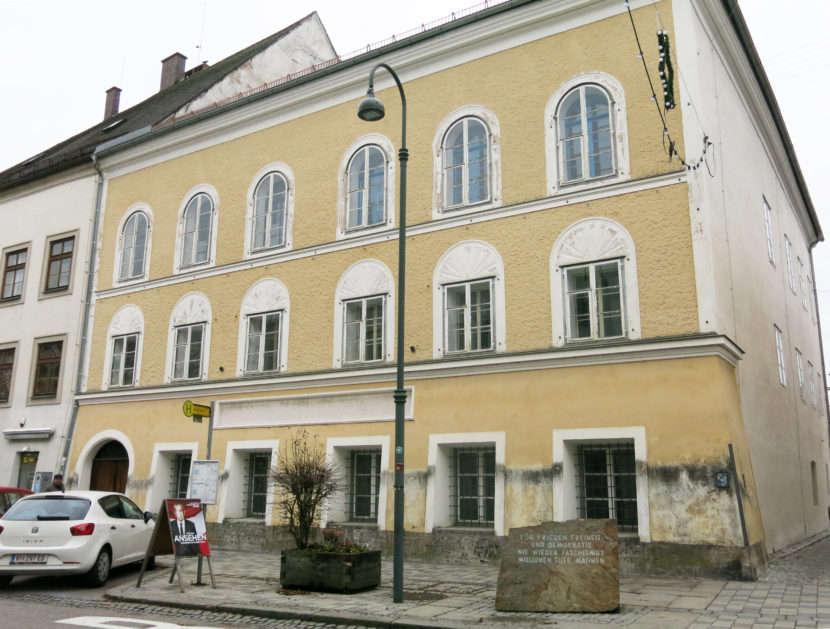
Adolf Hitler was born in 1889 in an upstairs apartment of this house in the Austrian town of Braunau am Inn, near the border with Germany. Soraya Sarhaddi Nelson/NPR
The question of what to do with Adolf Hitler’s birth house has plagued his home country of Austria for decades.
If it were up to the government in Vienna, authorities would simply tear it down. That’s what Germany did more than a quarter-century ago to the Berlin bunker where Hitler committed suicide in 1945. The site is now covered by a parking lot, with a plain plaque providing the only hint of what used to be there.
But many Austrians disagree with taking that approach to Hitler’s birth house, including some residents of the Fuehrer’s hometown, Braunau am Inn, near Salzburg.
“It’s a hot topic,” says Barbara Ebener, editorial director at the local weekly newspaper, BezirksRundschau. “If this house is torn down, people don’t want it left empty. And if it isn’t left empty, the question is — will what goes up there instead be acceptable?”
Adolf Hitler enters the city limits of Vienna, Austria, on Mar. 14, 1938. AP
Few people in this picturesque town, in walking distance from the German border, are willing to talk to NPR about the building Ebener says many would rather forget.
An exception is 87-year-old native Luise Keuschnig. She bristles over the Interior Ministry’s plans to seize the three-story building from its elderly owner, Gerlinde Pommer. “Personal property is personal property,” Keuschnig says. “The house is part of the town’s landscape.”
NPR couldn’t reach Pommer for comment. By many accounts here, she inherited the property from her mother, from whom the house had been seized once before — by the Nazis during Hitler’s rule. They turned the cream-colored home on the edge of the old town into a cherished monument.
That’s the opposite of what the current Austrian government is looking to do with the nearly three-century-old building. Interior Ministry spokesman Karl-Heinz Grundboeck said the government’s goal is to make sure the house doesn’t become a shrine for neo-Nazis.
“There is a certain mystification of this building under the Nazi ideology,” he says. “Therefore it was very important for the Interior Ministry to guarantee that nothing would happen there in this building that could support Nazi ideology in any way.”
For the past 44 years, the ministry rented the structure from Pommer and eventually turned it into a daycare center for people with special needs. But the government and owner repeatedly clashed over required renovations. The center shut down and moved elsewhere five years ago, Grundboeck says, though the government continued to pay rent on the building.
“We elaborated a number of concepts and discussed with the private owner on how again we could make use” of it, he says. “And the discussion became more and more complicated.”
He says the impasse eventually led to the ministry’s decision to seize the property. At first, officials simply planned to tear it down, which met with resistance from some historians and many Austrians, including townsfolk. Grundboeck says the current plan, after the government takes over ownership, is to appoint a committee to decide how to rebuild it so that it will look completely different than it does now.
Under current Austrian law, the ministry can’t apply eminent domain — seizing private property for public use, with compensation — because it doesn’t cover seizing historic property because the history is objectionable. So the ministry appealed to Austria’s parliament, and last week, a committee approved a draft bill forcing Pommer to sell Hitler’s birth house to the government. How much she would get for the sale of the house is unclear.
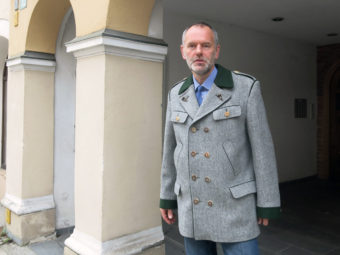
The final approval could come from the parliament as early as January, says Braunau Deputy Mayor Christian Schilcher. He says Pommer, whom he talks to on occasion, isn’t happy about what the Austrian government is doing.
Branau am Inn Deputy Mayor Christian Schilcher says he worries the Austrian government’s plan to seize Hitler’s birth house from its elderly owner will “open Pandora’s box” to more seizures of private property outside existing eminent domain laws. Soraya Sarhaddi Nelson/NPR
Schilcher isn’t happy, either — he fears this will set a precedent leading to more private property being taken by the government against people’s will.
“We are opening Pandora’s box,” he says. “This could launch something that we won’t be able to put the brakes on.”
Schilcher, a member of the populist Freedom Party of Austria, also disputes the Interior Ministry’s claim that the birth house could become a magnet for neo-Nazis. When people come to look at the house, he says, they’re usually tourists.
Ilja Sichrovsky, an Austrian who founded the Muslim Jewish Conference, an educational nonprofit in Vienna, is disappointed in the government’s plans, but for different reasons.
“This is a huge chance for an educational institution, a huge chance for a physical landmark which can be combined with a whole concept of understanding about what happened here, about the social and political dynamics that started in Braunau and took off from there,” he says. “There might be neo-Nazis coming there and worshiping the place, so think about it — what are you going to do with it, what are your strategies to face that?”
Instead, he says, “The only solution is, ‘Oh my God, we don’t know what to do with it, let’s tear it down, let’s do nothing with it.’ ”
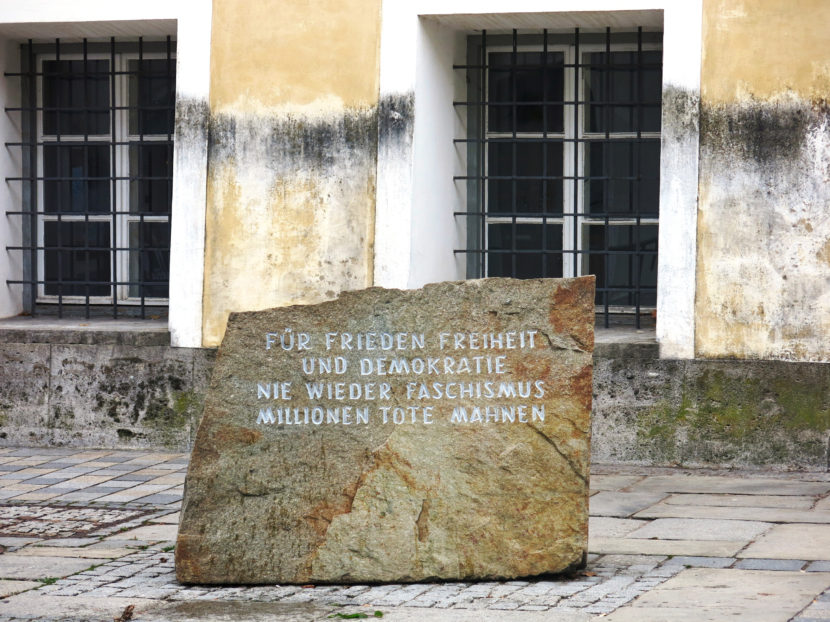
One thing the Interior Ministry’s Grundboeck says the Austrian government has no intention of removing is a jagged stone memorial to the victims of Adolf Hitler in front of the house.
It came from the former Mauthausen concentration camp, about 80 miles away, and is inscribed with a warning: “For peace, freedom and democracy. Never again fascism. Millions dead are a warning.”
This jagged stone in front of Adolf Hitler’s birth house in Branau am Inn comes from the former Mauthausen concentration camp, a 90-minute drive away. The inscription reads: “For peace, freedom and democracy. Never again fascism. Millions dead are a warning.” Soraya Sarhaddi Nelson/NPR
Copyright 2016 NPR. To see more, visit http://www.npr.org/.
Alaska’s Governor Mansion will host its annual holiday open house on Tuesday, Dec. 6. The open house has been a holiday tradition since 1913. (Photo by Tripp J Crouse/KTOO)
The annual holiday open house at the Governor’s Mansion is scheduled for 3 to 6 p.m. Tuesday.
The house at 716 Calhoun Avenue was built in 1912. The open house has been an annual tradition since 1913, when then-territorial Gov. Walter Eli Clark began the tradition. The open house was not held for two years during World War II.
Guests in line will be served hot apple cider and holiday treats. Heaters will be provided for those waiting outside.
Several community music groups and individuals will perform.
Individuals with special access needs should contact Lisa Boman at 907-465-3500 to arrange advance entry.
Parts of Indian Street around the mansion will be closed for the duration of the event.
Gov. Bill Walker plans to take questions from reporters beforehand.
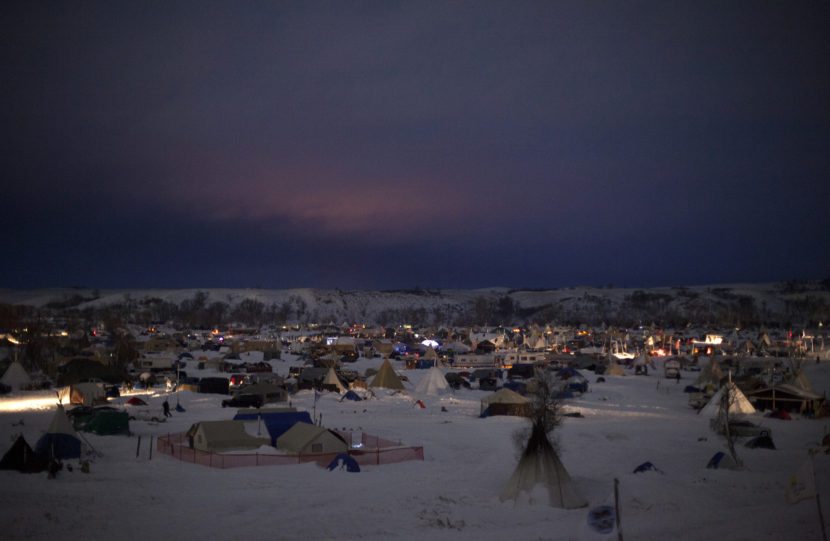
Though emergency evacuation orders have been issued by both the state of North Dakota and the Army Corps of Engineers, the three camps along the Cannonball River, now covered in snow, show no sign of packing up. Celia Talbot Tobin
Protesters have been camped for months at the construction site of the Dakota Access Pipeline in North Dakota. Now, winter has arrived, dumping almost 2 feet of snow on the encampment in the last week of November. The winter storm hit just before news that President-elect Donald Trump indicated he supports completion of the pipeline.
The two-day blizzard drove out some of the more fair-weather protesters, but most have been geared up to stay. All are waiting to see what happens on Dec. 5, the deadline set by the Army Corps of Engineers for protesters to leave federal land.
At the camp this week, protesters were busy preparing for more winter weather. Cusi Ballew wrapped insulation around a small wooden structure — more of a little box house — at the Oceti Sakowin Camp near the Standing Rock Reservation. “It’s essentially a glorified tent with a lot less chance caving in with snow,” explained Ballew.
Volunteers wrap insulation around a small box bunkhouse, one of many winterized structures popping up in the three camps along the Cannonball River. Celia Talbot Tobin for NPR
Ballew is from Ohio, a member of the Pokagon Band of Potawatomi Indians. He said people in the encampment needed this kind of structure. It wasn’t comfortable, he admitted, but said the protesters were not at the camp for comfort.
Ballew is one of several thousand people committed to this protest against the Dakota Access Pipeline. They’re living in three camps along the banks of the Cannonball River. The Oceti Sakowin Camp is the only one on federal land, where authorities say campers are illegally trespassing.
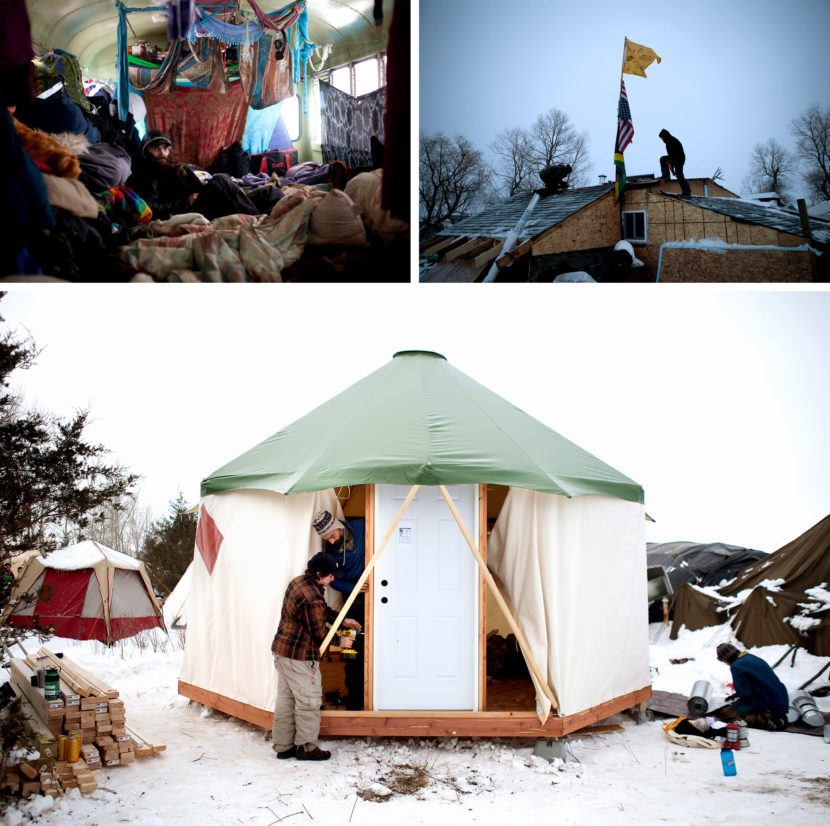
(Left) Flutter-By, a newer arrival, rests in the middle of his school bus, “Mamacita,” which sleeps 12 people side-by-side. (Right) Brad Kallio of Michigan and Linus Yellowhorse of Arizona patch roofing on a dwelling at the Oceti Sakowin camp. (Bottom) Protestors from North Carolina brought a “yome,” a combination yurt and dome, to erect and leave at the Rosebud camp for whoever needs it. Celia Talbot Tobin for NPR
The day after Thanksgiving, the U.S. Army Corps of Engineers issued an emergency evacuation order for land it manages near the river. A few days later, North Dakota Gov. Jack Dalrymple issued a similar order, warning that people trying to truck in supplies to the camp could be fined and the state will no longer provide emergency services.
“We will do our best to respond to emergencies,” said Dalyrmple in a press conference earlier in the week, “but in those conditions, we cannot guarantee a response.”
Early reports of the evacuation order described it as a blockade. Dalrymple said blocking food and water into the camps would be a “humanitarian mistake.” But he still believes people should leave for their own safety. He said this emergency order was the same he would issue during an intense flood.
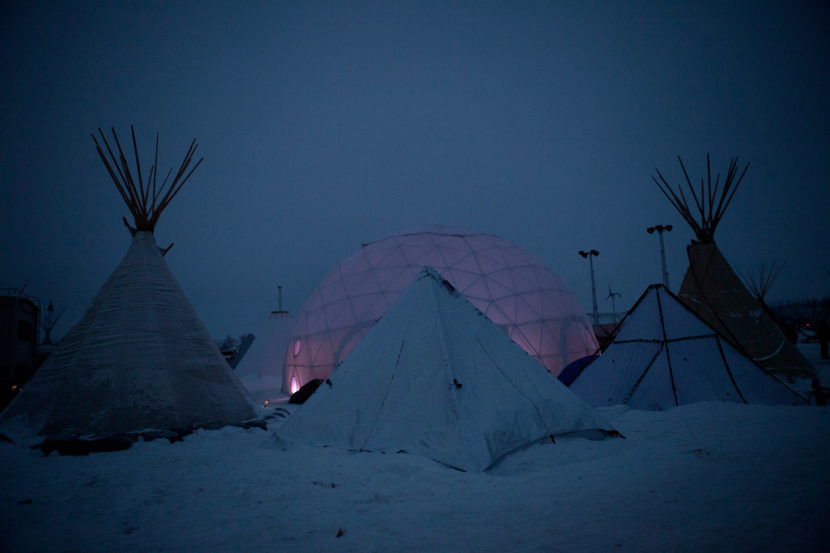
A geodesic dome, which was donated in October, now serves as a community gathering space. It is one of many structures that have been erected in the camp to prepare for the long winter ahead. Celia Talbot Tobin for NPR
“We have not at any time ever contemplated going to the main camp and removing people from that area,” Dalrymple said, “All we’re saying is we encourage you to find a better place to be, and we will continue to do that. We want the entire public to know, this is a not a safe place.”
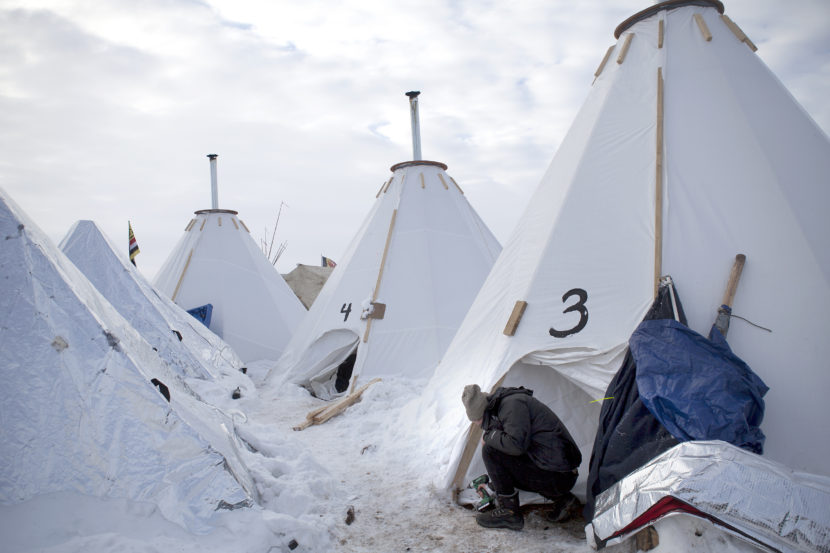
Some people did leave camp after the storm and governor’s order, but more were digging in for a long winter. Paul Cheokoten Wagner designed and is building a new style of teepee for people preparing to stay and continue protesting the pipeline despite the pair of evacuation orders.
“They have been endeared with the name tarpee,” he said, “they’re kind of like unicorn teepees, because they only have a stovepipe sticking out the top.”
Jacob Brooks makes adjustments to one of the camp’s many “tarpees,” a winterized teepee made of tarp with a built-in chimney, designed by Paul Cheokoten Wagner. There are roughly 60 tarpees around various camps now, and Wagner has fundraised enough for another 20 more. Celia Talbot Tobin for NPR
Wagner is from the Saanich tribe and lives in Washington state. He says he came up with the design after his first trip to Standing Rock in September. He started a GoFundMe site and raised enough money to build 80. They come equipped with a stove, fire extinguisher and carbon monoxide detector.
Closer to the Missouri River, Kareen Lewis is living in Michigan Camp. She’s part of the Little River Band of Ottawa Indians and has been shuttling back and forth between the camp and her house in Michigan for a few months.
“I felt like I was so at home and empowered to be here,” she said.
Kareen Lewis, a member of the Little River Band of Ottawa tribe, has bounced back and forth for months between home, in Hart, Michigan, and the Oceti Sakowin camp. Celia Talbot Tobin for NPR
Michigan Camp is a cluster of three green canvas sleeping tents, a mess hall, a teepee filled with supplies and a few tents half-buried in snow. Currently, about 50 people live there. Lewis thinks they can make it without grocery runs for about a month. Even though she’s living in the evacuation area, she says she has no plans to leave.
“I don’t want to leave. I want to stay here and see what’s gonna happen,” she said.
Despite the orders to evacuate, more people are arriving every day, including a group of 2,000 veterans who say they plan to act as human shields between protesters and the police.
Protesters head back to camp after an evening ceremony honoring the of veterans making their way to join the ranks. While some have been trickling in throughout the week, up to 2,000 are said to be expected to arrive this weekend. Celia Talbot Tobin for NPR
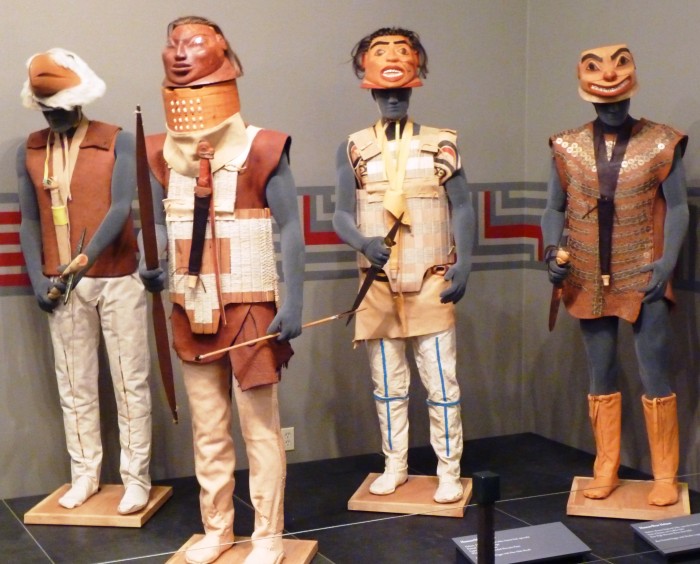
Four armed, armored figures display Tlingit war gear created by Sitka’s Tommy Joseph as part of the Alaska State Museum’s “Rainforest Warriors” exhibit April 29, 2013. Such helmets and armor were the topic of a Dec. 1, 2016, lecture by the Alaska State Museum’s Steve Hendrickson. (Photo by Ed Schoenfeld/CoastAlaska News)
Tlingit battle helmets were designed to inspire fear. The thick, wooden head armor carried imagery of strong warriors, fierce animals or revered ancestors.
But helmets also played a ceremonial role, representing clans or helping shamans scout behind enemy lines.
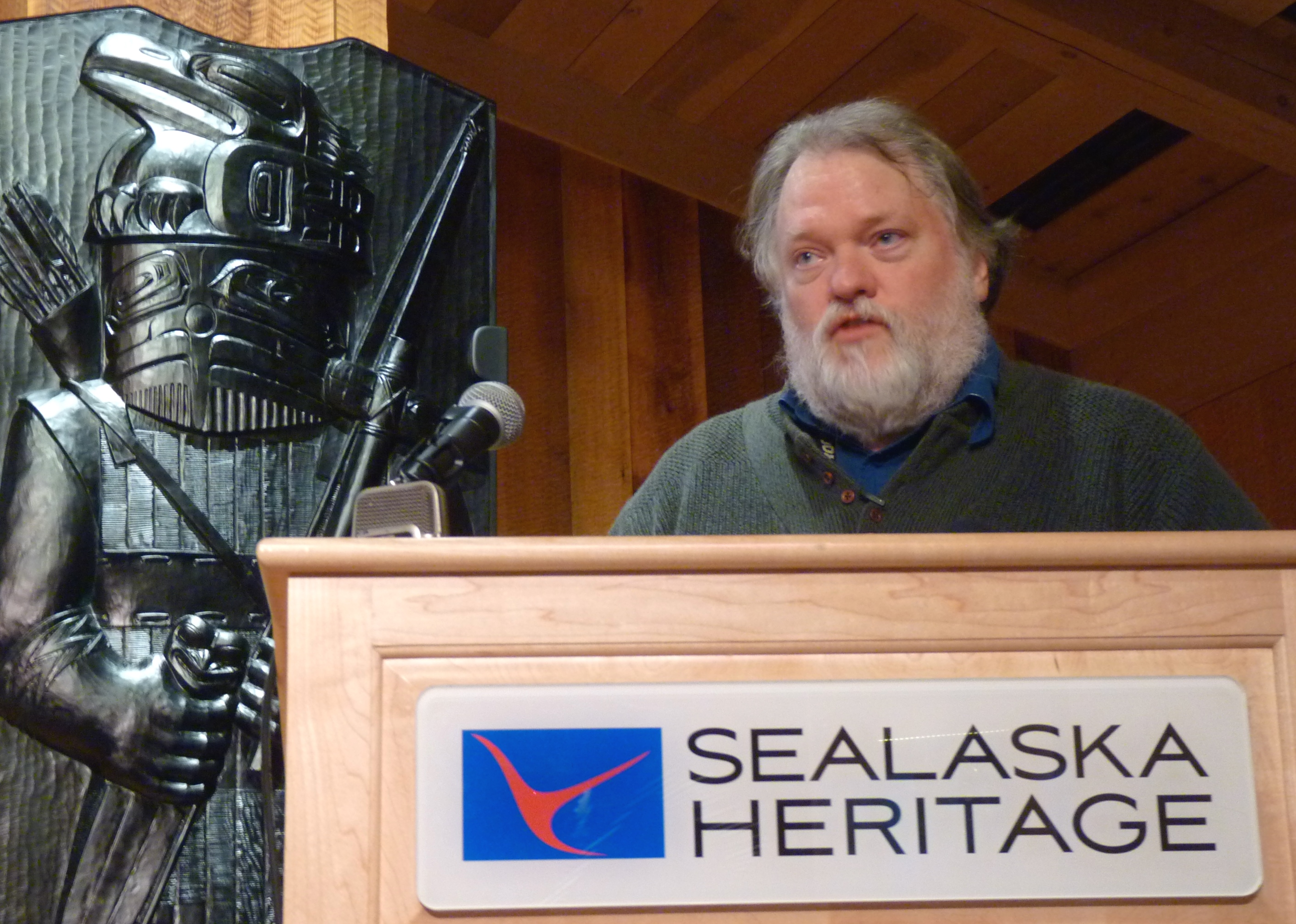
Steve Henrickson discusses Tlingit armor during a Dec. 1, 2016, lecture in Juneau. To the left, Preston Singletary’s house pole depicts an armored warrior. (Photo by Ed Schoenfeld/CoastAlaska News)
When Alexander Baranov led Russian fur traders into Southeast in the late 1700s, he met some fierce resistance.
The Alaska State Museum’s Steve Henrikson said Tlingit warriors appeared one night within their camp.
“He has a very vivid description of how terrified this made everybody seem because these big figures just materialized in the middle of their camp. Because of the layers of padding, they were all really big and tall. The helmet might add another 6 to 8 inches,” he said.
But they were exceptions. Henrikson, the museum’s collections curator, said most warriors did battle with little to protect them, beyond animal hides.
The carved, painted helmets, bentwood face shields and wooden body armor was just too bulky.
“The types of battles that they had often required lots of quick movements and if you’re wearing that armor, it’s fairly heavy and bulky and it restricts your movements. So it would only be employed in very strategic ways,” he said.
Henrikson presented images and information at a Dec. 1, 2016, Sealaska Heritage Institute lecture, Terrifying Visages: Armored Warriors of the Northern Northwest Coast, at the Walter Soboleff Building in Juneau.
He showed examples of helmets adorned with sea lion whiskers and animal skins.
“Some helmets used the headskin of a bear, a brown bear stretched over a plain, wooden form,” he said.
Battle helmets were thick, made out of burls and other off-grain pieces of wood, which were harder to penetrate or crack.
Henrickson said the origins and ages of many are not known. But one whale design points to a possible origin.
“This one has a seal in its mouth and that may point to it being from the Killer Whale Chasing Seal House of Angoon,” he said.
Steve Henrikson has found nearly 100 battle helmets made by northern Northwest Coast Natives at the Sealaska Heritage Institute in downtown Juneau. (Photo by Tripp J Crouse/KTOO)
Henrikson and his fellow researchers have tracked down nearly 100 helmets in museums in the U.S. and overseas.
And sometimes they just show up at an auction. That was the case for one recent find, which appears to represent a merganser, a crested duck with a serrated beak found in Alaska waters.
“Again, no documentation. It was just found in a castle in France. But it’s purely Tlingit,” he said.
He said there’s no question Southeast’s Haidas and Tsimshians made armor too. But so far, most examples are Tlingit.
Armor was made of wood, animal hides or both, sometimes held together by sinew or yarn.
Henrickson said they were strengthened by other materials, including outdated Chinese coins brought in by Russian fur traders.
“They were able to get a good deal on them and they brought them out here and Northwest Coast Natives used them for decorating their regalia but also to maybe make the armor more impermeable to bullets and buckshot,” he said.
That only worked for a while. Early firearms were often weak and inaccurate. As guns gained strength, armor became no match.
But it still had ceremonial use, which continues to this day. And, a number of modern artists have created their own versions for display or use in dance groups.
Hear the full lecture Terrifying Visages: Armored Warriors of the Northern Northwest Coast, with Alaska State Museum Curator of Collections Steve Henrikson.
Steve Henrikson gives a presentation Dec.1, 2016, on wearable armor worn by northern Northwest Coast Natives at the Sealaska Heritage Institute in downtown Juneau. Henrikson is Alaska State Museum’s curator of collections. (Photo by Tripp J Crouse/KTOO)
Close
Update notification options
Subscribe to notifications
Subscribe
Get notifications about news related to the topics you care about. You can unsubscribe anytime.









9(MDEwMjQ0ODM1MDEzNDk4MTEzNjU3NTRhYg004))

9(MDEwMjQ0ODM1MDEzNDk4MTEzNjU3NTRhYg004))

9(MDEwMjQ0ODM1MDEzNDk4MTEzNjU3NTRhYg004))




9(MDEwMjQ0ODM1MDEzNDk4MTEzNjU3NTRhYg004))