Science & Tech

Scientists think they’ve found a big, weird moon in a far-off star system

""
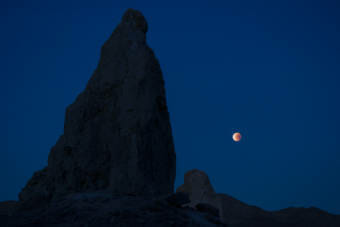
A lunar eclipse viewed from California’s Trona Pinnacles Desert National Conservation Area. Scientists believe there may be more moons in the galaxy than planets. (Photo by Lauren Hughes/NASA)

The hunt for moons outside our solar system has just turned up another possible lunar world, a moon bigger than Earth that’s orbiting a Jupiter-like planet.

The planet and its moon — if it really is a moon — orbit a Sun-like star that’s over 5,000 light years away, according to a report in the journal Nature Astronomy.
“The moon is pretty alien compared to any moon in the solar system,” says David Kipping, an astronomer at Columbia University. “We’re not sure if it’s rocky, we’re not sure if it’s gaseous. It’s kind of in between the size of Neptune, which is gaseous, and the Earth, which is rocky.”

This isn’t the first time astronomers have spotted something that might be a moon in another planetary system, which is sometimes called an exomoon.

In fact, Kipping and his colleagues announced a few years ago that they’d detected something moon-like orbiting a different planet. That discovery has yet to be confirmed with additional telescope observations, and some astronomers are skeptical that it will hold up to more scrutiny.

This new finding needs to be confirmed too, says Kipping. “It’s again another surprisingly large moon, if it’s real.”

Exomoons may be common, but they’re hard to find

Moons outnumber planets in our own solar system, so it stands to reason that planets orbiting other stars would also have moons. Scientists want to find them, in part because a moon might have conditions that are right for life.

“If you’ve seen Avatar or Star Wars, you’re probably familiar with this idea that moons, in and of themselves, could be habitable,” says Kipping. And real-life moons like Jupiter’s Europa and Saturn’s Enceladus are believed to have features like liquid water that might sustain life.

Scientists have found thousands of planets in recent years, but so far there’s been no incontrovertible sighting of a moon around any of them.

“Finding these exomoons is extremely challenging,” says Mary Anne Limbach, a researcher at Texas A&M University who also has been searching for moons. “These detections tend to be right at the detection limit. So it’s often difficult to disentangle the noise from the exomoon signal.”

Existing telescopes aren’t powerful enough to let astronomers see moons in other planetary systems directly. Instead, scientists can only infer the presence of a moon. If they see a tell-tale pattern of dimming in a star, for example, that can mean a moon and its planet are passing in front of the star and blocking some of its light.

Limbach thinks this new find, detected with the help of NASA’s planet-finding Kepler telescope, is interesting. “Certainly, you know, I think the object, the event, does warrant further follow-up with space-based observatories,” she says.

Others are also taking a wait-and-see attitude.

“All the Kepler data is public and we can be sure another team will independently analyze the data,” says Sara Seager, a planetary scientist at the Massachusetts Institute of Technology. “This is a fascinating but perplexing discovery. We were not expecting moons larger than the size of Earth. This system, if real, is more like a double planet.”

“I don’t believe it yet, but I think it’s certainly a promising candidate worthy of follow-up,” says Laura Kreidberg, an astronomer with the Max Planck Institute for Astronomy in Germany.

Finding “the biggest weirdos in the universe”

So far, astronomers have reported finding hints of exomoons about a dozen times using different techniques, says Limbach. Most of those observations, for technical reasons, can’t ever be followed-up or confirmed, she added.

But other exomoon claims can, like this new one as well as one that Limbach and colleagues recently reported.

Kipping notes that his two candidate moons both seem strangely large.

“But if they weren’t freakishly large, we never would have had the capability of detecting them,” he said. “So it’s only natural that the first things you’d detect would be the biggest weirdos in the universe. They’re not necessarily common, they’re just the easiest for us to find.”

New telescopes, like the recently launched James Webb Space Telescope and the Nancy Grace Roman Space Telescope that is scheduled to launch later this decade, will be much more capable of finding and confirming the presence of moons, even small ones.

Seager says astronomers would like to find evidence for a moon or supermoon around a planet orbiting a nearby star, because that would make it easier to do follow-up measurements.

The first confirmed moons in other solar systems will be exciting discoveries not only because they’re moons and not planets, says Limbach, but also because, in many cases, they might be rocky worlds with the right kinds of conditions for life.

“I certainly think,” she says, “this decade will hopefully lead to the first confirmation of an exomoon.”

Copyright 2022 NPR. To see more, visit https://www.npr.org.

Magnitude 4.6 earthquake wakes parts of Southeast Alaska early Friday

A map of showing the earthquake's epicenter marked with a red circle
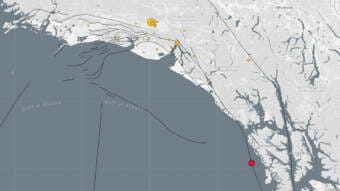
The Alaska Earthquake Center reported a magnitude 4.6 earthquake (red circle at bottom right) about 35 miles south of Pelican at 5:51 a.m. on Friday, Jan. 14, 2022. (Alaska Earthquake Center graphic)

An earthquake centered northwest of Sitka shook the ground Friday morning, waking many in Southeast Alaska.
The Alaska Earthquake Center reported that the earthquake happened at 5:51 a.m., about 49 miles northwest of Sitka and about 10 miles deep. The center at first reported a magnitude of 4.9. About 20 minutes later, the magnitude was downgraded to 4.6.

People reported to the USGS that they felt the earthquake in Sitka, Juneau and as far away as Metlakatla.

The U.S. Tsunami Warning System did not issue a tsunami watch or warning.

Editor’s Note: This is a developing story and may be updated.

Magnitude 6.8 quake near Nikolski was part of an ‘energetic’ seismic cluster

A map showing the locations of earthquakes south of Nikolski
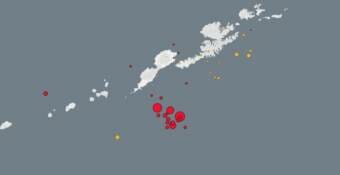
Locations of earthquakes in the seismic sequence south of Nikolski on Tuesday, Jan. 11, 2022. (Alaska Earthquake Center)

A magnitude 6.8 earthquake hit about 58 miles southeast of Nikolski early Tuesday morning, according to the Alaska Earthquake Center.

Natalia Ruppert, an Earthquake Center seismologist in Fairbanks, said the quake hit at about 2:30 a.m. and was preceded and followed by more seismic activity.

“It triggered a very energetic sequence of aftershocks,” Ruppert said. “The largest aftershock was a magnitude 6.6 — about an hour after the magnitude 6.8 — at 3:40 a.m. today, and we are still recording seismic activity in that cluster.”

The center had recorded about 20 other earthquakes of magnitude 4 and above by about 10 a.m. Tuesday morning, she said.

“This is unusual,” she said. “We normally don’t see such an energetic sequence in such a quick succession.”

There’s no reason for Aleutian Island residents to be alarmed at the moment, according to Ruppert. But there is a small chance this sequence could be followed by a larger earthquake. She said the AEC will continue to monitor the seismic activity.

Ruppert advises that people stay alert and pay attention to earthquake activity in the area in case the sequence develops into something more serious.

No tsunami alert was issued, and as of Tuesday morning, Ruppert said none of the activity was large enough to generate a tsunami.

As of about 2:30 p.m., the U. S. Geological Survey had published 21 felt reports, which are online surveys the public can use to describe the location, intensity and overall effect of earthquakes. Reports were submitted by people in Nikolski, Unalaska and Akutan.

Space tech startup examines Unalaska for potential satellite launch site

In 2020, SpinLaunch identified Ugadaga Bay as a possible location to build a large centrifuge to launch satellites into low Earth orbit. The project would likely require building a road down Ugadaga Trail, a popular hiking trail and historic Unangax̂ trading path. (Photo by Maggie Nelson/KUCB)

A tech startup that visited Unalaska in 2020 as a potential satellite launch site says they are finalizing their choice of location. And while communication between the company and the city began to fade earlier this year, the startup says Unalaska is still in the running.

SpinLaunch identified Ugadaga Bay as a possible location to build a large centrifuge to launch satellites into low Earth orbit. The project would likely require building a road down Ugadaga Trail, a popular hiking trail and historic Unangax̂ trading path.

While the land at Ugadaga Bay is owned by the Ounalashka Corp., the island’s Native village corporation, visitors have to cross public land to access it.

The Los Angeles-based startup aims to launch satellites using kinetic energy, as opposed to a traditional rocket launch system that relies heavily on fuel.

“SpinLaunch is in the final stages of examining a large number of launch sites,” Diane Murphy, a SpinLaunch spokesperson told KUCB. They won’t comment until that decision is made.

A 2020 mock-up from city emails shows an approximate location for the proposed SpinLaunch satellite launch site. (City of Unalaska)

The Ounalashka Corp., which is a private company, owns much of the land that would be used, and city officials were reluctant to discuss the matter. So KUCB requested records from the city to get a window into the situation.

Notes from the city’s planning department suggest the 20-acre site would sit along the Ugadaga Bay Trail, one of the community’s most popular hiking trails, and a historic trading path between Iliuliuk and Biorka villages.

Representatives from the space technology company visited Unalaska in September of 2020 and gave a presentation to city officials about their plans to work with the community.

Emails between city officials shortly after discuss the potential risks and benefits of having SpinLaunch in Unalaska.

In correspondence between city officials, Unalaska Director of Public Utilities Dan Winters called SpinLaunch a “good project for Unalaska.”

“This is a good opportunity to bring more money into its economy through new technology,” Winters wrote in a September 2020 email.

Tom Cohenour, the director of Public Works for Unalaska, lauded the potential for SpinLaunch to help diversify the local economy.

But Ports Director Peggy McLaughlin raised concerns about the long-term economic benefits to Unalaska.

“It sounds [like] Unalaska may provide SpinLaunch the ideal location, but SpinLaunch [has] little or nothing long-term to offer in return,” McLaughlin responded.

McLaughlin told KUCB this week that she asked questions about the long-term opportunities for Unalaska, such as job opportunities, housing development and an influx of students into the school. She says SpinLaunch was unable to provide satisfying responses and she left the September 2020 meeting with more questions than answers.

After that meeting last year, the city’s associate planner, Thomas Roufos, stressed the importance of SpinLaunch developing a public outreach plan, and having a clear aim for “how they’ll invest back into the community.”

Roufos also stressed the importance for the Ounalashka Corp. to handle the loss of the Ugadaga trail.

The Ounalashka Corp. owns the land at Ugadaga Bay and has been tight-lipped about any plans to develop it. The corporation’s chief executive, Chris Salts, has not responded to several requests for comment.

A rough diagram of the proposed 20-acre site shows the approximate location of the launch site and a road to the bay from the pass at the top of Overland Drive.

SpinLaunch launched its first successful test flight this October from a base in New Mexico. According to the company’s website, the New Mexico accelerator measures more than 160 feet. And the next site they build could measure three times the size.

According to a note from the planning department, the proposed site would cover around 20 acres, with an additional five to 10 acres for road and access.

Emails from 2020 suggest the road would be open to the public — which would make the beach accessible for people with limited mobility — but it would be blocked off during launches. The company estimates they would conduct approximately 10 launches a day, which could last around two hours each. If accurate, that would render the road essentially closed to the public.

Emails also show discussions around the sonic booms the centrifuge would create every time it launches. But the company says the blasts would not affect Unalaska city residents because the site is too far from the center of the community and faces the opposite direction.

City officials discussed the benefits of SpinLaunch as having the opportunity to create jobs and to generate significant tax revenue for the city, which has been a chief concern of late.

In recent months, city officials have stressed the importance of diversifying Unalaska’s economy. The city estimates it could lose more than $2 million in tax revenue from the closure of the red king crab fishery, and has been taking steps to diversify the local economy.

An illustration from SpinLaunch’s website depicts an accelerator and launch site. (SpinLaunch)

In 2018, SpinLaunch considered developing a base in Hawaii, but public opposition prompted representatives from the company to travel to Hawaii to hold a public meeting. A video on YouTube shows angry residents disrupted the April 14 meeting several times and SpinLaunch ultimately scrapped plans for the project.

The company would need to apply for a commercial space license from the Federal Aviation Administration, and the application process would require an environmental review.

An FAA spokesperson said the agency “has not received any commercial space license application that would support launches from Unalaska.”

An email SpinLaunch sent in January 2021 said they are “still very interested in Unalaska.”

But emails show that correspondence between SpinLaunch and city officials ceased this summer, and the city’s planning director says he hasn’t been in contact with the company since then.

Representatives from the company said last month they are in the final stages of picking a location for their next launch site and will inform the community with any further updates.

‘Tidal Network’, Tlingit & Haida’s new broadband internet service, coming to Wrangell

Wrangell in June 2018 (Photo by David Purdy/KTOO)

Southeast Alaska’s regional Tribal government will pilot its new broadband internet program in Wrangell, which it says will, eventually, be available to everyone on the island.

Last year, the Federal Communications Commission opened up a special program to allow rural Tribes to secure broadband licenses to improve connectivity. Hundreds of Tribes applied, more than a third in Alaska.

The Central Council of Tlingit and Haida Indian Tribes of Alaska announced on December 17 that it got its license. The FCC has granted the regional Tribe exclusive use of a mid-band broadband spectrum in a number of Southeast Alaska communities.

Chris Cropley, one of the Tribal council’s network architects, says the license is for the 2.5 gigahertz spectrum: the same tech used by cell phone LTE networks.

“We’re starting in Wrangell,” Cropley said. “It’s perfect – it’s the Goldilocks, as they say. It’s got everything going for it. We’ve got a lot of people there, relatively, we own the 2.5 [GHz spectrum] there, and we have funding for it.”

The Tribe is calling its broadband service Tidal Network. It will just be home internet, not mobile data service. But it will still need to build its own towers, so that wireless internet can be broadcast directly to homes and businesses that don’t already have reliable internet access.

“Anywhere that’s already served, we’re not interested in serving,” Cropley said. “So if you have a cable modem to your house, fiber optic to your house, if you’ve got good service to your home or are downtown, we’re not really super interested in replacing that with something else. We’re not looking to displace GCI or ACS or AT&T or anybody.”

Wrangell is ideal because there are people with spotty service, but it’s not such a remote community that the Tribe would struggle to get people and equipment to town. Cropley said residents living towards the southern end of the 14-mile stretch of Zimovia Highway would be good candidates for Tidal Network.

Once the service is in place, Tlingit & Haida will be required to “defend” it – meaning they have to offer internet service to 80% of the area’s population within the first two years of holding the license, and full-coverage after five years. But that doesn’t mean people have to take the new provider up on the offer.

Central Council of Tlingit and Haida Indian Tribes of Alaska began working on getting its license back in 2019. And federal pandemic relief it has received since will help pay for the project.

“We are buying two what we call COWs – cell on wheels,” he said. “They are towers on a trailer with a generator and a little cabinet underneath, and they extend out. We’re able to stand them up, and they have radio microwave on them and they accept fiber optic and we’re able to wire them up or wireless them and begin to provide service on those towers.”

Permanent towers can cost $500,000 to $600,000 each and come with miles of red tape.

The pieces are already in place to get started now, though. Cropley said he has a multi-million dollar budget headed to Wrangell for the pilot broadband project, but declined to say precisely how much.

Once the details are worked out, Tidal Network will operate in Wrangell as a subscription service with different plans, like any other internet provider. The goal is to provide the best possible internet at the lowest possible price.

“We’re just looking at finding the most people with the least internet or no internet, ideally, and providing them with internet where they didn’t have before, where they had to use a satellite,” he said.

The pilot project in Wrangell is just that: a test. It’ll help flesh out the program – from the tech itself to collaboration with other vendors, policies and provide training to Tidal Network employees.

The process will take time, and investment.

“There’s a reason that somebody isn’t already doing this, right?” Cropley said. “There’s no gold mine at the end of the road here. It is a service.”

Cropley says they hope to have the Tidal Network up and running by spring 2022. And after piloting the program in Wrangell, the service could expand to more than 20 other Southeast Alaska communities in the coming years.

Christmas Eve telescope launch has astronomers hoping for good tidings of great joy

The telescope, shown during checkout tests in December 2020, before it was carefully packed up and sent to the launch site in French Guiana. (Photo by Chris Gunn/NASA)

A churning mix of excitement and anxious dread has taken hold of astronomers around the world as they wait for the launch of the most powerful telescope ever, planned for the morning of Christmas Eve.

The James Webb Space Telescope has been in the works for decades, and its gold-plated, 21-foot mirror will see much farther out into space than the venerable Hubble Space Telescope. Its launch has been delayed so many times over the years that, for many, it seems almost unbelievable that it’s finally about to happen.

Someone on Twitter even joked that anyone nervous about the James Webb Space Telescope colliding with Santa during liftoff should relax because “James Webb launching is just a story we tell children, it’s not real.”

As surreal as it may seem, the 7-ton, once-in-a-generation scientific instrument named after a former NASA administrator is in fact now at a launch site in French Guiana, almost ready to go. Jackie Faherty, an astrophysicist at the American Museum of Natural History in New York City, says that every time the impending launch pops into her head, her stomach turns.

“I am so nervous! And excited,” says Faherty, noting that on a scale of 1 to 10, with 10 being maximum terror, she’s currently at 6 in terms of her baseline anxiety level. “Then when I really think of it, I feel like I pop up to like an 8, where I am like, ‘How are we going to do this? What’s going to happen?'”

Asked about coping strategies, one astronomer quipped, “Does wine count?”

The three-story-tall telescope, with its heat shield the size of a tennis court, is all folded up and crammed inside a rocket. It will have to unfold itself and travel about a million miles away from Earth, cooling down to temperatures around minus 370 degrees Fahrenheit.

Before all that can happen, it has to get safely off the planet. Astronomers can’t help but imagine this $10 billion telescope getting obliterated in an instant by an unlikely, but still possible, rocket explosion. But Faherty, who will be using the telescope for her research, thinks her anxiety will actually lessen on launch day.

“On launch day, I would say it’s going to turn into that feeling of watching a historic moment, of being a part of a historic moment,” Faherty says. “We’re launching this amazing engineering feat into the cosmos.”

If liftoff goes well, astronomers’ brief celebration will once again turn to nervous waiting as the telescope slowly unfurls itself over days and weeks.

“We’ll have our 29 days of terror as we’re watching things being deployed,” says astronomer Garth Illingworth of the University of California, Santa Cruz. “That first month is going to be rough.”

Unlike the Hubble Space Telescope, this one can’t be repaired by astronauts because it will be too far away. And NASA isn’t exactly playing down the fact that this time there are no second chances. The agency put out a video titled “29 Days on the Edge” that runs through all of the different little bits that could malfunction.

“I think the first few minutes of the launch will be the most worrisome as there is nothing to be done if something goes wrong, but a close second is the unfolding of the mirror,” astronomer Scott Sheppard of the Carnegie Institution for Science told NPR in an email.

“I have images in my head of a half-unfolded mirror stuck in place, which would be very bad, something like what happened to the Galileo spacecraft with its main antenna getting stuck during the fold out process,” said Sheppard. “Anytime you have a moving part that needs to unfold, it is a worry as the launch is a very violent event that could damage a mechanical device and not allow it to work properly when needed.”

Still, if all goes well, this telescope should transform astronomy. Sheppard, for example, is looking forward to the chance to learn more about distant planets that orbit faraway stars. Other researchers can’t wait to capture light from some of the first galaxies to form in the universe.

And even as they anxiously wait, some astronomers philosophically ready themselves to accept whatever comes.

“Look, it can fail, and from history we know that you have to dare to dream,” says Priyamvada Natarajan, an astronomer at Yale University who wants to use this telescope to study black holes. She adds that the ongoing coronavirus pandemic has changed her perspective and made her far less worried about any losses that don’t involve human lives.

“I’m very excited, slightly tense, but I really think we can pull this off,” says Natarajan. “I totally trust that we’ve done the best that we can. Let’s just hope it all unfolds.”

Copyright 2021 NPR. To see more, visit https://www.npr.org.

Site notifications
Update notification options
Subscribe to notifications