Science & Tech

A piece of space junk the size of a school bus is barreling straight toward the moon

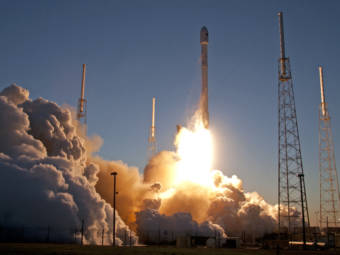
A rocket lifting off from a launch pad
A Falcon 9 SpaceX rocket lifted off in Florida in Feb. 2015, on its way to send the Deep Space Climate Observatory satellite into space. But seven years later, part of the rocket left behind in space is hurtling straight toward the moon. (Photo by John Raoux/AP)

A piece of space junk from a SpaceX rocket launch in 2015 is hurtling toward the moon, and is set to crash into the lunar surface on March 4, astronomers have predicted.

The piece is part of a Falcon 9 rocket that launched from Florida in 2015. The purpose of the mission was to send the DSCOVR Space Weather Satellite into space, approximately one million miles away from earth.

But seven years later, the upper stage of the rocket booster remains tumbling through space. It was too far away from Earth and had too little fuel to return, so instead, it’s been yanked around by the Earth and the moon’s gravitational pull in what experts say is a “chaotic” orbit.

“It’s almost like a billiard ball bouncing off of other billiard balls,” Bill Gray, an independent astronomer who first discovered that the Falcon 9 piece would hit the moon, told NPR.

In other words, the path of this piece of space junk could have gone in a lot of different directions — like the many scenarios for where balls may roll when a player breaks in pool. Gray says it could have gone into an orbit where it would have hit the Earth, or it could have even been picked up into an orbit around the sun.

But in mid-January, Gray got new data that showed the rocket piece was going to crash into the moon, making it the first time — that we know of — humans have accidentally crashed something into the lunar surface.
The moon will get a new crater

The rocket piece that will crash into the moon is no small thing. It’s about 12 meters the long, or the size of the school bus, and weighs four tons. It’s also whizzing through space at about 5,600 miles per hour, Jonathan McDowell, an astronomer with the Center for Astrophysics Harvard and Smithsonian.

The rocket piece is “going to get completely destroyed. A huge plume of moon dust is going to go up where it hit and then settle down over a wide area of the moon,” he said.

After about a day, the dust will settle and there will be a “sparkly fresh new lunar crater,” McDowell said.

In the past, NASA has conducted missions to crash objects into the moon on purpose. In 2009, they sent a spacecraft called LCROSS to see if water particles would come up in the impact.

Overall, this predicted impact in March won’t be a significant change to the moon, but Gray still believes there’s something to learn from it.

“It could be a reasonably interesting scientific discovery that we’ll be able to learn a bit about the nature of lunar impacts, how large a crater you get for a given size object and a given speed. We may also learn a certain amount about the geology of this particular part of the moon,” Gray said.

Space needs to get cleaned up

While experts are tracking the path of the Falcon 9 rocket piece and what can be learned from this accidental impact, there’s also a renewed conversation about how to handle the amount of space junk that’s floating around.

The U.S. Department of Defense is tracking more than 27,000 pieces of space junk, including old rocket pieces and satellites. But movement on how to actually remove the junk has been somewhat stalled.

“I know the government is really taking a very close look at this at the moment,” McDowell said. “People are aware that space junk is a big issue that needs to be addressed. It’s just getting off the committee stage and onto the actually doing something about it stage that seems to be stuck right now.”

The amount of old space junk in low Earth orbit is of particular concern.

John Crassidis, director of the Center for Space Cyber Strategy and Cyber Security at the University at Buffalo, says it’s possible that within 50 years, we get to the point where there’s so much debris, we won’t be able to launch any more satellites.

“When objects start to collide with other objects, that’s going to cause more debris … and you get a cascading effect,” he said, citing what’s known as Kessler’s Syndrome. “That’s a big concern.”

What isn’t a big concern, though, is this accidental lunar crash causing any harm to people on Earth, or any major problems for the moon itself.

“It’s a policy concern in the long run,” McDowell said. “But this particular piece of space junk smashing into the moon… the moon’s had lots of things smash into it over the years. It’ll be fine.”

Copyright 2022 NPR. To see more, visit https://www.npr.org.

NASA scientists estimate Tonga blast at 10 megatons

before-and-after satellite photos of he island of Hunga Tonga-Hunga Ha'apai. In the after photo, there is very little left.
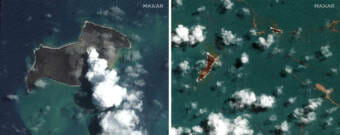
The island of Hunga Tonga-Hunga Ha’apai as imaged by the satellite company Maxar on Jan. 6 (left) and Jan. 18 (right). It was obliterated in a volcanic eruption that scientists estimate was 10 megatons in size. (Maxar Technologies)

NASA researchers have an estimate of the power of a massive volcanic eruption that took place on Saturday near the island nation of Tonga.

“We come up with a number that’s around 10 megatons of TNT equivalent,” James Garvin, the chief scientist at NASA’s Goddard Space Flight Center, told NPR.

That means the explosive force was more than 500 times as powerful as the nuclear bomb dropped on Hiroshima, Japan, at the end of World War II.

The blast was heard as far away as Alaska and was probably one of the loudest events to occur on Earth in over a century, according to Michael Poland, a geophysicist with the U.S. Geological Survey.

“This might be the loudest eruption since [the eruption of the Indonesian volcano] Krakatau in 1883,” Poland says. That massive 19th-century eruption killed thousands and released so much ash that it cast much of the region into darkness.

In the case of this latest event, Garvin says that he believes the worst may be over — at least for now.

“If the past precedent for volcanic eruptions in this kind of setting has any meaning at all,” he added, “then we won’t have another one of these explosions for a while.”

Even three days after the blast, Tonga remains largely cut off from the world. Undersea communications cables appear to have been cut, and the airport is covered in ash, preventing relief flights from arriving at the capital city of Nuku’alofa.
Reconnaissance flights by the government of New Zealand showed ash had blanketed houses and many other structures. New Zealand’s Foreign Ministry reported that two people had been confirmed killed and that a tsunami had inundated the western coast of the main island of Tongatapu, causing major damage. Wire reports cite the government of Tonga claiming one additional death and even more damage on outlying islands, including Mango island, where all homes have been destroyed.

An aerial view of heavy ash fall on Jan. 17 on the island of Nomuka, Tonga. The extent of the damage to the island nation remains largely unknown.
An aerial view of heavy ash fall on Jan. 17 on the island of Nomuka, Tonga. The extent of the damage to the island nation remains largely unknown. (New Zealand Defence Force/Getty Images)

The volcano behind the eruption had been the subject of study by the NASA team in the years running up to this explosive event. The islands that form Tonga lie along a subduction zone where one part of the Earth’s crust dips under another, according to Garvin.

“In this particular case, we don’t know when, a kind of volcano with a big summit ring of hills and things formed,” Garvin says.

In late 2014 and early 2015, along the rim of that caldera, volcanic activity built a platform that rose up out of the sea, creating a new island. Layers of steam and ash eventually connected the island, known as Hunga Tonga-Hunga Ha’apai, to two much older islands on either side of it.

Hunga Tonga-Hunga Ha’apai was completely destroyed by Saturday’s explosion, says Dan Slayback, a research scientist for NASA’s Goddard, as well as Science Systems and Applications Inc. Slayback says the blast was so massive it even appears to have taken chunks out of the older islands nearby.

“They weren’t ash — they were solid rock, blown to bits,” he says. “It was quite amazing to see that happen.”

Garvin says the island’s formation also probably seeded its destruction. As it rose from the sea, layers of liquid magma filled a network of chambers beneath it. He suspects the explosion was triggered by a sudden change in the subterranean plumbing, which caused seawater to flood in.

“When you put a ton of seawater into a cubic kilometer of liquid rock, things are going to get bad fast,” he says.

But for all its explosive force, the eruption itself was actually relatively small, according to Poland, of the U.S. Geological Survey. Unlike the 1991 eruption of Mount Pinatubo, which spewed ash and smoke for hours, the events at Hunga Tonga-Hunga Ha’apai lasted less than 60 minutes. He does not expect that the eruption will cause any short-term changes to Earth’s climate, the way other large eruptions have in the past.

In fact, Poland says, the real mystery is how such a relatively small eruption could create such a big bang and tsunami.

“It had an outsized impact, well beyond the area that you would have expected if this had been completely above water,” he says. “That’s the thing that’s just a head-scratcher.”

Garvin says that scientists want to follow up with additional surveys of the area around the volcano’s caldera. Satellite imagery analysis is already underway and may soon be followed with missions by drones. He hopes the volcano will be safe enough for researchers to visit later in the year.

Poland says he believes researchers will learn a lot more in the days and months to come, as they conduct new surveys of the area.

“This is just a horrible event for the Tongans,” he says. But “it could be a benchmark, watershed kind of event in volcanology.”

Copyright 2022 NPR. To see more, visit https://www.npr.org.

The eruption near Tonga was so powerful you could hear it in Alaska

An eruption of an underwater volcano bear Tonga, which triggered a tsunami that was seen throughout the Pacific. In Alaska, people reported hearing the eruption several hours before the tsunami made it to shore. (Image courtesy CIRA at Colorado State University)
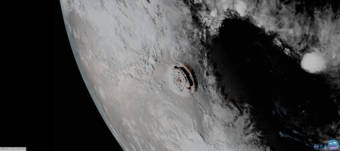
An eruption of an underwater volcano near Tonga, which triggered a tsunami that was seen throughout the Pacific. In Alaska, people reported hearing the eruption several hours before the tsunami made it to shore. (Image courtesy CIRA at Colorado State University)

Communities across the West Coast woke up Saturday morning to tsunami advisory alerts. An underwater volcano near the Kingdom of Tonga had erupted and sent waves thousands of miles across the ocean.

Waves of up to about three feet reached parts of Alaska by Saturday morning. But hours before those waves arrived, sounds from the blast reached the homes of many Alaskans — all the way from Juneau to the Aleutians. 

Iris Caldentey and her kids were sleeping peacefully in their home early Saturday morning in Palmer when she woke up to loud, strange noises.

“How I would envision Pearl Harbor sounded — just constant, boom, boom, boom,” she said. “I mean, it was intense.”

Could it be avalanche control? A burglar? Maybe the kids bouncing off the walls? Like many people, Caldentey had no idea what she was hearing.

“I went outside to check the cars because then I was like, well, maybe there’s a burglar trying to get into our cars. And they’re opening, closing the door. Not a very good burglar,” she said.

In Unalaska, Laresa Syverson woke to similar sounds and vibrations.

“I thought for sure it was my cat — like, what’s my cat doing? So he got blamed for most of it,” she said.

First she thought her cat, then maybe fireworks, then she thought it could have just been bass coming from someone’s car.

While Syverson says she wasn’t immediately alarmed, neither she nor Caldentey would have guessed that the sounds were coming from an underwater volcano erupting near Tonga.

But that’s what it was — an eruption so massive it sent sound waves and a tsunami throughout the Pacific.

In Alaska, the largest tsunami waves hit the Aleutians and the Alaska Peninsula. King Cove recorded waves just over three feet. The tsunami destroyed property in Hawaii and Japan, caused flooding in California and killed two people when the waves reached Peru.

Syverson says she saw on social media that people had posted about hearing similar things — and that the booming sounds were from an eruption in the South Pacific.

“To be honest, I still didn’t even really believe it after that until I saw the satellite images of the actual eruptions. I was like, “Oh, yeah, that’s probably what we were hearing,” she said.

But how did so many Alaskans hear a sound from so far away? The short answer is that this volcanic blast was so big it traveled thousands of miles.

For the long answer, Ken Macpherson has some good insight. He’s a scientist at the Wilson Alaska Technical Center at the University of Alaska Fairbanks. The center has listening stations and seismic monitoring all over the world.

But usually they’re listening for something completely different — they’re monitoring the world for secret nuclear testing.

“And of course, those sensors are good at detecting things like nuclear bombs, but they’ll also pick up any kind of atmospheric blast of volcano being a good example,” Macpherson said.

He says they pick up all kinds of earthquakes and landslides and volcanic blasts. He slept right through this one, but he says the listening sensor in Fairbanks picked up the blast. And it’s interesting because those sensors are built for listening to frequencies that are lower than human hearing.

Think of it like a foghorn. They have this very low frequency sound.

“And the reason for that is a long period or low frequency signal like that will travel a longer distance. For higher frequencies, they attenuate,” Macpherson said. “That is, they just kind of get filtered out by the medium that they’re moving through.”

In other words, a higher-pitched sound won’t travel as far.

The top panel shows the pressure wave as recorded by an infrasound station on the Kenai Peninsula. The spectrum in the lower panel shows how the energy of the wave is distributed across frequencies. The times with the most audible energy are about 4:30 a.m. Alaska Time which fits with reports from Alaskans. (Courtesy of David Fee University of Alaska Fairbanks/Alaska Volcano Observatory).
The top panel shows the pressure wave as recorded by an infrasound station on the Kenai Peninsula. The spectrum in the lower panel shows how the energy of the wave is distributed across frequencies. The times with the most audible energy are about 4:30 a.m. Alaska Time, which fits with reports from Alaskans. (Courtesy of David Fee/University of Alaska Fairbanks & Alaska Volcano Observatory).

“But it looks like this Tonga blast was so big that even a high-frequency signal that’s audible to the human ear was able to travel almost 6,000 miles to Alaska and be heard widely across the state,” he said.

Data from UAF researchers clocks the sound wave from the blast moving at roughly 700 mph.

“And so it still took a long time to get to Alaska, because that’s almost 6,000 miles away,” Macpherson said. “But around eight hours after that huge explosion down in Tonga, those sound waves started to arrive in Alaska.”

He says if he hadn’t seen that data for himself, he’s not sure he’d believe it.

“And to be honest, when I first heard reports of this being heard, I was like, skeptical of that,” Macpherson said. “But it looks like it was possible to hear it. And the timing looks right. And so it does seem like it was widely heard across the state, which is just amazing.”

Macpherson says it’s scientifically interesting, but it’s important to keep the human toll of such an event in mind. What sounded like a loud boom to Alaskans can be devastating up close.

And the true toll on the people on the islands nearest to the volcano still isn’t clear. Communications with Tonga have been largely cut off since Friday. Surveillance flights showed significant damage to boats and buildings along the coastline. The country’s capital is covered in thick volcanic dust. 

And many people around the world are still anxiously waiting to hear from friends and family on the islands

Past heat waves and low sea ice continued to impact Alaska’s waters in 2021

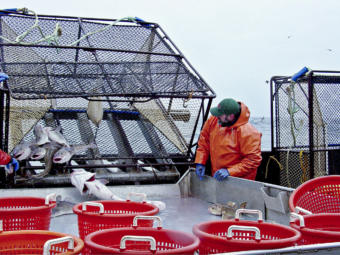
A man in an orange raincoat watches Pacific cod slide out of a black cage onto the boat.
NOAA Fisheries scientists collect Pacific cod samples in the Aleutian Islands. The North Pacific Fishery Management Council, closed the Pacific Cod fishery in 2020 after the blob decimated cod stocks in the Gulf of Alaska. (Public domain photo by
NOAA Fisheries)

The so-called blob that brought warm surface water temperatures to the Gulf of Alaska between 2014 and 2016 has passed.

But the effects of that blob, and a subsequent heat wave in 2019, are not all in the rearview mirror. And researchers are bracing for more as climate change brings with it more ocean warming.

“For an area like the Gulf of Alaska, definitely this is a topic we need to understand better,” said Bridget Ferriss, a research fish biologist with NOAA Fisheries. She edited this year’s Ecosystems Status Report for the Gulf of Alaska, used by federal managers to inform fisheries policy in Alaska.

Last year, researchers continued to track the impacts of recent heat waves on Alaska’s marine species.

Ferriss said a heat wave happens when the sea surface temperature on a given day is warmer than 90% of the temperatures on record for that same day, for five days in a row.

The gulf wasn’t dominated by heat waves in 2020 and 2021 like it was in the years before. But some populations are still responding — for better or worse.

Forage fish, some seabirds and humpback whales in Prince William Sound all seemed to see declines in the gulf related to warm temperatures, with mixed rates of recovery.

Herring, on the other hand, have done great since the heat wave. They thrive in warmer water.

Salmon were likely impacted by the blob as well. Ferriss said decreases in salmon runs in 2020 track with low juvenile salmon survival in the years immediately following.

“I think definite signs are that they were affected by the heat wave,” Ferriss said. “We don’t have a nice concise story yet to really what caused each one.”

NOAA Fisheries Research Biologist Elizabeth Siddon was the editor of the Bering Sea ecosystem report. She’s also taking the long view at how conditions over the years have impacted salmon runs.

“Many of the stories or the things we saw in 2021 were a result of conditions that these organisms — fish or crabs, salmon — have experienced since 2014 when this new warm phase started,” she said.

Siddon has been thinking about three coincident crashes in the Bering Sea — snow crab, salmon and sea-birds.

She said having the historical perspective is important. Understanding the salmon crashes in the Arctic-Yukon-Kuskokwim region, for example, requires following the run through the last several years.

“What we’re seeing this year could be the results of what happened this year,” she said. “Could be the results of what happened two years ago or three years ago.”

Scientists who are monitoring the Bering Sea are looking at another important factor: sea ice.

“When the ice melts, we get this cold, dense water that sinks to the bottom of the Bering Sea,” Siddon said. “And that cold water then changes the distribution of the fish in the Bering Sea.”

She said when sea ice was low and there were no cold pools in the years after the wave, so species were freer to move into the northern Bering Sea. Now, she said NOAA is seeing different combinations of species living there than it has seen in the past.

Reports like NOAA’s are used to inform policy decisions by the council that manages fishing in Alaska’s federal waters. That group, the North Pacific Fishery Management Council, closed the Pacific Cod fishery in 2020 after the blob decimated cod stocks in the gulf.

Ferriss said it’s too early to tell if that species is recovering, years after the fact.

“It’s still at a low level since the marine heat wave period,” she said. “And we’re monitoring it and trying to make sure we’re managing that fishery correctly so it can recover.”

She said it’s important for researchers and fisheries managers to stay up to speed on how changes like these impact species in the gulf because the area is changing so rapidly.

That’s true now, just a few years after the blob subsided. But as heat waves continue to increase in the North Pacific, as they are predicted to do, it could be more critical than ever.

New smartphone feature allows for anonymous reporting of COVID exposure in Alaska

Kenrick Mock, a University of Alaska Anchorage computer science professor, shows how to use the Alaska COVID ENX feature. (Photo by Wesley Early/Alaska Public Media)

With the omicron variant of the coronavirus spreading rapidly in Alaska, contact tracing is increasingly difficult. A new feature for Alaska smartphones could help.

The service COVID ENX was developed by Apple and Google to allow users to anonymously report that they’ve tested positive for COVID-19.

Kenrick Mock is a computer science professor at the University of Alaska Anchorage who’s part of the team that optimized the feature for Alaska phones.

“If you’ve got an Apple iPhone, and it’s kind of recent, then it’s already baked into the operating system,” Mock said. “All someone would have to do is go to their settings, and there’s a setting for exposure notifications, and all they would have to do is turn it on.”

From there, the feature uses Bluetooth to connect with other phones nearby that have the function activated. A random code is generated and sent automatically and anonymously to nearby phones, where it’s saved for 14 days.

“If someone tests positive for COVID, then what they can do is they can share their positive test,” Mock said. “And when they do that, it’s anonymous. It doesn’t link back to them or say it was their phone or anything like that. And then based on the exchange of those random codes, other phones that had contact with the person that shared their diagnosis will be notified that they may have been exposed to COVID-19.”

Mock said users are then directed to state resources for testing and isolating. While he said the app removes some of the contact tracing strain from health care workers, it doesn’t send the positive result to the state database.

Mock said it wouldn’t ping every nearby phone, just ones that meet a typical COVID exposure threshold — within six feet for more than 15 minutes. He said a good example is a movie theater.

“You’re sitting in a theater for maybe two hours and you don’t know who these people are that might be near you,” Mock said. “One of them might test positive and if they share their diagnosis, then you could get notified and know that you should get tested.”

For Apple users, Mock said they need to have at least the iOS 14.4 software update to have the feature work on their phone. For Android users, an app for Alaska COVID ENX is rolling out next week in the Play store.

Fact check: The theory that SARS-CoV-2 is becoming milder

""
This colorized transmission electron micrograph image shows SARS-CoV-2, the virus that causes COVID-19. This specimen was isolated from a patient in the U.S. Particles of the virus (yellow) are emerging from the surface of cells cultured in the lab (pink). The spikes on the outer edge of the virus particles give coronaviruses their name: Corona is Latin for “crown.” (Science Source)

There’s a growing narrative in the mainstream media, on social media — maybe even at your dinner table. That is: The coronavirus SARS-CoV-2 is weakening and evolving into a less deadly virus. In the future, each new variant that crops up will cause milder illness than the previous variant.

“There’s this story that we’re going to have variants that are progressively less severe,” says Dr. Roby Bhattacharyya, who’s an infectious disease specialist at Massachusetts General Hospital and Harvard Medical School.

But that’s completely untrue, Bhattacharyya says. “It’s comforting to think there might be some tendency for SARS-CoV-2 to evolve toward a milder form. That’s not what we’re seeing here.”

The origins of the mild theory

This narrative has arisen over the past month as scientists and doctors increasingly find evidence that the omicron variant of the coronavirus is less likely to cause severe disease than previous variants.

Data from hospitals in South Africa, the U.K., and the U.S. all suggest that the risk of a patient with omicron being admitted to a hospital is about half that observed with the delta variant. If you are admitted to the hospital, the risk of being put on a ventilator has dropped by about 75%.

On top of that, laboratory experiments and animal studies have shown that omicron acts differently in the lungs than previous variants. For example, biologists at the University of Cambridge found that omicron doesn’t infect lung cells as aggressively as delta does.

Specifically, Ravi Gupta and his team looked to see how well omicron and delta can infect lung and respiratory organoids — miniature 3D clusters of cells that resemble specific types of tissues in the lungs and respiratory tract. Omicron grew about tenfold slower than delta inside the lung cells. But the team saw no difference in replication inside upper respiratory cells.

“Omicron’s growth was severely disabled in cells that delta infected very aggressively,” Gupta says. “And that was a real shock, because we were seeing omicron spreading very, very rapidly globally and yet omicron’s [ability to grow] in certain cell types was really attenuated.”

The team also found that omicron uses a different path to enter cells than delta. And this alternative entryway likely causes less damage inside the lungs. “I think these differences are having quite marked consequences in terms of what we’re seeing clinically,” Gupta says, “with patients having less inflammation in the lungs and a reduced requirement for supplemental oxygen.”

Gupta and his team published their findings online last month. And right away, the media “seized upon them as a sign of the endgame of COVID,” Gupta says. “I was very worried about that narrative because … omicron is still a very dangerous infection.”

And the emergence of a less severe variant like omicron is not a sign that SARS-CoV-2 is evolving into a milder virus that is less able to infect the lungs.

“It’s important to emphasize that the next variant — and there will definitely be one — may not evolve from omicron and it will not necessarily have these characteristics,” Gupta says.

An evolutionary history of SARS-CoV-2

Before omicron came along, SARS-CoV-2 was actually evolving to be more severe, says Bhattacharyya, of Harvard Medical School. “We’re looking at a virus that’s gotten progressively more severe over time,” he says.

A study from the U.K. found that alpha was about 40% more likely to kill a person than the original virus. And delta was about two times more likely to put you in the hospital than the alpha variant.

“Omicron may be a small step back in severity. But it’s probably more severe on its own than the original version of the virus,” Bhattacharyya says. Becoming “more mild” hasn’t been the trend or evolutionary trajectory, he says.

In addition, omicron didn’t evolve directly from delta. It evolved from an earlier version of the virus circulating in 2020. And so omicron could actually be more severe than its ancestral virus, and it could be progressing toward higher severity, Bhattacharyya says.

And thus, there’s no guarantee that the next variant to emerge will be milder. It could be the most severe yet.

“I think we don’t really know what direction this virus is taking,” says evolutionary biologist Stephen Goldstein at the University of Utah. “We’ve learned that trying to predict the evolutionary trajectory of this virus is very, very difficult. If not impossible.”

What will future COVID-19 surges look like?

When SARS-CoV-2 spreads from one person to another, that spread occurs primarily at the beginning of a person’s infection, even before they know they’re sick. During this period, the virus infects mainly the person’s upper respiratory tract. It hasn’t reached deep in the lungs, where severe disease occurs.

The primary way SARS-CoV-2 survives is by causing mild or moderate illness in the upper respiratory tract. “Causing severe illness is not one of SARS-CoV-2’s survival strategies, let’s say,” says Gupta, of the University of Cambridge.

So for a new variant to spread to more people and outcompete previous variants, it needs to become really good at infecting a person’s nose and airway. But it doesn’t matter how well the new variant infects cells in the deep lungs. As more people become immune to SARS-CoV-2, a new variant also has to be really good at evading antibodies and other immune responses.

So future variants will likely continue to improve their ability to infect and grow in the upper respiratory tract (and they will continue to be more immune evasive).

“Whether those changes also make the new variant more severe or less severe, that’s kind of the luck of the draw” Bhattacharyya says.

Why doom and gloom isn’t the only scenario

On the surface, this sounds horrible, right? It suggests that the next surge, after this omicron one, could be worse than even the delta surge.

But Goldstein says that’s probably not likely because there’s one more factor to take into account: people’s immunity.

Just as the virus is changing and evolving, so is your immune system. At the population level, immunity to SARS-CoV-2 is growing rapidly in the United States. More than half of the U.S. population has likely been infected. After the omicron surge, that percentage could rise above 80% or 90%. And more than 60% of people are vaccinated.

Both of those types of exposures to SARS-CoV-2 will reduce a person’s risk of severe disease in future surges, many studies have found. “Whether you’ve been previously infected or vaccinated, you’re more likely to have a milder course than a person who is immune naive,” Goldstein says.

And thus, over time, all future variants will likely look less severe than delta or earlier versions of the virus. “Even if the variant had no change in virulence, if the population now has a high level of existing immunity, then [the variant] will, in effect, be less virulent because the average severity of infections will go down over time,” he says.

So the hope among scientists is that no matter what the virus throws at us, future waves of COVID-19 will be less deadly and less disruptive, not because the virus itself has changed but because our bodies will be better able to handle the virus.

Copyright 2022 NPR. To see more, visit https://www.npr.org.

Site notifications
Update notification options
Subscribe to notifications