Science & Tech

Art and music therapy seem to help with brain disorders. Scientists want to know why

A man sitting on a stool by a workbench, playing a ukulele
Following a traumatic brain injury, veteran Michael Schneider found that art and music therapy helped him manage his epilepsy and PTSD. Schneider explains that by playing music, he can prevent a seizure. (Photo by Madeline Gray for NPR)

When Michael Schneider’s anxiety and PTSD flare up, he reaches for the ukulele he keeps next to his computer.

“I can’t actually play a song,” says Schneider, who suffered two serious brain injuries during nearly 22 years in the Marines. “But I can play chords to take my stress level down.”

It’s a technique Schneider learned through Creative Forces, an arts therapy initiative sponsored by the National Endowment for the Arts, in partnership with the departments of Defense and Veterans Affairs.

It’s also an example of how arts therapies are increasingly being used to treat brain conditions including PTSD, depression, Parkinson’s and Alzheimer’s.

But most of these treatments, ranging from music to poetry to visual arts, still have not undergone rigorous scientific testing. So artists and brain scientists have launched an initiative called the NeuroArts Blueprint to change that.
The initiative is the result of a partnership between the Johns Hopkins International Arts + Mind Lab Center for Applied Neuroaesthetics and the Aspen Institute’s Health, Medicine and Society Program. Its leadership includes soprano Renée Fleming, actress and playwright Anna Deavere Smith, and Dr. Eric Nestler, who directs the Friedman Brain Institute at Mt. Sinai’s Icahn School of Medicine.

One goal of the NeuroArts initiative is to measure how arts therapies change the brains of people like Schneider.

“I had a traumatic brain injury when I was involved in a helicopter incident on board a U.S. Naval vessel,” he explains. That was in 2005.

Later that same year, he experienced sudden decompression — the aviator’s version of the bends — while training for high-altitude flights. The result was like a stroke.

“On my right side of my body I lost all feeling,” he says.

A wooden rack with commemorative coins on it.
Challenge coins that Schneider, a retired Marine Corps Master Sergeant, has received over the years sit in his garage studio at his home. (Photo by Madeline Gray for NPR)

Schneider recovered from both incidents. But they took a toll on his brain. And in 2014, he began having serious problems.

“I had this progression of really bad seizures,” he says. “At one point I was having 20 to 40 seizures a day.”

He also developed symptoms of post-traumatic stress disorder, known as PTSD, and depression. Schneider went to Walter Reed National Military Medical Center in Bethesda for treatment. But he wasn’t getting better.

“I’d lost hope,” he says. “I didn’t really believe that I was going to make it through the next couple of years. My brain was just shutting down.”

That’s when military doctors referred Schneider to Rebecca Vaudreuil, a music therapist at Creative Forces and the Henry M. Jackson Foundation. Early on, Vaudreuil learned something intriguing about the big Marine from Marquette, Michigan.

“He had a history in doing theater arts,” she says. “And so I could tell, you know, there was some priming there.”

Vaudreuil had Schneider play a few notes on a piano.

“I started to hum the notes and she’s like, ‘You can sing,'” he recalls.

So they sang Andrea Bocelli’s operatic hit Con Te Partirò.

That led to a lot of musical exploration, including the ukulele. It also helped Schneider start talking about his struggles and gave him a way to reduce his seizures and relieve some of his anxiety and PTSD.

A man holds a garage door open to show a home workshop inside.
The Semper Fi Fund, which supports injured military service members and veterans, built Schneider’s home studio. (Photo by Madeline Gray for NPR)

“Relearning music took away that fight-or-flight, that ingrained piece of how I trained,” he says. “It was able to open up all these new pathways through my brain.”

Personal experiences like Schneider’s are beginning to get some scientific confirmation, Vaudreuil says.

“We know that when we receive music, even when we hear music, we’re activating multiple parts of the brain,” she says. And studies suggest that this strengthens brain circuits that help repair damage.

There are also hints that the brain changes in response to other art therapies, like dance, poetry, painting, sculpture, even leatherwork. But so far, there hasn’t been much scientific study to back that up.

photos of leatherwork and leather stamping tools
Schneider has been doing leatherwork for the past five years as therapy. He also teaches the craft to other veterans. Schneider uses stamping tools to emboss leather (top; bottom left) and plans where stitching will go (bottom right) on a final product. (Photos by Madeline Gray for NPR)

“We’re going to need to provide the robust, empirical data demonstrating that there is efficacy,” says Nestler, a co-chair of the NeuroArts initiative advisory board.

“It’s harder in some ways to do that with music or art than with a new medication,” he says. “On the other hand, I think it’s very doable.”

Nestler says advances in brain imaging technology are making it possible to objectively measure brain changes produced by arts therapies.

For example, there are lots of anecdotal reports of Alzheimer’s patients who can no longer speak, but will begin singing and become more interactive when they hear a familiar song.

“Now, in addition to reporting the behavioral changes, one could identify a greater level of activity in circuits in the brain related to memory and emotions,” Nestler says.

Fleming, another co-chair of the advisory board, has actually seen the effect of singing on her own brain.

During a visit to the National Institutes of Health in 2017, she agreed to perform while inside an MRI scanner.

“They had me singing, imagining singing and speaking,” she says. “They would probably have guessed that singing would have the largest effect on my brain, but it didn’t. It was imagining singing.”

A man and a woman looking at a computer screen
Singer Renee Fleming looks at a brain scan with NIH neuroscientist David Jangraw after singing in the MRI machine, at the National Institutes of Health in Bethesda, Md. in 2017. (Photo by National Institutes of Health via AP)

For Fleming, the existence of something like the NeuroArts Blueprint represents a big and important shift in thinking since the early days of her career.

“I had terrible stage fright. I had somatic pain from performance pressure,” she says. But at the time, doctors tended to dismiss symptoms involving the link between mind and body.

So now Fleming makes a point of using her performance trips to meet with brain scientists and arts therapists.

“I saw a music therapist working with a gentleman who’d had a stroke and couldn’t speak,” she says. “And within one session of singing he could communicate.”

In order to understand why that happened, she says, neuroscientists and artists need to create a new field of expertise: neuroarts.

Nestler, the neuroscientist, agrees.

“We’ve realized how our two worlds can merge in this really interesting way,” he says.

A man in a suit fingerpicking an acoustic guitar while a woman stands next to him, singing
Fleming (left) performs with NIH Director Francis Collins at NPR’s headquarters in 2017. (Photo by Shelby Knowles/NPR)

But Nestler says even with good scientific evidence, arts therapies are likely to face obstacles to gaining widespread acceptance and support.

“No one asks a question about paying $100,000 or more for spinal surgery,” he says. But coverage of music therapy for a brain condition, he says, “that is going to be a major struggle.”

Copyright 2022 NPR. To see more, visit https://www.npr.org.

Scientists use drones to count Chukchi Sea walruses without disturbing them

An aerial photo of many walruses hauled out on a beach
Thousands of Pacific walrus gather on shore near Point Lay in this aerial image captured during a NOAA survey of the Chukchi Sea. The arctic surveys serve to document the distribution and relative abundance of bowhead, gray, right, and fin whales, belugas, and other marine mammals in areas of potential oil and natural gas exploration, development, and production activities in the Alaskan Beaufort and northeastern Chukchi Seas. (Photo by Corey Accardo/NOAA)

Scientists from both the U.S. and Russia are using less invasive technology to get a more complete survey of the walrus population in the Bering Strait region. Their updated methods of surveying could lead to better management and protection of the subsistence marine mammal.
Tony Fischbach is a wildlife biologist with the U.S. Geological Survey Alaska Science Center. He’s been collaborating with scientists from the Russian side of the Bering Strait to test newer methods of surveying walrus on both sides of the Strait.

“With the help of Anatoly Kochnev and a team of biologists working there (in Chukotka), they were able to monitor five different sites using drones, and they also did controlled experiments in places where there weren’t too many walruses to determine what altitude the walruses will tolerate,” Fishbach stated.

The partnership helped scientists determine that if they flew a drone less than 50 meters above the head of a walrus, the walrus would be disturbed and flee, Fischbach said during a Strait Science presentation hosted by the University of Alaska Fairbanks Northwest Campus in Nome. But if the drone was flown higher than that height, then they would be able to safely conduct their surveys.

Fishbach says his team now flies drones about 100 meters above walruses, to be doubly sure they don’t disturb them. Overall, he thinks relying on drones rather than aerial surveys in small planes flown by private pilots is the better option.

“It’s much, much safer, not only for humans, but much safer for walruses. The best thing for us, is you can get more data. Whenever the weather breaks, the rain stops, and lays down, we can get out of our tents, launch this thing, get the survey done, and do it safely,” Fischbach said. “And the data is better too.”

Fischbach’s research team was able to fly 26 drone surveys in a span of two years to count walruses. That’s compared to the old method of flying planes for aerial surveys a few times a year, which was limited by costs, weather, and seasonal challenges.

Thanks to drone surveys, they were able to release “defensible numbers” from their annual walrus count at a previous Point Lay haul out, Fischbach said. The team estimated almost 60,000 walruses were on the beach during surveys taken at Point Lay in the fall of 2018 and 2019.

Once Fischbach and his team combine the survey data with information gathered from radio telemetry tags they placed on a number of walruses, then he says they will have a fuller picture of the regional population.

“And now that we have this methodology worked out, we can collaborate with partners in Northern Chukotka,” Fischbach said. “If they are interested, we can build a team, and we can do an estimate for the entire Chukchi Sea during that open water period.”

Anatoly Kochnev is one of the scientists who has been doing similar drone surveys on the Chukotka side of the Strait since 2017 and studying walruses for decades. Kochnev has also conducted aerial surveys of walrus, as well as focused on the local polar bear population in Chukotka for 30 to 35 years.

“The Pacific walrus is our shared resource, and Russia and the US need to work together to effectively manage and conserve the population,” Kochnev told KNOM via email. “Therefore, I really hope for continued cooperation. I think we need to focus on developing a simple and reliable method for regularly estimating population size – for example, using satellites is exactly what Tony [Fischbach] is doing right now. I would also like to continue monitoring the land walrus haulouts. In addition, we need to focus on tracking changes in the population associated with climate change.”

Kochnev’s and other Russian scientists’ involvement hinges on the 1994 re-negotiation of the U.S.-Russia Environmental Agreement to cooperate on environmental issues of mutual interest and concern.

As scientists from both sides of the Strait gather better survey data of walruses, this data could be used to inform management practices for U.S. and Russian agencies and to protect the animals from increasing vessel traffic.

Fischbach pointed to numerous ships transiting up and down the Chukotka side of the Bering Strait, mostly going in and out of the Sea of Okhotsk.

“The main thing is that we’re able to provide near-real-time management information and let people know ‘oh, take that different approach,’ so don’t fly over them [the walrus] for the aviators. And the same thing for mariners. That can be provided to authorities and they can give advice to people. It can also be used to support haul-out based estimates we were working on before,” Fischbach explained.

One of the next goals for Fischbach and his research team is to do future population estimates of walrus using satellite imagery counting the animals directly from space.

The U.S. Fish and Wildlife Service does not yet know when they will do an updated survey of the Chukchi Sea walrus population, according to Fischbach.

Mercury levels in Stellar sea lion pups are rising. Researchers look to the past to find out why

Two women looking at plastic bags laid out on a table
Nicole Misarti (left) and Caroline Funk traveled to Unalaska in the summer of 2021 to collect bone fragments from Steller sea lions, northern fur seals and Pacific cod. They scanned the bones for mercury levels to answer whether spikes in certain areas of the Aleutian Islands were caused by human activity. (Photo by Theo Greenly/KUCB)

Researchers looking into the decline of Steller sea lions over the last decade noticed that the concentration of mercury levels in lion pups was increasing in some parts of the Aleutian Islands — but they didn’t know why.

Now, a group of scientists from around the nation are working to solve that mystery with a research project called Aleutian Mercury Dynamics.

The project’s goal is to create a timeline to see mercury levels in the Aleutian Islands over the last few thousand years.
“We are looking at how mercury is present in the marine food web over thousands of years, to better understand implications for today,” said Caroline Funk, an archeologist from the University of Buffalo in New York.

Funk traveled to Unalaska in the summer of 2021 with another scientist from the project, Nicole Misarti from the University of Alaska Fairbanks. Together, they collected tiny fragments of bone from Steller sea lions, northern fur seals and Pacific cod to bring to Fairbanks and scan for mercury.

A shelf covered with ziploc bags filled with bone fragments
Animal remains from midden sites across the Aleutian chain reveal mercury levels as far back as 4,000 years ago. (Photo by Theo Greenly/KUCB)

The Museum of the Aleutians in Unalaska has the remains from midden sites — mounds of refuse from ancient villages — across the region, some dating back more than 4,000 years.

The bone fragments come from Unangax̂ villages across the Aleutian chain. This can be a culturally sensitive topic, so the researchers are working closely with the museum, as well as Unangax̂ tribes and corporations across the region.

Mercury can spike for natural reasons. Two prime causes are volcanic eruptions and the melting Arctic. When a volcano erupts, it releases mercury into the atmosphere. Additionally, permafrost stores mercury, so the element is released as the permafrost thaws.

But human activity can also release mercury into the atmosphere. Industrial activities, like burning fuel, release mercury as well.

The mercury research project aims to see if there were spikes in mercury across the region in pre-industrial times. That would help answer the question of whether this is solely a human-caused problem, or if it predates human activity.

“Is it coming from factories down south or in Asia that’s being blown over and dropping here?” Misarti said. “If we look 4,000 years in the past, and we have times…when there are spikes in mercury that are as much or bigger than the mercury we’re finding now, then we know this isn’t completely a human problem.”

A pair of gloved hands beginning to saw into a bone fragment with a dremel tool
Nicole Misarti from Aleutian Mercury Dynamics saws off a small fragment of marine mammal bone to bring to her lab at the University of Alaska Fairbanks. (Photo by Theo Greenly/KUCB)

Bones can be a window to the past. They can tell you what an animal was eating and where it was eating it. Misarti said they can extract reproductive hormones, stress hormones, and ancient DNA. And they can tell how much mercury was in the environment when the animal was alive.

After collecting tiny bits of bone fragments — about two grams of each animal — Funk and Misarti traveled to their lab in Fairbanks, where the team began analyzing the bones for mercury.

“It appears that we do have some changes through time over the last 4,000 years,” Misarti said. “From there, we’re looking at what those patterns might mean.”

They don’t have a lot of the answers they’re hoping to find yet. This is the beginning of a long, complicated process, and researchers expect to go through hundreds of samples over the next few years.

Why NASA’s new space telescope is pointed at the Big Dipper

""
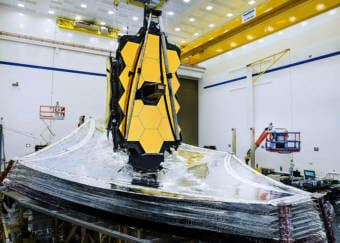
Technicians successfully performed a critical test on Webb’s 5-layer sunshield by fully deploying each of its uniquely sized layers to the same position that they will have while orbiting the Sun a million miles away from Earth. (Photo by Chris Gunn/NASA)

NASA’s newest big telescope orbiting Earth, the James Webb Space Telescope, is currently pointed right at a constellation iconic to Alaskans: the Big Dipper.

That, of course, is what’s on the Alaska Flag, and the James Webb is focusing on a star in the Big Dipper to calibrate its ultrasensitive mirrors, which researchers hope will allow them to see almost all the way back to the beginning of the universe.

Lee Feinberg is the Webb Optical Telescope Element Manager with the NASA Goddard Flight Center, and he’s been working on the project for more than 20 years. As Feinberg explains, the Webb is thought of as a replacement for the Hubble Space Telescope.

Listen here:

The following transcript has been lightly edited for clarity.

Lee Feinberg: The universe expanded rapidly, and light is just getting to us now from the very early universe. Well, Hubble could see back when the universe was a little bit before a billion years old, but it couldn’t see back to some of the first stars and galaxies that formed when the universe was just a few hundred million years old. And that’s because the light from those stars and galaxies has been stretched into the infrared, which Hubble cannot see. And so Webb was really originally designed to go after the very early universe. And to do that it needed a telescope that’s larger than Hubble — it’s six and a half meters versus 2.4 meters for Hubble — but it also needs to be infrared. And that means that it needs to be really cold.

And the reason it needs to be cold is that when mirrors are warm, like the mirrors on Hubble, which are room temperature, they generate infrared light. And it’s really just due to the fact that any object that is warm generates infrared light. That’s how how heat is emitted. And so in the case of the mirrors on a telescope, if those mirrors are warm, they generate a lot of infrared light, which contaminates the images, it prevents you from seeing these very distant, very faint objects.

And the James Webb Space Telescope is actually going to be cooled to about minus 400 degrees Fahrenheit, through this very large sunshield. The telescope’s actually already in space, and it’s cooling down as we speak. And it’s getting closer and closer to this very cold temperature. And at that very cold temperature, we have all sorts of sensitivity and wavelengths, a level of sensitivity that we’ve never had in these infrared wavelengths. And that’s going to not only allow us to study the early universe, but it allows you to study just about every type of astronomy and astrophysics that other space telescopes have studied, including one that’s very exciting, which is exoplanets. And exoplanets have atmospheres, and with Webb, we will be able to look at these exoplanets as they pass in front of stars, and understand the atmospheres of those exoplanets by understanding how those atmospheres absorb different infrared wavelengths. So Webb is really suited for that problem as well, as well as many other problems in our solar system and in galaxies and star formation. So Webb is a very large cryogenic, which means cold, infrared telescope designed to be a successor to Hubble and Spitzer Space Telescope.

Casey Grove: Wow, yeah. So it’s cooling down, and it’s been a long time coming to get to this point. It sounds like there’s still some time to go before it starts doing some of those bigger experiments. But all these years of work kind of also came down to a rocket launch that needed to go well, and that’s a relatively short period of time. What’s that like? It must be nerve racking.

Lee Feinberg: Yeah, you know, it is nerve racking on the one hand. On the other hand, for example, in this case, we actually launched on an Ariane 5, which is a rocket that was a European contribution to the mission. And that rocket, we were tracking it over the many years, it was extremely reliable. So in some ways, we felt pretty confident that it’s a very reliable rocket, it’s launched a lot of times. On the one hand, it’s nerve wracking, but I think what was more nerve wracking, to be honest, was just the fact that we were sort of the largest mission, the heaviest, and we filled it up the most, and the fact, really, that we had to deploy unfolding mirrors and the heat shield in space. So we were probably a little bit more thinking that the deployment was going to be the hardest problem, that there was a lot of reliability in these kinds of launches. But anytime you launch a mission to space, there’s always some level of concern because, you know, nothing is 100% reliable when it comes to launching rockets.

Casey Grove: Yeah, no doubt. Well, I just want to be totally clear, I saw that the James Webb was calibrating using a star in the Big Dipper constellation. And, of course, the Big Dipper is very near and dear to Alaskans. It’s the image on our state flag. People have tattoos of it even. And so just very quickly, Lee, do you think that’s a good enough excuse to be talking to you about the James Webb Space Telescope?

Lee Feinberg: I think it’s a good enough excuse for us to pick that star. Yeah, I mean, you know, it’s really neat. There’s so many ways that people are connecting to James Webb Space Telescope all over the world. And actually, to hear that is really interesting to me. And honestly, for me personally, the Big Dipper was always the thing in the sky that I always recognized when I was growing up. I’m learning about sort of what it means in Alaska, but I think it also means a lot to everybody. We didn’t pick this particular star specifically because it was in the Big Dipper. It turns out that we actually just needed a really bright star that is pretty well isolated. So in other words, we didn’t want any other bright stars nearby it. And that is to allow us to do some of the first steps, where we are searching for the 18 primary mirror segments, which we know after deployments are going to start off misaligned. So we just needed a bright star, we needed one that was in the right region of the sky that we could see it continuously. And this is the star that we just happened to pick. But, yeah, you’re right, I mean, it’s in Ursa Major, right near the bowl of the Big Dipper. And I personally agree with you that it’s great that we picked one from Big Dipper because it’s something people can relate to. And if you go on the JWST website, you can actually find the information about the star, it’s HD 84406. But that star is actually bright enough to see with binoculars. So you can actually go outside, and if you know where it is relative to the Big Dipper, you can kind of find it and look at it.

Casey Grove: Yeah, I guess we should say, you can’t see it with the naked eye. But if you want to look at the same thing that the James Webb space telescope is pointed at, you can with binoculars.

Lee Feinberg: Exactly, exactly.

Casey Grove: What are you looking for during this calibration process? Are there problems that could crop up that you’re trying to avoid or trying to notice?

Lee Feinberg: Well, the James Webb Space Telescope is unique in that that primary mirror is broken into 18 hexagonal segments. And we don’t normally do that with telescopes. Normally with a telescope the big thing is you’ve got a secondary mirror that you need to focus, or in the case of maybe a telescope that you have at home, you just have some little eyepiece, and you just have a little knob that you turn in order to focus it. But here, these 18 primary mirror segments, they have to all get aligned as though they’re a single monolithic mirror. And that means literally to a fraction of a wavelength of light, which, by the way, is about one 20,000th the diameter of a human hair. So we really need to align this extremely well. But because we had to deploy this system, it’s sort of unique, you don’t normally deploy and have something unfold, and then have mirrors deploy, you know, into these positions. Because of all that, from one mirror to the next, they could be separated by as far as a millimeter. So we have to go from a millimeter to what we call a nanometer. And a nanometer is about a millionth of a millimeter. So we’re gonna have to go a factor of a million better in how well these mirrors are aligned. It literally is a process that takes almost three months. But when it’s all said and done, all 18 mirrors are going to be aligned to a fraction of a wavelength of light, as though they’re just a single, big monolithic mirror. And that’s that’s the challenge here.

Casey Grove: That’s pretty amazing, how precise it needs to be. So for about three months, it’s going to be pointing at HD 84406, which is just sort of if the Big Dipper is upright, just to the right of the main Big Dipper?

Lee Feinberg: Well, we use that star initially. But we’ll actually be choosing some other stars along the way. Because turns out that for this telescope, which is so large and so big, you don’t normally want to use such a bright star. we consider this a very bright star even though you can only see it with binoculars. But we wanted to start with a very bright star. So we start with it, because initially our mirrors aren’t very well aligned, and therefore we need something that’s brighter so that we can see it. But as we go along, we’ll actually choose stars that are actually dimmer as things get better and better aligned. And so this is the first star we use, but it’s not the only star. But we will be choosing stars that are in the continuous viewing zone and we might choose some other stars in or near the Big Dipper. But this will be the first and then this one gets used for the first couple of weeks and then as it makes sense, we migrate to other stars.

Nation’s sole heavy icebreaker returns to Antarctica to resupply American scientists

An icebreaker docked in Dutch Harbor
The Polar Star sits in the Port of Dutch Harbor in January, 2021. The ship is nearly 400 feet long and can break ice up to 21 feet thick (Photo by Hope McKenney/KUCB)

The nation’s sole heavy icebreaker arrived in Antarctica on Monday after a nearly three-month trip from Seattle.

The deployment marks the Polar Star’s 25th journey to the earth’s southernmost continent, supporting Operation Deep Freeze, an annual mission to resupply American scientists doing research near the South Pole, according to a Coast Guard statement.

Each year, the crew maneuvers the nearly 400-foot, 13,000-ton icebreaker to cut a channel to McMurdo Station, the U.S. Antarctic Program’s logistics hub. It carves through miles of ice, sometimes up to 21-feet thick.

This winter, the icebreaker’s 157 crew members spent four weeks breaking ice and grooming the shipping channel to the station, which was established on Ross Island in 1955.

The cleared route will enable two supply vessels to safely offload more than 8 million gallons of fuel and a thousand cargo containers. Together, the two ships carry enough fuel, food and critical supplies to sustain research operations throughout the year. Supply ships will return again during the next austral summer — the season in the Southern Hemisphere that runs from about November to February.

The mission marks the Polar Star’s first return to Antarctica since the start of the COVID-19 pandemic, according to the Coast Guard statement.

Last winter, instead of going south, the 46-year-old icebreaker conducted an Arctic deployment, and stopped in the Port of Dutch Harbor for the first time since 2013.

It was the ship’s first winter Arctic deployment in nearly four decades.

The Polar Star patrolled Alaska’s Arctic waters, including the maritime boundary line separating the U.S. and Russia, to assert maritime sovereignty and security in the far north and train the next generation of polar sailors.

Last winter’s patrol was the farthest north any American ship has sailed in the winter months.

The Coast Guard has been the sole provider of the nation’s polar icebreaking capability since 1965, according to the statement. Commissioned in 1976, the Polar Star is the United States’ only heavy icebreaker. The Coast Guard is increasing its icebreaking fleet with construction of three new polar security cutters “to ensure persistent national presence and reliable access to the polar regions.”

The construction on the first new icebreaker is expected to be completed in 2024.

Alaska permafrost thaw is clue in mystery of Arctic methane explosions

A man is roped up at the edge of a huge hole in the snowy tundra
A member of an expedition group stands on the edge of a newly formed crater on the Yamal Peninsula in northern Siberia in November 2014. (Photo by Vladimir Pushkarev, Reuters via Nova and Geophysical Institute)

Arctic methane explosions and the scientists who love to study them are the focus of the newest episode of the public television program Nova.

The show follows University of Alaska Fairbanks researchers investigating the appearance of craters, sometimes big ones, in northern regions. That’s where a rapidly warming climate has thawed permafrost and allowed more methane to percolate upward from deeper in the Earth. As the thinking goes, the methane travels upwards and forms a kind of tube, not unlike magma in a volcano, and then builds up pressure at the surface until — kaboom! — it erupts, sometimes even with a fiery explosion.

Longtime permafrost researcher Dr. Vladimir Romanovsky with UAF’s Geophysical Institute, a professor emeritus as of this week, is featured in the Nova episode that aired Wednesday night. And Romanovsky says there are several reasons to keep an eye on the exploding methane phenomenon.

Listen here:

The following transcript has been lightly edited for clarity.

Vladimir Romanovsky: So it’s still in discussion, the process, the physical process behind this phenomena. But I think it’s more and more clear that there is some protrusion of high pressure gas, and this protrusion goes from below the bottom of permafrost toward the surface. And eventually, when the pressure is high, then it just erupts and removes this cap. And these pieces of frozen material and the big chunks of ice are flying away, very far sometimes, like 300 feet and even more away from the crater. And sometimes even there is some evidence that during this eruption, coming out, methane was ignited, and it was not just eruption, but eruption and then explosion. And yeah, people are aware of it, and they are monitoring. And of course, the satellite data is high, very high resolution, and are also now used very, very widely to, first of all, to look for these existing craters and how they change with time, but also looking at suspicious, little hills, round hills, the right size, and potentially could be those ones ready — sooner or later — to explode or to erupt.

Casey Grove: Some of those hills, maybe now you’re thinking, they’re not full of ice, they might be suspiciously full of methane, then?

Vladimir Romanovsky: Yeah, and not just full, but this high pressure. So it makes it dangerous to try to just simply drill into these hills. You may not survive, you know, because the pressure is very high, and also possibly there could be ignition. So it would make a really serious explosion and definitely will be not safe. Definitely. I wouldn’t recommend anybody to drill in those in those hills.

Casey Grove: I will note that for future reference, in case I find myself in that position.

Vladimir Romanovsky: Yeah. Just stay from a distance and look.

Casey Grove: Why is this happening? I mean, why is this showing up here relatively recently?

Vladimir Romanovsky: That’s a very good question. Why now? Why not before? And, of course, what really happened, what changed? Well, the climate warming. So that’s why, the first kind of reaction to explain why now. It’s related to a warmer climate, and why a warmer climate would trigger this, this phenomena, that’s where we need to have a very good understanding of the physics, the processes behind it. I have a very possible scenario why it is happening. And this explanation is, well, pretty straightforward. So this protrusion from below may be happening for a long, long time. But before, the permafrost was much colder. We have data, we have our measurements, going on for the last 40 years. And we see that, for example, permafrost on the North Slope now is about 3-4 degrees warmer near to the surface of permafrost, compared to 30-35 years ago. So now, warmer permafrost will allow this protrusion to come closer and closer to the ground surface and eventually allow these eruptions.

Casey Grove: And I guess the concern isn’t just that you might be standing nearby and the thing would explode, or if you were drilling into it or whatever, it has to do with the actual methane being released into the atmosphere. Can you explain that?

Vladimir Romanovsky: Yeah, that’s true. And the amount of methane which will be released during the eruption is not that much. And especially if it explodes, then methane will just turn into CO2 and water, pretty much. But if this chimney or connection to below permafrost environment will be still open, which we see in some cases — it’s still open in this case — it’s allowed to escape a much, much larger amount of methane, which is sequestered there and otherwise will be sitting there for, you know, millennia, it will be able to escape to the atmosphere. It’s still a question of how much. It’s still a question, it needs to be assessed and estimated, but it may be one of the potential sources of increase in methane concentration in the atmosphere, increasing this greenhouse effect, because it’s a very, very potent greenhouse gas.

Casey Grove: And that would just sort of cause a feedback loop and maybe even make the problem worse, I imagine?

Vladimir Romanovsky: That’s right. Yeah, the more greenhouse gas concentration, faster warming. Faster warming and permafrost thaw, more right conditions in more areas where it isn’t possible right now, and more explosions and so on. But I wouldn’t kind of neglect the possibility of problems with infrastructure with that, because according to my theory, this phenomena happens in the areas of warmer permafrost. And also, we know that any large infrastructure makes permafrost warmer. So in this case, this protrusion will actually be directed toward the warmer permafrost, which is under infrastructure, and that makes it very dangerous. So, you see, it’s kind of some sort of heat-directed missile, you know. It goes to the source of heat. Of course, it’s speculation. Of course, it’s kind of like an interesting twist in this phenomena, but it’s possible.

Casey Grove: Yeah, that does seem pretty troubling, and also interesting, just that, if that’s the case that it goes toward those things, it definitely seems worth studying more.

Vladimir Romanovsky: Right. And in the Yamal Peninsula, in Siberia, several of them have already happened. And very, very close to this Bovanenkovskoye gas field infrastructure, to the pipelines. So for them, it’s not a theoretical, potentially possible problem, but it is real problem. They’re already pretty much worried about what is going on there.

Casey Grove: Wow, yeah. And also I thought I’d ask, while I have you on right now, about your retirement, because I think I read that you are retiring from the Geophysical Institute after something like 30 years, right?

Vladimir Romanovsky: Right. Well, it’s my second day of retirement today.

Casey Grove: And you’re still talking to me while you’re retired?

Vladimir Romanovsky: Well, I am a professor emeritus, which allows me to be active and to be present at the Geophysical Institute. So for for a while, they will keep some office for me, and I have even free parking. So that’s my privilege. So I will be around as a professor emeritus, and I will talk to anybody who would like to know more about permafrost and permafrost-related questions.

Casey Grove: That’s great. And, I mean, as a former UAF person myself, I know that the parking really does matter. You know, Dr. Romanovsky, I thought I would ask, just as a Fairbanks person myself — and, you know, having been born there, I didn’t have much of a choice — but I like to ask people that moved to Fairbanks, why did you end up there? How did you end up in Fairbanks?

Vladimir Romanovsky: Well, Fairbanks is very, very proper — and obvious even — choice for a person who studies permafrost. My previous life, scientific life, was related to Moscow State University, which is in Moscow. And even in all American movies about Moscow, it’s always winter and it’s always snowy. There is, unfortunately, no permafrost around Moscow. And to study permafrost, we had to go far, far away from it. And Fairbanks is a great place. It’s a great place. First of all, because permafrost is just around — just outside. But also because the University of Alaska Fairbanks and the University of Alaska in general, it’s a very, very great scientific institution. So it’s a worldwide kind of leader in the cold regions research. And it’s a great place to be to study permafrost, because I have the huge knowledge of people around me. And any question I have, outside of my expertise, I can go and simply ask and work with those people around me. So that was great place, great decision on my side to come here and I’m very happy to be here.

Casey Grove: It sounds like you’re not leaving anytime soon for somewhere warmer, where you don’t have to just drive up the haul road to do permafrost research.

Vladimir Romanovsky: No, I will be here for a while, yes. It’s not easy to get rid of me.

Site notifications
Update notification options
Subscribe to notifications