KRBD is our partner station in Ketchikan. KTOO collaborates with partners across the state to cover important news and to share stories with our audiences.
The quota for this winter’s annual wolf hunting and trapping season on Prince of Wales Island has been set at 11 animals, up slightly from last year’s quota of nine.
According to an announcement from the U.S. Forest Service, the most recent population estimate of wolves in Game Management Unit 2 is 108, an increase from last year’s estimate of 89.
The federal subsistence hunting and trapping season on POW runs from Sept. 1st through Nov. 15th. The state season starts on Dec. 1st, and will close whenever the harvest approaches the quota limit.
Last year’s wolf hunting and trapping season sparked controversy because the population News Tileestimate indicated a steep drop in the number of wolves on POW.
According to the Forest Service announcement, this year’s estimated increase shows that the wolf population has not declined since then, so the game management strategy can continue.
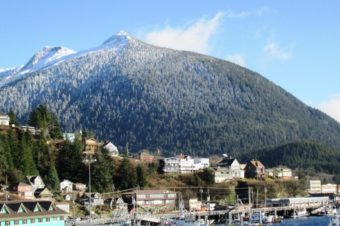
A springtime view of Deer Mountain. (File photo by Leila Kheiry/KRBD )
The Alaska Mental Health Trust took its first step toward logging Ketchikan’s iconic Deer Mountain, along with a parcel in Petersburg.

During a Board of Trustees meeting Wednesday morning, the board agreed with staff recommendations to move forward with plans to negotiate timber sales for both parcels by Jan. 15th, unless Congress approves a bill trading that land for selected U.S. Forest Service land.
Mental Health Trust executive director John Morrison said time is running out for the region’s timber industry, and the trust needs to make money while it can.
“We’ve reached the recognition that we need to be prepared to harvest the timber that we have while there is a timber industry to harvest it, in the event that the legislation is not passed this session of Congress,” he said.
Morrison said the trust has been working on the land exchange with the Forest Service for about a decade.
While Morrison is optimistic that the land exchange will be approved, he said this first step was necessary.
“Our process can be fairly lengthy, so this is to get the ball rolling and to let people know that we are serious about abiding by our mission, which is to maximize revenue to the trust,” he said.
Revenue from trust lands is the sole funding source for mental health programs in the State of Alaska.
Morrison said the lands to be exchanged have been identified through an administrative process. It just needs to get through Congress.
“We would be very much in favor of the legislation passing and having a successful exchange,” he said. “People who are concerned can certainly direct their efforts toward helping to pass that legislation.”
The Ketchikan Gateway Borough Assembly recently approved a resolution urging Congress to approve S. 3006, the Alaska Mental Health Land Exchange Act of 2016. The measure is sponsored by U.S. Sen. Lisa Murkowski, R-Alaska.
A musician well-known in the Ketchikan jazz community and who performed at First City Players Jazz and Cabaret Festival for more than a dozen years has died.
Several Ketchikan residents who knew Kindred shared their memories of him.
Bob Kindred
Bob Kindred was best known as a tenor saxophone player, but his first instrument was the clarinet.
His father did not want him to pursue a career in music, so Kindred studied business and had a successful business career.
At the age of 30, he heard Phil Woods in concert and decided to take up playing again. He studied with Woods for several years.
At a time when the popularity of big band music was fading, Kindred was able to succeed, playing with the Glenn Miller and Woody Herman tribute bands, among others.
Since the early 1990s, local theater group, First City Players, has held jazz and cabaret workshops.
First City Players artistic director Elizabeth Nelson said Anne Phillips was brought in about 1999 or 2000 to conduct vocal workshops.
Phillips was married to Kindred at the time, and suggested he come the next year to conduct instrumental workshops.
The instrumental workshops lasted only a few years, Nelson said, but Kindred continued to return, backing vocalists.
“It was an astounding thing to listen to,” she said. “When he was at his best, to sing with him, it was really having a conversation. It was just a musical conversation and he would listen to every single way you would inflect a lyric and he could answer that back sensitively. Really just beautiful in that way.”
During jazz and cabaret week, guest artists visit the local elementary schools, Nelson said.
“He could be so much fun,” she said. “He could make the kids laugh. The last day, when we do the concert for the school, we always bring our guest artists in, so Bob would be part of that, and would just make the kids giggle with the sounds he could make through his saxophone and then they would just be rapt when he would play.”
In 2010, guest artists Bob Kindred, Anne Phillips, Paul Meyers and Matt Perri were recognized as honorary citizens of Ketchikan for their work in the schools and contributions to the jazz community. The proclamation was signed by City Mayor Lew Williams III.
Baritone saxophonist Lynn Caldwell recalls first meeting Kindred.
Caldwell was in his garage playing when there was a knock on the door at about 9 pm.
“He said, ‘I heard some baritone sax in here. Are you kidding me?’” he said. “Those were his exact words. ‘Are you kidding me?’ He was truly blown away by the fact that he comes to Ketchikan, he’s living right there, no clue at all there was even a baritone sax player in town.”
Kindred was staying at a bed and breakfast across the street and had heard Caldwell playing.
They became fast friends and played together often: Kindred on the tenor saxophone, and Caldwell on the baritone.
Caldwell had never played with a professional musician before, and learned a lot from Kindred.
“He taught me so much about the instrument – about mouth pieces, about reeds, about breath control,” Caldwell said. “He couldn’t practice for me, and I was still being lazy about learning scales and chords, but it really improved my playing. Particularly the sound. That’s all I really cared about anyway. I loved the sound of the baritone.”
Kindred had cancer about 20 years ago and wasn’t expected to live more than 10 years, Caldwell said. Kindred had many other health issues, made worse by a drinking problem and bad habits.
“He didn’t complain much. A lot of people didn’t even know those things about him,” he said. “But it seems like it was such a waste for this great man to not be able to make more of a contribution than he was by getting his life under control.”
Trumpet player Dale Curtis met Bob Kindred and Anne Phillips at the Fairbanks Summer Arts Festival. When they came to Ketchikan, Curtis played with Kindred in the Jazz and Cabaret Festival band.
They also would just get together to play.
“I’ve been playing my whole life, and I’ve got a lot of professional experience, and I know a lot of tunes, and so does he,” Curtis said. “We’d just get together and play these tunes that we both know, and we both had such a similar style. For me it was really easy, phrasing, and I kind of knew what he was going to do. It made it easy.”
In 2011, Curtis recorded an album “Bridge to Nowhere,” at Bennett Studios in New Jersey.
The members of the Dale Curtis Quintet were Curtis, guitarist Paul Meyers, bass player Christian Fabian, drummer Ed Littlefield, and Kindred on saxophone and clarinet.
“He asked me if he could do this song called ‘Tenderly’ by himself,” Curtis said. “So I let him do that and I’m glad I did because it’s just amazing, his approach to that. Such a beautiful player and beautiful guy. He will be missed.”
“He was always so gracious and so kind to other musicians. A good man.”
Kindred lived in New York for many years but moved to Nashville about two years ago.
Curtis spoke with Kindred about a month ago and, despite his health problems, Kindred continued playing and was still booking gigs.
With just a few days left for candidates to file for local office in Ketchikan, the ballot so far is looking pretty sparse.

For Ketchikan Gateway Borough Assembly, there are two open seats and two candidates.
Political newcomers Rodney Dial and Keith Smith are the only ones who turned in their paperwork for the seats currently held by Bill Rotecki and Alan Bailey as of Monday afternoon.
Neither incumbent can run for re-election because of term limits.
The only candidate for borough mayor so far is incumbent Mayor David Landis.
The Ketchikan Gateway Borough School Board has two open seats, currently held by Trevor Shaw and Dave Timmerman.
No one has filed to run for school board as of Monday.
The Ketchikan City Council also has two open seats this year.
The incumbents, Judy Zenge and Julie Isom, both filed for re-election, and so far have no challengers.
The deadline to file for city and borough office is 5 p.m. Thursday, Aug. 25. Information on how to file is available on the city and borough websites.
Canned Alaska salmon. (Creative Commons photo courtesy of cookbookoman17)
There used to be hundreds of seafood canneries all along Alaska’s coastline. Two people are involved in documenting and preserving some of that rich history in order to share it with others.
When Anjuli Grantham was growing up she would help her family beach seine on the west side of Kodiak Island. It was the same place that an old cannery site had once operated.
“My early childhood memories are playing in cannery rubble,” Grantham said.
Now Grantham is an Alaska historian based in Kodiak working as the Director of the Historic Canneries Initiative. It’s part of the Alaska Historical Society. The Initiative is a statewide grassroots effort to help educate people about the history of the seafood industry in Alaska.
“We’re looking at all fisheries but mostly on canneries because they’re such magnificent, dilapidated structures all along Alaska’s coastline and very little attention’s been paid to the documentation and preservation of these places,” she said.
These places, the old cannery sites, have been around since 1878 when the first ones opened in Sitka and Klawock. Over the next hundred years, their popularity grew and hundreds of processing sites popped up along Alaska’s coastline.
“It was really important to have processing sites on the fishing grounds because there was no refrigeration and so you had to be putting up fish nearby where people were fishing otherwise you know how quickly fish will go bad,” Grantham said.
Canned salmon label courtesy of Karen Hofstad
Canning was the favorite form of seafood processing for many years. But in recent decades the number of cannery sites dropped dramatically with the onset of refrigeration technology.
“Suddenly tenders could go longer distances as well and so people can fish wherever and deliver to a centralized location because of refrigerated seawater and freezer capacity,” Grantham said.
Now freezing salmon and other seafood is the most common method of moving the fish to market.
While it lasted, the business was booming and canned salmon was in high demand. And every can needed a label. Petersburg resident Karen Hofstad is kind of a canned salmon label expert.
“There’s not a lot that say canned in Alaska,” Hofstad said. “In the olden days they were shipped out and stored down south in Washington or somewhere and then the brokers would sell the product and then those people like it may be some Jones grocery store, they want their own labels on it.”
Canned salmon label. (Courtesy of Karen Hofstad)
Hofstad’s collected canned salmon labels for over 50 years. It started slowly with just a few at a time but once the word spread that she was collecting many people came forward giving her what they had, even anonymously sending them through the mail. She’s proud that she’s never collected them over the internet.
“Now I have thousands,” she said. “I’m sure I have the largest label collection, for sure in Alaska, maybe the West Coast.”
About 300 of the labels are still on the original tin cans.
Along with collecting canned salmon labels, Hofstad found herself researching the history of them.
“I have a lot of fish packers’ records that go back from the early 1900s that lists all of the labels that were members of that association and I have all of the Pacific Fishermen starting in 1900,” Hofstad said. “A lot of research information there.”
Hofstad has been carefully archiving all of her labels and plans to eventually donate her collection to a museum.
Both and Karen Hofstad and Anjuli Grantham are presenting their historical projects tonight in Petersburg at the public library at 6:30 p.m. A reception will follow at the Clausen Museum.
Limited funding for the Historic Canneries Initiative has been pieced together from multiple sources: the Alaska Historical Society, Alaska Seafood Marketing Institute, Alaska Sea Grant, Alaska Historical Commission, and individual donors.
Ensign Mari Freitag, a student naval aviator with the “Rangers” Training Squadron that operates the T-6 Texan II aircraft, attended the University of Alaska, Fairbanks, studying political science and justice.
During her last semester, she took flying lessons and decided she wanted to be a pilot. She considered several avenues to achieve that goal, Freitag said.
“I was trying to explore which route I could take to be a pilot, and which one I thought I would like the most, and I ended up settling on the military – the aviation side of everything,” she said. “I applied to both the Air Force and the Navy and I eventually settled on choosing the Navy. Mostly because I like the idea of landing on ships because it seems really hard and so I wanted the challenge.”
Freitag always wanted to be a police officer, and feels the aviation side of the military combined her two passions – justice and flying.
“I honestly didn’t know I wanted to be a pilot, but looking back on my life – flying in floatplanes in Ketchikan with Ernie (Meloche), the ER doctor – it makes sense looking back on it all now,” she said. “It was this weird path towards being a pilot. And while I was getting my private pilot’s license, it just became very clear to me that’s what I wanted to do with my life.”
Freitag started her training in Pensacola, Florida, with aviation pre-indoctrination, a six-week ground school class.
She is currently in the second phase of her training, flying the T-6 Texan II.
“It’s a turbo-prop aircraft. It’s pretty awesome. I’m very lucky to be able to fly it. The part of the program I’m in now, primary, lasts about six months.”
Freitag says after six months she’ll be scored.
That score will determine what type of aircraft she’ll fly in the next phase of her training. If she scores high enough, then she can train to fly jets.
It will be a year-and-a-half to two years before she gets her wings,” Freitag said. She says she committed to eight years with the Navy after she completes training, but plans to stay in longer.
“I’ve been told if you do the absolute best you possibly can at your job, the Navy will never tell you what to do, but it’s a lot of work. I love my job so far. I love being in the Navy. So I’d like to work as hard as I can for the mission, the Navy, and to, hopefully, stay in. My goal is, honestly, to retire in the Navy, so serve at least 20 years.”
Freitag says success in the Navy is due to luck, timing and hard work.
She has been in the Navy less than a year, and doesn’t know what the future holds, but Freitag says she eventually hopes to become a fighter pilot.
Close
Update notification options
Subscribe to notifications
Subscribe
Get notifications about news related to the topics you care about. You can unsubscribe anytime.