NPR News

KTOO is the NPR member station in Juneau. NPR offers its members radio and digital stories.

People are leaving some neighborhoods because of floods, a new study finds

An empty lot where a house once stood in Houston. The former residents moved because of flood damage. A new study suggests that people are moving away from the most flood-prone neighborhoods in cities that are otherwise growing in population. (Claire Harbage/NPR)

Hundreds of thousands of neighborhoods in the United States are seeing population decline as a result of flooding, new research suggests. Those neighborhoods are often located in areas that are growing in population overall, including parts of Florida, Texas and the region around Washington, D.C.

The results underscore how flood risk – which is growing due to climate change – is already affecting where Americans live.

“People are being more selective about where they live,” says Jeremy Porter, one of the authors of the study and a researcher at the First Street Foundation, a research and advocacy organization that publishes analyses about climate hazards including flooding. The study was published in the journal Nature Communications.

Americans are flocking to some of the most flood-prone parts of the country, including coastal areas, and low-lying cities in Florida, Texas and coastal Virginia. At the same time, heavy rain and sea level rise from climate change means floods are getting larger and more frequent.

As a result, the cost of flood damage in the U.S. has skyrocketed in recent years. The Federal Emergency Management Agency, home insurance companies and climate and housing experts all warn that huge financial losses from flood damage are not sustainable for families or the economy.

At the same time, people buying homes are increasingly aware, and wary, of flood risk. More and more states are requiring that homebuyers receive information about whether a house has flooded before, and whether it is likely to flood in the future. Some real estate listing sites include information about flood risk. And people are less likely to search for flood-prone properties when they are given information as part of the listing about whether a home flooded in the past or is likely to flood in the future, according to a study by the real estate website Redfin.

But if people are trying to avoid moving to flood zones, why are so many people ending up in the most flood-prone parts of the country? The authors of the new study offer some new insight.

They looked at the number of people living in each of the more than 11 million census blocks in the contiguous U.S., and analyzed how that number changed in places with high exposure to floods versus lower exposure to floods. They found that about 7% of census blocks – which are roughly the size of a city block – are experiencing population decline due to flood exposure.

They estimate that those neighborhoods saw a net loss of about 9 million residents between 2000 and 2020. And they found that many of those neighborhoods are located in places that are growing overall, such as South Florida and Southeast Texas.

The results suggest that the influx of new residents into flood-prone cities such as Miami and San Antonio may obscure the millions of people who are moving more locally to get away from the lowest-lying neighborhoods in those cities.

Moves to the Sun Belt “are a macro migration trend,” explains Porter. “But they’re dwarfed by the amount of people that move within their same city. Keep the same job, keep the same friends, stay close to family.”

Previous research has found that most people stay local when they move to a new home, including in situations where a flood disaster forced them to relocate. That means decisions about where to live and how to stay out of harm’s way often come down to block-by-block or even house-by-house comparisons.

And, while flood risk appears to play a role in where people choose to live, social factors including race and class are also hugely important, says Kevin Loughran, a sociologist at Temple University who studies relocation from flood zones.

“Flood risk, or environmental risk in general, is not the only criteria they’re using to make these decisions,” says Loughran.

The new study offers a new level of national insight into how flood risk might be affecting local trends in population, he says. But the details are still fuzzy, and further research is underway by social scientists and others to study exactly how people who live in areas threatened by climate hazards decide whether, and where, to move.

Copyright 2023 NPR. To see more, visit https://www.npr.org.

Tribes celebrate historic deal with White House that could save Pacific Northwest salmon

FILE – This Oct. 24, 2006 file photo shows file photo shows the Ice Harbor dam on the Snake River in Pasco, Wash. (Jackie Johnston/AP)

BOISE, Idaho — The White House has reached what it says is an historic agreement over the restoration of salmon in the Pacific Northwest, a deal that could end for now a decades long legal battle with tribes.
Facing lawsuits, the Biden administration has agreed to put some $300 million toward salmon restoration projects in the Northwest, including upgrades to existing hatcheries that have helped keep the fish populations viable in some parts of the Columbia River basin.

The deal also includes a five year stay on litigation and a pledge to develop more tribally run hydropower projects and study alternatives for farmers and recreators should Congress move to breach four large dams on the Snake River, a Columbia tributary, which tribes say have long been the biggest impediment for the fish.

“Many of the Snake River runs are on the brink of extinction. Extinction cannot be an option,” says Corrine Sams, chair of the wildlife committee of the Confederated Tribes of the Umatilla Indian Reservation.

The agreement stops short of calling for the actual breaching of those four dams along the Lower Snake in Washington state. Biden administration officials insisted to reporters in a call Thursday that the president has no plans to act on the dams by executive order, rather they said it’s a decision that lies solely with Congress.

A conservation bill introduced by Idaho Republican Congressman Mike Simpson to authorize the breaching of the dams has been stalled for more than a year, amid stiff opposition from Northwest wheat farmers and utility groups.

When the details of Thursday’s salmon deal were leaked last month, those groups claimed it was done in secret and breaching the dams could devastate the region’s clean power and wheat farming economies that rely on a river barge system built around the dams.

“The agreement announced by the Biden Administration commits the U.S. Government to spending hundreds of millions of dollars that will ultimately end up being paid by electricity consumers in communities throughout the West,” said Heather Stebbings, interim executive director of Northwest RiverPartners in a statement.

Copyright 2023 NPR. To see more, visit https://www.npr.org.

Broken wings: Complaints about US airlines soared again this year

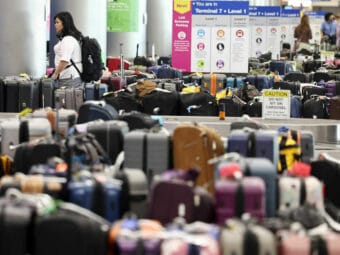
A traveler looks for baggage amid rows of unclaimed luggage at Los Angeles International Airport in June. (Mario Tama/Getty Images)

If you’re unhappy about the state of air travel in the U.S., you’re in good company.

Complaints about U.S. airlines climbed sharply in the first half of the year, consumer advocates say, as passengers remain deeply dissatisfied despite some improvements in performance.

“The complaint data is pretty jaw-dropping,” said Teresa Murray, a consumer advocate with U.S. Public Interest Research Group, which published a new report based on data released by the Department of Transportation.

Flight cancellations were down significantly in the first nine months of the year, according to the DOT. Murray called that trend encouraging but said delays and mishandled luggage remain major problems.

“People are still ticked off and unhappy with their airline experience,” she said in an interview. “The complaints are continuing to pour in.”

Travelers filed more than 26,000 formal complaints about U.S. airlines in the first five months of 2023 — more than double the number filed during the same period last year, according to the report, and on pace to break the annual record set in 2022.

The aviation system has struggled to keep pace with a surge in demand, as travel volumes rebounded quickly to pre-pandemic levels. That’s left both the airlines and many air traffic control centers short-staffed.

“We are seeing more people flying than ever with fewer cancellations than we have seen in years,” Transportation Secretary Pete Buttigieg said at a news conference last month.

The biggest U.S. airlines canceled about 1.6% of flights from January through September of this year — down from 2.8% during the same period last year.

Buttigieg called that “a clear improvement in the numbers” and said airlines deserve some of the credit, “both in terms of the realism of their schedules and in terms of having the staffing and the preparation to meet the demand that’s come in.”

But at the same time, the number of delays has grown.

The largest U.S. airlines had an on-time performance of 76.2% during the first nine months of the year, down from 76.6% last year. That figure has fallen below 77% only one other time in the past 15 years, Murray said.

The aviation system was largely able to avoid major service disruptions during the recent Thanksgiving holiday. But many travelers haven’t forgotten the meltdown of 2022, when winter storms and a software glitch at Southwest Airlines caused thousands of canceled flights and chaos across the country.

Murray said travelers should brace for another challenging holiday travel season.

“We know that the flights are going to be absolutely jam-packed here in the next couple of weeks,” she said. “We definitely recommend that you do the old thing of getting to airports early because you have less of a chance of getting bumped. You have more of a chance of getting where you want to get.”

Copyright 2023 NPR. To see more, visit https://www.npr.org.

House votes to formalize Biden impeachment inquiry

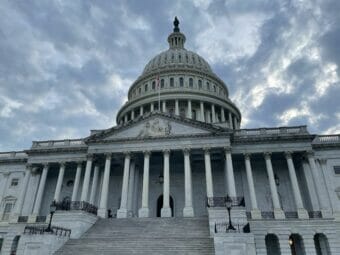
The U.S. Capitol building
The U.S. Capitol. (Liz Ruskin/Alaska Public Media)

The House of Representatives has voted along party lines to formalize an impeachment inquiry into President Biden, as House Republicans intensify the investigation into Biden they opened earlier this year.

The vote was 221-212, with all Republicans in support. The vote is intended, in part, to give committees greater legal authority to enforce subpoenas.

House Republicans allege that President Biden and his family engaged in an “influence peddling” scheme and took payments from foreign adversaries. The inquiry focuses largely on the president’s son, Hunter Biden, and his foreign business dealings.

So far, Republicans have not presented any clear evidence of impeachable offenses by President Biden. Both Hunter Biden and the White House have vehemently denied the allegations.

Speaking on the House floor ahead of the vote, House Oversight Chair James Comer said the committees “are now at a pivotal moment” in their investigation.

“We will soon depose and interview several members of the Biden family and their associates…but we are facing obstruction from the White House,” Comer said. “President Biden must be held accountable.”

Congressional Democrats have decried the inquiry as politically motivated.

Rep. Jamie Raskin, D-Md., who served as an impeachment manager in former President Trump’s second impeachment trial, said Republicans’ “stupid, blundering investigation” was preventing the House from getting any work done.

“After 11 months of this, no one can tell us what President Biden’s crime was, much less where it happened, when it happened, what the motive was, who the perpetrators were or who the victims were,” Raskin said on the House floor.

Materially, the vote will change little about the ongoing investigations already being conducted by the House Oversight, Judiciary, and Ways and Means committees. But politically, securing a formal impeachment inquiry is a victory for the far-right flank of the Republican party.

In a statement, President Biden called the inquiry a “baseless political stunt.”

“Instead of doing anything to help make Americans’ lives better, [House Republicans] are focused on attacking me with lies,” he said.

The White House has repeatedly dismissed the impeachment inquiry — with claims dating back before Biden was president — as a political charade. It’s occurring as Biden’s predecessor and likely opponent in the 2024 campaign, Donald Trump, faces dozens of criminal charges in several indictments, including for attempts to subvert the 2020 election.

Hunter Biden gives a forceful denial in rare public statement

The vote comes hours after Hunter Biden failed to appear for a closed-door deposition with the House Oversight Committee.

In a rare press conference on Capitol Hill Wednesday, Biden told reporters that he is willing to testify in a public hearing, but not behind closed doors.

“Republicans do not want an open process where Americans can see their tactics exposed, expose their baseless inquiry or hear what I have to say,” Biden said.

Comer and Judiciary Chair Jim Jordan, R-Ohio, said in a statement that Biden “defied lawful subpoenas” by failing to appear, and that they would now “initiate contempt of Congress proceedings.”

Speaking to reporters at the Capitol, Hunter Biden said that “there is no evidence to support the allegations that my father was financially involved in my business. Because it did not happen.”

“Let me state as clearly as I can,” Biden said. “My father was not financially involved in my business. Not as a practicing lawyer. Not as a board member of Burisma, not my partnership with a Chinese private businessman. Not in my investments at home nor abroad, and certainly not as an artist.”

Last month, Oversight Committee Chair Comer presented documents that allegedly suggested President Biden received payments from Hunter Biden’s law firm, which had received payments from Chinese companies and other foreign entities. Hunter Biden’s lawyers responded that the payments were from Hunter to his father, to repay him for financing a truck when he was unable to secure credit.

“In the depths of my addiction, I was extremely irresponsible with my finances,” Hunter Biden said. “But to suggest that is grounds for an impeachment inquiry is beyond the absurd. It’s shameless.”

Hunter Biden accused House Republicans of “cherry-picking lines from a bank statement, manipulating texts I sent, editing the testimony of my friends and former business partners, and misstating personal information that was stolen from me.”

Republicans defend their probe

Comer defended his investigation Wednesday morning, calling it “a serious, credible, transparent investigation from day one.”

“This is an investigation about public corruption at the highest levels,” the Kentucky Republican added. “We have accumulated mountains of evidence that’s concerning to an overwhelming majority of Americans. … We expect to depose the president son and then we will be more than happy to have a public hearing with him.”

Jordan said he was “disappointed” that Biden did not appear, and said that an initial public hearing wouldn’t work.

“You do it in an open format now, you’re gonna get filibusters, you’re gonna get speeches, you’re gonna get all kinds of things,” he said. “What we want is the facts.”

Copyright 2023 NPR. To see more, visit npr.org.

Most Americans with mental health needs don’t get treatment, report finds

Americans with mental health conditions often can’t get treatment, a new report finds. (SDI Productions/Getty Images)

Roughly two-thirds of Americans with a diagnosed mental health condition were unable to access treatment in 2021, though they had health insurance. And only a third of insured people who visited an emergency department or hospital during a mental health crisis, received follow-up care within a month of being discharged.

These are among the findings of a new report by the actuary firm Milliman, released Wednesday. The mental health advocacy group, Inseparable, commissioned the report and also released an accompanying brief offering policy solutions to address the gaps in mental health care.

“We kept hearing nightmare stories about Americans not getting the treatment that they needed because insurance companies were denying them care,” says Bill Smith, founder of Inseparable. “But we didn’t have enough data to show just how extensive and deep the problem was.”

The report is “illuminating” and timely, says Meiram Bendat, a psychotherapist and an attorney, who wasn’t involved in writing it. “We’re dealing with an issue that [is] on top of mind for nine out of ten people.”

While the overall findings aren’t surprising, “it is striking that the access impediments remain what they are,” adds Bendat who founded PsychAppeal, a law firm focused on mental health insurance advocacy. Those barriers include a workforce shortage, poor reimbursement rates for providers, and “substandard enforcement” of consumer protections and laws requiring that insurance companies cover mental health conditions.

“The data confirm what so many families and our friends know, which is that mental health access is a problem,” says psychologist Benjamin Miller, one of the authors of the accompanying policy solutions brief. “It’s very clear that there are people who have identifiable conditions, who are not able to find providers to help them.”

The Milliman report, which used a range of publicly available surveys as well as proprietary health insurance claims data, found that nearly a quarter of people with insurance – Medicaid, commercial insurance and Medicare – had at least one mental health diagnosis in 2021.

Many of those people don’t get treatment. Among the roughly half of Americans who are covered with commercial insurance, only about 30% of those with a mental health or addiction diagnosis got connected to a behavioral health specialist.

People on Medicaid with such diagnoses were the most likely to see a mental health care provider, with about 44% getting care. Only about 15% of those on Medicare got care for their diagnoses.

That’s an “astonishing gap” in mental health coverage, says Smith. “Across the board, the numbers aren’t great.”

The gap in mental health treatment, “won’t close unless private insurance companies” take steps to increase access to mental health care, he says. “We have a long way to go.”

The report also finds that over half of the U.S. population lives in areas designated as Mental Health Professional Shortage Areas, and that the country has less than a third of the psychiatrists needed to meet those provider shortages.

“We have not moved the needle on increasing availability of our workforce,” says Miller. “I’ve been using the same data point for about ten years that half the country lives in a mental health provider shortage area. And it hasn’t changed.”

In their report, Miller and his colleagues offer concrete policy solutions to address the workforce shortage and coverage gaps in insurance plans, including expanding the use of telehealth and use of peer support specialists.

The authors also suggests providing “competitive reimbursement rates” for mental health care professionals

Another report by Milliman published in 2019 had found that mental health care providers are reimbursed at lower rates than physical health providers. “We’ve known for a long time that there is under-reimbursement of care,” says Bendat.

Addressing that disparity in payment would help prevent health care worker burnout and ensure more mental health providers are in-network to care for the growing number of people in need.

The Inseparable solutions report also recommends that insurance companies be mandated to provide up-to-date accurate directories for in-network providers.

“The problem with these in-network directories is that when you begin to call around and you begin to ask people, ‘Can you see me? Are you accepting new patients?’ The answer to a lot of them is no, they’re not accepting new patients,” says Miller. “Some provider directories are old enough that you might even have people on there that are not practicing anymore.”

But requiring health plans to cover out-of-network care is also crucial, say Miller and his colleagues.

“The insurance company should pay that cost to cover your care regardless of whether or not it’s in their network or not,” says Smith. “It’s a huge problem when you have people that are making decisions about their health and the safety of their families and doing that from a place of scarcity.”

As the Milliman report finds, the average out-of-pocket cost for an hour-long psychotherapy session in 2021 was $174, which is a huge barrier to access.

Copyright 2023 NPR. To see more, visit https://www.npr.org.

From Alaska outlaw to Oregon transplant, zoo welcomes captured son of Grubby the opossum

Homer the opossum is an ambassador animal at the Oregon Zoo. (Photo courtesy of Michael Durham/Oregon Zoo)

Homer was born an outlaw.

The 7-month-old opossum is one of the latest arrivals at the Oregon Zoo. His journey to Portland covered three states and involved a monthslong search for loose opossums.

The journey started in Washington state, where his mother snuck aboard a shipping container en route to Alaska. Opossums are considered invasive species in the state — potentially dangerous to native wildlife — and the state removes any that are found.

When authorities noticed his mother, named Grubby, on the streets of Homer, Alaska, about four hours south of Anchorage, officials from the state Department of Fish and Game tried for two months to capture her. The hunt garnered widespread attention, even inspiring the hashtag #FreeGrubby.

a possum
Grubby the opossum, seen Wednesday, May 24, 2023 during her capture in Homer. (From Homer Police Department)

Eventually, authorities caught her and sent the opossum to a zoo in Anchorage — but that wasn’t the end of the story.

“Baby opossums started showing up at Homer City Hall,” said Kate Gilmore, an animal curator at the Oregon Zoo.

During those two months on the run, Grubby had a litter of babies, called joeys. Fish and game officials ended up capturing five of the tiny joeys, and they were all sent to different zoos.

Homer, named after the city of his birth, ended up in Portland. Gilmore said Homer can help tackle misconceptions the public might have about opossums, North America’s only marsupial.

“When you hear of an opossum or you see one, it’s normally probably on the side of the road as roadkill,” Gilmore said. “They kind of get the reputation of just being these, like, trash eaters, and that’s really not true.”

Homer is the latest addition to Oregon Zoo’s ambassador animal program. These animals are often featured on the zoo’s summer stage, where attendees can get much closer to the animals compared to a normal exhibit and see how they behave.

“It’s a really great way to get guests really engaged, more so than you can get from just watching an animal in its habitat from the outside,” Gilmore said.

First, Homer will have to train to acclimate to the noisy, dynamic environment of a zoo. He’s never seen strollers or heard children scream, so the zoo has to see how he’ll react to those new experiences, Gilmore said.

Gilmore said she hopes Homer expands people’s views on what animals they can expect to find at a zoo.

“Having one on grounds here that we can introduce people to would help them understand a nice part of the local ecosystems,” she said. “A lot of people kind of overlook what’s going on around them.”

This story has been republished from the original at Oregon Public Broadcasting with permission.

Site notifications
Update notification options
Subscribe to notifications