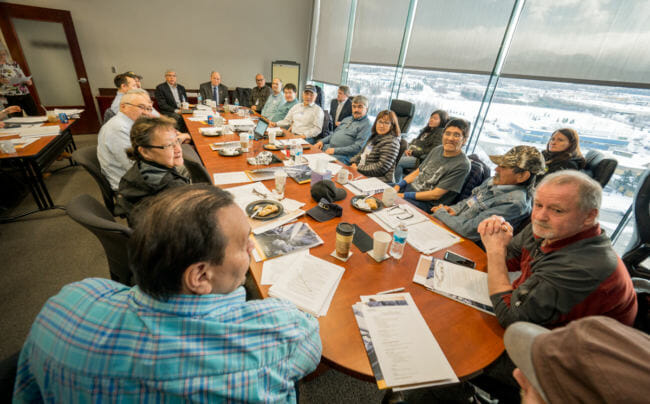
Sealaska directors on Friday approved a spring distribution totaling $23 million. The amount paid to each shareholder depends on the class of their shares. (Graphic courtesy Sealaska Corp.)
Sealaska’s spring shareholders’ payout is more than twice the size of the previous year’s.
The Southeast regional Native corporation announced Friday it will distribute $23.1 million to tribal members beginning April 13. Last spring’s dividends totaled $10.6 million.
The Juneau-headquartered corporation has more than 22,000 shareholders, almost all of Tlingit, Haida or Tsimshian descent. Dividends will range from approximately $236 to $1,586 each, depending on the class of shares and the number owned.
In a press release, officials said the corporation is also investing more money into its scholarship endowment. President and CEO Anthony Mallott cited rising costs for secondary education and the need to advance shareholders and their descendants.
The corporation’s board will also look into creating a burial-assistance program. Some Sealaska critics have lobbied for the benefit.
Officials cited increased business earnings as one reason for the larger payout and scholarship increase.
Sealaska began investing in Seattle-area fish-processing businesses in 2016.
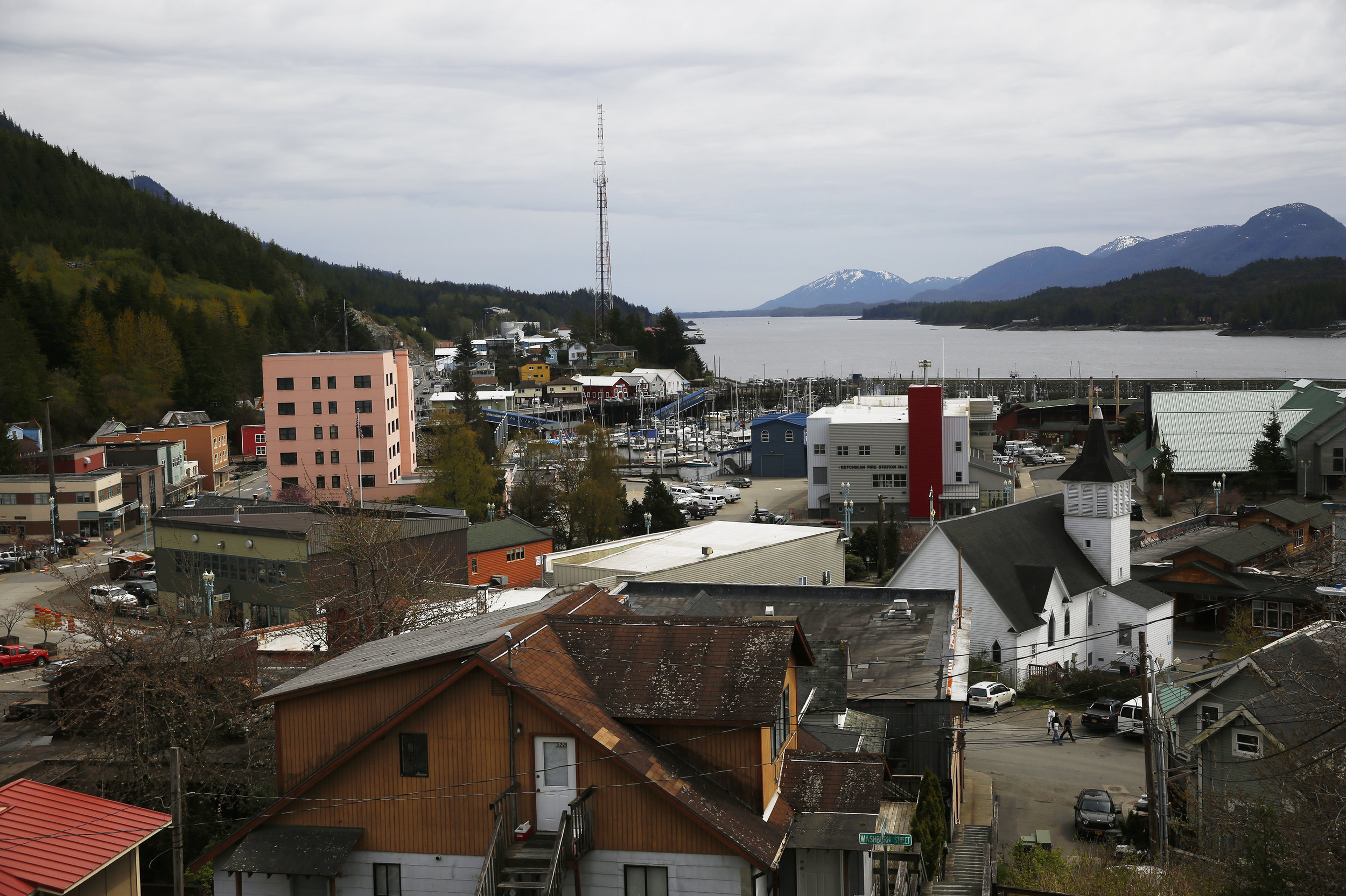
Downtown Ketchikan in spring 2017. The Southeast city is one of five without its own Alaska Native corporation. A bill before Congress would change that. (Photo by Elissa Nadworny/NPR)
Representatives of five Southeast Alaska communities continue their fight for recognition under the Alaska Native Claims Settlement Act.
But they’re still facing opposition.
It’s been almost a half-century since Congress passed the Alaska Native Claims Settlement Act, which created more than 200 corporations with land, money and shareholders.
It left out Ketchikan, Wrangell, Petersburg, Tenakee Springs and Haines, known as the landless communities.
Alaska’s Congressional delegation has introduced a number of bills over the years to address the situation. None has passed.
Supporters haven’t given up, and they said it’s not about money.
“It’s about the land, said Joseph Reeves, president of the Landless Natives of Ketchikan. “The land is our centerpiece and we ain’t ready to give up that idea.”
“Let’s have just a sliver of what we used to totally own,” he said. “And that’s all it is, 23,000 acres in Ketchikan out of the millions of acres around us that we always owned.”
U.S. Sen. Lisa Murkowski co-sponsored the measure with Sen. Dan Sullivan.
“This is a matter of equity,” she said. “To have five communities that were left out was not right then and it’s not right to this day that they continue to be on the outs.”
The bill was introduced last summer and had its first hearing in February.
It remains in the Senate Committee on Energy and Natural Resources, which Murkowski chairs.
Its best chance of passing is to be part of a larger lands measure.
The bill is opposed by a number of environmental organizations, because it would transfer a total of more than 100,000 acres of Southeast’s Tongass National Forest to the five new corporations.
One critic, Andy Moderow of the Alaska Wilderness League, also opposes land transfers elsewhere in the state.
“Under the guise of correcting past wrongs, Sen. Murkowski is pushing ahead with a bill that will create a whole bunch of new sets of problems in Southeast Alaska and around Alaska by privatizing up to 600,000 acres of land in our state with very few protections for areas that currently are public resources,” he said.
Others said the Forest Service and the then-thriving timber industry didn’t want to lose access to the land.
Still others have said it was a paperwork mistake in the rush to pass the legislation.
Reeves thinks that like its predecessors, this bill may not make it through Congress. But he and others will continue the work begun decades ago by people who are now elders or have passed away.
“We still have their children and their children’s children here that will benefit from this,” he said. “It will help them in their seeking of an identity as an Alaska Native person in this community. To be a part of an ANCSA corporation is something that we hope will help our people for generations to come.”
Most of the people who would gain stock in the new corporations already are shareholders of Sealaska, Southeast’s regional Native corporation. That’s the case for most members of the region’s other 13 urban or village corporations.
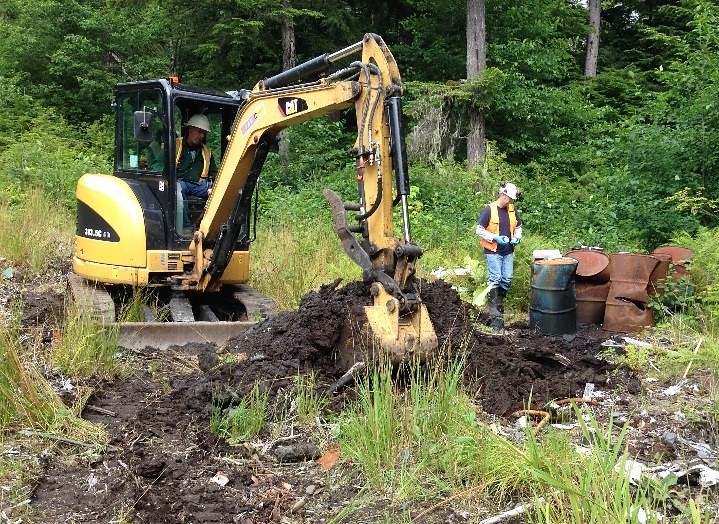
A backhoe digs up part of the old Byford Junkyard in Wrangell in 2014. After removing old cars, oil drums and other trash, the state is treating and moving contaminated soil to a rock quarry south of town. (Photo courtesy Department of Environmental Conservation)
The cleanup at the old Byford junkyard is on hold, pending further environmental testing from the state.
The state still plans on hauling 20,000 cubic yards of lead contaminated soil from the junkyard to a rock-pit, a quarter of a mile from Pat’s Creek.
The local tribe and city have spoken out against this proposed site, as it is near a fishing stream and recreation spot.
Wrangell Cooperative Association provided a report to the state outlining potential environmental hazards of the project at the site.
Biochemist Kendra Zamzow prepared the report, which suggests there could be phosphate leeching and other issues.
The Alaska Department of Environmental Conservation says it will address those concerns through additional testing in the next few weeks.
Contaminated Sites Program environmental program manager Sally Schlichting said the rock-pit still is the best option.
It is easy to access, does not require excessive permitting and already has been used as an industrial site in the past.
The state originally planned to start hauling the soil by April 1, but that’s been pushed back indefinitely.
Assembly members asked Schlichting whether there was a go/ no-go date, when the soil would be stuck at the junkyard.
Schlichting said there is no cut-off date, but delays will make the project more time consuming and costly for the state.
The local tribe has not budged from its position to oppose the site.
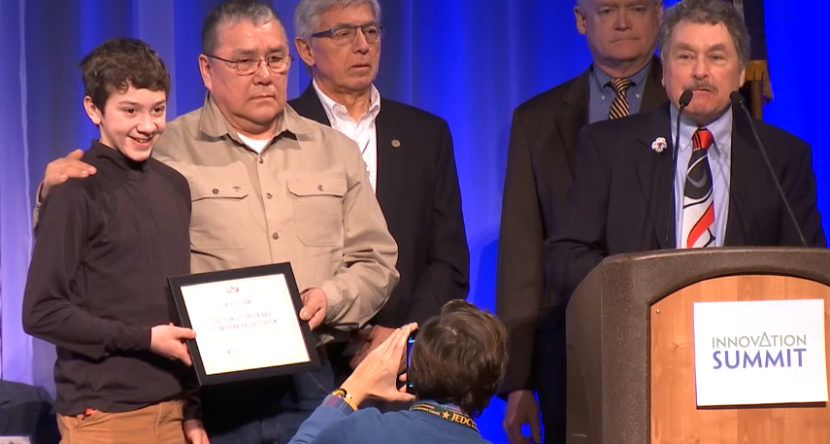
Thomas George and his grandson accept an award on behalf of Tlingit, Haida, and Tsimshian people for the traditional halibut hook. (Photo courtesy of 360 North/Juneau Economic Development Council)
The Alaska Innovators Hall of Fame recently inducted its first indigenous tool. Few people still use the hand-carved halibut hook, once popular with Southeast tribes. But there’s a push to make sure the tradition sticks around for future generations.
Standing on a stage with his grandson at the Juneau Innovation Summit a few weeks ago, Thomas George accepted an award.
“I’ve been trying to get help to keep this part of our heritage alive for years or decades,” George said.
The Alaska State Committee on Research gives credit to people and inventions which have made a lasting impact in the state.
George accepted the honor for a collective achievement: the halibut hook, which has been used by Tlingit, Haida and Tsimshian people for thousands of years.
Even though the technology is old, George says it isn’t a relic.
“Over the years everybody thought it was decoration for the wall,” George said. “But my hooks never did hang on the wall. They hung out on the porch.”
George only knows of one other person — in all of Southeast Alaska — who fishes with the traditional halibut hook, and he’s a big proponent for bringing them back. He’s taught classes at the Sealaska Heritage Institute on how to make them.
Growing up in Klawock, he says carving the hooks was part of his childhood. His grandmother was one of the people who passed on the knowledge, and he remembers some advice she gave him: All of the measurements you need to know are in your own hand.
“And if you got small hands you don’t need a big fish,” he said.
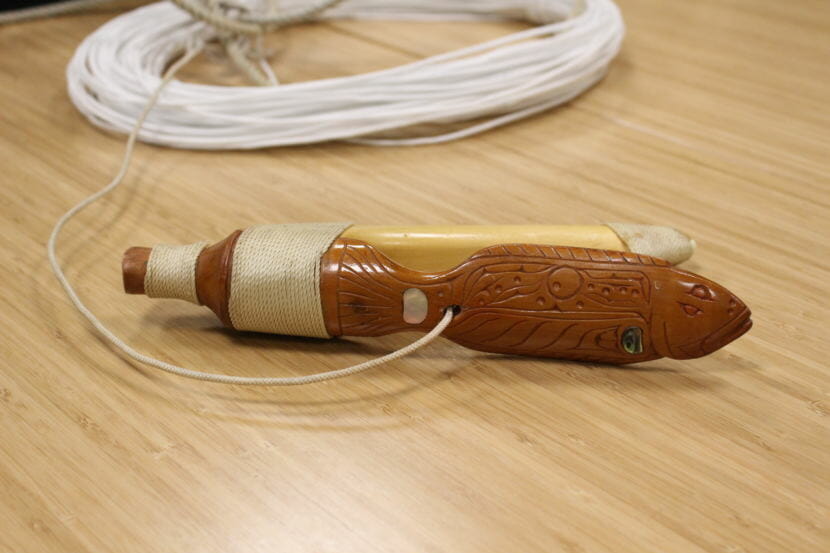
Typically, people jig for halibut on their boat using a metal circle hook. But the traditional design and method is different. The hook itself is shaped like a V, with a more buoyant wood like yellow cedar on one side and a denser wood on the other. This makes it float in a certain direction.
George says the best part about this way of fishing is you can set the line in the water and come back later. It’s suspended by floats.
“You could go to the beach and build a fire and boil coffee,” he said.
A traditional halibut hook at Sealaska Heritage Institute. (Photo by Elizabeth Jenkins/Alaska’s Energy Desk)
Each of his hooks is named after a different girlfriend, which he admits can sometimes be confusing.
“It’s getting harder to remember all of my girlfriend’s names, Tlingit names,” George said with a laugh. “Catching less and less fish.”
But over the years he says there’s been plenty of fish in sea. Just one hook alone, he estimates, has caught around 800 halibut.
He says even though the practice is sustainable and effective, fishing the traditional way hasn’t always been encouraged.
Back in the 1970s, before there were subsistence permits, he invited a state trooper to see the halibut hooks’ in action. After about five minutes, George had a halibut on the line.
“And we rolled them in, and he pulled up beside us and he said, ‘My god! I was going to confiscate your gear and write you a citation.’ But [the trooper] said, ‘That was truly amazing just to witness.'”
George begged the state trooper to write him a citation because he wanted to challenge the issue in court. But the trooper was elated. He never bothered him again.
In 2000, the North Pacific Fishery Management Council established a subsistence program for halibut. But George thinks there’s still roadblocks to preserving the traditional ways. Having to obtain a subsistence permit at all, he says, creates an additional barrier, and he’d like to see more people use the hand-carved halibut hook.
“So that part of our heritage does not die,” he said.
George wishes the state legislature would address the issue and take it up with the regional fishery management council.
In the meantime, he’s doing his part to make sure the next generation knows how to make the traditional hooks. His 14 year-old grandson has already picked up the skill.
“Well, he hasn’t said much except ‘let’s go fishing’,” George said.
George says the state recognizes the halibut hook is an important innovation. It’s a technology worth keeping around.
The Voice of the Arctic Iñupiat annual board meeting at the Arctic Slope Regional Corporation headquarters in Anchorage, Alaska in March 2018. Governor Walker and Lt. Governor Mallott were also in attendance. The organization consists of many of the Iñupiat leadership organizations of the North Slope, and the Governor has been invited to fill an advisory role on the board. (Credit: Brice Habeger, Office of the Governor)
In a place like the Alaskan Arctic, local issues often unfold on a national, or even international scale. Oil companies, the state, the federal government, environmental groups — they all have something that they want to see happen there.
So, how do the wants of local people get heard? And who gets to speak for them?
There’s a new organization that says the Iñupiat of the North Slope will be stronger if they speak as one.
The group is called Voice of the Arctic Iñupiat, or VOICE. It’s a nonprofit, and gets its funding from the North Slope Borough and the Arctic Slope Regional Corporation, as well as donations from its other member entities, and public contributions through its website. Their goal is to bring together the leaders of the region to weigh in on policies that affect their communities.
“Whether it’s development, whether it’s subsistence rights, we want to be heard in our fashion, in our manner,” says John Hopson, Jr., the mayor of the village of Wainwright and vice chairman of VOICE in a promotional video on their website. “Not someone who lives in Washington D.C. telling us what’s right and what’s wrong for us.”
Leaders like Hopson from the local governments, tribal councils and native corporations say they kept hearing outsiders — like politicians in Washington, D.C., and environmental groups — talking on a national stage about their local issues. And some of those leaders felt that their groups would be better heard on that national stage if they unified.
Speaking at a Resource Development Council conference last November, VOICE Chairman Rex A. Rock Sr. described the idea for the group this way: “To allow us, as many different individual organizations with unique purposes and goals to come together, to finally speak with one voice.” Rock is also the President and CEO of the Arctic Slope Regional Corporation.
Since VOICE was launched in 2015, it’s invited 28 leadership organizations across the North Slope to be members. Twenty have accepted.
The city of Utqiaġvik is a member, and the mayor, Fannie Suvlu, represents the city at VOICE meetings. She says that hard conversations sometimes happen around the table. Some policies affect certain parts of the North Slope differently than others, and not everyone agrees. She likes that part of it — hearing what other leaders are thinking.
“I know what’s happening with [the Arctic National Wildlife Refuge], but I don’t know how it’s affecting the people at home in ANWR,” Suvlu said. “Or…I know that that we have development in Alpine real close to Nuiqsut, but I don’t see the everyday effects of that.”
But Mayor Suvlu also says that in this regard the organization hasn’t yet reached its full potential.
That’s because despite the emphasis on unity, there are some big gaps in the membership. For example, there’s currently no representation from the village of Nuiqsut, which is one of the places on the North Slope most directly impacted by development.
Also missing is the regional tribal government, the Iñupiat Community of the Arctic Slope, or ICAS. That’s the group that the federal government has to consult with before taking any action in the region.
George Edwardson is the President of ICAS.
“We don’t want to weaken our ability to speak and stand, and to join the VOICE we would have to,” Edwardson said.
To be clear, Edwardson doesn’t have a problem with the fact that these other leadership groups have teamed up as VOICE. He just thinks that remaining separate from the organization will give his group the independence it needs to counterbalance some of the others in the region, like the local corporations.
“They’re doing what they were designed to do: make money. And as a regional tribal government, my job is to protect the ecosystem, and the people and the culture.”
One of Edwardson’s group’s big issues is offshore drilling. He says they’re completely opposed. But VOICE has decided not to take a position on offshore development, though they have said they want several critical subsistence areas to be off-limits.
And this gets at the real question facing leaders on the North Slope. Do they join together, hash out their differences, and try speak to issues with one voice, like Mayor Suvlu and the members of Voice of the Arctic Iñupiat are suggesting?
“I definitely think it’s possible to have a unified voice but it’s never going to be truly unified unless all entities that were invited to the table take advantage of it,” Mayor Suvlu said.
Or, are their constituents better served by a chorus of distinct ones, like George Edwardson and his group?
“So when the community has issues, we’ll stand up with them,” said Edwardson. “Sometimes the issues might be against one of the organizations in Voice of the Arctic… Sometimes we internally fight each other; that’s no problem…that’s how democracy works. Everybody has its voice.”
Voice of the Arctic Iñupiat says it respects the regional tribal government’s decision not to become a member, and that the door is always open for the groups that have been invited to join.
Editor’s Note: The original version of this story listed the North Slope Borough and Arctic Slope Regional Corporation as the funding sources for VOICE. It has been corrected to reflect additional sources of funding.
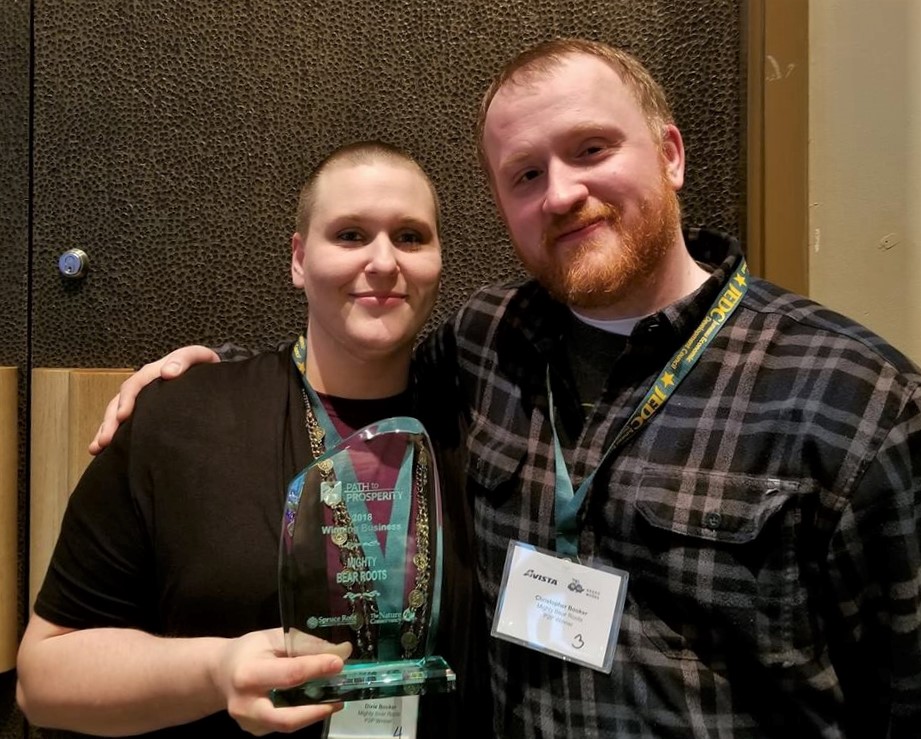
Dixie Booker and Chris Booker won a Path to Prosperity grant to build an aeroponic farming business. Their startup, Mighty Bear Roots, is meant to provide local produce to the Wrangell community. (Photo courtesy Dixie Booker)
A Wrangell pizza shop owner just got a $25,000 grant to jump-start a new, slightly different business. Dixie Booker will start an aeroponic greenhouse to provide local, year-round produce in the community.
Booker received the grant from Path to Prosperity, which is part of Sealaska Corp.’s regional development efforts. For the past four years, the program has awarded grants to Southeast business startups based on their proposed economic, social and environmental benefits.
“Our local produce, and it’s not any of the stores’ fault, it’s what they’re shipped. But we get subpar produce most of the time or produce that doesn’t last very long,” Booker said. “And you can only in good conscience feed your organic produce to your chickens so many times without getting frustrated.”
She’s been experimenting with aeroponic farming. It’s a process that suspends plants’ roots in air, rather than soil, for high density growing.
“I like using dirt and getting my hands dirty, but I knew I had to do something different around here to grow year-round,” she said.
While gardening is popular in Southeast, that doesn’t mean it’s easy.
“Sometimes we get a really hard rain, and if you don’t get out there and cover it fast enough it turns into mush,” Booker said.
She got an aeroponic tower to test out. It can hold a couple dozen plants and has a timed watering and aerating system. She’s grown strawberries, pumpkins and tomatoes.
“The season was really cruddy, it got fairly cold quickly. So, I pulled the tomatoes off and even though they weren’t ripe, they were absolutely delicious,” Booker said.
Based on those results, she decided this was the right technology to pursue for her startup, Mighty Bear Roots.
Booker will start growing lettuce and herbs on her insulated porch this summer. Once that gets going, she plans to buy a dozen aeroponic towers. Eventually she hopes to build a 2,000-square-foot greenhouse with more than 100 towers.
But the grant is not meant for buying the towers or building the greenhouse. Instead, it funds training and business development opportunities. Booker plans to go to a large-scale greenhouse in Arizona, similar to the one she hopes to build.
“I haven’t really stepped into that situation where I can look around and say, ‘Oh yeah, I never thought about this. How do you manage X, Y, Z?’,” Booker said.
The grant will also pay for packaging and logo designs.
“I’m sure there’s going to be stumbling blocks,” Booker said. “But I really feel like being able to utilize this money for training purposes will give us such a better leg up in the process and hopefully minimize our stumbling blocks.”
And Booker said she’ll incorporate that new fresh produce with her tried-and-true pizza shop, Not So Famous Pizza. She’ll add salads and fresh herbs to the menu.