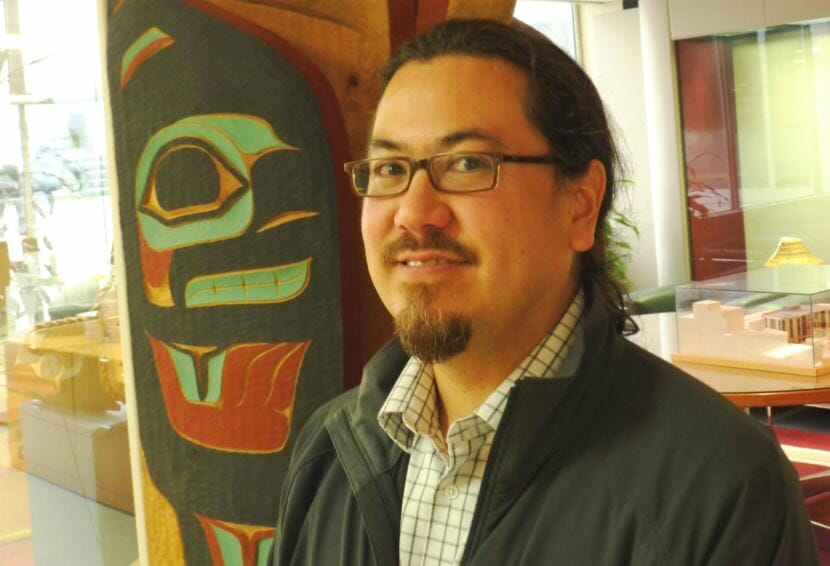
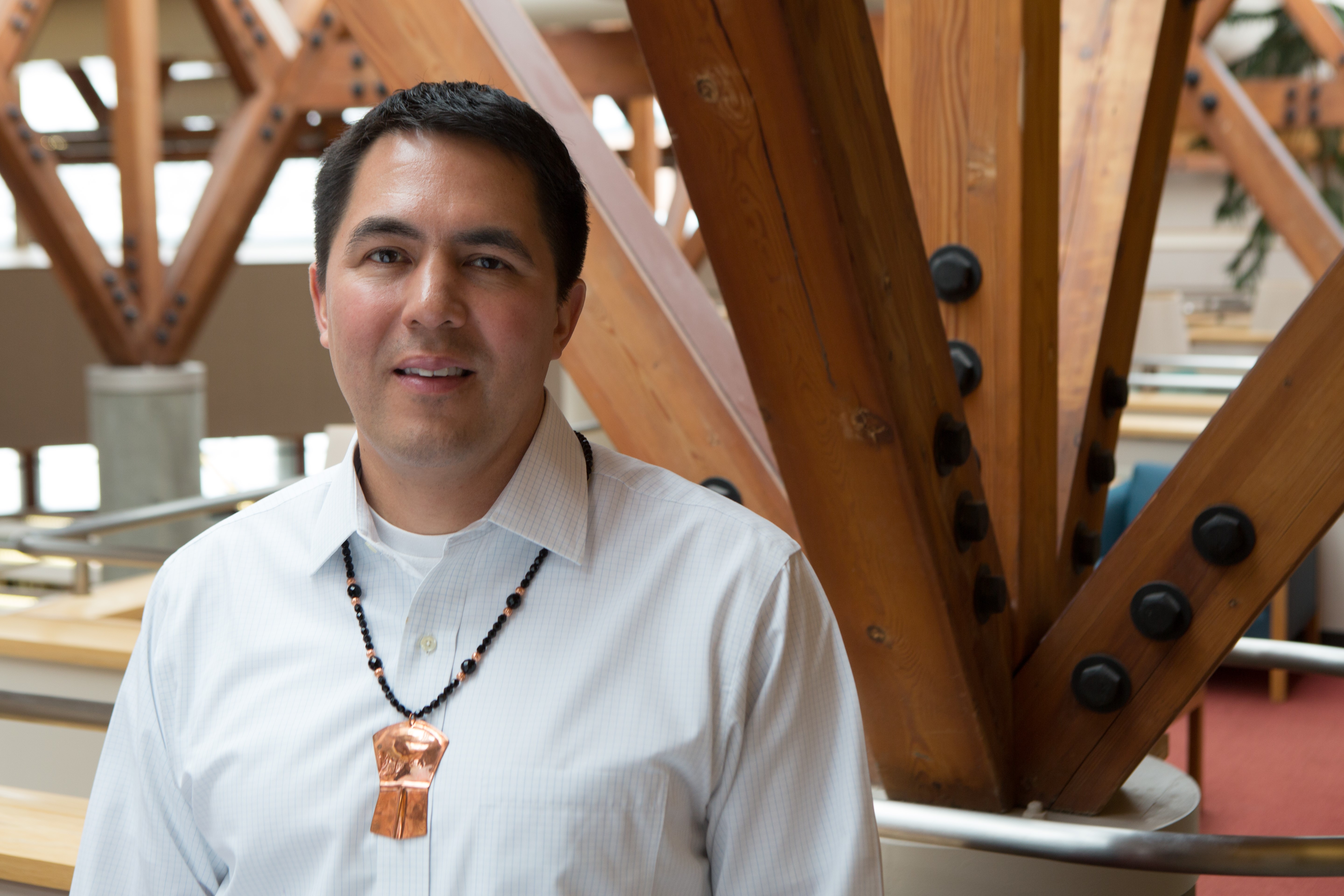
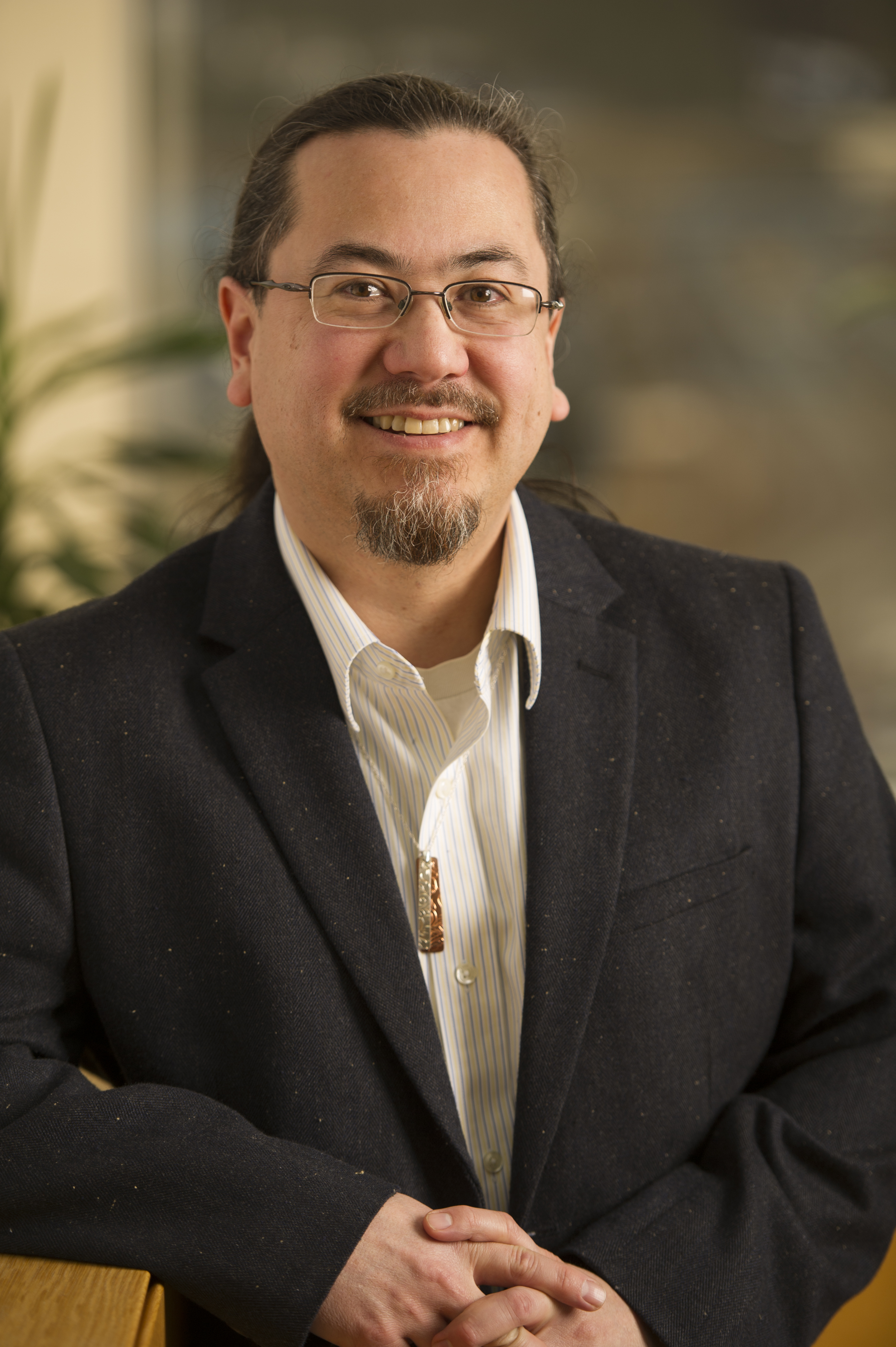
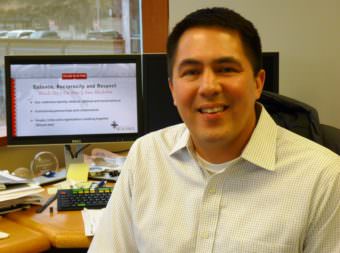
Sealaska Board Chairman Joe Nelson poses at corporate headquarters in Juneau after he was elected to the position in June 2014. Nelson announced a new shareholder burial assistance program on Monday. (Photo by Ed Schoenfeld/CoastAlaska News)
Sealaska is helping its shareholders with burial and cremation costs. The Southeast regional Native corporation’s board voted Monday to offer bereavement benefits of up to $1,000.
Losing a loved one is difficult enough on its own. Add the cost of a funeral, burial or cremation and it can be too much to handle.
A thousand dollars isn’t enough to cover all expenses, which can easily top $10,000. But it can help.
“This is one that’s been out there for a long time and we haven’t been able to get there. But this year, because of our financial performance and our anticipated continued solid performance, that I think everybody in the company’s just excited that we’re able to move on this one this year,” he said.
Survivors will receive $1,000 when an original shareholder dies. That covers those enrolled in the corporation since it formed in the early 1970s.
Descendants of original shareholders, and those who inherited or were given stock, will receive up to that amount. The corporation said payments will be based on the number of voting shares at the time of the shareholder’s death.
“It’s a function of being in a healthy financial position and then having the specific carbon project where we want to associate that carbon program to a benefit that all shareholders will feel for generations to come,” he said.
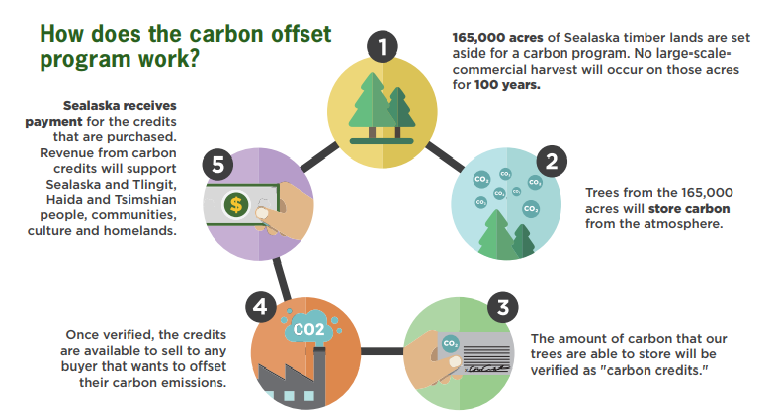
That project allows Sealaska to sell carbon offset credits through a program based in California. It’s complicated, but basically, the corporation keeps some of its forests intact, in exchange for payments from polluters.
Shareholder bereavement benefits began May 7, the day Sealaska’s board of directors approved the new program.
“I think this is fantastic news for shareholders,” said Nicole Hallingstad, a former Sealaska corporate secretary who’s running for the board as an independent candidate.
She’s among other candidates and corporate critics who’ve called for bereavement benefits.
“The most important thing about this announcement is that it just proves that when shareholders are united and are persistent in their voice in raising an issue, that we can actually accomplish the change that we’re asking for,” she said.
Nelson said a recent survey showed the benefit among shareholders’ top priorities. It was outranked by scholarships and dividends.
“Whenever we go out in the communities, just in our regular shareholder engagement, it is a regular theme — that a lot of folks could use help with burial assistance. And it’s also part of our cultural values, especially in Southeast, where we come together and support each other during times when someone passes,” he said.
Some other regional Native corporations already provide a similar benefit.
Nelson said the mechanics of payments are being worked out, but applications will be available sometime in June.
Sealaska estimates around 300 shareholders die every year. The corporation has between 22,000 and 23,000 shareholders.
Alaska Army National Guard Col. Wayne Don pledges the Oath of Office after being promoted to full colonel on July 14, 2017. (Photo by Sgt. David Bedard/courtesy U.S. Army)
The Calista Regional Corporation denies its CEO mishandled a sexual harassment complaint.
Calista’s Board of Directors alleges in a press release that ousted chairman Wayne Don is deliberately spreading misinformation about the company.
Don and his attorney said in interviews with KYUK that Calista CEO Andrew Guy failed to properly respond to a sexual harassment complaint against a former employee.
Tthe woman never made even one complaint to Mr. Andrew Guy that she had been sexually harassed,” the board claimed in their statement Friday.
“The woman who was harassed did not approach Andrew Guy,” Calista Communications Manager Thom Leonard reiterated in an interview Friday with KYUK.
The board’s new chairman Paul George Guy released the statement, which further claims that Wayne Don made “incorrect and misleading” statements to both KYUK and the Delta Discovery and violated his “fiduciary duties.”
Friday’s press release is the latest in a series of allegations that Calista has made against Don, who is refusing to resign from the corporation’s board.
His fellow board members already have stripped Don of his chairmanship and voted to publicly censure him.
An unnamed former Calista employee is accused of repeatedly sexually harassing a woman.
According to Don and his attorney, the woman told CEO Andrew Guy what was happening, but Guy failed to respond to her complaint.
The harassment claim eventually made its way to Calista’s Human Resources Department, and Calista investigated and fired the offending employee.
In their statement Friday, the Board denied the woman ever told Andrew Guy about sexual harassment. It also cast doubt on whether she was harassed at all.
The board said that Calista’s former employee had not, in fact, repeatedly sexually harassed the woman and that “this highly inflammatory statement is completely false.”
However, the press release then says an attorney who reviewed the allegations concluded that it was likely” that the employee’s conduct violated Calista’s sexual harassment policies.
The release further says that the employee was fired as a result of an investigation, apparent contradictions in the corporation’s press release.
“Yeah, I don’t have any further light I can shed on that,” Leonard said.
Attorney Sam Fortier said Don tried to address Andrew Guy’s alleged failure to respond to the sexual harassment, but that Calista’s Board of Directors shut him down.
Fortier said that the board is now pushing Don out of the corporation.
Calista claims that they publicly censured Don for different reasons.
The board’s press release states that Don committed at least 14 instances of misconduct while serving as Calista’s chair, though Leonard didn’t know what any of that misconduct actually was.
“The specific details on that have not been shared by the board at this time,” he said.
Fortier said that he and Don stick by what they said in KYUK’s previous coverage. “Everything we told you is true,” he said, “and we have the evidence to back it up.”
The board also previously claimed that Don had threatened CEO Andrew Guy, interfered with an internal investigation, and improperly issued orders to other employees.
Neither Andrew Guy nor the current Calista Board chair Paul George Guy could be reached for comment Friday.
Wayne Don still refuses to resign from Calista’s board and says that the board has called a special meeting.
Sealaska Corp. distributed its 2017 annual report to shareholders Thursday, showing it had a very good year.
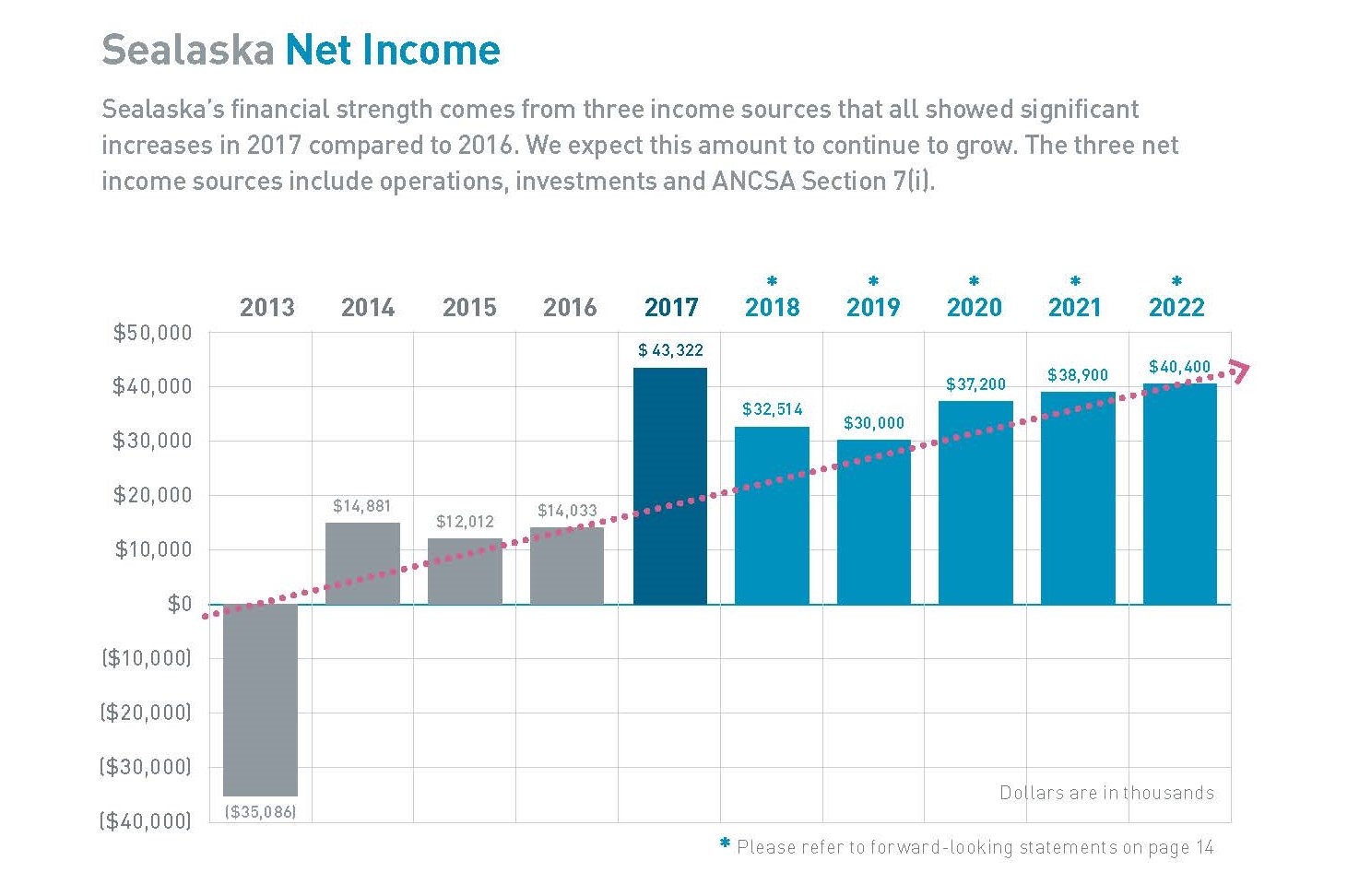
The regional Alaska Native corporation for Southeast said it earned $43 million in profit last year — tripling its 2016 earnings.
“2017 is a great year, it’s a milestone, it should be recognized,” CEO Anthony Mallott said. “But the excitement is really the new era, the change. That we have confidence that we can keep that business performance going and just create consistency of growth for Sealaska that we haven’t had in our history.”
The first graph in the annual report tells the story of the company’s turnaround at a glance; a total reversal from being $35 million in the red in 2013 and a clear trend line into the future.
This graph appears in Sealaska’s 2017 annual report, distributed on May 3. CEO Anthony Mallott said 2013 crystallized the history of cyclical success, upheaval, and underperformance among the corporation’s subsidiaries. He said 2017 marks a new era and a new normal. (Courtesy Sealaska)
Last year was the final year in a five-year plan that included a goal of financial stability based on the businesses Sealaska directly operates. Previous years’ profits relied on its passive investment income and revenue sharing income from other Alaska Native corporations.
The plan called for realigning Sealaska’s business interests with its shareholders’ values. “Relevant and meaningful” was the refrain in the boardroom.
“We are focusing on enhancing the health and the productivity of our ocean and land environment,” Mallott said. “That ocean and land environment is our homelands. Enhancing the health and productivity of our homelands is what our ancestors have done for 10,000 years. We’re just following a path.”
In other words, ruthless corporate exploitation is out. One practical effect in recent years has been Sealaska selling off its grab bag of far-flung businesses.
Sealaska CEO Anthony Mallott. (Photo courtesy Sealaska)
“There was a broadness of the operating portfolio and no tie to, why is Sealaska in these businesses?” Mallott said. “So we were in stand-up guard services that were in Miami. We were in plastic injection molding facilities that were in Guadalajara (Mexico), Alabama and Iowa. We were in a global logistics company based out of Georgia. We were in heavy civil construction in Hawaii.”
The new corporate philosophy also meant generally scaling back timber operations, entering the carbon credit market through forest preservation, and expanding government contracting services focused on environmental work. And in 2016, the corporation began adding new lines of business in seafood processing in the Pacific Northwest.
Sealaska does still own some real estate near San Francisco it once intended to develop into a resort casino for a small California tribe. Mallott said that’s a legacy project from a previous CEO that Sealaska’s been trying to unload for years. It got caught up in the 2008 financial crisis.
“There’ll be a developer, we’re just not the right developer,” Mallott said.
Mallott said there will be no more casinos in Sealaska’s future, and no other lingering misalignments in its portfolio.
Timber remains Sealaska’s main income source among its businesses, Mallott said. But he said it will soon be overtaken by its second-most profitable line: government contracting in environmental services. That’s included contracts with the Forest Service and NOAA, and work on salmon habitat restoration and water quality monitoring.
Seafood was a small piece of the profit pie. But Mallott expects a lot of income growth among its recently acquired packing plants, and said expansion into other foods is coming.
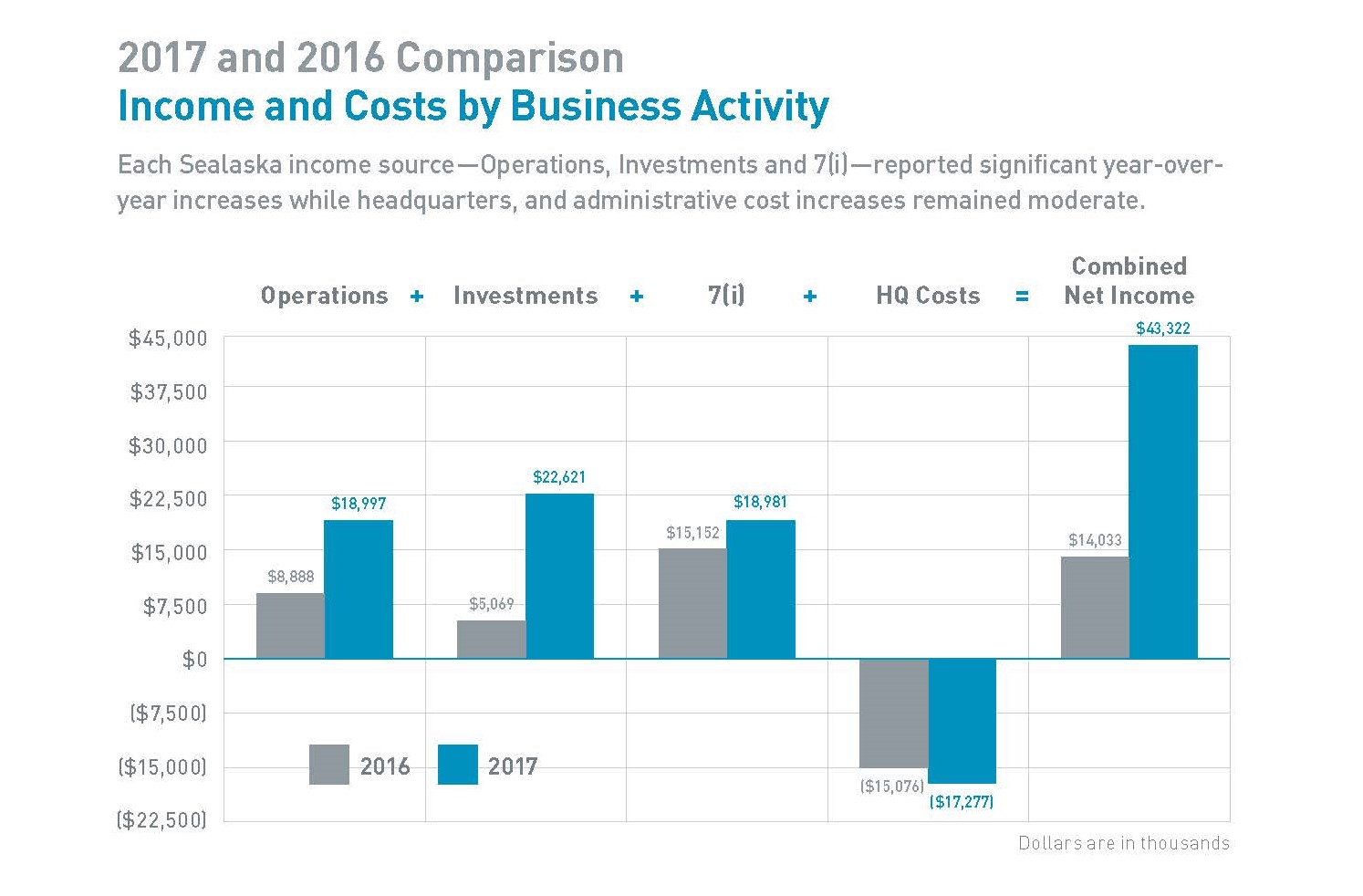
There is a big caveat on Sealaska’s 2017 profits. Roughly two-thirds came from sources it has little control over: financial investments and revenue sharing from other Alaska Native corporations. Without those two sources, which can vary a lot from year to year, Sealaska still would have turned a profit.
This graph appears in Sealaska’s 2017 annual report, distributed to on May 3. The corporation has little control over its investment income and 7(i) income. (Courtesy Sealaska)Sealaska Board Chairman Joe Nelson. (Photo courtesy Sealaska)
Sealaska Board Chairman Joe Nelson said that’s a huge milestone.
“The next phase for Sealaska is going to be a lot more energy focused on our people, our communities, our homeland, which is core to our mission,” Nelson said. “You know, we’re a for-profit company, that’s never been in question, but we’ve really turned things around in terms of our operating companies such that we’re able to get to the real work of investing in our communities.”
One community investment the annual report highlights is in Sealaska’s scholarship program. The corporation set aside an extra $10 million last year, nearly tripling the endowment that helps pay for shareholders and their kids’ post-high school education. It’s already boosting scholarships being awarded this spring.
For accounting purposes, it’s an expense. But philosophically, Mallott said it isn’t.
“The money we put into (Sealaska Heritage Institute), the money we put into put into scholarships, the money we put into internship programs – we don’t consider those expenses, we consider those investments,” Mallott said. “It flows through as an expense if you read (generally accepted accounting principles), but they’re an investment, for sure. The ability to help our people attain their educational goals is positive for them personally, provides upside for our communities, having a better educated base of community members, and can lead to talent development specifically for Sealaska. It’s all part and parcel.”
Mallott came up through those programs himself.
“I was a scholarship recipient and an intern,” Mallott said. “Joe (Nelson) was a scholarship recipient and an intern. Our vice chair was a scholarship recipient and an intern. So it’s been working, we just think there’s so much more we can be doing.”
The more Sealaska’s business operations grow, the more Sealaska can invest in its communities. Mallott said income from its business operations will be half the net income pie within the next couple of years, and longer term, he’s aiming for three-quarters.
“At three-quarters, you really diminish volatility that our passive investment sources have,” Mallott said.
Subsidiaries aside, Mallott said Sealaska’s turnaround also came from cutting the corporate headquarters’ operating budget by about 40 percent since 2012. A lot went into that. For example, reorganizing many human resources managers at many subsidiaries into a centralized human resources team.
“And, we were clearly overspending at that point in time, as well,” Mallott said.
The geographic consolidation and clearer mission also helped cut costs. Like the third-party audits that backstop financial reports. Mallott said they became less complicated, and less expensive.
The message is that Sealaska’s financial turnaround is validation that tying traditional values to business practices was the right call.
“Plastics was not a part of who Sealaska was,” Mallott said.
But he said that’s only half the story. The company’s next five years will tell the rest.
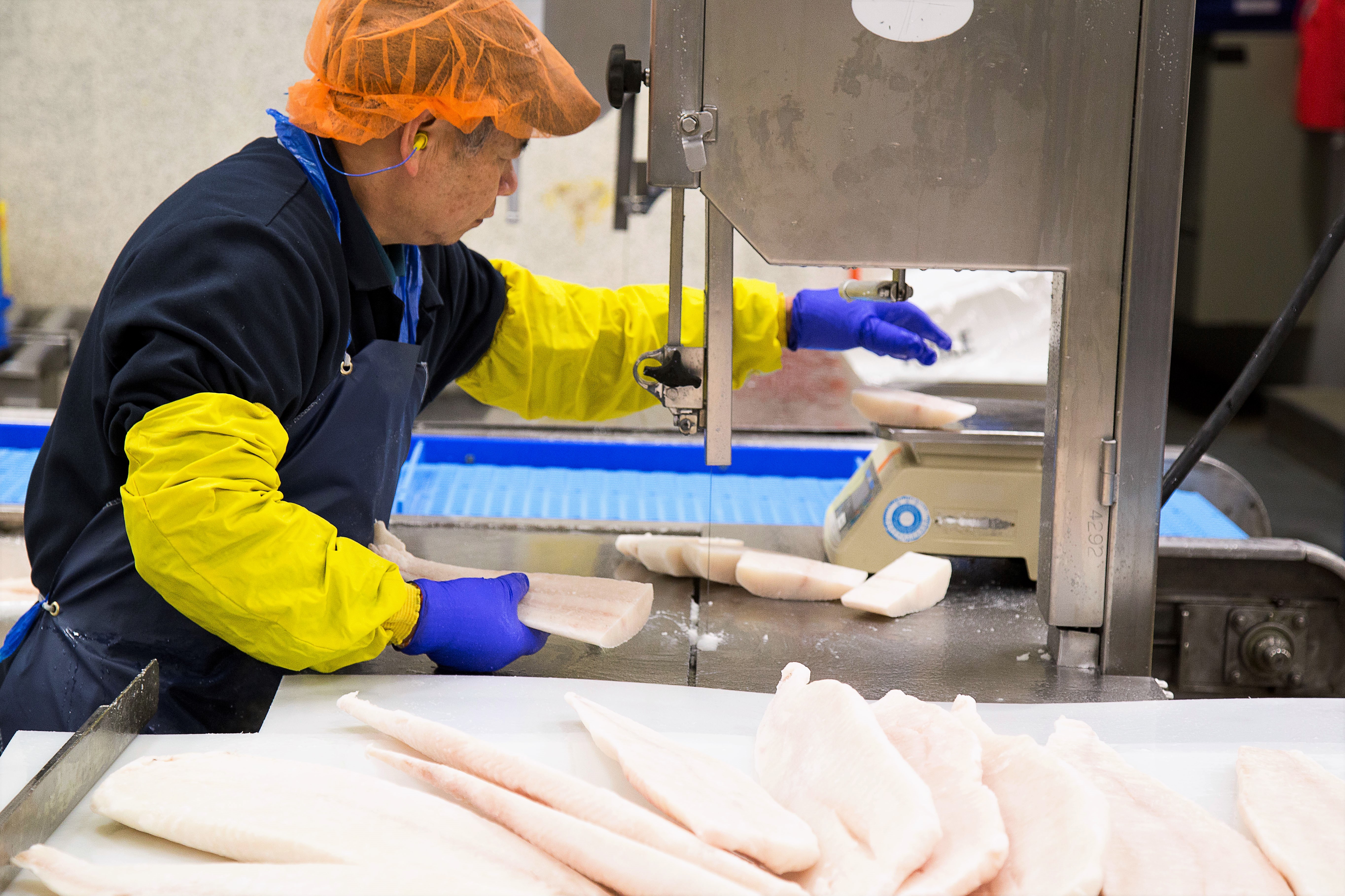
A worker portions halibut at a processing line at Odyssey, one of Sealaska’s recent Seattle-area seafood investments. The corporation says those investments boost earnings and dividends. (Photo courtesy Sealaska Corp.)
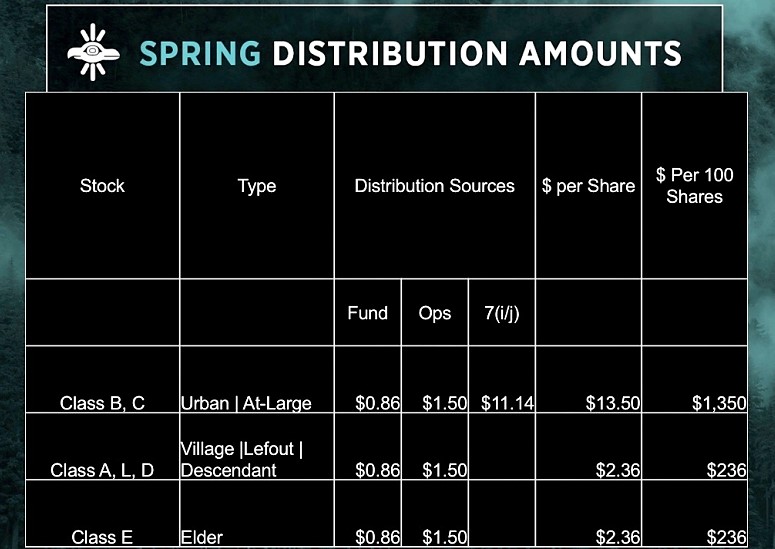
Sealaska Corp. will distribute more than $23 million to its shareholders Friday. It’s twice last spring’s amount, in part because the Southeast regional Native corporation’s own businesses are making more money.
But the largest part of many shareholders’ checks come from other regional Native corporations’ earnings.
Some ended up with large stands of trees, rare mineral deposits or other valuable natural resources. Others did not.
So the act – and a later legal agreement – required those with more to share their wealth with those with less. It’s known as section 7(i/j).
Juneau-headquartered Sealaska used to be one of those with more. It made a lot of money off its timberlands and shared 70 percent with other regional corporations. But in more recent years, it’s been getting considerable revenue from two of its northern cousins.
“That’s been down from historic levels and is still down from historic levels,” said Anthony Mallott, Sealaska’s president and CEO.
The other owns the rights to a profitable mine in northwest Alaska.
“This last year, zinc prices have been headed upward. And there’s more income from the Red Dog Mine that NANA (Regional Corp.) is the landowner of,” Mallott said.
Dividend totals differ. This year, they range from $13.50 to $2.36 per share. That’s because the corporation’s more than 22,000 shareholders are divided into classes.
For those getting the largest dividends, more than 80 percent comes from the shared revenue pool. A little more than 10 percent comes from the corporation’s own businesses. The remainder is from the corporation’s permanent fund earnings.
Mallott said they’re doing well.
“The land-management (and) natural resource business is one of the leaders. We’re actively investing in the seafood side, meaning expectations that seafood will quickly be the greatest source of income for Sealaska,” he said.
The corporation also continues to earn money through investments and government contracting.
“They were all profitable in 2017 just like they were all profitable in 2016. And they’re all growing,” he said.
“If this a trend line for Sealaska, that’s great news,” said Nicole Hallingstad, a former vice president and corporate secretary for Sealaska.
She’s also run for its board of directors as an independent – and sometimes critical – candidate.
“Shareholders want to support the corporation and they’re excited that the corporation seems to be on a trend of profitability,” she said.
It’s hard to tell how well Sealaska’s different subsidiaries are doing. That’s because the corporation reports financial results by sector, not for each separate company.
Hallingstad said that’s understandable because corporations don’t want competitors to know too many details. But she thinks Sealaska could be more transparent in its dividends breakdown for shareholders.
“It would be great if there was a number that showed the earnings from our subsidiary holdings as opposed to the investment holdings. And that way, shareholders really can begin to track what our subsidiary operations are doing,” she said.
About five years ago, Sealaska’s revenues dropped significantly due to more than $30 million in losses from its construction subsidiary and some other operations.
The losses were spread out over several years. But Mallott said they’re no longer part of the dividend equation.
Alaska was invited to participate in the California cap-and-trade market in 2015 after lobbying from the Chugach Alaska Corporation. Chugach is also working on developing its own carbon offset credits. (Creative Commons photo by Xa’at)
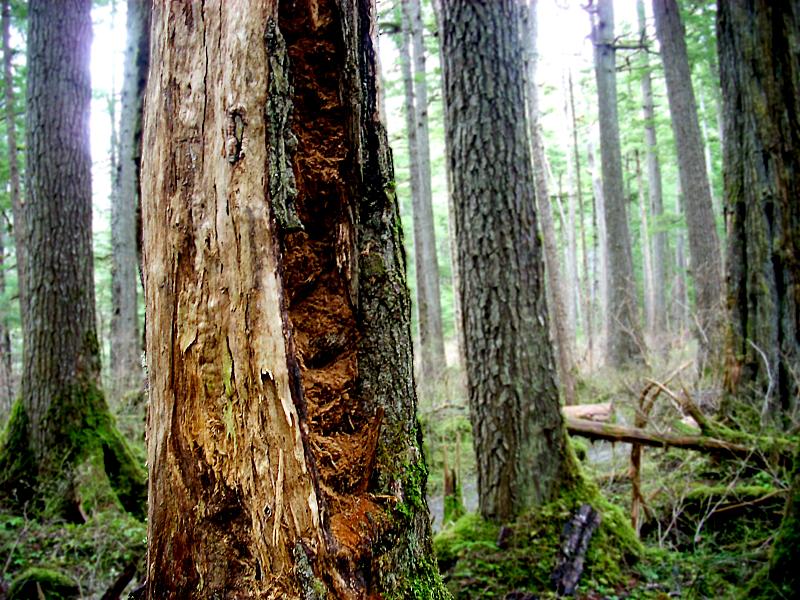
Big greenhouse gas emitters in California are now able to buy carbon offset credits based in Alaska. The Southeast regional Native corporation Sealaska is using some of its lands for carbon sequestration. Thousands of acres of old growth trees will stay intact for over 100 years. It’s the first carbon bank in the state to be approved for the market.
Sealaska says its another way of securing a future for shareholders.
On the fourth floor of Sealaska Plaza, there’s a board room with an amazing view. A long glass window overlooks the Gastineau Channel. Beyond that, you can see a canopy of evergreens.
Anthony Mallott gestures to the landscape.
“We think we live in a very protected, amazing sacred place on this Earth,” Mallott said. “But there’s room for economic activity.”
Mallott is Sealaska Corporation’s President and CEO. At 42 years old, he’s one of the younger leaders. This morning he went skiing. But he jokes he doesn’t always feel so youthful with a bad knee.
Mallott began working at Sealaska over a decade ago.
“I started in a time period where we could see effectively the end of our timber harvests without getting additional news lands,” he said.
Anthony Mallott in his Juneau office. (Photo by Ed Schoenfeld, CoastAlaska News)
The corporation manages around 360,000 acres in Southeast Alaska, and Mallott says developing the natural resources, like timber, was an important part of creating the first dividends for its shareholders.
But he says the originallandallocation Sealaska received only represents a small part of the region.
“It wasn’t the be all and end all,” Mallott said. “It was something that allowed us to move forward. But it hasn’t fulfilled all the expectations.”
The corporation is expected to make money for its shareholders. But it’s already cut close to a third of its trees, and not all of the sites left are ideal for logging, like old growth stands next to salmon streams.
So, Mallott says the corporation faced a challenge. How do you protect those sensitive areas and still make money for shareholders?
“It was really the need to stretch our harvest and diminish our harvest from a higher level that put us in this framework thinking, ‘OK, what really is sustainability for Sealaska?” Mallott said.
Enter the California cap-and-trade program.
Basically, big polluters in the Golden State receive an allowance to release a planned amount of carbon each year. To account for each metric ton of carbon, companies can use that allowance or buy carbon offset credits. Those credits represent an actual, tangible thing: carbon stored in trees — in this case, trees belonging to Sealaska.
Image courtesy of Sealaska Corporation.
Mallott says carbon sequestration looked like the right opportunity. The money generated would help shareholders and nearly half of the trees on Sealaska land could stay in the ground.
He’s quick to point out this land isn’t locked up. The corporation can can still develop parcels for tourism or mineral exploration.
He says the project has already attracted a buyer. It’s too early to put a dollar figure on the deal. But he thinks the amount could be huge.
“Multiple millions,” Mallott said. “The financial benefit of this is very significant for Sealaska.”
In the past, conservation groups have been critical of the rate Sealaska has clear cut its forests.
Buck Lindekugel is a grass roots attorney for the Southeast Alaska Conservation Council, and he says that old model of logging doesn’t make sense for the region’s economy today. He welcomes the corporation’s new venture.
“We’re excited that Sealaska is seizing this opportunity to explore those options,” Lindekugel said. “We think it’s good for their shareholders, and it’s certainly good for all of us who care about the forest.”
But Mallott says Sealaska has always cared about sustainability and the bottom line.
“The carbon project. Is it a shift? It’s a recognition in the way we’ve always thought,” Mallott said.
He says the corporation isn’t going to stop logging on its remaining land. But it’s also planning to allocate more acreage to carbon sequestration in the near future.
As for what happens to the trees after the 110 years is up, Mallott says that’s up to a younger generation to decide.
Editor’s Note: The explanation about the California cap-and-trade has been updated. A spokesperson from the California Air Resource Board said companies aren’t allowed to go over the set cap, even with allowances and carbon offset credits.
Close
Update notification options
Subscribe to notifications
Subscribe
Get notifications about news related to the topics you care about. You can unsubscribe anytime.