Napaskiak Tribal Administrator Sharon Williams, seen here in July 2017, says that Bethel’s liquor store has led to an increase in alcohol-related deaths. (Photo by Katie Basile/KYUK)
The Native village of Napaskiak asked Gov. Bill Walker on Tuesday to declare a state of emergency, following an increase in alcohol-related deaths.
Bethel’s liquor store has disrupted village life so badly that it requires state and federal intervention, according to tribal council members.
“We’ve buried so many loved ones already,” said Napaskiak tribal administrator Sharon Williams. “I know we did before the liquor store opened, but ever since the liquor store opened (we’ve had) death after death. It’s wearing us down.”
In the years since Bethel’s liquor store opened in 2016, Williams said that community members have died in four-wheeler, boat and snowmachine accidents while driving intoxicated.
A man died near town in an alcohol-related accident only a few weeks ago, and he was someone Williams knew.
According to the tribal council’s resolution, even school attendance has been affected by alcohol disturbances.
“Something needs to be done,” Williams said. “We can’t take it any more.”
Napaskiak has used gaming revenue to hire four village police officers, said Williams, as well as employees for the village’s small jail. They might need to hire more.
The jail is often used to hold disorderly, intoxicated people for five or six hours, but after an alcohol-related murder in Napaskiak last July, village police officers doubled that holding period to 12 hours.
The tribal council’s resolution calls for Bethel’s liquor store to close, but Williams said that there might be ways to better regulate it.
Perhaps villages could provide a list of people they want barred from buying alcohol.
“It would be really good if our councils gave names to the state of Alaska to write on their state ID, ‘no alcohol sales,’ because they’re repeat offenders in the village,” Williams said. “I know it can be done.”
The governor’s office has not yet responded to Napaskiak’s resolution.
The local tribe in Wrangell received a $100,000 grant, in part, to curb outward migration.
The tribe will create a five-year plan to bolster industry and community services that could keep people from moving out of town.
“We have experienced in the last 10 years a decrease in tribal membership, because people are leaving Wrangell and they’re not coming back,” said Annya Ritchie, a project director for the Wrangell Cooperative Association, a Native organization represents about 550 members in town.
The tribe hired Ritchie with funds from the Association of Native Americans grant.
Ritchie is responsible for designing a five-year plan that addresses the long-term needs of the Native community in Wrangell.
“I always found it interesting that we focus on scholarships for our youth but we have no industry for them to come home to,” Ritchie said. “We invest in their education but we can’t invest further for them.”
The tribe set their priorities for the grant in 2015, which were to bolster economic, housing and healthcare development.
“We’re taking these three parts and we got to look at what our need is today versus two years ago,” Ritchie said. “What the community is already doing to grow some of these things and how are we going to contribute to that growth.”
She said the plan could target the tourism industry and set a goal of making a gift shop. Or it might build more senior housing. Right now it’s too early to tell.
Ritchie is just now getting community members involved to steer the goals of the plan.
“I’m looking at people that have a historical knowledge of the community, people that may have interest or knowledge about tourism and fishing or even the forestry,” Ritchie said.
Ritchie hopes that having set goals will streamline getting even more grants.
The tribal administrator Ester Ashton also encourages tribal members to join other planning committees regarding transportation, tourism and veteran affairs.
She also wants members to update their information with the WCA office. In other tribal news, board member elections will be held next Thursday, March 15.
The City of Utqiagvik is a member of Voice of the Arctic Inupiat, which recently wrote a letter to the Interior Department about the draft offshore drilling proposal. (Creative Commons photo)
Some of the oil industry’s biggest supporters got a lot more than they asked for in the Trump administration’s latest offshore drilling proposal. In early January, the Interior Department proposed opening up the vast majority of Alaska’s offshore areas to oil leasing. Senator Lisa Murkowski, Governor Bill Walker and others are already asking Interior to scale back, limiting oil lease sales to the Beaufort and Chukchi seas and Cook Inlet.
Now, Voice of the Arctic Inupiat (VOICE), an advocacy group of Inupiat leadership organizations across the North Slope, including tribal councils, municipal governments, Alaska Native Corporations and others, is also weighing in.
To be clear, VOICE isn’t against oil development. Last year, the group made a big push to allow drilling in part of the Arctic National Wildlife Refuge. When it comes to offshore oil development in the Arctic, VOICE doesn’t yet have an official position.
But it does have a position on how Interior went about its latest proposal.
In a recent letter to Interior Secretary Ryan Zinke, VOICE wrote, “with respect to the Arctic [Outer Continental Shelf] announcement on the [Draft Proposed Program], we feel the concerns of local organizations were ignored and that deeply disturbs us.”
VOICE chairman and Arctic Slope Regional Corporation president Rex Rock Sr. said,”we expressed our concerns and we felt that we were being ignored, such as the Barrow and Kaktovik whaling areas and the 25-mile Chukchi Sea buffer.”
In the letter, VOICE writes those particular areas are “critical to Northern Alaska food security” — they’re used by local communities for whaling and other subsistence hunting.
Interior’s draft proposal would allow oil drilling in these waters, although the proposal states that excluding the Barrow and Kaktovik whaling areas and the 25-mile Chukchi Sea coastal buffer “may warrant further analysis.”
Rock said North Slope leaders had already made it clear to the federal government that those areas should stay off limits.
“We had already worked this with the past administration and said, ‘here are the areas that we ask that you stay away from,'” Rock said.
He added, “we’ve always said that for us consultation is huge, you need to come in and talk to the people that are here.”
VOICE’s letter concludes that Interior decisions affecting the North Slope “must be based on consultation, coordination and engagement with Alaska Natives.”
The Interior Department has not yet responded to a request for comment on the letter. However, Interior has stressed the plan is not final; it’s still possible to remove many of the areas where offshore drilling is currently proposed.
A public hearing on Interior’s draft offshore drilling plan proposal is set to take place in Anchorage on February 21.
Reporter Ravenna Koenig contributed to this story.
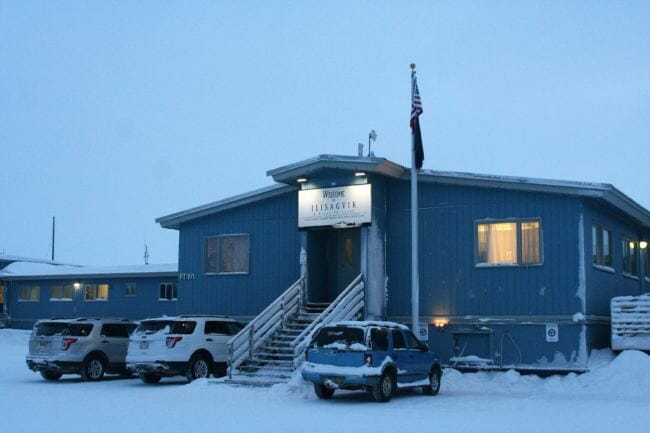
Iḷisaġvik College’s main campus on the northern side of Utqiaġvik. The college launched its first bachelor’s program last fall. (Alaska’s Energy Desk/ Ravenna Koenig)
There’s now another way for North Slope residents to get a college degree without leaving home. Iḷisaġvik College, Alaska’s only tribal college, launched its inaugural bachelor’s of business administration this past fall.
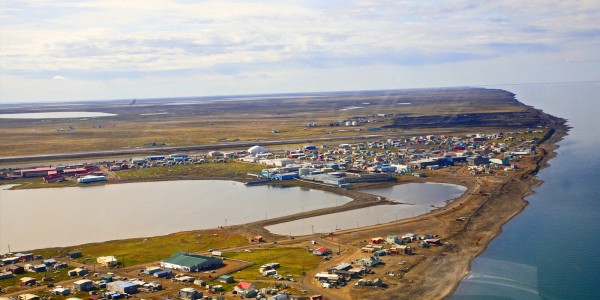
The main campus for Iḷisaġvik College is located in what’s known as the NARL complex in Utqiaġvik; it’s the spot where the Naval Arctic Research Laboratory used to operate until it was shuttered about 40 years ago. A short drive north of town, it’s a collection of scattered Quonset huts and a boxy blue building lofted up on stilts.
The President of the college, Dr. Pearl Brower, says that the vision for higher education on the North Slope began back in the 1970s with the Borough’s first mayor, Eben Hopson Sr.
Hopson felt strongly that local education was the key to self-governance, and he made it one of his top priorities.
“He recognized that that was going to be one of the most important things for the future of the North Slope given the fact that we were playing such a major role in oil and gas development, and the fact that we were on the edge of the Arctic in regards to science and climate change,” Brower said.
Shirts and hats for sale in the Iḷisaġvik College Bookstore. Iḷisaġvik is currently Alaska’s only federally recognized tribal college. (Alaska’s Energy Desk/ Ravenna Koenig)
Over the years, higher education here has gone through several different iterations. But in the 1990s Iḷisaġvik College was established in its current form, offering vocational certificates, associate degrees, and short-term workforce development training. And now, exactly one bachelor’s degree as well.
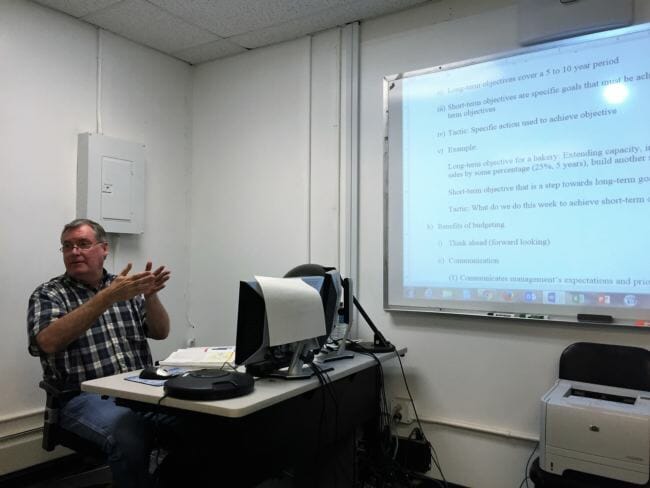
At 5:30 pm in one of Iḷisaġvik’s classrooms, professor David Rice is teaching a managerial accounting course to a classroom of five students. The main topic is budgets. How you set them, who within an organization should get a say in how they’re set, and the advantages and disadvantages of different budgeting tactics.
Iḷisaġvik professor David Rice, teaching a class in January on managerial accounting. One of the students in this class is in the new bachelor’s degree program. (Alaska’s Energy Desk/ Ravenna Koenig)
Not all of the students in this class are part of the bachelor’s program. But one of them — Roxanna N. Evikana just started the program this semester.
Evikana grew up here on the North Slope. She attended some college in Anchorage and Washington State, but now that she’s back on the Slope, she’s excited that she can work towards her degree without leaving behind the things that are important to her.
“Me and my family try to live a subsistence lifestyle,” Evikana said. “I believe that’s what’s best for my children growing up… and being home, being able to go to college at the same time is just… that is the best.”
Evikana currently works as an accounting manager for Utqiaġvik’s village corporation. She says she joined the bachelor’s program mostly because it was a personal goal of hers. But also because she thinks she may want to open her own business one day.
She says there isn’t a ton of entertainment in town, so she’s leaning toward that. “Bowling, movies, you know, something fun,” she said.
Roxanna N. Evikana is currently a student in Iḷisaġvik’s new bachelor’s of business administration program. It’s been a longtime goal of hers to get her bachelor’s degree. (Alaska’s Energy Desk/ Ravenna Koenig)
Her professor David Rice says that most of the students in the Bachelor’s program are like Evikana — they’re not taking the course because they don’t have jobs. They’re taking it to open up more opportunities down the road.
“They’re just making sure that they’re getting the training so they can move up to upper management,” Rice said. “That keeps the jobs here in the local population. That keeps the money here in the local population. We don’t have to bring anybody up from the lower 48 or even from Anchorage.”
President Brower echoes this idea. She hopes the bachelor’s program will give local students the qualifications they need to fill positions that might otherwise go to applicants from elsewhere.
“We see this influx of an outside workforce in our state,” she says. “We have every ability to… have local control of that. But that takes education. In today’s world — it’s not the world of our ancestors — in today’s world we need that education to go along with our indigenous experiences.”
While the bachelor’s in business administration is Iḷisaġvik’s first, Brower says the college hopes to soon have another. They recently started offering courses in elementary education with an indigenous focus, and they hope to grow it to a bachelor’s program in the coming years.
In December, Iḷisaġvik College announced that starting this semester, the college will waive tuition for all Alaska Native students, including for the bachelor’s in business administration.
Editor’s note: The first line of this story has been changed to reflect that Ilisagvik is not the only place to get a bachelor’s degree on the North Slope. There are distance education programs available for enrollment.
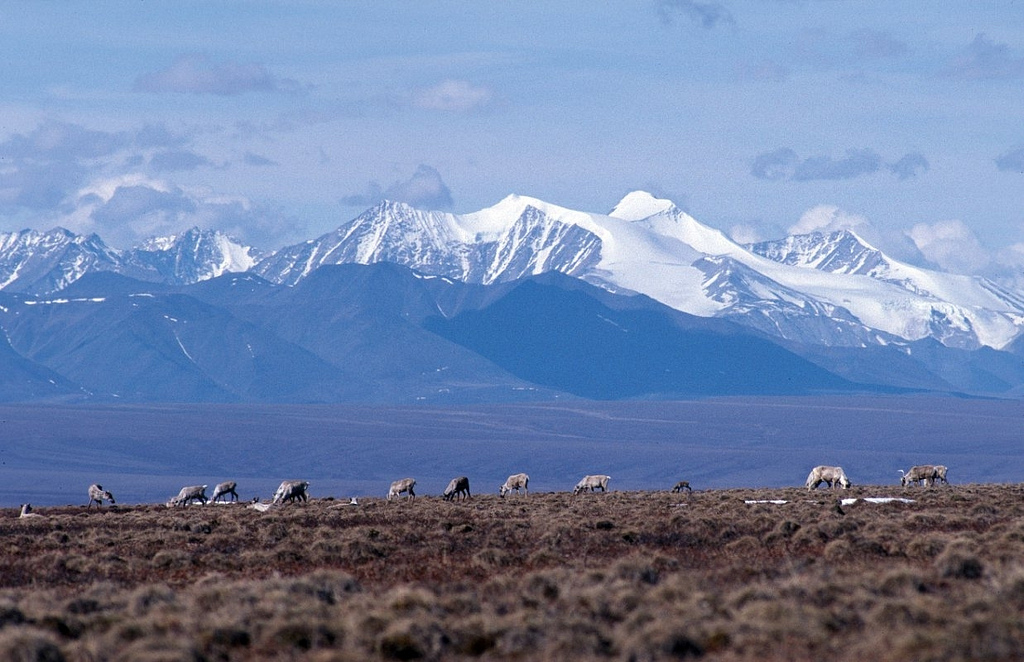
Caribou graze on the coastal plain of the Arctic National Wildlife Refuge, with the Brooks Range as a backdrop. (Creative Commons photo by USFWS)
Now that Congress has OK’d oil and gas exploration in the Arctic National Wildlife Refuge’s coastal plain, opponents are preparing for the next phase in their decades-long struggle to protect the environmentally sensitive area.
“This fight is not over. For the Gwich’in, it has just begun, on a whole new level,” Bernadette Demientieff, executive director of the Gwich-in Steering Committee.
She says members of the Fairbanks-based organization are taking a few days off before they resume their efforts to protect the coastal plain and its wildlife from oil-industry development.
“Right now, we just take the time to calm down, because there’s a lot of anger,” she said. “And we can’t act out in anger.”
The Gwich’in consider the lands that would be opened to oil and gas exploration as sacred. They also worry the industrial activity will harm the Porcupine caribou herd and other wildlife that’s essential to indigenous peoples’ subsistence.
“I would just say for every body just to enjoy their loved ones,” Demientieff said. “And in the new year, we will unite, get back on track, and work on ways that we are going to keep them out of the Arctic refuge.”
Local conservation groups also are preparing to launch campaigns to protect the coastal plain, in concert with their national counterparts and indigenous peoples organizations.
“You’ll see Northern Alaska Environmental Center and our partners here in Alaska continue to stand in solidarity with the Gwich’in nation,” Elizabeth Dabney, executive director of the Northern Alaska Environmental Center. “This is a huge blow to their way of life. And a lack of an acknowledgement of the time they spent in Washington, D.C., raising their voices.”
Fairbanks Climate Action Coalition spokeswoman Jessica Girard accuses Alaska’s congressional delegation of favoring industry over Alaskans who oppose opening the coastal plain to oil and gas development.
She said U.S. Sen. Lisa Murkowski sold out by voting in favor of the federal tax-reform bill that contained provisions to open ANWR, despite another part of the bill that will cripple the Affordable Care Act – which the senator said she opposed earlier this year.
“I think we saw a spike in support for the refuge, specifically here in Alaska, when people began to realize that Murkowski did sell out her health-care vote simply to get her pet project, which is the Arctic refuge,” Girard said.
Murkowski has denied those accusations, saying the bill’s provision to repeal the universal mandate from the health care act, quote, “restores to people the freedom to choose” because it eliminates the requirement that all Americans be covered by health insurance.
Dabney said Murkowski’s role in including ANWR in the final budget bill casts doubt on her explanation.
“It was an underhanded way to get the coastal plain in there. And it was also pretty dangerous and totally disregarded the Gwich’in,” she said.
Neither Dabney nor Girard would offer specifics on the new campaigns they say will be launched in the coming year to halt development of the Arctic Refuge.
Girard says conservation groups intend to take full advantage of the years-long federal process of identifying lands with oil and gas potential and then conducting lease sales, all of which must be done before drilling can begin.
“There’s many hurdles that are in the way of opening the refuge.”
Throughout that time, Girard says opponents will be waging political fights in Congress, filing lawsuits and staging protests here in Alaska and nationwide.
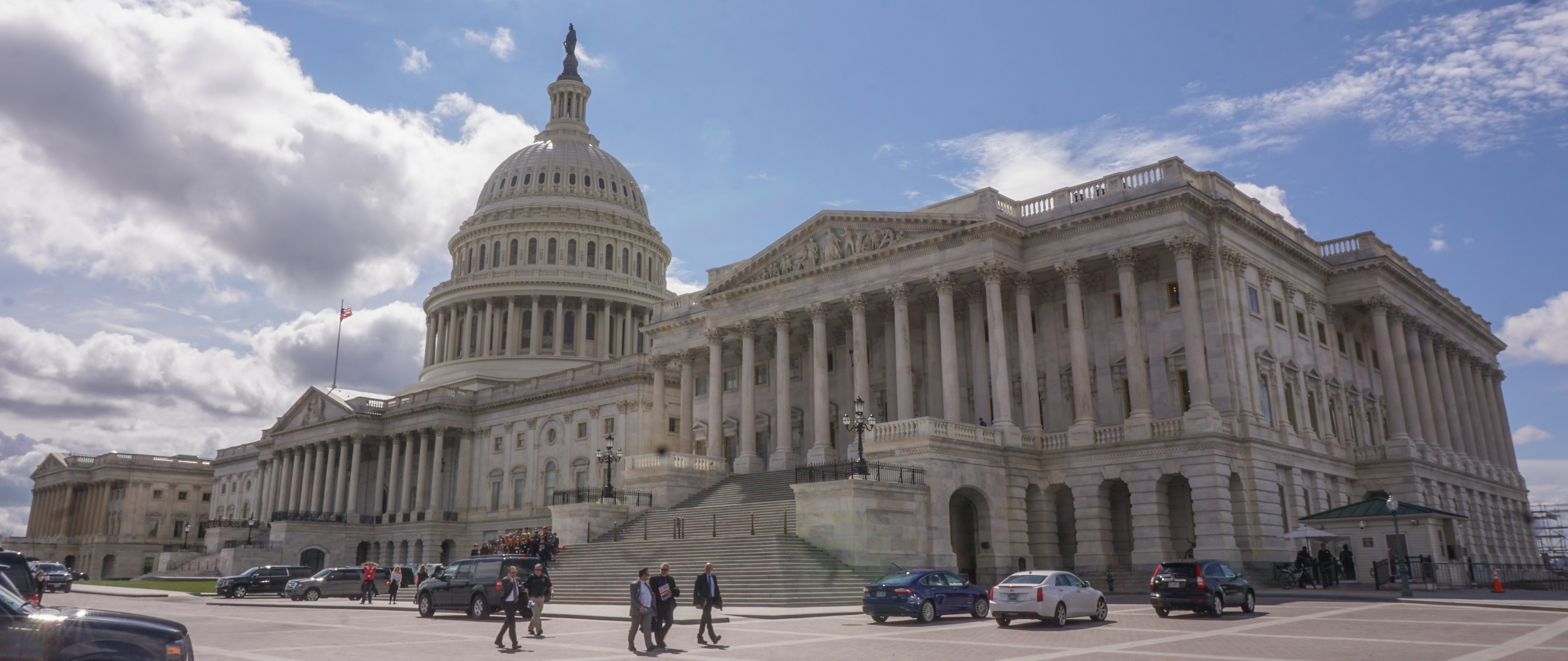
The U.S. Capitol in Washington, D.C., on March 28, 2017. (Photo by Jeremy Hsieh/KTOO)
Alaska’s two U.S. senators not only helped Republicans pass their tax cuts early Saturday.
They made a pair of 11th-hour additions: one kills a new tax on the cruise industry, another helps Alaska Native corporations.
Sen. Dan Sullivan offered the cruise ship amendment. It erased a section of the bill that would have taxed foreign cruise lines for the time they spend in U.S. waters. The tax would have raised an estimated $70 million a year.
Cruise Lines International Association Alaska president John Binkley says the tax would have specifically hurt Alaska routes because they spend so much of their time in U.S. waters.
“We were concerned when we saw that come up in the Senate version,” Binkley said. “We contacted Sen. Sullivan, his office, and also Sen. Murkowski’s office.”
Sullivan’s spokesman says the senator already had noticed the tax in the bill and quickly moved to ditch it, to help Alaska communities that benefit from cruise ship visitors.
Sen. Lisa Murkowski added her own last-minute amendment that provides favorable tax treatment for Alaska Native corporations that put land or other assets into Alaska Native Settlement Trusts.
Congress created these trusts in 1988, in part to allow Native corporations to help “after borns” – Alaska Natives born after the 1971 settlement act — too late to be allotted shares in the corporations.
Old Harbor Native Corporation CEO Carl Marrs testified at a U.S. Senate hearing last month on the need to change tax law for settlement trusts.
He said, by law, a corporation’s duty is to its shareholders.
“We need a mechanism to be able to move assets over to take care of the whole (community), not just those born before 1971,” Marrs said.
Marrs said the tax changes would, among other things, allow a corporation to put pre-tax funds in a settlement trust. The trust would be taxed on the income, but the rate is much lower. Marrs described it as a way a community’s corporation can help its tribe.
“I think corporations are now realizing our job should be there supporting the tribal efforts, because those are the important programs to our indigenous people,” said Marrs, a former CEO of Cook Inlet Region Inc.
Friday night, the cruise-ship and Native corporation amendments appeared on a list of 30 changes Republicans had decided to make.
The list emerged while Democrats were on the Senate floor complaining they still had not seen the final language of the tax-cut bill.
Democratic Minority Leader Chuck Schumer groused that his side had to get the list from lobbyists.
“My Republican friends allowed lobbyists to see amendments, and likely the text of this bill, before their fellow U.S. senators,” Schumer said.
This is so bad. We have just gotten list of amendments to be included in bill NOT from our R colleagues, but from lobbyists downtown. None of us have seen this list, but lobbyists have it. Need I say more? Disgusting. And we probably will not even be given time to read them. pic.twitter.com/Mn0i56JeZg
The tax bill, including a provision to open the Arctic National Wildlife Refuge to oil drilling, will be sent next to a conference committee with the House version so lawmakers can write the final bill.
Close
Update notification options
Subscribe to notifications
Subscribe
Get notifications about news related to the topics you care about. You can unsubscribe anytime.