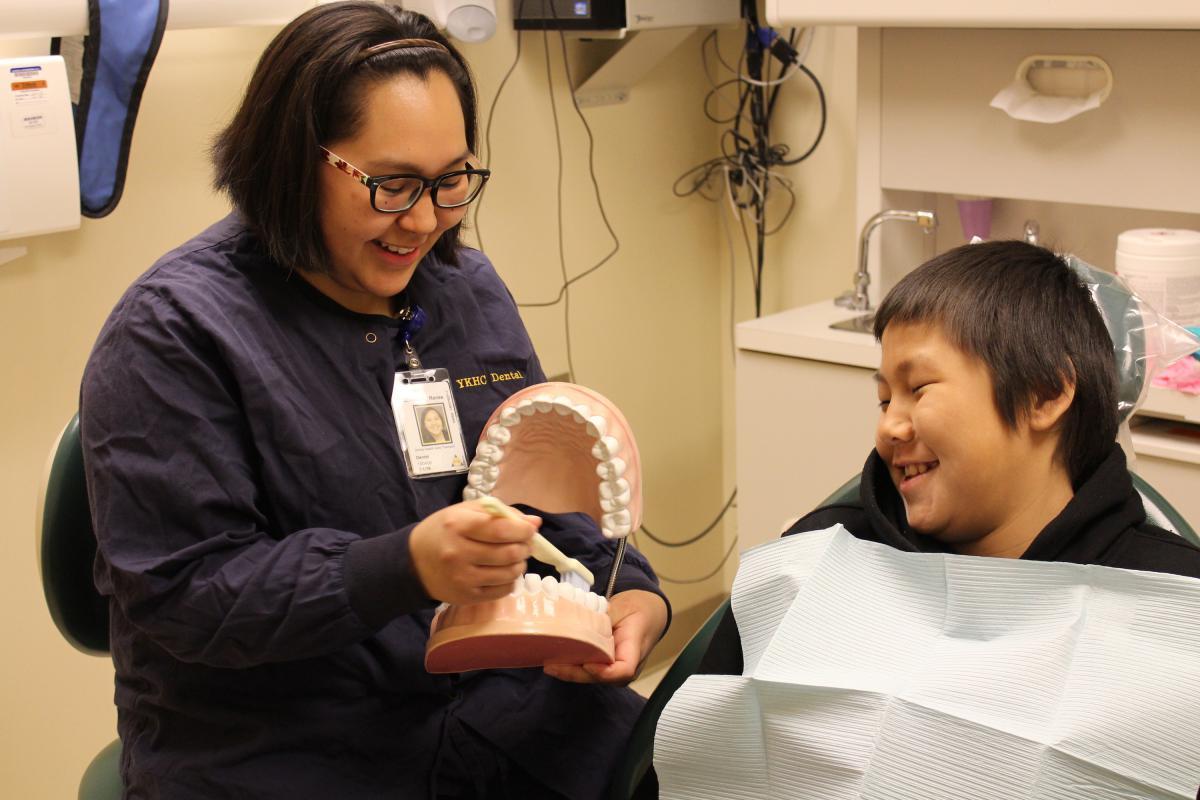
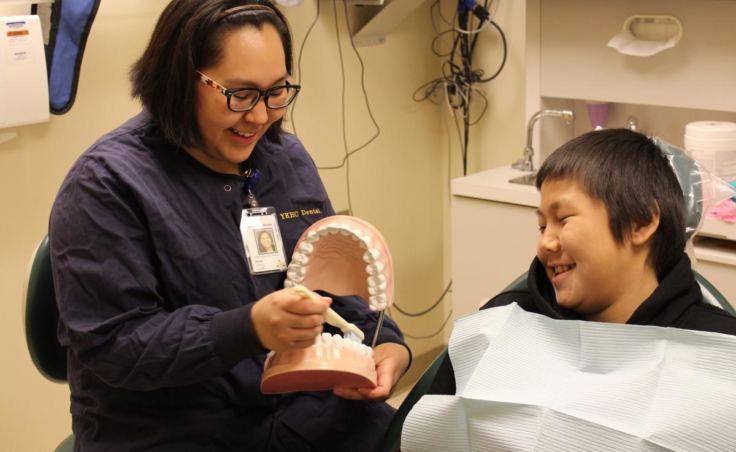
Dental health aide therapist Renee Cheek shows a patient how to brush his teeth at the Emmonak YKHC Sub-Regional Clinic. (Photo courtesy Yukon-Kuskokwim Health Corporation)
Dental health aide therapist Bonnie Johnson examining a child's teeth in the Emmonak YKHC Sub-Regional Clinic. (Photo courtesy Yukon-Kuskokwim Health Corporation)
Rural health aides have a long, successful history of improving access to health care in Alaska.
Now, dental a program based on that model is improving oral care in the Yukon-Kuskokwim Delta.
The Dental Health Aide Therapist program was controversial when it started a decade ago, but a new study suggests that smiles have gotten healthier, cleaner, and toothier in villages where it’s appeared.
Phylicia Wilde grew up in Mountain Village on the Yukon River.
When she was 12, she got a toothache. It started small, but soon she couldn’t sleep.
With the pain, she began missing school. Then, a dentist arrived for the village’s yearly dental visit.
“I was entered into that list to get seen, but the list was so long. It was four or five pages of patients,” Wilde said.
Wilde didn’t make the cut and had to fly to Bethel for treatment. By then, the tooth had abscessed, or become infected.
“It was on a permanent tooth that had a huge cavity, and I needed a root canal.”
If Wilde had had a dental provider in her village, she said that the problem may never have occurred.
Now, Wilde herself is a provider, certified as a dental health aide therapist for the Yukon-Kuskokwim Health Corporation.
After training for two years, she offers many of the same services that dentists do such as X-rays, fillings and extractions.
This program was started by the state’s tribal health organizations because nothing else was working.
Dentists were willing to travel to rural areas and donate services, but it was never enough.
National dental groups sued to stop the program, saying that it wouldn’t be safe.
They lost, and the program began turning out trained health aides capable of doing dental therapy.
“Dental therapists seem to be making a difference in terms of providing the type of care that you and I would want for ourselves and maybe family members,” said Donald Chi, an associate professor of Dentistry at University of Washington and a pediatric dentist who’s practiced in the YK Delta.
Recently, he published a study evaluating the impact of dental therapists on Delta communities. The findings are significant.
The study is the first long-term review of health impacts by dental therapists, and Chi says that the results could change the way dental care is provided in rural areas across the U.S.
“The more number of dental therapist treatment days communities got, the more preventive care people got, and fewer people were getting extractions,” Chi said.
Dentist Judith Burks, who coordinates YKHC’s 10 dental therapists, has seen the transformation.
“I go out to villages and instead of the main focus being on emergencies, we get to focus on things like prevention and higher level care for the patients,” Burks said.
In other words, dental therapists can now educate communities on how to live healthier lifestyles for a healthier mouth, like not using tobacco and avoiding sugar.
Wilde knows her efforts mean that villagers are having fewer of the painful, sleepless nights and missed school days like she experienced growing up.
“It’s been awesome, just seeing the patients and their gratitude,” Wilde said. “That feeling is just amazing.”
YKHC hopes to nearly double the number of dental therapists serving the region over the next two years.
They’re offering full scholarships, and applications will be available on the YKHC website in February.
Abandoned equipment at CVRF’s Quinhagak plant. The organization shut down the facility when they opened their new plant in Platinum. Now Platinum is closed too. (Photo by Teresa Cotsirilos/KYUK)
Several weeks ago, the financing fell through on a plan to bring the “Akutan,” a floating fish processing vessel, to Kuskokwim Bay.
Fishermen in the coastal community of Quinhagak have nowhere to sell their catch for the second summer in a row.
Many in the village are now struggling to make ends meet.
Timothy “Johnny Boy” Matthews doesn’t remember when he started fishing commercially.
He must have been 5, he said, or maybe 6.
On most summer evenings, Matthews’ father would load him and his brother into a wooden boat that he built himself and sail into Kuskokwim Bay.
They would net salmon for the next 12 hours, working through the short, sunny night.
Matthews’ job on board was to count the reds, kings and chums that his father caught, although as the night wore on he would fall asleep in the boat’s cabin.
When his father sold the fish, he made sure to share the profits with his sons.
“Every time he’d pay me he’d tell my mom, ‘here’s the money he got for sleeping,’” Matthews said with a laugh.
Matthews has a family of his own now.
He bought his own limited entry permit a decade ago and spent his summers selling silvers to a newly opened processing plant in Platinum.
It’s owned by Coastal Villages Region Fund, a corporation that is supposed to use its Bering Sea fishing quota to support economic development in the area.
Matthews remembers when fishermen could make about $6,000 a year selling to Platinum. Some in Quinhagak said that in good years expert fishermen could earn more than $20,000 a season.
Last year, the Coastal Villages corporation decided not to re-open its plant, saying that it was losing money.
There was nowhere to sell fish and limited prospects for any sort of summer work.
Matthews works as the maintenance man at the local Head Start during the school year, but in the summers he doesn’t have any money coming in.
His phone’s been cut and he said that he’s afraid that his water and sewer will be cut soon too.
The lack of money also means that Matthews has been unable to buy fuel for subsistence activities.
“It’s really, really hard on us,” Matthews said.
After two years without a buyer, a lot of the fishermen in Quinhagak tell similar stories.
Jimmy Anniver is an elder here, who worked as a commercial fisherman for more than 60 years – first in Bristol Bay, then in the Kuskokwim Bay – right up until the Platinum plant closed.
“High prices in the stores fill up those credit cards to $10,000 or more, or something like that,” Anaver said. “It’s hard to live here in Alaska.”
Last year a fish broker tried to buy in Quinhagak, but the Coastal Villages corporation refused to lease him equipment.
And now a second plan has fallen through.
Warren Jones, the CEO of Qanirtuuq Inc., surveys Quinhagak’s defunct processing plant. (Photo by Teresa Cotsirilos/KYUK)
“We had really high hopes,” Warren Jones, the CEO of local Native village corporation Qanirtuuq Inc, said. “All the fishermen were getting excited, and then everybody was like, ‘oh no – not again.’”
Before the Platinum plant opened, Jones was the operations manager of a processing facility right in Quinhagak.
It’s now sunken and rusted; a door clanged in the wind as we toured the facility.
Jones said that he tried to get CVRF to give or sell Quinhagak some of the plant’s unused buildings – there’s a housing shortage here – but the company declined.
The buildings are still empty, and rotting away.
As a leader in the local Native corporation, Jones said that he’s doing what he can for local fishermen by hiring them part time.
“Two weeks on, two weeks off,” Jones said. “That way the other guy gets paid too. People are suffering, and winter’s coming. And the corporation here is doing as much as we can. We’re extending their credits, people are running out of fuel. And we can’t let nobody freeze to death, so sometimes we let them charge more. These are my people; we have to help them.”
Jones said that at this point, he keeps several gallons of heating fuel on hand at his home.
He never knows when someone might knock on his door at 2 a.m. in the winter, asking for heat.
Small Business Administration Alaska District Office Director Nancy Porzio, left, tours Kwethluk school with former wrestling maven and SBA Administrator Linda McMahon and Ana Hoffman. (Photo by Teresa Cotsirilos/KYUK)
A member of President Donald Trump’s Cabinet visited the Yukon-Kuskokwim Delta last week.
Linda McMahon is the head of the Small Business Administration, or SBA, and she spent Friday morning in Bethel touring local facilities and meeting with local business owners and CEOs at Yuut Elitnaurviat.
McMahon then took a crowded boat to Kwethluk for lunch where she visited the construction site of the village’s new state-of-the-art school.
The trip was one of many for McMahon, who has promised to visit each of the SBA’s 68 offices across the country.
She’s trying to raise awareness about the many opportunities that her department provides.
“SBA is actually an incredibly well-kept secret,” she said.
The SBA offers mentoring for entrepreneurs and guarantees loans for small businesses.
Businesses aren’t always aware of these resources, according to McMahon.
McMahon also discussed Alaska Native corporations which are businesses themselves. She said that they can take advantage of lucrative government contracts ranging from $7 million to $20 million in size.
“More Alaska Native corporations should take advantage of those government contracts,” McMahon said. “They’re substantial programs.”
Prior to her political career, Linda McMahon and her husband founded Worldwide Wrestling Entertainment, or WWE, where she served as CEO until 2009.
She considers Trump a friend and says that while she never sought or expected to direct the SBA, she is honored to do so.
View from the Near Island Bridge. (Photo by Mitch Borden/KMXT)
The Alaska Tribal Conservation Alliance held a regional conference in Kodiak recently.
Organizers flew in to promote local communities coming together to preserve their natural resources.
The last day of the Alaska Tribal Conservation Alliance Regional Conference in Kodiak, attendees and organizers are sitting in a conference room at the Kodiak Inn Best Western discussing issues facing the region. And, of course, joking around.
The Alaska Tribal Conservation Alliance came to Kodiak to promote the formation of tribal conservation districts.
These districts are organizations formed by tribes and the Department of Agriculture. They declare a region that they want to be responsible for. Then use local and traditional knowledge in coordination with other organizations to address natural resource issues in their area.
The alliance’s former chairman, Robert Stephan Sr., said tribal conservation districts can help communities tackle natural resource problems of almost any nature.
“Soil and water, land issues, energy issues, gardening issues, moose habitat, fish habitat,” he said. “Whatever they could think of, we try to work on programs for em to help them in any way to sustain and help their land out.”
Currently, there are 14 of these districts in Alaska, but none of the tribes in the Kodiak region have established their own.
The alliance is in Kodiak to reach out and educate local community members about the benefits of establishing a tribal conservation district.
After attending this conference, Qiilugaruaq Inga, a former resident of Old Harbor, said she felt empowered after learning about all the possible resources for communities.
“Our lifestyle when I was growing is a lot different than it is today,” she said. “We need to know about the help that’s out there available that will bring us to a point where we can be self sustaining.”
At the core of the alliance’s mission is to help communities enhance and preserve their natural resources and their traditional subsistence way of life. For ATCA executive director Angela Peters this value seems to hit close to home.
“You know really the way I look at it the subsistence life I lived when I was growing up created who I am today. I want my kids and grand kids to be able to be afforded to learn the culture I have so I hope others do to.”
Back at the Kodiak Inn, everyone is still cracking jokes as the meeting winds down.
Since this was alliances’s first attempt at holding a conference in the region there was not a big turnout. But they’re hoping to return to Kodiak in the future to continue reaching out to community members from across the region.
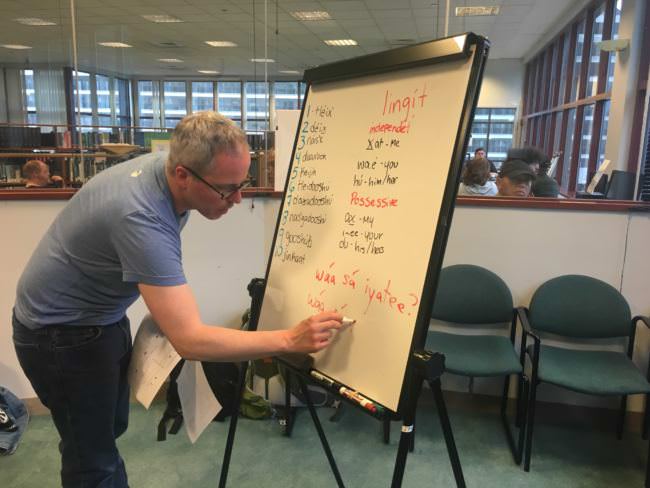
Richard Radford writes on a whiteboard during the Monday night Tlingit language learners workshop in the Juneau Public Library. (Photo by Carter Barrett/KTOO)
This isn’t a class, and there is no teacher. About 15 people are participating in a Tlingit language workshop at the Juneau Public Library on a Monday night.
The group of Natives and non-Natives are learning a language that only about 100 people speak fluently.
The non-structured workshop studies the complicated sounds and structure of the Tlingit language. On this particular night, they are using pages from a new workbook to teach different greets and responses.
Sealaska Heritage Institute recently published the “Beginning Tlingit Workbook.” It is part of the ongoing effort to revitalize Tlingit, and the workbook is available free online.
Daniel Hernandez was fascinated with the few Tlingit words he learned in his training as a season tour guide in Juneau.
He’s made going to the Monday night workshop part of his routine.
“The information I got briefed on just really started to fascinate me, and I wanted to learn more and more,” Hernandez said. “So far, it’s amazing. I really love the class, I’m really learning a lot.”
X̲ʼunei Lance Twitchell, a fluent Tlingit speaker and professor at the University of Southeast Alaska, authored the workbook.
He’s been at the forefront of revitalizing the language, which was nearly destroyed through colonialist efforts that forbid Native children from speaking their language.
“If Tlingit is gone and nobody is teaching it, you have a total assimilation and a total linguistic and cultural genocide,” Twitchell said. “People attacked this language and really tried to remove it.”
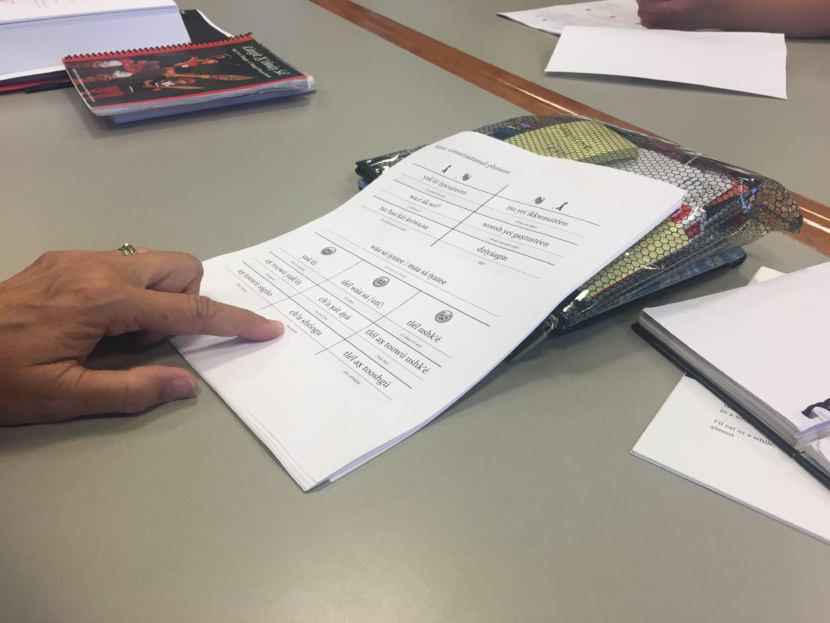
A page from the “Beginning Tlingit Workbook” showing different responses to “How are you?” or “Wáa sá iyatee?” (Photo by Carter Barrett/KTOO)
The workbook is an extension of the “Beginning Tlingit” book by Richard and Nora Dauenhauer, and uses a lot of illustrations and pictures to help teach the language.
“It would be strange to think to go live in some part of rural France or something, and just go spend my life there and never learn the language,” Twitchell said. “But you can expect that in indigenous areas, and that’s part of the colonial mindset.”
Twitchell hopes that in 30 years there will be about 5,000 fluent Tlingit speakers.
A movement to vote in independent directors and remove CEO/President Ken Cameron is gathering steam online and on the ground. Shareholders made protest signs in advance of the annual meeting last month. (Photo courtesy of Shee Atiká Shareholders Facebook page)
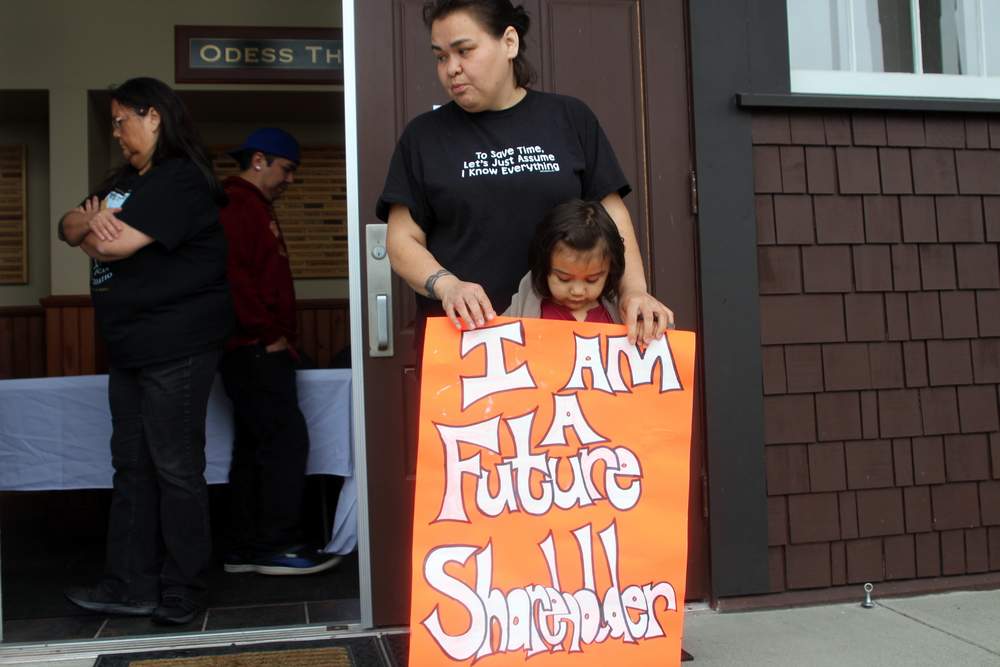
Bunny Blackbird with her mother, Martina Dundas, a partial shareholder born after ANCSA was signed in 1971. Shee Atiká issues distributions to shareholders, funeral benefits, and scholarships. (Photo by Emily Kwong/KCAW)
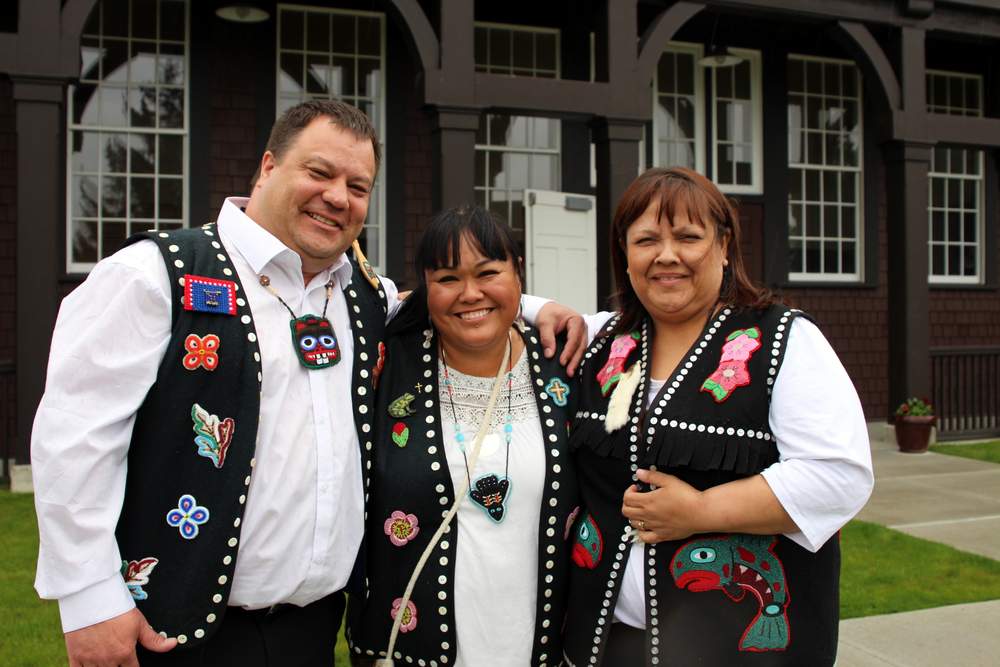
Laurence Garrity, left, Dionne Brady Howard, and Lillian Young pose. Nearly 98,000 independent proxies were handed in, which was enough to put Garrity on the nine-member board of directors. (Photos by Emily Kwong/KCAW)
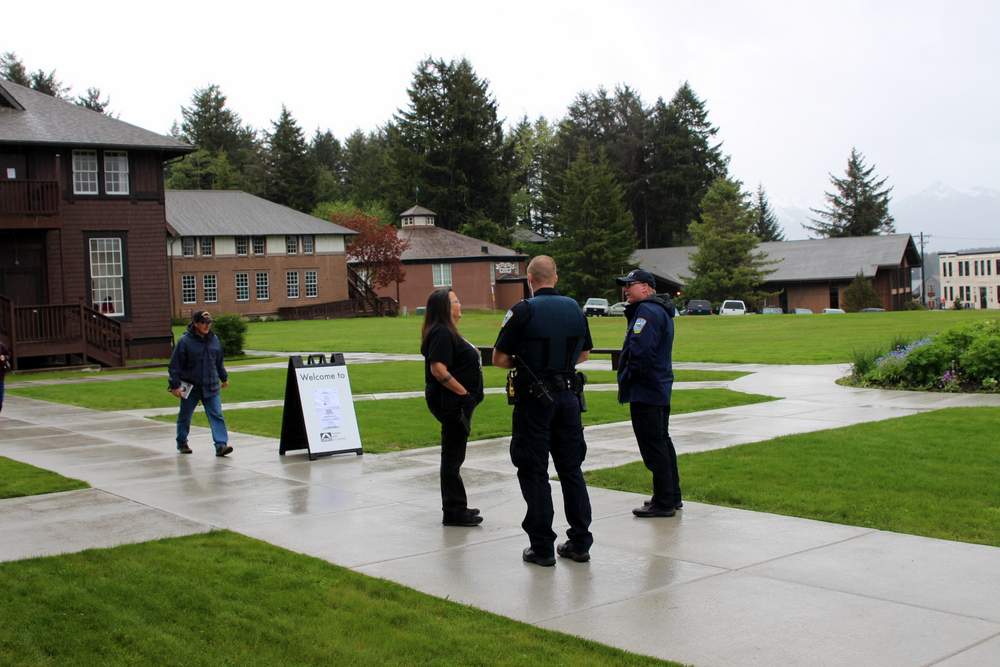
Shee Atiká called Sitka police to the annual meeting twice out of a concern for public safety. They said shareholders had made threats in person and online in the past. (Photo by Emily Kwong/KCAW)
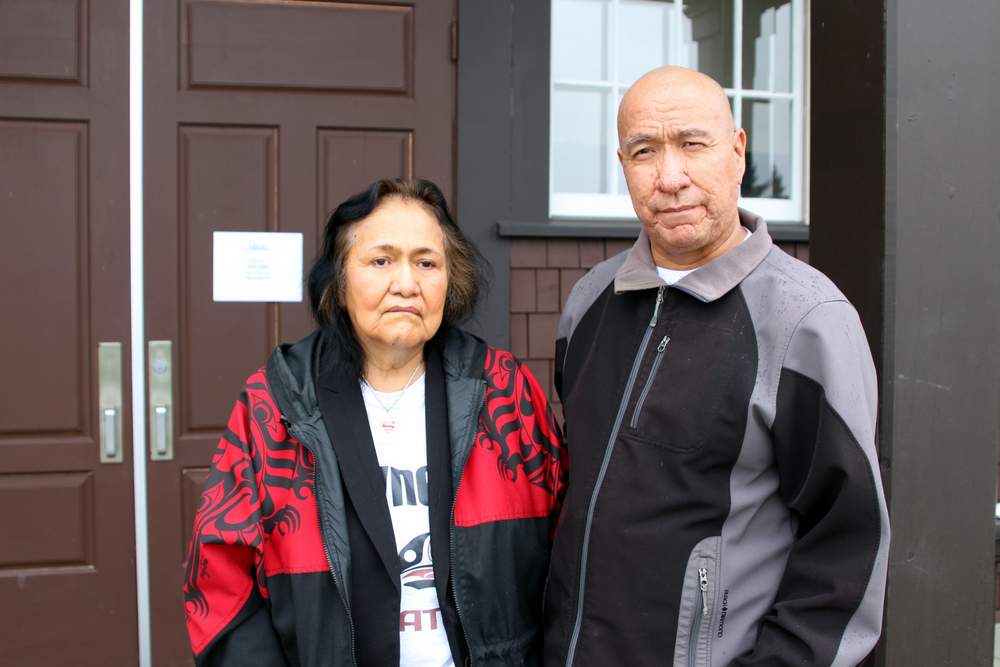
David and Eloise Kanosh return to the meeting after a three-hour recess to count votes. “I used to support the board. I used to support Ken Cameron. The way they’re treating everyone now, things have got to change,” David said. (Photo by Emily Kwong/KCAW)
Tension between a Native village corporation and its shareholders has reached a boiling point.
Shee Atiká called Sitka police to their annual meeting, saying threats had been made against staff and the board.
Shareholders have a different story: one of raising their voices against a corporation in financial free-fall and calling for new leadership.
Shee Atiká has 3,000 shareholders.
Christine Silvanio is one of them. She flew all the way from New Jersey to attend the annual meeting May 20, but was asked to leave when two staff members noticed she was live-streaming the gathering over Facebook.
She stood alongside Margaret Carlson of Sitka. They huddled outside the front door of Allen Hall, as the rain poured and shareholders milled about.
“Basically, they both threatened to have me escorted out,” Silvanio said.
“I interpret it as they’re hiding something,” Carlson said.
The purpose of the meeting is to elect three board members.
The corporation recommended incumbents Joshua Horan, Faleene Worrell and Shirley Yocum for those slots, while a grassroots movement put together their own slate of candidates: Laurence Garrity, Roxanne Drake Burkhart and Lillian Young.
Calling themselves Shareholders for Shee Atiká’s Future, the group organized through a 1,000-plus member Facebook page.
”It’s time for a change,” Carlson said. “All (current leadership) has done is take our corporation down millions of dollars.”
As of the last annual report in 2015, Shee Atiká’s revenue had plummeted to $3 million.
In a letter to shareholders, Cameron attributed this nosedive to a variety of things, from outstanding debts to negative cash flow from Shee Atiká’s hotels to a loss of federal contracts.
To shareholders, the recovery has been slow and questionable. Funeral benefits and scholarships have been trimmed, while Cameron’s salary has only grown. He made $411,000 in in 2016.
Shee Atiká is selling thousands of acres of its land in Cube Cove to the Forest Service to bring the corporation back into the black.
Mike Kinville, a shareholder based in North Pole, is worried the corporation is on the path toward landlessness and bankruptcy.
“It’s not a corporation to me. It’s not a business to me. It represents my legacy,” Kinville said. “As a Tlingit man, it’s my responsibility to pass it to my descendents. But when I see it being run like this … and if you look at the financials, you can see that it’s failing.”
Shee Atiká’s business strategy isn’t the only thing raising tempers today, it’s also how they’re treating shareholders.
Unlike some other Native corporations, independent candidates for Shee Atiká’s board are not allowed to run on the same ballot – called a proxy.
When an independent group of shareholders mailed out their own proxy with their own money, Shee Atiká put up a regulatory block: They claimed one of the three independents – Lillian Young – was ineligible to run.
The morning of the meeting, a huge wave of people showed up – filing past those two police officers Shee Atiká called – to hand in their proxies.
The board closed polls about 9 a.m., as planned, and went into recess for three hours to count votes, refusing to take questions like it had in the past.
This left roughly 200 shareholders, many of them elders, waiting and frustrated.
David Kanosh is blind. He returned with his arm looped around his mother’s, Eloise.
“We just went home after all of this. I was too upset to stay around,” David Kanosh said. “When you can’t see where you’re going and nobody’s helping you, this is disabled abuse. This is elder abuse.”
Shee Atiká did not return KCAW’s requests for comment after the meeting, but later published a statement on their website, saying they didn’t intend to mistreat anyone and the elections inspector needed time to properly count all the votes.
They called police out of concern, claiming threats had been made in the past.
Shee Atiká called Sitka police again around lunchtime. Police Lt. Lance Ewers said they were concerned about public safety.
“They knew it would be very emotional,” Ewers said. “They just don’t want anybody getting in trouble or causing a ruckus.”
Shareholders did come bearing protest signs and boisterous attitudes, but not much else.
Officers determined there was no threat to public safety and left.
Both sides, it seemed, had their defenses up: Shee Atiká stonewalling any attempt by shareholders to speak, and shareholders voicing that outrage at will.
While KCAW was standing in the foyer of the building, the corporation’s lawyer – Bruce Edwards – said no press were allowed in the building.
“If you want to talk to them out there, take pictures out there … but not inside the premises,” he said.
Then, along with staff, Edwards shut the door. Carlson and Silvanio – she’s the one who was livestreaming – were pretty upset.
“See how they treat us. This is how they treat us,” Silvanio said
Many shareholders said the conduct of staff and the board was especially hurtful given Shee Atiká’s history.
Native and Native village corporations were created to protect rights and sovereignty, from the oldest shareholder to the youngest.
Bunny Blackbird came with an orange sign that said, “I am a future shareholder.”
Her mom, Martina Dundas, is a partial shareholder, born after the Alaska Native Claims Settlement Act was signed in 1971.
The way the corporation is going, she’s worried her daughter is going to inherit nothing.
“(Bunny) got on the microphone in there, after they adjourned for the first intermission,” Dundas said. “She said, ‘I want Shee Atiká to be saved.’ And she said, ‘Amen.’ Many people in there had tears in their eyes as they said, ‘Amen’ as well. I don’t want this corporation to go away. I want it to be a legacy of their grandchildren, my great-grandchildren.”
From inside, we hear a chorus of applause and cheering. The independent movement just got a break: enough votes to unseat Shirley Yocum, a board director for 30 years, with newcomer Laurence Garrity.
Dundas let out a big exhale. “Finally, it seems like we have somebody that has our interests.”
The meeting is over. The board is about to convene behind closed doors.
Carrying a huge stack of papers, Garrity hopes his election will send a message to Shee Atiká.
“You know, in nine days, we got 98,000 votes,” Garrity said. “In three weeks, they got 90,000. They need to listen to our elders, listen to our people.”
As for the independent movement? They’re gathering steam, raising money through silent auctions, crowdfunding and other means to support more independent representation and attempt to remove Cameron entirely.
Close
Update notification options
Subscribe to notifications
Subscribe
Get notifications about news related to the topics you care about. You can unsubscribe anytime.