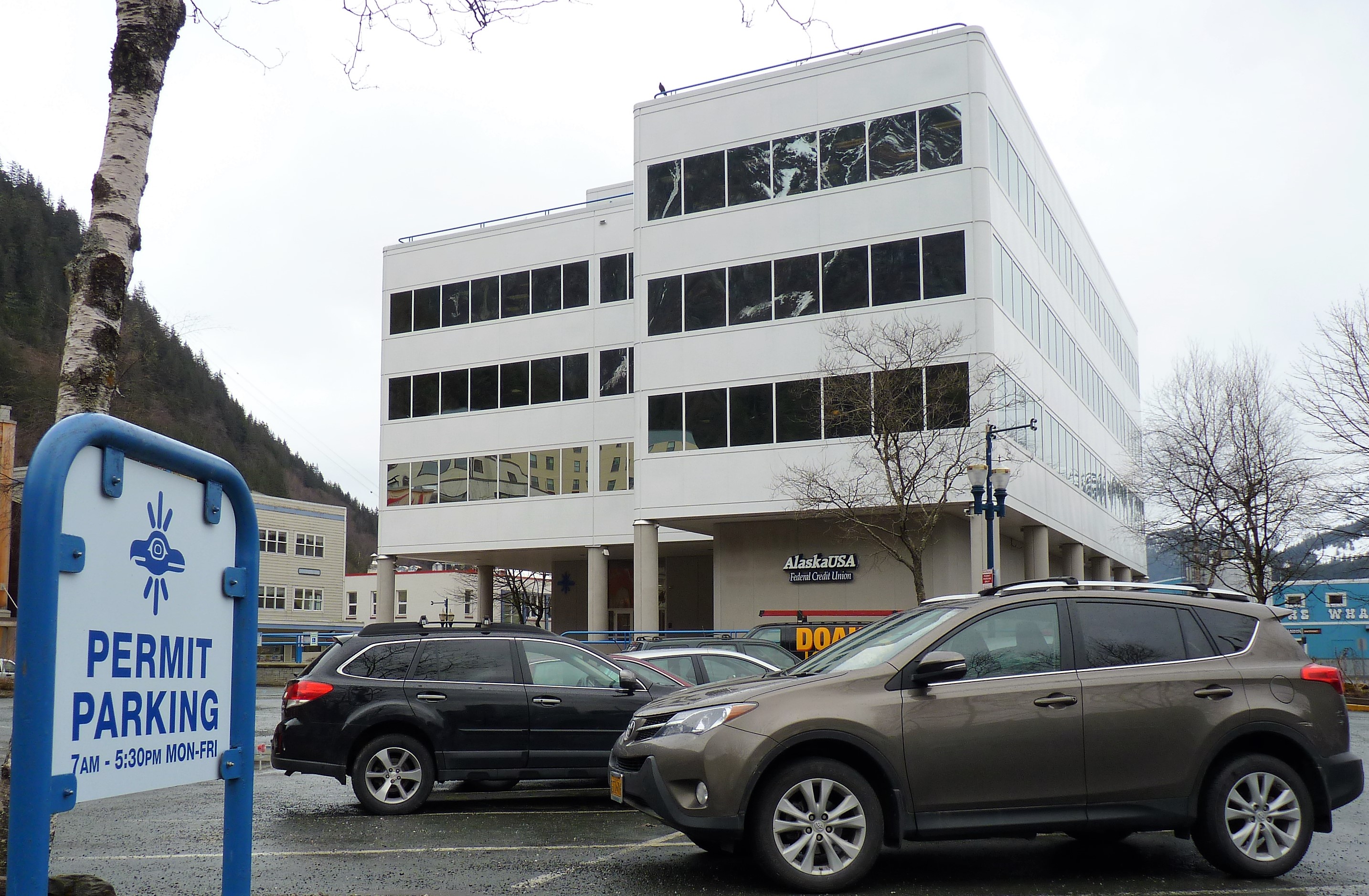
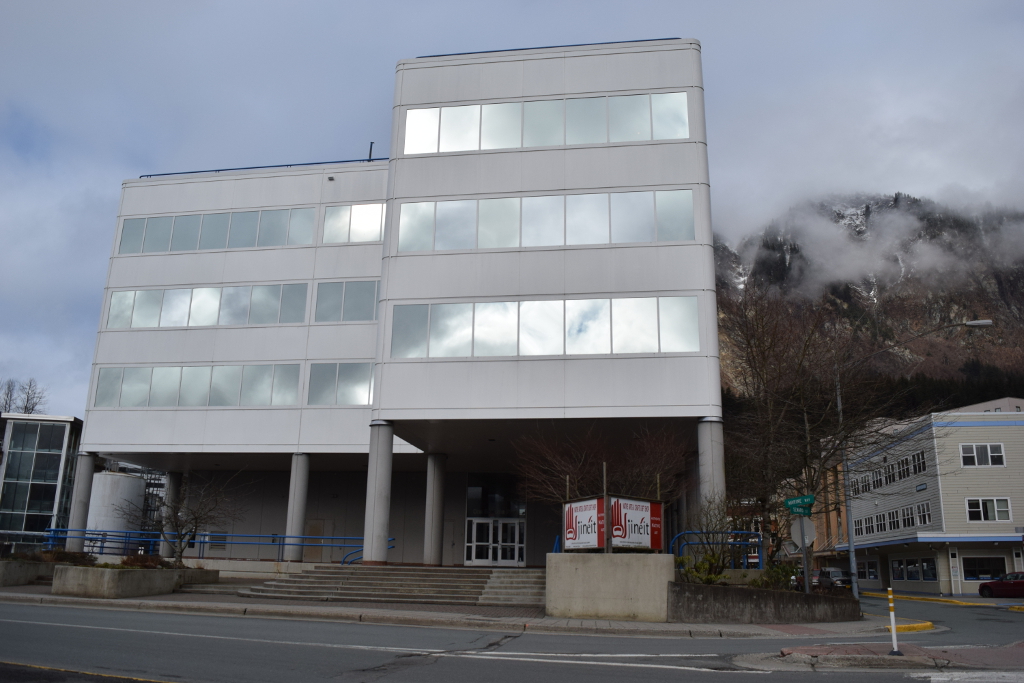
The Sealaska regional Native corporation is headquartered in downtown Juneau. (Photo by Ed Schoenfeld/CoastAlaska News
The management slate won this year’s Sealaska board election.
Three incumbents and a newcomer who ran with them beat out eight independent candidates.
Results were released Saturday via Sealaska’s Facebook page during the Southeast regional Native corporation’s annual meeting, held in Hydaburg, on Prince of Wales Island.
Juneau-based Sealaska has about 22,000 shareholders, which gives it the largest base of Alaska’s dozen regional Native corporations.
Sidney Edenshaw of Hydaburg is one of the three winning incumbents. He’s president of his community’s tribal association and has been on Sealaska’s board for 12 years.
Another is Ed Thomas of Kingston, Washington. The former Juneau resident spent 27 years as president of the Central Council of Tlingit and Haida Indian Tribes of Alaska. He’s been on Sealaska’s board for 27 years.
The third winning incumbent is Ross Soboleff of Juneau. The writer and fisherman won a board seat three years ago after running as an independent.
The fourth winning candidate is Morgan Howard of Kirkland, Washington, who owns a communications company. The board chose him from a group of about 50 shareholders who applied to run on its slate.
The seat he filled was vacated by Rosita Worl. The 30-year board member did not seek re-election this year. She continues to run the Sealaska Heritage Institute, the corporation’s cultural arm.
Eight independent candidates also ran for Sealaska’s board of directors. The highest vote-getters were Karen Taug and Doug Chilton of Juneau, and Nicole Hallingstad of Arlington, Virginia.
Taug works in finance, Chilton is an artist and teacher and Hallingstad works for the National Congress of American Indians. She used to be Sealaska’s corporate secretary.
The board-size measure would have shrunk the 13-member panel to nine members over several years. It targeted long-time incumbents.
Board election results list the number of shares cast for each candidate.
Amber Alerts were first implemented in Alaska in March 2009. Since then, six alerts have been issued in the state.
Five Amber Alerts were issued out of Anchorage and one was from Palmer. Because many Alaska communities are either off the road system or otherwise isolated, it’s difficult for a child to be removed from their area, according to Paul Fussey, search-and-rescue coordinator with the Alaska Department of Public Safety.
The committee also approved a second bill that would transfer Indian Health Service property in Sitka to SEARHC. The committee unanimously passed the land transfer bill, S. 825.
According to a news release from Murkowski’s office, a clean title would let SEARHC improve and expand the nearly 70-year-old facility, which SEARHC has operated since 1986.
Both bills head to the U.S. Senate for consideration.
Sealaska corporate headquarters is in Juneau. The Southeast regional Native corporation will hold its annual meeting June 24 in Hydaburg. (Photo by Casey Kelly/KTOO)
Should Southeast’s regional Native corporation shrink its governing board? That’s a question before Sealaska’s more than 22,000 shareholders. Management opposes the change.
Shareholder Karen Taug thinks that’s too many — and costs too much.
“I believe that if we were a moneymaking machine and we were just rolling in successful corporations and we had a lot to manage, I think it’s justified to have more board members,” she said.
But, she said, that’s not the case.
Taug, who works in finance, is one of 12 shareholders running for four seats on Sealaska’s board of directors this spring.
She’s also the author of a resolution to shrink the board from 13 to nine members.
Sealaska opposes the measure, though it would not grant an interview on the topic. A statement on its website said a smaller board would result “in decreased representation of shareholder interests.” It also said fewer seats would lessen the chance of independent candidates being elected.
Part of the resolution would make it harder for longtime board members to win re-election, by prohibiting a management endorsement. Taug reads from her proposal.
“The longest-serving directors will not be eligible for the board slate. However, (they) will be able to run as an independent candidate to begin in the year 2018 and each year thereafter until there are nine members,” she said.
Sealaska opposes the measure, saying it would damage the corporation.
On its website, officials wrote “The resolution as written targets longest-serving directors for removal to accomplish the reduction, regardless of their experience.”
Nicole Hallingstad, also an independent board candidate, said that’s the point.
“I think the current resolution is one more way that shareholders are trying to deliver their message that there are directors who have served far too long on Sealaska’s board,” she said.
Previous resolutions proposed term limits or changes in discretionary voting. All failed.
To pass, a resolution needs to attract more than 50 percent of all shares that could be cast. That’s a higher standard than a majority of just the shares cast that year.
There’s no standard board size for Alaska’s 12 regional Native corporations. Sealaska is one of three with 13 members. Another three have nine. The others range from 11 to 23.
Edgar Blatchford is a former regional Native corporation CEO. He teaches journalism and Native studies at the University of Alaska Anchorage. Blatchford said reducing board size just puts more power in a few shareholders’ hands.
“In my experience in dealing with Chugach Alaska Corp., I think it has left holes in the argument that it has created efficiencies. I think what it has created is a lack of transparency and it has put more corporate control, more board control, in the board of directors,” he said.
Most Sealaska shareholders have already cast their ballots, called proxies, by mail or online. The final deadline is at Sealaska’s annual meeting, June 24, in Hydaburg on Prince of Wales Island. Results will be announced there.
The ballots also list the names of those shareholders running for four board seats.
Occupation: Commercial Fisherman, owner of the F/V Jerilyn, and the Walking Boss Dispatcher for Southeast Stevedoring.
Education: Graduate of Hydaburg High School.
Sealaska positions: Served on the Sealaska Board since March 2005, manager on the Haa Aaní LLC Board.
Directorships: Former Haida Corp. Board member.
Affiliations: President of Hydaburg’s Tribal Association. Member of Hydaburg ANB Camp 6, president of the tribe’s nonprofit foundation, XKKF, Tlingit & Haida Hydaburg Delegate. Shell Fish Preservation Alliance.
Bradley Fluetsch, 54, independent, Lamy, New Mexico.
He has withdrawn from the race but his name remains on the ballot.
Nicole Hallingstad, 51, independent, Arlington, Virginia
Occupation: Director of Operations, National Congress of American Indians.
Education: Bachelor of Arts in History, University of AK Fairbanks; Master of Arts in European History, University of CA Berkeley.
Sealaska positions: Former Sealaska VP & Corporate Secretary, VP of Human Resources, VP of Communications; former Director of Alaska Coastal Aggregates and Haa Aaní Community Development Fund, Inc.
Directorships: Board service for Cancer Connection, Capital Community Broadcasting Inc., Bartlett Hospital Foundation, United Way of SE Alaska.
Affiliations: Member ANS Camp 16 Petersburg; Member of Tlingit & Haida Indian Tribes of Alaska; Individual Member of NCAI.
Morgan Howard, 48, running on the management slate, Kirkland, Washington.
Occupation: Owner of Morgan Howard Communications, LLC.
Education: Bachelor of Arts in Film Production from Columbia College – Hollywood; Bachelor of Science in Communications from Northern Arizona University.
Sealaska positions: Provided communications and public relations services to Sealaska in 2016. Consulting, creative and design services, writing, advertising and media support.
Directorships: Tlingit Haida Tribal Business Corp. (8 Years); Yak-tat Kwaan Inc. (10 years from 2006-2016)
Affiliations: Seattle Chapter of CCTHITA, Treasurer and Delegate; Alaska Native Village CEO Association, Founding Member; Alaska Innovation and Entrepreneurship Group, Founding Member; and Fledge.Co start-up mentor.
Occupation: President and CEO, First Nations Development Institute.
Education: MBA, Finance & Operations Management, University of Washington’s Foster School of Business.
Directorships: Sustainable Agriculture & Food Systems Funders; Three Affiliated Tribes – the Mandan, Hidatsa, and Arikara; Center for Native American Public Radio; The National Center for Family Philanthropy; Native Americans in Philanthropy; First Nations Development Institute; chair of First Nations Oweesta Corp.; and Four Times Foundation.
Ross Soboleff, 65, incumbent running on the management slate, Juneau
Occupation: Writer, small business owner, commercial fisherman.
Education: Bachelor of Science in Community Service and Public Affairs from the University of Oregon.
Sealaska positions: Former VP Corporate Communications of Sealaska. Member of the Sealaska Board of Directors since June 2014. Trustee of the Elders’ Settlement Trust.
Occupation: Retired. Former President of Central Council of the Tlingit and Haida Indian Tribes of Alaska (27 years), President Emeritus.
Education: Associates in Science from Sheldon Jackson College; Bachelor of Science from the University of Alaska Fairbanks; and a Master of Education Administration from Pennsylvania State University.
Sealaska positions: Sealaska Board member since October 1993. Member of the Haa Aaní, LLC Board of Managers, director of the Spruce Root, Inc. Board (formerly known as Haa Aaní Community Development Fund, Inc.).
Directorships: Former director and chairman of Shaan Seet, Inc. (Craig Village Corp.). Former President of Ketchikan Indian Community.
Affiliations: Former president of Ketchikan ANB Camp 14, a former 1st vice-president ANB Grand Camp and the parliamentarian of the 2016 ANB Convention; former executive director of the Ketchikan Indian Education Program; elected secretary of the National Congress of American Indians (NCAI) and parliamentarian; former board member of the Alaska Federation of Natives, member of the Council for the Advancement of Alaska Natives.
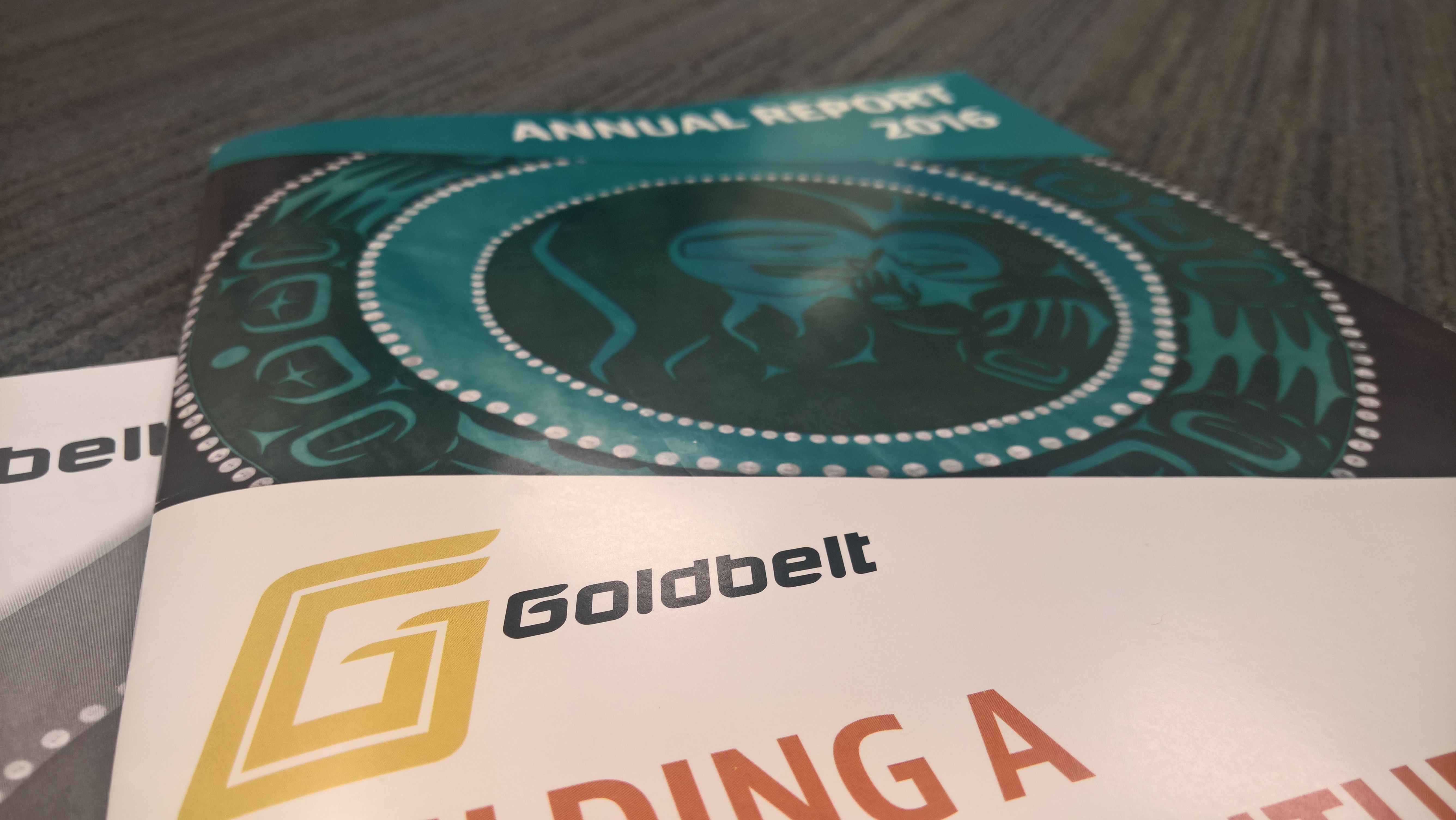
The cover design of Goldbelt Inc.’s 2016 annual report was inspired by the late Clarissa Rizal, a Goldbelt shareholder and weaver. (Photo by Jeremy Hsieh/KTOO)
Two longtime board members of Juneau’s urban Alaska Native corporation board have been ousted through elections at an annual shareholder meeting on Saturday.
Goldbelt Inc. announced Monday that Lori Grant and Leilani Wilson Walkush will replace Joseph Kahklen and Randy Wanamaker on the nine-member board.
A third member up for re-election, Andrea Cadiente-Laiti, retained her board seat.
Randy Wanamaker had served on the board for 24 years. He said he thinks the election results reflected confusion among shareholders about the company’s finances and cultural contributions.
“Some of the candidates were talking about how Goldbelt is losing money, and it’s not profitable. And that’s highly inaccurate. Goldbelt is not unprofitable. It’s very successful in shareholder hire, and support for culture and scholarship programs,” Wanamaker said. “And somehow, I think people tuned into the inaccurate message.”
The company’s annual reports in recent years do show the company has been profitable and contributes to the programs Wanamaker referred to.
Over the years, Wanamaker and the other outgoing board member, Joseph Kahklen, were party to the creation of the Goldbelt Heritage Foundation and several shareholder programs offering scholarships, internships, even managers’ training.
In fact, one of the new board members, Leilani Wilson Walkush, cited her experience as a Goldbelt intern — “1995, so I guess technically 22 years ago,” she said with a chuckle — as part of why she ran.
She said she wants to bring back to Goldbelt some of the skills and experiences she’s had since then.
Outgoing board chairman Joseph Kahklen also has a long history with Goldbelt. He was its first CEO when it incorporated in 1972, and had served 35 years on the board.
The new board reorganized after the election and selected Ben Coronell as the new chairman. In a news release, Coronell said Goldbelt continues to grow despite uncertainty in the federal, state and local budgets and a down economy. He said while most of the company’s revenue comes from government contracting, it is exploring new business.
Exploration well Tolsona No. 1 is located about 11 miles west of Glennallen, Alaska. (Photo by Elizabeth Harball/Alaska’s Energy Desk)
The state is proposing a $380,000 fine for Alaska Native corporation Ahtna, Inc., for safety violations at a gas well near Glennallen.
The Native corporation started drilling the exploration well last September, hoping to find natural gas to use as cheaper fuel for interior Alaska communities.
The Alaska Oil and Gas Conservation Commission stated the violations posed a “serious and significant risk to public health and the environment.”
In an order sent May 24, the commission charged that an oil and gas exploration company owned by Ahtna, Tolsona Oil and Gas Exploration, didn’t install proper safety equipment.
The commission also said the company “stonewalled” the agency’s attempts to address the issues.
Ahtna is challenging the fine. In a statement released yesterday, the corporation disputed parts of the commission’s account. The company said it took “immediate action” to comply with the state’s order, installing the required equipment this week.
Ahtna added the project has an “outstanding safety record,” but also stated that it lacks the “decades of experience that Alaska’s major oil and gas producers do.”
Goldbelt Inc. is holding its annual shareholder meeting and an election for three members of its governing board on Saturday in Juneau.
One disqualified candidate and shareholder with the Alaska Native corporation has been vocally agitating for a change in leadership.
He claims the company of 3,600 shareholders has performed poorly and that incumbents up for re-election violated conflict of interest bylaws.
Goldbelt’s latest annual report boasts that it’s become Alaska’s 15th biggest company; grown its gross revenue by $16 million; expanded several training and scholarship programs; and in November paid out its biggest dividend in five years.
William Andrews poses for a portrait in Juneau on May 10, 2017. Andrews is a Goldbelt Inc. shareholder who’s been calling for a change in the Alaska Native corporation’s governing board ahead of a shareholder election. (Photo by Jeremy Hsieh/KTOO)
Shareholder William Andrews said those aren’t good measures of the company’s health. He highlights net income per share from the financial statements. According to the annual report, from 2015 to 2016, that profitability indicator fell 80 percent.
Board Chairman Joseph Kahklen had some context.
“The number that is put there is strictly a … mathematical thing,” he said.
He acknowledged there were past losses catching up, but that net income per share wasn’t an ideal way to judge Goldbelt. He noted atypical business expenses that do directly benefit shareholders, such as scholarships, donations to the cultural nonprofit Goldbelt Heritage Foundation, internships and professional development programs.
But Andrews’ concerns aren’t just financial.
“So when I couple, you know, what I perceive as unethical governance with poor financial performance, I have strong concerns about the future prosperity of a corporation that I am a shareholder of.”
In the last few months on his personal Facebook page and on Goldbelt’s, Andrews has been sharply critical of the governing board, and especially the decision-making process that led to his disqualification as a board candidate for this election.
He said there was a clear violation of the company’s conflict of interest bylaws when incumbent board members up for re-election failed to recuse themselves from a vote affecting the election.
“They participated because they wanted to ensure their chances of being re-elected by disqualifying other people from running against them,” he said.
The incumbents are Chairman Joseph Kahklen, Andrea Cadiente-Laiti and Randy Wanamaker.
Kahklen did recuse himself, but said in retrospect, he would have participated. Williams said the recusal was proper, and that as chairman, Kahklen should have barred the other two incumbents up for re-election from participating.
According to annual meeting documents, board members’ compensation in 2016 ranged from $15,000 to $37,700. It’s a combination of a monthly stipend, and payments for attending meetings and travel.
Kahklen said the vote in question wasn’t specific to Andrews, but about how strictly to enforce stated candidate eligibility requirements.
“The vote was, do we change our rules to accommodate? Or do we stick to the rules?” he said.
Multiple candidates were disqualified as a result of the vote for strictness.
In Andrews’ case, he failed to answer a candidacy question about financial disclosures.
“To be eligible, you had to complete the questionnaire, all candidates had to do that,” Kahklen said. “If they didn’t complete it, then they weren’t eligible.”
Andrews said he accepts that. His issue was with the ethics of the incumbent candidates participating.
His rhetoric has softened since his Facebook posts in March and April.
He said he doesn’t want a legal fight or to force his way back into the election mix. He just thinks shareholders should vote new blood onto the board and send a message that board members are accountable for their actions.
“It’s really not about blame and shame, ’cause that’s really not what my motive is,” Andrews said. “My motive is that we elect new leadership into the stewardship of our corporation.”
And to him, it’s not just corporate infighting — Goldbelt’s standing affects the entire region.
“They do government contracting, and they partner with local agencies on business ventures here in the region,” Andrews said. “So if a local government wants to engage into a potential business deal with Goldbelt, then they should do so with confidence knowing that Goldbelt’s governance is of an ethical standing.”
In addition to the three incumbents, there are five other candidates that made the cut to be included in the official annual meeting materials.
Shareholders were asked to vote by mail in advance of annual meeting, though they can be overridden by voting in-person.
Kahklen encouraged all shareholders to attend Saturday’s annual meeting and to participate.
The election results are expected to be announced Sunday.
Close
Update notification options
Subscribe to notifications
Subscribe
Get notifications about news related to the topics you care about. You can unsubscribe anytime.