Alaska Native Corporations

Seeing the value of the forest in the trees: Chugach enters California’s carbon market

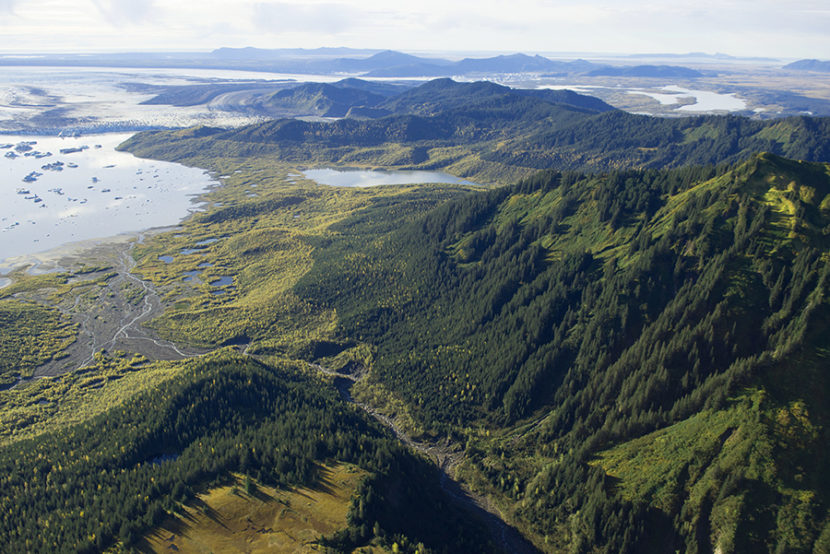
An aerial view of the eastern edge of Alaska’s Copper River Delta. The area is the focus of an innovative deal that safeguards old-growth forests and major coal reserves. (Photo courtesy David Little/Eyak Preservation Council)

“Anyone who’s been to Prince William Sound can tell you it’s an area of tremendous beauty,” said Josie Hickel, Senior Vice President of Chugach Alaska Corporation. “Glaciers, forested acres, wilderness areas. The area is full of wildlife and birdlife, and the fishing is obviously fantastic.”

Among Chugach Alaska’s 900,000 acres are hundreds of thousands of acres of forest — some of it old growth and a lot of it hard to get to. Instead of selling their trees directly, they’re selling the carbon stored in those trees. There’s a market for this in California, and it recently opened up to Alaskan landowners.

“The major emitters  of greenhouse gas have to have a permit or an offset for every ton of pollution they emit in the state of California,” said Brian Shillinglaw with New Forests, the group in California that will help Chugach manage its carbon assets.

Maybe you’ve heard California’s system called “cap and trade.” There’s a cap — or a limit — on how much pollution companies can emit and then there’s a trade for anything above and beyond the cap.

Think of any excess pollution as a carbon sin. Companies in California can pay to have their sins absolved. That absolution comes in the form of sustainably managed forests in other parts of the country.

“Five million acres of forest land are enrolled in this system nationwide,” Shillinglaw said. “This is the first time there’s been a real market for growing older growth forests. The system will pay you to not cut down your forest and to grow inventory.”

Basically, companies in California can emit more carbon because places like Alaskan forests are storing carbon in exchange.
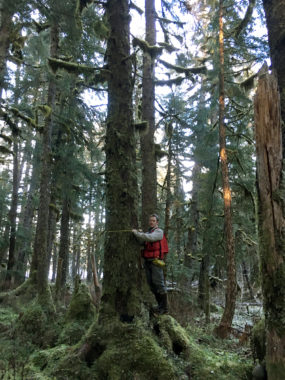
A forest carbon offset project on Chugach Alaska Corporation land relies on a forest inventory based on field measurements conducted by New Forests. (Photo courtesy New Forests)

The California cap and trade market is the largest carbon market in North America, but currently there isn’t enough supply of carbon offsets to meet the demand of California’s polluters. Alaska’s entrance to the market could help change that.

Josie Hickel says other Alaska Native Corporations are considering similar deals, but Chugach’s is the first one that’s been finalized.

Chugach is waiting for spring for a complete forest inventory to take place, but Hickel says they estimate that they have several million carbon credits in their forest land. The carbon market fluctuates like any other market, but right now offsets are selling for around $13 per ton of CO2 emissions. That means that Chugach owns tens of millions of dollars worth of carbon credits that can be sold anytime a California polluter goes over their cap.

In the same deal, on the same piece of land, Chugach sold their right to develop the Bering River coal field to The Nature Conservancy. The Nature Conservancy doesn’t own a lot of coal rights and they’re not planning on doing any coal mining any time soon, according to Rand Hagenstein, Director of the Alaska Program for The Nature Conservancy.

“Our intent is to keep the coal underground in perpetuity,” he said.

And keeping that coal in the ground has positive impacts downstream — all the way to the  Copper River Delta.

“This area is globally renowned for its wildlife habitat. We all know about Copper River red salmon. Many people are also aware that this is one of the world’s premier migratory shorebird and waterfowl sites,” Hagenstein said. “So, there’s a tremendous amount of biological value there.”

For Josie Hickel, with the Chugach Alaska Corporation, the deal means more than just a new revenue source.

“We need to be able to have financial benefits for our shareholders as well as making sure we have the  funding for many generations to come in terms of upholding our heritage and our culture and our language,” she said. “This is a great way to be able to do that.”

This is uncharted territory for Alaskan landowners, but the economic benefits to the Corporation as well as to subsistence and commercial fisheries make California’s carbon market an attractive new frontier.
Eklutna reaches deal with Anchorage over trash gas and new housing

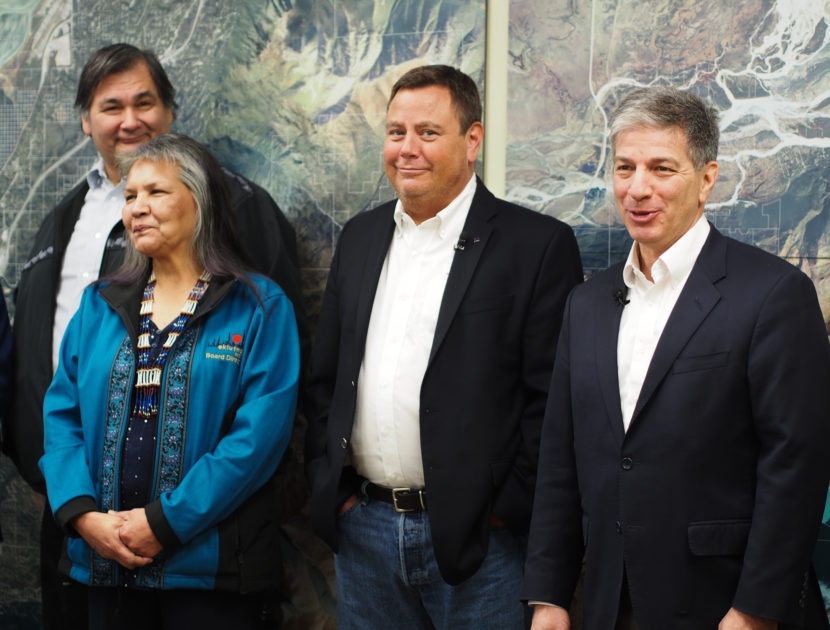
Eklutna Inc. board members Michael Curry, left, and Maria Coleman stand next to Eklutna CEO Curtis McQueen and Anchorage Mayor Ethan Berkowitz at a news conference in Eagle River on January 4, 2017. (Photo by Zachariah Hughes, Alaska Public Media)
Eklutna Inc. chair and President Michael Curry, left, and Treasurer Maria Coleman stand next to Eklutna CEO Curtis McQueen and Anchorage Mayor Ethan Berkowitz at a news conference in Eagle River on Jan. 4, 2017. (Photo by Zachariah Hughes, Alaska Public Media)

The Municipality of Anchorage has reached an agreement with a local Native corporation in a deal that will avoid years of costly litigation for both sides.

During a news conference Jan. 4, leaders from both the city and Eklutna Inc. shared details of the multi-part agreement, which include promises of new housing stock, infrastructure and cash for natural gas produced at the Anchorage landfill.

“We’re all on the same page today,” Eklutna Inc. CEO Curtis McQueen said, standing before a wall-sized map of Denai’ina lands at the corporation’s office in Eagle River as he summed up the company’s special relationship with the municipality.

“Eklutna thinks long term. We’ve been a partner with the city a lot longer than the last 45 years,” McQueen said, adding that the relationship could continue for “centuries to come.”

The for-profit Alaska Native Claims Settlement Act company is the largest owner of private land within the municipality of Anchorage, holding 90,000 acres according to its website.

Those holdings are primarily within the thinly populated neighborhoods of north Anchorage, from Eagle River to Peters Creeks.

In 1982, a federal deal called the North Anchorage Land Agreement between Eklutna, the city and the state resolved ownership issues over portions of contested claims in the area, which includes the Anchorage landfill.

In 2012, the city implemented an energy system that captured methane from decomposing trash at the landfill and sold it as energy to nearby Joint Base Elmendorf-Richardson.

The next year, Eklutna sued Anchorage over that sale, alleging that the city is legally obligated under NALA to split the millions of dollars in revenue coming from the trash gas at the landfill.

Now, the city and corporation have reached an agreement on that suit.

“Eklutna is going to waive any future claims about gas, the municipality is going to forward about $5.75 million,” Anchorage Mayor Ethan Berkowitz said.

The money is a one-time payment, with $5 million coming from general government funds, and the other $750,000 paid by Solid Waste Services, the local trash utility.

Going forward, any money from gas sales at the dump will stay with city.

At Wednesday’s news conference, the payment was framed as a capital resource to help Eklutna build 108 residential units in the next three to five years on property it owns. Residential construction, primarily of single-family homes, is one of the corporation’s best proven abilities.

According to McQueen it was part of what they brought to the table when Eklutna began discussions around the lawsuit when the current administration came into office.

“You’ve heard a lot about the Anchorage Bowl running out of land,” McQueen said. “North Anchorage and Eklutna have a lot of that. We’ve been part of many neighborhoods around Anchorage, and we’ve been talking about how to stimulate making more lots available.”

The deal also laid out who will pay for utility infrastructure to the new developments. Anchorage’s water utility will front the costs for building sewer lines through, though Eklutna will pay that money back.

Speakers at the news conference stressed that the agreement was worth more than the particulars of the settlement, saying it is an accomplishment just for both parties to once again be working together in good faith.

“It takes good hearts to get there, not just business,” said Maria Coleman, treasurer for the corporation’s board of directors.

The deal does not need approval from the Eklutna tribal government to go forward.

Tribal Council President Lee Stephan was present at the news conference, but declined to speak in an official capacity.

Now, the measure is set to go before the Anchorage Assembly next week during its regular meeting.

Southeast’s top 2016 stories: Ferries, elections, forests, rivers

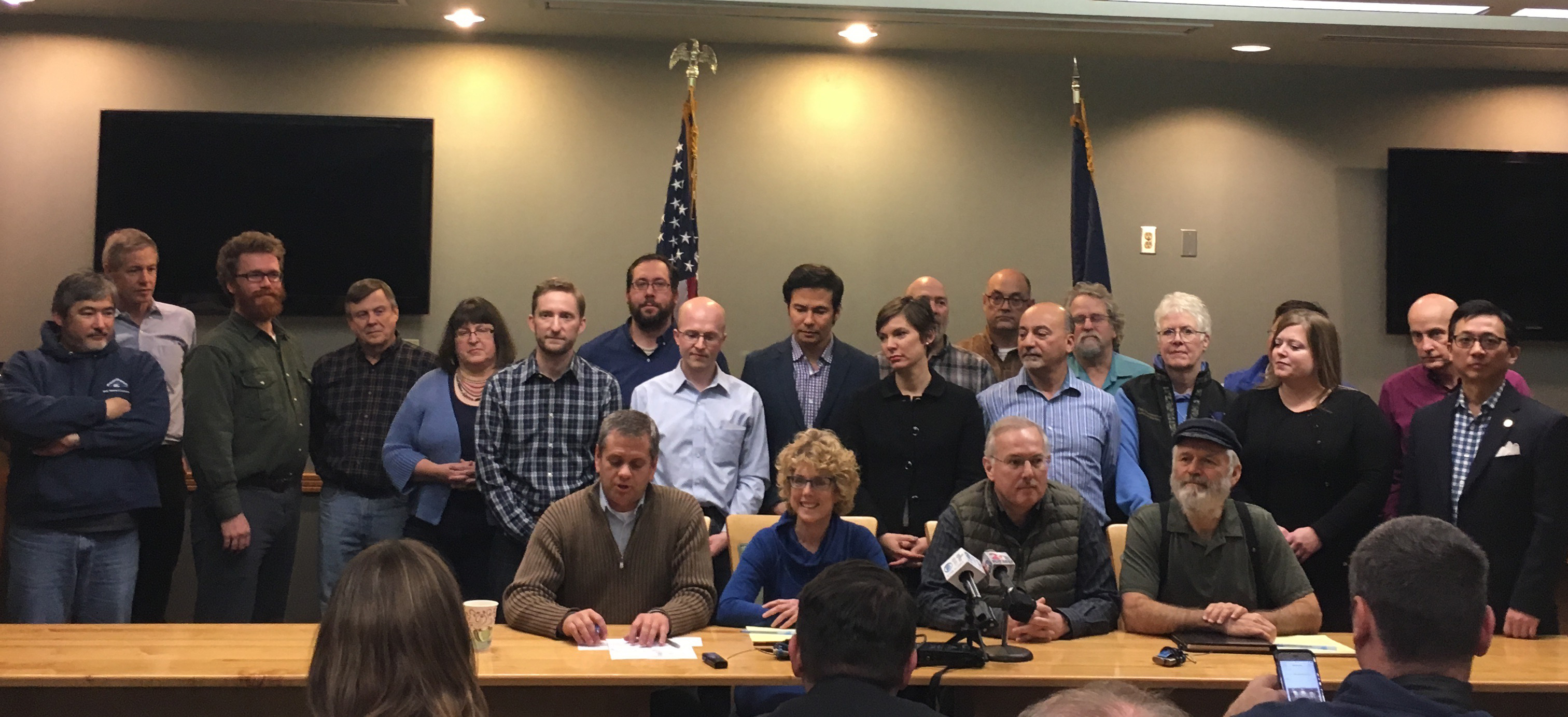
The new bipartisan House majority caucus. The leaders, seated left to right, include Majority Leader Chris Tuck, Rules Chairwoman Gabrielle LeDoux, Speaker Bryce Edgmon, and Finance Co-Chairman Paul Seaton. Nov. 9, 2016. (Photo by Andrew Kitchenman/KTOO/APRN)
The new bipartisan House majority caucus holds a press conference after forming in November. Southeast members are Juneau’s Sam Kito III, far left, Juneau’s Justin Parish, third from left, Sitka’s Jonathan Kreiss-Tomkins, center, and Ketchikan’s Dan Ortiz, second from right. (Photo by Andrew Kitchenman/KTOO/APRN)

The legislature, transboundary mining, timber harvest plans and a shrinking ferry system are among Southeast Alaska’s top stories of 2016.

November legislative elections significantly improved the region’s standing in the House.

Democrat Justin Parish narrowly beat incumbent Republican Cathy Muñoz in Juneau’s Mendenhall Valley district. That contributed to a statewide shift that put Democrats and their allies in charge of the House for the next two years.

Parish was among those promising to protect regional interests.

“From my seat there … I’ll able to quash any possible thought of a capital move,” he said.

He and Southeast’s three other representatives will all have majority leadership positions once they’re sworn in in January. Only one Southeast representative was in the majority during the past session.

The Taku loads in Sitka Sunday morning before sailing to Hoonah and Juneau. It was then tied up for repairs. Photo by Ed Schoenfeld.
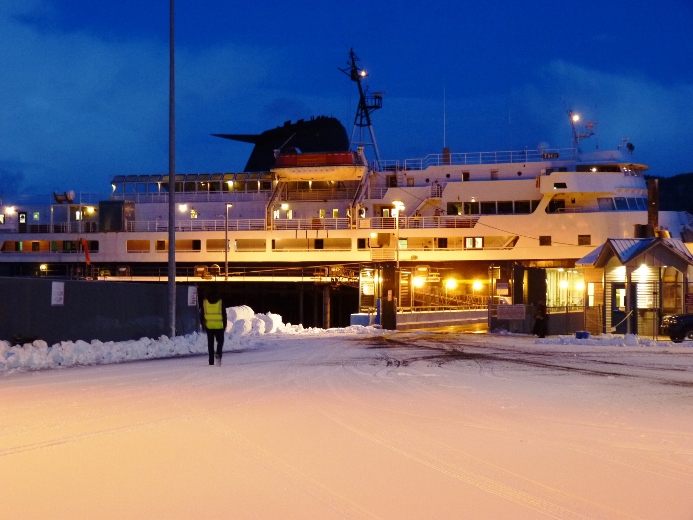
The ferry Taku loads in Sitka in 2012. Now, it’s tied up and waiting to be sold or scrapped. (Photo by Ed Schoenfeld/CoastAlaska News)

Driving on or off an Alaska Marine Highway ferry became harder in 2016, as budget cuts shrunk the number of sailings and two ships went into long-term storage.

The 11-year-old fast ferry Chenega was tied up in Tacoma with an uncertain future. And the 50-year-old Taku was docked in Ketchikan with the intent of being scrapped or sold.

Exploration companies in 2016 continued drilling to expand ore bodies at potential mine sites near the British Columbia-Alaska border.

And critics in Southeast kept pushing for restrictions on mines in transboundary watersheds that drain into the state.

That led state and provincial officials to sign a statement of cooperation in October promising more openness and increased environmental monitoring.

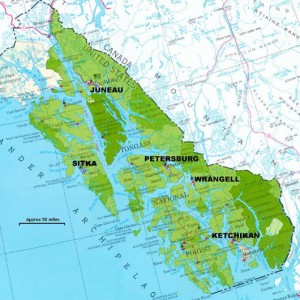
The Tongass National Forest makes up most of Southeast Alaska (Courtesy U.S. Forest Service)

Critics – and the state — said it was not enough and will continue pushing for a binding federal agreement.

Also in 2016, the U.S. Forest Service finalized long-debated plans to move Tongass timber harvests from old-growth to younger trees.

The industry said the plan, announced in December, would make future timber sales uneconomical. Environmental critics said the transition was too slow and didn’t protect enough fisheries and wildlife habitat.

In other news, Southeast Alaska’s regional Native corporation rejoined the fishing industry in May by investing in Independent Packers Corp., a Seattle processing plant.

Arctic Slope Regional Corp: Obama acts in our name, ignores our needs

The Arctic Slope Regional Corp. building in midtown Anchorage in September 2007.
The Arctic Slope Regional Corp. building in midtown Anchorage in September 2007. (Creative Commons photo by chuck t)

President Obama cited subsistence and the needs of Alaska Natives yesterday as part of the reason he decided to block future oil and gas lease sales in Arctic waters. Some Alaskan Natives welcome the resource protection. But the Arctic Slope Regional Corp. said the president didn’t consult with its members and is ignoring the real needs of the Inupiat people.

To see how offshore development would help the people of the region, ASRC Executive Vice President Tara Sweeney said to look at what happened when Shell was exploring in the Chukchi Sea.

Tara Sweeney is the executive vice president for external affairs of the Arctic Slope Regional Corp.
Tara Sweeney. (Photo courtesy Arctic Slope Regional Corp.)

“Our communities were working,” Sweeney said. “Our shareholders were marine mammal observers. We were providing services to the industry in Barrow, in Wainwright, out of Point Hope and in our communities. And absent any of those types of opportunities, people are looking for work.”

As requested by national environmental groups, Obama put the entire Chukchi Sea and nearly all of the Beaufort Sea in what’s known as a 12(a) withdrawal, making the areas unavailable for any future lease sale. Advocates of the move say the withdrawal can’t be undone by the next president.

Industry associations dispute that, and Alaska’s all-Republican congressional delegation said it’s already laying the groundwork to cancel the withdrawals.

Sweeney said the president is thwarting the needs of Arctic people to have things like toilets, running water and a healthy economy. It’s especially galling to her that the White House, according to Sweeney, made the withdrawals without discussing it with ASRC or other Native groups.

“It’s easy for someone in New York or Washington, D.C. — an E-NGO or a limousine liberal — to sit there and say ‘leave the oil in the ground’ when they have access to modern amenities that are considered luxuries in the U.S. Arctic,” Sweeney said.

A White House official said Native corporations and other stakeholders were consulted over several years, not directly for this decision, but when the Interior Department was considering the Arctic for its five-year offshore leasing plan.

A recent poll, sponsored by a pro-drilling lobby, found a large majority of Alaskans support Arctic offshore development. Among Native respondents, the pollsters found 72 percent in favor.

But that’s not everyone.

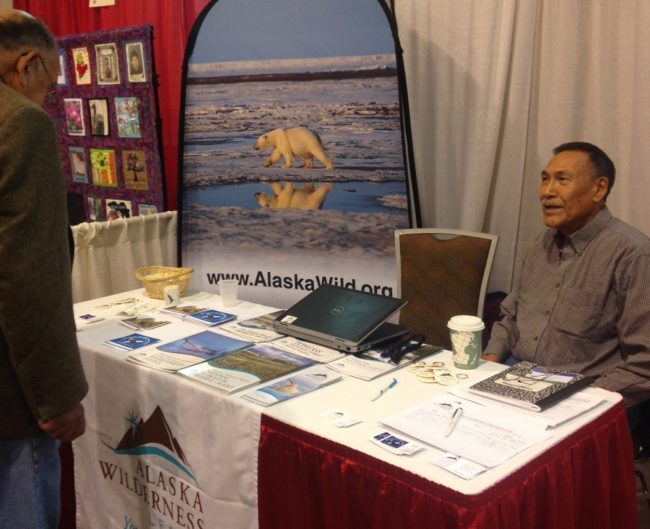
“I’m very, very grateful for everybody’s concern for all the Arctic, the Beaufort and Chukchi,” Ole Lake said. Lake works for the Alaska Wilderness League in Anchorage.

Ole Lake mans the Alaska Wilderness League table at the 2015 Alaska Federation of Natives convention.
Ole Lake mans the Alaska Wilderness League table at the 2015 Alaska Federation of Natives convention. (Photo courtesy Alaska Wilderness League)

Lake is originally from Hooper Bay. It’s well south of the North Slope, but he said Yupik and Cupik cultures like his depend on harvesting the creatures that pass by on their way to the Arctic, and he wants to protect that way of life.

“The coastal people have been witness to that magnificent migratory route for thousands and thousands of years and have grown with it,” Lake said.

Lake believes lots of Native people are probably happy the president decided to keep oil rigs out of Arctic waters, but they’re too busy with subsistence activities to make their views known.

Terrifying visages: Native armor inspired fear in foes

Four armed, armored figures display Tlingit war gear created by Sitka's Tommy Joseph as part of the Alaska State Museum's "Rainforest Warriors" exhibit. It's one of three Alaska shows tourists will see this season.
Four armed, armored figures display Tlingit war gear created by Sitka’s Tommy Joseph as part of the Alaska State Museum’s “Rainforest Warriors” exhibit April 29, 2013. Such helmets and armor were the topic of a Dec. 1, 2016, lecture by the Alaska State Museum’s Steve Hendrickson. (Photo by Ed Schoenfeld/CoastAlaska News)

Tlingit battle helmets were designed to inspire fear. The thick, wooden head armor carried imagery of strong warriors, fierce animals or revered ancestors.

But helmets also played a ceremonial role, representing clans or helping shamans scout behind enemy lines.

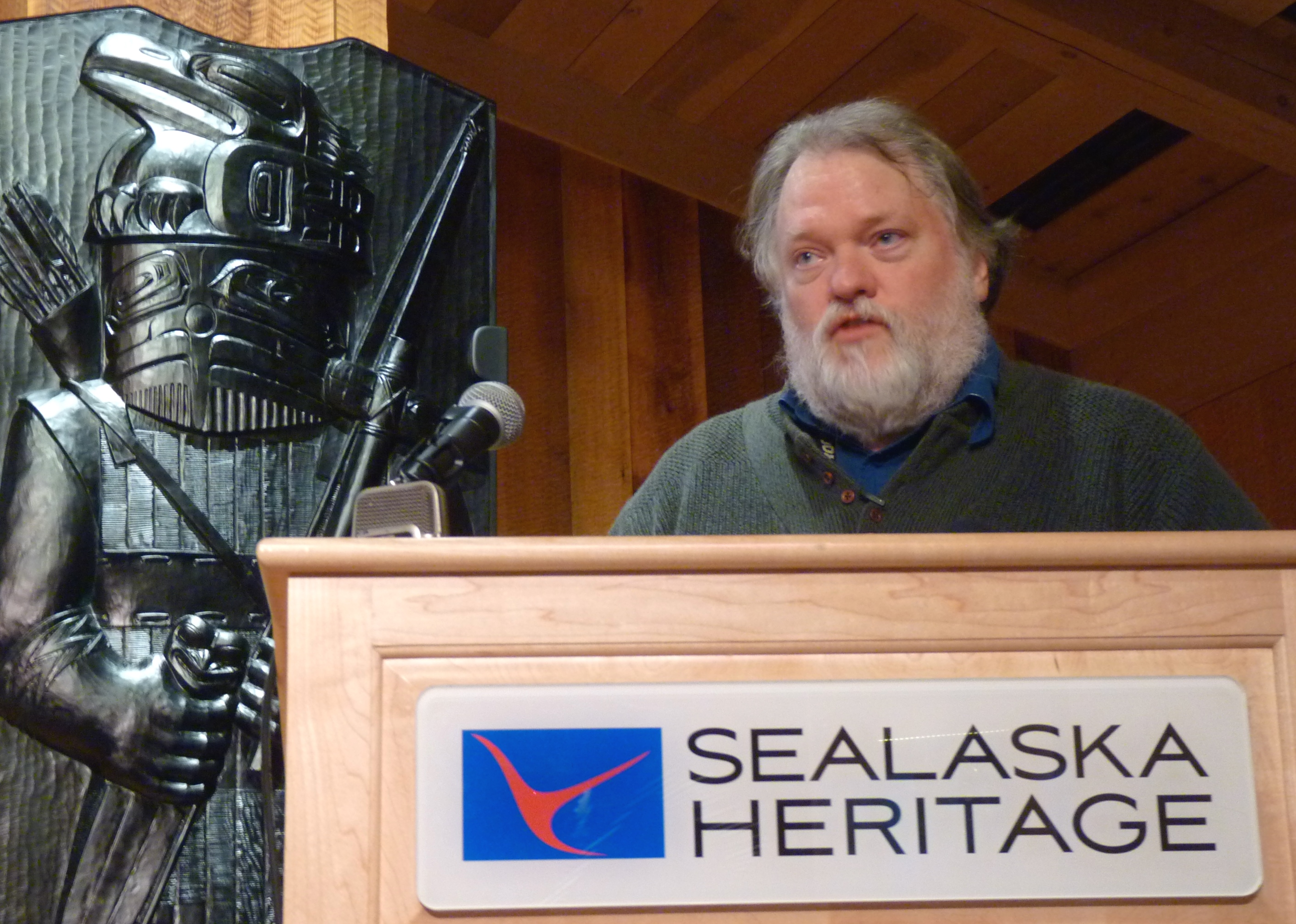
The Alaska State Museum's Steve Henrickson discusses Tlingit armor during a Dec. 1, 2016, lecture at the Walter Soboleff Building. To the left, Preston Singletary's house pole depicts an armored warrior. (Photo by Ed Schoenfeld/CoastAlaska News)
Steve Henrickson discusses Tlingit armor during a Dec. 1, 2016, lecture in Juneau. To the left, Preston Singletary’s house pole depicts an armored warrior. (Photo by Ed Schoenfeld/CoastAlaska News)

When Alexander Baranov led Russian fur traders into Southeast in the late 1700s, he met some fierce resistance.

The Alaska State Museum’s Steve Henrikson said Tlingit warriors appeared one night within their camp.

“He has a very vivid description of how terrified this made everybody seem because these big figures just materialized in the middle of their camp. Because of the layers of padding, they were all really big and tall. The helmet might add another 6 to 8 inches,” he said.

But they were exceptions. Henrikson, the museum’s collections curator, said most warriors did battle with little to protect them, beyond animal hides.

The carved, painted helmets, bentwood face shields and wooden body armor was just too bulky.

“The types of battles that they had often required lots of quick movements and if you’re wearing that armor, it’s fairly heavy and bulky and it restricts your movements. So it would only be employed in very strategic ways,” he said.

Henrikson presented images and information at a Dec. 1, 2016, Sealaska Heritage Institute lecture, Terrifying Visages:  Armored Warriors of the Northern Northwest Coast, at the Walter Soboleff Building in Juneau.

He showed examples of helmets adorned with sea lion whiskers and animal skins.

“Some helmets used the headskin of a bear, a brown bear stretched over a plain, wooden form,” he said.

Battle helmets were thick, made out of burls and other off-grain pieces of wood, which were harder to penetrate or crack.

Henrickson said the origins and ages of many are not known. But one whale design points to a possible origin.

“This one has a seal in its mouth and that may point to it being from the Killer Whale Chasing Seal House of Angoon,” he said.

Steve Henrikson gives a presentation Thursday, Dec.1, 2016, on wearable armor worn by northern Northwest Coast Natives at the Sealaska Heritage Institute in downtown Juneau.. Henrikson is Alaska State Museum's curator of collections. (Photo by Tripp J Crouse/KTOO)
Steve Henrikson has found nearly 100 battle helmets made by northern Northwest Coast Natives at the Sealaska Heritage Institute in downtown Juneau. (Photo by Tripp J Crouse/KTOO)

Henrikson and his fellow researchers have tracked down nearly 100 helmets in museums in the U.S. and overseas.

And sometimes they just show up at an auction. That was the case for one recent find, which appears to represent a merganser, a crested duck with a serrated beak found in Alaska waters.

“Again, no documentation. It was just found in a castle in France. But it’s purely Tlingit,” he said.

He said there’s no question Southeast’s Haidas and Tsimshians made armor too. But so far, most examples are Tlingit.

Armor was made of wood, animal hides or both, sometimes held together by sinew or yarn.

Henrickson said they were strengthened by other materials, including outdated Chinese coins brought in by Russian fur traders.

“They were able to get a good deal on them and they brought them out here and Northwest Coast Natives used them for decorating their regalia but also to maybe make the armor more impermeable to bullets and buckshot,” he said.

That only worked for a while. Early firearms were often weak and inaccurate. As guns gained strength, armor became no match.

But it still had ceremonial use, which continues to this day. And, a number of modern artists have created their own versions for display or use in dance groups.

Hear the full lecture Terrifying Visages: Armored Warriors of the Northern Northwest Coast, with Alaska State Museum Curator of Collections Steve Henrikson.

Steve Henrikson gives a presentation Thursday, Dec.1, 2016, on wearable armor worn by northern Northwest Coast Natives at the Sealaska Heritage Institute in downtown Juneau.. Henrikson is Alaska State Museum's curator of collections. (Photo by Tripp J Crouse/KTOO)
Steve Henrikson gives a presentation Dec.1, 2016, on wearable armor worn by northern Northwest Coast Natives at the Sealaska Heritage Institute in downtown Juneau. Henrikson is Alaska State Museum’s curator of collections. (Photo by Tripp J Crouse/KTOO)

Keeping its promise, Interior Dept. gives Ahtna region more say in moose, caribou hunt

Deouty Interior Secretary Michael L. Connor joins Christopher Gene (center) and Karen Linnell of the Ahtna Intertribal Resource Commission to sign an agreement giving Alaska Native tribes in the Ahtna region more say over subsistence resources. (Photo by Rachel Waldholz/Alaska's Energy Desk)
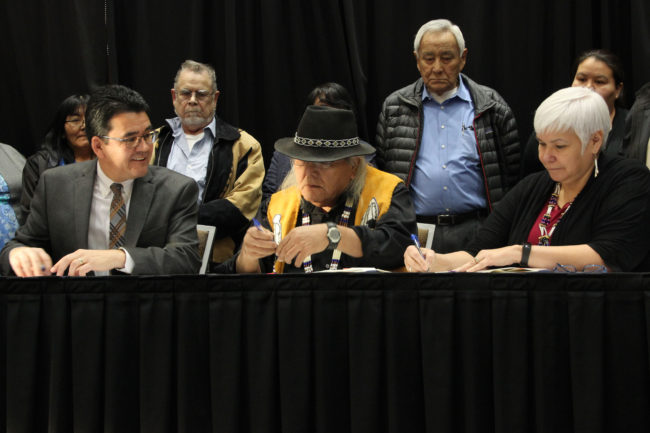
Deputy Interior Secretary Michael L. Connor joins Christopher Gene (center) and Karen Linnell of the Ahtna Intertribal Resource Commission to sign an agreement giving Alaska Native tribes in the Ahtna region more say over subsistence resources. (Photo by Rachel Waldholz/Alaska’s Energy Desk)

In its final days, the Obama administration is forging ahead with a promise to include Alaska Native tribes in the management of fish and wildlife on federal land.

Deputy Interior Secretary Michael Connor was in Anchorage today to announce a pilot project giving Native communities in the Ahtna region greater say in managing the subsistence hunt for moose and caribou.

The Ahtna region includes eight villages from Cantwell to Gakona to Copper Center along the Parks and Richardson Highways in Southcentral Alaska. It’s one of the most accessible hunting areas in the state, attracting hunters from up and down the Railbelt.

That has put pressure on subsistence resources, Connor said. The goal of the agreement is to try to relieve some of that pressure.

“We think over time we will develop better strategies that will allow them better access to critical subsistence resources, which has been a big issue for those communities,” Connor said.

The announcement comes a month after Interior Secretary Sally Jewell spoke to the Alaska Federation of Natives convention in Fairbanks and issued an order aimed at expanding the tribal role in managing federal lands.

The announcement was met with emotion at the Bureau of Indian Affairs conference in downtown Anchorage.

Karen Linnell is the executive director of the Ahtna Intertribal Resource Commission (AITRC), which will represent the tribes in the partnership. She choked up as she described the agreement as the culmination of 45 years’ work to gain a greater say in the management of their traditional lands.

“I just want to thank the people back home for their support in getting this done. It’s a monumentous occasion!” Linnell said, to a standing ovation at the Dena’ina Center.

Speaking afterward, she said the agreement represents incremental progress in a long fight.

“This is just a little bit closer to being more in the driver’s seat. We’re almost there,” she said. “Not so much driver’s seat, but being able to sit at the table, and be on the bus, is important.”

The pilot project will allow the Ahtna Commission to manage the subsistence moose and caribou hunt on federal land for tribal members. It will also create a local advisory committee and formalize a bigger role for local communities in federal wildlife management decisions.

It’s the second such cooperative management agreement in Alaska. The first governs the harvest of king salmon on the Kuskokwim River.

Both Linnell and Connor stress the agreement will not affect access for non-Native rural subsistence and sport hunters. Gov. Bill Walker and Lieutenant Governor Byron Mallott released a statement applauding the agreement.

The push to increase collaboration with tribes has been a hallmark of the Interior Department under President Obama; it remains an open question whether the incoming Trump administration will continue the policy.

Site notifications
Update notification options
Subscribe to notifications