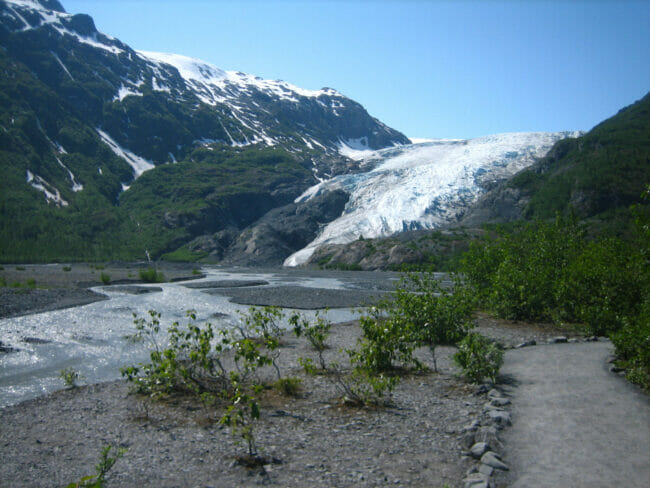
A view of Exit Glacier from the National Parks trail. (Courtesy National Parks Service)
A recent study found that two-thirds of the world’s glaciers could disappear by the end of this century.
That may sound pretty far into the future, but in Alaska those frozen landmarks are a strong attraction for the state’s tourism industry.
For at least one glacier-focused company, Seward-based Exit Glacier Guides, which takes visitors to its icy namesake, the end is already in sight.
“The difference from the glacier over the past decade is mind-boggling,” said Brendan Ryan, the company’s founder. “It’s a completely different topography out there than it was, you know, even really six years ago.”
The receding Exit Glacier is located at the edge of the Harding Icefield just west of Seward, and it’s shrunk by more than 2,300 feet since 2004.
In 2005, Ryan’s company started taking hikers out through a backcountry trail that took them directly onto Exit Glacier. They now offer helicopter tours and ice climbing as well, but the guided hikes that they’re known for are becoming more challenging.
Ryan said it’s getting harder and harder to access the glacier from the trail.
“Rather than it being a gentle step up, it’s literally a sheer wall of ice because it’s melted so far back from the sides of the cliffs where it used to be butted up against,” he said.
These days, Ryan said they often have to cut stairs into the ice to get up onto the glacier, and those stairs usually melt away by the next day. They’ve also had to lengthen their tour times and implement a number of new safety measures.
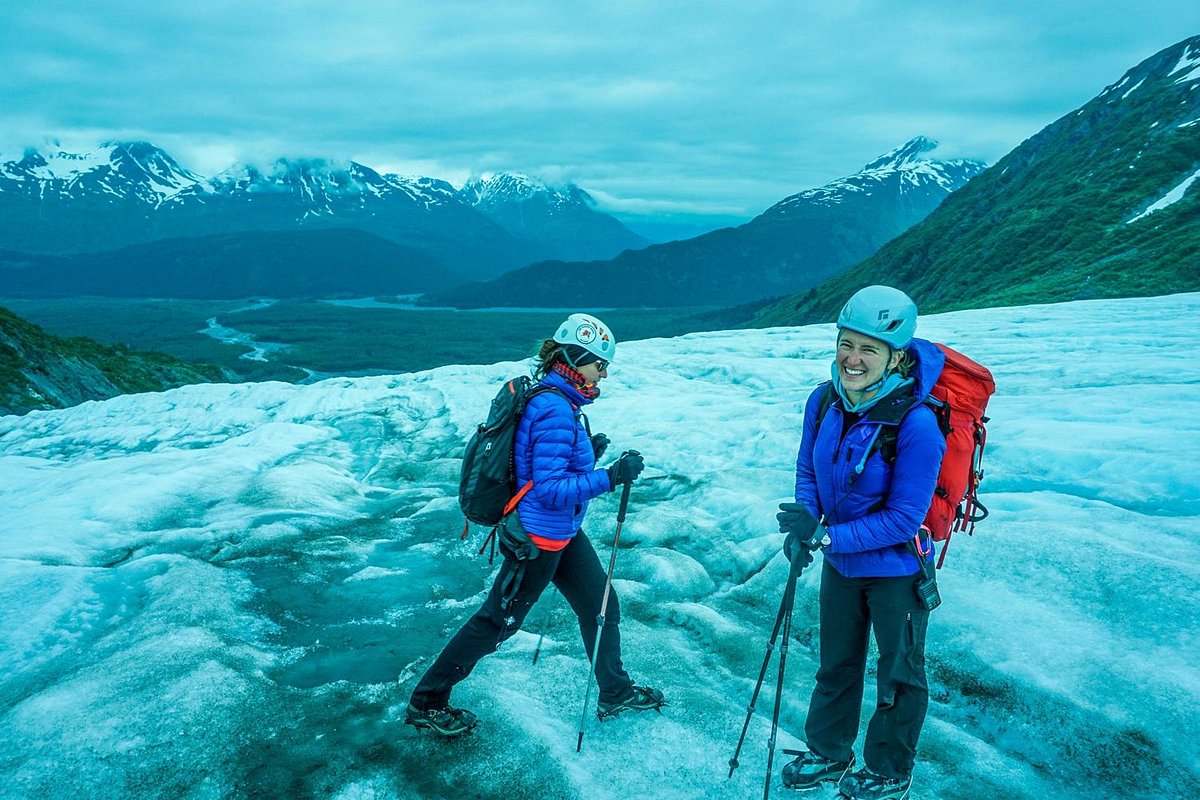
Seward local and Exit Glacier Guides guide Tekla Seavey smiles atop Exit Glacier. (Courtesy Exit Glacier Guides)
“To see the difference from when we started running out there, to what it is now, it’s unrecognizable,” Ryan said. “It’s almost emotionally hard for me to go out and be on Exit Glacier anymore. So I don’t do it very often, because it is so much different. It kind of hurts, if that makes sense.”
In January, a study published in the journal Science found that glaciers around the world are melting faster than anticipated, and at the current rate of global warming, two-thirds of Earth’s glaciers could be entirely gone by 2100. That would have drastic consequences for sea level rise and for the billions of people who rely on that runoff for everything from drinking water to irrigation.
In Alaska, the impacts are visible now.
Mike Loso is a glaciologist with the National Park Service based at Wrangell-St. Elias National Park and Preserve.
“I like to say that in Alaska, the glaciers are not ornaments on the mountains,” Loso said. “To a large extent, they are the mountains.”
He explained that glaciers are an iconic part of the state and an integral part of many Alaskans’ lives.
“Many, many people in Alaska have had the experience of walking on glaciers, skiing on glaciers, snowmachining on glaciers,” Loso said. “You don’t go and just see one off in the far distance.They’re a regular part of our lives in a lot of ways, at least for many of us. And that’s changing, and it’s going to change even more. Our landscape, as we know it, is really being changed wholesale.”
Because they’re so large, most of Alaska’s glaciers won’t go extinct any time soon, he said, they’ll just shrink out of the views we’ve become accustomed to. Loso said that many of our tourism patterns are oriented around where glaciers are now. Exit Glacier and the Kenai Fjords are popular because they’re easy to get to from the road system.
“And so they’re hotspots for tourism, and we have businesses and communities that have developed around those hotspots,” he said. “Some of those hotspots are not going to be any good for viewing glaciers in 100 years or even in 50.”
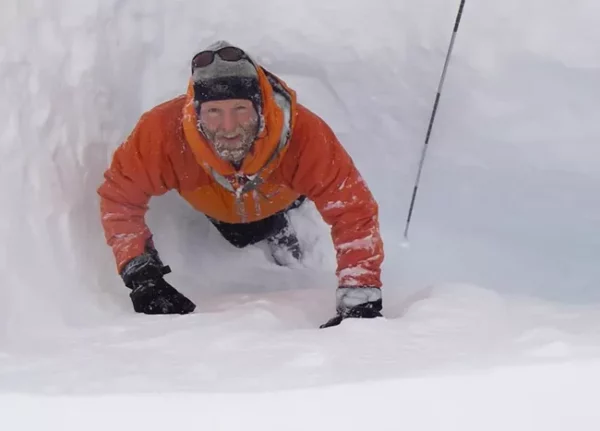
National Parks Service glaciologist Mike Loso measuring snowpack depth. (Courtesy Mike Loso)
It’s unclear how fast and how far the glaciers will retreat, because the degree of change depends on how much more we heat the planet. Loso said this new study illustrates that we can substantially reduce the amount of glacial loss if we reduce greenhouse gas emissions.
“The glaciers of the future are going to be responsive to the choices we as a society make,” Loso said. “And so, though some additional loss of glacier mass is inevitable, the magnitude of that loss is in our hands.”
According to Loso, the National Park Service is now partnering with the researchers behind the January study, Carnegie Mellon University and author David Rounce, to refine their survey model with specific observations of glacier change in Alaska.
In the meantime, tourists will continue flocking to communities like Seward, where the harbor comes alive every summer with tens of thousands of people eager to see the glaciers and wildlife of Kenai Fjords National Park.
Kirsten McNeil is the marketing manager for Major Marine Tours. She said the company hasn’t started planning for a future without tidewater glaciers, but viewing them is a vital part of their business.
“We would have to change our entire operation,” McNeil said. “As far as where we go, the routes we take, what we’re telling passengers we see. I believe it would happen gradually over time, but it would definitely make us change our operations and what we’re promising that passengers will see.”
For businesses like Exit Glacier Guides and founder Brendan Ryan, though, the timeline is much shorter.
“Eventually, it’ll mean that we don’t run our operations at all at Exit Glacier,” Ryan said. “And each year, we think that’s an inevitability within the next couple of years.”
Ryan said his mindset at this point is to not look too far into the future. He’s just trying to eek out one season at a time.
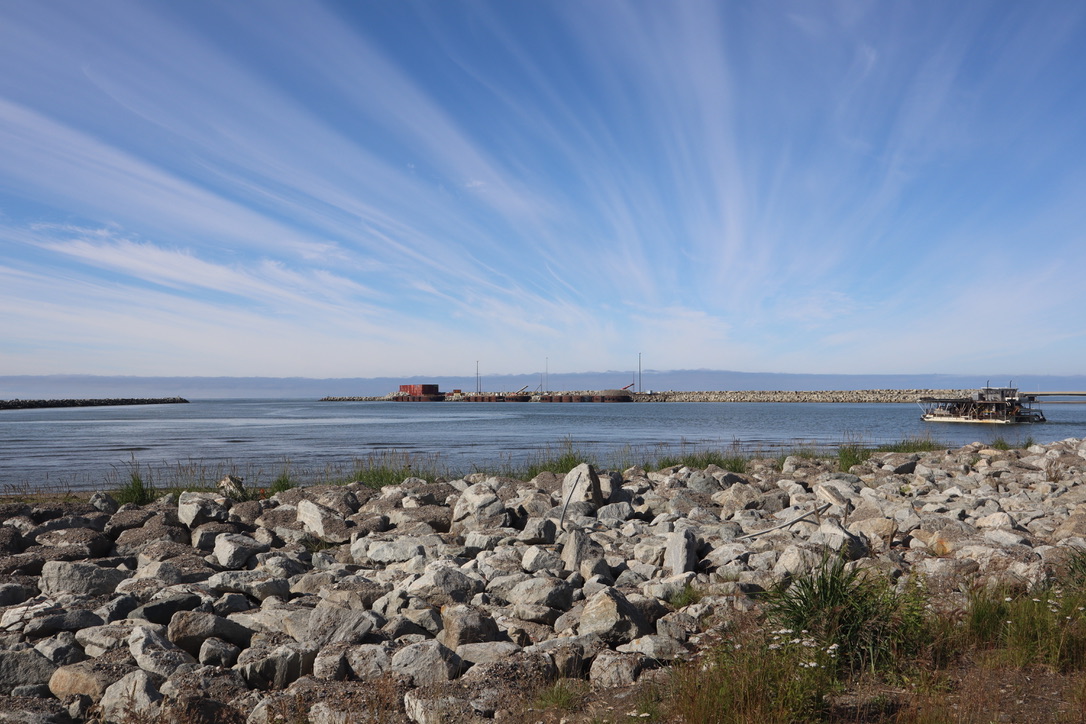
Currently, Nome’s port can only handle ships of a certain size, but an infusion of cash through the Biden Administrations 2021 Infrastructure Investment and Jobs Act means an expansion of the existing port could make the region more inviting for larger vessels. (Photo by Emily Schwing / KNBA)
By 2050, ships traveling through the Arctic’s Northwest Passage may not need an icebreaker to escort them for the journey. In Nome, residents are wondering whether a new port will help or hinder efforts to address a myriad of chronic social problems. Some are also concerned that an onslaught of industrial marine traffic may impact Indigenous people, who have thrived along the coastline here for generations.
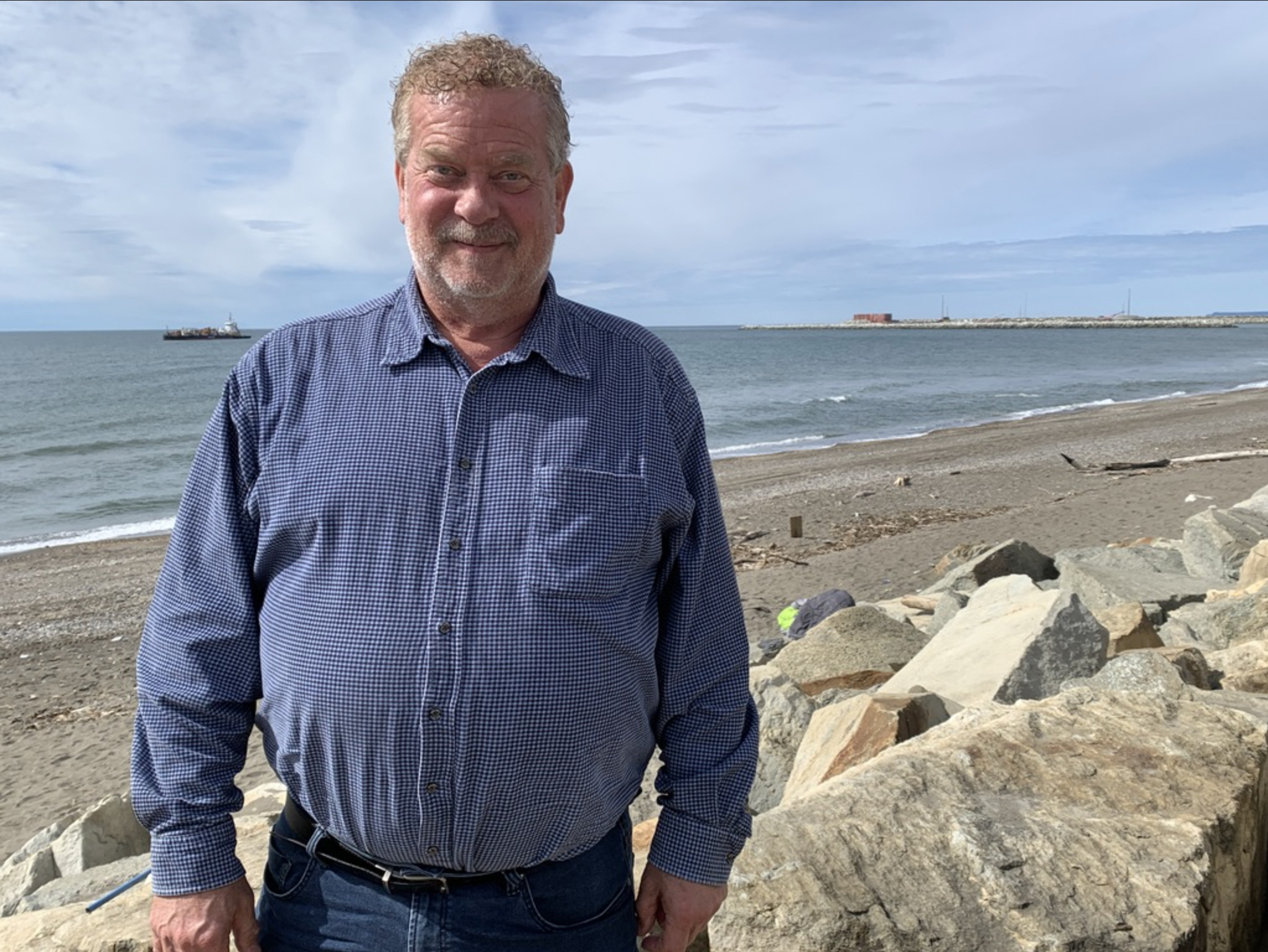
One warm summer day, Austin Ahmasuk stood on Nome’s sand spit. A light breeze blew against his face as he looked over the thin slice of land that lies at the mouth of the Snake River and stretches out in front of the city’s port.
“When you look up ‘sand spit, Nome’ and you look up historical photographs, you’re going to see Alaska Native people living here, celebrating here, harvesting here,” he said.
Ahmasuk grew up in Nome. He has a lot of memories of this place, both good and bad.
“My uncle was working in the tugboat industry and he drowned right over here,” he said. “But I also have really fond memories growing up here, before all these rocks were here.”
He pointed across the spit.
“Cigar fish used to come here and spawn and so myself and a childhood friend — one of us had a box of matches and we cooked cigar fish on a rock and we spent most of the day here,” he said.
A gold discovery here in the late 1890s brought 10,000 stampeders, all looking to get rich. Now, the melting ice caps have triggered another kind of stampede. Large industrial ships can travel through here faster — shaving days off transit times that would otherwise take them through the Panama Canal.
But, Ahmasuk said his memories and the legacy of the Iñupiat who have lived here for thousands of years, shouldn’t have to compete with the modern-day monetary gain some people hope to capitalize on as the Arctic becomes increasingly ice free.
“It’s like a highway going right past us now,” said Nome’s Harbormaster, Lucas Stotts.
Stotts sees Nome as the last pit stop before ships head through the Bering Strait and north into the Arctic.
As the climate warms and sea ice along the northernmost coast of North America dwindles, all kinds of marine traffic — from cruise ships, to hobby sail boats to large-scale industrial ships — is picking up in the icy waters of the Arctic Ocean. According to the Arctic Council, marine traffic increased by 44% through the Northwest Passage between 2013 and 2019.
“There is a lot of traffic that currently isn’t coming into Nome,” Stotts said. “That’s only because they’re too deep draft to come in.”
Anything that rides deeper than 20 feet under the surface of the water can’t dock. He said that’s why Nome needs to expand its port. A $250 million dollar infusion of cash from the Biden Administration’s 2021 Infrastructure Investment and Jobs Act means the basin could be nearly twice that deep in coming years.
“We feel we’re already behind the times in terms of what is needed for the region and by the time this thing is built, I think we’ll be behind as we’re already at that point,” he said.
Nine cruise ships passed through Nome last summer, fewer than Stotts expected due to ongoing concerns about the coronavirus pandemic and conflict between Russia and Ukraine.
“We were going to have 24,” he said. “That is massive growth by itself and that industry isn’t basing that growth on our facility. That was happening well before any expansion was ever slated.”
Erica Pryzmont runs the Pingo Bakery and Seafood House in Nome. She said she’s more concerned with hiring and keeping good staff on hand than she is with whether a port expansion in Nome will raise her bottom line in coming years. (Photo by Emily Schwing / KNBA)
Roughly half a mile from the harbor, at Pingo Bakery and Seafood House, things are pretty quiet after lunch service ends. The restaurant is tiny, with seating for 12, run by Erica Pryzmont. She’s not sure an influx of shipping traffic will influence her business.
“It’s interesting because sometimes the cruise ship visitors just sort of come to the threshold and peer in like you’re some sort of a curiosity or almost like you’re on exhibit,” she said.
Right now, she’s more concerned with trying to find and keep reliable staff to serve the clientele she already has.
A bright red Help Wanted sign hangs on her front door. While she’s looking for employees, others are looking for work. At 4.5%, the unemployment rate in Nome is higher than both the national and state averages.
The Bering Straits region is also facing a serious housing shortage. The local emergency shelter is often full, especially in the winter. Chronic substance abuse is another social ill the community is fighting to manage. And, while there is federal funding for the port expansion, a local funding match is required. So, some residents believe the city should address the issues the community already faces, before assuming millions of dollars in debt the federal government requires in matching funds for the port expansion.
Nome’s Mayor John Handeland doesn’t see it that way.
“You know, if we build all these other resources first because we think we need it, it’s all on speculation,” he said. “And, I haven’t been successful going to my bank and, you know, getting a loan for something that’s purely speculative.”
Nome’s Mayor John Handeland believes a port expansion will decrease the town’s cost of living while also boosting long-term investment in the community and bringing badly-needed jobs to town. (Photo by Emily Schwing / KNBA)
Handeland said a port expansion will decrease the cost of living while simultaneously boosting long-term investment and available jobs in Nome.
Others in favor say it’s essential for national security. They say it will be crucial for environmental protection and emergency response as more ships traverse the Arctic Ocean in the future. But Austin Ahmasuk calls these “the three big lies.” He grew up in Nome and for years worked as a marine advocate and lobbied for improved food security for Alaska Natives through his Alaska Native Corporation Kawerak.
“It certainly makes sense to shippers that cutting a thousand or so miles or a couple of thousand miles off is cheaper. Right. But it doesn’t mean that it’s less risky. You’re still going to the Arctic. It’s still going to be cold,” he said.
Declining sea ice allows more ships to pass through the Arctic. They are coming in larger numbers through the Bering Strait. With them, they bring more greenhouse gas emissions. At least 10% of ships utilizing Arctic waters today are burning heavy fuel oil, which if spilled, can solidify or remain floating for weeks in cold water.
“The weather is so changeable up here, and it’s shallow,” said Vernon Adkison. A lifelong mariner, he says the Bering Sea is not to be underestimated. “So when the wind really picks up, the seas build quicker than out in the middle of the deep blue sea.”
Adkison stars in the Discovery Channel’s reality show Bering Sea Gold. He’s depicted as a gruff and wry business man, with old-school beliefs and a no-nonsense approach to making money off Norton Sound’s rich ocean floor sediments. But he also has some misgivings.
When ships pull into port at Nome, many use much smaller boats to deliver cargo and people to shore. The process is known as lightering. It’s necessary, because the current port can’t accommodate ships over a certain size. Even with a port expansion, lightering would still need to happen. For Adkison, that means more accidents waiting to happen.
“I know what can go wrong in conditions with no eyeballs on the scene,” he said. “They’re out there littering and doing various things. I used to be a lightering master in the Gulf of Mexico, and I saw what some of those guys will do if there’s nobody watching. And then not everybody is ethical. There are bilges, there are spills, there are all kinds of things that can happen if there’s nobody really keeping eyes on the situation.”
The largest Coast Guard base in Alaska is located hundreds of miles south in Kodiak. It could take days to respond to a shipping related accident or spill in the Bering Strait.
“If it was up to me, I’d like to leave it the same as it is right now. I don’t know if I want to have to deal with all the bigger boats and the bigger industry-type scenario just right there where we start our hunting journeys,” said Ben Payenna.
He fishes commercially for crab, salmon and halibut and when he’s not catching fish as his sole source of income, he’s out on his boat, hunting for his family’s main sources of food: seal and fish, many different bird species and walrus.
“I was able to harvest my first one when I was seven,” he said. “I wasn’t really quite big enough to hold a rifle to my shoulder yet. And so my dad actually sat me in his lap and he held the rifle on his shoulder.”
Payenna said that the whole crew of men he used to hunt walrus with is now gone. And he wonders what else he might lose as declining sea ice makes way for more shipping traffic.
This ongoing series is made possible through a grant from the Climate Justice Resilience Fund.
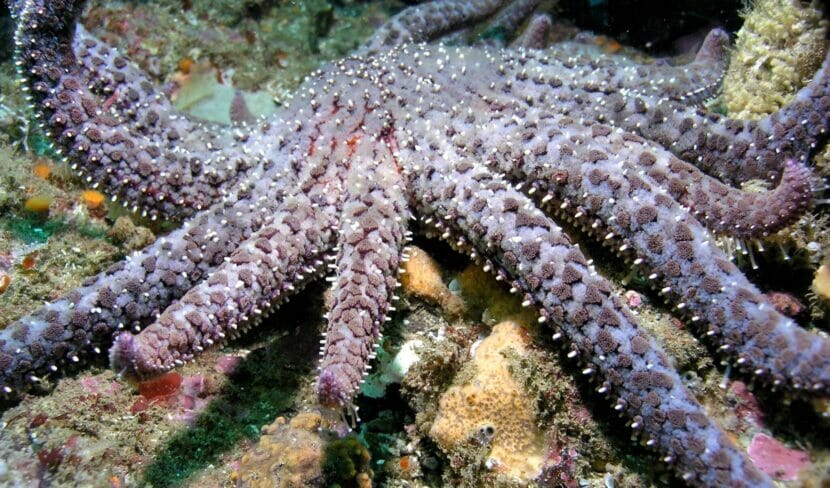
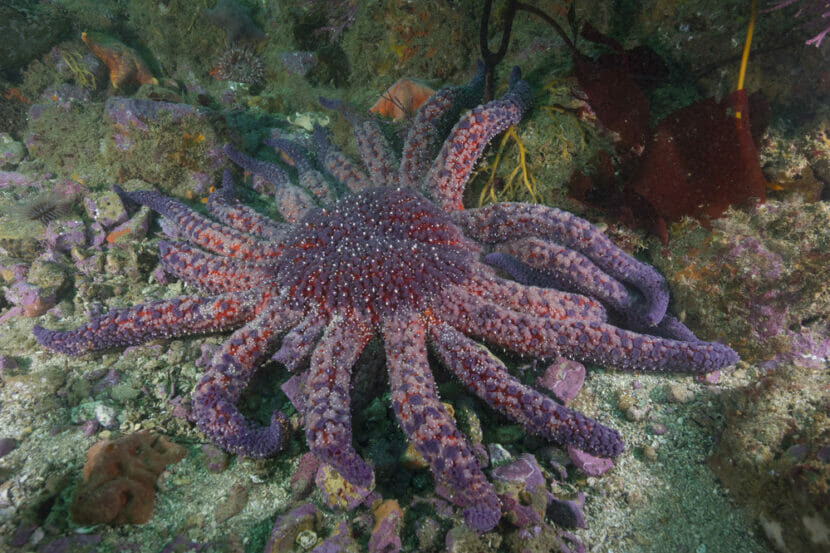
A sunflower sea star is seen on the ocean floor. They are some of the world’s biggest sea stars. Their habitat ranges from waters from the western tip of the Aleutian Islands to the coast of Baja California. But sea star wasting syndrome has cut the population by about 90% since 2013, and federal regulators are considering an Endangered Species Act listing. (Photo by Kevin Lafferty/U.S. Geological Survey)
One of the biggest sea stars in the world has been devastated by a malady likened to an underwater “zombie apocalypse” and could soon be granted Endangered Species Act protection.
Sunflower sea stars, fast-swimming creatures that can have up to 24 arms and grow to three feet in diameter, have largely vanished from their habitat, which stretches from the western tip of the Aleutian Islands to the waters off Baja California.
The National Oceanic and Atmospheric Administration is on the verge of a decision on an Endangered Species Act listing sought in a 2021 petition filed by an environmental group, the Center for Biological Diversity. The petition cites an approximately 90% loss of the animals since 2013.
A sunflower sea star is seen on the ocean floor. These sea stars, some of the biggest in the world, can have up to 24 arms and can measure 3 feet in diameter. (Photo provided by National Park Service)
“Sunflower sea stars have been decimated by sea star wasting disease, urgent action is needed to prevent their extinction,” the center’s petition said.
A listing determination should come within a month, said Sadie Wright, a Juneau-based protected species biologist with NOAA Fisheries. If the agency decides to list sunflower sea stars as threatened or endangered, a proposed rule would be published, followed by a final rule a year later, she said.
Endangered Species Act listings allow the federal government to take actions to conserve wild populations facing threats of extinction.
Sea star wasting syndrome has been linked to climate change. The disease “does appear to be exacerbated by warming ocean temperatures, or significant shifts in water temperature,” Wright said by email.
Preserving sunflower sea stars is about more than preventing extinction of a distinctive and colorful sea creature. Their loss is “devastating for the entire kelp forest ecosystem in which they live,” the Center for Biological Diversity’s listing petition said.
“Sunflower sea stars are a keystone species and a top predator in the intertidal zone. In the absence of a healthy population of sea stars, sea urchins can proliferate and devour the kelp forests that provide habitat for many fish and other wildlife. The decline of sunflower sea stars has caused a cascade of harmful changes in the ocean food web,” it said.
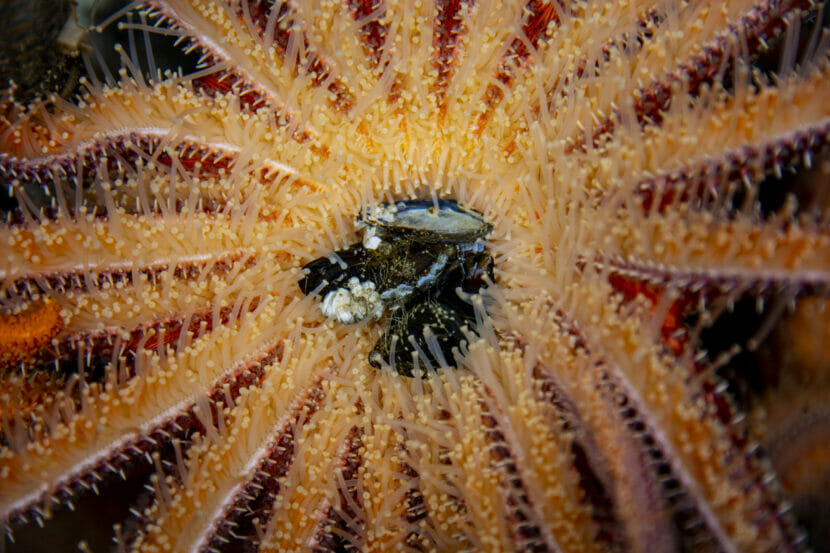
The underside of an adult sunflower sea star is seen in 2021 feeding on mussels at the University of Washington’s Friday Harbor Laboratories. The sunflower sea star captive breeding program there, a partnership between the university and The Nature Conservancy, is a pioneering project that may help in restoration work. The sea stars eat sea urchins, and by keeping urchin populations in check, they help preserve underwater kelp forests. (Photo by Dennis Wise/University of Washington)
While the most severe impacts have been in the southern parts of the range, sunflower sea stars’ disappearance from Alaska waters has been profound. Prince William Sound and Kachemak Bay have been some of the places notably affected, said Brenda Konar, a marine biology professor with the University of Alaska Fairbanks.
“I used to see a ton of them while diving in Kachemak and they totally disappeared for a while,” Konar said by email. “They are starting to make a patchy comeback but it is really slow.”
The International Union for the Conservation of Nature in 2021 listed the sunflower sea star as critically endangered. However, the IUCN uses different listing criteria than those used in the Endangered Species Act, Wright said.
Listing holds possible implications for the fishing industry. While the warming-associated wasting disease is the overwhelming threat, an additional threat is bycatch, the unintentional catch in harvests targeting other species. The animals occasionally wind up in the pots, traps and nets used to catch fish, so listing could mean stricter rules preventing that.
The Alaska Department of Fish and Game and some Alaska fishing groups, in comments to NOAA Fisheries, argued against listing. Their comments said listing is premature and based on incomplete science and that NOAA Fisheries should consider that there are some signs of recovery emerging in Alaska waters.
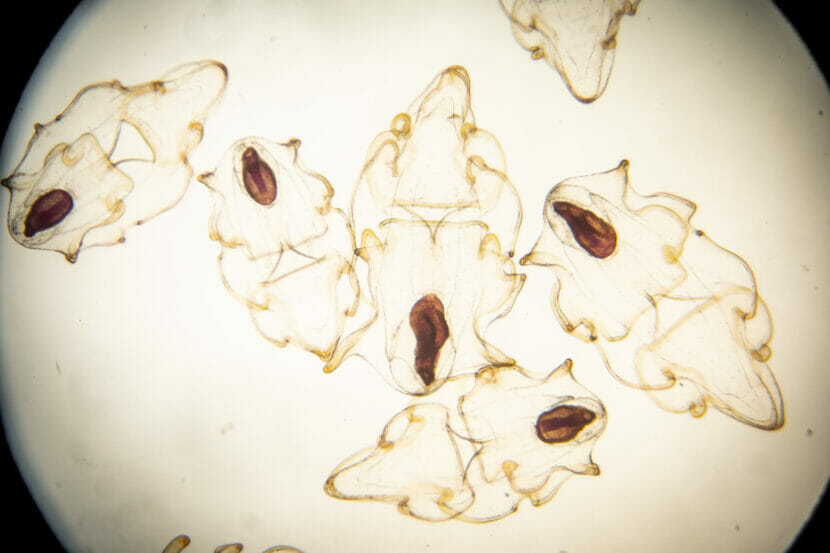
Sunflower sea star larvae, born in January of 2021 at the University of Washington’s Friday Harbor Laboratories, are seen under a microscope. The sunflower sea star captive breeding program, a partnership between University of Washington and The Nature Conservancy, could contribute to efforts to recover the population. (Photo by Dennis Wise/University of Washington)
Even if the population is nearly wiped out in the southern part of the range, the Department of Fish and Game said in its comment letter, sunflower sea stars could shift their range north. “This possibility changes the lens through which the risk of extinction should be viewed: a population that shifts its distribution can look like an extinction at the local scale, but not at the regional scale or across the range,” the department’s letter said.
Preserving sunflower sea stars could benefit the Alaska fishing industry, however. By keeping urchin populations in check and thus protecting kelp beds, sunflower sea stars benefit the marine ecosystem that produces the fish the commercial industry harvests, scientists say.
A possible benefit of listing would be more attention to the sunflower sea stars’ plight – and that could lead to more support for a pioneering captive-breeding program at the University of Washington’s Friday Harbor Laboratories.
The program, a cooperative effort with The Nature Conservancy, started with 16 adults collected in the wild in 2019. The group is now in its third generation, with over 100 1-year-olds now at the lab, said senior research scientist Jason Hodin, who leads the program.
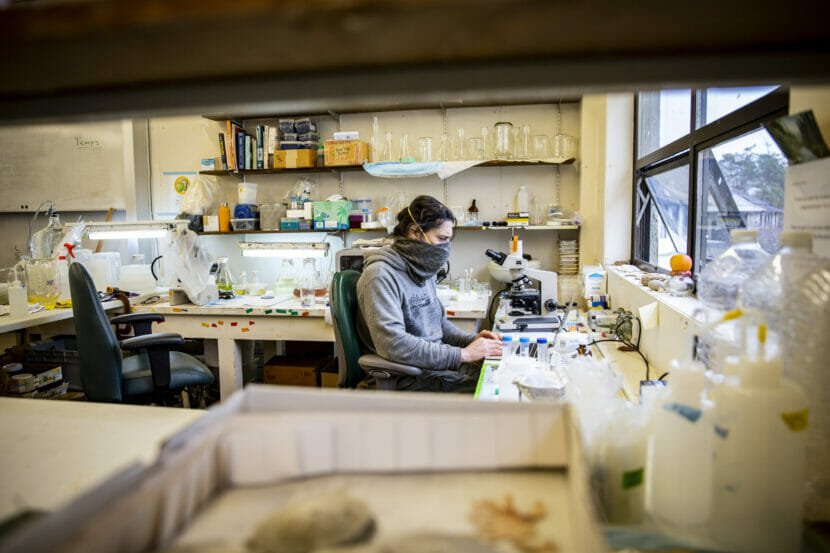
Jason Hodin, a research scientist at the University of Washington’s Friday Harbor Laboratories, is seen in 2021 in the sea star captive rearing lab. Hodin is leading the program. (Photo by Dennis Wise/University of Washington)
The Friday Harbor Laboratories operation is far too small to repopulate the Pacific coast with sunflower sea stars, and that is not its mission, Hodin said. “We’re not a sunflower sea star production facility,” he said. “We’re scientists. We’re trying to understand the lifecycle of organisms.”
However, the work at Friday Harbor might lead to new captive-breeding programs, and restocking parts of the range might wind up as part of a recovery plan, he said. “If we can get more of these, and larger-scale ones, there’s a lot more that can be done,” he said.
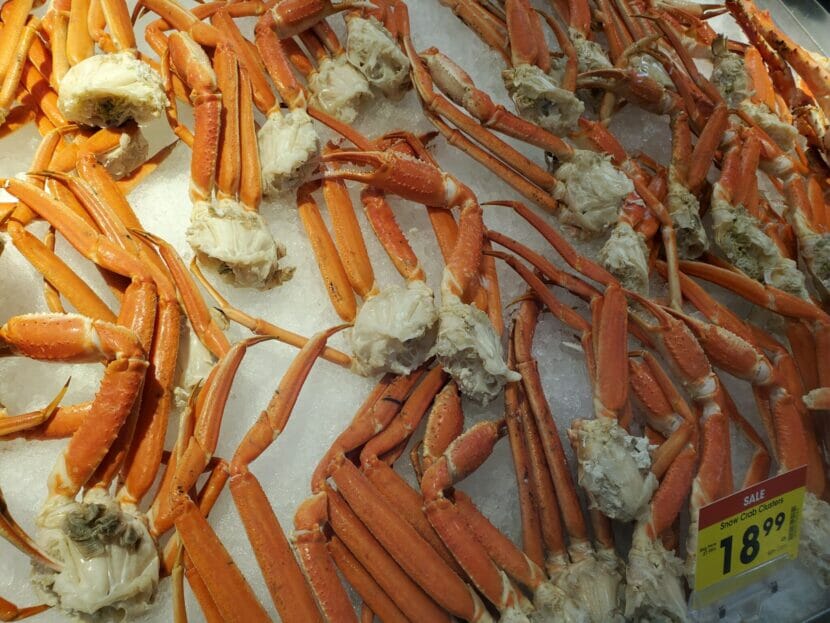
Clusters of snow crab legs are displayed on Jan. 13 at the seafood counter at a midtown Anchorage grocery store. The product was identified as previously frozen. This season’s Alaska’s Bering Sea snow crab harvest was canceled because of low stocks. Scientists warn that the warm conditions that led to this first-ever harvest cancelation are likely to be more common in the future. (Photo by Yereth Rosen/Alaska Beacon)
The first-ever cancellation of Alaska’s Bering Sea snow crab harvest was unprecedented and a shock to the state’s fishing industry and the communities dependent on it.
Unfortunately for that industry and those communities, those conditions are likely to be common in the future, according to several scientists who made presentations at the Alaska Marine Science Symposium held in late January.
The conditions that triggered the crash were likely warmer than any extreme possible during the preindustrial period but now can be expected in about one of every seven years, said Mike Litzow, a National Oceanic and Atmospheric scientist based in Kodiak. By the 2040s, those conditions can be expected to occur one out of every three years, he said.
Blame “borealization” for the disaster befalling snow crab, which is an Arctic species, Litzow said. That term refers to an ecosystem becoming boreal, with groups of organisms — called “taxa” by scientists — that have been south of the Arctic until recently.
“If we think about an Arctic animal at the southern edge of its range that’s exposed to really rapid warming, that leads us sort of inevitably to the concept of borealization,” said Litzow, director of NOAA Fisheries Kodiak laboratory and shellfish assessment program. “As you warm Arctic ecosystems, those systems become prone to a state change, where Arctic taxa such as snow crab become replaced by subarctic taxa that are better able to tolerate ice-free and warm conditions.”
Snow crab are dependent on the winter sea ice and the cold conditions created even after the seasonal melt, he said. While they are widely dispersed through the Bering Sea, the sweet spot for the commercial harvest — the place where the crab are big enough to be commercially valuable — is in the southeastern Bering Sea.
But consecutive years of extreme warmth in the Bering Sea, conditions that precluded much ice formation even in winter, kept temperatures above the 2-degree Celsius threshold that is ideal for snow crab — and made the area suitable for sea life from farther south, including groundfish that may prey on juvenile crab, Litzow said.
Though fishery managers are in the process of crafting a detailed plan to rebuild the stock to help harvesters, processors and communities in the short term, in the long term the suitable habitat for snow crab will be farther north, he said.
Litzow said that points to a need to change management of snow crab and other fisheries.
“We really need to start evaluating our risks less on our lived experience and more in terms of the trends going forward,” he said.
Borealization is occurring around the Arctic Ocean and the seas that border it, a product of climate change.
In Alaska’s Bering and Chukchi seas, that means that suitable habitat for Arctic-specialized species like snow crab and fat-packed Arctic cod is shrinking, and lower-latitude species like Pacific cod and pollock are increasingly found at higher-latitude areas, as University of Alaska Fairbanks-led research has detailed. Borealization is happening on land, too, with woody plants growing farther north and animal populations shifting.
Juvenile snow crab are sorted on a wooden plank during a 2019 NOAA Fisheries trawl survey in the Bering Sea. (Photo provided by NOAA Fisheries)
For Bering Sea snow crab, which in 2021 dwindled to the lowest abundance of adults observed in the 50-year record, the crash took multiple steps.
The low abundance in 2021 followed what was a record-high population of crab surveyed in 2018. Dramatic increases in ocean conditions forced those snow crabs into a smaller area, said Gordon Kruze, a professor emeritus at UAF’s College of Fisheries and Ocean Sciences. The higher temperatures, combined with a much denser population, increased crab metabolism — so much so that the crabs’ caloric needs in some cases quadrupled, “leading to mass starvation,” Kruze said.
The concurrent crash of red king crab in the Bristol Bay region was also devastating economically, but it is not unprecedented. For the second year in a row, no harvests of that iconic Alaska species will be allowed. It is not the first such closure; the harvest was also barred for two consecutive years in the mid-1990s.
Between the snow crab and red king crab closures, losses are not just the nearly $300 million in foregone direct payments that the state has calculated, said Scott Goodman, executive director of the Bering Sea Fisheries Research Foundation. Losses probably amount to at least $1 billion when all multipliers are considered, “which really paints a bleak picture for the industry, and really any strategies to get through and find ways to help here are complicated,” Goodman said at the symposium.
“The reality in Alaska is that major plants that process crab are closing,” he said. “The reality at the community level is, impacts are extreme. Entire fleets are tied up.”
One ongoing project, though, offers a glimpse of hope that human intervention could restore the populations in the future.
Chris Long, a scientist working at the NOAA Alaska Fisheries Science Center laboratory in Kodiak, has been experimenting for several years with projects that might show how to enhance natural crab stocks with hatchery-raised larvae. Much of his work focuses on red king crab in Kodiak, a region in Kodiak, a region where the once-thriving king crab fishery crashed in the 1980s and never recovered.
In experiments so far, very few of the larvae have survived after being spread in the water, at best about 2%, he said in his presentation at the symposium. However, that survival rate is not much different from what happens in the wild, where crab larvae are tempting and ideal food for bigger fish.
Legislation passed last session may turn out to help make mariculture-assisted crab fisheries a reality, Long said. The law, House Bill 41, expanded authorizations for nonprofit hatcheries, adding various types of shellfish to the suite of species that those organizations will be allowed to grow, and it created a framework for the state to regulate cultivation of those shellfish.
If the process works, crab enhancement projects are more likely to get industry funding, thanks to the new legislation, Long said.
Whether crab enhancement will be successful is, for now, an unanswered question. Future success might depend on precise local conditions, Long said. “In one place, crab enhancement might work. But in another place, you’re putting a bunch of expensive fish food into the ocean,” he said.
The Great Salt Lake is roughly 8-9 feet lower than it should be. A snowy winter recently has helped lake levels some. (Kirk Siegler/NPR)
Trekking along the shoreline of the Great Salt Lake — the largest remaining saltwater lake in the western hemisphere — can feel eerie and lonely.
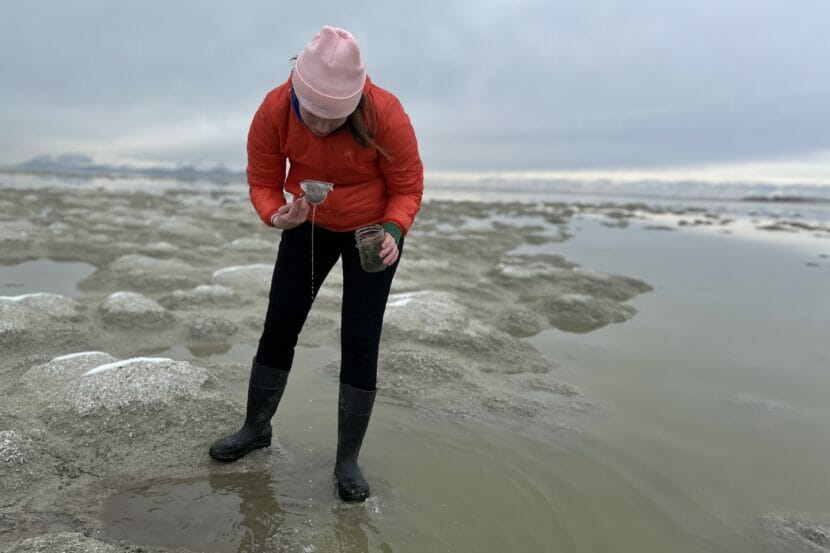
“These might even be my footprints from last week,” says Carly Biedul, pointing to indents in the mud. Biedul is a biologist with the Great Salt Lake Institute. She’s bundled up in an orange puffy jacket, gloves and hat. Most important she’s wearing thick, sturdy, rubber boots.
The mud with a frozen, slick layer of ice on top gets treacherous. One thing that’s hard to prepare for though, is the stench: a pungent odor like sulfur and dead fish. But it’s actually a good thing, a sign of a biologically healthy saline lake.
“People have been saying that they miss the lake stink because it just makes them feel like home,” Biedul says. “It’s just not here [much] anymore, so you’re lucky that it gets to smell so bad.”
Lucky? Maybe one small bright spot in an otherwise grim story of a looming ecological disaster. The lake doesn’t really stink anymore because it’s drying … and dying.
Scientists point to climate change and rapid population growth — Utah is one of the fastest growing states and also one of the driest — as the culprits. A recent scientific report from Brigham Young University warned that if no action is taken, the Great Salt Lake could go completely dry in five years.
Over two decades of the western megadrought, water diversions from rivers that feed the lake have increased in order to support farms and thirsty, growing cities.
Utah leaders and activists are springing into action.
A drying lake could lead to an environmental and economic collapse
Carly Biedul and her team of researchers and students from Westminster College are on the front lines of the crisis and the fight to save the state’s signature lake.
Once a week they hike out to try to collect brine fly larva samples, with the idea that they could keep some alive in their lab back in the city should more water re-enter the lake in the near future.
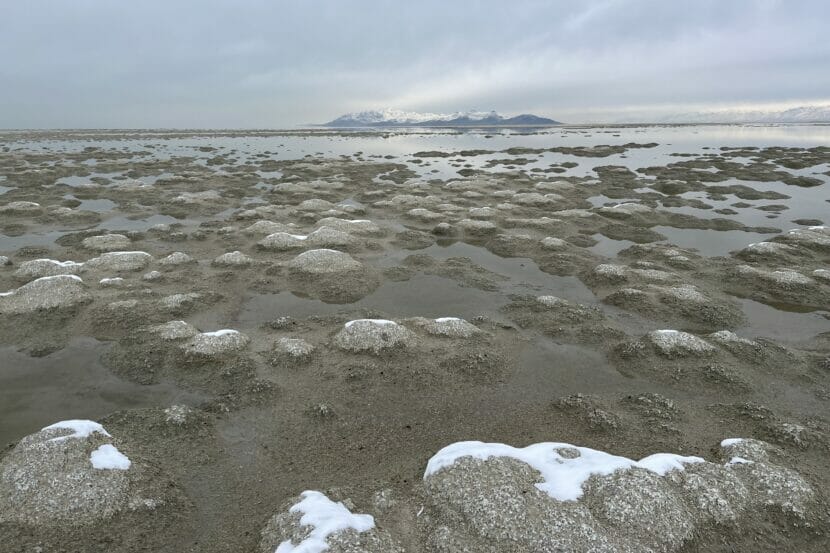
The larvae are harder and harder to find. On a recent cloudy, bitter cold morning, Biedul pointed out mounds or “lumps” of lake deposits called microbialites. They should be mostly submerged, but this day were protruding out along the receding shore. She dug out a refractometer to measure the water’s salinity. Researchers have been worried the current levels — upwards of 17% in places — are too salty to sustain life.
“We’re kind of at the threshold,” Biedul says. “If things get any saltier we’re super worried.”
Carly Biedul of the Great Salt Lake Institute is collecting lab samples on a recent chilly morning on the lake’s receding south shoreline. (Kirk Siegler/NPR)
Consider the disappearing brine flies as an indicator species. They’re at the bottom of the food chain, and feed the brine shrimp, which sustain the thousands of migrating birds and so on. The environmental consequences of a dried up lake are far reaching, and the economic fallout scenarios are dizzying — from the lake’s brine shrimp fishing industry to mineral harvesting, to Utah’s famous ski resorts that benefit from extra lake effect snow.
But the most pressing concern right now in the Salt Lake Valley as the lake dries is shaping up to be air pollution. Salt Lake City already has some of the dirtiest air in the country. In the winter its natural topography causes cold air inversions, and emissions from vehicles and industrial sources form a haze in its bowl-like valley.
The big unknown is how bad dust storms could get from a dried up lake bed. There is precedent. Along California’s Eastern Sierra Nevada mountains, years of water diversions from the Owens River by the city of Los Angeles caused downstream saline Owens Lake to dry up. Dust storms from that lake bed became the largest single source of dust pollution in the nation.
In Utah, the Great Salt Lake is more than seven times larger than the historic footprint of Owens Lake.
“This other piece of the dust coming in really scares people,” Biedul says.
Doctors sound the alarm about vulnerable populations
Scientists warn the Great Salt Lake has high concentrations of neurotoxins and cancer causing carcinogens — including arsenic and mercury.
“If the lake bed dries up, and we’re having winds blowing dust storms into our neighborhood, the heavy metals are going to land right on top of this neighborhood,” says Turner Bitton, a community activist in Glendale, a traditionally working class neighborhood in Salt Lake City’s west valley.
Much of the area is zoned for manufacturing, but it’s also one of the last bastions of affordability in the city. Bitton’s neighborhood is already hemmed in by two busy freeways, an international airport, and it’s close to Utah’s largest oil refinery.
He says many local families are alarmed at the prospect of the air getting even worse.
“We’re talking about something that could potentially make these neighborhoods, I don’t want to say uninhabitable, but for those that are vulnerable, for those that have lung issues, uninhabitable,” Bitton says.
Researchers have found higher rates of asthma and cardiovascular disease in neighborhoods like these. One University of Utah study even showed that students in schools here scored lower on tests during bad air days.
Moench says the state should have declared an emergency years ago.
“A lot of people think that dust is pretty benign because it’s quote — natural,” he adds. “Well that’s not the case, and in the case of dust from the Great Salt Lake, it is particularly toxic, because we know that it is laced with high concentrations of heavy metals.”
The majority of Utah’s 3.3 million population lives near the lake, just to the east along the Wasatch Mountains. The lake is about nine feet lower than normal. And locals are already complaining of dust storms. Moench counted more than a dozen in the past year — when a decade ago there were none.
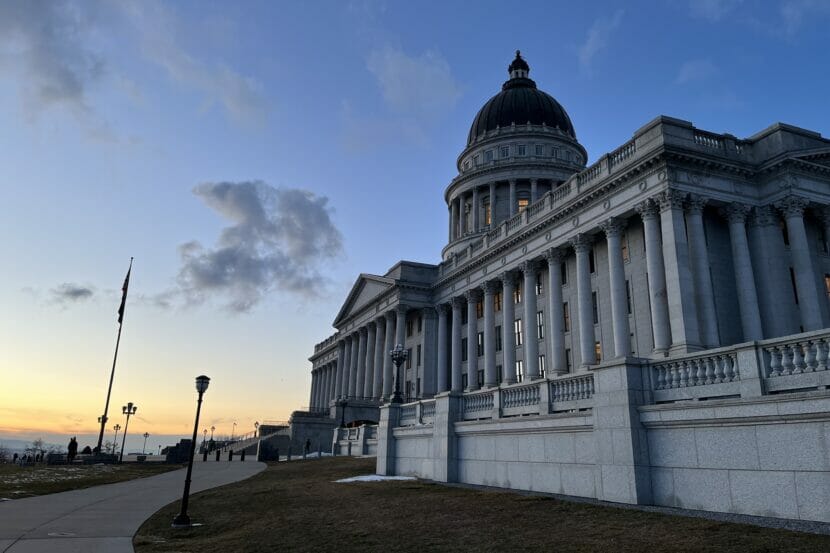
On Utah’s Capitol Hill, state lawmakers are debating a roughly $500 million spending package geared toward saving the lake. (Kirk Siegler/NPR)
Utah leaders insist they won’t let the lake dry up
At the state capitol, lawmakers this session are facing pressure to save the lake, and Gov. Spencer Cox is under the gun to call a state of emergency. In his state of the state address last month, Cox nodded to the BYU study which warns that in just “five short years,” the Great Salt Lake will completely disappear: “Let me be absolutely clear, we are not going to let that happen.” Cox said.
Earlier this week, a bipartisan group of state lawmakers unveiled bills ranging from expanding turf-reduction programs in cities, to providing more incentives to farmers to divert less water from rivers that feed the lake. Some pledged to spend upwards of a half billion dollars to save the lake.
“Even though the Great Salt Lake has risen a foot so far, we know that one wet winter is not going to wipe out two decades of very, very, very dry climate here in Utah,” said Brad Wilson, the Republican House Speaker.
Some ideas that have been floated sound like something out of a science fiction novel — including cloud seeding, and even a plan to build pipelines to pump in water from the Pacific Ocean.
“We are getting some really fantastical suggestions from some of our lawmakers as to how to solve this,” says Moench, of Physicians for a Healthy Environment.
Moench and environmental activists are arguing for buying out alfalfa farmers so more water will return to the Great Salt Lake. But some are encouraged that at the very least saving the lake is one of the top priorities of this legislative session.
From Utah’s Capitol Hill, there’s a sweeping view of the Salt Lake City skyline, and to the west, past the airport, the receding lake is visible, shimmering gray at dusk. It’s an ominous sight, but if nothing else, hard for state leaders to ignore.
Down at the lake, Carly Biedul of the Great Salt Lake Institute is doing her best to keep positive. She thinks there’s still time to save this lake, but not much.
“It’s really pretty right now, you can see the reflections of the mountains on the water,” she says. “And that’s kind of what we’re been trying to do is find these moments of beauty when it’s so … sad.”
Copyright 2023 NPR. To see more, visit https://www.npr.org.
Transcript :
STEVE INSKEEP, HOST:
A popular 19th-century book describes the Great Salt Lake. In the 1840s, that lake was well known to local people, but not on the East Coast. The Western mapmaker John Charles Fremont described boating on the lake to an island. He accidentally left the cover to a spyglass on that island and mused that some future explorer might find it. Unless something changes, future explorers of that island may be able to walk there because the lake is drying up. A report says climate change and population growth in Utah may destroy it in five years. NPR’s Kirk Siegler takes us there.
KIRK SIEGLER, BYLINE: The Great Salt Lake is the largest remaining saltwater lake in the Western Hemisphere.
(SOUNDBITE OF FOOTSTEPS SLOSHING IN WATER)
SIEGLER: Now, trekking along its receding shoreline, especially if it’s the dead of winter, can feel eerie and lonely.
CARLY BIEDUL: These might even be my footprints from last week.
SIEGLER: Carly Biedul is a biologist with the Great Salt Lake Institute. She’s bundled up in an orange, puffy jacket, gloves and hat. And most importantly, she’s wearing thick, sturdy rubber boots. The mud with the frozen, slick layer of ice on top – it’s treacherous.
(SOUNDBITE OF FOOTSTEPS SLOSHING IN WATER)
SIEGLER: Well, the only thing we’re not really prepared for is the stench.
This is pungent right here.
BIEDUL: (Laughter) Yeah.
SIEGLER: Smells like dead fish almost.
The stink is a sign of a biologically healthy saline lake.
BIEDUL: People have been saying that they miss the lake stink because it just makes them feel like home, and it’s just not here anymore. So you’re lucky that it gets to smell so bad.
SIEGLER: It doesn’t really stink anymore because it’s drying and dying. Biedul hikes out here weekly, trying to collect samples of brine fly larva, which are getting harder and harder to find.
BIEDUL: I’m going to get my jar out.
SIEGLER: Brine flies are at the bottom of the food chain, feed for the brine shrimp, which sustain the migrating birds and so on. Most of the water that’s left here is too salty now.
BIEDUL: The threshold is – we’re kind of at the threshold. So if things get any saltier, we’re super, super worried.
SIEGLER: So what brought us to this brink? Two decades of a Western megadrought and water diversions from rivers upstream for farms and suburbs.
BIEDUL: Yeah, sorry. This is our crossing point.
SIEGLER: Now, if this lake goes away, just the economic fallout alone is dizzying, from brine shrimp fishing to mining to Utah’s ski resorts that benefit from extra lake effect snow. And then there’s the pollution.
BIEDUL: The inversions here in the winter that we get just from being in the valley is already a big problem. And so having this other piece of the dust coming in really scares people.
SIEGLER: Partly because of those inversions, Salt Lake City already can have some of the dirtiest air in the U.S.
(SOUNDBITE OF CAR HORNS HONKING)
SIEGLER: And the lakebed has high concentrations of mercury and arsenic.
TURNER BITTON: If the lake bed dries up and we’re having winds blowing dust storms into our neighborhood, the heavy metals are going to land right on top of this neighborhood.
SIEGLER: Turner Bitton is a community activist in Salt Lake City’s West Valley. These more working-class neighborhoods are already hemmed in by busy freeways, an international airport and Utah’s largest oil refinery.
BITTON: I mean, we’re talking about something that could potentially make these neighborhoods – I don’t want to say uninhabitable – but for those that are vulnerable, for those that have lung issues, uninhabitable.
SIEGLER: He’s not being dramatic. Researchers have found higher rates of asthma and cardiovascular disease in neighborhoods like these. And one University of Utah study even showed that students in schools here scored lower on tests during bad air days. Dr. Brian Moench is president of Utah Physicians for a Healthy Environment. He says the state should’ve declared an emergency years ago.
BRIAN MOENCH: A lot of people think that dust is pretty benign because it’s, quote, “natural.” Well, that’s not the case. And in the case of dust from the Great Salt Lake, it is particularly toxic because we know that it’s laced with high concentrations of heavy metals.
SIEGLER: And most of Utah’s 3 million or so residents live just east of the lake along the Wasatch Mountains. The lake is about 9 feet lower than normal right now, and locals are already complaining of dust storms. The crisis is all over the mainstream news here.
(SOUNDBITE OF NEWS MONTAGE)
UNIDENTIFIED PERSON #1: And, you know, even with all of this snow, Utah still remains in a drought.
UNIDENTIFIED PERSON #2: Now to what some tonight are calling a looming environmental nuclear bomb in Utah. The mighty Great Salt Lake is drying up. And as…
UNIDENTIFIED PERSON #3: As the Great Salt Lake…
SIEGLER: At the state Capitol, lawmakers this session are under pressure to save the lake. Some ideas floated sound like sci-fi – cloud seeding, even a pipeline to pump Pacific Ocean water in. Right now, lawmakers are debating a half-billion-dollar package that would do things like pay farmers in cities to use less water. Here’s Republican Governor Spencer Cox in his recent State of the State address.
(SOUNDBITE OF SPEECH)
SPENCER COX: Earlier this month, a report predicted that in just five short years, the Great Salt Lake will completely disappear. Let me be absolutely clear. We are not going to let that happen.
SIEGLER: Now, from up here on Capitol Hill, there’s a sweeping view of the Salt Lake City skyline. And when you look to the west, past the airport, there’s the receding gray lake shimmering at dusk. It’s an ominous sight but hard for lawmakers to ignore.
(SOUNDBITE OF FOOTSTEPS SLOSHING IN WATER)
BIEDUL: We can see the reflection of the of the mountains on the water. It’s really pretty right now.
SIEGLER: Now, for her part, down at the lake, biologist Carly Biedul is keeping positive.
BIEDUL: And that’s kind of what we’ve been trying to do – is find these moments to see the beauty when it’s so sad.
SIEGLER: Sad because Biedul says there’s very little time left to save this lake.
Kirk Siegler, NPR News, Salt Lake City. Transcript provided by NPR, Copyright NPR.
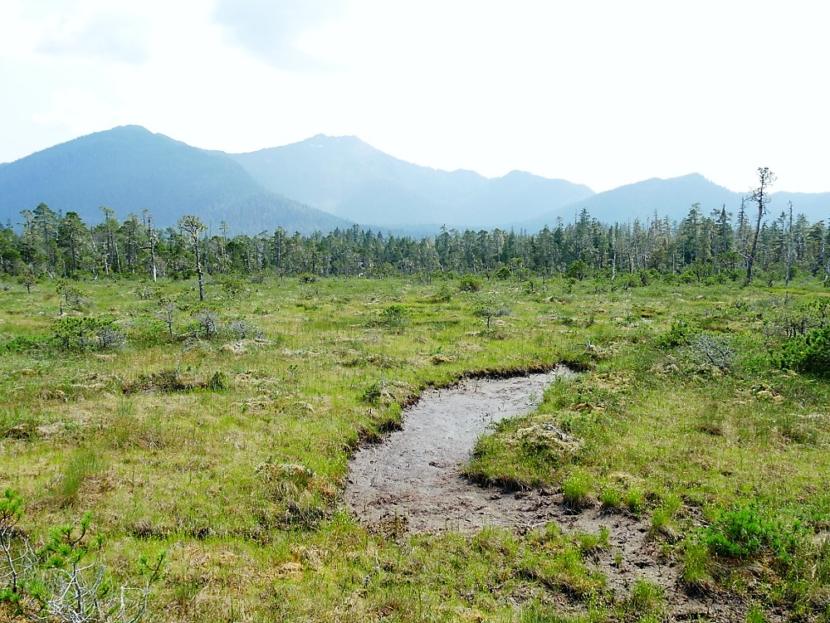
A dried, muddy patch was all that was left of this muskeg pond near Petersburg in the summer of 2019. (Photo by Joe Viechnicki/KFSK)
The fall of 2016 ushered in a historic drought for Southeast Alaska. Hot, dry summers wreaked havoc on subsistence crops like wild berries. Warmer waters disrupted salmon hatcheries in Juneau. And in 2018, about twice as many fires burned in the Tongass as what’s typical.
By 2019, the U.S. Drought Monitor had declared an extreme drought across the region. Rick Thoman, a climate scientist with the University of Alaska Fairbanks, says dry spells are not abnormal, even in a temperate rainforest. But the drought from 2016 to 2019 was unique.
“This was a warm, dry drought. And that is very different,” he said. “Droughts from the ’50s, from the ’70s, even into the early ’80s — they were cold, dry droughts. And that matters a lot.”
Though there have been warmer droughts and drier droughts in the past, the region’s longest droughts on record have often been accompanied by below-average temperatures. With 2016, Southeast’s warmest year on record, that changed.
In a new retrospective report, Thoman and collaborators at the National Oceanic and Atmospheric Association examine the impacts of the 2016-2019 drought in the context of past droughts and future climate projections.
Hotter droughts ahead
Andy Hoell, a NOAA research meteorologist and co-author on the report, said warming temperatures are changing droughts in Southeast.
“Now we’re seeing these droughts that are so much warmer to the tune of like three, four or five degrees,” he said.
According to the report, the lower levels of precipitation during the 2016-2019 drought were not caused by climate change. But the warming was, and scientists say that warming will continue. Climate models predict that Southeast may get up to 6 degrees warmer by 2050. That’s a big deal because higher temperatures cause more evaporation.
When droughts come with higher temperatures, the gap widens between how much water falls from the sky and how much makes it to lakes, streams, plants and soil. Things dry out faster, which threatens ecosystem health and increases the risk of wildfires.
A wildfire near Juneau in May 2018. Tongass National Forest responded to 32 wildfires in 2018. 15–20 fires/year is normal in the forest. (U.S. Forest Service photo)
Higher temperatures also increase the risk of snow droughts, which happen when less mountain snowpack accumulates. That can decrease supplies of freshwater over time and increase stream temperatures when snow melts in the spring and summer, which harms fisheries.
Many of the plants and animals of Southeast’s temperate rainforest cannot survive long, dry periods. They’re adapted to a stable snowpack and heavy rains. And Southeast’s people are, too.
Preparing for drought in a wetter Southeast
As the 2016-2019 drought stretched on, water levels in lakes and reservoirs reached record lows. Communities across the Southeast had to cut back. Wrangell and Haines placed restrictions on water use, and places that rely on hydropower — like Juneau, Ketchikan and Metlakatla — faced rising energy prices. Some even switched over to diesel generators.
The drought highlighted that water-related infrastructure may fail during droughts.
“It’s not like there hasn’t been drought in the rainforest before,” Thoman said. “One of the big reasons that this drought was more impactful had nothing to do with how much rain was or wasn’t falling out of the sky, but changes in society.”
Southeast is getting wetter — precipitation could increase as much as 14% by mid-century — but Thoman says that won’t necessarily mean fewer droughts. Some projections suggest that climate change may create more distinct wet and dry seasons in the Southeast. That means extreme wet periods may be offset by extreme dry periods, especially in the summer.
“You might get 160 inches of rain for the year in Ketchikan,” Thoman said. “But if you only get five inches between June and August, that’s going to be a drought for the Tongass.”
Hoell hopes the report will help communities prepare for future droughts. It highlights the importance of improving water storage, supplementing hydropower and increasing awareness around water conservation.
He emphasized that the next drought could happen at any time.
“The rain could shut off and go back to the levels that we had during, say, 2017 or 2018,” he said. “The thing is, you usually don’t care about something unless you’re actually in it.”
Close
Update notification options
Subscribe to notifications
Subscribe
Get notifications about news related to the topics you care about. You can unsubscribe anytime.



9(MDEwMjQ0ODM1MDEzNDk4MTEzNjU3NTRhYg004))