Climate Change

As coastal erosion pulls rural Alaska communities into the sea, new research seeks solutions

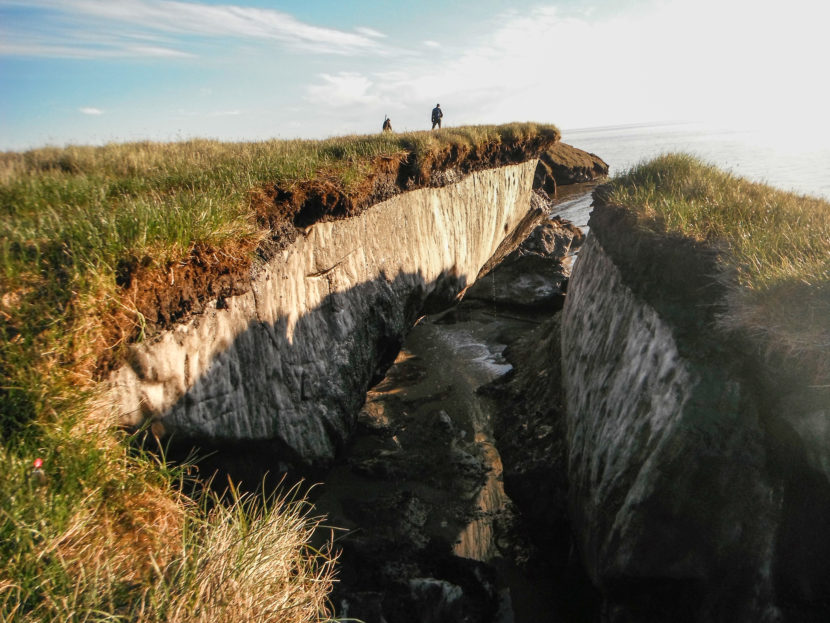
Coastal erosion reveals the extent of ice-rich permafrost underlying active layer on the Arctic Coastal Plain in the Teshekpuk Lake Special Area of the National Petroleum Reserve – Alaska. (Brandt Meixell/USGS)

For years, coastal Alaska communities, a majority of them Alaska Native villages, have contended with erosion, eating away at the land and pulling more and more of the coast into the sea. It’s led to a growing field of research into what can be done to address the problem.

new article from nonprofit environmental news outlet Grist takes a look at what’s at stake in these communities and what residents are doing to combat the loss of land. Author Saima Sidik discussed her story with Alaska Public Media.

Listen:

This interview has been edited for length and clarity.

Wesley Early: So can you set the scene for us in these communities? What are community members in Dillingham and other coastal communities having to contend with due to erosion?

Saima Sidik: Yeah, it’s really striking. If you walk down the beach in a lot of these places, you can just see the earth crumbling away. Huge bluffs are just not where you left them the day before. Rocks and trees fall over the edge. Landmarks are disappearing in some cases. These points that people used to use to navigate are just not there anymore to guide them. So definitely a big problem threatening a lot of infrastructure, a lot of people’s livelihoods and just overall causing a lot of havoc and hardship.

Wesley Early: Your story lays out a lot of local proposals to mitigate the impact of erosion. One of them has to do with reinforcing melting permafrost with something called thermosiphons. Can you explain what those are and how they address erosion?

Saima Sidik: Yeah, this is really interesting. So, this is something that Tom Ravens at the University of Alaska Anchorage is looking into. So thermosiphons are these large tubes that stick partly into the ground and partly out of the ground. And in them, there is a substance that alternates between being a gas and being a liquid. So when the substance gets cold, it condenses and it falls to the bottom of the tube, which is in the ground. And if the ground is warm, then that substance then heats up and turns back into a gas and goes up to the top of the tube where it’s colder. And in doing that, it delivers heat out of the ground and into the air. And so it sort of keeps the ground frozen. These have been used in some inland sites and there are some people who are suggesting that maybe they could be more widely used and maybe they could be part of a solution for erosion along coastlines.

Wesley Early: I know that scientists made another observation that has to do with this correlation between where subsistence hunters process marine mammals and the rate of erosion. Can you talk about that a little bit?

Saima Sidik: Yeah, for sure. So subsistence hunters have noticed that places on beaches where they process marine mammals after they catch them, those places tend to be resistant to erosion. And some scientists are wondering if there are oils that leak out of the mammals that might be responsible for that. And they’re wondering if similar compounds could be found in other oils, like maybe even waste cooking oil. So this could be a way to possibly, you know, repurpose your French fry oil. After you eat your fast food, you could isolate these compounds from the leftover oil. And maybe that could be a way to stabilize the beaches.

Wesley Early: In response to erosion, several Alaska villages in recent years have already begun the process of relocating their communities. Can you talk a little bit about discussions researchers are having around portable housing?

Saima Sidik: Well, my understanding — and I must say I’m not in Alaska, I’m not a Native person myself — but my understanding is that back in the history of a lot of these groups, they used to move from one place to another, depending on the season to keep themselves synced up with where natural resources were available. And some researchers are wondering, is it worth considering a move back to that sort of mobile lifestyle. And so there’s another researcher I talked to who is currently applying for funding to have conversations with Indigenous communities and ask them if they think living in structures that are meant to be moved when conditions necessitate that, if that could be a viable strategy.

Wesley Early: In addition to coastal villages losing physical land, you mentioned there is a historical component to what’s being lost in primarily Alaska Native communities. What did locals tell you about what’s at stake if the erosion continues to eat away at the coast?

Saima Sidik: Well, you know, it just really changes their, the way of life that they’ve had for a long time. These are people who have a really long and deep relationship with the coastline and for whom the resources that they get from the ocean are deeply important. And so having to change their whole lifestyle and their whole communities, having to rearrange their whole communities in response to this problem, it’s not as simple as it might be in some parts of the world. You know, if you buy all your food at the grocery store, then it might not be such a problem to just start going to another grocery store, but it’s not that simple when you’re used to relying on the land a bit more.
Murkowski, Peltola tell ComFish more needs to be done about ‘crisis’ levels of species decline

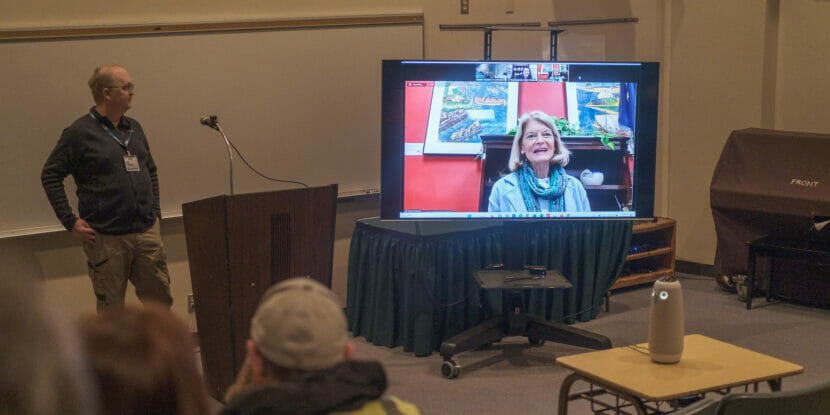
Sen. Lisa Murkowski and Rep. Mary Peltola addressed attendees virtually for the kickoff forum of ComFish on Thursday, March 16, 2023. (Brian Venua/KMXT)

Alaska’s congressional delegation says species collapse in Alaska’s fisheries is nearing crisis levels. Sen. Lisa Murkowski and Rep. Mary Peltola discussed the monumental challenges faced by Alaska’s fishermen and coastal communities during their legislative update on the opening day Thursday of Kodiak’s annual commercial fishing trade show, ComFish.

Murkowsi and Peltola kicked off ComFish’s federal legislative update with a brief acknowledgement of the Willow project’s recent approval — calling the $8 billion oil development a win for the state of Alaska. Sen. Dan Sullivan was not at Thursday’s forum due to a scheduling issue. He’ll speak on Saturday instead.

But much of their time was spent detailing the uncertainties caused by species collapse in the waters off Alaska’s coast. Murkowski said the declines in salmon, crab and halibut fisheries across the state are at crisis levels.

“I don’t like to use the word ‘crisis’ lightly, but I think crisis is the appropriate word here. I wish that we could tell you the exact causes, I wish there was one single thing to explain everything,” she said.

Population declines that were once “acts of God are becoming trends of nature,” Murkowski said, adding that current fisheries management doesn’t always reflect what’s happening in the water.

“Our management systems are not inherently nimble. And that’s a challenge for us,” Murkowski said.

Alaska’s congressional delegation has been pushing for more funding to study the effects of ocean variability caused by climate change.

Murkowski said that includes money for more bottom trawl surveys, and programs through the Pacific Salmon Treaty. Murkowski said nearly $3 million had been allocated for the research in the Bering Sea through the Bering Sea Fisheries Research Foundation. And money from the Bipartisan Infrastructure Law will also help coastal communities facing reduced revenue streams from crashing fisheries.

Peltola took time to call out bycatch, which is the incidental catch of a non-target species, saying not enough is being done to understand and address the issue.

“I just really want to be clear that I personally feel like we can be doing better. Progress has been made, but we can’t settle for the status quo, we need to make changes at a much faster pace than we are today,” Peltola said.

In a followup forum later that day, members of the state’s Bycatch Review Task Force detailed some of what those changes might be.

The group published a series of recommendations late last year, including the development of a statewide bycatch policy — bycatch is currently regulated federally under several federal policies, including the Magnuson-Stevens Act – and updating the types of gear and how much bycatch is allowed for certain vessels.

But according to the task force, shifting distribution patterns of marine species as ocean temperatures change also presents a hurdle to developing effective solutions.

Murkowski said there needs to be a collaborative approach to address the whole problem.

“We need to be working together to find these solutions because the challenges really are too great for anybody to face alone,” Murkowski said.

That process will take time, although Peltola noted that probably wasn’t satisfying for anyone in the room.

“Even if we do everything right starting today, it still could take 30 years for our fisheries to fully recover, and we really need to be clear about the timeline that we’re looking at. But we can’t let the perfect be the enemy of the good, we can’t hold ourselves back from making every marginal improvement that we can,” she said.

Peltola and Murkowski spoke for about an hour including a question and answer session. Both also addressed the lawsuit against Southeast Alaska’s king salmon fishery brought by a Washington-based environmental group, saying it was an effort to bully the fleet, and they would stand united in fighting it.

Threatened listing proposed for sunflower sea star after population devastated by wasting disease

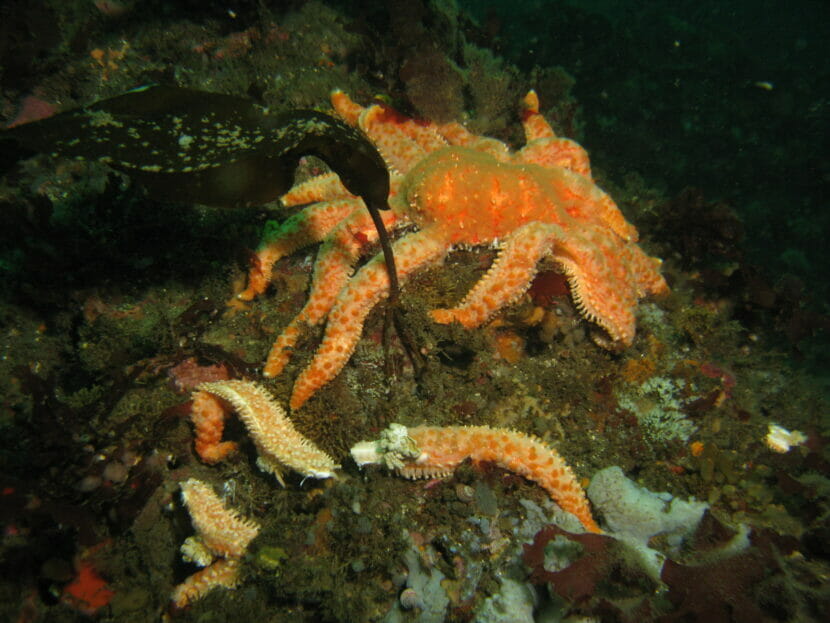
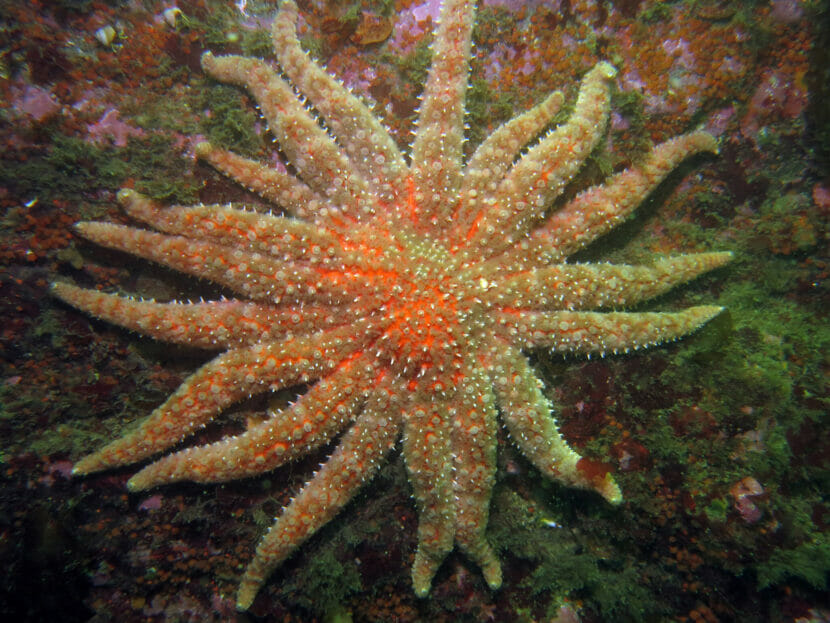
A healthy sunflower sea star is seen on the seafloor in 2014. NOAA Fisheries on Wednesday announced it is seeking a threatened listing for the distinctive sea stars, which have been nearly wiped out in some areas by a wasting disease that coincided with warming Pacific waters. (Photo by Ed Gullekson/Washington Department of Fish and WIldlife, provided by NOAA Fisheries)

One of the world’s largest sea stars is on track to receive Endangered Species Act protections.

Federal regulators announced on Wednesday that they are proposing a threatened listing for the sunflower sea star, a creature that has been killed off in much of its Pacific habitat by disease. While the effect of a listing on Alaska and its fisheries is not certain, scientists say they don’t expect significant changes in the state in the near term.

The official proposal for the threatened listing is scheduled to be published Thursday by the National Oceanic and Atmospheric Administration’s Fisheries Service. That will kick off a 60-day public comment period, with a final listing decision due in a year.

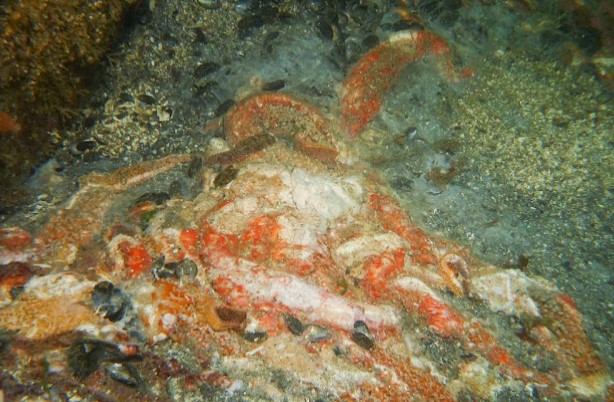
The proximate cause of the sunflower sea star decline is sea star wasting syndrome, which wiped out about 90% of the animals across its vast range, according to NOAA Fisheries. The wasting system has hit a variety of sea star species, though sunflower sea stars have suffered especially severe harm, according to scientists. It causes legs to fall off and, ultimately, results in disintegration of the animals’ bodies. Climate change may be behind that disease, as the arrival of Pacific marine heat waves coincided with the disease outbreak, according to federal biologists.

Sunflower sea stars are distinctive and colorful creatures found from Baja California to Alaska’s Aleutian Islands. They can grow up to 24 legs and be as big as 3 feet in diameter. They are considered a keystone species in the marine environment; their top food is sea urchins, and by eating the kelp-feeding urchins, they protect kelp forests that support numerous other species, including those of commercial significance in Alaska.

If it goes through, the listing will be the first for any sea star under the Endangered Species Act.

The proposed listing is unusual in other ways.

While there are some big geographic differences in population trends, with the heaviest impacts in the southern areas and less-severe impacts in Alaska and other northern areas, the listing would cover sunflower sea stars over their entire range. That is because the Endangered Species Act does not allow listings of invertebrates to be broken down into distinct population segments, as is the case in Alaska with endangered western Steller sea lions and Cook Inlet beluga whales.

A sunflower sea star is seen in 2014 with early symptoms of wasting syndrome, including lesions and arms that curl and break off. (Photo by Janna Nichols/ NOAA Fisheries)

Compared to the near-total wipeouts “across the board” in Lower 48 waters, declines in Alaska waters range from 40% to 100%, said Sadie Wright, a Juneau-based protected species biologist with NOAA Fisheries who helped compile the status review that led to the proposed listing.

Beyond listing, ensuing recovery work could consider geographic differences, she said during an online news conference. “Later in the process, when we’re looking at protections, we can tailor those more regionally if that’s a better fit,” she said.

There is also no plan, as of now, for designation of critical habitat, normally a part of the regulatory action to conserve listed species, officials said. That is because critical habitat is considered “indeterminable,” said Dayv Lowry, the NOAA Fisheries biologist who led the status review.

“We know that it occurs around kelp forests. We know that it’s a part of that ecosystem and an integral part of it. But the animal is also found over rock piles, sand, mudflats, eelgrass meadows. It’s found all over the place,” Lowry said in the news conference. “At this point, we’re saying the animal is protected anywhere and everywhere you encounter it.”

There are additional unknowns. Scientists are still trying to figure out the sea stars’ life cycles and lifespans and fundamental biology, Lowry said. The exact pathogen that triggered wasting syndrome is not yet identified. And any contribution of the sunflower sea star deaths to a longer-term decline in kelp forests is still unclear.

“The biggest problem that we ran up in trying to do the status assessment is that there’s a lot of information about the species that is not well known,” he said.

Also yet to be determined are any potential impacts of listing to commercial fishing.

Whatever damage is being done to the sea star population by bycatch, the unintended catch during harvest of targeted fish, it is considered a low-level threat, far overshadowed by the wasting syndrome, Wright said.

“While we want to work with commercial fisheries and the fishery management councils to gather more information and promote safe handling of sea stars that are bycatch in fisheries, we don’t anticipate significant changes to fisheries as an outcome of this proposed rule,” she said.

A sunflower sea star killed by wasting syndrome, its body mangled and partly dissoved, is seen on the sea floor in this undated photo. The disease killed over 90 percent of sunflower sea stars across the entire range, according to NOAA Fisheries. (Photo by Janna Nichols/NOAA Fisheries)

There is an effort to get more details in bycatch reports, Lowry said. For now, those reports often refer to sea star bycatch generically, without identifying species.

While listing will not itself fight off any disease or address climate change, it can heighten awareness and help support various research activities, the NOAA officials said at Wednesday’s news conference. Among the programs they cited was the captive-breeding research underway at the University of Washington’s Friday Harbor Laboratories.

The proposed listing results from a petition submitted in 2021 by the Center for Biological Diversity.

In a statement, the center hailed Wednesday’s listing news.

“Protection under the Endangered Species Act will be so important for reviving these incredible sea stars,” Miyoko Sakashita, the center’s oceans program director, said in the statement. “Disease fueled by climate change has devastated this gorgeous species, and these safeguards will help tackle threats to their survival and promote the health of the kelp forests they live in.”

Officials with Alaska Department of Fish and Game and Alaska fishing organizations have previously expressed concerns about the wide geographic span that listing would affect.

This story originally appeared in the Alaska Beacon and is republished here with permission.

Climate solutions do exist. These 6 experts detail what they look like

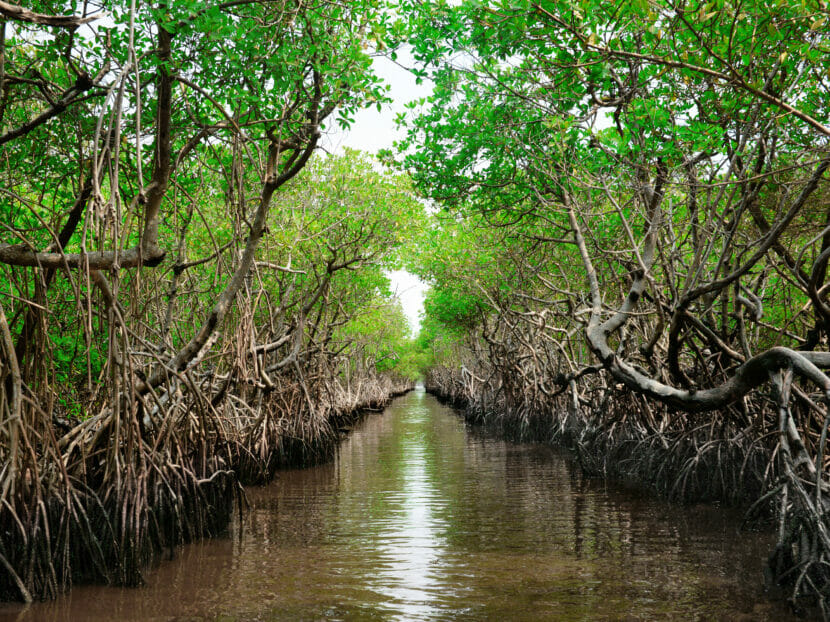
Researchers say protecting mangroves that soak up carbon is a great climate solution. But they caution against programs that slap carbon offsets onto it as those offsets can be hard to verify. (Marie Hickman/Getty Images)

Scientists say there’s a lot we can still do to slow the speed of climate change. But when it comes to “climate solutions,” some are real, and some aren’t, says Naomi Oreskes, historian of science at Harvard University. “This space has become really muddied,” she says.

So how does someone figure out what’s legit? We asked six climate scholars for the questions they ask themselves whenever they come across something claiming to be a climate solution.

A big climate solution is an obvious one

It may sound basic, but one big way to address climate change is to reduce the main human activity that caused it in the first place: burning fossil fuels.

Scientists say that means ultimately transitioning away from oil, coal and gas and becoming more energy efficient. We already have a lot of the technology we need to make this transition, like solar, wind, and batteries, Oreskes says.

“What we need to do right now is to mobilize the technologies that already exist, that work and are cost competitive, and that essentially means renewable energy and storage,” she says.

Think about who’s selling you the solution

It’s important to think about both who’s selling you the climate solution and what they say the problem is, says Melissa Aronczyk, professor of media at Rutgers University.

“People like to come up with solutions, but to do that, they usually have to interpret the problem in a way that works for them,” she says.

Oreskes says pay attention when you see a “climate solution” that means increasing the use of fossil fuels. She says an example is natural gas, which has been sold as a “bridge fuel” from coal to renewable energy. But natural gas is still a fossil fuel, and its production, transport and use release methane, a greenhouse gas far more potent than carbon dioxide.

“I think we need to start by looking at what happens when the fossil fuel industry comes up with solutions, because here is the greatest potential for conflict of interest,” Aronczyk says.

A solution may sound promising, but is it available and scalable now?

Sometimes you’ll hear about new promising technology like carbon removal, which vacuums carbon dioxide out of the air and stores it underground, says David Ho, a professor of oceanography at University of Hawaii at Manoa.

Ho researches climate solutions and he says ask yourself: is this technology available, affordable, or scalable now?

“I think people who don’t work in this space think we have all these technologies that are ready to remove carbon dioxide from the atmosphere, for instance. And we’re not there,” Ho says.

If it’s adding emissions, it’s not a climate solution

These days all kinds of companies, from airlines to wedding dress companies, might offer to let you buy “carbon offsets” along with your purchase. That offset money could do something like build a new wind farm or plant trees that would — in theory — soak up and store the equivalent carbon dioxide emissions of taking a flight or making a new dress.

But there are often problems with regulation and verification of offsets, says Roberto Schaeffer, a professor of energy economics at the Federal University of Rio de Janeiro in Brazil. “It’s very dangerous, very dangerous indeed,” he says.

He says with offsets from forests, it’s hard to verify if the trees are really being protected, that those trees won’t get cut down or burned in a wildfire.

“You cannot guarantee, ‘Okay, you’re gonna offset your dress by planting a tree.’ You have no guarantee that in three years time that tree is gonna be there,” he says.

If you make emissions thinking you’re offsetting them, and the offset doesn’t work, that’s doubling the emissions, says Adrienne Buller, a climate finance researcher and director of research at Common Wealth, a think tank in the United Kingdom, “It’s sort of like doubly bad.”

If a solution sounds too easy, be skeptical

Many things sold as carbon offsets — like restoring or protecting forests — are, on their own, great climate solutions, Buller says. “We need things like trees,” she says, “To draw carbon out of the atmosphere.”

The problem is when carbon markets sell the idea that you can continue emitting as usual and everything will be fine if you just buy an offset, Buller says. “It’s kind of a solution that implies that we don’t have to do that much hard work. We can just kind of do some minor tweaks to the way that we currently do things,” she says.

Schaeffer says there is a lot of hard work in our future to get off of fossil fuels and onto clean energy sources. “So people have to realize there is a price to pay here. No free lunch.”

It’s not all about business. Governments must play a role in solutions, too

We often think of businesses working on climate solutions on their own, but that’s often not the case, says Oreskes. Government often plays a big role in funding and research support for new climate technology, says June Sekera, a visiting scholar at The New School who studies public policy and climate.

And governments will also have to play a big role in regulating emissions, says Schaeffer, who has been working with the United Nations’ Intergovernmental Panel on Climate Change for 25 years.

That’s why all the scholars NPR spoke with for this story say one big climate solution is to vote.

Schaeffer points to the recent election in Brazil, where climate change was a big campaign issue for candidate Luiz Inácio Lula da Silva. Lula won, and has promised to address deforestation, a big source of Brazil’s emissions.

There’s no one solution to climate change – and no one can do it alone

Aronczyk wants to make one thing clear: there is no one solution to climate change.

“We’re human beings. We encounter a problem, we wanna solve that problem,” Aronczyk says, “But just as there is no one way to describe climate change, there’s no one way to offer a solution.”

Climate solutions will take different forms, Sekera says. Some solutions may slow climate change, some may offer us ways to adapt.

The key thing, Aronczyk says, is that climate solutions will involve governments, businesses, and individuals. She says: “It is an all hands on deck kind of a situation.”

Copyright 2023 NPR. To see more, visit https://www.npr.org.

In its first bill this year, Alaska House votes to allow environmentally friendly refrigerants

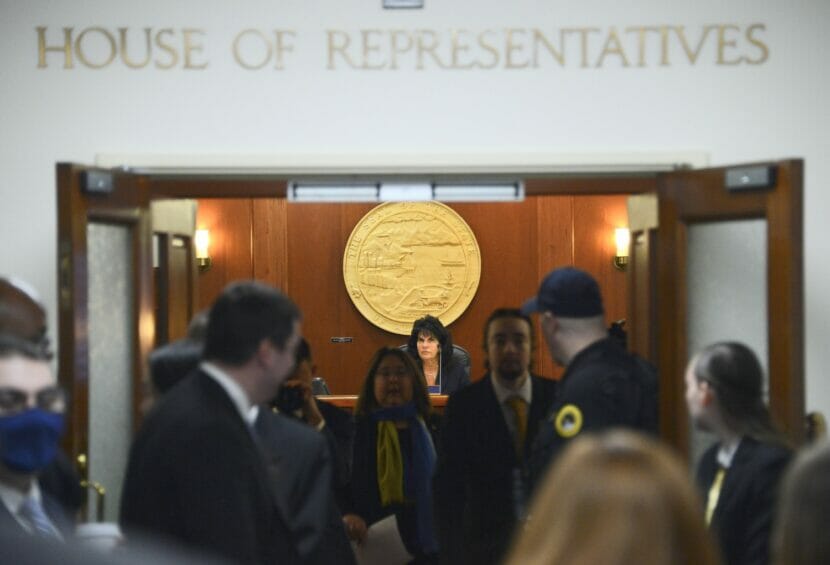
Speaker of the House Cathy Tilton, R-Wasilla, presides over the Alaska House of Representatives on Feb. 22, 2023. (Photo by James Brooks/Alaska Beacon)

The Alaska House of Representatives voted almost unanimously Wednesday to allow the use of environmentally friendly refrigerants even if they are not specifically allowed by the state building code.

House Bill 51, from Rep. Stanley Wright, R-Anchorage, was approved in a 35-1 vote with only Rep. David Eastman, R-Wasilla, opposed. Four legislators were in Washington, D.C., and excused absent on Wednesday.

The bill was the first passed by the House this year and the first passed by Wright, a new member.

HB 51 now advances to the Senate for further work. If passed there and approved by Gov. Mike Dunleavy, the bill would implement a change mandated by Congress and signed by former President Donald Trump in the American Innovation and Manufacturing Act of 2020.

That law requires the federal Environmental Protection Agency to regulate and phase out the use of hydrofluorocarbons, commonly used in refrigerants but a significant contributor to climate change.

The phaseout is handled at the federal level; the state bill ensures Alaska building standards allow alternatives.

Eastman, the lone vote against the measure, said he doesn’t like that the proposed state law would incorporate federal law by number. Federal law numbers have been included in state laws since Alaska became a state.

An amendment to the federal law could automatically create consequences in Alaska.

All 50 states are required to pass legislation like HB 51, according to documents provided to legislators by the Air Conditioning, Heating and Refrigeration Institute, a trade group. To date, 10 other states have done so, the group said.

Kotzebue residents want a say if Arctic traffic brings the military back to town

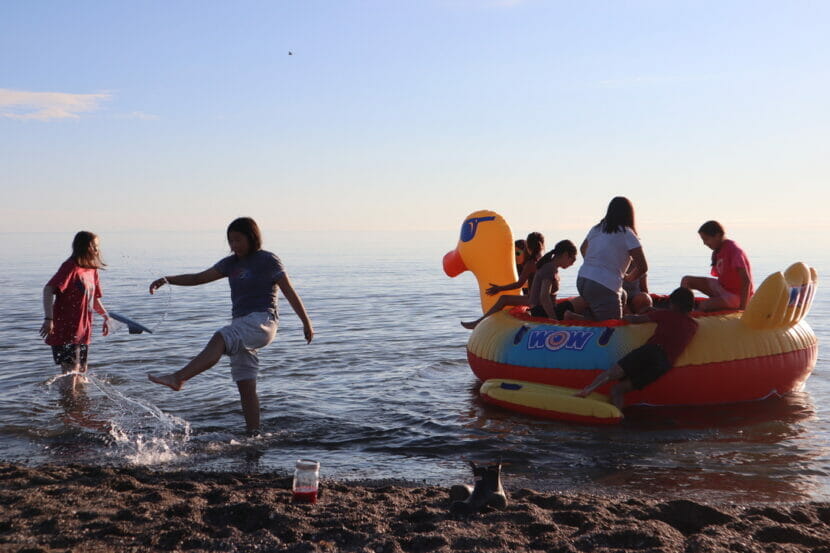
Kotzebue Sound, 30 miles north of the Arctic Circle, is separated from the open Chukchi Sea by 70 miles of shallow, protected water. On warm summer days, it’s a place to recreate, often young swimmers brave the cold and take to the water. Beyond the Sound, an increasing number of large industrial ships and other marine traffic are taking advantage of declining sea ice and increasingly navigable waters. (Emily Schwing)

This is the second part of a series. Read the first part here.

Concerns about national security are heating up in the rapidly changing Arctic. In 2021, the U.S. Coast Guard opened a seasonal airbase in Kotzebue. The community was once home to a permanent Air Force station, but that closed in 1983, as the Cold War wound down.

In recent years, more fighter jets have been based in Alaska, cold weather training for soldiers here has increased and an effort to provide the U.S. Coast Guard with a new, state-of-the-art icebreaker is underway. Russia lies about 250 miles west of Kotzebue and conflict with Ukraine has only fueled discussion about whether a more permanent military presence along Alaska’s west coast is both needed and warranted.

“This is our table,” said Vice President of Lands for NANA Qaulluq Cravalho. “We have to make sure that we’re there when it comes to policy making decisions because there is activity happening.”

NANA is one of the largest Alaska Native corporations in the state. Cravalho is also a member of the U.S. Arctic Research Commission. She said any military buildup in Northwest Alaska should include input from Alaska Natives.

“People can think of the Arctic as this pristine place where there’s no activity happening and that might be relatively true. On the U.S. side, there’s not as much activity, but on the Russian side, there is and all of our food resources go over there and come back,” she said. “So, it’s all one environment. There’s a lot of risk associated with it, and so how do we make sure we’re at the table to define what it looks like?”

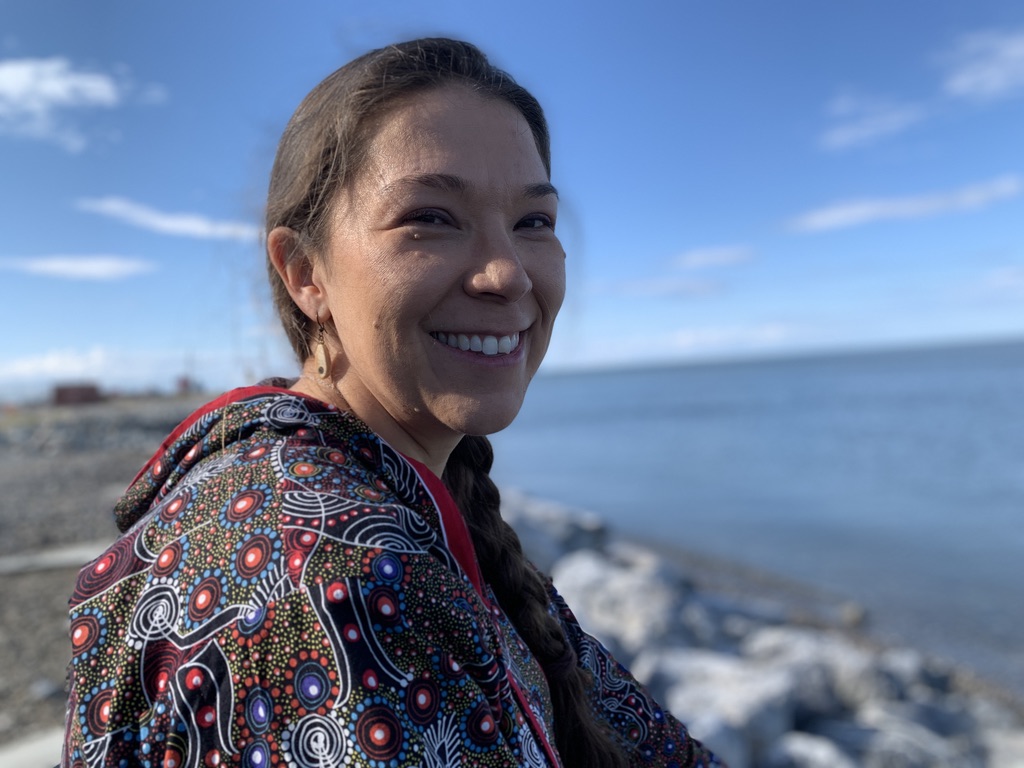
a woman smiles near the shore
Qaulluq Cravalho. (Emily Schwing)

In recent years, the Arctic has seen a drastic increase in industrial marine traffic in the region. According to the Arctic Council, marine traffic increased by 44% through the Northwest Passage between 2013 and 2019. As a self-described Coastal Iñupiaq, Cravalho has concerns about what more ships and a beefed-up military presence might mean for subsistence resources in the region. People here are heavily reliant on marine mammals and fish that provide a sustained food source.

“When you’re harvesting, when you’re participating in these activities, this is how you learn our culture and our language,” she said. “This is how it’s passed down generation to generation, because of the close relationship with the land in the water. It’s a primary means not only to provide sustenance for ourselves and our people in our communities. It’s also a primary means for our culture to continue.”

That culture has become a defining feature in Nate Kotch’s life, since he arrived here from Hawaii in his early 20s.

“So, it was certainly a culture shock to me to some degree,” he said.

The Air Force stationed him here in in the 1970s. He is one of the last remaining Kotzebue residents that remembers when there was an active military station here. Today, it functions as a long range radar site, with minimal full time civilian staff.

“It’s taken time for me to even learn what the culture really is in the community,” Kotch said. “I mean, the Native community, you know? What are their values, what are their needs? You know, what are they looking for?”

a man in a black hat poses for a portrait
The U.S. Air Force stationed Nate Kotch in Kotzebue in 1975. (Emily Schwing)

After his time with the Air Force, he married into an Iñupiaq family and spent 27 years on Kotzebue’s City Council.

He said if the military ever decided to resurrect a base here, the community would need to be involved “because if that doesn’t happen that way, then there’s going to be a negative impact.”

Last October, the United States rolled out a new National Strategy for the Arctic Region. In a video posted to Twitter U.S. Secretary of State Antony Blinken included national security as one of four main pillars of a new National Security Strategy for the Arctic.

“We have no higher priority than defending our country and our people and securing the Arctic is key to that,” Blinken said.

Currently, a military buildup is just a discussion and no decisions have been made to move forward. There is talk of basing Coast Guard Personnel here permanently. There has also been talk of developing a naval base here, complete with a deep water port.

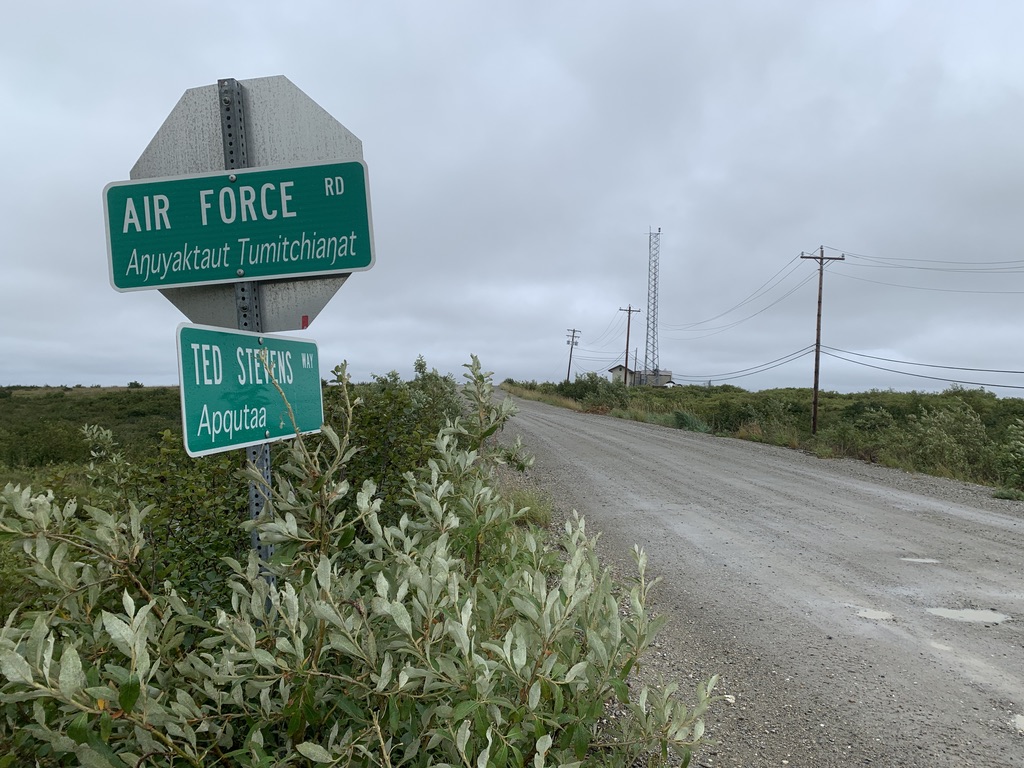
an intersection in a rural area
The U.S. Government built an Air Force Station in Kotzebue at the beginning of the Cold War. Construction was completed in 1958. Once a radar station, it was closed in 1983, as the conflict began to cool off. Today, it functions as part of the Alaska NORAD system. Minimal civilian staff are tasked with its upkeep. There are only a handful of people in Kotzebue today who were once full-time soldiers at the station when it was fully operational. (Emily Shcwing)

In early August, the Sound bustled with small boats. The fishermen inside lined up at a handful of docks, waiting to offload chum salmon. Overhead, small commuter planes shuttled cargo and passengers to nearby remote villages.

Qaulluq Cravalho said if the military does come this far north, the community will be ready.

“This community is not unfamiliar with it,” she said. “We’ve had a base here in the past. Certainly there’s always that risk of the community changing. So, it’s how we interact with that change that’s really important, right? You know, the tools and types of infrastructure needed to be present here have really changed over time.”

Kotzebue is set back from the open Chukchi sea by nearly 70 miles of shallow, protective water in Kotzebue Sound. So, even though marine traffic in the Arctic is increasing — it can feel far away here.

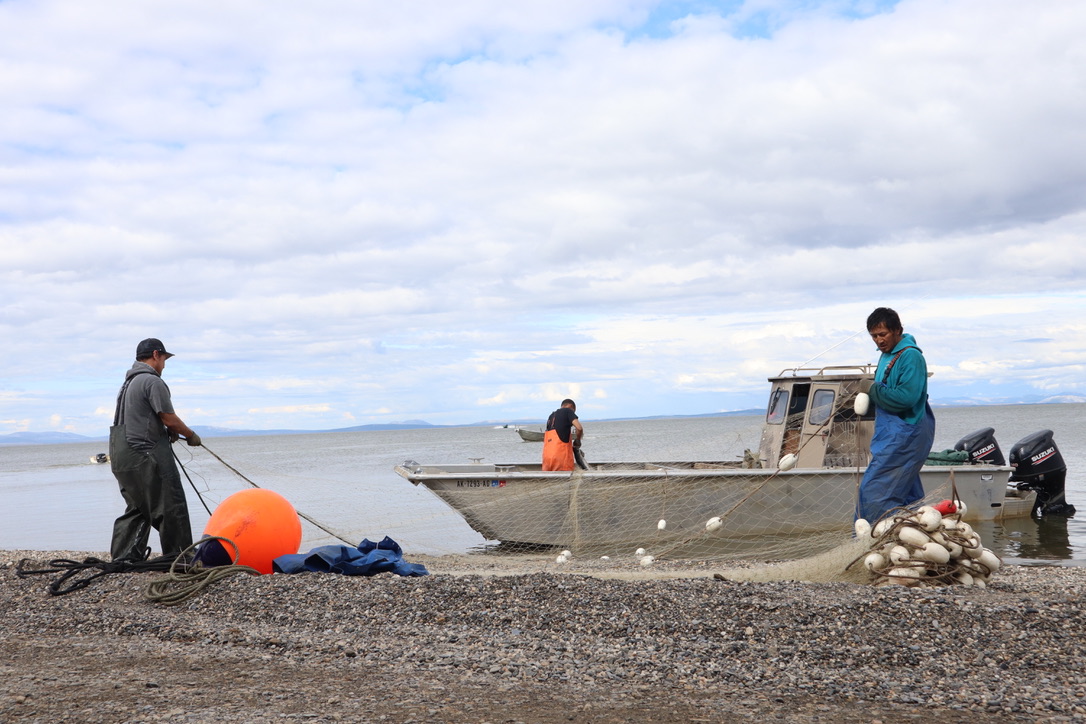
people on a skiff near the shore
In late summer, the chum salmon arrive in Kotzebue Sound. It’s a fishery that’s not well understood. Alaska’s Department of Fish and Game doesn’t maintain long-term data on the fishery, but in recent years, those who fish commercially have seen booming harvests. (Emily Schwing)

What 85-year-old elder James McClellan is delighted to focus on is the successful chum fishery.

He’s spent many afternoons sitting on the beach, peering through binoculars as boats pulled in to offload their catch. He said 2022 is the first summer he didn’t fish commercially.

“I just like living from the country,” he said with a smile. It’s good. It keeps you healthy.”

The night before, he said, he’d had salmon for dinner. “Oh, it was good! Fried salmon, fried potatoes and onions and, boy, it was good.”

As McClellan scanned the horizon, what he couldn’t see is beyond Kotzebue Sound: a growing traffic jam of industrial ships, a potential for increased conflict with a foreign neighbor and the unknown impacts of a changing climate on food resources, including the chum salmon.

This ongoing series is made possible through a grant from the Climate Justice Resilience Fund.

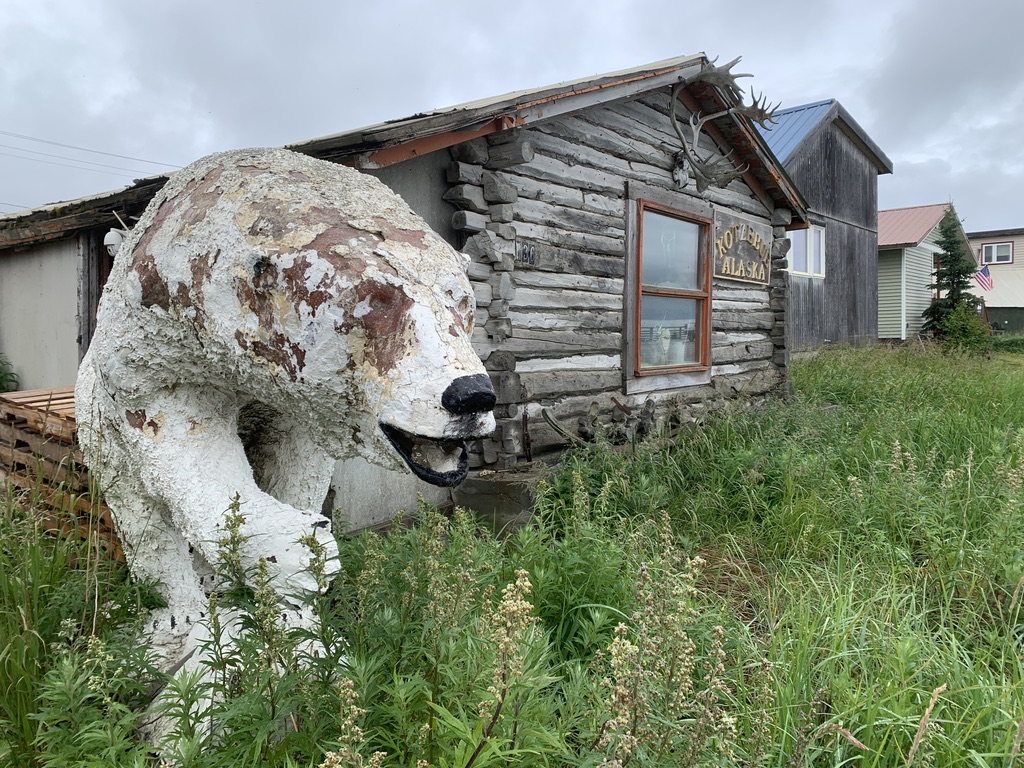
a worn polar bear statute near a wooden home
All over the community of Kotzebue, the past seems to be part of the immediate present. The community of 3,100 people relies on subsistence hunting and fishing and has seen the military come and go. “We’ve had a base here in the past,” said Qaulluq Cravalho. “ Certainly there’s always that risk of the community changing. So it’s how we interact with that change that’s really important, right?” (Emily Schwing)
Site notifications
Update notification options
Subscribe to notifications