Climate Change

A Homer scientist is bringing changes in Arctic permafrost into high resolution

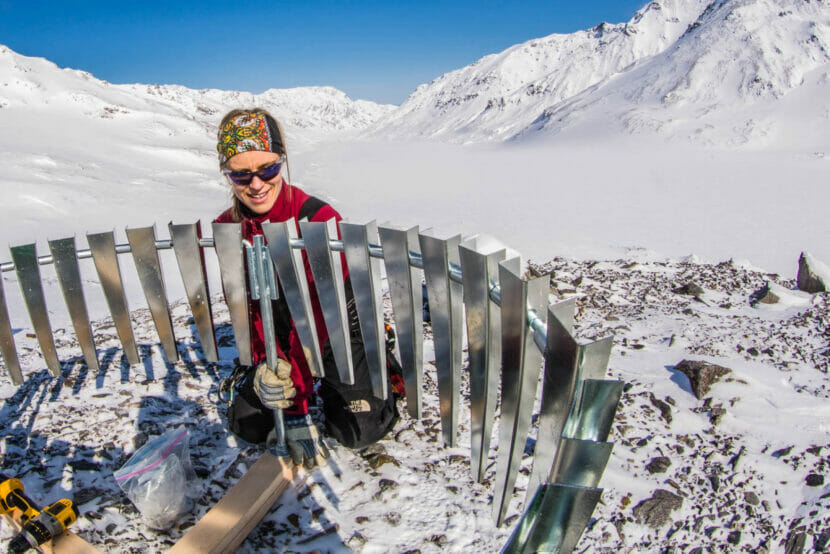
Anna Liljedahl on a research trip on Jarvis Glacier in the eastern Alaska range. Liljedahl is working to install a weather station on the glacier to model glacial melt. (Todd Paris/University of Alaska Fairbanks)

With permafrost thaw in the Arctic rapidly outpacing previous projections, researchers are racing to understand the impacts of an increasingly unstable future.

After growing up in Sweden, Anna Liljedahl moved to Alaska to study hydrology at the University of Alaska Fairbanks. She now lives in Homer, where she conducts research as an associate scientist at the Woodwell Climate Research Center, focusing on how climate change is impacting water in Arctic ecosystems.

Liljedahl is now leading a team to create more accurate, interactive maps of Alaska’s permafrost. Their project, called the Permafrost Discovery Gateway, is a novel effort to make Arctic research quicker to share and easier to access. That’s critical as the climate crisis accelerates thaw, impacting Alaskan communities and global carbon and methane emissions.

“Changes are happening so fast that we need to come up with automated ways of tracking this permafrost thaw through remote sensing imagery,” Liljedahl said, “and make automated tools that help us identify where change is happening.”

Permafrost is ground that remains frozen for at least two consecutive years, though some of it has been frozen for thousands of years. Scientists estimate that more than 80% of Alaska has permafrost. In some places, like the North Slope, it stretches continuously across the entire region, where it can be 2,000 feet thick. South of the Brooks Range, though, the permafrost layer is often much thinner, and broken up by patches of unfrozen ground.
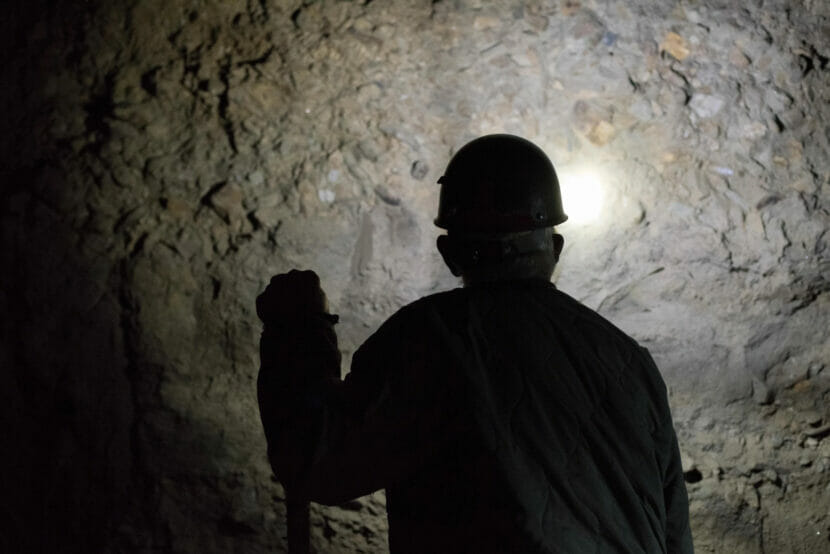
A gold miner inside of their privately owned permafrost tunnel outside Fairbanks, who often allows researchers to take soil and ice to study. (Sean McDermott/KBBI)

The actual ice content of permafrost also varies. Liljedahl said regions with high ice content, called ice-rich permafrost, are exciting from a scientific perspective, but also create the biggest challenges for houses, buildings and roads.

“So imagine, if you melt that ice, it’s going to become water,” she said. “Then suddenly the soil doesn’t have any support anymore.”

Though damage to infrastructure may not be as immediate as other natural disasters, rapid thaw is already having a huge impact on Alaskans. Some people, for instance, have had to level their home foundations multiple times a year.

“There’s insurance for flooding and hurricanes that people can buy and utilize, but when it comes to permafrost thaw, there’s nothing,” Liljedahl said. “People are just left on their own.”

Getting a better sense of how much ice is in Alaska’s permafrost is also important for modeling potential greenhouse gas emissions as it disappears.

“You need to know how much carbon is in the permafrost to begin with, and that estimate depends on how much ice you have,” she said. Permafrost with less ice in it has more organic material, like frozen roots, which release more greenhouse gasses like methane when it thaws.

With temperatures rising across the far north, the climate crisis is rapidly changing the ground. Liljedahl said it can take a decade for research in the Arctic to get peer-reviewed and published, and with changes now outpacing many projections, that’s just not fast enough.

“Ten years is a long time frame in Arctic permafrost thaw,” she said.
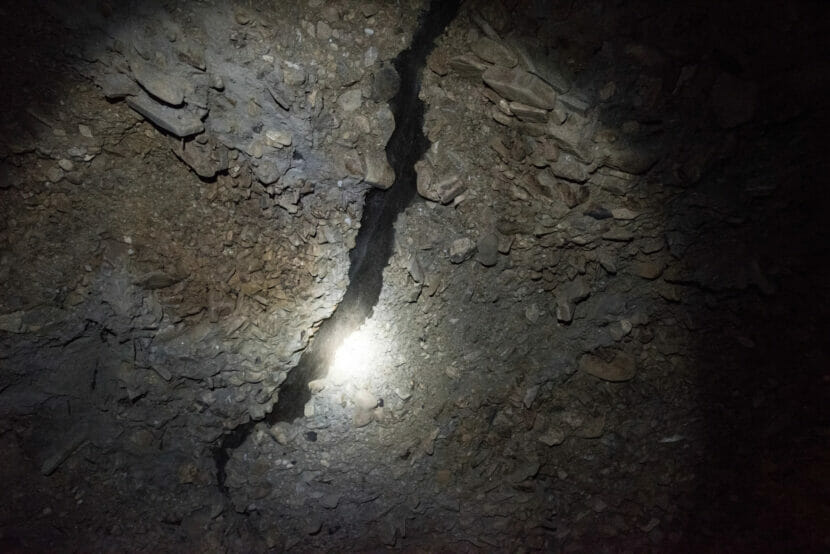
An ice wedge in the wall of a privately owned permafrost tunnel outside of Fairbanks. (Sean McDermott/KBBI)

The Permafrost Discovery Gateway provides a new level of detail and scale to mapping the Arctic, and could help fill these gaps with more automated tools, helping scientists better track how these ecosystems are shifting.

“We had to create our own software, our own visualization tool, where you can view this really, really big map at the pan-Arctic scale, and at the same time, zoom in and look at what’s happening in your backyard,” Liljedahl said.

One of the features this high-resolution imagery can help researchers identify are called ice-wedge polygons. Over years of freeze and thaw cycles, water flows into cracks in the ground and gradually builds into walls of ice below the surface. These ice wedges push soil into distinctive shapes — visible to satellites — and stand out as they thaw, causing the ground above to slump or new ponds to form.

Being able to see these kinds of changes is shedding new light on Arctic trends. Elizabeth Webb is a postdoctoral researcher at the University of Florida who has shared research on the Permafrost Discovery Gateway database. She has been studying the connection between vanishing surface water and permafrost thaw.

Previous models projected thawing would initially increase water in lakes, and then decrease later this century with more sustained warming. But that’s not how things seem to be playing out.

“What my research was showing is that it’s just the very beginning of the 21st century,” Webb said, “and we have already reached the latter part of that continuum.”

Instead, in some regions, surface water is disappearing more quickly than anticipated, according to research Webb and Liljedahl published earlier this year. Warmer temperatures lead to increased autumn rainfall in the Arctic, so having less surface water is a little counterintuitive, Webb said.

“You would think more rain would mean more water. But actually, more rain means more permafrost thaw — which means more drainage.”

This can be a big issue for Arctic communities. Not only can permafrost thaw damage homes and infrastructure like pipes, it can also impact the availability of reliable drinking water as lakes shrink or drain completely.

“People rely on lakes for household use and for drinking water. It’s not like all the lakes are going to drain and then suddenly, there’s not going to be any water left for them,” Webb said. “But it does mean that these communities are now more vulnerable.”

Researchers across the state are working hard to better understand these intricacies — and the unique Alaskan landscapes permafrost has created. On a recent virtual tour of the U.S. Army Corps of Engineers’ permafrost tunnel in Fairbanks’ Goldstream Valley, senior scientist Tom Douglas welcomed more than 500 viewers across the country on a journey back through time.

With geologic formations stretching millennia, Douglas said that there is no other tunnel quite like this one.

“You can wander through, and on the walls you can map different features. You can measure them, you can do statistics on them, [and] we can collect samples representing about 40,000 years of permafrost formation,” he said.

Getting field data from different areas around the state is still a huge challenge, making samples from the permafrost tunnel incredibly valuable. The tunnel offers a glimpse of geologic shifts in permafrost, and an up-close look at changes that satellites can’t see from above.

Douglas said permafrost researchers need to get better at talking to the public about their work, sharing data and making information more accessible. That includes everything from looking at historical mining pictures, to getting people across Alaska to share their lived experiences and observations.

“We really need any type of information possible and ways to basically accumulate, synthesize and display that information,” Douglas said.

Permafrost may be a northern phenomenon, but the consequences of carbon emissions released around the world have a huge impact on how quickly these changes are happening in Alaska. Permafrost holds twice the amount of carbon than is currently in the atmosphere, Douglas said. Accelerating thawing also has the potential to magnify the impacts of climate change globally — releasing more carbon and methane and speeding temperature rises.

Liljedahl said using tools like satellite imagery, mapping, and up-to-date visuals can help create a better picture of this rapidly changing area of the world.

“We’re not just talking about 50 years from now. We’re talking about what happened yesterday, and what’s happening right now.”

You can take a digital stroll back through thousands of years of geology on a virtual tour of the permafrost tunnel outside of Fairbanks, and explore the growing database of permafrost research on the “Permafrost Discovery Gateway.”
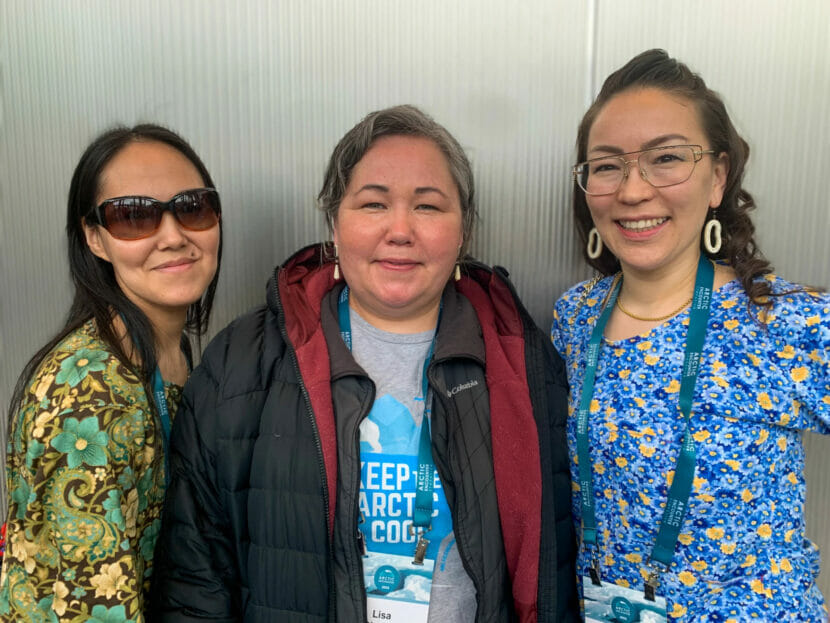
Y-K Delta women describe the realities of living with climate change for foreign dignitaries

Della Carl, Lisa Charles, and Carolyn George spoke about the unsettling realities of living with climate change at the Arctic Encounter Symposium in Anchorage. (Emily Schwing/KYUK)

Three Alaska Native women from the Y-K Delta delivered a powerful story about the impacts of climate change and village relocation to hundreds of international dignitaries and federal officials gathered last week in Alaska for the Arctic Encounter Symposium.

Carolyn George is raising five young daughters in the small community of Newtok, which lies on the edge of the Ningliq River. She’s candid about what it’s like to live in a community that has been ravaged by a changing climate.

“We have flooding everywhere, every year and, you know — we don’t have sanitation, we don’t have plumbing, we don’t have running water,” George said to a crowd of hundreds. “We have honey buckets. It’s a bucket where you poop and pee and we dump it in the river. And when it floods, it comes back washing in. It’s gross!”

Residents in Newtok are supposed to be moving 9 miles across the Ningliq River to Mertarvik, but the process has been ongoing for more than two decades, complicated by politics and disagreements between local, state, and federal governments.

The largest hurdle to relocating out of Newtok is available housing. There simply isn’t enough in Mertarvik.

“Every year it seems to get worse,” George said. “And I can’t wait to move to the new site.”

But when George will have her chance to move is unclear. Some families started relocating back in 2019. To date, only 150 people have relocated permanently to Mertarvik. There are still nearly 200 people living in Newtok.

Last year, the U.S. Department of Interior announced a $25 million infusion of cash for relocation. The cost to fulfill the housing need alone is roughly a third of that, and it’s not clear that the new money can actually be used on housing.

Last fall, a massive storm fueled by Typhoon Merbok brought waves so fierce that the water claimed roughly half of the remaining land that stands between the village’s school and the Ningliq River. What’s left is about 30 feet of spongy, waterlogged land and George says that Newtok is out of time.

“I think if everyone works together, you know, the state, the federal [government], and all the companies work together, it will make it so much faster. We need help and this is America. We still don’t have running water. We’re Americans!” George said.

The women told their story to a crowd of officials from the U.S. Department of Interior as well as Arctic ambassadors from Finland, Norway and Germany.

After Lisa Charles’ 10-year old daughter relocated to Mertarvik in 2019, she wrote a letter as part of a school assignment.

“I have a dream for the workers to finish working on Mertarvik so that people can move here…” it reads. “… we have friends and families at Newtok that are split up from us… It is important that we need to be one village again, because we just want to be in Mertarvik and see our friends and family.”

Charles, who is raising seven children in Mertarvik, said that the separation is hard on them.

“When we first moved over, every weekend they would ask if they could go spend the weekend with everyone over in Newtok because they missed everyone over there,” Charles said.

There’s no store in Mertarvik, so residents often make the trip by boat or snowmachine back across the river to buy food at the store in Newtok.

When it was Della Carl’s turn to share her perspective, she talked about what her kids notice when they travel between the two communities.

“So we took the boat over and we were getting close to Newtok. And they were saying something like ‘oh what is that smell?’ Like it was… it smelled like muddy poop.”

She said that her kids were excited when they returned to Mertarvik and they noticed the stark difference. “As soon as we got to the barge landing, my daughter hops out and she goes ‘Mom. Mom, do you smell that? It smells like watermelon here!’”

6 things to know about heat pumps, a climate solution in a box

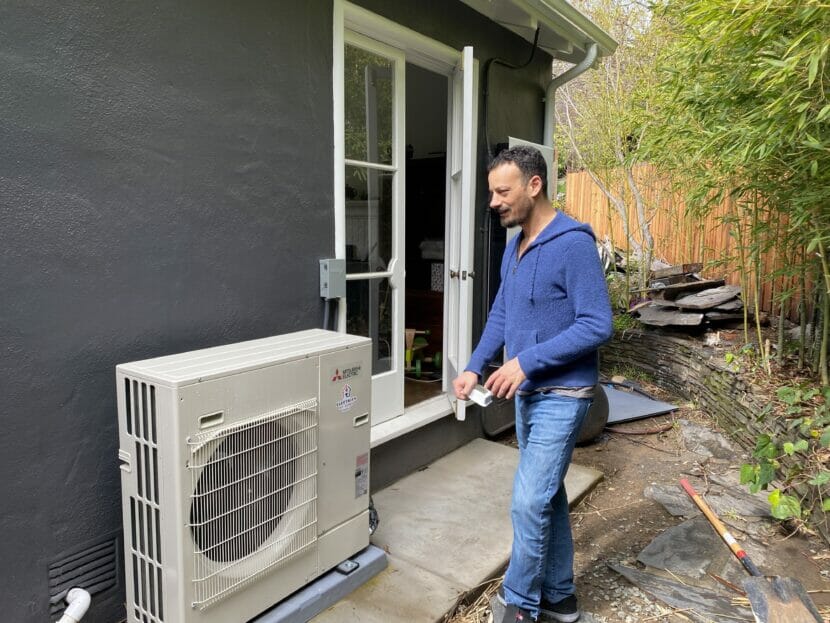
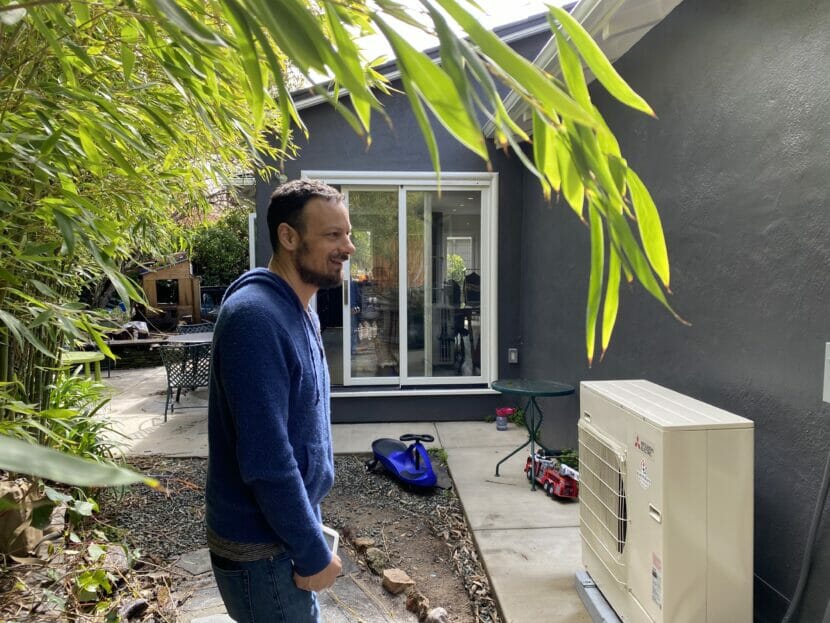
James Tucker got an efficient heat pump for his home near Oakland, Calif., last year. Now homeowners can get new credits for heat pumps from federal climate legislation. (Julia Simon/NPR)

Sales of super-efficient electric heat pumps are rising, now overtaking sales of gas furnaces in the U.S. But what are heat pumps? And why do some call them a key climate solution? Here are the answers to your most burning heat pump questions.

What is a heat pump and how does it work?

The name “heat pump” is a bit of a misnomer, says Kevin Kircher, assistant professor of mechanical engineering at Purdue University who works with the Center for High Performance Buildings.

“A lot of people dislike the name ‘heat pump’, right? ‘Cause it doesn’t really convey, you know, the full range of what the machine can do,” he says.

Heat pumps can work for both heating and cooling. Kircher says you can think of a heat pump as an air conditioner that can also work backwards. The highly efficient machines use electricity and refrigerants to cool air on hot days.

In the winter, even if the outdoor air is cold, it’s still normally warmer than the refrigerant inside the heat pump, Kircher says. So the refrigerant can absorb bits of heat from the outdoor air and bring it inside to warm your home.

What are the climate benefits of heat pumps?

The fact that heat pumps use electricity is a big reason why governments around the world see them as a key climate solution, says Yannick Monschauer, energy analyst at the International Energy Agency in Paris. That’s because heat pumps can replace gas furnaces, and the electricity they run on is increasingly powered by renewables, Monschauer says. Reducing gas usage in homes also reduces leaks of methane, a potent planet-heating gas.

Fossil fuel-based heating still accounted for 45% of global heating equipment sales in 2021. But if governments like the US and the European Union meet the targets laid out in climate legislation like the Inflation Reduction Act and REPowerEU, heat pumps could significantly slash planet-heating fossil fuel use in buildings, Monschauer says.

“We see that heat pumps could bring down global CO2 emissions by half a gigaton by the end of this decade,” he says. “So that is comparable to the annual emissions of Canada.”

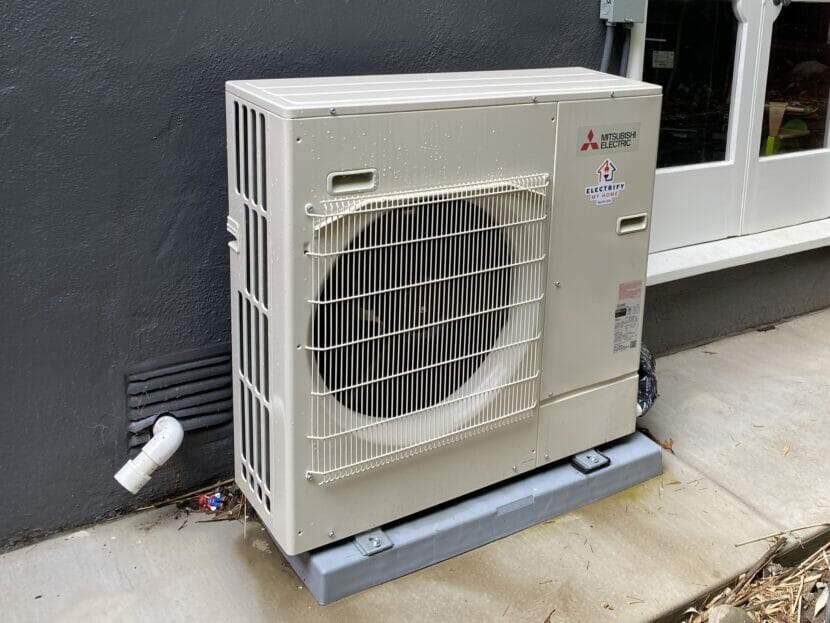
James Tucker with his heat pump that replaced his old gas furnace. (Julia Simon/NPR)

Will the government help me pay for it?

Last year’s federal climate legislation offers new economic incentives for homeowners to install heat pumps, says Steven Nadel, executive director of the American Council for an Energy-Efficient Economy, a research organization working on saving energy. An IRS spokesperson tells NPR that the new credits can translate to up to $2000 for efficient heat pumps bought after January 1, 2023. If you buy a new heat pump, Nadel says to keep your receipts for reference for next year’s tax season. If you bought a heat pump in 2022 you can get credit for this upcoming tax season, but the previous incentive was smaller, up to $500, the IRS says.

Some states and some utilities also give rebates for efficient heat pumps. Nadel says you should check with your utility to see if there are programs available in your area.

As for renters, it’s also possible to get credits for appliances like efficient heat pumps according to the IRS.

Do heat pumps actually work in cold temperatures?

Earlier generations of heat pumps didn’t work as efficiently in freezing temperatures, but Monschauer says there’s been great improvements in technology.

“In the coldest parts of Europe we also have the highest shares of heat pumps. So in Norway, for example, 60% of the households are equipped with heat pumps. And in Sweden and Finland it is also 40%. So it’s definitely proven that it’s possible.”

The heat pump systems commonly found in Scandinavian homes do not need to run on backup fossil fuels, Monschauer says.

Not all heat pumps sold in the U.S. work well in the coldest weather. It’s important that you consult with an installer who is familiar with heat pumps, and make sure to find a machine that’s most efficient for your weather, Nadel says.

“In a cold climate that gets below 20 degrees Fahrenheit fairly often, you should look into getting into an Energy Star cold climate certified heat pump,” Nadel says, referring to a U.S. government program that makes markers for efficiency.

Heat pumps can work for both heating and cooling. You can think of a heat pump as an air conditioner that can also work backwards. (Julia Simon/NPR)

Can heat pumps save money?

Because heat pumps move heat around instead of burning fossil fuels for heat, they are more efficient than gas furnaces. And while heat pumps are typically more expensive on the front end, the savings come over time when you end up spending less on gas, says Brian Rees, a heat pump installer at Bryant Air Conditioning & Heating Company in Lincoln, Nebraska.

Rees says the cost savings are what attract his customers to heat pumps, “It’s more about hitting their pocketbook,” he says. “It’s more about what’s going to save them money in the long run, and heat pumps will do that.”

Kircher says you can also save money if you can buy a heat pump for both your heating and cooling needs. “It’s typically cheaper than buying a gas furnace plus an air conditioner,” he says.

Are there downsides to heat pumps?

Like refrigerators or air conditioners, heat pumps use refrigerants. The primary refrigerants commonly used in heat pumps are called hydrofluorocarbons, or HFCs, says Duncan Callaway, associate professor of Energy and Resources at UC Berkeley. These HFCs have high global warming potential if they’re released into the atmosphere, Callaway says.

That’s why it’s critical that heat pump installers make sure that those refrigerants don’t leak and are disposed of properly, he says.

“We need well-trained technicians that sort of understand the importance of collecting that refrigerant and not letting it emit into the atmosphere,” Callaway says.

Kircher also notes that researchers are currently working on developing refrigerant substitutes for HFCs that can drastically reduce climate impacts.

Copyright 2023 NPR. To see more, visit https://www.npr.org.

What history’s hidden grandmother of climate science teaches us today

There are no lasting photos of Eunice Foote. Her experiments set the foundation for climate science. (Carlyn Iverson/NOAA Climate.gov)

Today, most climate science is done with satellites, sensors and complicated computer models. But it all started with two glass tubes.

“A woman, about 170 years ago, used a very simple experimental setup – two glass tubes, two thermometers, an air pump – and was able to demonstrate that if you add carbon dioxide to the atmosphere, you warm it up. It’s basic physics,” says Annarita Mariotti, a climate scientist and program director of Modeling, Analysis, Predictions, and Projections at the National Oceanographic and Atmospheric Administration.

Eunice Foote, the woman behind that glass tube experiment, has largely been left out of the history books. Until about 10 years ago, John Tyndall was seen as the grandfather of climate science for setting the foundation for the understanding of the greenhouse gas effect. But Foote’s experiment, done three years prior, showed that air with more “carbonic acid,” or carbon dioxide, both heated up faster and cooled down slower than regular air.

“She actually did some really important work before John Tyndall even got going. So why was there this grandmother of climate science that had essentially been written out of the history books?” asks Katharine Wilkinson, a climate scientist and the executive director of The All We Can Save Project. “Some of the frustration is that her story is still all too relevant today, that there are still far too many women doing really important work that either flies under the radar or gets shoved under the radar.”

Foote’s study was relatively straightforward. In a series of experiments, she took two glass containers full of air and would pump different gasses – including carbon dioxide and water vapor – into one of the containers. She would then leave those containers in the sun and monitor how quickly they heated up and cooled down in the shade.

Her work was presented in 1856, at the annual meeting of the American Association for the Advancement of Science. It was the first work done by a woman to be presented at the conference – though she did not give the presentation herself. Rather, it was done by physicist and first secretary of the Smithsonian, Joseph Henry.

But Foote didn’t just pioneer the field of climate science. Mariotti says, “She opened doors for women in science and in general broader representation in sciences … She did not have a Ph.D. and she did not have sophisticated experimental set up. And still she did it.”

Foote was a pioneer in more ways than one. She was the first woman in the United States to publish papers on physics; she also advocated for women’s rights outside of academia. Foote helped organize the Seneca Falls Convention, which launched the women’s suffrage movement in the U.S. “There was something sort of intersectional, perhaps, in her thinking in her life,” Wilkinson says. “If we are not bringing critical lenses to understand the root causes of the climate crisis, if we’re not bringing critical lenses to understanding the need to embed equality and justice in the solutions to the climate crisis, we’re not going to get to a good outcome … There’s early seeds of that in Eunice’s story as well.”

Listen to Short Wave on Spotify, Apple Podcasts and Google Podcasts.

This episode was produced by Liz Metzger, edited by Rebecca Ramirez and fact-checked by Anil Oza. The audio engineer was Robert Rodriguez.

Copyright 2023 NPR. To see more, visit https://www.npr.org.

Judge likely to rule next week on halting Willow construction on Alaska’s North Slope

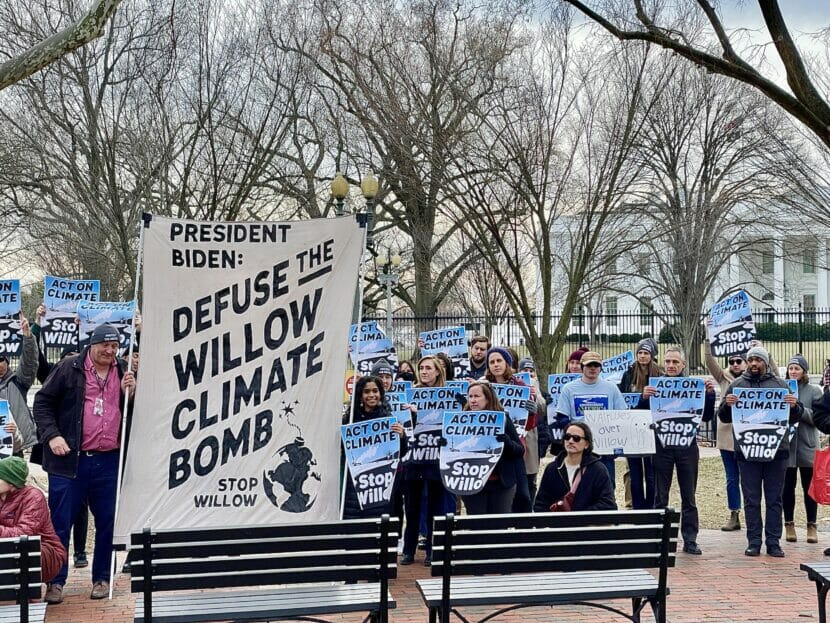
Protesters asking President Biden to rule against the Willow project outside the White House in January. (Liz Ruskin/Alaska Public Media)

A federal judge could issue a decision as early as next week to temporarily halt construction of Willow, ConocoPhillips’ controversial oil drilling project in the National Petroleum Reserve.

Two lawsuits, filed by environmental groups and an Inupiat advocacy organization, aim to overturn the Biden administration’s approval of Willow. The plaintiffs have asked for an injunction to halt construction until the case is decided.

U.S. District Court Judge Sharon Gleason said she’d try to have a decision on the injunction by April 3.

The Interior Department’s decision to allow three drill pads and 200 oil wells was a blow to climate advocates. It drew applause from ConocoPhillips, labor unions and many constituencies on the North Slope, as well as Alaska’s Legislature and congressional delegation.

The Legislature and the trio who represent Alaska in Congress have taken the unusual step of jointly filing an amicus brief, to offer their perspective to the judge.

“We are working hard to get the judge to hear our voices — literally collectively, tens of thousands, if not hundreds of thousands of Alaskans — to convince her that this project going forward, of course, abides by the law, but is strongly in the public interest,” U.S. Sen. Dan Sullivan told reporters Monday.

The public interest is a big factor the judge must weigh in deciding whether to grant an injunction, Sullivan said.

“In many ways, discerning the public interest is what elected officials do all the time,” he said. “And so we thought it was very important to have a brief from all the statewide elected officials in Alaska, that lay out what we see as the public interest, which is to deny this preliminary injunction.”

Trustees for Alaska attorney Bridget Psarianos, who filed one of the lawsuits, said the amicus — or friend of the court — brief does nothing to negate her claim that the administration failed to follow environmental laws in issuing the Willow decision.

“This is unfortunately emphasizing Sen. Sullivan’s blinders — that the state government and oil companies and our own congressional delegation from Alaska have — to the impacts that Willow would have on local communities and global climate,” she said.

Nationally, opposition to the project built rapidly in February and early March. Anti-Willow videos on social media garnered millions of views, and young voters in particular say they feel President Biden violated a campaign promise.

Biden said last week that he was inclined not to approve Willow but was advised that ConocoPhillips would sue and likely win.

The company has held the Willow leases since the 1990s.

Juneau residents join national demonstrations against banks who finance fossil fuels

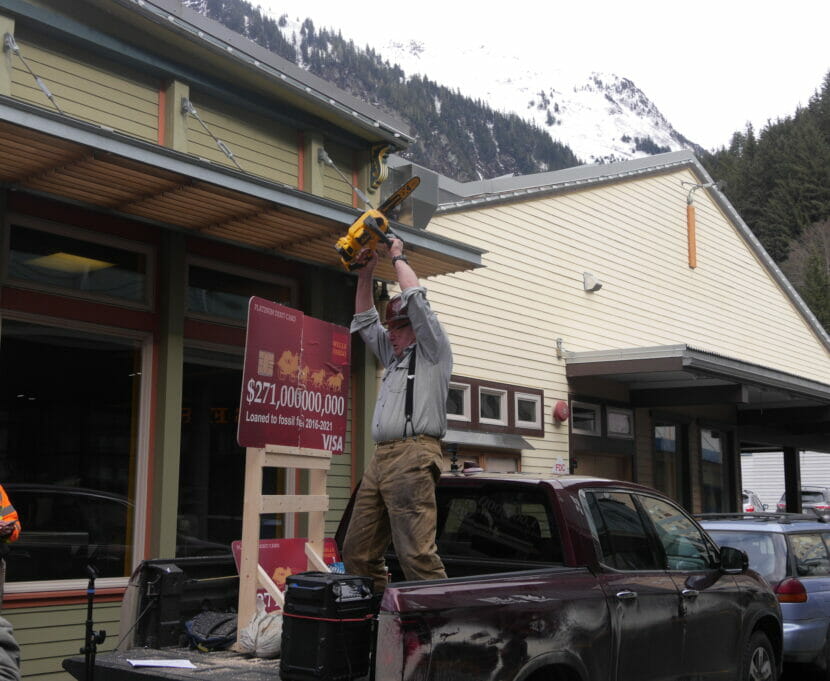
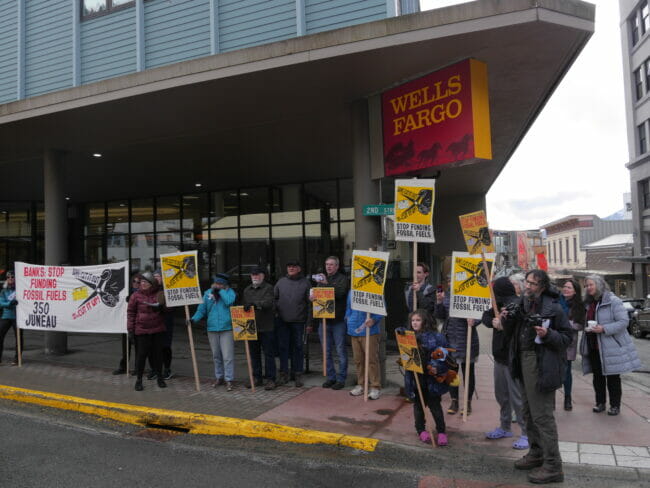
Bob Schroeder with 350 Juneau saws a model Wells Fargo credit card in half outside of the bank’s downtown Juneau branch on the national “Stop Dirty Banks Day of Action” on March 21, 2023. (Photo by Anna Canny/KTOO)


The buzz of a chainsaw and a low, steady drum beat drew attention to the Wells Fargo bank in downtown Juneau on Tuesday, where about two dozen demonstrators lined the sidewalk.

On the bed of a pickup truck, Bob Schroeder stood before a plywood model of an Alaska Airlines credit card. 

“What do we say?” Juneau organizer Doug Woodby called out. “Cut it out or we’ll …”

“Cut it up!” the crowd responded.

Schroeder revved the chainsaw over an intensifying drumbeat and then sliced the card in two, tossing the pieces onto the street. 

What organizers called the “Great Alaska Credit Card Chainsaw Massacre” was one of more than 100 protests on Tuesday for the national “Stop Dirty Banks Day of Action.” Demonstrators aimed to draw attention to the connection between the fossil fuel industry and big banks like Wells Fargo, CitiBank, Chase Bank and Bank of America, the owner of the popular Alaska Airlines credit card. 

The protests called on the banks to end their investments in oil and gas expansion. Together, those four banks have invested more than a trillion dollars in fossil fuels since 2016. 

“That’s a lot of money,” Woodby said after the demonstration. “And I think that a lot of people probably don’t realize just how integral big banks are to funding the climate chaos experience.”

Retirees lead the way

That was true for many of the protestors in Juneau. Sally Wilson has had a Wells Fargo account for more than 30 years. She said she’s been satisfied with it, but after learning about where her money is being invested, she’s reconsidering her choices.

“I had separated the two things,” Wilson said. “My money management is one part of my life. My concern about climate change is another part of it. And this is linking the two.”

Kate Troll agreed. She said she’s already made conscious choices about her financial portfolio, deciding to move money to things like renewable energy investments. The next step, she said, might be ditching her Alaska Airlines credit card.  

“We love the miles,” she said. “But I think we have to think about the greater trade off.”

Both Wilson and Troll are retirees, along with many of the nation’s demonstrators yesterday. The protests were organized by Third Act, an activist group for older adults founded by climate journalist and advocate Bill McKibben. 

That demographic is well-suited to lead the charge against banks. Seventy percent of U.S. wealth is held by Americans over 55.

Woodby says that appealing to big banks is a more promising avenue than pleading with oil companies directly. 

“We’re customers. They listen to us, hopefully. And they know that they depend on us,” he said. “They have a choice. The banks can loan for other uses, like renewable energy.”

Willow Project a rallying point

Alaska was at the center of a national debate on fossil fuel expansion earlier this month, when the Biden Administration approved the Willow Project, a major ConocoPhillips oil drilling project on Alaska’s North Slope.

Organizers with 350 Juneau joined national demonstrations to draw attention to big banks’ investments in fossil fuel expansion on March 21, 2023. (Photo by Anna Canny/KTOO)

The project, which received bipartisan support from state legislators, will emit more than 287 million metric tons of carbon dioxide over its 30-year operation — the emissions equivalent of more than 70 coal fired power plants. 

And much of the project’s financing will likely come from huge banks. ConocoPhillips has received $10 billion from these four banks since the signing of the Paris Agreements. 

Wanda Kashudoha Loescher Culp, an Alaska Native activist with Women’s Earth and Climate Action Network, spoke at the event, reminding demonstrators that the history of bank-funded resource extraction in Alaska dates back before the fossil fuel industry moved in.

“Our ancestors witnessed first explorers and then the expeditions taking our resources for business. All of this was bank funded,” she said.

And while moving away from fossil fuel expansion will be challenging in a state that relies on it so heavily, she said it’s an issue of environmental justice. She believes the state has prioritized resource extraction over the environment and human health. 

“Alaska has never been a government of the people, it’s always been corporate oriented,” Culp said. “And we need to change that.”

Woodby and national Third Act leaders encouraged demonstrators to sign a pledge to close their accounts if banks don’t commit to end their oil and gas investments. Before Tuesday’s day of action, the pledge had over 17,000 signatures nationally.

Site notifications
Update notification options
Subscribe to notifications