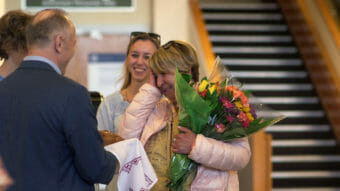
A Ukrainian woman wipes away tears upon arriving at Ted Stevens Anchorage International Airport on Saturday, May 21, 2022. (Photo by Shiri Segal/Alaska Public Media)
Exhaustion and relief were written on the faces of arrivals of Condor flight 2050 Saturday morning as they walked into the lobby of the Ted Stevens Anchorage International Airport.
Family members and volunteers from the Ukraine Relief Program were there to greet them with flowers and hugs. Twelve people from Ukraine arrived over the weekend, and hundreds more are expected in the coming weeks thanks to the local nonprofit and a new federal program.
Among those on Saturday’s nine-hour flight were Mariia and Anton Bershytska and their three-year-old son, Iaroslav. They spent three months in Poland after fleeing their home in Bucha, outside Kyiv, in February.
“Our city was destroyed by war, and many people died there and all infrastructure of Bucha was destroyed, too. And it was awful,” said Mariia Bershytska.
Now they’ll stay with family here in Anchorage thanks in part to the federal Uniting for Ukraine program, which allows Ukrainians sponsored by U.S. citizens to come for a two-year parole period.
“We will stay here in this program during two years, and we hope that the peace in our Ukraine will be (restored) and we can (go) back there. We hope so,” said Bershytska.
Three-year-old Iaroslav Bershytska reaches for his mother Mariia Bershytska as Ukraine Relief Program Director Zori Opanasyvch upon arriving in Anchorage. (Photo by Shiri Segal/Alaska Public Media)
The United Nations estimates that more than six million Ukrainians have been displaced since Russia invaded earlier this year. That number will rise as the conflict drags on.
“It’s been sort of surreal at times. I mean, it’s, as an American, it’s hard to understand,” said Mike Robbins, the finance and outreach chair for the Ukraine Relief Program. Anton is his nephew. Robbins’ wife is Ukrainian, and their family has been closely following news of what’s happening back home.
The local nonprofit run by members of New Chance Christian Church received generous financial support from the Rasmuson Foundation and others, allowing them to purchase plane tickets for Ukrainians with relatives in Alaska.
Robbins said donations are welcome, but it’s not what they need most right now.
“What we really need is people who would like to help us sponsor them into the country,” Robbins said. “Then we help with job placement, and all of the other things that go along with coming.”
They hope to bring up to a thousand people to Alaska in the coming weeks and months. Anyone interested in becoming a sponsor can visit ukrainereliefprogram.com to learn more.
Joshua John Rukovishnikoff, 2, died in December. His sister, Jaylene Philemonoff, started a petition to bring his body home. (Photo courtesy of Jaylene Philemonoff)
A 2-year-old allegedly killed by his foster parents has been laid to rest on St. Paul Island. The child, Joshua John Rukovishnikoff, was buried on top of his mother’s grave during a memorial service Saturday.
Jeremy Philemonoff is from the Pribilof community of about 350 people and used to be married to the toddler’s mother, Nadesda “Lynnette” Rukovishnikoff, who was killed in September 2021.
Philemonoff said they laid John to rest right on top of her casket and placed a small cross in front of hers.
“When you’re born, the doctor usually puts the baby on the chest of the mother,” he said. “And that’s kind of what we were doing. It’s just kind of a beautiful ending to such a tragic death.”
Jaylene worked for months getting 6,000 signatures from across the globe on the petition that brought him home, according to her father. (Photo courtesy of Jeremy Philemonoff)
Several community members gathered for the memorial service at the St. Peter and Paul Russian Orthodox Church. There was a wake after the burial.
In mid-December, while in the care of his foster parents, John was medevaced to a hospital in Anchorage where he died of a serious head injury, according to a report from the Alaska State Troopers. His foster parents now face felony murder charges in his death.
His mother was killed just months before him. Joshua Rukovishnikoff — her husband at the time and John’s father — faces charges for her murder.
John had family in Anchorage and on the island. His half-sister, 17-year-old Jaylene Philemonoff, said she planned for him to be returned to St. Paul to be buried. But John’s paternal aunt had power of attorney. That side of the family had pushed for him to be buried in Anchorage, where he died.
Jaylene and her brother are enrolled citizens of the Aleut Community of St. Paul Island tribal government. The court said the tribe has inherent jurisdiction in this case.
That also means Philemonoff finally got to bring her brother home.
“At the end of the day, he’s with my mom now,” Jaylene said. “I guess that’s all that really matters.”
Jaylene worked for months getting 6,000 signatures from across the globe on the petition that helped bring John home, according to her father.
After all that work, she’s still somber, but glad that John was returned to their mother.
“I still don’t really know how I feel about it all because I did all this work and he’s still not here,” she said. “He’s still gone. So I’m very numb, but I know I did the right thing.”
A memorial service was also held in January at the Saint Tikhon Orthodox Church in Anchorage.
John’s death is still under investigation. His father’s next court hearing in the death of his mother is set for July.
The Office of Children’s Services Building in Bethel. (Photo by Lakeidra Chavis/KYUK)
A new federal class-action lawsuit filed against Alaska’s Office of Children’s Services asserts that the state is failing children in foster care. Lawyers for the 13 child plaintiffs claim the state has known about widespread foster care problems for years but hasn’t addressed them.
In the 90-page complaint filed Thursday, they say problems include high caseloads for caseworkers and high turnover among those workers, plus few adequate foster homes and a lack of adequate support for placing foster children with family members.
The group of attorneys representing the plaintiffs include A Better Childhood, a New York-based advocacy nonprofit focused on foster care. The group has filed a number of class action lawsuits in other states, including Oklahoma, West Virginia and Indiana.
Marcia Robinson Lowry, executive director of A Better Childhood, said Alaska isn’t the worst state when it comes to meeting federal requirements, but it’s far from the best.
“Alaska is fifth-worst in returning kids to their family homes and seventh-worst in the country on the frequency with which children are visited, which is a federal mandate,” Lowry said.
The state Department of Health and Social Services and OCS are listed as defendants in the complaint.
Officials with the state agencies said Friday that they hadn’t been served with the complaint and couldn’t comment on the case. In a statement, they said, “What we can say is that the State takes its obligations for reunification of families, foster care, and the health and welfare of all Alaskan children very seriously.”
The complaint says the problems in the state’s foster care system are widespread.
It says the system is causing particular harm to Alaska Native children, who make up roughly two-thirds of all Alaska children in foster care, despite being a little over a fourth of the state’s population. Under the Indian Child Welfare Act, or ICWA, child welfare agencies are federally compelled to work as hard as possible to house Native foster children with their families or tribes.
The complaint details numerous stories from the plaintiffs, including five Alaska Native siblings who hadn’t been placed in homes that complied with ICWA, a boy with ADHD who had been moved to seven different homes since April of last year and a 16-year-old girl who reported she was sexually assaulted at a mental health treatment facility she was placed at hundreds of miles from her home.
The complaint also says the state isn’t doing enough to address foster children who have disabilities.
Lowry said another issue is that sometimes when kids are placed with family members, the families aren’t licensed by the state as official foster parents, so they don’t receive the funding and support that comes with that licensing.
“And the children either struggle alone without adequate money available for their food and clothing and other activities,” Lowry said, “or the foster parents basically break under the pressure and the kids get moved out and moved to another placement, and another placement, and another placement.”
Lowry said the plaintiffs hope their lawsuit results in the federal court ordering the stateto take a number of actions, including reducing caseloads for foster care workers. Currently, those workers sometimes are trying manage case numbers that total three times the national average. Turnover among staff is roughly 60%.
“So there’s a lot that has to be done with regard to caseloads, and the state has to develop more and better foster homes,” Lowry said. “At the same time, the state needs to provide services so that kids can return home more quickly, or if that’s not appropriate or safe, so the kids can be adopted, either by relatives if possible or other people as well.”
There are roughly 3,000 children in the foster care system in Alaska.
Correction: An earlier version of this story said the lawsuit is in Superior Court. It was filed in federal court.
Juneau Douglas High School Yadaa.at Kalé has reported more than 30 cases since its prom was held at Eaglecrest on Saturday, May 7. (Photo by Bridget Dowd / KTOO)
Juneau’s two public high schools saw an increase in new COVID-19 cases following their proms. Masks were optional at both events.
Juneau Douglas High School Yadaa.at Kalé has reported more than 30 cases since its prom was held at Eaglecrest Ski Area on Saturday, May 7.
But Juneau School District Superintendent Bridget Weiss says there’s no way to know for sure if that event caused the spike.
“There’s a lot of end of the year activities,” Weiss said. “We had prom on May 7, but we also had a lot of teams traveling for sports right about the same time.”
Weiss says there was more of a noticeable spike at Juneau Douglas High School, which could be due to it having a smaller venue. But Thunder Mountain High School’s prom was held a week later on May 14th on campus. There have been nine reported cases at the school since then.
“The JDHS cases really came pretty quickly following that prom,” Weiss said. “Like we started to see the cases as early as Tuesday (May 10). We have not seen the exact same result from the Thunder Mountain prom, although it could happen.”
Weiss says the schools are doing their best to make sure students can keep their end-of-year traditions and those events always come with risk. Graduations for both schools are expected to be indoors with masks highly encouraged, but not required, on May 29.
Interior Secretary Deb Haaland at the Interior Department’s press conference on its federal boarding school investigation in Washington, D.C. on Wednesday, May 11, 2022. (Photo by Jourdan Bennett-Begaye, Indian Country Today)
The U.S. Department of Interior released its investigative report Wednesday on the Federal Indian Boarding School Initiative. It’s being called the first volume of the report and comes nearly a year after the department announced a “comprehensive” review.
Interior Secretary Deb Haaland, Bryan Newland, assistant secretary for Indian Affairs, Deborah Parker who is the chief executive officer of the National Native American Boarding School Healing Coalition and James LaBelle Sr., a boarding school survivor and the first vice president of the coalition’s board, spoke at a news conference in Washington announcing the report’s findings.
“The consequences of federal Indian boarding school policies — including the intergenerational trauma caused by the family separation and cultural eradication inflicted upon generations of children as young as 4 years old — are heartbreaking and undeniable,” Haaland said in a statement. “We continue to see the evidence of this attempt to forcibly assimilate Indigenous people in the disparities that communities face. It is my priority to not only give voice to the survivors and descendants of federal Indian boarding school policies, but also to address the lasting legacies of these policies so Indigenous Peoples can continue to grow and heal.”
Newland led the over 100-page report, which includes historical records of boarding school locations and their names, and the first official list of burial sites.
The findings show from 1819 to 1969, the federal Indian boarding school system consisted of 408 federal schools across 37 states, some territories at that time, including 21 schools in Alaska and seven schools in Hawai’i. Some of these schools operated across multiple sites. The list includes religious mission schools that received federal support, however, government funding streams were complex therefore, all religious schools receiving federal, Indian trust and treaty funds are likely not included. The final list of Indian boarding schools will surely grow as the investigation continues. For instance, the number of Catholic Indian boarding schools receiving direct funding alone is at least 113 according to records at the Bureau of Catholic Indian Missions.
About 50% of federal Indian boarding schools may have received support or involvement from religious institutions or organizations including funding, infrastructure and personnel, Newland said.
The federal government, at times, paid them on a per capita basis for the children to enter into the schools.
Approximately 53 different schools had been identified with marked or unmarked burial sites. Specific locations of the burial sites will not be released to protect against grave robbing, vandalism and other desecration. The department expects the number to increase as the investigation continues.
In June 2021, Haaland announced an Interior investigation in federal Indian boarding schools to make “a comprehensive review of the troubled legacy of federal boarding school policies” from as early as the 19th century.
She said the initiative was created after the discovery of 215 unmarked graves of Indigenous children by Canada’s Tk’emlúps te Secwépemc First Nation at the Kamloops Indian Residential School in May 2021.
The first volume of the report highlights some of the harsh conditions children endured at the schools. Children’s Indigenous names were changed to English names; children’s hair were cut; the use of their Native languages, religions and cultural practices were discouraged or prevented; and the children were organized into units to perform military drills.
The report cites findings from the 1928 Meriam report in which the Interior acknowledged “frankly and unequivocally that the provisions for the care of Indian children in boarding schools are grossly inadequate.”
A map of boarding school sites provided by the Interior Department
Examples included descriptions of accommodations at select boarding schools such as the White Earth Boarding School in Minnesota where two children slept in one bed, the Kickapoo Boarding School in Kansas where three children shared a bed and the Rainy Mountain Boarding School in Oklahoma where, “single beds pushed together so closely to preclude passage between them and each bed has two or more occupants.”
The 1969 Kennedy Report, cited in the Department investigation, noted that rampant physical, sexual and emotional abuse: disease; malnourishment; overcrowding and lack of health care at Indian boarding schools are well-documented.
It also found schools focused on “manual labor and vocational skills that left American Indian, Alaska Native, and Native Hawaiian graduates with employment options often irrelevant to the industrial U.S. economy, further disrupting Tribal economies.”
Federal boarding schools first started with the Indian Civilization Act of 1819 when the government enacted laws and policies to establish and support Indian boarding schools. For more than 150 years, Indigenous children were taken from their communities and forced into boarding schools that focused on assimilation. An unknown number of religious Indian boarding schools, funded by private and government funds, predate the Civilization Act by at least 100 years.
Native land and wealth diminished
In a major finding, the report documents the use of tribal trust and treaty funds for the federal boarding school system as well as mission schools operated by religious institutions and organizations. Although the total amount of these funds used to directly fund schools is unknown, according to an investigation by Indian Country Today, more than $30 million in today’s dollars were siphoned away during a nine year period by Catholic schools alone.
The U.S. also set apart tracts of Native lands for use by religious institutions and organizations. According to an ongoing investigation by Indian Country Today, a large portion of this land may still be held by churches.
Indeed, the relationship between major religious denominations and the federal government regarding Indian mission schools is described as “an unprecedented delegation of power to church bodies that were given the right to nominate new agents, direct educational and other activities on the reservations.
Members of the Sicangu Youth Council help provide a formal burial at the Rosebud Indian Reservation on July 17, 2021, for some of the nine Rosebud students who died at Carlisle Indian Industrial School in the 1880s. The children’s remains were finally returned to their homelands after 140 years, wrapped in a buffalo robe bundle and placed in a cedar box. Earth collected at the Carlisle graves were added to the children’s final resting places. (Photo by Vi Waln for Indian Country Today)
Although the report makes little mention of accountability for religious organizations that operated boarding schools, it does indicate that non-federal entities will be given support in releasing their records associated with the schools.
Parker said the organization’s collaboration with the Interior found an additional 89 boarding schools that did not receive any federal funding.
As part of the initiative and in response to recommendations from the report, Haaland announced the launch of “The Road to Healing” year-long tour. It’ll consist of a tour across the country to allow boarding school survivors to share their stories, help connect communities with trauma-informed support and to gather a permanent oral history.
The report also points to the 2019 watershed Running Bear studies, funded by the National Institute of Health. This research contains the first medical studies to systematically and quantitatively show that the Indian boarding school system experience continues to impact the present day health of adult boarding school survivors.
Newland cited the need for more investigation because of the COVID-19 pandemic and its resulting closures of federal facilities that affected obtaining and reviewing documents and the department’s limited funds at that time.
The second volume will be aided by a $7 million investment from Congress through fiscal year 2022. Newland recommended for it to include a list of marked and unmarked burial sites at federal Indian boarding schools — with names, ages, tribal affiliations of the children at those locations — an approximation of the total amount of federal funding used to support the boarding school system and to further probe the impacts on Indigenous communities. Additionally, the department wants to approximate the total number of children who attended the boarding schools.
“This report presents the opportunity for us to reorient federal policies to support the revitalization of Tribal languages and cultural practices to counteract nearly two centuries of federal policies aimed at their destruction,” Newland said in a statement. “Together, we can help begin a healing process for Indian Country, the Native Hawaiian Community and across the United States, from the Alaskan tundra to the Florida everglades, and everywhere in between.”
Opportunity to submit stories
On Thursday, members of Congress held a hearing at 1 p.m. ET, for the bill “Truth and Healing Commission on Indian Boarding School Policies in the US.” Rep. Sharice Davids, Ho-Chunk, is the lead sponsor of the bill.
The National Boarding School Healing Coalition is requesting people who attended a boarding school or are a descendent of a boarding school attendee to submit their written testimonies to the House of Natural Resources Committee by May 26. Email submissions to HNRCDocs@mail.house.gov and CC NABS at info@nabshc.org.
The National Boarding School Healing Coalition has an available template to use here.
ICT’s Mary Annette Pember contributed to this report.
This story was originally published by Indian Country Today and is republished here with permission.
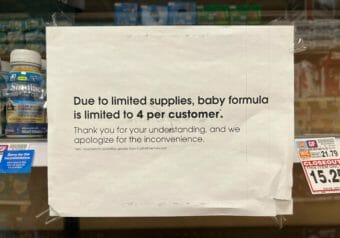
Baby formula is displayed on the shelves of a grocery store with a sign limiting purchases in Indianapolis on Tuesday.(Photo by Michael Conroy/AP)
Stores across the U.S. are continuing to run low on baby formula, with the Biden administration saying it is working to ease the problem for American families and caregivers.
During the first week of May, the average out-of-stock rate for baby formula at retailers across the country was 43%, according to data from the firm Datasembly, which collected information from more than 11,000 sellers.
In late April, the rate was even higher in some states, with an out-of-stock rate over 50% in Iowa, South Dakota, North Dakota, Missouri, Texas and Tennessee.
“This issue has been compounded by supply chain challenges, product recalls and historic inflation,” Datasembly CEO Ben Reich said in a statement.
White House press secretary Jen Psaki said during a press briefing Monday that the Food and Drug Administration is working to make sure baby formula is available to consumers.
“They are working around the clock to address any possible shortage,” she said.
Psaki said the FDA is coordinating with formula manufacturers to ramp up production, while prioritizing those products that are of the greatest need.
The shortage has the potential to impact many children across the country. Only about a quarter of infants born in the U.S. in 2017 were fed exclusively through breastfeeding in their first six months, the Centers for Disease Control and Prevention reported.
Part of the reason the formula supply is so low is because, in February, the company Abbott issued a recall of some of its baby formula products. The voluntary recall included certain lots of Similac, Alimentum and EleCare formula products.
“It is a real crisis and, in many cases, potentially life-threatening,” Dr. Benjamin Gold, a pediatric gastroenterologist in Atlanta, said of the shortage in an interview with NPR.
Gold said he had just seen a young patient with a metabolic disease who requires formula, but their family couldn’t find any at the chain pharmacies near where they live in southern Georgia.
“We’re working on getting the company that makes one of the substitute formulas to ship – actually my nurse is still on the phone with them right now – to ship the formula to this family,” he said.
Gold – who is also president of the North American Society for Pediatric Gastroenterology, Hepatology and Nutrition – says there are some brands of formula that can be substituted for the products that were recalled.
If you can’t find your child’s formula, a website run by the American Academy of Pediatrics recommends to first contact your pediatrician. In urgent situations, you could check smaller stores or buy online, the website says.
Copyright 2022 NPR. To see more, visit https://www.npr.org.
Close
Update notification options
Subscribe to notifications
Subscribe
Get notifications about news related to the topics you care about. You can unsubscribe anytime.