Family

Here’s what could happen if Roe v. Wade is overturned

Demonstrators carrying signs with slogans like abortion is health care
A crowd of people gather outside the U.S. Supreme Court early on Tuesday after a draft opinion was leaked indicating the court could strike down Roe v. Wade. (Photo by Alex Brandon/AP)

Nearly one in four women in the U.S. are expected to get an abortion at some point in their lives, according to a 2017 study.

If Roe v. Wade is struck down, as a leaked draft memo from the Supreme Court suggests it could be, it will have a major impact in states across the country that have already signaled their intention to restrict or ban abortion.

According to the Guttmacher Institute, a research group that supports abortion rights, 58% of U.S. women of reproductive age — or 40 million women — live in states that are “hostile” to abortion.

The Supreme Court verified that the document published by Politico is authentic while noting that draft opinions can change before a final ruling. Chief Justice John Roberts has ordered an investigation into the leak.

The draft opinion overturning of Roe would not ban abortion nationwide but instead allow states to drastically restrict or even ban abortion, which advocates for reproductive rights say could have seismic consequences for the country.

Here’s what a future without Roe v. Wade could mean:

  • More than 20 states have laws that could restrict or ban abortion soon after the Supreme Court overturns Roe, according to Guttmacher. One type of statute, called a “trigger law,” is designed to take effect after a Supreme Court ruling. Some states also still have pre-Roe abortion bans on the books that haven’t been enforced. Other laws express the intent of states to crack down on abortion if permitted by the Supreme Court.
  • States that continue to allow abortion could see an influx of patients seeking care. For example, after Texas enacted its roughly six-week ban on abortion last year, some residents began to get abortions out of state. In the final four months of last year, Planned Parenthood clinics in states near Texas reported a nearly 800% increase in abortion patients from Texas compared the same period in the prior year.
  • Women of color will bear the brunt of further abortion restrictions. According to The Associated Press, Black and Hispanic women get abortions at higher rates than their peers. Women of color are also often poor and could have a harder time traveling out of state for an abortion, the AP said.
  • Limits on abortion access can lead to negative long-term health effects. A major study from the University of California, San Francisco, found that women are harmed by being denied abortions. The women surveyed who gave birth had economic hardships that lasted for several years, were more likely to raise the child alone and were at higher risk of developing serious health problems than those who’d had abortions.
  • Some blue states are already taking steps to enshrine the right to abortion in state law. From Colorado to New Jersey, Democratic governors have signed laws protecting reproductive rights and announced their intention to be able to provide abortion services to people who live in states where the procedure is restricted.
Copyright 2022 NPR. To see more, visit https://www.npr.org.

Moderna asks FDA to authorize first COVID-19 vaccine for very young children

""
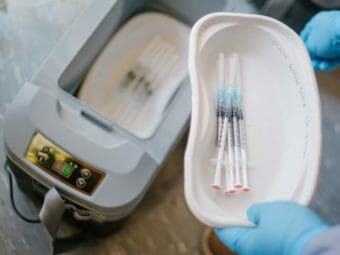
Moderna says its vaccine appears to be about 51 percent effective for children ages 6 months to less than 2 years, and 37 percent effective for those ages 2 to less than 6 years. (Photo by Ole Spata/dpa picture alliance via Getty Images)

Moderna announced Thursday that the company has asked the Food and Drug Administration to authorize a low-dose version of its COVID-19 vaccine as the first vaccine for children younger than age 5.

In a study involving about 6,700 children, the company said two doses of the vaccine administered 28 days apart to children ages 6 months to less than 6 years triggered levels of antibodies equivalent to what has protected older children and adults.
“We are proud to share that we have submitted for authorization for our COVID-19 vaccine for young children,” said Stéphane Bancel, Moderna’s chief executive officer, in a statement. “We believe [the vaccine] will be able to safely protect these children against SARS-CoV-2, which is so important in our continued fight against COVID-19, and will be especially welcomed by parents and caregivers.”

The vaccine appears to be about 51 percent effective for children ages 6 months to less than 2 years, and 37 percent effective for those ages 2 to less than 6 years, the company says.

“That means that you’re going to reduce your chances of getting disease by about a half. That’s very important for these kids,” Dr. Paul Burton, Moderna’s chief medical officer, told NPR in an interview.

While that level of effectiveness is lower than many had hoped, it’s not surprising given the study was conducted when omicron was the dominant variant, company officials and others say. Omicron can evade immunity better than previous variants, resulting in more “breakthrough” infections among vaccinated older children and adults.

But “the levels of antibodies that we see clearly shows that we should have very good protection against severe disease and hospitalization, which obviously is what counts most,” Burton said.

The FDA will probably convene a committee of outside advisers to consider the request. The FDA is also awaiting data from Pfizer and BioNTech about the effectiveness of three doses of a low-dose version of their vaccine in children younger than age 5. Two doses proved ineffective, disappointing parents of young children eager to vaccinate their children.

While officials had hoped to make a vaccine available for this age group by the end of April, the FDA is now expecting to consider it in June once all the data have been submitted, according to an official familiar with the issue who is not authorized to speak publicly.

The possibility of a delay has angered many parents of young children, who are frustrated and anxious that they haven’t been able to vaccinate their children even as mask requirements have been dropped and infections are creeping up.

Some lawmakers have urged the FDA to act more quickly.

But it remains to be seen how much demand there will be for the vaccine. Only about a third of parents of children ages 5 to 11 have vaccinated their children even though they’ve been eligible for months.

“We have very reassuring data. This is an unmet need here for these young children. They have no other opportunity for protection right now. So I would be hopeful that the FDA will take the data, do their normal very thorough but excellent review, and approve this as soon as possible,” Burton said.

The Centers for Disease Control and Prevention and many independent infectious disease specialists have been urging more parents to vaccinate and boost their children. Even though the omicron surge has receded, and children are less likely to get severely ill, the virus can still pose a serious health risk, they say.

Copyright 2022 NPR. To see more, visit https://www.npr.org.

Their mom died of COVID. They say conspiracy theories are what really killed her

A woman seen in profile with her shadow cast against a house
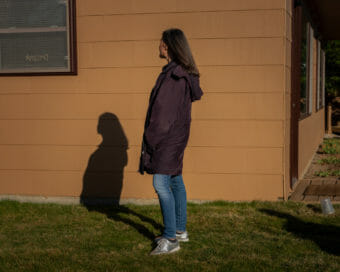
Laurie’s mother, Stephanie, 75, died of COVID-19 in December. “I don’t believe she was supposed to die,” Laurie says. “I blame the misinformation.” Stephanie had been wrapped up in a world of conspiracy theories online, which led her to refuse treatments for COVID. (Photo by Meredith Rizzo/NPR)

One thing everyone agrees on is that Stephanie didn’t have to die. Even months after it happened, her family is struggling to figure out why.

“There is no perfect puzzle piece,” says Stephanie’s daughter Laurie. “I literally go through this all the time.”

Stephanie was 75 when she succumbed to COVID-19 this past December. But Laurie says it wasn’t just COVID that killed her mother. In the years leading up to her death, Stephanie had become embroiled in conspiracy theories. Her belief in those far-out ideas caused her to avoid vaccination and led her to delay and even refuse some of the most effective treatments after she got sick.

“I don’t believe she was supposed to die,” Laurie says. “I blame the misinformation.”

As America approaches a million deaths from COVID-19, many thousands of families have been left wondering whether available treatments and vaccines could have saved their loved ones. According to the Kaiser Family Foundation, more than 230,000 deaths could have been avoided if individuals had gotten vaccinated.

Not everyone who refuses a vaccine believes in elaborate conspiracy theories, but many likely do. Anti-vaccine advocates have leveraged the pandemic to sow mistrust and fear about the vaccines. Local papers across the country are dotted with stories of those who refused vaccination, only to find themselves fighting for their very lives against the disease.

Stephanie’s family wanted to share what happened to her in the hope their story can help others. NPR agreed to use only family members’ first names to allow them their privacy as they continue to grieve.

“I know we’re not alone,” says Laurie. “I know this is happening all over the place.”

From vaccine supporter to skeptic

Stephanie was a native of the Bronx, and for almost 55 years she was married to a man named Arnold. They met shortly after he returned from the war in Vietnam. Her family’s dry cleaning shop was just a few blocks from his parents’ house.

Parking in the Bronx was always tricky, Arnold quips. “So I said, ‘You know, this isn’t bad — she’s very attractive, she’s pleasant to be with — maybe I’ll start dating her and I won’t lose my parking spot.”

Hands holding a wedding photo
Arnold and Stephanie met in the Bronx in the late 1960s. Arnold had just returned from military service in Vietnam. One month later, they were engaged. (Photo by Meredith Rizzo/NPR)

They got engaged after just one month. After a few years of marriage, they moved to Long Island and bought a fixer-upper home. They had two daughters, Laurie and Vikki, who Stephanie stayed home to raise. Vikki remembers Stephanie had an unwavering belief in her children’s ability to achieve whatever they wanted.

“She just believed we could do anything, and I think that’s really powerful as a parent,” she recalls.

When the daughters reached high school, Stephanie began to get into astrology and tarot. She did readings to advise people about things like houses, kids and jobs. It was quirky, but Laurie says that Stephanie brought a lot of positivity and optimism to her sessions.

“Everybody loved it, because everybody is always trying to figure out their lives. There’s always the struggles,” she says. “She spread hope with people.”

For all her star charts and spiritual ideas, Stephanie was practical when it came to her health. She went for regular checkups, and she was a big believer in vaccines. “She made sure I took the flu shots, we took the shingles shot, we took the pneumonia shot,” Arnold recalls. “I mean, I was like a pincushion.”

The family lived for many happy years this way. The daughters grew and started families of their own. Arnold retired from a job working for the gas company.

Then, just before the pandemic began, there was a change in Stephanie. Nobody can exactly pinpoint when it happened. Part of it was physical. Throughout her life, she had played tennis. But it had taken a toll on her knees. She was finding it hard to walk and had to have a stair lift installed in her house.

A suburban street at dusk
Stephanie and Arnold raised their two daughters, Vikki and Laurie, in Long Island. The daughters grew up and started families of their own. Life was good, the family says. (Photo by Meredith Rizzo/NPR)

The loss of tennis from her life also had a psychological impact, says Vikki. “It was her everything. It’s where she felt really valued and strong and important.”

Perhaps partially because she was isolated and feeling down, Stephanie got into watching strange videos and sending them to the rest of the family. Vikki says it was Laurie who was really the first to notice.

“She called me up one day and was like, ‘All right, have you been watching these videos that Mom is sending us?'”

The videos covered a wide range of far-fetched conspiracy theories: JFK Jr. is still alive; reptilian aliens control the government. Arnold says he wouldn’t even look at them: “Watching them, to my way of thinking, would have reinforced that they were valid. Even if I’d argued against them, she wouldn’t have accepted my argument.”

Stephanie’s fringe ideas were troubling, but the family still hung out. Laurie says sometimes they fought over her beliefs, but often they kept the conversation on things like the grandkids.

Then came the pandemic, and everything changed. Stephanie’s videos told her COVID was a hoax. But Laurie and Vikki took it seriously. They were worried about giving their parents the virus. So they stayed away, trying to keep them safe.

“We just stopped seeing each other as a family,” Laurie says. “We didn’t do Thanksgiving that first year.”

While the family stayed away, others did not. Through her astrology, Stephanie had formed a spiritual group that met weekly at her house. And like Stephanie, other members of that group didn’t believe the virus was real.

The more time they spent together, the more Stephanie became invested in her beliefs. Arnold says it was “tribal”: “Staying in the same clique, reinforcing each other, and not getting outside opinions.”

An elderly man sitting on a wooden planter in a back yard
“A couple of times I tried to speak to her on an analytical basis,” Arnold says. “But I could see she was getting defensive, and I didn’t want to alienate myself from her.” (Photo by Meredith Rizzo/NPR)

When the COVID vaccines came along, Stephanie absolutely refused to get one because she falsely thought the shots contained tiny microchips. Moreover, she began avoiding her daughters, who had gotten vaccinated, because she believed false information that the vaccines were being used to somehow spread COVID.

Arnold didn’t get vaccinated, to try and keep the peace.

Good vs. evil

The family felt stuck. They didn’t know how to shake Stephanie out of her beliefs. And they are hardly alone. Diane Benscoter runs a nonprofit called Antidote, which seeks to help families whose loved ones have been taken over by cults and conspiratorial thinking. She says she’s inundated with emails from families facing the same struggles.

“My inbox,” she says. “It’s horrible.”

Much of the public conversation around misinformation focuses on fact-checking and flagging false posts online. But these methods don’t provide much help for people like Stephanie, says Sander van der Linden, a professor of social psychology at the University of Cambridge in the U.K.

“Most people who are really into disinformation and conspiracy theories don’t believe in a single conspiracy theory,” he says. Rather, they’re drawn into a self-reinforcing conspiratorial worldview in which conspiracies build on one another. While the theories can seem disparate, they often have unifying themes: They feed distrust in sources of authority; they claim insider knowledge that makes the believer feel valuable; and frequently, that knowledge includes a secret plan to defeat the forces of evil.

Van der Linden says there are three major reasons why people are drawn into this world in the first place: fear and anxiety about the future, a desire to have a simple explanation for complex or seemingly random events, and the social support that communities around conspiracy theories can provide.

""
Stephanie got into astrology as a hobby when Vikki and Laurie were in high school. Over the years, her interest turned more professional — she gave tarot readings to hundreds of clients who turned to her for insight on houses, jobs and kids. (Photo by Meredith Rizzo/NPR)

While it’s impossible to say exactly what drove Stephanie, her daughters identify several things that seem to roughly correspond to those broad categories of motivations. First, they say Stephanie suffered from a lot of anxiety throughout her life. With her tennis days behind her, much of her self-esteem now lay with her astrology work and her spiritual group. And that group was clearly playing the role of echo chamber, reinforcing her ideas and beliefs.

Benscoter thinks the pandemic has also pushed many people further into the shadows of conspiracies. “The pandemic increases fear, and fear is a really hard emotion. And isolation is a really hard place to be,” she says.

Benscoter herself is a former cult member. She says the conspiracy narratives provide reassurance. Even if the facts seem crazy, they can provide emotional stability. Speaking of her own past, she says these tales gave clarity because they turned complex problems into simple questions of good versus evil.

“It feels so good; I never felt so secure. I mean I knew what was right and wrong. There was no question,” she says.

""
Stephanie’s interest in star charts, numerology, tarot and singing bowls (right) were quirky but her sessions gave people a lot of hope and positivity, Laurie says. (Photo by Meredith Rizzo/NPR)

Because those motivations are all about psychological needs, arguing the facts around individual conspiracies will do little to shake people out of their beliefs. Moreover, “when you try to pull on one, the whole thing collapses for people,” van der Linden says. “So the resistance becomes much stronger.”

Efforts to dissuade Stephanie from her beliefs were frequently met with outbursts of rage, her family says. “She was angry that we weren’t listening to her and believing what she believed,” Vikki says. “A couple of times I tried to speak to her on an analytical basis,” Arnold says. “But I could see she was getting defensive, and I didn’t want to alienate myself from her.”

Both Benscoter and van der Linden say there is no surefire way to get someone from abandoning conspiratorial thinking. They also say one of the best strategies is to try and get a person to question the messenger, not the message. “People, especially these kinds of people, don’t want to feel like they’re being manipulated,” van der Linden says. He says it’s good to ask questions like: “Do you think it’s possible that other people are profiting off you?”

It was a strategy Stephanie’s family said they tried a few times. But even then, van der Linden says, these interventions take time. People can’t change their thinking instantly, and often will backslide as they talk again to their fellow conspiracy theorists.

“It’s an extensive process,” he says.

Out of time

Unfortunately for Stephanie, she did not have time. In November of 2021, just before Thanksgiving, Arnold and Stephanie met two other couples for dinner at a popular local restaurant.

“Afterwards, she started developing symptoms,” Arnold says.

But she refused to get tested. Instead, she ordered drugs online from a natural healer in Florida. Two of the drugs, ivermectin and hydroxychloroquine, are ineffective against COVID, but many conspiracy theorists believe they work. Stephanie waited for the pills to come.

“She was waiting for the pills and I said, ‘Why wait? You could go to the doctor right now. You have amazing health insurance. You don’t have to wait,'” Laurie says.

All the while, she was getting sicker and sicker. The daughters got her a device to check her blood-oxygen level: It was at just 77%.

Vikki called a friend who was a nurse: “She said, ’77?! You need to get your mom to the hospital. She could die!’ And I said, ‘Really?'”

Stephanie still didn’t want to go, but after hearing she could die, she eventually gave in. Arnold drove her to the hospital.

Blister packs of pills strewn on a table
The pills Stephanie received in the mail were labeled as ivermectin and hydroxychloroquine. They appeared to come from manufacturers in India. (Photo by Meredith Rizzo/NPR)

Even after she was admitted, she turned down some effective treatments for COVID. One drug, called remdesivir, has been proven to reduce the severity of COVID, but Stephanie believed conspiracy theories claiming the drug was actually being used to kill COVID patients. Stephanie also refused another treatment shown to be very effective for patients with COVID-19: monoclonal antibodies. Laurie remembers how one doctor responded when he learned that Stephanie had refused the drugs:

“He was like, ‘Why didn’t you take any of the treatments Stephanie?’ She found every little piece of energy in her and yelled back at him, ‘BECAUSE IT’LL KILL ME!'”

Meanwhile, Arnold had developed symptoms and was getting sicker and weaker. He eventually asked his daughters for help.

Vikki drove him to get monoclonal antibodies. He worsened overnight, and the next day, he was admitted to the same hospital that Stephanie was staying in. Unlike his wife, Arnold accepted every treatment he was offered.

“He said yes to everything. He said yes to every treatment they were willing to give him,” says Vikki. “My Mom said no.”

He was discharged after just five days.

“I felt hopeful, because I told her I was going home. I told her, ‘I’ll be waiting for you.’ And then, everything started deteriorating,” Arnold recalls.

“She was fighting a fight without any defenses,” says Perihan El Shanawany, a doctor with Northwell Health, who was part of the team that cared for Stephanie. As Stephanie grew sicker, she started developing blood clots on her lungs. El Shanawany knew that as things progressed, Stephanie would only suffer more.

“Patients at that point feel like they’re suffocating, they’re drowning,” El Shanawany says. “It’s a horrible way to die.”

The only option Stephanie had left was to go on a ventilator. So Dr. El Shanawany sat down with her and asked her what she wanted.

“She did say that she’s had enough. That’s her words, ‘I’ve had enough. This is not a life. I can’t live like this anymore’,” El Shanawany says.

During a video call, Laurie heard her mother’s wishes. She had been urging Stephanie to fight because she felt it wasn’t her time. But hearing those words, “I can’t live like this anymore,” something changed. For years they had been battling over the lies and conspiracies. Laurie knew it was time to make peace with the mother she loved.

And that meant helping Stephanie to die comfortably. “My whole mission after hearing that was to help her get her wishes,” she says.

Laurie stayed by her mother’s side, reading text messages from friends and relatives who wanted to say goodbye. At one point, seeing she was suffering, Laurie played her some music written by a family member: “She gave me a thumbs up,” Laurie recalls. “She was there.”

“We all said goodbye and told her she was the best,” Laurie says.

Stephanie died the next day. It was Dec. 28, a few days after Christmas.

At the funeral, Arnold heard from scores of people whom Stephanie had helped over the years, through her astrology, and just her advice and friendship.

“They all said, ‘She changed my life,’ ” he says tearfully.

A father and daughter walking with their arms around each other
Laurie says she’s “a lot less angry” now. But she still thinks about those who continue to make the kinds of videos her mother watched. In the months since Stephanie’s death, she’s moved closer to her father and sister. (Photo by Meredith Rizzo/NPR)

In the months since Stephanie died, the family has begun the long road to healing. Arnold has received the COVID vaccine. And Laurie recently bought a home closer to her father and sister. “We’ll be able to be in each other’s lives more,” she says.

She also says she’s slowly making her peace with Stephanie’s death.

“I’m a lot less angry,” she says.

But she still thinks about the people who make the paranoia-laced videos that her mother consumed day after day. She understands that something inside her mother drew her to those voices, but Laurie still sees Stephanie mainly as a victim of the grifters and attention-seekers who generate many hours of falsehoods every day to grab money, likes and shares.

“Whoever is creating all this content, is on some level waging a war — here in America — inside of every family,” she says. “I think people need to wake up to that.”

Copyright 2022 NPR. To see more, visit https://www.npr.org.

How soaring inflation forces stark choices

A shopper rolling a cart down a supermarket aisle
A shopper walks through a grocery store in Washington, D.C, on March 13. Surging inflation poses a particular challenge for working-class families, impacting the cost of basic necessities such as groceries. (Photo by Stefani Reynolds/AFP via Getty Images)

From rising rent to higher heating bills, surging inflation impacts everybody, but it poses a particular hardship for people with little extra money to spare.

On Tuesday, the Labor Department reported that consumer prices in March were 8.5% higher than a year ago — the sharpest increase since December of 1981.

While no one likes paying more for haircuts or hamburgers, high inflation is especially painful for low-income families, whose spending is heavily weighted toward necessities such as gasoline and groceries, which have seen some of the largest price hikes.

Gasoline prices have jumped 48% in the last year while grocery prices are up 10%.

These families have little fat in their household budgets to start with, so when inflation cuts into their limited spending power, something has to give.

Take Laura Kemp, a widow in Muldrow, Oklahoma who says that her heating bill last month was $306, more than double the $125 she paid a year ago.

“I live in a two-bedroom mobile home,” she says. “I don’t understand what’s going on. Every month it’s increasing and it’s taking up about a third of my income.”

Kemp feels like she’s losing ground, priced out of even small indulgences like a McDonald’s meal.

“By the 10th of the month, I have $200 left,” she says. “The $200 a month is now going into my gas tank.”

“I’m not making it to the end of the month anymore,” she adds. “Even getting a Big Mac now — a Big Mac meal is $8 — I can’t afford it.”

When the weather warms up, Kemp plans to plant a vegetable garden in hopes of defraying her food bill. She has picked out seeds for tomatoes, zucchini, peppers and eggplants, and she’s eyeing some of the land her brother owns — where her mobile home also sits.

masked women cutting canteloupe
Community volunteers cut and prepare fruit at the Houston Food Bank on Feb. 8. (Photo by Brandon Bell/Getty Images)

From groceries to rent, prices are surging everywhere

Charlene Rye, who retired after 28 years in the poultry industry — much of that time in chicken-processing plants — finds herself having to make hard choices after chicken prices rose sharply over the last year, like everything else in the grocery store.

“You have to be a little more cautious in what you cook and things you make and things you buy,” she says.

Rye has been getting help from a food pantry in Sallisaw, Oklahoma, which has gotten busier as prices have climbed.

“They open at 10 o’clock, and if you’re there at 9, there’s already people in line,” she says.

For Terrie Dean, it’s the cost of housing that really stings. She and her teenage son are living temporarily in a motel in Sallisaw. She relies on disability payments of about $1,600 a month, which for now puts an apartment out of reach.

“They want first month and deposit, not realizing that may be all this family brings in,” said Dean.

Low-income families typically spend about 45% of their income on housing, compared with 18% for upper-income families. Shelter costs have risen 5% in the last year.

A man pumps gas by a sign advertising $4.50 gas
Gasoline prices hover around $4 a gallon for the least expensive grade at several gas stations in Washington, D.C., on April 11. (Photo by Chip Somodevilla/Getty Images)

Gas prices tend to hit especially hard

The disparity for food and transportation is even larger — consuming 9% of high-income households’ budgets but 26% for households that are low income.

After Russia’s invasion of Ukraine, gasoline prices jumped to $4.33 a gallon in March — an all-time high, not adjusting for inflation.

The increased gas prices can impact family ties. Soaring energy prices forced Patricia Bridgmon of Chicago to cut back on visits to her elderly mother in Hammond, Indiana, about 25 minutes away.

“It’s just horrible with the gas,” she says. “I usually go to see her three days out of the week. Now, it’s down to one, because of the gas.”

Kemp, the widow with the increased heating bill, has also cut back on driving to Fort Smith, Arkansas, about 35 minutes from her home in eastern Oklahoma.

“I love going to the art museums and thrift store shopping and just getting out,” she said. “But I can’t even go anymore.”

Meanwhile, Rye, the retired poultry worker, has to weigh the cost of driving to a larger supermarket that’s farther away against shopping closer to home, where prices are higher, even in good times.

""
Federal Reserve Gov. Lael Brainard at her nomination hearing in Washington, D.C., on Jan. 13 after being proposed by President Biden to serve as the central bank’s vice chair. (Photo by Drew Angerer/Getty Images)

The Federal Reserve plans to fight inflation aggressively

Federal Reserve officials are well aware of the toll that inflation is taking, especially on lower-income families, a point that Fed Gov. Lael Brainard highlighted in a speech last week.

“While all Americans are confronting higher prices, the burden is particularly great for households with more limited resources,” Brainard said. “That is why getting inflation down is our most important task, while sustaining a recovery that includes everyone.”

The Fed began raising interest rates last month in an effort to tamp down consumer demand and bring prices under control.

The central bank started slowly, raising rates by a quarter percentage point. But markets anticipate that the Fed will become more aggressive, with a half-point increase now widely expected at the next Fed meeting in early May.

Although forecasters say March could be the high-water mark for inflation, consumer prices are likely to keep climbing at an uncomfortably fast pace for the rest of this year, continuing to put a particular strain on the families that can least afford it.

Copyright 2022 NPR. To see more, visit https://www.npr.org.

When death arrives in Utqiaġvik, volunteer gravediggers answer the call

Two men stand at the bottom of a freshly dug grave
Herman Ahsoak and Marvik Kanayurak dig a grave dusted in snow in winter 2021. (Photo courtesy of Herman Ahsoak)

When Betty Ann Bodfish died from COVID-19 complications, her family wanted to follow her wishes and bury her in Utqiaġvik, next to her mom and grandparents. Relatives gathered from Wainwright, Chugiak, Unalakleet and Colorado, hoping to have the funeral as soon as they could — but the weather was bad and volunteers were already busy digging another grave.

Still, the five men who always volunteer to dig graves in Utqiaġvik were up to the task, even on a long and stormy day.

“When my mom, Dorothy Edwardsen, asked if they could double up, dig two graves in one day, they didn’t hesitate. They never hesitate,” Bodfish’s cousin Iñuuraq Moss said about the volunteers. “They always show up, grave after grave, snow or shine. They honor our loved ones that way, and we couldn’t do what we do without them.”

When people pass away in Utqiaġvik, the family reaches out to a team of volunteer gravediggers, and they take time off from their jobs, bring their tools and get to work, asking for nothing in return. About 20 people in the community sometimes help dig graves, but about five of them come every time.

“We’re here for the people that love those who passed the most, that are hurting the most,” said one of the volunteers, Marvin Kanayurak. “I can’t imagine them having to dig a grave for a person they loved so much. So we’re here for them. We dig graves so that they don’t have to worry about it.”

In a tight-knit community like Utqiaġvik, volunteers do end up digging graves for people they know — or even people who harmed their families. A few years ago, Kanayurak helped bury a person who died in jail after murdering his aunt.

“They buried him in Barrow, and we went there and helped dig that grave,” he said. “There’s always the same five, six guys that are always there. And I mean always.”

Kanayurak has been volunteering for several decades, and he noticed that in the past few years, the number of deaths in Utqiaġvik — the biggest village on the North Slope and the northernmost community in the state — has grown.

“We used to only get two or three deaths a year, and now we’re getting way too many,” he said. “I don’t count them, I just know that the gravesite that we have, when we started it, was empty.”

This winter was a bad season for Utqiaġvik, a city of fewer than 5,000 people. Residents needed eight new graves in December and another 11 since January, said another longtime volunteer, Herman Ahsoak, who digs graves “working from the heart” for his community.

“It’s almost 20 graves in a two-month time frame,” Ahsoak said.

Bodfish’s death a few weeks ago was another addition to the graves volunteers needed to make.

To thank the Utqiaġvik gravediggers “for their continuous tireless hard work,” Bodfish’s family — Dorothy Edwardsen and her daughters, Tracy Benson, Qiñuģan Roddy and Moss — made five hats for the volunteers. The women got together last week to cut out the patterns and sew hats using seal and sea otter skins, a fleece lining and yarn for tassels.

“Our mom said, ‘They’re digging another grave on Monday. I’d like to give them to the guys then.’ And that was our deadline,” Moss said. “It was definitely a labor of love.”

The hats turned out to be quite warm, which was welcome news for the Utqiaġvik gravediggers who were working at temperatures of 20 below zero last month.

Five men stand at the edge of a snowy graveyard, with a wheelbarrow filled with shovels beside them
(From left to right) Volunteer gravediggers Simon Ahluk Toovak, Herman Ahsoak, Marvin Kanayurak Sr., Will Ahlook Stevens and Tony Kaleak received hats as gifts for digging graves for the community of Utqiagvik. (Photo by Clifford Benson)

Kanayurak explained that gravediggers work even if it’s windy or cold because they try to make the graves the day before the burial, following the tradition of not letting anyone “sit above ground.” The team goes out to dig during blizzards, even if the gusts are blowing 45 to 50 miles an hour and the visibility is limited to 150 feet.

“The other day, we’re just facing the wind,” Kanayurak said, “and the guy standing next to me, I looked at his face and said, ‘Hey, your cheeks are turning white!’ And he looks at me and says, ‘Yours too!’ ”

At 59, Kanayurak has been on the volunteer crew the longest. When Kanayurak was a 10-year-old boy in the 1960s, he said, his mother asked him — “a strong young man” — to go help gravediggers. Back then, volunteers only used buckets, sledgehammers and a big ice pick, and it would take them up to three days to dig one grave.

“My job was to hold that pick while they hit that sledgehammer at it, and they would say, ‘Don’t lose!’ Oh, that was the scariest thing I’ve done in my life. But I got good at it,” he said.

Once gravediggers started using a drill, it cut down the digging time to about 10 hours. Nowadays, using different equipment and after years of working side by side, they can dig a grave in solid permafrost in about four or four and a half hours, Kanayurak said.

They drill eight holes close to each other, drill out the middle pieces of mud and use an excavator to dig a grave 6 to 7 feet deep. The ground has changed in the past years too: When Kanayurak first started, the permafrost was about 10 inches to a foot deep. Now the permafrost is only down to 3.5 inches, and the soil is muddier.

Kanayurak observes the passage of time with a smile: “I used to be the youngest gravedigger, and now I’m the oldest.”

Today, the youngest volunteer is 15-year-old Donald Adams, known to everyone as Button. Adams was 8 when he helped dig his first grave — the one for his auntie.

“At first, I didn’t know what I was doing,” Adams said. “At first, I was a little emotional.”

He said that as he has volunteered more and more, he’s gotten better and better at managing his emotions and understanding the importance of the help he is providing.

“We dig other people’s graves to show appreciation to the people that passed on,” Adams said. “We help them because we might have known them. They might have been part of our families, part of our life in some way.”

Ahsoak and Kanayurak both have helped bury their family members as well, but for Kanayurak, there was one grave he couldn’t bring himself to dig: his mother’s.

“I didn’t even dig when my mom passed away. I tried to, but it just made me cry so much,” he said. “I sat there all the way through, and it was the first time I did absolutely nothing on a grave.”

For Ahsoak, the hardest graves to dig are for really young people.

“When it comes to the elderly, I look at it as, we’re going to celebrate their life,” Ahsoak said. “But when there are young people, those are the harder ones to dig. … There’s been moments in the past where I’ve actually started crying while shoveling because it’s hard to witness young people passing away.”

Overall, digging graves becomes easier for the volunteers with time.

“At first it was kind of hard. Now, it hardly fazes me anymore. Death. I’m just so used to it now. But I’ve been doing it for a very long time,” Kanayurak said.

Kanayurak used to get complaints from his wife, asking him to volunteer less and focus on work more, but he would always respond that nothing was more important than honoring people who passed.

“I know we need money, but this is the last time we’re going to help them. So I’m just going to go and help them,” he said. “I just really love my community that much, and I’ll give anything to my people. I hate digging graves, but I love helping my people.”

While working on a grave, the team tries to keep the mood positive, among themselves and with the family, Kanayurak said. They share a meal with the relatives of a person who passed. They start their work with a prayer and finish it with a prayer after they cover the grave with plywood.

“The most memorable part of digging is when you taste the mud, and you smell the mud,” Ahsoak said. “The Heavenly Father says, ‘From dust you were made and to dust you shall return.’ … Every time I dig, I remind myself that one day, they’re going to have to dig a grave for me, you know. So it reminds me to stay humble.”

This story was originally published by the Anchorage Daily News and is republished here with permission.

Refugees from Ukraine could be placed in Alaska communities where they have family ties

A garage sale sign with a Ukrainian flag painted on it, outside a church
A sign at Word of Life church near Delta Junction advertising a garage and bake sale to raise money to help the people of Ukraine. (Photo by Tim Ellis/KUAC)

The state’s refugee coordinator has told local officials that refugees fleeing the war in Ukraine will begin arriving in Alaska over the next year or two, and some will be placed in communities where they have family ties.

Meanwhile, members of the Slavic community in Delta Junction say that a few have already arrived.

President Biden declared two weeks ago that the United States and its European allies will soon begin helping Ukrainian refugees find homes.

“Many Ukrainian refugees will wish to stay in Europe, closer to their home,” he said in a March 24 speech to NATO officials meeting in Brussels. “But we also will welcome 100,000 Ukrainians to the United States, with a focus on reuniting families.”

Last week, State Refugee Coordinator Issa Spatrisano began informing municipal officials that Alaska’s share of those refugees will be placed in some communities beginning next year.

Delta Junction was among the first places she contacted.

“We’re aware that in our state, there are a number of Ukrainians that live in the Delta area,” she said, “and they may have family members that will come join them.”

Refugees and immigrants from Ukraine and other Slavic-speaking nations in the former Soviet Union began to settle in the Delta area in the mid-1990s, after the USSR collapsed. They now make up an estimated 15% of the area’s population.

Some of those residents are already preparing to help their Ukrainian family members get settled in.

“If we do get refugees and we find accommodations for them, like housing and everything, I’m sure we’ll be able to help them with jobs,” said Igor Zaremba, a Delta Junction resident and member of the Word of Life church. “I mean, the construction season is just picking up.”

Zaremba sat in on Tuesday’s Delta City Council meeting. After the council reviewed the letter from Spatrisano, Zaremba told them about his church’s refugee assistance plans and asked if the city can help out “… to cover the bills, to cover food expenses and all that stuff until these refugees get on their feet and get a little more self-reliant.”

Mayor J.W. Musgrove said the city can’t offer any direct assistance but can help refer them to agencies that do.

Spatrisano says she’ll also inform Anchorage and Mat-Su officials about the refugees. Both municipalities also have sizable Ukrainian populations.

“If we’re aware of something that’s going to affect your local community through the U.S. Refugee Admissions Program, our goal is never to surprise people,” she said in an interview Tuesday.

Spatrisano works for Catholic Social Services, which oversees the U.S. State Department’s Refugee Resettlement Program in Alaska. She says the agency hasn’t yet advised her office on how many Ukrainian refugees Alaska might get through the program, or when they’ll begin arriving. But she says it’s likely take a while.

“This is not going to happen overnight,” she said. “The screening processes that are required for refugees take 18 to 24 months.”

Spatrisano says her program only handles Ukrainians who will come to Alaska through the refugee resettlement program. She says others who aren’t with that program may also come to Alaska.

Delta resident Vicky Shestopalov says that some are already here.

“We actually have a refugee family right now who is visiting us,” she said.

Shestopalov says they’re only temporarily staying with her parents, who are expecting another refugee family in the next couple of weeks.

“We do have a lot of Ukrainians here, with ties directly still in Ukraine, trying to move their families out,” she said in an interview Wednesday.

Shestopalov says local Ukrainian-Americans are organizing their own refugee assistance efforts because they’re increasingly alarmed at what they’re hearing from family and friends who are still in the war zone.

“When you talk with your friend first-hand, it’s shocking,” she said. “It’s devastating, you know, and it’s just scary what’s happening there right now.”

Shestopalov says she’s glad the federal government is offering refugee status to Ukrainians. But she and other members of the local Slavic community also hope the federal government will help other victims — including Russians

She says many Russians oppose the war, and many others don’t know much about it.

“I have friends here and all over the U.S. who’ve been trying to get their Russian family members out of Russia,” she said. “They’re telling them, ‘Hey! There’s this war in Ukraine that’s happening! Get out of there before you get recruited or whatever!”

Site notifications
Update notification options
Subscribe to notifications