Family

Delta Junction’s Slavic community, reeling over Ukraine war, launches relief effort

A garage sale sign with a Ukrainian flag painted on it, outside a church
The Word of Life church near Delta Junction is holding a weeklong garage sale/bake sale to raise money to help the people of Ukraine. (Photo by Tim Ellis/KUAC)

Victoria Shestopalov says she began worrying about loved ones in Ukraine a few weeks ago, when the Russian military was conducting large training exercises near the Ukrainian border. She says when she called to check in, they reassured her all was well.

“We have family in Kharkiv, and then we have family in Kyiv, and then spread out in small villages as well,” she said. “And they said, ‘It will be OK, everything’s going to be OK. No one’s panicking.’”

But when Russian President Vladimir Putin sent tanks into Ukraine a couple of weeks ago, Shestopalov says her worst fears had come to pass.

“And then,” she said, “just all of a sudden, it kind of just happened. And, yeah, we were all very crushed with the news.”

Since then, Shestopalov says she and many other members of Delta Junction’s Slavic community have been trying to monitor the situation in Ukraine and keep in touch with those who are still there.

“It really breaks our heart,” she said. “It’s really touched us. I didn’t realize that I would feel this way. It’s just happening — in the 21st century. It’s just unbelievable.”

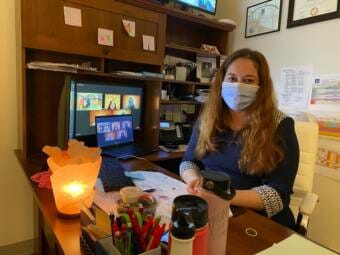
A family photo of a daughter with her parents at a table
Vicky Shestopalov with her mother, Sirje, and father, Paul. (Courtesy of Vicky Shestopalov)

Shestopalov’s family was among the first in a wave of refugees that began arriving in Delta Junction in the 1990s. They came from Russia and Ukraine and other nations in the former Soviet Union’s orbit, many looking for a place where they’d be free to worship according to their conscience.

The Slavic community here now constitutes about a fifth of the area’s population. And Shestopalov says they’re united against the war in Ukraine.

“I know the Russian people don’t this war to be happening,” she said. “Our friends from Russia are reaching out — actually, all over Europe. Nobody wants this to be happening.”

Shestopalov’s dad is Ukrainian. Her mom was born in Finland but moved to Estonia, where Shestopalov was born. And her husband is Russian. She says some members of her family are now wondering whether their country will be the next to be attacked.

“I spoke to my cousin in Finland, which is right there. She said Finland is on pins and needles. They are prepared. They are ready to act,” she said.

Delta Junction’s Slavic community also is ready to act, says Diana Gelever. Her family is one of those that came to Delta Junction from Ukraine back in the 1990s.

A portrait of a woman in a house
Diana Gelever is helping her church, The Word of Life, raise money to help people in Ukraine. (Courtesy of Diana Gelever)

“A couple of the ladies in our church have been reaching out to family in Ukraine,” said Gelever, a member of the Word of Life Church in Delta Junction.

And she says the responses that fellow congregants have been getting from family members in the old country are heart-breaking.

“There are people just hiding in bunkers and underground, in the subway and stuff,” she said. “And there are children down there, others, pregnant women, some men here and there, as well. And they’ve just been reaching out, (saying) that they have nothing. And they’re scared.”

To relieve the suffering, the Slavic community has been sending donations directly to family and friends in Ukraine and neighboring countries. And Gelever says members of the church have launched a weeklong garage sale and bake sale to raise money for the cause.

“They’re baking as many goods that they can,” she said. “They’re trying to sell as much as they can as fast as they can to get the money out there as soon as possible to help those who need it.”

Millions of relief dollars are finally on the way for Alaska’s child care centers

Jamie Shanley at her desk at Little Eagles and Ravens Nest Child Care in Juneau on Feb. 25, 2022. (Photo by Claire Stremple/KTOO)

Last year, the Gold Creek Child Development Center in Juneau was operating at half capacity even though it had more than 100 kids on its wait list. It was struggling to hire and keep teachers. But after an infusion of aid money, Director Amanda Gornik says things have turned around.

“We’re expecting to be at full capacity, staff-wise, and we’re starting to increase our [student] numbers as well,” she said.

The state of Alaska received nearly $100 million dollars last year to support the ailing child care system. Almost half of that was slated to go directly to child care centers in the form of grants. By the end of last year, the state’s Child Care  Program Office had distributed only about $5 million of those federal funds, most of them from the American Rescue Plan Act, to care centers in its first round of grants. Now that number is closer to $20 million.

Now it has a plan for the rest of the money. Just over $45 million is slated to go directly to child care providers like Gornik.

She has applied for another grant and says the first is already helping because she’s been able to make new hires.

“We will have a total of 15 staff members inside our facility,” Gornik said. “So we’ve almost doubled.”

That means she can enroll kids from the waiting list, so her classrooms are filling up. And she says more staff is better for everyone.

“Kids can feel everything,” she said. “When a staff member comes in and they’re stressed and overworked, the kids feel it. Having more staff to be able to handle the work, decrease the stress. Our students are happier and feeling less stressed as well.”

The first influx of money hasn’t solved every child care center’s hiring woes. Up the road at Little Eagles and Ravens Nest Child Care, administrator Jamie Shanley says she made a much needed hire in January, but she still needs more staff.

“We are still actively recruiting, and the applicant pool is very small or non-existent. We’re really exhausting our resources and finding different and creative ways to recruit,” Shanley said.

She says the child care system has been broken for a long time — centers have to choose between paying low wages or charging parents more than they can pay.

“We need reliable money. We need to know how much it’s going to be every month. And, you know, something that’s gonna be long lasting,” she said.

Shanley applied for $30,000 in relief money from the state last week.

Christina Hulquist works for the state’s health and social services department, which is administering the grants. She says the “long lasting” part is what took time to figure out. The plan is that direct assistance will continue through October of this year. The department is also investing millions in programs to ease financial strain on families and care centers.

“Now it’s just about getting all of those different strategies stood up, you know. Some of them are brand new programs, so they take a little bit longer, but it’s nice to have a vision and I feel great about the decisions we’ve made so far,” Hulquist said.

The good feeling is echoed by early childhood education boosters in Juneau. Blue Shibler runs Southeast Alaska Association for the Education of Young Children, a non-profit. She says the only criticism she’s heard from providers is that they would like to get the grants faster.

“The state, I do think, is doing their best in getting them out equitably. And as fast as they possibly can, while also making sure that they’re complying with all the federal guidance that comes with those funds,” Shibler said.

She praised the state for listening to providers more and investing in their feedback.

The state has begun sending out checks for the second phase of grant funding to child care centers. Applications will be open until June 1.

Correction: A previous version of this story misstated Christina Hulquist’s department. She works for the Alaska Department of Health and Social Services. The article has been updated to clarify that about half of the total aid is going directly to care providers in the form of grants and to update the amount of money the state has distributed.

Supreme Court to hear challenge to Indian Child Welfare Act

The U.S. Supreme Court building in Washington, D.C. (Photo by Liz Ruskin/Alaska Public Media)

The U.S. Supreme Court announced Monday that it will hear several cases challenging the constitutionality of the Indian Child Welfare Act, or ICWA. The law was passed in 1978 in response to the disproportionate removal of Native children from their homes, families and communities.
The Indian Child Welfare Act is a federal law that is used in Native child adoption cases.

ICWA provides Tribes with an opportunity to intervene when state child welfare and adoption agencies consider whether to remove a Native child from a home. The children can be enrolled citizens of the Tribe or be eligible for membership status.

Some states passed their own ICWA laws, but those laws must offer additional benefits — not change or remove the application of federal law.

Many of the arguments opposing ICWA say that law illegally discriminates against non-Native families based on race when placing Native children in homes.

That’s the argument at the core of Brackeen v. Haaland. The case began as a lawsuit in 2018 in Texas. It challenges ICWA as a race-based law and says it should be struck down based on equal protection grounds.

In April, the U.S. Fifth Circuit Court of Appeals split on Brackeen v. Haaland and ruled that parts of ICWA were constitutional, while others were not.

Because of the split decision, the ruling applies only to the judicial district which includes Louisiana, Mississippi and Texas.

In September, four Tribes, the state of Texas and several parents filed petitions to ask the Supreme Court to review the decision.

The Supreme Court has consolidated all of those petitions but has not yet set a date to hear them.

Also Monday, the Supreme Court declined to hear arguments in a case between Little Traverse Bay Bands of Odawa Indians and Michigan Gov. Gretchen Whitmer.

The federally recognized Tribe, which includes more than 4,000 Tribal citizens, appealed a decision against them in which they argued the 1855 Treaties of Detroit established a federal reservation for the Tribe.

The Tribe filed its petition for the Supreme Court to hear the case in November.

Alaska lawmakers and telehealth providers work to improve access to contraceptives

Two blister packs of birth control pills, in a tree
Telehealth providers can prescribe various forms of birth control. (Photo by Sage Smiley/KSTK)

Many Alaskans have to travel for health care needs, including contraceptives. They aren’t always easy to get and sometimes they aren’t available as long-term prescriptions which can lead to inconsistent birth control use. Telehealth companies and state lawmakers are trying to change that.

Recent polling suggests that a majority of Alaskans support easy access to contraceptives. But that doesn’t necessarily mean it’s easy for patients to get them — especially in rural areas.

Wrangell Island’s state public health office is only open for a few days every month or two. It closed in 2016 after cuts to the state budget forced the department to shutter offices in Wrangell and Haines.

“At this point, since there’s not a full-time health nurse that’s located in Wrangell,” says public health nurse Erin Michael. She serves Wrangell, Petersburg, Point Protection and Point Baker. “That means that they haven’t been able to bring over the nurse practitioner like they had previously, when we had a full-time staffed health center there.”

Public Health provides a variety of services including immunizations, STD testing, and birth control. But without a nurse practitioner in town, the office can’t prescribe birth control. For Wrangell residents, that can mean a plane or ferry ride to get a prescription.

Wrangell has a tribal clinic run by the Southeast Alaska Regional Health Consortium that provides birth control. But even with sliding scales for lower-income patients, out-of-pocket costs for some birth control methods can range into the hundreds or even thousands of dollars.

Women all over the state are having this problem. According to the nonprofit Power to Decide, more than 30,000 Alaska women live in areas where they don’t have full access to birth control.

In some places, telehealth providers like the Pill Club have begun moving in to try and cover the gaps. That’s a digital healthcare provider focused on contraceptives that expanded to Alaska earlier this year.

Stephanie Swartz is its senior director of policy and public affairs.

“Telehealth really has the potential and the promise to reach people who have historically struggled to receive the care that they deserve,” Swartz says, “Whether that’s because providers and centers are far away or because they felt like providers just have not paid attention to their needs and their personal conditions.”

Insurers have to cover the cost of contraceptives, although bureaucratic technicalities can still make it difficult for women to find birth control that works for them.

“Even if people aren’t covered by insurance, we also work to keep our prices as low as $7 a month,” Swartz said.

Companies like the Pill Club also aim to improve access. The average wait time for an OBGYN is more than 20 days in the U.S., and many small communities, like Wrangell, don’t have one.

“If you have an urgent need or if you have lost a pill pack, that is a real barrier to getting timely care that you need,” Swartz said.

She says there are also benefits to communities when more have easy access to contraceptives.

“History has shown that access to birth control leads to many follow-on benefits for people who need birth control, whether that’s the opportunity to complete schooling to fulfill a career of their choice, and to have better control over the when, how and whether they want to have a family,” Swartz said.

In the state legislature, West Anchorage Democratic Rep. Matt Claman has also been working to expand access to contraceptives. For the last few legislative sessions, he’s sponsored a bill that would, among other things, require insurance companies and state entities to cover up to a year’s worth of birth control at a time.

“It’s not just people in rural jobs and working out on the water, but it’s also people in rural communities that might not even have a drugstore in their community. And they’re relying on mail-order pharmacies to get their prescriptions filled,” Claman said. “All those all those folks that, if you have a slight change in your schedule and you run out of your prescription birth control, you actually then lose the benefits of having the medication.”

The Alaska Public Health Association has supported previous versions of the bill. The Alaska Network On Domestic Violence and Sexual Assault has weighed in, too. Supporters there see a legal mandate to provide longer-term prescriptions to birth control as a way to prevent domestic violence like contraceptive coercion or pregnancy pressure.

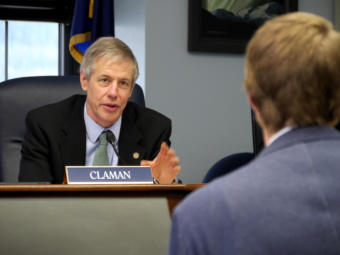
Rep. Matt Claman, D-Anchorage, questions Chad Hutchison, counsel for the Senate Majority, at a free conference committee in the Capitol in Juneau on April 22, 2019. They were discussing Senate Bill 89, which would change the law regarding conflicts of interest involving legislators, family members, employers and potential employers.
Rep. Matt Claman, D-Anchorage, in the Capitol in Juneau on April 22, 2019. (Photo by Skip Gray/360 North)

There’s been some opposition to the bill from groups who see the bill’s coverage of emergency contraceptives as coverage of abortions.

Claman disagrees.

“We actually had an analysis from the Department of Health and Human Services that showed that it actually would save millions of dollars a year to the state in unwanted pregnancies,” Claman said. “These aren’t abortions, these are people that want to be on contraception, and the contraceptive works. There’s no pregnancy.”

The bill – HB58 – hasn’t moved since last April, but Claman says he’s optimistic.

“So many Alaskans care very deeply about this issue and believe it’s a really positive step to really improve access to health care for all Alaskans,” Claman said. “We’re optimistic that we will one day pass the legislation and are not giving up.”

While the legislative expansion of contraceptive access is stalled for now, telehealth providers like the Pill Club, local clinics, and Public Health still provide access to a variety of birth control methods. And even when public health centers aren’t open, many, including Wrangell’s Public Health office, keep free condoms outside the door.

Community-centered approaches to child welfare can keep more families together, researchers say

Two young girls playing on a playground
Children playing on the school playground in Kwigillingok. UAA researcher Saniġaq Jessica Ullrich says a Kwigillingok program has helped keep kids out of foster care because “there was that relationship and connectedness that happened among the community members.” (Photo by Anne Hillman/Alaska Public Media)

When a child enters the foster care system, it often means being removed from their family, a traumatic process that disproportionately impacts Native children.

new study from the University of Alaska Anchorage explores alternative child welfare strategies to limit family separation.

Saniġaq Jessica Ullrich is co-author on the study. She is Iñupiaq, enrolled in the Nome Eskimo Community. She worked for the Alaska Office of Children’s Services for more than eight years.

“My whole passion has been about ending the disproportionate number of Alaska Native children in out-of-home care,” Ullrich said. “And I felt like I did everything I could within the system to create change, but the number stayed the same.”

Of the more than 3,000 Alaska children in out-of-home care, roughly two-thirds of them are Alaska Native or American Indian. Alaska Native people only make up a fifth of the state’s population.

In order to address the disparity, Ullrich left OCS to go back to school and get her doctorate in social welfare. In her dissertation, she interviewed people with experience in the child welfare system, including Alaska Native foster care alumni and relative caregivers, as well as foster parents.

She said she heard stories of trauma from the separation of families and loss of culture. She equates it with trauma experienced by Native children in residential boarding schools.

“What happened in the past is still happening today,” Ullrich said. “And I feel like there’s not enough attention or recognition that the current policies of child welfare are slanted toward removal.”

In her new study published this month with fellow UAA social work researcher Yvonne Chase, the two looked at an alternative approach to child welfare. Their proposed framework is built around empowering families and communities rather than removing children from their homes. That means acknowledging past trauma, working to get families the resources they need and shifting the focus towards reunifying families.

Ullrich said instead of finding more foster care families, OCS could look for “safety plan participants.” They’d be tasked with checking up on families to make sure they’re OK rather than removing children and taking over caregiving responsibilities.

“I don’t have the ability, time and resources to be a foster parent right now,” Ullrich said. “But instead, I’m assisting, and I’m helping to preserve a family, and keep the children with their parents if at all possible.”

Ullrich said communities might be able to handle their own child welfare cases through more preventative measures. She points out that the Yup’ik village of Kwigillingok is already doing that through its Child Protection Team.

“Kwigillingok showed a drop from 20 something cases to zero in a relatively short amount of time because there was that relationship and connectedness that happened among the community members,” Ullrich said. “Checking in, ‘How are you? How can I support you? What’s going on?’”

She said in some cases it’s still safer to remove the child from their home, but using preventative measures would drastically reduce that need.

Funding this community-centered approach to child welfare, however, has been a problem for decades. Chase, the other author of the study, put forth similar recommendations to the first Bush administration in the early 1990s.

Chase said addressing child welfare goes beyond the state Office of Children’s Services. It would require top-down approaches to byproducts of generational trauma, including poverty, substance misuse, housing and food insecurity. She said these preventive measures aren’t well funded.

“Every time we move funds from something like investigation and removal to prevention, we lose the funding. So I think there’s also a reluctance on the part of systems of agencies to do that because they know in budget crunch times, that’s what goes.”

The study notes the federal government has budgeted more than $9 billion on foster care and adoption this fiscal year with only millions of dollars on support and prevention.

Chase and Ullrich hope their research will show that, to enact real change in child welfare systems, lawmakers and administrators will have to look beyond where families are and instead address how they got there.

For now, Ullrich said she’s working on putting together resources for tribes to enact community-focused child welfare systems in their own communities.

The study “A Connectedness Framework: Breaking the Cycle of Child Removal for Black and Indigenous Children” was published earlier this month in the International Journal on Child Maltreatment.

Alaska kids’ COVID vaccination rates are low, and pediatricians say misinformation is the challenge

12-year-old Juliet O’Connor shows off her vaccinated arm on May 13, 2021. (Matt Faubion/Alaska Public Media)

Vaccination rates for Alaska children lag far behind the rates for older kids and adults, according to data from the state health department.

In Alaska, only 25% of kids ages 5 to 11 had received at least one shot by mid-February. Nationally, 31% have.

Pediatricians in Anchorage say misinformation is a big problem as they work to help parents understand the vaccines are safe.

Dr. Killian Schafer, a pediatrician at the Children’s Clinic, said he’s still getting a lot of the same questions from parents as he did in November, when the CDC authorized the vaccine for children from 5 to 11 years old. He said he tries to address parents’ concerns by explaining how getting kids vaccinated can help other family members.

“A lot of times, being able to travel, having family visit, being able to visit family — especially family that may have health problems — encourages parents to get their kids vaccinated,” he said.

He said some parents were quick to bring their kids to his office’s drive-through vaccination clinic back in November. But most parents are still hesitant, even if they’re vaccinated and boosted themselves.

“A lot of people like to consult Dr. Google,” he said. “That can cause a lot of problems because there’s a lot of misinformation.”

Much of that misinformation revolves around this being a new type of vaccine. It contains mRNA rather than a live virus, like the chickenpox vaccine does, or a dead virus, like flu shots do.

“They’re more than willing to get their kids vaccinated for all the prior childhood vaccines that have been available, but some are wanting to wait to see as far as this new vaccine is concerned,” Schafer said.

Dr. Jeff Brand is a pediatrician with Providence Alaska Medical Center in Anchorage and Eagle River. Because parents are already confused about mRNA vaccines, he said, misinformation is that much more effective.

A man sitting at a desk, typing on a laptop
Dr. Jeff Brand works in his office at the Providence Alaska Medical Center in Eagle River. (Photo by Matt Faubion/Alaska Public Media)

“I’ve had several parents, like, ‘I don’t want to give it to my daughter and have to tell her 20 years from now when she can’t have a baby it was from the vaccine,’” he said. “It doesn’t get into the ovaries, it doesn’t change your DNA.”

Brand often compares the COVID-19 vaccine to other vaccines, like for polio or measles. He said any negative side effects from a vaccine usually appear in a population within the first year.

“When the measles vaccine came out in the ‘60s, nobody knew what was going to happen one or two years later, and they didn’t wait until they were 35 to figure it out. No one said, ‘I think I’ll wait ‘til my kid’s 20 to find out if he really is going to get meningitis or if the Hib’s going to protect him. That’s what’s going on now, and I guess I don’t understand that,” he said. “I’ve been doing this since 1982. I’ve never seen a long-term side effect from a vaccine.”

One rare complication from vaccination in teens is myocarditis, which causes chest pain and other symptoms. But studies show that it’s extremely rare and usually subsides quickly. COVID-19 infections bring greater risks for heart problems like multisystem inflammatory syndrome than COVID vaccinations, according to researchers.

Omicron has brought up new questions, said Brand. He said some people are wondering why they should bother getting vaccinated at all, if they might get COVID-19 anyway because omicron is so contagious. He said it’s important to recognize that while the vaccine isn’t 100% effective — and no vaccine is — it’s still protecting most people from getting hospitalized.

“Very early on, it was like, if we can get a vaccine that’s as effective as the flu vaccine, we’ll be happy,” he said. “But then we had two vaccines come out that are 90% effective at preventing death, at preventing hospitalizations. And people kind of got spoiled in the sense that, originally we were talking about, we want one as good as the flu, which is 40% effective.”

The FDA recently postponed its meeting with Pfizer on vaccines for kids under 5. In the meantime, Brand reminds parents to read trustworthy sources, avoid scientific studies that aren’t peer reviewed and ask pediatricians about any concerns.

Site notifications
Update notification options
Subscribe to notifications