Juneau Mayor Beth Weldon answers questions from Diane Antaya’s second grade Harborview Elementary class on Friday, Feb. 4, 2022. (Photo by Bridget Dowd/ KTOO)
Juneau City Hall was a little busier than usual on Friday as second graders from Harborview Elementary made their way in from the snow, following instructions from their teacher, Diane Antaya.
Antaya said the kids made the trek because they’ve been learning a lot about cities.
“Coming to City Hall is very empowering, even for young children,” Antaya said. “They get the sense of the importance of working together to make something great like Juneau.”
The class filed into the Juneau Assembly chambers where Mayor Beth Weldon started showing them around.
“You can see all of the names of our Assembly members,” Weldon said. “That’s one of the things I like to ask the adults if they can name all the Assembly members and most of the time they can’t.”
She told the second graders a little bit about what Assembly members do and explained her role as their executive officer.
“My job is to try to keep them in line, probably like your teacher in your classroom,” Weldon said. “Sometimes she does a good job keeping you guys in line and sometimes it’s a little hard for you wiggle worms to hold still and do what you’re told, so very similar to the Assembly.”
A second grade student raises her hand to ask Juneau Mayor Beth Weldon a question on Friday, Feb. 4, 2022. (Photo by Bridget Dowd/KTOO)
She went on to tell the class about some of the things that make Juneau a unique city, like the fact that it owns an airport and a ski resort.
A few students had the chance to ask Weldon a question. One student asked if Weldon liked being the Mayor.
“Most of the time,” Weldon said. “Not all the time. COVID has been a bit of a challenge for all of us, but it’s really fun getting to meet lots of new people and to try and find laws that help people.”
Other students had more complex questions, like how the city keeps Juneau’s landfill from filling up.
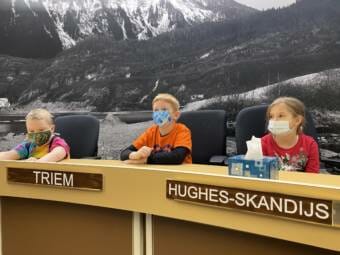
Second grade students from Diane Antaya’s Harborview Elementary class pretend to be members of Juneau’s assembly on Friday, Feb. 4, 2022. (Photo by Bridget Dowd/KTOO)
“This is going to be an interesting question,” Weldon answered. “We’re not. The landfill will just keep getting more giant … By regulation, it can only go so high. We’re trying to figure out ways to make that smaller or else we’re going to have to ship it out of town.”
To end their visit, the second graders had an opportunity to sit in Assembly member chairs and take part in a mock vote. They were asked to decide whether roosters should be allowed in neighborhoods.
Willym Koester sat in Assembly member Carole Triem’s chair and gave his opinion on the rooster issue.
“I think no,” he said. “Because they can nip at you and that sometimes hurts.”
A welcome sign at the Office of Children’s Services Child Welfare Academy. (Photo by Jeff Chen/Alaska Public Media)
For many of the roughly 3,000 foster children in Alaska, finding a stable home has never been harder.
“Children are sleeping in offices, in OCS offices, because they test positive for COVID, and there’s no one available to take them,” said Amanda Metivier, interim director of the Child Welfare Academy, a University of Alaska Anchorage organization that provides training for people working with foster youth.
Alaska has long struggled to have enough foster homes for the children and teenagers who need them, but the pandemic has made the problem even worse. Fewer families are volunteering to foster for a variety of reasons, from fear of COVID-19 spread to pandemic-driven financial challenges, said Metivier.
On top of that, the state Office of Children’s Services — which places kids in foster homes — has long had trouble filling open jobs and has a high rate of staff turnover. It’s all resulting in more Alaska children staying in shelters during a pandemic instead of with families in foster homes.
“They’re sleeping in hotels, and staff are doing shifts for 40-50 hours to stay with children in a hotel until they can find a family setting for them to stay in,” Metivier said. “More than ever, young people are staying in shelters.”
Amanda Metivier speaks with a reporter at the Office of Children’s Services in Anchorage on Feb. 1, 2022. (Photo by Jeff Chen/Alaska Public Media)
From 1,100 licensed foster homes to 650
One of those young people was 17-year-old Jesse Herrera. She stayed at the Covenant House youth shelter in Anchorage for a month last year, until she found a foster home.
And before that, it also wasn’t easy.
Since the age of four, Herrera has bounced around the foster care system between California and Alaska, experiencing failed adoptions, group homes and treatment facilities. She said typically teenagers in foster care have behavioral issues and trauma from their experiences and are less likely to find homes than younger kids.
“The biggest thing for me is I’m also trans, and a teenager,” Herrera said. “So a lot of people don’t want teenagers, but also a trans youth, so there were no homes that would take me so they had to place me at Covenant House.”
Jesse Herrera poses for a photo outside the Office of Children’s Services in Anchorage on Feb. 1, 2022. (Photo by Jeff Chen/Alaska Public Media)
Herrera eventually found her own way to a foster family in Anchorage after visiting the home of a friend’s foster mother.
“I went there for a weekend to spend time with my best friend and hang out, and returned back to the facility at Covenant House, and they said I had to leave because I was gone for too long,” Herrera said. “She said, ‘Get in the truck. Let’s go. You’re staying with me now.’ The caregiver that she is, she took me in out of her own heart.”
While Herrera said she got lucky in finding her foster mother, thousands of other Alaska kids remain stuck without a stable home. Metivier said the number of children in the foster care system has been pretty stable during the pandemic, but the number of foster homes has declined dramatically.

There are roughly 3,000 children in the foster care system.
But by the end of last year, there were just over 650 licensed homes that could take any child — down from more than 1,100 the year before, according to the Office of Children’s Services. That drop doesn’t take into account the licensed homes that aren’t taking in new kids because of things like stress and worries over COVID-19 spread.
‘A systematic failure’
According to some foster care advocates, the problems at OCS go beyond a lack of families and started well before the pandemic. And for one foster parent, those problems prompted him to leave the system.
“I think there’s a lack of training. I think it’s a lack of a qualified workforce. It’s a systematic failure,” said Jason England.
England moved to the Lingít community of Klawock on Prince of Wales Island in 2014. He met his wife, who’s Lingít and the two became licensed foster parents in 2018. He said the demand was immediate.
“We get the phone call, ‘You’re licensed. Here you go, everything’s good.’ It was literally a couple days later, we had three kids in foster care,” England said.
Art made for the Foster Care Alumni of America Post Secret project is taped to a door at the Office of Children’s Services in Anchorage. (Photo by Jeff Chen/Alaska Public Media)
England had done work at the local school and was familiar with the three kids — they were siblings and related to his wife. But the transition was difficult, he said. The only OCS case worker on Prince of Wales at the time told England he had an emergency in Hydaburg, so England would have to pick up the kids.
“It was definitely awkward,” England said. “Going into their house, getting their stuff, the mom sitting there, them crying. And that was the beginning of this journey.”
England said having to pick up the foster children highlights another problem with OCS: There aren’t enough workers. England has had eight different OCS case workers in his roughly three years as a foster parent. There’s rarely more than one to cover Prince of Wales cases, he said
“Prince of Wales is the size of Rhode Island,” he said. “And you’re expecting one person to cover that?”
England said none of his OCS concerns had to do with the kids he was watching. Though he is done being a foster parent, England was able to get the children who were in his care back home to their mother. He said not having to deal with OCS anymore has reduced his stress.
“The last child that we had went home Jan. 21,” England said. “I’ve seen him, he still comes over and watches football with me. And I had my blood pressure checked a couple days ago, and I’m down 20 points.”
Pandemic makes staffing problems worse
State OCS director Kim Guay said the number of foster families in the state has been declining for the past five years, stretching back to before COVID-19 hit. She said staff turnover is normally around 30%, but the pandemic has made it worse. Now it sits at roughly 60%.
As a result, the department sometimes has to ask more of their foster parents, said Guay.
“That’s kind of the nature of our job, is constantly trying to reprioritize what’s needed,” she said. “What’s an emergency, what can be moved.”
Guay said not everyone who’s being hired as an OCS case worker has a background in social work or a similar field because of a small pool of qualified applicants. That has led to OCS shifting focus to more on-the-job training.
The department is also trying to provide foster parents with more support, said Guay. It’s working to create forums for them to discuss issues, as well as a new hotline to get foster parents directly in contact with OCS instead of waiting for their case workers to be available.
Training DVDs for foster parents sit on a shelf at an Office of Children’s Services office in Anchorage. (Photo by Jeff Chen/Alaska Public Media)
Gov. Mike Dunleavy also announced a program in December called the People First Initiative, which would provide millions of dollars in funding to areas including public safety and foster care.
“He did make this announcement to really invest in child welfare,” said Metivier with the UAA organization. “I don’t know that that’s reflected in the current state operating budget and what he’s proposed. So I’m interested to see what’s to come.”
Guay said more information on the funding should be available in the coming weeks. She said recruiting new foster families and OCS workers is a priority, as is keeping the foster families who are already licensed.
She says her message to foster parents is: “Please hang in there.”
“We need you, and this work can’t be done without you,” she said. “And it’s not that OCS needs you. The kids in this state need our foster parents, and we need them to be strong and healthy.”
Already, withgrant funding from the Anchorage Assembly, Metivier and UAA’s Child Welfare Academy have produced ads to try to recruit new foster families.
“Through social media, putting it out at public gatherings, doing things like coffee sleeves, pizza inserts, you name it,” Metivier said. “There’s a huge call to the community to sign up to be a foster parent.”
As for Herrera in Anchorage, who is in one of those ads, she’s thriving in her new foster home since moving in last May.
“It made me feel like I was loved and cared for,” Herrera said. “My depression was rough, and if I wasn’t in this home, I don’t think I’d be here today.”
Herrera turns 18 in March and will age out of the system. Her goals include getting an MBA or J.D. degree, so she can help advocate for the thousands of children that live the same struggles she did.
Correction: An earlier version of this story said Amanda Metivier was assistant director of the Child Welfare Academy. She is the interim director.
Melehoko Pauu Ma’ake talks to a friend during her family’s regular meetup to play pickleball on Jan. 22, 2022, in Juneau, Alaska. Most of the family is Tongan and they’ve been trying to reach family and friends in the island nation after a volcanic eruption and tsunami. (Photo by Rashah McChesney/KTOO)
Last weekend, two locations of the Church of Jesus Christ of Latter-day Saints will be open for eight hours on Saturday and Sunday to accept donations for Tonga.
Melehoko Pauu Ma’ake is helping to coordinate the aid drive. She said it all came together veryquickly after a got a call from Edric Carillo who works in Sen. Jesse Kiehl’s office earlier this week.
She said Kiehl’s staff were hoping to make contacts in the Tongan community in Juneau and “they wanted to find out if I can help, you know, find a facility that would be able to house all of the donations here in Juneau.”
Ma’ake and another family member made some calls and within a few hours, both bishops of their local LDS churches called back to volunteer church space.
“That was just so awesome,” Ma’ake said. “Knowing that, you know, that we can have a place like that at the spur of the moment, very last minute in a situation.”
Right now, suggested donations are nonperishable foods like flour, sugar and canned goods. There’s also an option to donate at a website set up through the church. Specify “Tonga Relief,” in the comment section after donating.
They’re also looking for donations of personal protective equipment to help prevent the spread of COVID-19.
“Masks, hand sanitizer, any, you know, cleaning supplies, you know would be what is most needed. The latest thing that’s going on right now is, you know, COVID has come to Tonga. For them it’s a very very big deal because they’re a third-world country, they’re very poor, so they know they cannot afford to handle a situation if COVID starts effecting and goes out of hand rapidly,” Ma’ake said.
There have been worries of an influx of foreign aid and workers bringing the pandemic to Tonga. Right now, the whole country is on lockdown because the country recorded its first cases of community transmission of the virus.
This food drive and fundraiser have been a way for them to direct their efforts.
Siua Sekona watches a pickleball game on Jan. 23, 2022 in Juneau. Sekona was born and raised in Tonga and, along with the rest of his family, has been waiting to hear from friends and family who still live there. (Photo by Rashah McChesney/KTOO)
“They’re very excited… they’re kind of like ‘OK Mele, whatever you have in mind, let us know and we’ll jump on it,’” she said.
Ma’ake and several members of her family will be taking donations at the church locations over the weekend and then several members of her family and a few other Tongan families have offered to help pack donations on Tuesday, but they’d welcome more hands to help with that process. They’ll be packing at 4 p.m.
“We’ll be packaging it up and delivering it over to Alaska Airlines, and Alaska Airlines will be sending it directly to Anchorage,” Ma’ake said.
Ma’ake says that a larger shipment of goods will be going out to Tonga next Wednesday.
This is the first official aid drive for Tonga in Juneau, but Ma’ake said she doesn’t think this will be the last one.
“This is going to be a long haul for Tonga,” she said. “Livestock … and also agriculture has been devastated by this volcano. Hopefully, the people of Juneau will come together and donate what they can.”
A nurse administers a pediatric dose of the Covid-19 vaccine to a girl at a L.A. Care Health Plan vaccination clinic at Los Angeles Mission College in the Sylmar neighborhood in Los Angeles, Ca., January 19, 2022. (Photo by Robyn Back/AFP via Getty Images)
The last age group of the population unable to get a COVID-19 vaccine may soon be able to do so — and much earlier than anticipated.
Pfizer-BioNTech is expected to file a submission for emergency use to the Food and Drug Administration for a vaccine regimen designed for use in children aged six months to five years, according to a person familiar with the plan. The companies could file for the authorization as early as Tuesday.
Clinical trials last fall showed that the low doses of the vaccine generated protection in children up to 2 years old but failed to do so in kids aged 2-5. The companies announced in December they’d add a third dose to its trials, which would delay the submission to the FDA.
Emergency use authorization could allow children to begin a two-dose regimen, which would prepare children between 2-5 years old to receive a third shot when the data demonstrates its effective.
“By now they probably have more information on whether the two shots provided any protection at all,” Dr. Bob Wachter, chair of the University of California San Francisco Department of Medicine, said .
“It seems likely the third shot will be necessary … but you can’t get shot #3 until you’ve [had] shots 1 and 2,” he wrote in an email Monday night.
A spokesperson for Pfizer emailed a written statement that says “At this time, we have not filed a submission, and we’re continuing to collect and analyze data from both two and three doses in our younger age cohort.”
The FDA authorized the companies’ vaccine for children aged 5 through 11 years old last October, but use among children remains significantly lower than the overall population. According to data from the Centers for Disease Control and Prevention, only 21.6% of children 5-11 are fully vaccinated.
“The key question is whether the parents of younger children will get their kids vaccinated,” Dr. Celine Gounder, a clinical assistant professor at NYU Langone Health, said . “Parents are relatively more hesitant to get their young children vaccinated than themselves.”
Gounder predicted vaccination rates for the younger group of children would mirror that of the group already authorized for the doses.
Copyright 2022 NPR. To see more, visit https://www.npr.org.
A child carries breakfast and lunch from the school bus in Glencaren Court in East Anchorage on Friday, March, 20, 2020. (Photo by Tegan Hanlon/Alaska Public Media)
Tisha Pike lives in Eagle River with her son, who’s in second grade. Before the pandemic, he got free lunches at his school, Birchwood ABC Elementary. Then, schools went online, and she had to spend more on groceries.
She got reimbursed for those groceries through a federal program called the Pandemic-Electronic Benefits Transfer Program, or P-EBT.
“That stability, and being able to know that I have money coming to make sure that my child has food, it means the world,” she said. “Because I know that’s something that he doesn’t have to stress out about.”
Students were eligible for P-EBT if they were enrolled in their school’s free or reduced-price meal program and if the school closed due to COVID-19. In the Anchorage School District, nearly 14,000 students — about a third of students in the district — meet the requirements for free and reduced meals.
Anthony Reinert, the SNAP outreach manager for the Food Bank of Alaska, said it’s meant to make up for those lost meals.
“This is not a benefit in the traditional sense — this is a reimbursement,” he said. “Those children who couldn’t attend school because of the pandemic missed meals that would have been provided through free and reduced meal programs. Those meals then had to be paid for by parents while they ate at home.”
Families can check the Food Bank’s online eligibility calculator to see if they were automatically enrolled for the 2020-2021 school year. Reinert said some families could receive up to $1,800 per child.
Jo Dawson, the state administrator for the department of education’s child nutrition program, said reimbursing families for spring 2020 was an easier process. That’s because closures were fairly consistent across schools.
“Essentially two weeks in March, four weeks in April, and three weeks in May,” she said. “School year 2021 was all over the map.”
Last year, schools were closing and reopening at different times. Some students switched schools or left their districts. That made the data much more complicated.
Shawnda O’Brien directs the state’s Division of Public Assistance. She said dispersing funds is taking so long because state workers are combing through school district data manually. Automating the process requires using an outdated computer programming language.
“Most of the individuals who have that experience are retired or retiring,” she said. “It’s not something that someone in college would be learning to do.”
Starting from scratch in a more modern programming language would take years. They’ve started that process, but in the meantime, the department is looking nationally for people who can work with the existing system.
“Asking folks to be patient is difficult, especially when it comes to money,” O’Brien said. “The biggest thing we can do is let them know that we’re working on it, and we understand the hardship that it’s placing on families and that we’re working as hard as we can to find a solution.”
Some states have applied for P-EBT again for this school year. But like many states’, Alaska’s application is still pending. For now, families waiting on last year’s funds can check the Food Bank of Alaska’s website for updates or sign up for their emails.
Until their cards arrive in the mail, parents like Pike will have to keep waiting.
“Most people have written it off,” Pike said. “I’m never going to get that money. At this point, it’s like beating a dead horse.”
O’Brien said the Division of Public Assistance aims to have a clearer disbursement timeline within the month.
Coastal Villages Region Fund constructing a tiny home in Eek in 2018. (Coastal Villages Region Fund photo)
A surge of new housing is coming to the Yukon-Kuskokwim Delta. Most of those new units are slated to be of the trendy, tiny home variety. But with households in the Yukon-Kuskokwim Delta generally much larger than the national average, some tribes are questioning whether tiny homes are a good fit for their communities.
The U.S. Department of Housing and Urban Development recently announced almost $7 million in funding for Aniak, Atmautluak, Napaimute, Newtok, Quinhagak, Toksook Bay, and Tununak to begin construction on 25 new homes this year. The funding stems from federal coronavirus relief funding, which has brought a huge influx of money into Alaska for tribes to build homes.
“An explosion is a good term for how much that has increased,” said Greg Stuckey, administrator for the Alaska Office of Native American Programs of HUD.
Because these grants are tied to coronavirus relief funding, tribes must use the homes as isolation or quarantine units, at least at first.
“And then, you know, later, when COVID is eventually over, that you can use those to lower overcrowding in your communities, because that is a major issue in rural Alaska,” Stuckey said.
About 40% of homes in the Y-K Delta are either overcrowded or severely overcrowded. According to a statewide housing assessment, over 2,400 homes need to be built to fix that.
Nearly all of the homes that will be built in the Y-K Delta using these HUD grants will be tiny homes. They will be smaller than 500 square feet, with the kitchen, bed, and living space all in the same room. There will be a separate bathroom, but no separate bedrooms.
Tiny homes have been all the rage in recent years, often billed as an answer to affordable housing. But are they a good fit for a region where households are, on average, 50-80% larger than the national average?
The Yukon-Kuskokwim Delta has experimented with tiny homes before. The non-profit organization, Coastal Villages Region Fund, built one in Eek in 2018. The organization says that it would not do it again.
“We found that people need more space than a tiny home with the number of people in the family,” said Oscar Evon, Regional Affairs Director at CVRF.
Evon said that there were other issues with tiny homes, such as how banks wouldn’t finance mortgages for them. CVRF had originally planned for homeowners to purchase tiny homes through mortgages, which would have opened another pathway to homeownership in Y-K Delta villages. Most are currently built and paid for by the regional housing authority or through grants. After pivoting away from tiny homes, CVRF now builds more traditional three- to four-bedroom homes, which Evon says banks finance mortgages for and fit families’ needs better.
“A bigger home gives a family more space to raise their families and sometimes even their extended families,” Evon said.
Some of the tribes that recently received a HUD grant to build tiny homes have come to the same conclusion. Toksook Bay was awarded $1,035,000 to build five tiny homes, but Tribal Administrator Robert Pitka Sr. said that Toksook Bay would rather build bigger homes.
“We would choose two-bedroom home instead of tiny home,” Pitka Sr. said.
However, Toksook Bay submitted a grant application and received funds to build tiny homes. Pitka Sr. said that he thought the grant was specifically for tiny homes.
“The ICDBG [Indian Community Development Block] grant already had wording in there where it’s for tiny homes,” Pitka Sr. said.
HUD’s ICDBG grant requirements suggest building tiny homes as one way to use grant funds, which may have been enough to convince tribes to include tiny homes in their grant application. Tununak, which also received a grant to build tiny homes, also said it would prefer to build homes with bedrooms.
Stuckey said that HUD does not require applicants to build tiny homes or any particular type of housing and did not favor applications that included tiny homes. For example, Newtok received the same grant award to build three three-bedroom homes.
“It’s self determination. The tribes decide, the tribes are going to tell me what they’re going to build,” Stuckey said.
If tribes like Toksook Bay decide that they would rather build larger homes, they will be able to do so. HUD spokesperson Vanessa Krueger said that tribes can submit an amendment to their grant application.
In Toksook Bay, Pitka Sr. said that the new homes, whether they’re tiny or not, will make a big difference to the families currently living in old, unsuitable homes.
“They’re moldy. They’re cold. They’re rotten. They don’t have water and sewer system. Some are even tinier than tiny homes. And at least a brand new tiny house would make it 100% better,” Pitka Sr. said.
Pitka Sr. said that those families could move into their new homes later this year.
Close
Update notification options
Subscribe to notifications
Subscribe
Get notifications about news related to the topics you care about. You can unsubscribe anytime.