Family

Parents and caregivers of young children say they’ve hit pandemic rock bottom

""
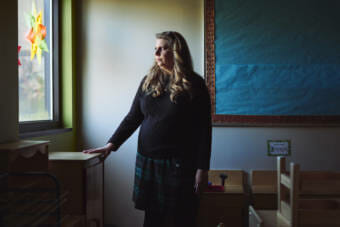
Cori Berg is executive director of the Hope Day School early childhood program in Dallas. (photo by Cooper Neill for NPR)

“I had a parent tell me to f— off last week,” Cori Berg said. She directs the Hope Day School, a church-affiliated early childhood program in Dallas.

The unhappy mother took her two children out of Berg’s center after each of their classrooms were closed for quarantines, saying she’d hire a nanny. Wanting to return, she emailed, called and finally showed up in the middle of the day. Just as Berg had warned her, her spots were taken.

The mother, according to Berg, threw a fit before coming back and apologizing. “She was like a toddler; she was jumping up and down.”

The people who take care of and educate children under 5 years old — both parents and providers — are in a special kind of hell right now. These children are too young to be vaccinated, and it’s difficult for them to wear masks consistently. Many child care directors, like Berg, are still following 10- or 14-day quarantines, closing entire classrooms after a single positive test, which has caused nonstop disruptions given the current record numbers of COVID-19 cases. Recently, Berg’s infant room had “double decker” quarantines: closed for two weeks, back for one day, closed for another two weeks.
Meanwhile, caregivers told NPR they can’t get a hold of enough rapid tests, and they’re struggling to apply the Centers for Disease Control and Prevention’s safety guidance. Center directors say they have few substitutes to cover for those out sick, and early childhood educators typically don’t have union protection. Providers say they are spending out of pocket on equipment like masks and gloves.

Parents, meanwhile, are losing their tempers, losing sleep and losing jobs when the child care they pay for is canceled, over and over. About 1 in 6 parents told pollsters they had experienced either a school or a day care shutdown in the past few weeks, in a national poll from Axios and Ipsos released Jan. 11.

Child care centers are struggling with repeated quarantines

A woman standing in the entrance to a classroom
Berg spoke to NPR while quarantining at home after being exposed to COVID-19 at work. (She has since returned to the classroom.) Before this quarantine, Berg had taken only about two sick days in her nine years at the school. (photo by Cooper Neill for NPR)

The child care crisis in the United States predates the pandemic. The average annual public spending on early childhood care across rich countries is $14,436 per child. In the U.S., it’s $500. Child care is scarce, expensive for most families, and of varying quality, and providers earn an average of around $25,000 a year, even with specialized training and degrees.

Still, as hard as things have been, advocates, parents and early childhood educators like Berg told NPR that January 2022 has been the worst month of the pandemic.

The latest job numbers show child care workers leaving the workforce, even as other sectors are hiring. The federal incentives for employers to offer paid leave ran out in September. And while the American Rescue Plan provided $24 billion in stabilization grants to child care programs in 2021, the Build Back Better plan, with its $400 billion in federal child care and preschool funding, is stalled in Congress.

“This is the worst it has ever been,” Berg said. “It is so fractious between parents and centers. Last week in particular, every single director I know got really beat up.”

Berg spoke to NPR while she was quarantining at home after being exposed to COVID-19 at work. (She has since returned to the classroom.)

“I’ve got [a] sore throat, fever, chills.”

""
Recently, Berg’s infant room had “double decker” quarantines: closed for two weeks, back for one day, closed for another two weeks. (photo by Cooper Neill for NPR)

But she wasn’t sure she actually had COVID — she couldn’t find a rapid test, and the earliest PCR test appointment she could find was four days later.

“I’m almost more worried that I don’t have it and people are going to be mad at me that I’ve been out these days,” she said.

Before this quarantine, Berg had taken only about two sick days in her nine years at the school.

Berg has already downsized from eight classes to four since the start of the pandemic because of a lack of available staff. As of Tuesday, she had 12 cases reported among children, and two of her four classrooms shut down for quarantine.

Like Berg, Kasia Kaim-Gonçalves, who runs an early childhood program in Brooklyn, N.Y., also said the omicron wave marked the hardest time of the pandemic.

“Not only did I get sick — my whole family was sick — but also with such high positivity rates half the children are out at a given time.”

In January, she has resorted to requiring rapid tests every day for the roughly half of her children who have yet to contract COVID.

“It’s very stressful for families, it’s very stressful for us,” she said.

Both of her employees quit recently.

“One said that she didn’t feel safe coming in, and that was really difficult for her and for me.”

Working parents can’t always afford to keep a sick child home

Two women chaperoning children who are playing on a playground
Bernadette Ngoh runs an at-home day care in West Haven, Conn. She said some of her parents are front-line workers who have been reluctant to test their children for COVID-19. (Photo by Mohamed Sadek for NPR)

Gladys Jones is an in-home day care provider in Staten Island, N.Y. She serves families on public subsidies, who are living paycheck to paycheck. Some are in shelters. They can’t afford to miss work, so sometimes sick children show up at Jones’ house. One recent morning a toddler girl started vomiting — it turned out her sister had been exposed to COVID on the school bus.

“Her mother didn’t come get her until the evening. We cleaned her up, made her comfortable, but in the meantime we’re all exposed,” Jones said.

Bernadette Ngoh also cares for children in her home, in West Haven, Conn. She said some of her parents are front-line workers who have been reluctant to get their children tested for COVID when they show symptoms.

A woman holding two children on her lap on a playground while other kids play around them
Bernadette Ngoh cares for children at her home in West Haven. She said they spend a lot of time outdoors, no matter the weather. (Photo by Mohamed Sadek for NPR)

“Some parents explain to me, ‘If I take my child to test and then it comes back positive, then I cannot go to work, because this child cannot go to day care. What will I do with my rent, with my bills?'”

She has told families that she will not charge them if they keep a sick child out for a week, even though she can’t really afford to do that.

“It was so, so expensive [for me] — but if more than one child might get sick, then the whole program will be closed.”

Parents and children are dealing with unpredictable disruptions

“We got the email at 9:30 p.m … there’s been an exposure. And now we’re done with having child care for our 4-year-old for the rest of the week,” said Elliot Haspel. He’s a father of two in Richmond, Va., and this is his second daycare shutdown in as many months. He also happens to be an early childhood care advocate, and author of the book Crawling Behind: America’s Child Care Crisis and How to Fix It.

“My experience is privileged — I can work from home; my wife works part time, she can work from home,” he said. “It’s just the constant — it’s like a quakestorm of disruption, and it’s so unpredictable, which is not great for young kids, either, by the way, who thrive on predictability and reliability. That’s certainly not great for the mental health of parents.”

Early childhood educators don’t know what health guidance to follow

A woman standing by a wall covered with children's art work about covid and covid safety
The walls of Ngoh’s day care display children’s artwork and reminders about wearing masks and washing hands. (Photo by Mohamed Sadek for NPR)

In December, the CDC endorsed “test to stay” policies to keep K-12 students in school despite COVID exposures, using rapid tests. The agency also cut its recommended isolation periods for people infected with the coronavirus from 10 days to five, without requiring a test to return to activities. With worker shortages across the economy, employers are summoning people, including working parents, back to work faster than before. And those parents need child care.

But child care centers, full of unvaccinated children, aren’t sure exactly how to apply the new rules. That leads to tension between parents and providers.

Two women in side a day care holding children on their laps
Gladys Jones, left, runs a day care in Staten Island, N.Y. (photo by Mohamed Sadek for NPR)

“It’s crazy because we don’t know which guidelines to follow,” said Kasia Kaim-Gonçalves in Brooklyn.

On Monday, New York state issued new guidance, recommending a shortened five-day isolation period for children in child care, in some cases. Before that, Kaim-Gonçalves had been requiring 10 days, and families had been lobbying her to change the rules.

“People send me articles like, ‘Look, I’ve read this. Look, CDC changed the rules to decrease the quarantine. Can’t we do that?’ ”

In Texas, Cori Berg said some parents who don’t like her day care’s policies have gone one step further, calling the state’s health department and its child care licensing agency to demand changes.

Back in March 2021, Texas Gov. Greg Abbott issued an executive order lifting all state-imposed COVID operating limits on businesses. So it’s now up to “little mom and pops” like her to enforce health guidance all by themselves, Berg said.

“Everybody threw us under the bus.”

The market can’t solve the child care problem

To child care advocates like Haspel, in Richmond, the omicron wave is an acute disaster on top of the long-term problem of child care supply.

“Child care staffing is still 10% below its pre-pandemic levels,” he said, “and pre-pandemic was not robust … There is so little public money in the child care sector that programs cannot offer competitive wages at a time when many other industries have been able to raise their benefits and their wages.”

The child care industry has bled workers for the past three months — 3,700 in December alone — at a time when other sectors are hiring.

“You can get paid more to go work at Walmart than you can to take care of a child for eight hours a day. We can’t compete,” said Berg, who starts her assistant teachers at $12.50 an hour.

“We can’t take in any more children. Parents are upset with us, but they can’t leave to go find another center that meets their needs because they can’t get in somewhere.”

In September, a study of American child care put it this way: “The existing child care system in the United States, which relies on private financing … fails to adequately serve many families. This is not just happenstance — sound economic principles explain why relying on private money to provide child care is bound to come up short.”

""
A young boy holds a chicken at Ngoh’s at-home day care. (Photo by Mohamed Sadek for NPR)

Those words didn’t come from a progressive child advocacy group, but from the U.S. Department of the Treasury. The report explains that high-quality care and education for small children requires low child-staff ratios, specialized training and experience, and clean, healthy facilities. Being human-capital intensive, it is inherently expensive.

President Biden’s Build Back Better bill includes funding for states to expand infant and toddler care, a universal preschool program for 3- and 4-year-olds, payments directly to parents to lower the out-of-pocket cost of care, plus a child tax credit for all parents. While the full package seems to have faltered, in a press conference on Wednesday, Biden said, “I’m confident we can get pieces — big chunks of the Build Back Better law signed into law.” But, he said he was “not sure” about the child tax credit.

By some reports, Sen. Joe Manchin, D-W.Va., one of the two Democrats whose vote on the full package has been most elusive, backs at least the pre-K part of the proposal.

“What we’re seeing now is sort of a taste of what is to come on a more permanent basis if we don’t put public money into the child care sector,” warned Haspel. “The U.S. Treasury Department is very clear. It’s a market failure — and it’s not a pandemic artifact. It’s not going away.”

He said unless the Senate can agree to pass a new plan, this is the new “terrible” normal.

""
Ngoh has told families that she will not charge them if they keep a sick child out of school for a week, even though she can’t really afford to do that. (Photo by Mohamed Sadek for NPR)

Copyright 2022 NPR. To see more, visit https://www.npr.org.

For Tongans in Alaska, a fretful wait for news after eruption and tsunami

""
Image of volcanic eruption in Tonga taken from the Himawari-8 satellite on Jan. 15, 2022 at 5:50 p.m. Tonga Local Time. This volcanic eruption produced a 3.9 foot (1.2 meter) tsunami which struck Nukuʻalofa, the capital of Tonga. Also visible in this image is the remnants of Tropical Cyclone Cody to the southwest. (NASA/public domain)

A massive volcanic eruption near the Kingdom of Tonga sent people nearby scrambling for higher ground and prompted warnings of tsunamis throughout the Pacific. 

While the physical impact in Alaska has been relatively minor, Alaskans with ties to Polynesian island communities say the emotional impact of waiting for news of friends, family and loved ones is heavy. 

“Many Tongans over here did not sleep well,” Juneau resident Melehoko Pauu Ma’ake said on Saturday.

Melohoko Pauu Ma’ake with her mother and niece on Nuku’alofa in Tonga. Ma’ake, who lives in Juneau, knows her mother is safe, but she is concerned for other friends and family who live in Tonga after a volcanic eruption and tsunami that has largely cut off communication from the island nation to the outside world. (Photo courtesy Melohoko Pauu Ma’ake)

There has been very little contact with Tonga since Hunga Tonga-Hunga Ha’apai erupted. It has been difficult to get information about how the island communities are faring. Radio New Zealand reports that communication has been out since Friday evening, and there are reports that power has been cut in the capital.

Ma’ake and her husband have family in Australia and New Zealand and in other communities in the U.S. She said they are hungry for news and have been texting each other every update they find on social media.

“We’re dying for information to see what’s going on because we’re not hearing anything,” Ma’ake said.  “The first thing — we’re waiting all ears to see more of our relatives — how they are doing.”

Early reports from the eruption show lightning and ash was raining from the sky. Ma’ake said that on Friday evening, before communication was cut off, she video-chatted with a friend in Tonga. 

“She was driving from work with the ash and the rocks, raining rocks. And so she put on her phone the whole time for me so I can watch her drive home and see what’s going on,” Ma’ake said. “And it got to the point in her drive, she couldn’t see anymore, so she had to pull off the road.”

An aerial view of the very flat coastal landscape
The approach to Fua’amotu Airport, Tongatapu, Tonga on Oct. 20, 2014. (photo by David Broad/Creative Commons)

The volcano is about 40 miles of north of Tongatapu, the island where the capitol is located. It has been erupting intermittently since December, according to a report from the Smithsonian Institution’s Global Volcanism Program. 

Despite Tonga’s relative isolation, a booming sound after the initial eruption was heard 5,800 miles away in communities throughout Alaska several hours later. 

Some people have shared photos and videos on social media of people fleeing to higher ground and a tsunami flooding the shore line of Tongatapu. 

Ma’ake said she goes home to Tonga every year. And when she heard that Tongatapu was submerged, it scared her because she said there’s not a lot of places to get to higher ground. The island is relatively flat — the highest point is about 92 feet above sea level. 

And Ma’ake’s uncle lives 10 minutes away from Nuku’alofa, the capital on Tongatapu. He’s 84, and she says he lives by himself, is very stubborn and loves his home. 

“You know, he’s not very far away from the oceanfront. Walking it took me just like 20 minutes to walk from his waterfront to his house when I was there last time,” she said. “I hope he left his place. You know, I can see his daughter coming to take him to higher ground and him like ‘no, you know, I’m staying here in my house.”

Pita Taufatofua with Melohoko Pauu Ma’ake’s niece. An undersea volcanic eruption near the Kingdom of Tonga prompted warnings of tsunamis throughout the Pacific, and cut off the Polynesian island community from the outside worlds. Taufatofua has posted on social media that he has been unable to reach his father who lives in Tonga.  (Photo courtesy Melohoko Pauu Ma’ake)

With the lack of clear communication about what’s happening in Tonga, it’s hard to know what kind of aid the islands will need. Ma’ake said so far her friends and neighbors in Juneau have supported her by calling and checking in to make sure she’s OK.

And for Tonga, she said everything is still so fresh — but there will probably need to be some fundraising at some point because the eruption and tsunami will probably have a huge financial impact. 

“They’re not poor in their friendliness and love, Tonga is very rich in that. But economically they are a poor island so I know they’re going to need a lot of help.”

Troopers find mother of newborn found at Fairbanks intersection

A note left with the newborn, identified as Teshawn, found at an intersection in Fairbanks on Dec. 31, 2021. (Screenshot from Facebook)

Update — Wednesday, Jan. 5, 2:48 p.m.

Alaska State Troopers say investigators located the mother of the newborn who was found New Year’s Eve in a cardboard box at a Fairbanks intersection.

Troopers say the mother, who is a minor, was brought to a hospital in the Fairbanks area for an evaluation and medical care.

“The investigation into the circumstances surrounding the baby being abandoned is ongoing, and no criminal charges have been filed at this time,” troopers wrote in an online dispatch.

Original story – Wednesday, Jan. 5, 12:43 p.m.

Efforts to find the parents of a baby left in a cardboard box on a west Fairbanks street corner on New Year’s Eve continue.

Alaska State Troopers say they are pursuing all avenues, including DNA analysis, to find the family of the newborn — whose name is Teshawn, according to a letter left with the child.

The baby was found near a bank of mailboxes at the intersection of Dolphin Way and Chena Point Avenue. The note refers to parents who lived nearby on Cormorant Street, but troopers say the newborn may have come from a different location in town.

The note said the family could not care for the baby, who was wrapped in a blanket inside the box. Troopers say the child appears to have been found shortly after being left.

The child remains in good health and is being cared for by the state Office of Children’s Services.

Operation Santa heads to Chevak and Buckland in Western Alaska

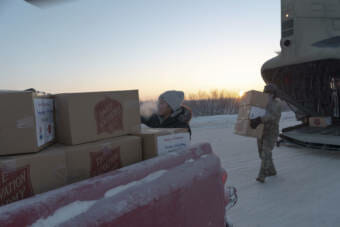
Members of the Alaska Air National Guard board a C-130 plane at Joint Base Elmendorf-Richardson in Anchorage on Dec. 2, 2021, to participate in Operation Santa. (Jeff Chen/Alaska Public Media)

A camouflaged Santa whirled into Buckland on a funny-looking sleigh this year. As part of its annual Operation Santa Claus, the Alaska National Guard delivered 261 presents to the community in northwest Alaska on December 14. Santa says he’ll drop off 360 gifts to Chevak after the holidays and once weather conditions allow.

Azara Mohammadi, tribal liaison for the Alaska National Guard, coordinated with the Native Village of Buckland and Chevak Native Village to organize and shop for gifts. The Salvation Army made the purchases, and volunteers wrapped gifts that began their journey to the two predominantly Alaska Native communities at the start of the month.

Randell Andrew, a sergeant with the Active Guard Reserve in Bethel, operates a forklift to unload 2,770-pounds of presents from an Operation Santa flight on Dec. 2, 2021. Presents will be delivered to Chevak as part of Operation Santa. (Jeff Chen/Alaska Public Media)

On December 2, 24 Guard members boarded a C-130 plane loaded with 631 presents. The gifts were offloaded in Bethel and Nome, where they would be stored until delivery to the two communities. The Chevak-bound presents are still in Bethel, as of Christmas Eve.

Joseph Sallaffie, a sergeant with the Active Guard Reserve in Bethel, said Operation Santa helps the communities a lot during the holidays.

“Yesterday, me and my wife went to the local store here to look for some water and Gatorade, and we just had a hard time getting cases of water, so imagine if Bethel stores are having a hard time, imagine what the village stores are going through,” he said.

Dana Rosso, a public affairs specialist with the Alaska National Guard, said Operation Santa began in 1956, when St. Mary’s Mission was hit with spring floods and then a drought – impacting subsistence fishing and hunting. Rosso said the Air National Guard flew in donated gifts and supplies to help residents that year.

Rosso said Operation Santa recipient communities are identified by Alaska’s Division of Homeland Security and Emergency Management as communities that have experienced particular hardship that year. The tribes in Chevak and Buckland could not be reached by time of publication.

No Guard members wore masks on the trip to Bethel and Nome, but Rosso said service members selected for the mission came from the same unit and office area, in order to lower the risk of Covid transmission. December 2, the day of the initial Operation Santa flight, was also the national deadline for Air National Guard service members to be vaccinated. Rosso said he did not have current vaccination numbers for the Alaska National Guard.

Members of the Alaska Air National Guard ride on a C-130 plane to Bethel on Dec. 2, 2021, the first stop in Operation Santa. (Jeff Chen/Alaska Public Media)

“This means a whole lot since, like I mentioned, Covid-19 and hard times – this means a whole lot,” Sallaffie said. “It’s kind of hard for them to enjoy a Christmas like it used to be, but with all this, it makes a difference.”

The Year in KTOO News: Looking for Juneau’s missing

Spirit Lodge Singers use a healing drum to offer songs and prayer for the safety of Geraldine Nelson as the search for her continues around Lemon Creek on Wednesday, May 19, 2021, in Juneau, Alaska. (Photo by Matt Miller/KTOO).

Looking back on the local issues we covered this year, a disturbing trend emerged. We reported on several members of our community who went missing. While it’s not clear that more people went missing in Juneau in 2021 than in other years, at KTOO we definitely gave the topic our attention. Instead of waiting for police reports about missing persons, we started turning to social media where family members were organizing searches for loved ones who stayed away from home too long.

In May, an elder named Geraldine Nelson went missing in Lemon Creek. After an extensive search, largely coordinated by volunteers, Nelson’s body was found. Her story forced KTOO and the community at large to scrutinize the Silver Alert system designed to help find vulnerable adults who go missing. 

In August, Joe Clayton was visiting family in Juneau from Oregon and didn’t return from a hike. Some of his belongings were later found in a wooded area near the University of Alaska Southeast and his family offered a $5,000 reward for information about him. In October, human remains were found near the ferry terminal that Juneau police confirmed were Clayton’s

Overlapping with Joe Clayton’s disappearance was the search for Doug Farnsworth, who was last seen driving a truck that was found abandoned near the Perseverance Trailhead. An extensive search involving dogs and a Coast Guard helicopter were unsuccessful. Farnsworth’s sister told KTOO in October that law enforcement officials told her that “they don’t look for people that don’t want to be found.” A hiker with a dog found Farnsworth’s remains in November, not far off the popular Flume Trail.

Barbara Charles shares some of her memories at a vigil for her grandson, Doug Farnsworth, on Oct. 27, 2021, in Juneau, Alaska. Farnsworth disappeared in late September. (Photo by Rashah McChesney/KTOO)

Clifford White has been missing since October. His family said he wasn’t the same after his mom died of COVID-19 late last year. He’s a local MMA fighter. People describe him as being in good shape. He’s 29 years old and Alaska Native. He has short black hair and his father says he has a goatee and mustache right now. He’s about 5 feet 11 inches tall and has tattoos.

And just this month, authorities identified human remains found two years ago as James Christopher Cole, who had been missing since 2017 when a skiff he was riding in capsized near Aurora Harbor. Three people and a dog made it safely to shore but Cole and another man, Sheridan Scott Stringer were lost.

KTOO is looking back at 2021 through the stories that had the widest and strongest impact on the community. Read about the pandemic’s second year in Juneau.

Alaskans we’ve lost to COVID: Elizabeth Ketah, family matriarch

""
Elizabeth Ketah was 82 when she died of complications from COVID-19 in Anchorage on Dec. 14, 2020. (Photo courtesy of Tina Mullins)

More than 850 Alaskans have died of COVID-19 since early 2020. We asked readers and listeners to tell us about the lives of some of those Alaskans, and they responded.

Tina Mullins lost her mother, Elizabeth Ketah, on Dec. 14, 2020. She was 82 years old.

Ketah was born in Seldovia, met her husband while in boarding school at Mt. Edgecumbe and then moved to Ketchikan. She most recently lived in Anchorage, near her great-grandchildren.

Listen here:

The following transcript has been lightly edited for clarity.

Tina Mullins: She was like the glue that kept our family together. My mother held her family and God to the foremost, so everything she had done was either for her family or for the community or our church. She was kind, she was a very forgiving person, and I learned unconditional love from her.

She met my father in Mt. Edgecumbe. They actually ran away together — they eloped — and came to Ketchikan. They were married for 60 plus years, and my dad was a preacher. She worked at a cold storage. And I still can smell that fish, I’ll tell you, and she could identify fish more than my dad could. Even though he was the fisherman, she could fillet it better than he could.

There were six of us all together, and I’m the middle child. All of us grew up with our mom always being the one holding down the fort at home, so to speak. My mom taught us that we have to be responsible for ourselves. You know, making sure you get your chores done before you go outside. My parents were also foster parents. And so, when my mom passed away, it literally impacted quite a few families throughout Southeast. So I’m really happy and proud about that — that I’m not grieving by myself.

I worked through the entire pandemic, and because I wasn’t able to see her in the hospital, and we didn’t have a formal funeral, I have to look at the positive side. I have to look at the memories that she gave us, how she helped shape me as an adult and how I deal with the world and myself. Sometimes I feel like she’s going to walk in, or she’s going to call me. And I know that’s not going to be true, but I miss her so much. I still feel her here, and I still dream about her, so she doesn’t feel like she’s definitely gone.

If you would like to share a story of a friend or family member in Alaska who was lost to COVID-19, please to write us here.

Site notifications
Update notification options
Subscribe to notifications