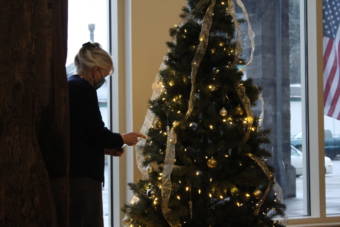
Alice Rooney adds a dove to Wrangell’s Dove Tree on Nov. 28, 2021. (Sage Smiley/KSTK)
For many, the winter holidays are a time of togetherness. But they can also be a stark reminder of the recent loss of loved ones. For nearly two decades, Wrangell has begun the holiday season with a ceremony of remembrance for those who have passed on.
In the high-ceilinged lobby of Wrangell’s Nolan Center, a small Christmas tree with gold and white decorations stands dwarfed between two 20-foot high totems. But its purpose isn’t small at all.
Known as the Dove Tree, it’s a nearly two-decade-old tradition meant to give community members a time at the outset of the holiday season to remember and grieve loved ones lost in the years previous.
Central is the symbolism of a white dove. Hospice of Wrangell’s Alice Rooney penned a story about the bird and its importance. Cindy Martin read the story at this year’s ceremony, which took place on Nov. 28. It concludes: “No matter what your religious beliefs are, and whether the dove means to you, we hope the dove brings you comfort.”
A list shows some of the names of those who have passed on this year. (Sage Smiley/KSTK)
The annual Dove Tree ceremony is an interfaith celebration. Pastor Sue Bahleda of Wrangell’s Island of Faith Lutheran Church delivered the homily.
“We — each of us — are unique and particular and special,” Bahleda said. “There is no one else who has lived our story, yet in all that diversity we hold one thing in common. We die. And that is what has gathered us here today — to hold for one moment longer, the memory of those who have died. They are our mothers and our fathers, our children, our spouses, our family, our neighbors, our friends. They were ordinary and amazing. Sometimes ornery and awful, and what will we do without them? I appreciate that the symbol that we use to mark this day is a dove. It is the symbol of peace. And as we speak of those who have died, we often express this hope, ‘May they rest in peace.’ They do. I have entire faith and confidence in this.”
Wrangell also celebrated and remembered loved ones with music. Wrangell assistant librarian Sarah Scambler sang the Rogers and Hammerstein tune “You’ll Never Walk Alone,” accompanied by Rooney.
The Dove Tree and ceremony were started by Wrangell nurse Trudy Johnson in 2003 after a triple murder-suicide rocked the community. The nature of the crime meant closure was difficult. The ceremony has carried on every year since, organized by Hospice of Wrangell.
Little has changed, except for precautions taken earlier during the pandemic when the tree was moved to an outdoor pavilion downtown. The paper doves were secured with wires so they wouldn’t blow away, and the 2020 program was broadcast on KSTK.
Doves hang on this year’s Dove Tree. (Sage Smiley/KSTK)
Wrangell tribal citizen Thomas Rooney, Jr. drummed as volunteers read the names of Wrangell’s loved ones who have passed on in the last year. Slowly, community members placed white paper doves on the branches of the tree.
After the reading of names and placing of doves, Bonnie Demerjian on cello and Alice Rooney on piano played “Heroes of Longhope,” a Scottish fiddle tune written to commemorate the crew of a rescue vessel who were lost in a storm.
The Dove Tree will stay in the lobby of the Nolan Center through the new year. Paper doves are available for anyone who lost a loved one to add their name to the tree.
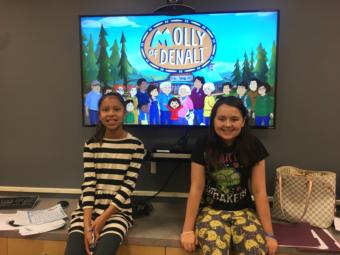
Nanibaa’ Frommherz (left) and Isadora Kizer participated in a voice acting workshop led by creators of Molly of Denali, organized by the Central Council of the Tlingit and Haida Indian Tribes of Alaska, on Aug. 9, 2019. (Photo by Zoe Grueskin/KTOO)
Molly of Denali, about a 10-year old Interior Alaskan girl and her friends, has been airing in English since 2019. Now the Doyon Foundation is working to dub two episodes of the show into the Gwich’in and Koyukon languages.
The language revitalization program of Doyon Foundation put out a call for actors who can speak two of the languages of the region. The Foundation is working with WGBH Boston, which produces the fictional PBS Kids’ cartoon to create episodes representing all the real Mollys out there.
The Molly of Denali project is just one effort of Doyon Foundation’s language revitalization program, which works to preserve the ancestral languages of the Doyon region.
Allan Hayton, the Language Revitalization Program Director says the episodes of the show called “King Run” and “Grandpa’s Drum” will be dubbed into Dinjii Zhuh K’yaa (Gwich’in).
Lynnea Frank was cast as Molly in the Gwich’in episodes of Molly of Denali. (Photo courtesy of Doyon Foundation)Adriel Ginnis will be the voice of Tooey, Molly’s best friend, in the Gwich’in episodes of Molly of Denali. (Photo courtesy of Doyon Foundation).
“We did have quite a number of auditions,” he said. “I’ve been reviewing those, and we were able to nail down the Gwich’in cast; we’re still working on the second cast, the Denaakk’e, or Koyukon.”
Children have been cast in the lead roles. Lynnea Frank will play Molly and Adriel Ginnis will play her friend Tooey.
Gwich’in cast members will rehearse to perfect the language pronunciations and the emotions of the stories. Then they will record at KUAC’s radio studio in Fairbanks.
“And then, once we have the audio, we’ll have to make sure it times out as well,” Hayton said. “Because Athabaskan language is very different than English and a word in Athabaskan could be full sentence length, especially the verbs. So you have to time it with the actual animation, because we can’t change that that’s going to stay the same.”
When the Gwich’in audio is correctly timed with the animation, the tracks will be sent to Atomic Cartoons in Vancouver, Canada, who will integrate the audio into the existing Molly of Denali episodes. Hayton said he’s consulted on the show and trusts folks in British Columbia and Boston to represent Alaska faithfully.
“They do a really good job at WGBH and integrating culture and making sure that they vet things, including all those cultural elements that maybe most people would miss, but people that are here in Alaska watching the show would definitely know,” he said.
The cartoons will be used in Doyon region language revitalization efforts. They will likely air across the state and perhaps in the Athabascan-speaking areas of Canada.
The Denaakk’e/Koyukon group chose the episodes “Have Canoe Will Paddle” and “Main Game.” Hayton says the cast for the Denaakk’e episodes will be chosen soon.
The second season of Molly of Denali began on November 1.
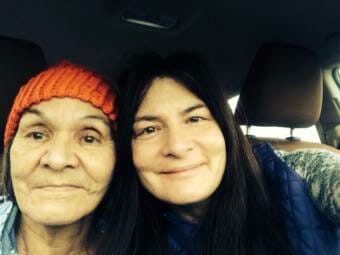
Teresa Maria Pope (left) and her daughter Gina Pope in the car together. The two loved to take car rides through Fairbanks. (Gina Pope)
More than 800 Alaskans have died of COVID-19 since early 2020. We asked readers and listeners to tell us about the lives of some of those Alaskans, and they responded.
Gina Pope lost her mother, Teresa Maria Pope, on Feb. 27, 2021. Teresa Maria was 77. She was born in Pastolik in Southwest Alaska and sent to a Catholic boarding school as a child. She spent much of her adult life in Anchorage and later lived at an assisted-living home in Fairbanks. That’s where Gina believes her mom contracted COVID-19.
Gina says she remembers her mom for her warmth and her laugh. She remembers so many of the little things too: Her mom reading “Archie” comics to her, her mom’s smile as she watched her kids ride their bikes and her love of riding in the car.
Listen here:
The following transcript has been lightly edited for clarity.
Gina Pope: One of her favorite things to do pre-COVID was to jump in the vehicle with me or us, whoever I was with, and ride around Fairbanks. We would just ride around and look at, like, Second Avenue had a really nice Christmas tree. And we’d stop at a coffee bar where they sold ice cream cones.
When we would be in the car, she would sometimes say something kind of offhand, real serious and complainy. And then she would just give this most joyous laughter. It was like I had two moms sitting in the car with me: one was the happy-go-lucky mom. And one was the mom that was a bit concerned about something that she didn’t think was right.
Here in Fairbanks, she had kind of a pretty set routine and a nice place to stay and food that was served three times a day. But when she lived in Anchorage, she was basically homeless. She had places that she could stay and, you know, family there that she could stay with. But she really was her own person. She had her own rules, and she didn’t want anyone else’s rules to rule her rules, rule what she does. And she loved to go to Bean’s Cafe and help out and she also ate there. But she would help them cook too. And she knew a lot of people at the shelter. Like she knew people all over Anchorage. And I’m sure that many of them may not have even known that she passed. But she was close to so many people.
And even here in Fairbanks, she would make friends and I wasn’t aware of it until after she passed how much of an impression she would make on people. Because I would go to this one place and pick up food and I would bring mom, and mom would take those little square boxes or rice. That was all she wanted was rice and soy sauce. And when I told the lady that worked there that my mom had passed, the lady said, “Oh, your mom? I loved her.” And I thought, “Wow, this lady only knew my mom for less than a year and she already loved her.” And it was like that with so many people. Mom would take the time to talk to each person she met.
I was also going to kind of remark on: My mom had lots and lots of children that she called her children and her grandchildren. And they called her Chida-mom. And the way that came about was my late sister, Roberta, her oldest boy, Irvin, when he was just starting to talk and put two and two together — who was related to who — he would hear someone call mom ‘chida’ which means grandmother in Dena’ina and then he would hear us call her mom. So he was wondering, ‘OK, is she chida? Or is she mom?’ So he called her Chida-mom. And that just stuck with everybody for years. It just stuck.
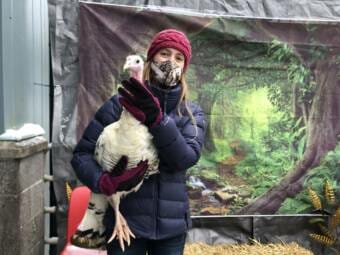
Juneau Douglas High School student Ashlynn King poses with Penny, a turkey she raised as part of the school’s IGNITE program. Penny was part of a photo shoot fundraiser for the program on November 20, 2021. (Jennifer Pemberton/KTOO)
Over the weekend, students in a career and technical program at Juneau Douglas High School: Yadaa.at Kalé held a “turkey shoot” fundraiser.
The set featured a hay bale and a lush scenic backdrop with foliage that looked more like Costa Rica than Southeast Alaska. And waiting for someone to sidle up next to her and smile was a beautiful flightless bird named Penny.
Penny is white with flecks of black at the tip of each feather.
“Like a snowy owl,” said my four-year-old son, who was seeing a turkey for the first time.
Penny is a royal palm turkey, an ornamental breed, but he’s exactly right that her plumage looks like a snowy owl.
Donations for the privilege of posing with Penny go to a program called IGNITE, which introduces students to career and technical programs at the high school.
“We’re kind of a weird club. I won’t say we’re underfunded,” said club member Gabe Hansen, who’s a junior at the high school. “We just spend a lot on feeding birds and rabbits.”
Hence the fundraiser.
Juneau is not known as an agricultural hotbed, but in addition to raising animals, students work on construction projects. They made a goat barn and a swinging door for the school’s library. They also learn how to manage money and people.
“You got to get all the people down here to feed the animals when it’s their time, otherwise animals don’t get fed, which isn’t really good for them,” Hansen said.
“We also emphasize getting girls — women — into this … without the toxic environment of our trade classes,” said Eva Sturm, a senior.
“I have this issue with southeast Alaska because there’s not enough agriculture and kids are freaked out by things they eat every day,” said Caplan Anderson, the students’ advisor. “So, it’s exciting to see some kids who are ready to snuggle a turkey.”
A family of four set up on the hay bale. Penny nestled right in with them, looking like part of the family. Anderson told them it was okay to take off their masks, so you could really see their smiles.
“A lot of what we do is show people animals they might not see on a regular basis,” said Ashlynn King. She’s Penny’s handler and is actually raising the turkey at home.
All eyes were on the exotic bird, but right then a great blue heron flew right over.
“More people have seen herons than turkeys,” said Hansen. “It’s wild.”
That is certainly the case with my son, who had seen hundreds of bald eagles at once but had never seen a turkey before.
“I thought the turkey was going to be a turkey you eat,” he said on the walk home. “I thought it would be like meat that had eyes and a mouth.”
So now, in addition to venison and salmon, at least he knows where turkey meat comes from, thanks to Penny and the IGNITE students.
Military sites, ranging from abandoned pill boxes to quonset huts, are scattered all over the island. Many pose no threat, and are popular tourist attractions. (Theo Greenly/KUCB)
Unalaska may be one step closer to cleaning up some of the contaminated military sites left over from World War II.
Formerly Used Defense Sites — or FUDS — are properties the military used for things like defense or weapons testing. And as anyone who has spent any time in Unalaska knows, there are World War II sites all over the island.
Rena Flint is the project coordinator for the Amaknak FUDS, which covers 190 thousand acres across Unalaska and Amaknak Islands. While the U.S. Army Corps of Engineers has taken strides to clean up some of those places, she says it’s been a long road with lots of red tape.
“The restoration history in this area is very, very, very long. So we’re reframing all the history, we’re trying to put it into bite-sized pieces,” Flint said. “We’re at a jumping off point right now.”
Last year, Flint helped organize a group of community members to determine the best plan for moving forward.
Police Chief Jay King is one of those community members. He says the group discussed which sites to focus on first, including places like Little South America and Summer Bay. He says the group ultimately prioritized “residential and recreational areas for our families.”
“Trying to make sure that ‘I serve and protect; doesn’t necessarily mean always fighting crime,” King said. “It also means making sure the environment and the surroundings are safe for families.”
Flint said cleanup of contaminated sites in the Unalaska Valley could begin as early as next summer if the corps approves funding, which she anticipates they will. When that happens, the corps will move in with machinery to start removing contaminated soil from several locations in the valley, including a fuel tank storage unit up Ski Bowl.
“It’s an area where we would like to do additional removal action. And so that would be [with] an excavator, and it would also be a dewatering plan. So we would have some equipment on site to deal with the shallow water and remove soil,” Flint said.
In the meantime, the corps may be adding another site to its list. The Unalaska Airport Master Plan, which aims to improve Tom Madsen Airport, creates a new challenge.
Thomas Roufos works for the city’s planning department. He says the airport master plan proposes an object-free buffer zone off the runway to protect aircraft coming in and out of town. And that zone is currently where the World War II Visitor Center is located.
“The proposal is to basically pick up the museum and move it down the road across Terminal Drive,” Roufos said.
The corps will visit Unalaska again in January. They say they expect to know by then if funding is approved for the cleanup to begin in the Unalaska Valley next summer.
Dr. Barbara Knox left the University of Wisconsin and American Family Children’s Hospital after colleagues complained of workplace bullying and parents accused her of misdiagnosing abuse. Now, complaints about her are surfacing in Alaska, where she is the state’s top child abuse pediatrician. Here, Knox is seen testifying on Sept. 14, 2017, at a murder trial in Huntington, W.Va. In that case, Aaron Brendon Miles and Mariya Ajena Jones were found guilty of second-degree murder of a 3-year-old. (Courtney Hessler/The Huntington, W.Va. Herald-Dispatch)
This story is a collaboration between the Anchorage Daily News and Wisconsin Watch, a nonprofit newsroom that focuses on government integrity and quality of life issues.
Two years after leaving the University of Wisconsin amid allegations of workplace bullying, Dr. Barbara Knox, UW’s former top child abuse pediatrician, is drawing similar scrutiny at her new job in Alaska.
Seven current and former employees of Providence Alaska Medical Center say they made dozens of complaints about Knox’s management and medical judgment to supervisors, with no response for months.
Knox now heads Alaska CARES, a statewide child abuse forensic clinic operated by Providence that, over the past two years, has lost its entire medical staff to resignations or eliminated positions, the Anchorage Daily News has learned.
Providence, which houses Alaska CARES, is investigating the clinic’s workplace environment. Two sources with direct knowledge of the clinic operations confirmed that Knox was placed on leave pending an investigation. Those sources declined to be named for fear of retaliation. Alaska CARES declined to confirm Knox’s employment status.
Knox formerly led the UW’s Child Protection Program in partnership with American Family Children’s Hospital in Madison. She left that job in 2019 after being placed on paid leave while the UW investigated claims that Knox bullied and intimidated colleagues who disagreed with her clinical approach. A settlement agreement shielded details of her exit from future employers. That included Providence, which hired Knox as Alaska’s top child abuse pediatrician later that year.
Although Knox once testified she had never made a mistaken diagnosis of child abuse, Wisconsin Watch found a dozen instances in which Knox’s suspicions of abuse were rejected by officials in the criminal justice system, by child welfare workers and medical specialists. Other defendants, proclaiming innocence, remain in prison and have appealed their cases.
On Friday, a Dane County, Wisconsin jury quickly acquitted a day care provider who the state criminally charged after Knox declared a child in her care was the victim of “obvious child abuse.” Knox had been scheduled to be a “key witness” in the five-day trial, but the prosecution removed her name from the witness list, and Judge Susan Crawford ordered both parties to refrain from mentioning her findings.
In Anchorage, all six Alaska CARES medical staff members there when Knox took over — advanced nurse practitioners and forensic nurses charged with examining children believed to be victims of abuse — quit or saw their positions eliminated over the past year.
Sarah Duran-Wood, a former forensic nurse at the clinic, said she believes in the work of her colleagues who remain at the clinic but questions Knox’s leadership. Duran-Wood said she brought concerns about Knox to Providence officials multiple times without a response before her position was eliminated in March 2021.
“I felt articulate in my concerns,” she said. “We all were. And it was swept under the rug.”
“Providence is aware of increasing concerns about the workplace environment at Alaska CARES,” a spokesperson for the hospital said in a statement. “We take these concerns very seriously, and per our normal process, Providence is conducting an investigation into those concerns.”
Anastasia Kenney, a former family care coordinator at Alaska CARES who also described a toxic work environment, said that families can still safely bring children to the clinic, despite the problems.
“There’s still a strong, competent team that’s dedicated to the care of Alaska’s most vulnerable children and families,” she said.
Knox declined to comment through a Providence spokesperson.
High stakes for child abuse team
The new job put Knox in charge of a department that makes medical assessments about whether a child has been abused.
The stakes are high: The medical opinions of Knox and her staff can be used by agencies such as the Office of Children’s Services and law enforcement to take children into state custody or can lead to criminal charges for alleged abusers.
Induction of Dr Barbara Knox as the incoming President of the Academy on Violence and Abuse pic.twitter.com/TaDAZe7h5o
In this 2019 image posted on Twitter, Dr. Barbara Knox is seen being inducted as president of the Academy on Violence and Abuse. Alaska CARES hired Dr. Barbara Knox as Alaska’s top child abuse pediatrician after the University of Wisconsin suspended her in 2019 for allegedly bullying colleagues. She is facing similar allegations in Alaska.
At first, staff members at Alaska CARES were star-struck by Knox, Duran-Wood said. Knox had a national reputation for her expertise and had been a frequent speaker at conferences.
Then in February 2020, a few months after Knox started work in Alaska, Wisconsin Watch published its investigation into Knox’s treatment of a Mount Horeb, Wisconsin, family who said she wrongfully accused them of abusing their 9-month-old son. The Anchorage Daily News, in partnership with Wisconsin Watch, wrote a follow-up story days later.
But before ADN published its story, a director at Providence emailed dozens connected to the child welfare system around Alaska, warning them of the additional impending negative news story about Knox.
Bryant Skinner, the director of forensic services, assured recipients that the hospital had thoroughly vetted Knox with background checks and pre-employment inquiries, and that Alaska has a “rigorous licensing process.”
He sent the email to more than 75 people in the child protection community, including Alaska CARES staff, law enforcement, lawyers, nonprofit advocates and public school employees.
“We are confident Dr. Knox is the right person for this role.” Skinner wrote. “And a great addition to our care team.”
Knox dismisses news reports
Knox explained the 2020 news story to staff at her new job as a hazard of working as a child abuse pediatrician, two former staffers said.
“It was, ‘This is somebody who abused their children and they’re trying to discredit me,’ ” Duran-Wood said. “It was very open and shut.”
“We believed her and discounted the story,” said Kenney. “Then our team unfortunately experienced similar bullying over the next year and a half.”
Dr. Barbara Knox is seen in a Catholic Health Association of the United States video recognizing the work of Alaska CARES, a statewide child abuse forensic clinic. Speaking in the video, Knox says the clinic aims to get involved early in child abuse cases. “To be able to really effectively decrease and eliminate child maltreatment, it takes everyone in a community’s participation,” she says.
According to interviews with seven current and former employees at Alaska CARES, concerns about Knox developed around the spring of 2020, an already tense time when the team was figuring out how to work amid the coronavirus pandemic.
Five of the seven people interviewed asked not to be named because they still work for Alaska CARES, in the Providence system or are seeking employment.
At least three nonmedical staff have left Alaska CARES during Knox’s tenure in addition to the entire medical staff’s departure, said Duran-Wood. Kenney blamed a toxic workplace environment.
“All four of our seasoned, wonderful advanced nurse practitioners who had been with Alaska CARES and Providence for many years all quit within a year solely because of their treatment by Dr. Knox,” Kenney said.
Kenney said the final straw came for her when, in front of a group working on a case, Knox “cut a co-worker off in midsentence who was speaking to the team by throwing her palm up about four inches from my co-worker’s face and angrily said, ‘You stop talking.’”
Knox then refused to talk to the co-worker or answer her medical questions for the remainder of the case, Kenney recalled.
“Dr. Knox did that to our co-worker, and Providence did nothing,” she said.
‘They were wrong’
Other staff members criticized Knox’s approach to families, and how she would not tolerate dissenting medical opinions.
In one case that another co-worker was handling, Knox blamed an injury on intentional abuse that others considered a potential accident.
“Rather than (Alaska Office of Children’s Services) and advocacy talking to me, they called her,” Duran-Wood said. “She made decisions. And OCS followed those decisions. And they were wrong.”
The following Monday, according to Duran-Wood, Knox called multiple radiologists looking for someone to agree with her opinion about the cause of an injury.
“None of them would,” Duran-Wood said. Still, Knox’s judgment “resulted in an infant being removed from the custody of a nursing mother for over a month,” she said.
In this excerpt of an April 2019 letter, Dr. Ellen Wald, chair of the University of Wisconsin pediatrics department, informs Dr. Barbara Knox that UW colleagues are complaining about Knox’s workplace behavior. Knox was later placed on administrative leave. Seven current and former employees of Providence Alaska Medical Center say they made dozens of complaints about Knox’s management and medical judgment to supervisors, with no response for months.In this excerpt of an April 2019 letter, Dr. Ellen Wald, chair of the University of Wisconsin pediatrics department, informs Dr. Barbara Knox that UW colleagues are complaining about Knox’s workplace behavior. Knox was later placed on administrative leave. Seven current and former employees of Providence Alaska Medical Center say they made dozens of complaints about Knox’s management and medical judgment to supervisors, with no response for months.
Veteran child protection advocate Pam Karalunas’s experience of Knox differed. The former head of the Alaska Children’s Alliance said, “In my experience, she’s always been respectful, always eager to learn about new cultures . . . and passionate about keeping kids safe.”
Karalunas said Knox reached out to her, a lifelong Alaskan, for help understanding Alaska Native cultures after she was told she was being insensitive. The two have had a professional relationship for years. Karalunas has invited Knox to speak at several child maltreatment conferences in Anchorage in the past, and added Knox was “always a very popular speaker.”
Former and current staff members described lodging dozens of complaints, first through supervisor Skinner and then on up the Providence chain.
“I went to my manager. I went to his manager,” said Duran-Wood. “They seemed to all side with her.”
Providence did not answer questions about how it handled complaints about Knox.
“We will not comment on or share details about specific investigations or personnel actions taken regarding caregivers,” Providence said in a statement through spokesperson Mikal Canfield.
UW settlement shields reasons for leave
A settlement agreement Knox made with the UW upon resigning may have prevented Providence from hearing the whole story behind her departure from the children’s hospital in Madison.
Under Wisconsin public records law, Wisconsin Watch obtained a document showing University of Wisconsin officials agreed to keep the terms of her departure secret from future employers and credentialing processes unless she first released them from liability.
A settlement agreement required the University of Wisconsin to draft a letter stating that the 2019 departure of Dr. Barbara Knox “did not relate to dishonesty, clinical skills, medical diagnostic abilities, or incorrect medical diagnoses,” and “no disciplinary action” was taken against her. The Alaska State Medical Board received this letter before it licensed Knox to work in the state.
Internal UW hospital communications revealed that top officials there knew Knox was accused of mistreating her colleagues and patients’ families.
In an April 2019 warning letter, the UW Health pediatrics chair told Knox to change her interactions with colleagues and patients or face disciplinary action. Dr. Ellen Wald wrote that two patient families had complained, and Knox’s colleagues reported “feeling intimidated” by her and feared retaliation if they “disagreed with (Knox’s) approach to a clinical or administrative matter.”
Co-workers reported Knox’s interactions with patients seemed more focused on “ ‘collecting evidence’ than interacting with the patient and family,” Wald wrote.
Two months later, in June 2019, the hospital suspended Knox and prohibited her from practicing while they investigated complaints about her behavior.
Knox’s October resignation was voluntary, according to the settlement agreement. Upon her departure, the hospital gave Knox $20,000 and was required by the agreement to send the Alaska medical board a scripted letter that said her administrative leave “did not relate to dishonesty, clinical skills, medical diagnostic abilities, or incorrect medical diagnoses,” and “no disciplinary action” was taken against her.
What it did not say: That Knox’s alleged bullying prompted the leave, during which she was barred from contacting patients or co-workers.
Alaska medical board had ‘general knowledge’ about Knox
A spokesperson for the Alaska State Medical Board said the board had “general knowledge” of UW’s reasons for placing Knox on leave but had not been provided the letter detailing the reasons. Wisconsin Watch shared the letter with the board; the spokesperson said the information “would likely not have resulted in a different decision by the Board to issue a license to Dr. Knox.”
Recognizing and reporting child abuse can save lives, but labeling accidental injuries and medical problems as abuse can destroy the lives of otherwise stable families. And wrongful allegations can lead to criminal charges, landing innocent caregivers in court.
Kathryn Campbell is seen testifying in her own defense at the Dane County Courthouse, in Madison, Wis., on Nov. 12, 2021. Campbell was found not guilty of the charge of abusing a 4-month-old in her care. Dr. Barbara Knox, who became Alaska’s top child abuse pediatrician following a controversial tenure at the University of Wisconsin ending in 2019, had been scheduled as a “key witness” in the trial, but the prosecution removed her name from the witness list. Judge Susan Crawford ordered both parties to refrain from mentioning her findings. (Coburn Dukehart/Wisconsin Watch)
In Wisconsin, when presented with the allegation that Knox triggered child abuse investigations that were later unsubstantiated, UW Health spokesperson Tom Russell cited state law requiring physicians to report a reasonable suspicion of child abuse.
“The School of Medicine and Public Health took appropriate action in line with standard practices for reviewing human resources concerns,” Russell wrote about UW’s handling of Knox’s exit. UW was not at liberty to discuss personnel matters, he added.
The Child Protection Program’s staff and physicians, he wrote, are “committed to continuous improvement.” The program in 2019 “underwent a comprehensive review … to ensure that the health and wellbeing of our young patients and their families continue to come first.”
UW Health declined interview requests on behalf of staff and administrators.
UW Health also did not answer a question about whether it had investigated how many families were harmed by interactions with Knox. Nor did the spokesperson give specifics of how it plans to safeguard against wrongful diagnoses of child abuse in the future.
After hearing concerns about Knox’s interactions with families, Dr. Sabrina Butteris, the pediatrics department’s vice chair, wrote in a Feb. 27, 2019, email to the department’s chair: “I wonder how many other families there are out there like them. And how many families from disadvantaged groups that don’t have a voice may have been treated the same or worse.”
“This leaves a pit in my stomach,” Butteris wrote in the message to Wald. “And I do not have clarity about what to do about it.”
Wisconsin Watch reporter Dee J. Hall contributed to this story, which was a collaboration between Wisconsin Watch and the Anchorage Daily News. The nonprofit Wisconsin Watch (www.WisconsinWatch.org) collaborates with WPR, PBS Wisconsin, other news media and the University of Wisconsin-Madison School of Journalism and Mass Communication. All works created, published, posted or disseminated by Wisconsin Watch do not necessarily reflect the views or opinions of UW-Madison or any of its affiliates.
This article first appeared on WisconsinWatch.org and is republished here under a Creative Commons license.
Close
Update notification options
Subscribe to notifications
Subscribe
Get notifications about news related to the topics you care about. You can unsubscribe anytime.