Family

With reading and writing close behind, Juneau’s school board approves spoken Lingít teaching standards

Yeeskanaalx Tláa, cultural specialist at Sayeik Gastineau Community School puts the finishing touches on an eagle formline background she made for students who are attending in-person classes on Thursday, Jan. 14, 2020, in Juneau, Alaska. (Photo by Rashah McChesney/KTOO)
Yeeskanaalx Tláa, cultural specialist at Sayeik Gastineau Community School puts the finishing touches on an eagle formline background she made for students who are attending in-person classes on Thursday, Jan. 14, 2021, in Juneau, Alaska. (Photo by Rashah McChesney/KTOO)

Juneau’s board of education has approved new oral narrative standards for its Tlingit Culture, Language, and Literacy program. 

These are the first oral narrative standards to be developed for Lingít language to be taught to school children.

The literacy program is available to kindergartners through fifth graders in the Juneau School District. It requires an application and acceptance through a lottery process.

The school district has been working with community partners like Sealaska Heritage Institute, the Douglas Indian Association, and Goldbelt Heritage Foundation to foster the revitalization of Lingít language.

Before the school board’s vote last week, Director of Teaching and Learning Support Ted Wilson said the new standards were an important step in a long journey.

“We also have representatives from preschools and from UAS so that we can talk about what the curriculum looks like all the way through from when you’re tiny until you are in college,” Wilson said.

He said they’d like to see the program expand to other grade levels, but aren’t sure when that would be possible, considering they’d need to develop a number of fluent speakers who can teach it in order to do that.

The final reading of the standards during the school board meeting prompted several emotional responses from the public and board members, including new member Amber Frommherz. “I’m Diné from Arizona and this is a gift that you are presenting to probably many families who are not able to share it as much as we want to,” Frommherz said. “I would love to teach my children our language, but I was not taught my language.”

Paul Marks also spoke at the meeting, thanking the board, first in Lingít.

“I just want to say thank you to all those that are working toward a standard of our people to be taught to our children,” Marks said. “Our elders are the ones who taught us and they taught us so that we would teach our children.”

The district and its partners are working on developing a reading and writing curriculum for the program.

Alaskans we’ve lost to COVID: Vladimir Khadjinov, Russian father of 4

Vladimir Khadjinov holds his son, Ilija, in 1968. Vladimir died from COVID-19 in Anchorage Sep. 3, 2021.

More than 750 Alaskans have died of COVID-19 since early 2020. We asked you to tell us the about the lives of some of those people and you responded.

Rada Khadjinova lost her father, Vladimir Khadjinov, on Sept. 3. He was 85 years old. Rada says he was recovering from surgery at an Anchorage hospital when he contracted COVID-19 and then died.

Rada says her dad spent the last seven years of his life in Alaska but he was born on Sakhalin Island in Russia.

Listen here:

Rada Khadjinova: Alaska — well, it’s kind of like the Russian far east — very similar, in terms of four seasons, lots of snow, skiing and all of this great natural beauty is very similar so it felt like home.

Vladimir Khadjinov, holding his son Julian. Vladimir died from COVID-19 in Anchorage on Sep. 3, 2021.

He was born in 1936 in Russia and would have been four or five years old when WWII broke out. For any Russian person WWII was a very traumatic, dramatic. We call it the Great Patriotic War, and surviving that as a child and going through all of the aftermath is a story of survival in itself.

By Russian standards, to have four children is a huge family. Typically, our families would be two children maximum, and to raise four children in the 60s and 70s was an unbelievable oddity. I think both of my parents went out of their way to show that it’s possible to raise us all and give us so much love and attention. It’s just incredible to me.

We don’t even know until they’re gone, what kind of space they actually occupy in our life. It’s sad — it’s sometimes a cliche that you say you don’t know what you’ve got until it’s gone but it is so true. And personally for me it is so very true.

If you would like to share a story of a friend or family member in Alaska who was lost to COVID-19, please write us here.

Hundreds of Juneau kids are getting COVID shots this week. Here’s how a few of them are handling it.

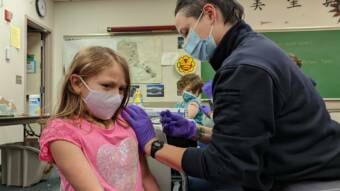
Sophie Griffith, 5, gets a kiss from her dad, Scott Griffith, after getting her COVID-19 vaccine during a pediatric clinic on Thursday, at Riverbend Elementary School in Juneau. (Photo by Rashah McChesney/KTOO)

Hundreds of young kids in Juneau are getting vaccinated for COVID-19 this week at clinics put on by local health officials.

A lot of kids barely notice the jab. For others, it’s really scary, but they have advice for anyone else who’s nervous about getting a shot.


At Dzantik’i Heeni Middle School, nurse Aisha Hill tells third grader Nehir Caf to take a big, deep breath. She gives her a quick poke with a needle to give her the vaccine.

“And let it out. All done,” Hill said.

It hardly registers on Nehir’s face. Mom and dad tell her good job.

Nehir Caf gets COVID-19 vaccine shot
Erin Felke-Caf comforts her daughter, Nehir Caf, as nurse Aisha Hill gives her a COVID-19 vaccine shot at Dzantik’i Heeni Middle School on Nov. 9, 2021 in Juneau. Nehir said it felt like her little sister pinching her. (Photo by Jeremy Hsieh/KTOO)

“That hurted like my sister pinching me, a little,” Nehir said. “I could get thousands of those in one day!”

She said she’s happy she got it.

“Because if everybody gets it, and then we might not have to wear masks in school,” she said.

She said COVID is like the villain from Harry Potter.

“I don’t know why, but COVID reminds me of Voldemort,” Nehir said.

Her little sister Feray goes next. No problem.

Giuli Russell had a tougher appointment. She was really quiet, right up until the needle was ready. Then she started whimpering.

“I don’t wanna get it!” she said between alarmed breaths.

Giuli holds onto her mom’s hand, who’s pouring praise on her. A volunteer nurse keeps Giuli’s exposed arm still. Giuli bawls through the shot.

“You did amazing!” her mom said. “Come here, monkey butt. Oh, you did awesome.”

Carolina Russell and Giuli Russell at COVID-19 vaccine clinic 2021 11 09
Carolina Russell takes a selfie with her daughter, Giuli Russell, as volunteer nurse Sue Webb looks on during a youth COVID-19 vaccine clinic at Mendenhall River Community School on Nov. 9, 2021, in Juneau. (Photo by Jeremy Hsieh/KTOO)

Mom gives her a big hug. Her next shot for the flu goes about the same.

A few minutes later, Giuli’s eyes are dry, and she said she feels good.

She and her mom hang out in the gym of Mendenhall River Community School, just in case there’s a bad reaction. For the other kids that need to get shots, Giuli said, “Be brave.”

Giuli’s mom, Carolina Russell, promises her some treats, too.

“Uh, I did say McDonald’s and froyo after,” she said. “And then we found out she gets to go to Coppa this weekend, so she’s got a pretty good deal out of this one. But I said, ‘If you’re gonna do that, you’ve got to get a flu shot, too.’ So pretty good negotiation, right?”

Giuli’s not so sure.

Coppa is offering a free scoop of ice cream to young kids with their vaccine cards.

Icee Delgado, 9, gets a flu shot after getting her COVID-19 vaccine on Thursday, at Riverbend Elementary School in Juneau. (Photo by Rashah McChesney/KTOO)

Carolina is eager to get her daughter vaccinated. Her parents live in Sweden, and she said the family had to cancel two trips to see them because of the pandemic.

“I’m trying to get to some sort of normalcy, as much as possible,” Carolina said. “So, I mean, that is one of many things, of course, but I feel like it’s important to be part of the solution in whatever way we can.”

Trey Powers is in sixth grade. He’s a few minutes away from getting his shot, and he’s nervous and upset.

“I didn’t have a choice! They forced me to get a shot,” he said. “They wouldn’t let me not get it.”

His parents walk him through some downsides of not getting the shot.

“What reasons do you not want to get a shot?” his dad asks.

He’s oozing with petulance. “Uh, I’ve done well without getting COVID for two years!”

Then mom: “And why is that?”

“Because I’ve been wearing a mask,” Trey said.

“And, staying at home all the time,” dad adds.

“That and –”

“– Not doing a lot of stuff because you’re not vaccinated?” dad continues.

Trey’s a little deflated. “Technically it’s only been a year,” he grumbles.

Once he’s in the hot seat, he asks to see the needle.

Geo Abad, 10 and his sister Bea Abad, 9, wait around in the gym at Riverbend Elementary School after getting their COVID-19 vaccines on Thursday, in Juneau. (Photo by Rashah McChesney/KTOO)

Nurse Aisha Hill shows him. “See how small that is? … So that’s what we’re going to put in, it’s .2 milliliters, so it’s that much fluid in there. OK?”

“OK. I’m like, gonna get a spot ready to pinch, so I can not deal with that,” he said, eyeing the needle.

And that’s his suggestion for other kids: Distract yourself with a pinch somewhere else.

A moment later, it’s over. Trey’s protests shift to how soon he can get free ice cream.

Nurse Aisha Hill talks with Trey Powers about the COVID-19 vaccine
Nurse Aisha Hill answers questions for Trey Powers about the COVID-19 vaccine he’s about to get at a clinic at Dzantik’i Heeni Middle School in Juneau on Nov. 9, 2021. Powers said he pinched himself as he got the shot to distract himself from the sting. (Photo by Jeremy Hsieh/KTOO)

Through Tuesday’s clinics, about 450 young children in Juneau got their first dose of the Pfizer vaccine. So far, none have had a bad reaction. At least, not in the medical sense.

These clinics are a big step for the school system.

“We have seen the highest percentage of our cases in schools being our elementary, unvaccinated population,” Superintendent Bridget Weiss told the Juneau Board of Education on Tuesday.

Among all school system employees, Weiss said at least 93% are vaccinated.

Appointments are still available for upcoming free, youth vaccine clinics in Juneau. You can sign up at Juneau.org/vaccine or by calling 907-586-6000.

Vigil held for Juneau man who has been missing for a month

Barbara Charles shares memories of her grandson, Doug Farnsworth, during a vigil for him on Wednesday, Oct. 27, 2021, at Overstreet Park in Juneau, Alaska. Farnsworth has been missing for a month. (Rashah McChesney/KTOO)

Nearly 50 people crowded into a shelter at Overstreet Park at a candlelight vigil for missing Juneau man Doug Farnsworth. Dozens more watched livestreams and left hundreds of comments.

Despite the darkness, rain and biting wind, they spent more than an hour talking about their memories of loving and being loved by Farnsworth. He was last seen more than a month ago walking on a trail near downtown.

No one said it explicitly, but the knowing laughter and the memories people shared with his grandmother on Wednesday evening made it clear that Doug Farnsworth knew how to have a good time.

“I had a lot of crazy times with your grandson,” said one woman who didn’t identify herself. “I won’t say what I did with him — with our friends — but I really appreciate you sharing him with us, cause he was a light.”

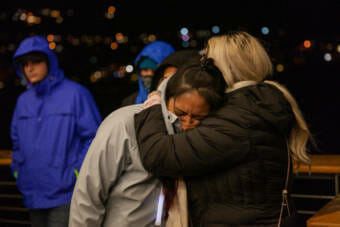
Jayme Donahue cries during a vigil for her friend Doug Farnsworth on Oct. 27, 2021, in Juneau. Farnsworth disappeared in late September and has been missing for a month. (Rashah McChesney/KTOO)

Jayme Donahue said it was deeper than just good times.

“You know, I just — I didn’t have like the picture-perfect upbringing, and I was always running from my home,” she said. “His home was always open to me, and he had this kind spirit that I just clung too.”

Donahue said the process of physically searching for his body has been really emotional for her. She said she searched the beach front along Overstreet Park where the group stood overlooking Gastineau Channel. She wiped away tears several times as she asked people at the vigil to remember to reach out to each other. To push past discomfort and social norms and connect with others.

“I just really encourage people to judge less and feel more and be there for those they love,” she said.

She said she didn’t always do that for Doug when he reached out to her, even though they’ve been friends since middle school.

“I would give anything to go back,” she said. “I don’t have our messages, I don’t have our pictures … I’m really ashamed of that, and I’m really broken-hearted over that. I just encourage everybody to not hold back. Tell people you love them, tell people how much they mean to you, how special they are to you. I would give anything to tell Doug how special he is to me. I would give anything to tell him all of the things I love about him, and I can’t.”

About 50 people showed up to a vigil for Juneau man Doug Farnsworth on Oct. 27, 2021, in Juneau. He has been missing for a month. (Rashah McChesney/KTOO)

Farnsworth is a 32-year-old Juneau man whose family reported him missing on Sept. 29. His older sister, Kiersten Farnsworth, says she and other family members believe he is dead. They’re offering a $5,000 reward for anyone who helps them find his body.

Kiersten Farnsworth lives in Arizona and flew up to Juneau to look for him. She has since had to go home. But she has been very active on social media, organizing search efforts and checking in with police and Alaska State Troopers with whatever information she can find. Juneau Police said Thursday that it’s an active case and they’re following up on leads, but they don’t have any updates.

Even though she’s thousands of miles away, she organized the candlelight vigil for her brother. Then she lit a candle of her own and watched from afar, commenting online as each person spoke about him. She said she doesn’t want people to forget that he’s still missing.

Dozens of residents attended a vigil for Juneau man Doug Farnsworth on Oct. 27, 2021, in Juneau. (Rashah McChesney/KTOO)

Barbara Charles, Farnsworth’s grandmother, thanked everyone for coming out and continuing to search for her grandson. She said she misses him running into her home, wrapping his arms around her and telling her she is the most beautiful woman in the world.

Juneau family members carried a large wooden cross and photos to put in the center of the group. They tried to light candles, but the wind didn’t cooperate. Someone else passed around glow sticks for people to hold. There were a lot of hugs and inside jokes.

A woman livestreams a vigil for Juneau man Doug Farnsworth on Oct. 27, 2021, in Juneau. (Rashah McChesney/KTOO)

It’s tricky to piece together exactly where Doug Farnsworth went the night he vanished, but Kiersten Farnsworth has footage of a truck he was driving on Basin Road at around 4:30 a.m. Then someone sent her a screenshot of him walking down the nearby Flume Trail at nearly 7 a.m. She asked that anyone who lives in that area check their game cameras and surveillance videos from Sept. 29 to try and spot him.

Volunteers are trying to organize a group search of the Basin Road area in a Facebook Group called Help Find Doug.

The Farnsworths are Lingít, and they have a lot of extended family in town. As the vigil wound down, one woman stepped forward to tell the crowd that there is no goodbye in the language, only the parting phrase “I will see you again.”

“So tsu yei ikḵwasatéen tsá tsú — until we meet again. That’s how deep that word and phrase is,” she said.

Correction: A previous version of this story misnamed the bridge the crowd gathered near for the vigil, it is the Douglas Bridge. 


Can Indigenous subsistence rights still be protected in Alaska?

A woman in the bow of a boat on the water with green cliffs in the background
(Photo courtesy of Haliehana Stepetin, 2021)

Rosita Worl unexpectedly grew teary eyed as she looked at the coho salmon a younger family member had brought her.

The silver fish was a sight she was used to, but one she had learned wasn’t always guaranteed.

“I just cried that our traditions were still viable, and that he was able to still bring food to me as an elder,” she said.

Worl, Tlingit, was born in Petersburg, Alaska, during the 1930s. She was brought up in a subsistence lifestyle, living off the land in Southeast Alaska as her ancestors had. As she grew older, the ceremonies, traditions, and community need for subsistence stayed constant, but the laws surrounding it changed.

She recalled the first time she realized this, as if it were yesterday. She was fishing with other kids from her village as they always did, when state officials suddenly told them that the familiar process was illegal.

“We didn’t know that it was against the law. They confiscated the fish and we couldn’t believe it. We kept saying, ‘what value is it to you to take that fish away and not return it?’ Whereas to us it meant winter food,’” she said.

Decades after this incident, similar legal disputes over subsistence are still occurring. The Alaska Native Claims Settlement Act was intended to protect this Indigenous community right, but the matter did not end up being resolved. As the 50th anniversary of the landmark legislation approaches, the question still remains: what can be done to protect subsistence rights today?

‘An unsettled and unsettling landscape’

(Illustration by Holly Mititquq Nordlum of Naniq Design)

While Indigenous land claims were being settled during ANCSA, many Alaska Natives fought to include subsistence rights in the final bill. The pairing appeared natural. After all, the legislation addressed traditional lands, which seemed inseparable from the hunting and fishing that accompanied them.

However, outright subsistence protections were left out of the final legislation, due to disagreements and a pressured timeline to develop oil. Instead, ANCSA ended up extinguishing all aboriginal hunting and fishing rights as part of the settlement. Congressional intent was for the Secretary of Interior and state of Alaska to “take any action necessary to protect the subsistence needs of the Natives.” Many believed this would be sufficient, but it soon became apparent that more concrete protections were needed.

The omission is viewed as one of the largest unintended consequences and unresolved portions of ANCSA.

“I think the ongoing, unsettled nature of subsistence has caused people to take pause; to see and ask themselves whether that part of ANCSA was a shortcoming,” said Margie Brown, Yup’ik, in an interview with University of Alaska Anchorage.

Subsistence fishing in the past. (Photo courtesy of University of Alaska, Fairbanks).

Around 10 years later, there was a second chance to protect subsistence with the passage of the Alaska National Interest Lands Conservation Act (ANILCA). While ANCSA determined the future of Native lands, ANILCA designated what would happen to the rest of state. Through the act, approximately 222 million acres of Alaskan land were put into conservation units such as parks, preserves, wildlife refuges, and national monuments. The decision meant that around 60% of the state was under federal control, making it the highest acreage of federal land ownership in the country by a long shot. Even states known for their national parks hardly compare — Alaska’s federal land is more than that of California, Oregon, Washington, Montana, Wyoming, and Idaho combined.

This time, subsistence was explicitly addressed. ANILCA protected the customary and traditional uses of fish and wildlife for food and other noncommercial use, and made subsistence the priority use on federal lands, above sport or commercial fishing and hunting.

But there was a catch. ANILCA designated subsistence to be a priority for rural residents, not Alaska Natives. Under this law, urban residents could still practice subsistence, they just wouldn’t receive priority status during times of shortage. The rural distinction was a compromise meant to protect Native subsistence, while not discriminating on the basis of ethnicity —something that several influential non-Native groups in the state opposed.

The state of Alaska set out to replicate this policy on non-federal lands, but urban hunters and fishers who considered it unfair were determined to fight it. After a few years of legal disputes, the Alaska Supreme Court ruled in their favor, deeming the rural distinction unconstitutional. The decision meant that any Alaskan resident could practice subsistence on state lands, if the state approved subsistence use in the area for that season.

An elder hangs salmon during the 1950s. (Photo courtesy of University of Alaska, Fairbanks).

Today, this dynamic has resulted in a vague and often-clashing dual system. The federal government regulates subsistence on the 60% of Alaskan land under federal control, while the state regulates subsistence on the 30%of Alaska which is under state management, the 10% which is privately owned, and navigable waters.

“You’ve got three different land jurisdictions in Alaska: you’ve got the state lands, you’ve got the federal lands, and then there’s this 40 million acres of Native lands,” said John Sky Starkey, Cheyenne River Lakota Tribe, a lawyer who has spent decades representing Alaska Native organizations in subsistence cases.

Since ANILCA passed, there have been several lawsuits between the state and federal government that have put this system to the test.

“Although the laws can potentially provide protection, the implementation of the laws is greatly lacking. And the legal meaning of the laws is also still in flux,” he explained. “In both the federal and the state regulatory regimes, Alaskan Natives have really very little say in what the regulations are going to dictate and the restrictions that they’re going to cause.”

Subsistence, a practice which past generations participated in without question, had now become a complex legal puzzle.

“It’s a very unsettled and unsettling [legal landscape] for Alaska Native people,” Starkey said.

‘An embodied way of life’

“We don’t think about subsistence as merely a quantifiable event. Subsistence is a whole structure, it’s a way of life,” explained Haliehana Alaĝum Ayagaa Stepetin, Unangax̂. Stepetin grew up subsistence fishing and hunting in her homelands on the Aleutian Islands. Today, subsistence is part of everything she does: her PhD research in Native American studies at the University of California Davis, her teachings at the Alaska Native Studies program at the University of Alaska Anchorage, and her performance and choreography of traditional Unangax̂ dance.

“It’s an embodied knowledge, an embodied way of life. And when we dance about these activities, we’re extending that process of subsistence,” she said.

Haliehana Alaĝum Ayagaa Stepetin, Unangax̂( Photo courtesy of Haliehana Stepetin, 2021)

From the Athabascans in the interior to the Inupiaq in the Arctic, this sentiment is consistently echoed. The practice itself looks different across the varying Alaska Native regions. Some communities hunt seals and whales along icy coasts, others fish for salmon during the long days of the midnight sun. The ceremonies might vary, and the passed down stories might differ. But despite these contrasts, all tribes have one aspect in common: subsistence means more than just food security, it also has greater cultural significance.

“Subsistence is absolutely critical to our survival. Without it, we don’t exist out here,” said Steve Ivanoff, Inupiaq, a subsistence hunter and fisherman from Unalakleet, a village of about 600 people in Western Alaska. For him, subsistence meant the community gathering and sharing of food from nature.

It can be difficult for those who aren’t familiar with subsistence to fully understand this concept.

“A major issue is that the general public, overall, does not understand the full significance of subsistence hunting as one, our basic food security, and then also the cultural dimensions of it,” explained Worl, who has a PhD in Anthropology and a renowned career in subsistence research and advocacy. She currently works as the president of Sealaska Heritage Institute and spent years on the Alaska Federation of Natives’ subsistence committee.

Worl believes some of the disconnect stems from antiquated views of Indigenous people, in which others expect them to be solely traditional, rather than the reality of modern people living in current times, who also practice their traditions.

“These spiritual things, they’re important to our cultural survival. And I don’t know that people realize that, because they see us driving cars and dressed up in modern clothes,” she said.

Stepetin also encountered misunderstandings surrounding subsistence, both as a teacher and a student.

In her PhD program, she found that the term “subsistence” was often corrected to “sustenance,” and that people viewed it in the same light as agriculture.

Past walrus hunting practices. (Photo courtesy of University of Alaska, Fairbanks).

“It’s always surprising to me that people don’t know what subsistence is, which is really just living a balanced and sustainable lifestyle with your local ecosystem, and stewarding that ecosystem for returns to come for generations in the future,” she said.

As a teacher of Alaska Native studies, she tries to emphasize this point for students who might be unfamiliar with the tradition.

“All of our our pedagogy revolves around transfers of subsistence, which includes sharing, storytelling, dance, song, and eating together,” she said. “It permeates into every single part of an Alaskan Native existence. So I try to make it clear in my curriculum.”

She starts by encouraging her students to think beyond what’s represented in mainstream culture, which can be a challenging exercise for anyone.

“It takes a lot of introspection to even be able to understand that there’s a whole other way of living and thinking and being in the world that exists,” she said. “So really, it’s a philosophical question of, “Can I get these students to think in a different way?’ And to think critically and to think deeper about the ways that people have adapted to living in place over time.”

For many Alaska Natives, the highlight of subsistence is the generational bonding formed over passed down knowledge and shared experiences.

“It’s an important part of our wellness, our health, and our healing culture. It’s the very center of who I am as an Alaska Native person,” said Jody Potts, Han Gwitch’in Athabascan. “And it’s important for me to be raising my kids this way.”

Jody Potts on the Yukon River.(Photo courtesy of Jody Potts, 2021)

But in recent years, the legal landscape has made the crucial generational component more difficult to fulfill. Subsistence life is usually tied to the village one is from. In the summers, people travel to their fish camps — settlements near one’s village where people fish, oftentimes in the same location their ancestors had practiced subsistence. In the winter, they trap or hunt in areas located near their village as well.

Today, an increased number of Alaska Natives have moved away from their family’s village to urban areas, such as Anchorage, for employment or educational opportunities. However, many still have ties to their home village, and return for key community events, such as subsistence practices and celebrations.

Ice fishing subsistence practices of the past. (Photo courtesy of University of Alaska, Fairbanks).

“They want to continue to engage with their village and their kin and everybody around subsistence activities. They want to bring the kids up with that culture. And because of this rural priority, if they live somewhere other than in the village, then they’re cut out, which causes a great amount of consternation to people,” Starkey said.

If the federal government exercises its authority to close a river to subsistence fishing to anyone who’s not a qualified rural resident, that means their own family can’t come out to fish camp anymore, says Starkey. Because federal subsistence protections extend to rural residents, urban Alaska Natives aren’t included.

“It’s just becoming a real tool for assimilation,” he explained.

Even those who do qualify for the rural precedent can have their access removed. For example, in 2006, the Federal Subsistence Board terminated the Southeastern village Saxman’s rural status and grouped it in with the larger town Ketchikan. For 10 years, the small community of 400 worked to restore their subsistence access before it was finally granted.

It’s situations like this that reveal how the rural precedent can be unpredictable, and demonstrate why some Alaska Natives would favor a law that more directly protects their subsistence practices.

“This does not mean that non-Natives from Anchorage and Fairbanks can’t go out and take a moose or go fishing,” wrote Thomas Berger in his 1985 Report of the Alaska Native Review Commission. “What it does mean is that I believe Congress should entrench Native subsistence rights, so they cannot be placed in jeopardy by any future state action.”

The argument that Berger made almost 40 years in his report to the Inuit Circumpolar Conference is still being debated today.

Basic rights, different wavelengths

In theory, the current legal setup is designed to provide equal hunting and fishing opportunities for all Alaskans. But some argue this approach doesn’t account for pre-existing societal inequities.

Most Alaska Native villages are located in highly remote areas, disconnected from roads and far from other communities. Food must be shipped in by plane or boat, and the unconventional transportation route can cause prices to skyrocket. Expensive airfare and unpredictable weather conditions can make grocery deliveries unreliable.

“There is currently this notion that all Alaskans, regardless of whether or not they’re living a subsistence way of life, are subsistence users. And if everyone is, then it dilutes the so called priority for real subsistence users. If everybody is a subsistence user then what does priority mean?” Starkey said, referring to the state’s subsistence laws.

Worl sees cases of these inequities all the time. For example, during the pandemic, transportation to the village of Kake was interrupted, meaning the coastal town was unable to get a steady supply of commercial goods during the health crisis. In light of the urgent situation, the village applied for an emergency subsistence use permit. The request was initially denied, briefly approved, then stalled by a lawsuit from the state government.

“It just seemed like it should be a basic right. But we must be on different wavelengths than other people,” she said.

Cutting the salmon at fish camp on the Yukon River in Alaska.(Photo by Meghan Sullivan, Indian Country Today)

To make matters worse, it occurred at a time when the health qualities of subsistence food were especially sought after.

“There was this great concern for elders who were more susceptible to getting COVID,” she said. “And the community really wanted them to be able to have this healing food.”

The case demonstrated how Alaska Native subsistence rights can often become tangled in legal conflicts focused on state vs federal power. Matthew Newman, an attorney for the Native American Rights Fund, says they should be two separate issues.

“Unfortunately, the board’s effort here has been attacked as part of a much different battle between the federal government and the state of Alaska about who gets to control fish and game management,” said Newman said in an interview with High Country News.

For those worried that an increase in subsistence practices could lead to a strain on natural resources, data says otherwise. Subsistence users take just 1% of the fish and game harvested in Alaska, according to the Department of Fish and Game, with the vast majority going to commercial fishers and hunters instead.

A worsening situation

The Alaska Native subsistence debate has been occurring for years. But the stakes are even higher in recent times, when a changing climate has altered everything from salmon runs and hunting seasons, to migration patterns and berry growth.

“There are so many threats to our subsistence and our traditional ways of life, be it climate change, be it laws, [other] hunters, and the stress on the resource,” explained Potts.

Many subsistence based communities have been impacted by this first hand. For example, the Yukon River has seen two consecutive years of record breaking low salmon runs, consistent with a decade of downward trends. Around 40 communities in the area rely on subsistence fishing. The situation was so dire that emergency shipments of salmon and other food had to be flown out to particularly afflicted regions.

This dismal data isn’t surprising news to subsistence users. Many have been seeing warning signs for years. Stepetin described how her dad taught her to observe the signs in the land, and note the interconnected nature of the wildlife that surrounded them. This knowledge was based on thousands of years of passed down insights. For instance, when there wasn’t enough snowfall, there would likely be a shortage of berries.

“We’re already Indigenous scientists and already know this. We don’t need outside sources to tell us what’s going on. We can tell them that we’re witnessing and experiencing a changing climate and returns of salmon and the different fish,” she said.

The value of traditional knowledge was apparent to outside perspectives as well. Through his legal work on subsistence, Starkey has witnessed countless times where Indigenous customs predicted food shortages, or traditional management prevented overfishing.

A fish camp in the past. (Photo courtesy of University of Alaska, Fairbanks)
A fish camp today (Photo by Meghan Sullivan, Indian Country Today)

He views this as another reason Alaska Natives should have an increased role in subsistence management.

“It’s not just for the sake of Alaska Native people, that Alaska Natives need to be much more meaningfully engaged in land management. It would benefit everyone,” he said.

50 years later, an ANCSA amendment?

From the very start of the legislative process, it was evident that many expected ANCSA lands to be tied to Indigenous subsistence. When ANCSA first passed and the various Alaska Native corporations began choosing the lands they would own, some corporations, such as Ahtna, specifically selected areas that were best for subsistence, says Starkey. Thousands of years of knowledge went into the decision. Decades later, Ahtna has had to consistently fight for hunting and fishing rights on their own lands.

“In one lifetime, we went from being the only inhabitants of our region to co-managing the resources of our homeland alongside state and federal actors,” said Ahtna chairman Ken Johns, Udzisyu Caribou clan, in an essay for the Anchorage Daily News.

It’s another example of the unsettled dynamic between subsistence and ANCSA. But there are still possibilities for change down the line.

“I think that there needs to be amendments made to the Alaska Native Claims Settlement Act that reinstates our Aboriginal hunting and fishing rights,” Potts said.

There are a few potential solutions. One change would be to enable Alaska Natives to manage and harvest ANCSA lands, as they initially believed they would be able to.

This could be accomplished through an amendment to ANCSA legislation. Many in the community, like Potts, believe this is a good compromise: if Alaska Natives aren’t legally given priority to subsistence hunt and fish on all Alaskan land, then they should at least be able to receive priority on their own lands.

Unfortunately, the amendment process would likely be extremely expensive. Already, Alaska Native subsistence advocacy has cost millions of dollars, says Worl. Furthermore, many of the Alaska Native organizations that could lead the process already are inundated with other pressing legal matters.

“There is an estimate that we’ve spent around $20 million trying to protect subsistence, because it seems that every time we try to do something, we end up with a lawsuit. And it’s still ongoing,” Worl said.

This is where the Alaska Native corporations have been able to help: funding. Any legal battle would most likely be a sort of David and Goliath dynamic, where subsistence users would have to go against resource-heavy opponents such as the state and federal government, or special interest groups like sports hunters that receive outside funding from national sporting organizations. Many villages simply don’t have the resources to counter these larger groups. But the Alaska Native corporations, which have more assets and organizing capacity, might be able to provide more assistance.

Subsistence hunting in the early 1900s. (Photo courtesy of University of Alaska, Fairbanks)

Another option would be to amend ANILCA, so that Alaska Natives have priority to subsistence hunt and fish on federal lands in addition to rural residents. This would also likely be a lengthy and expensive process.

The third option is to implement a co-management solution, which would enable Alaska Natives to have greater influence over state and federal subsistence laws.

“In both the federal and the state regulatory regimes, Alaskan Natives have very little say in what the regulations are going to dictate and the restrictions that they’re going to cause,” Starkey said. “They’re left out of control of one of the most important aspects of their way of being. And that’s just wrong. It’s been a huge problem from the beginning.”

As it currently stands, there are three Alaska Native representatives on the federal subsistence advisory board, and one representative from the BIA. However, these voices are often outvoted by the 5 other representatives that don’t have ties to Alaska Native communities. The setup can cause critical subsistence decisions to depend solely on the current administration.

“If your way of life depends on who’s in office every four years, either as a governor or president, what kind of security do you feel about that?” asked Starkey.

Worl also saw a need for a more concrete co-management policy.

“We’ve been pushing and pushing for increased co-management. I know some regions have more success with co-management, but it should be addressed on a statewide level,”’ she said.

Tribes fishing in the Pacific Northwest, where some states have adopted co-management approaches.(Photo courtesy of Linda Tanner, 2018)

This strategy has worked in other locations. In Washington, salmon and steelhead fisheries are managed cooperatively by Western Washington tribes and the Washington state government. The arrangement involves an annual agreement on salmon fishing seasons and on hatchery production objectives in Puget Sound and the Washington coast.

While the region still experiences the type of salmon population challenges that are becoming increasingly common today, the co-management approach has seen positive results overall.

“I don’t know of a better working relationship between a tribe and a state agency,” Scott Chitwood, Jamestown S’Klallam Tribe’s natural resources director, told the Northwest Indian Fisheries Commission in 2007. “By working well together, we’ve been able to make real progress toward recovering Dungeness chinook.”

Even sports fishers who had initially been against a co-management relationship eventually saw the value of Indigenous-led fishing policies.

“I had a lot of sports fishermen come directly up to me. And they put out their hand and they said, ‘Would you please tell the Yakama Nation thank you? Because we know if it wasn’t for their tribe, there’d still be no fish in that river,’” recalled Carol Craig, Yakama, in a 2016 NMAI interview.

As the Alaska Federation of Natives rolls around this year, Worl and others will be including a resolution to amend ANCSA to protect subsistence rights. Considering the cost it would take to change the law, coupled with the many other advocacy campaigns Alaska Native organizations are already handling, she isn’t optimistic that it will pass. But giving up doesn’t seem like an option, either. She’s hoping that increased emphasis on social and environmental justice might just make a difference this year.

“I was thinking this would be the perfect time to try to pursue it when people are looking at social justice and social equity. But again, it takes money to be able to push these things through Congress. So I just don’t know what it’ll take to move it past a stalemate,” she said.

Until then, Indigenous Alaskan communities will continue passing on their traditions despite legal barriers, just as they have done for centuries.

“It’s a sustainable way of life,” Stepetin said. “And we will keep it alive as long as communities with this knowledge continue to transmit it to the next generation, and keep these stories and lessons of subsistence alive within us.”

This story is part of a joint project between Indian Country Today, Alaska Public Media, and Anchorage Daily News on the 50th anniversary of the landmark Alaska Native Claims Settlement Act. Funding for ICT’s ANCSA project is provided in part by the Alaska Center for Excellence in Journalism and the Solutions Journalism Network. Stay updated on ICT’s ANCSA project using #ANCSA50 at https://indiancountrytoday.com/tag/ancsa-50.

Despite higher COVID risk, most pregnant Americans remain unvaccinated

Scott Baisley holds his son Sullivan, who was delivered shortly before his mother died of COVID-19. (Victoria Hansen/South Carolina Public Radio)

Kimberly Grice needed a walker during her final month of pregnancy just to get down the hall of her home near Myrtle Beach, S.C., to a freshly painted, lavender nursery.

The 36-year-old struggled to hang up tiny clothes or organize a changing table. She’d been hospitalized this summer with COVID-19 and on a ventilator.

She did not get the vaccine fearing it might hurt the baby. Doctors now want pregnant women to know it is safe.

In September, the Centers for Disease Control and Prevention urged expecting mothers to get vaccinated warning complications from COVID can be deadly for both mother and baby. Still, two-thirds of pregnant women have not.

The Grices and another South Carolina family are sharing their stories of pregnancies unvaccinated in hopes of changing minds.

Kimberly was rushed to a crowded emergency room in late July where a six hour wait revealed she had COVID pneumonia. Her husband Tory shares the rest of the journey she can’t remember including the question doctor repeatedly asked in case of complications. Whose life should they save first if something goes wrong, Kimberly’s or the baby’s?

“What you want to say is like, both of them. But that can’t be the answer,” says Tory.

Kimberly’s liver appeared to be failing when doctors considered an emergency C-section after taking her off a ventilator. But then her health improved, and they decided not to deliver the baby nine weeks early.

“You’re a miracle”

When Kimberly came to, it was nearly September and she was confused. How did she wind up in a Charleston hospital and who were the doctors and nurses now in her room?

“They’re like, I just need to see you. They’re like, you were sick. You’re a miracle,” says Kimberly.

Her body was worn out. But on Oct. 22, Kimberly gave birth to Leilani Grice, a healthy baby girl weighing 7 lbs. 2 ounces.

Kimberly and Tory Grice’s daughter Leilani was born healthy after her mother was hospitalized for COVID. (Victoria Hansen/South Carolina Public Radio)

“The risk of putting your life at risk, your unborn child’s life at risk, is not worth it,” says Dr. Rebecca Wineland. She is the director of labor and delivery at the Medical University of South Carolina in Charleston.

Wineland says expecting mothers infected with the fast spreading Delta variant are at a greater risk for stillbirths, babies with restricted growth and pre-eclampsia, a leading cause of maternal and infant death worldwide.

She is also seeing first-hand what the CDC warns, expecting mothers who get COVID are twice as likely to be admitted to the ICU and have a 70% increased risk of losing their lives.

“It will absolutely save your life and decrease your risk of hospitalization if you were to get COVID,” Wineland says.

But the message came too late for Scott Baisley and his two-month-old son Sullivan, who live just outside Charleston.

Scott cradles the crying infant trying to comfort him. An empty bottle sits next to a framed ultrasound picture and wedding photo displayed on a table beside them.

Scott’s wife Clair was 33 years old when she collapsed on the floor of their home in August, within days of being diagnosed with COVID. She was quickly hospitalized with double pneumonia.

A week later, doctors decided they had to deliver Sullivan by C-section. Clair was put on a ventilator and given a 10% chance to live. Less than a month after her diagnosis, doctors were desperately trying to save her.

“But that was it. I watched her numbers drop. I watched her blood oxygen continue to go down. I watched her heart rate increase,” Scott says.

Suddenly Clair was gone. COVID had taken her life. She never got to hold Sullivan.

“Having a son without a mother is one of the most painful things I’ve ever had to experience.”

It’s a pain Scott doesn’t want anyone else to have to endure.

Copyright 2021 South Carolina Public Radio. To see more, visit South Carolina Public Radio.

Site notifications
Update notification options
Subscribe to notifications