Family

Alaska scrambles to spend nearly $100M in federal child care relief as centers close

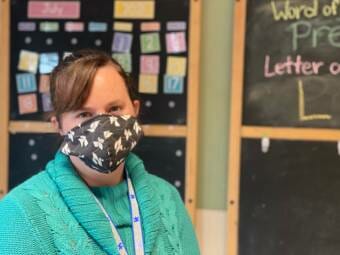
Amanda Gornik runs Gold Creek Child Development Center in downtown Juneau. She says she needs more government aid to make up for pandemic losses. (Claire Stremple/KTOO)

The first round of checks are in the mail to help child care centers across Alaska. They represent just 5% of the nearly $100 million in federal COVID relief funding the state has to stabilize its child care system. Meanwhile, care centers say they need more — and it can’t come fast enough.

Amanda Gornik is the director of Gold Creek Child Development Center, a preschool and daycare in downtown Juneau. The desks in an empty classroom come up to her shins. There can be up to 20 students in these little desks, but there are currently only six.

Gornik is running the center at under half capacity right now, at serious financial cost to the business. Just 29 students are enrolled in the whole center — and that’s despite huge demand.

“I have 125 kids on our waiting list,” she said. She has room for more students, but she doesn’t have the staff to support them, so she can’t offer up any spots.

Gornik is trying to hire more teachers. She’s offering a $1,000 signing bonus once they complete three months of work. She has 11 teachers and she would like about three more. But things are going the wrong direction. Two teachers have put in their notice since Gornik started as the center’s director two months ago.

“COVID is stressing our staff out. Because we don’t have as many here, they’re overworked. We have a lot of teachers doing overtime,” she said. “Stress sometimes isn’t worth it for them. And so they’re leaving. And it’s devastating to us all.”

COVID-19 is stressing a system that was already struggling. Nearly a fifth of the state’s licensed child care facilities have closed since March 2020, according to its Childcare Program Office.

Relief money is on the way. The state received about $95 million from the federal government this spring to address the child care crunch. It’s scrambling to figure out how best to distribute the money, while guidance from the feds trickles in. So far, the state has written a grant program to distribute only $5 million of that statewide.
“We are hearing that providers are concerned that there isn’t enough funding being distributed initially and that the timeline is taking too long,” said  Shawnda O’Brien, the director of the state’s Division of Public Assistance, the office responsible for distributing the funds to child care centers.

O’Brian’s staff is moving cautiously because the federal millions are a one-time payment. They want to make an impact that’s sustainable with a funding source that’s limited.

The typical budget to manage Alaska’s child care programs is about $28 million. Federal relief more than quadruples it.

So, even though she and her staff just got the windfall of their dreams, they say it’s a challenge to spend it right.

Meanwhile, care centers are hurting. Gornik’s Juneau preschool asked the state for $6,800 and is likely to get it. The state is awarding all requests up to $11,000 from qualifying centers. Gornik plans to spend it on bonuses for her current teachers and signing bonuses to attract new ones.

She says that money won’t go very far.

“We will take anything that we can get. And I’m blessed to use this to further our recruitment process,” Gornik said.

The state aims to have a plan for the remaining $90 million of federal funds by the end of the year. Applications for the next round of funding should be available between January and March.

Alaska is expecting COVID-19 vaccines for a wider group of kids in the coming weeks

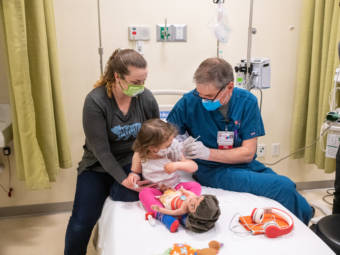
Eloise LaCour, 3, gets her COVID-19 vaccination as part of Phase 1 clinical trials on use of the Pfizer-BioNTech vaccine in children 5 and younger. Federal regulators could approve the Pfizer COVID vaccine for kids ages 5 to 11 in a few weeks. (Stanford Medicine)

Federal regulators could approve the Pfizer COVID-19 vaccine for kids ages 5-11 in a few weeks. And the Biden Administration announced Wednesday it will have enough shots for every eligible child in the country.
Meanwhile, the state of Alaska is working on a plan to make sure kids can get vaccinated as soon as possible. State of Alaska Immunization Program Manager Matthew Bobo joined Alaska Public Media’s Casey Grove to talk about those plans.

Listen here:

The following transcript has been lightly edited for clarity.

Matthew Bobo: So the timeline we’re looking at right now is, next week, October the 26th, the FDA’s advisory committee will meet to discuss this topic. If they make a recommendation to authorize the vaccine, then that will go to FDA for approval. Then the following week on November the 2nd and November the 3rd, CDC’s Advisory Committee on Immunization Practices will then vote to recommend vaccine for 5- through 11-year-olds. And then finally, the CDC will sign off on the recommendation, and then we’ll be able to vaccinate this age group.

Casey Grove: So how is Pfizer’s COVID vaccine for kids different from the version for adults?

Matthew Bobo: The pediatric vaccine will come in a different vial. And so we are working to get those doses distributed. And the pediatric formulation also has the same active ingredient as the adult formulation.

Casey Grove: Is the dose itself smaller for kids, though?

Matthew Bobo: The dose itself is smaller. Yes.

Casey Grove: Gotcha. Kids being smaller themselves, generally.

Matthew Bobo: Correct.

Casey Grove: Do we know at this point how many doses for kids the state’s going to receive? And when do we expect them? And I guess, you know, that’s related to this question of whether there will be limited access at first.

Matthew Bobo: So we learned about our doses that were allocated to the state of Alaska earlier this week. And we have received 33,000 doses. So that’s enough doses to vaccinate approximately 44% of Alaska’s 5- through 11-year-olds. And so we’re working with our health care providers to get them to order this vaccine, so when the CDC makes the authorization for the vaccine, it will be in providers’ offices and ready to go. And so that vaccine will be shipped to providers’ offices that first week in November.

Casey Grove: What’s the state’s plan for getting the vaccine for kids out to different communities?

Matthew Bobo: So when we first ordered this vaccine, it will come in an order set of a minimum order size of 300 doses. And so that’s a lot of doses for one individual provider. And so what we’ll do to get the vaccine throughout the system is, really, we’ll be breaking down those (shipments) into smaller quantities, and then shipping them across the state to make sure that these vaccines are in providers’ offices.

Casey Grove: And then I wonder about rural areas, what will access to this version of the vaccine look like for them?

Matthew Bobo: We’re working hand-in-hand with our tribal health organizations and our partners at tribal facilities. And so we will be able to send them vaccine, and a lot of these locations are also able to break down the doses and send them to smaller villages.

Casey Grove: So we know there are a lot of parents out there eagerly waiting to get a vaccine for their children. What can they do to prepare for that?

Matthew Bobo: So I think just be informed. We will be keeping our website up to date. And we’ll make sure that people are aware of events going on in communities. And so, just pay attention to the news. And then, once the vaccine is authorized by CDC, then make an appointment. And we encourage everyone to get vaccinated.

Casey Grove: How quickly do you think children in that age group can be vaccinated once it’s approved? And you know, is it going to take weeks to get it to everyone who wants the vaccine?

Matthew Bobo: So in that first week, we will have enough doses to vaccinate 44% of the population. But in that second week, we will get more vaccine and more allocation. So really it depends on what the demand is. We have enough supply, but it really depends on the demand. And for those parents who are eager to get the vaccine for their 5- through 11-year-olds, that vaccine will be available.

Casey Grove: Is it difficult to convince parents that might be skeptical to get their kids vaccinated?

Matthew Bobo: You know, I think there are a lot of questions. This is a new vaccine. This is a new disease. And I think people are trying to get the best information that they can to make a decision. And so I still think that’s happening, and so people are still on our vaccine ECHOs (videoconferences hosted by the state health department) asking questions and learning, and we want to provide them with the best information and the best information following the science.

Episcopal Diocese of Alaska to investigate the history of church-run boarding schools for Indigenous children

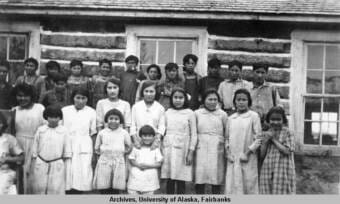
Boarding pupils of St. Mark’s Mission in Nenana in May 1924. It is from the Drane Family Collection, courtesy of the University of Alaska Fairbanks, APRCA (UAF-1991-46-782).

The Episcopal Diocese of Alaska says it will join a national effort to investigate the history of church-operated boarding schools for Indigenous children.

Episcopal Diocese of Alaska Bishop Mark Lattime said the action was prompted by the discovery this summer of unmarked graves where Indigenous children were buried at Canadian boarding schools run by churches.

“We recognize that it opened wounds that have been carried by so many of our Alaska Native brothers and sisters,” he said. “And the fact that the church was involved in this process is something that concerns us.”

The Episcopal Church was among those that ran boarding schools in Alaska and the Lower 48 in the 19th and 20th centuries.

Lattime said the Alaska church must look beyond its own account of history.

“The history that we’ve received is that those missions in schools were operated with care and respect for Indigenous culture and children. You know, we also have to recognize that history is written by one side of the story,” he said.

Lattime said the church in Alaska and nationally must “stand in the light of truth.”

“We might be able to say, ‘This wasn’t an issue in the Episcopal denomination.’ The fact is, if it happened in any church denomination, we, as a Christian body, I think are all responsible,” he said.

Lattime said the church is going through archival records and will work with Alaska Native organizations to hear from former boarding school students and their descendants.

The Episcopal Church hosted a national webinar on Indigenous’ Peoples Day about boarding schools, during which speakers described cultural genocide.

Pearl Chanar, who grew up in the Interior Athabascan village of Minto, recounted attending a boarding school hundreds of miles away.

“And what I remember most is that loneliness, missing my parents,” she said.

Pearl Chanar of Anchorage shares her story of attending a boarding school. (Episcopal News Service)

Chanar said she was denied expression of her culture.

“Not being able to speak my Native language, not being able to enjoy my traditional cultural activities such as my singing, dancing,” she said.

Chanar said she’s heard from other boarding school survivors who were abused. And she cautioned the Episcopal Church to be careful asking people about their experiences.

“That individual is going to tell you a story that happened 70 years ago,” she said. “It might have been traumatic for them. And if it was, then you’re asking them to repeat something that they’ve had buried for a very long time.”

Chanar noted that many boarding school survivors were subsequently lost to alcohol, drugs and suicide.

“And this is part of the truth of the Episcopal Church,” she said. “It’s a part of the history now. It’s not pleasant and it hurts.”

Chanar said the trauma experienced at boarding schools is passed to successive generations.

Bishop Lattime said the church is looking for Native guidance as it pursues “truth and reconciliation.”

“We need to be about listening and hearing and then following the lead of our Alaska Native people on the best way forward, and so really we’re just at the start of this process,” he said.

Lattime said Alaska Natives will be well represented in a state delegation which will attend a national Episcopal Church convention next summer in Baltimore, during which the boarding school issue will be a primary topic.

1 in 3 working families is struggling to find the child care they desperately need

Natalie Saldana would love to put her 1.5-year-old daughter in a quality child care program while she works and goes to school, but the $700 monthly price tag makes it impossible.

“Seven-hundred dollars is almost my rent,” Saldana said.

Saldana, 22, is a full-time student, single mom and health insurance agent in South Carolina. She’s one of the many parents struggling to find child care, even as many child care centers have reopened. According to a new poll conducted by NPR, the Robert Wood Johnson Foundation and the Harvard T.H. Chan School of Public Health, 34% of families with young children are facing serious problems finding child care when adults need to work.

The poll also found that in the last few months, 44% of households with children under age 18 have been facing serious financial problems. That figure jumps to 63% for Black families and 59% for Latino households.

As Congress continues to debate a spending package that would expand child care and provide universal pre-K, parents across the U.S. are struggling to find ways to pay for the child care they desperately need right now.

How a lack of child care is affecting families

Safe child care for young children is inherently expensive. Among other reasons, one caregiver can’t safely watch more than three or four infants or toddlers at a time. And the U.S. spends less public money on early childhood education and care than most other wealthy nations, according to the Organisation for Economic Co-operation and Development.

During the coronavirus pandemic, many existing child care centers had to shut down completely or reduce their enrollment numbers for safety reasons. As the economy has opened back up, child care centers, like a lot of businesses, are struggling to find workers. But many cannot provide the same employee incentives, like hiring bonuses, that bigger businesses can.

Joe Lopez, a father of three living in Sacramento, Calif., currently pays $1,000 a month to send his youngest to day care, but that high price tag doesn’t guarantee reliability. Coronavirus policies at the day care center mean that sometimes, after Lopez drops his son off in the morning, he has to turn around and pick his son right back up again.

“I wake up, log in to my computer to start work from home and then I randomly get a text from the day care that they’re shut down for two or three days,” Lopez said.

In NPR’s poll, 36% of adults in households with children say they experienced serious problems meeting both their work and family responsibilities in the past few months.

Saldana takes online classes in civil engineering and works from home. She said she’d rather work from an office and take in-person classes, but she needs to stay at home to watch her daughter.

“Hopefully I’ll be able to make enough money to pay for child care in the future,” Saldana said, as her daughter called for her in the background, “which would be so much better, because it’s hard when she wants me to do stuff with her or feed her while I’m working.”

While there are subsidized child care options in her area, Saldana is concerned about quality.

“I’ve seen facilities that teach children how to be self-sufficient, and I thought that was very nice,” Saldana said. “But then you look at the day cares for low-income families, and, yeah, there’s toys, but there’s no interactions with the child to facilitate mental growth.”

How the federal government could help

These child care struggles persist despite 73% of poll respondents with children reporting that they have received financial assistance from the government. Sasha Eugene, a mother of three living in Houston, has been heavily relying on the federal government’s expanded child tax credit after losing her job this month. But the money isn’t enough to cover the cost of a day care center or an after-school program for her children.

“[The child tax credit] either goes to them or my bills so that we can keep a roof over our head,” Eugene said. “That check is the only income I get.”

As part of his Build Back Better Agenda, President Biden has proposed expanding access to child care and providing universal pre-K. There’s no guarantee he’ll get those measures through, but Biden has made it clear that he wants expanded child care to remain a part of any bill the Senate passes.

“How can we compete in [the] world if millions of America’s parents, especially moms, can’t be part of the workforce because they can’t afford the cost of child care or elder care?” Biden said at an event on Friday.

Quality early education has lasting benefits, especially for children whose families are struggling economically. But without significant financial support, there isn’t a lot of hope that parents or their children will be able to reap these benefits.

“Anything would be better than balancing being a full-time mom, student and working,” Saldana said. “Except paying so much for child care that I’m struggling to pay my rent and bills.”

Copyright 2021 NPR. To see more, visit https://www.npr.org.

What’s the status of Juneau School District’s weekly employee testing requirement?

JSD Office
The Juneau School District has formally surveyed its employees on their vaccination status. Of the 600 or so who’ve responded, 92% are vaccinated. However, about 100 other staff members have yet to provide their information. (Photo by Bridget Dowd/ KTOO)

It’s been almost a month since Juneau’s school board voted to require Juneau School District employees to get weekly COVID-19 tests. The mandate was supposed to go into effect no later than Oct. 4. 

KTOO’s Bridget Dowd sat down with JSD Superintendent Bridget Weiss to get an update.

Read a transcript of the conversation with minor edits for clarity.

Bridget Dowd: Alright, so last time we talked, the district was gathering vaccine and exemption information to figure out how many employees would be required to test because only unvaccinated employees or those who hadn’t contracted COVID in the last 90 days are required to do it.

You were also working on expanding the number of testing sites you had available because in the past, the district had offered voluntary testing for staff members.

I know you had intended to start the required weekly testing by last week, so has it been officially implemented yet and if so, how is it going?

Bridget Weiss is the superintendent of the Juneau School District.
Bridget Weiss is the superintendent of the Juneau School District. (Photo courtesy of Bridget Weiss)

Bridget Weiss: So we started out at a couple of sites and then three sites and now we have testing five days a week. We have a morning session [and] an afternoon session and it’s spread out at 10 different sites. So we’ve increased the access to testing to make it as user-friendly as possible for our staff. 

The other thing that we have done is we had to survey our staff to determine vaccine status and we had not done that formally before. We still have some staff that haven’t done that yet. So this week, we’re hitting that real hard. 

We do have just shy of 600 employees who have completed the process to let us know their vaccination status. Of those people who have done that, 92% are vaccinated. We still have about 100 who haven’t completed the survey yet. 

Then the other way to opt-out of required weekly testing is if they’ve had COVID in the last 90 days. So we have some staff that have had COVID recently. So with all that said, up to this point, with 600 or so reporting, we have about 40 staff members who are going to be required to test and are required to test at this point.

Bridget Dowd: So for those 40, the requirement is already in place and they already have to do their weekly testing. But for those 100 or so employees who haven’t filled it out yet, are they being required to test until they provide their information or how does that work?

Bridget Weiss: Correct. That’s kind of what we’re getting at this week. We have to make sure that we’ve given everybody enough support in doing it. Then we’re going to reach out to their supervisors and have them check with them and really they have that choice: They can complete the survey, or test, or both, depending on their status, of course. But yes, if they haven’t completed the process, then we will be expecting them to test. 

How many of those 100 maybe don’t want to do it, or just didn’t get a chance to do it, didn’t have time, or didn’t know how to do it, I don’t know yet. Next week, I’ll know how much trouble we’re [having] getting the last little bit of that survey done.

Bridget Dowd:  Have you had anyone thus far, maybe of those 40 people, who have just decided they don’t want to share their vaccine status?

Bridget Weiss: I have had a couple people share that with me, you know, we’re a subset of our community. So every perspective that exists in our community is going to exist somewhere in our 700-person staff and we’re doing this as respectfully as possible. There is no judgment involved. There are many different reasons somebody might not be vaccinated. 

We are, right now, keeping our testing sites open for people who voluntarily want to test, who are vaccinated but still want to test. We’re going to keep that going as much as we can, depending on capacity once we get to the end of this whole survey piece. 

So when people go to our sites to test, nobody knows whether they’re vaccinated or not. We think that’s pretty supportive to people in not feeling pointed out or judged. 

Bridget Dowd:  Shifting gears a little bit, obviously, there’s been some talk recently about moving forward with COVID-19 vaccines for children five and up. Does the district have a plan in place for when COVID-19 shots are available to that age group, as far as setting up vaccine clinics for them?

Bridget Weiss: Yeah, we’re so excited by that news and we are working closely with CBJ and Juneau Public Health. We’ve done this all along, at every stage of the vaccine, we have planned in advance and been ready and prepared. As soon as the vaccine was available and the approval was there, we were ready to launch opportunities. So we’re doing that again. 

Because these are littler ones, we want to be very conscientious about parent involvement and opportunity. So we’re looking at how we can do these a little bit differently than we’ve done before. So that we are most supportive of families being with their kids and where we might do that. We’re still in the planning stages. It looks like this vaccine is a little bit different [of a] dose than the adult dose. So I don’t know if that’s going to slow things up at all once they get approval, if we’ll have to wait for certain doses to show up, but we’ve got it down so that we really know what works well and what doesn’t. So we’re going to be ready to make that opportunity available at the very first chance we can.

Bridget Dowd:  The last time we spoke you also mentioned that you were working on a plan to increase testing among students. Do you have any more information on that yet?

Bridget Weiss: We are still designing and looking. We want to focus on our elementary students because that is where we are seeing the most COVID, for good reason. They’re our unvaccinated population and because they’re unvaccinated, we’re having to quarantine a lot of students. 

So we’re just looking at those combinations of things and how we can be most strategic at elementary, again, with parent permission. Any way we can use that as well as some other strategies, increased screening as an example, to start reducing those quarantine numbers. So that’s kind of where our heads are at right now in the planning, but I’m hoping by next Tuesday, I’ll have a more distinct plan to share.

Alaska Supreme Court decision gives joint custody to non-biological mom in same-sex couple that split

This massive seal of the state of Alaska hangs on April 19, 2018, behind the dais where Alaska Supreme Court justices hear cases in the Boney Courthouse in Anchorage.
The seal of the state of Alaska hangs behind the dais where Alaska Supreme Court justices hear cases in the Boney Courthouse in Anchorage. (Jeremy Hsieh/KTOO)

Two Alaska women will share custody of their son after the biological mother lost her court fight for sole custody, according to a state Supreme Court decision published Friday.

The decision is the first of its kind in Alaska involving a same-sex couple. It relies on legal precedent from similar child custody battles between men and women where the non-biological parent is deemed a “psychological parent” and retains custody.

Susan Orlansky, the attorney representing the winning plaintiff in the case, says the justices agreed with her that the existing precedent on who should be considered a psychological parent also applies to non-biological parents in same-sex couples.

“Like my client, who’s not the biological parent but who has functioned for many years as a day-to-day parent, has a way of going into court and relying on well-established law in this state to have a claim to continue custody of the child once the parents split,” Orlansky said.

According to the Supreme Court’s published decision, here’s what happened:

The two women were in a committed relationship for 14 years. Prior to the legalization of same-sex marriage — in 2014 in Alaska and 2015 nationwide — they held a commitment ceremony. They never married, and later, after they had a child via artificial insemination, the non-biological mother never formally adopted the child.

But they had sought a sperm donor with similar physical features to the non-biological mother, and when they were raising the child, told him that he had two mothers. As both served as parents to the child in every way, he called his biological mother “mommy” and his other mother “mommo.”

They broke up in 2018, when the boy was five years old. And while the biological mother allowed the other mother visitation at first, she later cut off contact and filed for sole custody in Superior Court. A contentious custody proceeding followed — with interim visitation awarded to the non-biological mother — and the judge in the case eventually decided custody should be split.

The biological mother appealed to the state Supreme Court, and the justices’ decision Friday ends that dispute.

“Oh, I’m very pleased,” Orlansky said. “My client is devoted to the child and has been delighted by the Superior Court decision that gave her continued custody of the child that she considers her son. And we’re very gratified that the Supreme Court recognizes her role as his parent and allowed the award of shared custody to her to continue.”

A message seeking comment from the biological mother’s attorney was not returned Friday.

Site notifications
Update notification options
Subscribe to notifications