Family

As the season of respiratory illness begins, anxiety builds over Alaska’s pediatric hospital capacity

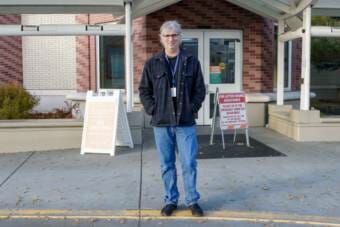
A doctor standing at the entrance to the Alaska Native Medical Center in Anchorage
Dr. Matt Hirschfeld in front of the Alaska Native Medical Center in Anchorage on Oct. 7, 2021. (Jeff Chen/Alaska Public Media)

Last year, as Alaskans braced for a COVID-19 surge that could stress the state’s medical system, things were oddly quiet at Dr. Matt Hirschfeld’s unit at the Alaska Native Medical Center in Anchorage.

Hirschfeld works in pediatrics. And the typical respiratory viruses that send children to the hospital — flu and respiratory syncytial virus, or RSV — had been vanquished, temporarily. Alaskans’ adherence to COVID-19 masking and social distancing recommendations nearly eliminated other viruses, too.

“Our pediatric intensive care unit doctors were offering their services to the adult ICU,” Hirschfeld said. “They were so much more busy than pediatrics was.”

This year, with kids returning to school and Alaska communities relaxing their coronavirus prevention measures, Hirschfeld and his colleagues around the state are expecting a very different winter — though they’re not quite sure how much different.

They’re expecting RSV and the flu, which can stress the state’s limited pediatric hospital capacity in normal years, to return. And now there’s the added layer of COVID-19, which generally hits adults harder but in rare cases can send small children to the hospital, too.

“How good is your crystal ball?” asked Dr. Laura Brunner, a pediatrician in Fairbanks. “The biggest concern is the combination of all of it.”

Alaska pediatricians say they still expect to be able to manage whatever surge in respiratory viruses hits them this winter. But the COVID-19 pandemic is adding a measure of uncertainty to those expectations because of its potential to sicken more kids and to divert scarce staff to the crush of sick adults that’s come close to overwhelming the state’s hospitals.

For those reasons, doctors say it’s especially important this year for kids and their family members to get the COVID-19 and flu vaccines, which can keep them out of the hospital and cut down on household transmission. Mask-wearing, hand-washing and social distancing will all help, too.

“To have a self-inflicted respiratory catastrophe, when we have months and months and months to prepare and see it coming, would just be unimaginable,” said Dr. Rob Lovrich, who cares for kids at two Anchorage intensive care units. “The solution is right there. It’s hanging right in front of us.”

Alaska’s system of hospital care for children is uniquely small and fragile. Only two hospitals — Anchorage’s Providence Alaska Medical Center and the Alaska Native Medical Center — have pediatric intensive care units.

A sign on the side of a hospital building that says "Alaska Medical Center"
Providence Alaska Medical Center in Anchorage. (Jeff Chen/Alaska Public Media)

Staffing by both doctors and nurses can also often be a limitation. There are only four pediatric intensive care specialists who live in Alaska, Lovrich said.

“If one of us gets sick, we have an obvious staffing issue,” he said. “If one of us makes the mistake of going over to the other’s house for dinner, and we both get sick, now we’re in a crisis.”

Alaska’s pediatricians are used to getting creative to manage those limitations.

Sometimes they take the unusual step of medevacing kids from Anchorage to hospitals with lower levels of care to make more room at the hospitals with ICUs.

And during a particularly bad surge of respiratory virus on the North Slope, stressed Anchorage hospitals once sent specialists to the region to train caregivers on treatments so that fewer kids would have to be transferred to Anchorage, Hirschfeld said.

Pediatricians, in interviews, said the coronavirus pandemic threatens to stretch their capacity further. Nurses or respiratory therapists, who are already in short supply, may have been pulled away to care for adults.

And hospitals in Seattle, Oregon and Utah, which sometimes serve as relief valves if Anchorage’s pediatric units get too busy, are tighter than in the past, Hirschfeld said.

“It may be more difficult to send kids out,” he added.

As Alaska experiences one of the nation’s worst COVID-19 outbreaks, pediatricians say they’re already seeing more kids being admitted to hospitals with the coronavirus.

But it’s not clear how much of an additional burden COVID-19 will present over the course of the winter. And both flu and RSV, which mostly affects newborns and infants, are also big unknowns.

American pediatricians can look to Australia — where the seasons are offset from North America’s — as a preview of what kind of respiratory viruses to expect during the winter here. And RSV cases in Australia rebounded sharply as residents emerged from stay-at-home and quarantine orders.

U.S. Centers for Disease Control and Prevention leaders, meanwhile, warned this week of a severe impending flu season, potentially because Americans built up less immunity than usual last winter.

“What concerns us with this upcoming season is we already have so much COVID. And we haven’t even hit the peak or the entrance to our flu and RSV season,” said Dr. Mishelle Nace, a Fairbanks pediatrician who works with the state health department. “It’s like a storm, and we don’t know how to predict it, just like the weather.”

What pediatricians do know is that vaccines will help blunt any impending surges.

Anyone six months and older can get the flu shot. And the Pfizer-BioNTech vaccine is available to children age 12 and up.

Those drug companies this week also filed their formal request with drug regulators to start giving the shots to kids between ages five and 11. Approval could come as soon as next month.

But pediatricians stress that the more family members 12 and older can get vaccinated now, the less likely it is that they will bring COVID-19 from schools or other settings back to their unvaccinated relatives.

And more adult vaccinations will cause less stress on hospital staff, they added.

“It’s a community,” said Nace. “It’s not just the adults. It’s not just the kids. It’s everybody.”

COVID deaths leave thousands of U.S. kids grieving parents or primary caregivers

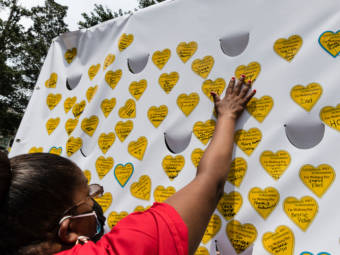
COVID-19 survivors gather in New York and place stickers representing lost relatives on a wall in remembrance of those who have died during the pandemic. (Stefan Jeremiah/AP)

Of all the sad statistics the U.S. has dealt with this past year and a half, here is a particularly difficult one: A new study estimates that more than 140,000 children in the U.S. have lost a parent or a grandparent caregiver to COVID-19. The majority of these children come from racial and ethnic minority groups.
“This means that for every four COVID-19 deaths, one child was left behind without a mother, father and/or a grandparent who provided for that child’s home needs and nurture — needs such as love, security and daily care,” says Susan Hillis, an epidemiologist at the Centers for Disease Control and Prevention and lead author of the new study.

The study, which was published Thursday in the journal Pediatrics, estimated the number of losses from April 1, 2020, through the end of June 2021 at 140,000. And that number has risen in the past three months: Hillis estimates it is around 175,000 today.

“This number will continue to grow as long as our pandemic deaths increase,” Hillis says.

These children are going to need support

Once a child loses their parent or primary caregiver, Hillis says, the tragedy is something they live with for “the entire duration of their childhoods.”

It’s a situation that calls for urgent action, Hillis notes. These children need “understanding, help, support,” she says. And it’s important “to ensure that they have a safe and loving family to continue to support their needs and nurture.”

And, just as COVID-19 has killed more people in communities of color, children in these communities are the most impacted by the loss of parents and primary caregivers.

“Sixty-five percent of all children experiencing COVID-associated orphanhood or death of their primary caregiver are of racial and ethnic minority,” says Hillis. “That is such an extreme disparity.”

The study defines orphanhood as the death of one or both parents. The study also tracked the loss of caregiving grandparents.

And if you look more closely at individual groups, American Indian and Alaska Native children were 4.5 times more likely to have lost a primary caregiver compared with white children. Black children were 2.4 times more likely and Hispanic children almost twice as likely.

Losing a parent or caregiver in childhood is a significant trauma. The study notes that this type of adverse childhood experience “may result in profound long-term impact on health and well-being for children.”

“Adverse childhood experiences are associated with increased risks of every major cause of death in adulthood,” says Hillis.

Losing a parent has other long-term effects

And in the short term, the impact of losing a parent or primary caregiver can lead to mental health crises for kids, including increased suicide risk, Hillis says, and “increased exposure to sexual, physical and emotional violence and exploitation.”

And in terms of life outcomes, a body of earlier research shows that losing a parent can put kids at a higher risk of economic, food and housing insecurity.

This adds a new layer of risk to kids in communities of color, which are already disadvantaged.

These communities experience inequities in access to health care, housing, education, and other factors that contribute to children’s well-being, says Dr. Warren Ng, a psychiatrist at Columbia University who primarily works with kids in communities of color.

“The numbers don’t tell the full stories,” he says. “The full story is really in the lives and the affected future of these children and adolescents and their families.”

Many children didn’t even get to say goodbye

Mental health care providers who are seeing the mental health effects of the pandemic on kids say these losses are particularly traumatic. Ng says even grieving has been difficult for them — many didn’t even get to see their parents or grandparents in the hospital, or say goodbye.

“One of the things that’s unique about the pandemic is that it’s also not only deprived us of a loved one, but it’s also deprived us of our opportunities that come together, so that families can heal, [and] support one another in order to really get through the most difficult times of life,” he says.

The study authors also call for policy action. “What we are proposing is that there be serious consideration to adding a fourth pillar to our COVID response, and that fourth pillar would be called care for children,” says Hillis.

This would involve finding resources and coming up with systems for “finding the children, assessing how they are doing and linking them to appropriate care,” she says, and strengthening economic support for families who care for the children.

The data highlighted here, especially the racial and ethnic inequities, “really does demand an urgent and effective response for all children,” Hillis says.

Copyright 2021 NPR. To see more, visit https://www.npr.org.

Will Muldoon jumps in the school board race two weeks before Juneau’s election

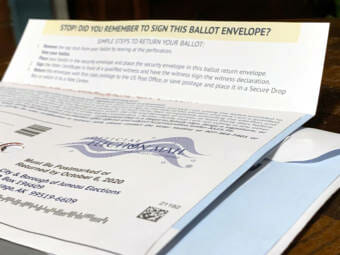
A mail-in ballot for Juneau’s 2020 municipal election. (Photo by Rashah McChesney/KTOO)

With just two weeks left before Juneau’s municipal election, a new candidate launched a write-in campaign for the city’s school board on Tuesday. So why is Will Muldoon is throwing his hat in the ring now?

This isn’t the first time Muldoon has run for school board, but it’s the first time he’s entered late as a write-in candidate.

Will Muldoon is a write-in candidate for Juneau's school board.
Will Muldoon is a write-in candidate for Juneau’s school board. (Photo courtesy of Will Muldoon)

“I know it’s pretty unconventional to launch a two-week write-in campaign,” Muldoon said. “But I think it’s worthy and I think I do have a shot of winning it if I keep at it.”

At first, he wasn’t planning to run this year.

“I had some folks reach out to me early on in the campaign trying to encourage me to run,” Muldoon said. “Then I got a lot more feedback from folks after the League of Women Voters forum and also during the last week.”

Many of those who reached out to him were concerned about some of the candidates’ stances on COVID-19 mitigation policies in schools, like wanting to get rid of the mask mandate in classrooms.

“People were just very nervous about that,” Muldoon said. “I agreed with them that masks work. I think the mitigation policies are sound. I think they’re science-based and I don’t want to see that change.”

Muldoon has lived in Juneau for 25 years and works for the State of Alaska as a data processor. He doesn’t have any children of his own, but he’s related to about a half dozen kids currently enrolled in the school district.

At 37-years-old, Muldoon has served on several other city boards. At the moment, he serves on the CBJ Aquatics Board and the Parks and Recreation Advisory Committee.

Muldoon has run for school board twice in the past, but didn’t win. He entered one of those races at just 18 years old.

“I thought that I still had an understanding of what it was like to be in the schools at that time and schools were tough for me,” Muldoon said. “I was intelligent, I understood the subject matter, but my interest wasn’t really there. I wasn’t really invested in the day to day.”

That’s when one of Muldoon’s teachers made a big difference.

“My high school government teacher was Laury Scandling and she got me set up with a service learning project where I worked with the parks and rec department to install the ‘clean up after your dog’ stations 20 years ago,” Muldoon said.

Muldoon said that experience set him on a path of civic duty and landed him an internship with the legislature.

“I think that raising good children and active community members and future leaders is something that we should all strive to be an active part of,” Muldoon said. “I think that we all have a sense of responsibility and a civic duty to step in where we can and that’s my primary driver.”

Although it will be an uphill battle to get the word out before the election on Oct. 5, Muldoon said he wouldn’t run if he didn’t think he still had a chance.
Anchorage refugee assistance program gets ready for up to 100 people fleeing Afghanistan

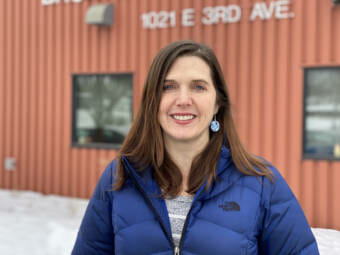
Catholic Social Services CEO Lisa Aquino in front of the nonprofit’s shelter for the homeless in Anchorage, the Brother Francis Shelter. (Alaska Public Media photo)

Alaska is set to welcome refugees who’ve fled Afghanistan following the U.S. military’s withdrawal there last month.

Catholic Social Services’ Refugee Assistance and Immigration Services program is expecting 50 to 100 Afghan refugees to begin arriving in Anchorage this month.

Catholic Social Services CEO Lisa Aquino says the refugee program’s staff and volunteers will help with things like finding housing and employment, as well as learning English.

Aquino says a wide range of Afghans are coming to Alaska, from translators and others who helped the U.S. in Afghanistan, to children and the elderly.

Listen here:

The following transcript has been lightly edited for clarity. 

Lisa Aquino: What they have in common is that they all needed to flee as a part of this humanitarian crisis — from their country from their home — in a really short period of time and leave everything that they knew behind. So if there’s one thing that ties them, it’s that they’re Afghans and they had to quickly leave their home for fear of being persecuted by the new government there.

Casey Grove: What do you know about their escape from Afghanistan? Or any part of that journey to the U.S.? And then, what’s their journey to Alaska going to be like?

Lisa Aquino: Sure, well, I would say we’re just finding out the details now. We don’t know much yet.

I would say that we know a little bit more about what’s happening after they leave Afghanistan. The people who are able to get on airplanes, they would fly to a U.S. military base in another country often, or to a U.S. military base in the Lower 48. And then, ordinarily, when people move to the United States — depending on the way that they go — there’s different processes that they follow. For these folks, because of the emergency situation in which they left, they’re doing a lot of that processing while traveling. So it’s one of those situations where they’re building the airplane as they’re flying it.

Casey Grove: That sounds pretty intense.

Lisa Aquino: And I’ll just say, too, about how they’ll get to Anchorage. So for these people, as a part of going through that process, they’ll go through a lot of different specific health checks to ensure their health and to ensure the health and safety of everybody in the United States. And that includes getting vaccinated for COVID and getting tested numerous times. And then they go through a number of security checks as well. So for people who are working for the U.S. government in Afghanistan, to get a job with the U.S. government, you have to go through a pretty intensive security check. And then as a part of this process, there’s at least three other security checks. There’s a rigorous process that people need to follow to come to the United States. And in this process — with people from Afghanistan — that rigor is still there.

Casey Grove: Gotcha. And I should probably ask: Do you anticipate pushback from the community about refugees coming here from Afghanistan?

Lisa Aquino: You know, I will say, we have received overwhelming support, Casey. We’ve had so many people reach out to us offering to donate their time, to donate their funds, to donate goods, to help people resettle here. So the response has just been overwhelming. We’ve had hundreds of people who already signed up to volunteer as a part of this process. I think there’s always questions to be answered about new processes. And we are happy and willing to answer all the questions that come to us. And I would just say that the Alaska spirit is alive and well. And there’s such an outpouring of love from Alaska for these new people to our state.

Casey Grove: I wonder in what ways can people help if they want to? I noticed in a news release that you sent out that there was even a sort of a letter writing thing to communicate just, you know, welcome to Alaska?

Lisa Aquino: Yes, there is. So if people want to find out ways to help, you can go to our website, cssalaska.org. And there’s different ways that people can help — everything from volunteering their time or donating goods or donating funds. And also, there’s an opportunity to write a message. This is a way that people in Alaska can welcome these newcomers to our country and to our state, and let them know that they’re supported here. And that we want to help.

Juneau School District employees will soon have to test weekly for COVID-19

Frank Henry Kaash Katasse guides students to his classroom for a Tlingit class at Dzantik'i Heeni middle school on the first day of school on Monday, August 16, 2021, in Juneau, Alaska. (Photo by Rashah McChesney/KTOO)
Frank Henry Kaash Katasse guides students to his classroom for a Tlingit class at Dzantik’i Heeni middle school on the first day of school on Monday, August 16, 2021, in Juneau, Alaska. (Photo by Rashah McChesney/KTOO)

Starting next month, all Juneau School District staff members will be required to get weekly COVID-19 tests. The school board voted unanimously to move forward with the mandate on Tuesday. 

At the moment, school staff members have access to testing, but it’s optional. About 150-200 of them have been testing each week, voluntarily. District Superintendent Bridget Weiss said the new requirement will go into effect no later than Oct. 4. 

“Staff [members] register [online],” Weiss said. “They can pick which day and which site they test at. So we will be expanding that to accommodate the required testing.”

Bridget Weiss is the superintendent of the Juneau School District.
Bridget Weiss is the superintendent of the Juneau School District. (Photo courtesy of Bridget Weiss)

Staff members who’ve been fully vaccinated or who’ve had COVID-19 in the last 90 days will be able to opt-out of testing. To make that possible, the district first has to verify everyone’s vaccination status. They’re hoping to use software that was put in place over the summer to collect that information. 

Ideally, people would just log in and upload a photo of their vaccine card or doctor’s note. Weiss said there are steps in place for staff members who don’t comply with the testing requirement. 

“We already have established progressive discipline for adults, kind of like we do for kids,” she said.

That can be everything from the supervisor talking with the person who missed the test all the way up to termination.

“That’s extreme,” Weiss said. “I don’t see that happening, but that’s kind of the end of the process.”

Like testing at any other place in town, staff members provide their health insurance information before getting the swab. While there’s no out-of-pocket cost to the employee, some union reps are concerned about insurance rates increasing in the future. But Weiss said if the district didn’t use the insurance system, it wouldn’t have the funding to support the program.

“And the cost for testing is minuscule in comparison to the cost to an insurance company when people contract COVID, get hospitalized from COVID, or those unknown, long-term effects of COVID,” Weiss said.

By adding another layer of mitigation and making testing convenient, the district hopes to keep schools and families healthier. So far, Weiss has received positive responses and very little pushback from staff. 

“We’re so blessed in Juneau that people understand that we have a priority around keeping kids in school,” she said. “There are so many different things that we can do that contribute to that and this just happens to be one of them.”

The district is also working on a plan to increase testing among students. Weiss will present that plan during the school board meeting on Oct. 19. 

More than 440 Alaskans have died with COVID-19. We know little about them.

Leaves begin to change color on a tree at the Anchorage Memorial Park Cemetery on Friday, Sept. 10, 2021. (Emily Mesner/ADN)

In Alaska, 444 people have died after contracting COVID-19. We know precious few of their stories.

Of hundreds of Alaskans who’ve died with COVID-19, the fact was acknowledged in only a handful of published obituaries. A sprinkling of online memorials and fundraisers fill out the details of a few more.

Recent deaths hint at the enormity of the losses: A respected airline pilot with two children. A U.S. Marine with a toddler son. A 36-year-old dad and restaurant employee.

Those are the exceptions. By and large, the grief — and the stories — of Alaskans who died in the unfolding wave of the coronavirus pandemic have remained private.

The result is faceless human toll growing by the day.

How can hundreds of Alaskans die and we know so little about who they are?

“I have wondered the same thing,” said Anne Zink, the state’s chief medical officer.

Inviting judgment

In the earlier stages of the pandemic, people came forward with stories about their loved ones’ illnesses and death.

Pink roses and handfuls of dirt, tossed by family and friends, rest on the casket of Amanda Bouffioux during her burial at the Anchorage Memorial Park Cemetery on Sept. 15, 2020. Bouffioux tested positive for COVID-19 last August and spent three weeks on a ventilator before she died Sept. 8, 2020. (Emily Mesner/ADN)

People like Scott Wells, whose wife, Amanda Bouffioux, died of COVID-19 one year ago. At the time, Wells said, he was willing to share about the death of the 44-year-old wife and mother because he wanted Alaskans to know how lethal the virus could be.

But as almost every aspect of the pandemic — from masking to vaccination to even the threat posed by the virus itself — has become the center of an ugly political debate, that’s changed.

“I keep thinking about the similarities between the opioid epidemic,” said Zink. “The shame and the stigma that can sometimes come with COVID. And the politicization of it.”

Now, with unvaccinated people making up the overwhelming majority of recent COVID-19 deaths in Alaska, there’s a sense among some family members that going public about a loved one’s illness and death means inviting the judgments of strangers.

“I think people want to grieve and process their own loss without judgment,” Zink said.

Even before vaccines were available, families that chose to share publicly about their loved one’s loss to coronavirus faced judgment.

Michi Shinohara’s mother, Rosemary Shinohara, a retired Anchorage Daily News reporter, died in December of COVID-19.

Shinohara tweeted a raw account of her time at her dying mother’s bedside. An adaptation of the thread was published in the Daily News.

At the time, Shinohara, a physician in Seattle, worried that people might question whether her mom and dad had been sufficiently cautious. She wondered if her mother’s death might be discounted because she was older, or because she had other health issues.

People just want to believe it won’t happen to them, or if they do, that everyone will be fine, Shinohara said.

“Admitting that’s not true lets in the hideous fear of this thing that’s looming,” she wrote.

‘Very simple and private’

Funeral directors and cemetery workers are encountering families dealing with the deaths of their loved ones to COVID-19. Many are opting for direct cremation and no immediate service, said Mindy Gustin, a licensed funeral director for Legacy Heritage Chapel at Angelus Cemetery in Anchorage.

“We’ve been seeing a lot of families going ‘OK, we are going to keep our arrangements very simple and very private,’” said Gustin. Causes of death are gradually disappearing from obituaries in general, Gustin said.

“In the pandemic we are grieving in a much more isolated way,” she said.

Roses rest on the ground and line a gravesite at the Anchorage Memorial Park Cemetery in downtown Anchorage on Thursday, Sept. 9, 2021. (Emily Mesner/ADN)

The Anchorage Memorial Park Cemetery downtown has been busy with burials in August and September. Families don’t often volunteer the cause of their loved ones’ deaths, but memorial park director Rob Jones sometimes hears which are due to COVID-19.

“I’ve noticed the obits are not mentioning it nearly to the degree that it is actually causing the death,” Jones said.

Tethering a loved one’s death to the coronavirus pandemic can make it feel like it subsumes the person’s life story and accomplishments, Zink said.

“There’s a desire to not have someone’s death to be boiled down to a virus that has become so political,” she said. “They want the obit to be about the life of that person, and what that looked like.”

Disenfranchised grief

Kenneth Doka studies grief, especially what he calls “disenfranchised grief.”

Disenfranchised grief is the kind that is not openly acknowledged, validated by society or mourned publicly, says Doka, a professor emeritus at the College of New Rochelle in New York and vice president of the Hospice Foundation of America.

People who have lost loved ones to suicide or drug overdose are familiar with their loved ones’ deaths being viewed as somehow the result of perceived moral failings.

You see it sometimes in deaths from lung cancer, Doka said.

“The first question is, did they smoke?” he said. “As if their smoking makes them somehow less deserving of sympathy.”

At first, people who died with the coronavirus did not seem to be subjected to such disenfranchisement. Now, with vaccines widely available and most deaths among unvaccinated people, “there may be a sense that this was preventable,” he said. “And that there’s a stigma associated with it.”

Grief that remains unspoken, unacknowledged or unexplored festers.

“You can’t explore your own questions,” Doka said. “You can’t really process your grief as well.”

What are we missing?

What do we lose by not knowing the stories of those who have died?

A sculpture of an angel marks a grave at the Angelus Memorial Park Cemetery in Anchorage on Wednesday, Sept. 8, 2021. (Emily Mesner/ADN)

Every one of us has been through the trauma of a global pandemic in the last year and a half, Zink said. But we’ve also experienced COVID-19 so differently: from a mild spell of illness to the economic loss of a business to the death of a mother, father, husband or wife. She thinks polarization — and not knowing one another’s stories — has pushed us further apart.

“We’ve lost a lot of the humanity of this response,” Zink said. Sharing stories about all the losses Alaskans have experienced could help, she thinks.

Gustin, the funeral director, says it’s never her role to judge. It’s to help families memorialize their loved ones as they wish to — publicly or privately, with or without acknowledgement of why the person died.

She’s busy right now. The bodies of three people who died with COVID-19 arrived at her funeral home just last weekend.

This story was originally published by the Anchorage Daily News and is republished here with permission.

Site notifications
Update notification options
Subscribe to notifications