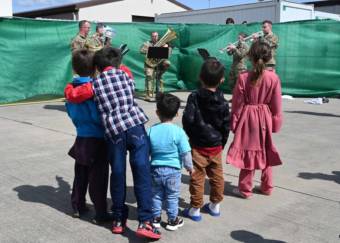
A U.S. military band at Ramstein Air Base in Germany entertains children evacuated from Afghanistan while they await their next flight on Aug. 22. (Caleb S. Kimmell/USAF)
Evacuees from Afghanistan will soon be making Alaska their home.
Catholic Social Services of Alaska said its refugee resettlement division is preparing to welcome 50 to 100 Afghans, beginning this month.
They were among the thousands of people the U.S. military evacuated from the country since the Taliban took control in August. Catholic Social Services said the evacuees will stay at military bases in the Lower 48 until they’re ready to move north. Those coming to Alaska include vulnerable populations and people who worked for U.S. forces in Afghanistan, said the agency.
Catholic Social Services of Alaska’s Refugee Assistance program is looking for volunteers to welcome the new arrivals and help them settle in.
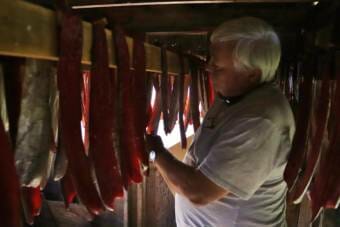
Gene Carlson checks red salmon strips in his smokehouse on July 16, 2021. Carlson was born in Chignik Bay but lives in Washington state now, usually returning in the summer to fish. He says this may be his last season. (Izzy Ross/KDLG)
Gene Carlson drove the streets of Chignik Bay one afternoon in July, between quiet wooden houses and old cannery buildings.
“That used to be a restaurant there,” he said. “That’s a web loft over there, which is shut down now. Here’s another one of my cousin’s houses. He’s not living there anymore.”
The Chignik River’s salmon runs have sustained generations in the century-old small fishing communities along the Alaska Peninsula.
But, for the fourth year in a row, the runs came in severely low. For years, residents have struggled to earn a living fishing and to put up enough fish for the winter, and some worry their villages will disappear, taking with them a fishing tradition that connects their families to the region.
Carlson was born in Chignik Bay, which is now home to around 90 people. He has fished commercially since he was a kid in 1961. Now he lives in Washington state and usually returns for the summer. Driving through the quiet village, he says this may be his last season.
“If we have another prediction like this year, I don’t think I can come back,” he said. “It’s expensive. ‘Cause you know, we come back, we bring food for the whole summer, ‘cause we’ve got to feed our crews, which you can’t find anymore.”
Gene Carlson with his nephew. July 16, 2021. (Izzy Ross/KDLG)
The area comprises Chignik Bay, Chignik Lagoon, Chignik Lake, Perryville and Ivanof Bay, and it’s been home to Native people for millennia. The village of Kalwak was previously located there, but it was destroyed when Russians came to the area during the fur boom in the late 1700s, according to the Lake and Peninsula Borough. Chignik Bay and Lagoon were established as fishing communities in the late 1800s, and more people of Alutiiq, Aleut, Russian and Scandinavian descent moved to the area.
The salmon runs are central to people’s lives in many ways. The economy has developed around the commercial fishery, and fish also provide food for the winter.

Some people think climate change is causing the runs’ decline. Others point to fishermen in other places catching Chignik-bound fish. Regardless of the cause, people are anxious that without the runs, the communities will die.
Chignik Bay. July 16, 2021. (Izzy Ross/KDLG)
The village of Chignik Lagoon, home to about 70 year-round residents, is an hour’s boat ride along the bay’s shoreline.
“It’s protected by that sand spit, which is a natural breakwater,” George Anderson said as he navigated his boat through the lagoon.
Anderson fishes commercially and for subsistence. He’s also the president of the Chignik Intertribal Coalition, which was formed after the run collapsed in 2018.
Earlier this summer, the run was so low that some people chose not to put out nets for subsistence fish. They were worried about harming the fragile run.
“We had something that we took for granted in the past — that the fish were just always going to be there for, you know, smoking, salting, freezer, whatever,” he said. “And to have that not be there for you is just something we were never prepared for. Never imagined even not subsisting.”
The low runs prompted federal managers to restrict subsistence fishing for sockeye to all but rural residents. King salmon fishing was closed completely in state and federal waters.
George Anderson on his seiner. July 16, 2021. (Izzy Ross/KDLG)
Since the Chignik run collapsed, much of the debate has centered on another state-run fishery to the south, called Area M. Critics see it as an intercept fishery, where sockeye traveling through are harvested before they can reach fisheries closer to spawning grounds, like Chignik.
This year’s early sockeye run didn’t meet its escapement goals — the minimum number of fish that managers want to see make it up the river. The late run did, and some people were able to fish. But the commercial fleet was just a fraction of its normal size. The area biologist said 15-20 boats fished, instead of around 60.
Some scientists have connected fishery failures in the Gulf of Alaska to marine heat waves in the past decade. But state research biologists also say it could be because of habitat changes in the salmons’ spawning grounds.
Salmon are notoriously difficult to research because part of their lives are spent in the ocean — a vast expanse that is mostly inaccessible to biologists. Along with warmer waters, a loss of spawning habitat might increase competition for habitat between Chignik’s two sockeye runs.
Anderson said the Chignik villages are shouldering the burden of conservation. He pointed to Area M, where South Peninsula fishermen landed more than 3.8 million sockeye this summer, and said the state wasn’t considering studies that showed Chignik fish caught further south in its management decisions.
Kevin Shaberg, a finfish research coordinator for the Alaska Department of Fish and Game based in Kodiak, said the situation is tough.
“It’s hard to understand that, you know, everybody else gets to go fishing, but you got to sit home next to the river and watch no fish go by. And that’s tough. And it’s something that we’ve, we’ve tried to handle in the past,” he said.
In previous years, he said, the department has limited fishing in nearby areas when Chignik was low. But Shaberg said the burden of conserving a run usually falls on the areas closest to where those fish should be returning to spawn.
“[Area M is] a traditional fishery that’s mandated and directed by the Board of Fish for us to prosecute, and we follow the management plans that are put in front of us,” he said.
The village of Chignik Lagoon. July 17, 2021. (Izzy Ross/KDLG)
Many people have asked for genetic sampling of harvests further south, in Area M, to figure out where Chignik fish are being caught. The state conducted tagging studies in the 1960s, and as late as the 1980s. In the 2000s, it conducted genetic studies in Area M in a project known as the Western Alaska Salmon Stock Identification Program, which showed fish from several stocks moving through — some of the sampled salmon were headed to the Chigniks, while in certain places, most of the fish were going to Bristol Bay or areas to the east. The state continued sampling in the early 2010s in parts of the area; the majority of fish caught during those studies were bound for the Chigniks, though percentages varied between areas and sampling groups
Still, Shaberg said, distribution of those catches change from year to year, so managers don’t know whether that applies to a given season. And the department hasn’t done additional testing in the area in years, he said, mostly because the state doesn’t have the budget for it.
Another question is what a study would seek to accomplish. Shaberg said a snapshot of genetics from one year, in one area, doesn’t help understanding of what’s happening or how to address it.
“One of the big issues for myself is that, you know, how long are we going to do this?” he said. “What’s the design for this? What are we really trying to answer?”
Shaberg said the department does plan to research the watershed, to try to figure out if something in the freshwater environment is affecting fish.
The Chignik Intertribal Coalition, along with state and federal agencies, has plans to research the river’s dwindling king salmon. That depends on funding approval, which they’ll find out about next year.
One of the coalition’s members, the Ivanof Bay Tribe, also received a $65,000 Tribal Resiliency Grant from the Bureau of Indian Affairs; it will partner with the coalition to gather environmental observations from Tribal members in the area.
But Chignik residents have had to contend with other forces, too. Anderson said they haven’t yet received the federal disaster relief money they were promised after the 2018 run failure. And due to the COVID-19 pandemic, the next Board of Fish meeting, which was supposed to take place this year, has been delayed until 2022.
Some industry organizations have tried to help as well. Last summer, Northline Seafoods, a commercial processor, donated thousands of Bristol Bay sockeye to the Chigniks. Lots of people said receiving that fish was helpful, but subsistence isn’t just about food; it is also a connection to place and family, as people work together to harvest.
A Chignik Lagoon beach. July 15, 2021. (Izzy Ross/KDLG)
On a warm evening in Chignik Lagoon, Al Anderson shucked clams with his wife, the shades of their house drawn to keep the heat at bay.
“It’s our lifeblood. Chignik’s going to go away — all the Chigniks are going to go away if we can’t get this run back up to where it used to be,” Anderson said. “You know, the young people are moving away. There’s not much for them here.”
Many of those who have moved away return in the summers to fish, including one of Anderson’s daughters.
“It’s so important that she comes back every year to do it. Typically it doesn’t take her three weeks to get her subsistence fish, you know,” he said, laughing. “Of course she comes back to visit, too, so that’s good.”
Elder Vivian Brandal, 80, and has lived in the Chignik area all her life. Now, she goes to Kodiak in the winter.
She said it’s difficult to comprehend what is happening.
“Subsistence fishing is a lifeline. I mean, we depend on that. That’s something we’ve done all our life,” she said. “It’s something we really depend on actually, not only fishing, but we used to be able to get caribou. We’d get caribou every year. You can’t even do that anymore.”
Brandal said the lower sockeye runs have changed the future of the Chignik communities.
“That’s five villages that depend on this fishery, and you look at it, you think, how can the state let this happen? How can they just let this happen without doing anything about it. I have grandchildren that thought this was their legacy,” she said.
Vivian Brandal in her backyard. July 16, 2021. (Izzy Ross/KDLG)
Brandal doesn’t think the state has managed the fishery correctly. She, along with many others, wants the state to be more responsive to the drop in the run and thinks it should conduct studies on why the fish aren’t coming back.
Still, Brandal is hopeful; she’s inspired by Katie John, an advocate and defender of Alaska Native subsistence rights who petitioned the state and federal government to allow for traditional fishing in her home.
“She fought for what she believed in, and that’s what I think we should do,” Brandal said. “We believe in this and we should fight for it. I won’t be able to anymore, but I just think the young people really ought to. It’s just, it’s very emotional for people. I’m sorry, I shouldn’t be crying, this is crazy. But it’s very hard.”
Brandal thinks they should work together to find a way forward, too.
This article has been updated to include additional context on the state’s genetic testing in Area M.
If you have a baby at home or are expecting one in the next few months, you might be on edge for all sorts of reasons, but particularly because of COVID-19. The delta variant of the coronavirus has turned nearly every community in the country into a bright red hot spot of viral infection. Babies can’t get vaccinated against COVID-19 yet — and the youngest age included in current vaccine clinical studies is 6 months old.
In fact, the rate of new cases of COVID-19 among babies and children younger than 4 years old in the U.S. recently surpassed the rate of new cases among adults older than 65, according to the Centers for Disease Control and Prevention (although the number of deaths among the children remains very low).
“People were saying ‘Oh, kids don’t get COVID’ — that’s really not true,” says Dr. Jennifer Shu, a pediatrician in suburban Atlanta. “They are getting it at the same rates as we would expect, based on their [portion of the] population.”
Shu says she’s concerned: “Because they are disproportionately unvaccinated, we are going to see higher [case] numbers from children, as variants like delta take advantage of people who are vulnerable.”
Here’s a guide to the latest science — and some practical advice — on how to protect a new baby from all variants of the coronavirus.
1. How to pass along some coronavirus antibodies during pregnancy
Then there’s this bonus from a pregnant individual’s vaccination, says Dr. Flor Muñoz, a pediatric infectious diseases specialist at Texas Children’s Hospital and Baylor College of Medicine: Fetuses get a share of the antibodies generated via the placenta.
“The paradigm of immunizing a pregnant woman so that her newborn and young infant is protected from a disease is an old one,” notes Dr. Karen Puopolo, who heads the newborn medicine section at Pennsylvania Hospital in Philadelphia and conducts neonatal infectious disease research. For example, pregnant people have long been encouraged to get vaccinated against whooping cough so that their bodies generate antibodies that pass to the fetus and protect the baby after birth.
There’s no particular recommended timing for when to get the COVID-19 vaccine during pregnancy, Muñoz says. But because of the timing required with Moderna and Pfizer, with two shots several weeks apart, if you get vaccinated “around the second trimester, you will be protected in the highest period of susceptibility, which is the third trimester.”
In fact, Puopolo explains, “late in the third trimester, there is an active process so that essentially your body makes it so that there is more antibody in your baby — in terms of the concentration — than there is in you.”
Muñoz is leading a large study funded by the National Institutes of Health called MOMI-VAX to gather lots of data about mothers and infants and vaccination, including measuring the concentration of SARS-CoV-2 antibodies in the mother versus the baby at birth. It will also look into how long these antibodies last and how well they protect the baby from infection. (The study began enrolling volunteers in early July, with plans to follow individuals and their infants for one year after delivery.)
It’s likely, Muñoz says, that the borrowed antibodies from pregnancy decline over the first couple of months of a child’s life.
2. Breastfeeding can help, too, if you’ve been vaccinated or already had COVID-19
Mothers who have been vaccinated or had prior infections with the coronavirus can also pass along antibodies to their babies through breast milk, which acts like a temporary shield inside the mouth and nose and stomach, Muñoz explains.
“It’s mostly a surface coating, if you will,” she says. That coating is helpful since “this is where these respiratory infections go in — from the nose or the mouth of the baby.” The details of how and how well that mode of protection works is part of her MOMI-VAX study.
To be clear, though, she adds, “compared to the [the quantity of] antibody that babies get through the placenta — so directly into the blood — the contribution of breast milk antibodies is less.”
That’s why Shu in Atlanta is concerned. She says even in her highly vaccinated community, she’s seeing many pregnant women who aren’t getting vaccinated.
“I’m seeing too many people who are choosing to wait to get the vaccine until after they’ve delivered,” Shu says, “and they’re really relying on some immunity going through the breast milk to protect their baby.” Nationally, only about 1 in 4 pregnant people had at least one dose of a coronavirus vaccine as of the end of August, according to the CDC.
“With the delta variant being as transmissible as it is, I would really like to see that the moms get the vaccine either before they become pregnant or during their pregnancy,” Shu says.
3. Try to create a caregiver force field
Beyond supplying antibodies, which can help babies fight off infection if they get exposed to the virus, parents can avail themselves of other strategies to keep babies from getting exposed in the first place.
Many of these tricks have been proven to work against other germs — babies have always been vulnerable to picking up viruses and other pathogens, especially early on. “The first month of a baby’s life is really delicate,” Shu explains. “In that month, if they get an infection, it can turn serious a lot faster than in older babies.”
So, although the pandemic is a particularly stressful time to be guarding a newborn’s health, “the steps that I would tell a family to take today are not shockingly different than I would have told them 10 years ago,” Puopolo says.
Bottom line, in regards to the people who are around your baby: “Make every effort to keep them healthy,” Puopolo advises.
In the era of COVID-19, she says, that means “ensuring that anybody — age appropriate — is vaccinated. The parents should be vaccinated; if you have grandparents or a nanny or someone who’s in your home helping with child care, make sure they’re vaccinated.” Siblings who qualify for the shots should get vaccinated, too, she says.
Having all of the people around the baby vaccinated acts like a force field. Those people are less likely to get infected, which means they’re less likely to bring the virus home.
“For the most part, what we have learned is that when an infant becomes ill with a respiratory illness, such as flu, COVID or pertussis, it’s because they’ve been in contact with someone in the house [who’s sick],” explains Muñoz.
Of course, the vaccines are not a perfect shield, so it’s smart to use several methods to fight off COVID-19, including having parents, caregivers and siblings wear masks when they’re out in public. Keep the home well-ventilated, and frequently wash your hands. And, if your baby is at day care, Puopolo suggests having conversations with staff about whether they’re taking those same steps to minimize risks.
If someone home with the baby is sick (with any illness, but especially COVID-19), keep them away from the baby as much as possible. “We highly recommend that people who are sick are not around babies — they don’t kiss the babies, they don’t have very close contact face to face,” Muñoz says.
If the parent or any direct caregiver gets sick or feels they might be coming down with something and is the only one to care for the infant, Muñoz recommends that they put on a mask when around the baby, especially if they’re symptomatic. “In some cases, it’s even been recommended to completely separate the person who’s ill — even if it’s the mother from the baby — when there is a high risk of transmission,” she adds.
4. Where to (not) go and who to (not) see
Life with a newborn is often a mix of harrowing and delightful — and during a pandemic, there’s definitely extra stress. Do go for walks with your baby, Shu says, but don’t take the baby to big gatherings.
“You don’t want them in large groups of people,” she says. “If you want to see guests, you might have them visit outside your house instead of inside. Anyone who wants to hold the baby needs to be healthy, wash their hands and — in this day and age — probably wear a mask.”
In other words, “stay away from settings where your baby can catch something,” Puopolo advises, especially in the baby’s first few months.
5. Watch for these red-flag signs of COVID-19 in your infant
So far, even though the delta variant is much more transmissible than the original coronavirus variant, researchers are still trying to figure out if it causes illness in children and babies that is any more severe.
“Fortunately, in my practice, the newborns and young infants I’ve seen who have had COVID have done well — they tend to have cold symptoms and recover,” says Shu. “That said, I’ve seen other infants with a fever lasting for many days from COVID [and] we sometimes see some breathing problems that may require a trip to the hospital.”
Especially for anyone in the first few months of life, fevers are a red flag, says Puopolo. “You should always call your pediatrician or seek emergency care if a baby has a fever greater than 100.4° Fahrenheit,” she says. “In addition to fever, you are worried about how the baby’s feeding, how the baby’s sleeping.” Since infants who are sick don’t tend to feed well, they can also get dehydrated, she says.
“So signs of a cold, signs of a fever, fussiness that can’t be resolved, poor feeding — these are, COVID or no COVID, always reasons why you should seek medical care for your infant,” says Puopolo.
Again, “the risk is low, but it’s not zero,” Shu says, that babies will develop severe complications from COVID-19.
So, when will babies be eligible for vaccination against this virus?
The clinical trials of COVID-19 vaccines currently underway only dip down in age as young as 6 months. But reduced doses of the vaccine might — at some point — be available for younger ages, says Muñoz.
“If you look at some of the guidance from the FDA from very early on in the pandemic, children under 6 months are not excluded,” she points out. “So they can be included, it’s just that at this time, to my knowledge, there are no studies evaluating vaccines at zero to 6 months of age.”
Vaccines are evaluated in a stepwise process by age, she explains. “We have been starting with adults and then adolescents and now working on the pediatric age groups,” Muñoz says. “It will take some time, because we have to establish safety and efficacy in older groups before we can go down to the newborns and the youngest babies.”
“So this is something that is not out of the [realm] of possibilities,” she says. “But it will also take some time.”
Copyright 2021 NPR. To see more, visit https://www.npr.org.
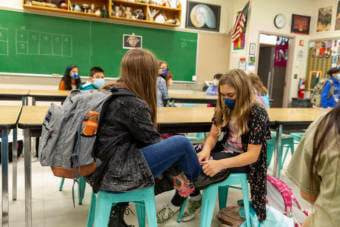
Maddie Bass watches as Zara Ritter ties her shoe during an art class on the first day of school at Dzantik’i Heeni middle school on Monday, August 16, 2021, in Juneau, Alaska. (Photo by Rashah McChesney/KTOO)
It’s been just over three weeks since students returned to Juneau’s classrooms and so far, school case numbers seem to be reflecting the rates of the city as a whole.
“Our most frequent cases are at elementary where kids can’t be vaccinated yet,” said Juneau School District superintendent Bridget Weiss. “Our response is most of the time to quarantine a classroom.”
Bridget Weiss is the superintendent of the Juneau School District. (Photo courtesy of Bridget Weiss)
When someone tests positive for COVID-19, staff at Juneau’s Public Health division determines when that person can return to school based on factors like their symptoms and when they took the test.
When someone has been in close contact with an infected person, they get tested five days after exposure and if the result is negative, they can return to school on day eight.
Weiss said so far, that response has proven effective, but it isn’t always easy because reports of positive cases or possible exposures come in at all hours.
“A couple of times, I’ve been notified of an elementary case at about 7:00 in the morning, 7:15, 7:20,” Weiss said. “So we are sometimes calling parents right before school starts to say ‘please don’t send your kid’ or ‘come pick up your kid’ and that’s unfortunate but it is what we have to do sometimes.”
Until recently, school officials were under the impression that they couldn’t ask staff members if they’d been vaccinated, but that’s no longer the case.
“We’ve gotten some clarity this week and I’m super excited that we can request verification of vaccination status, that it is not protected by [health information privacy laws],” Weiss said. “So that is going to be a huge tool for us and many many of our staff tell us that they’re vaccinated or not. It’s just very few that don’t want to do that.”
If for any reason a staff member doesn’t answer, the district just assumes they are unvaccinated for any protocols built around vaccine status.
“It is simply operational information,” Weiss said. “What we want is a safe environment. So whether somebody is vaccinated or not, we don’t hold any judgment on that. We just need to know so that we can respond accordingly.”
She estimates about 70 to 80 percent of all school staff members are currently vaccinated against COVID-19. Optional weekly tests are also available to staff members.
As for athletics and activities, participating high school students have been tested frequently for COVID-19. Starting this week, the district is also implementing that policy for middle schoolers.
Every opportunity for teams to travel is looked at individually and the trips are being kept as short as possible.
“We used to play football at seven or eight at night,” Weiss said. “Now, we’ve been playing them at three in the afternoon because teams can come in in the morning, play and then go home that night and not have any overnight. So again, [it’s] limiting that exposure.”
Those teams are no longer eating out at restaurants. They bring food with them instead. Student athletes who’ve been vaccinated are allowed to opt out of testing. However, all policies are subject to change based on the most up to date information.
“If we started seeing cases pop up in our activities, then we might tighten it and just say: ‘There’s no opt-out. Everybody’s testing,'” Weiss said.
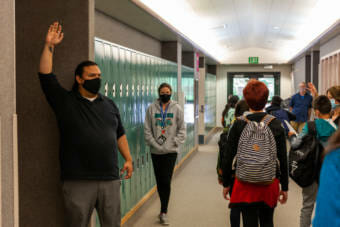
Back in school buildings, masks are still required for everyone, proper hand washing has been taught and re-taught to younger kids, and air purifiers have been installed.
“Most of our kids, most of our staff, when they’re at school, it’s the most mitigated environment that they participate in,” Weiss said. “So far that’s paying off.”
At this point, Weiss doesn’t see a scenario where the whole district would have to return to remote learning again.
“I just think we’re far enough down the road,” she said. “I could be wrong. Stranger things have happened in the last 15 months that we never would have predicted. But with everything that we know up to this point, I would be incredibly surprised if we ever had to take that step.”
In some cases, the district has moved one grade level or one school to distance learning when cases emerged. School officials plan to take that approach for the foreseeable future.
Stephanie Rimel looks at a photo of her brother Kyle Dixon, 27, who died of COVID-19 on Jan. 20. She says that during his illness and after his death, some people made insensitive comments or denied the pandemic’s reality. (Brett Sholtis/WITF)
Editor’s note: A photo in this story contains language that some may find offensive.
Months after Kyle Dixon died, his old house in Lanse, Pennsylvania, is still full of reminders of a life cut short.
His tent and hiking boots sit on the porch where he last put them.
The grass that he used to mow has grown tall in his absence.
And on the kitchen counter, there are still bottles of the over-the-counter cough medicine he took to try to ease his symptoms at home as COVID-19 began to destroy his lungs.
Dixon was a guard at a nearby state prison here in rural, conservative Clearfield County, Pennsylvania. He died of the virus Jan. 20 at age 27.
His older sister Stephanie Rimel is overwhelmed with emotion as she walks through Dixon’s home and talks about him.
“I’ll never get to be at his wedding,” Rimel says. “I’ll never see him old. Like, that was the last birthday in September we got to celebrate with him.”
Dixon with his 1-year-old niece during a cruise to the Bahamas with his family in November 2019. (Lauren Dixon)
Her grief, however, quickly turns to anger. Rimel recalls some of the misinformation that proliferated last year: Masks don’t work. The virus is a Democratic hoax to win the election. Only old people or people who are already sick are at risk.
Rimel says her brother believed some of that. He heard it from other prison guards, from family and friends on Facebook, she says, and from the former president, whom he voted for twice.
These falsehoods and conspiracies fostered a dismissive attitude about the coronavirus among many rural Pennsylvanians, here where she and her siblings grew up. Because of the misinformation, Dixon didn’t always wear a mask or practice physical distancing, Rimel says.
A welcome sign marks the edge of Lanse, Pa., a rural community in Clearfield County where Dixon lived. (Brett Sholtis/WITF)
Some of those beliefs were even expressed by members of their family — making Rimel’s grief more painful and isolating.
Rimel recalls a particularly tough time right after her brother had to be hospitalized. Even then, family members were repeating conspiracy theories on social media and bragging about not wearing masks, Rimel says.
Some of the same people who attended Dixon’s funeral are still sharing misinformation related to COVID-19 online, says another sister, Jennifer Dixon.
“They’re back to posting their same stuff,” she says. ” ‘It’s a hoax’ — that sort of stuff.”
Jennifer Dixon wishes those people could understand what her brother endured while hospitalized.
“I wish that they could have been there his last days and watched him suffer,” she says. “Watch his heart still be able to beat. His kidneys still producing urine because [they were] so strong. His liver still working. Everything. It was his lungs that were gone. His lungs. And that was only due to COVID.”
Dixon was in intensive care at Geisinger Medical Center in Danville, Pa., before his death in January. (Stephanie Rimel)
Both sisters wanted their brother’s death notice to be unambiguous about what had killed him. It reads, “Kyle had so much more of life to live and COVID-19 stopped his bright future.”
The notice also included a warning that the virus is real and can kill.
While these sisters have chosen to be outspoken about what happened, other families have opted to keep quiet about deaths from COVID-19, according to Mike Kuhn, a funeral director in Reading, Pennsylvania.
Kuhn’s business did not handle Kyle Dixon’s funeral, but over the course of the pandemic his chain of three funeral homes has helped bury hundreds of people who died from the coronavirus. He says about half of those families asked that COVID-19 not be mentioned in obituaries or death notices.
“You know, I’ve had people say, ‘My mother or my father was going to die, probably in the next year or two anyway, and they were in a nursing home, and then they got COVID, and you know, I don’t really want to give a lot of credence to COVID,'” Kuhn says.
Some families wanted to have their loved one’s official death certificate changed so that COVID-19 was not listed as the cause of death, Kuhn adds. Death certificates are official state documents, so Kuhn couldn’t make that change even if he wanted to. But the request shows how badly some people want to minimize the role of the virus in a loved one’s death.
Mike Kuhn stands outside one of his funeral homes in West Reading, Pa. Kuhn says some families who lose loved ones to COVID-19 want to share that information, while others want to keep it secret. (Brett Sholtis/WITF)
Refusing to face the truth about what killed a family or community member can make the grieving process much harder, according to Ken Doka, who works for the Hospice Foundation of America and has written books about aging, dying, grief and end-of-life care.
When a person dies from something controversial, Doka says, that’s called a “disenfranchising death.” The term refers to a death that people don’t feel comfortable talking openly about due to social norms.
Doka pioneered the concept in the 1980s, along with a related concept: “disenfranchised grief.” This occurs when mourners feel they don’t have the right to express their loss openly or fully because of the cultural stigma about how the person died. For example, deaths from drug overdoses or suicide are frequently viewed as stemming from a supposed “moral” failure, and those who are left behind to mourn often fear others are judging them or the dead person’s choices and behaviors, Doka says.
“So for instance, if I say my brother died of lung cancer, what’s the first question you’re going to ask — was he a smoker?” Doka says. “And somehow, if he was a smoker, he’s responsible.”
Doka says he saw this dynamic a lot when the AIDS crisis first began in the 1980s. At conferences, doctors often called children with AIDS “innocent victims.” Doka hated the term because it implied that the adults, in contrast, were somehow to blame and deserved to have the disease. “To me, anybody who had it was an innocent victim,” he says.
These days, Doka predicts, Americans who have lost loved ones to COVID-19 in communities where the virus isn’t taken seriously may also encounter similar efforts to shift responsibility — from the virus to the person who died.
Dixon’s sisters have experienced that firsthand: When they tell people their brother died of COVID-19, they’re often asked whether he had preexisting conditions or if he was overweight — as if he were to blame for his own death.
Jennifer Dixon holds a framed flag displaying the Pennsylvania coat of arms. Her brother Kyle worked at a state prison, and his coworkers gave the family the flag after he died of COVID-19. (Brett Sholtis/WITF)
Countering such attitudes is difficult, Doka says, because people who believe falsehoods about the virus will continue to seek out information that confirms their beliefs. They will work hard to reject or dismiss any information that opposes those beliefs.
Those who criticize or dismiss victims of the pandemic are unlikely to change their minds easily, says Holly Prigerson, a sociologist specializing in grief. She says those judgmental comments stem from a psychological concept known as cognitive dissonance.
If people believe the pandemic is a hoax, or that the dangers of the virus are overblown, then “anything, including the death of a loved one from this disease … they compartmentalize it,” Prigerson says. “They’re not going to process it. It gives them too much of a headache to try to reconcile.”
Prigerson says trying to fight someone’s cognitive dissonance rarely works. People double down on their beliefs when they are challenged, a concept known as the “backfire effect.”
She advises that people whose families or friends aren’t willing to acknowledge the reality of COVID-19 might have to set new boundaries for those relationships.
Prigerson says she had to cut ties with some of her relatives after her mother died of COVID-19.
As Rimel continues to mourn her brother’s death, she has found relief by joining bereavement support groups with others grieving who agree on the facts about COVID-19. In August, she and her mother attended a remembrance march for COVID-19 victims in downtown Pittsburgh, organized by the group COVID Survivors for Change.
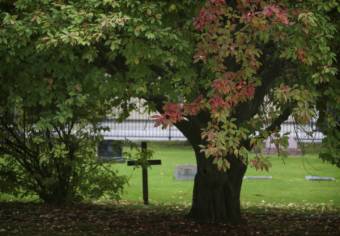
And in June, a headstone was placed on Dixon’s grave.
The epitaph says “beloved son, brother & uncle” over the dates of birth and death and an engraved portrait of Dixon. Near the bottom, chiseled in the same formal font as everything else, is a blunt message for the public, and for posterity: F**k COVID-19.
Dixon’s grave is in a family plot at Woodside Cemetery on Spring Valley Road near West Decatur, Pa. (Eric Kayne)
The family’s motivation for carving that into the headstone? It’s simple, Rimel says: Long after they are gone, they want the truth to endure.
“We want to make sure that people know Kyle’s story, and that he passed away from the virus.”
The coast of the Seward Peninsula near the community of Wales. (Laura Kraegel/KNOM)
Next year, Alaska’s international border with Russia will open for the Bering Strait Festival.
The seven-day festival is an effort to bring together residents of the high north from both sides of the strait, some of whom are relatives, and to honor their shared culture. It will include a cultural summit, an Indigenous peoples’ forum, traditional sports competitions and then a 43-mile boat crossing from Uelen in Russia’s Chukotsky District to Wales, on Alaska’s Seward Peninsula.
The festival’s head U.S. coordinator in Alaska, Mille Porsild, who is also an Iditarod veteran, says the hope is that the border will open every year for these seven days.
For the first crossing, set for the first week of August 2022, Porsild says people and boats of all kinds are welcome, but there’ll be an important frontrunner.
LISTEN HERE:
The following transcript has been lightly edited for clarity.
Mille Porsild: The first boat that will go across will be a skin boat. And that skin boat will be built by the hunters (in Chukotka) and supported by hunters from St. Lawrence Island, from Savoonga. And that is a very strong statement to the meaning of the Bering Strait and the crossing of this piece of water. Because the people that first came to North America, they actually came via this route, but before there was water. They walked across the steppe — the Beringia steppe. And then eventually water came and then they started traveling by skin boats. And still today, skin boats are a very important part of life in Chukotka, and it’s also a very important part of their sport. They have skin boat races. We’ll start out this whole historic event by having them go across first — that’s absolutely of tremendous importance. Then, following, will be literally anything or any way that people want to try and cross the Bering Strait. It’ll be open for all.
Casey Grove: I’m curious, as somebody who grew up in the ‘80s and had kind of this vague idea of what the Soviet Union was. How different is this now? I mean to even have the borders opened up for this limited amount of time, it seems so different from the past, of the Cold War.
Mille Porsild: I mean this is a really, really significant event and initiative to do this. I really can’t emphasize that enough. If you had asked me two years ago if this was going to happen or be possible, I would have looked at you with a smile and said, “I wish it was different, but I don’t think that’s going to be happening.” It’s really a result of the Arctic Council and the fact that the Russians now have the chairmanship, and they hold it until 2023. And so there has been this opening and this push that they should really look at: How can this forum — the council — support the need for collaboration across countries and the opening up of borders? How can it support and facilitate events that really support that? We can’t talk about an opening Arctic and not also look at the need to make sure that it’s open for people to travel and meet.
Casey Grove: In some ways, it’s almost like it’s going to be a family reunion for some of those folks that have relatives just on the other side of the border, right?
Mille Porsild: It is, it absolutely is a family reunion. Traditionally, there were people living on Big Diomede and Little Diomede, and they will be in the path of this 43 miles. Today, there’s a Russian military base on Big Diomede, and there’s a community of Alaskan Siberian Yupik on Little Diomede, and their families will live on the land and along the coastline there in Chukotka, and they will now be able to go back and forth by boat.
Close
Update notification options
Subscribe to notifications
Subscribe
Get notifications about news related to the topics you care about. You can unsubscribe anytime.