Family

Federal child tax credit expected to cut child poverty in Alaska

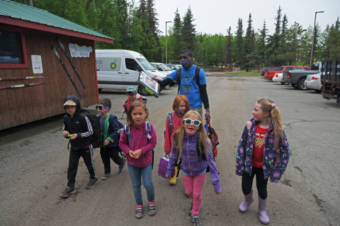
Kids at Camp Fire summer camp in Anchorage. Data from the Center on Budget and Policy Priorities show that 167,000 Alaskan children will benefit from the tax credit expansion. (Matthew Faubion/Alaska Public Media)

An expanded federal tax credit for working families rolled out last week as part of the American Rescue Plan Act. Many have already seen their bank accounts credited $250 to $300 per child this month. It’s a plan that experts say will cut child poverty in half across the country — including in Alaska.

Stephanie George is a single parent to two boys living in Eagle River. Her son Parker is in fifth grade and Brayden is in middle school. Both have autism. The last few years have been rough for the family.

A fire destroyed the inside of her house just before the 2018 earthquake, which meant living in hotels, rentals, and for seven months, a camper in their driveway. Taking care of both boys and their schooling without behavioral health staff during the pandemic was another challenge.

“They just require so much,” George said. “During the pandemic I had to basically do all of fifth grade with my fifth grader and stay on top of all this stuff with the middle schooler and basically reteach the fifth grader because he couldn’t wrap his brain around the distance stuff.”

Stephanie George is a mother to two boys with autism. She says the federal child tax credit will be a big help to make ends meet. (Photo courtesy Stephanie George)

George, who has master’s degrees in special education and educational administration, used to do private consulting for school districts until the pandemic hit. But she said it’s been difficult to find work that feels safe, especially because she has a medical condition that’s prevented her from getting vaccinated, and her younger son is too young to receive the shot. For now she’s relying on social security payments, food stamps and pandemic mortgage protections to make ends meet.

With all that hanging over her, George said the extra $250 a month for each of her kids won’t solve everything, but it is going to be a big help to be able to pay her bills.

“Getting that money would at least allow the basics to be paid so I can try to find something part-time or, you know, just find a solution,” she said. “Give me a little bit of wiggle room.”

In the past, families have received a $2,000 tax credit for children aged 0-16 when they filed their yearly taxes. The expansion increases the amount families qualify for and raises the age limit for children to 17. Families will receive up to $3600, or $300 a month, for every child under 6, and up to $3000, or $250 a month, for each child 6-17.

For the next six months, families can receive the first half of their money as monthly payments. The second half will be paid out when they file their taxes.

The full expanded credit is available for single parents who file as head of household making less than $112,500 or married couples filing jointly making less than $150,000. The amount decreases for families with higher incomes.

Automatic monthly payments started going out July 15, and George didn’t have to wait long for hers.

“Actually my informed delivery for USPS just came in,” she said, checking her email. “And that looks like an IRS type check in the mail today.”

Data from the Center on Budget and Policy Priorities show that 167,000 Alaskan children will benefit from the tax credit expansion. More than 20,000 of them will be lifted above or near the poverty line as a result.

Mouhcine Guettabi, an economist at the University of Alaska Anchorage, said it’s especially important for rural communities without strong economies even though the cost of living is higher in those places.

“Things are clearly more expensive the farther away you move from central Alaska,” he said. “However, those dollars potentially are more needed in those places and can potentially make more of a dent in an environment where cash is really hard to come by.”

Guettabi said he expects many families, like George’s, will benefit from being able to cover bills with the expanded credit. Others may use it to make one-time purchases to significantly improve their lives.

“There is very good research that shows that even a one time increase in income at an early stage in somebody’s life can affect their trajectory. Think about being able to put a down payment on a car so you can take your child to childcare, or get a better job. There are all sorts of little examples that could potentially alter the trajectory of somebody’s life.”

Cara Durr, spokesperson for Food Bank of Alaska, points to data projections that show less food insecurity among children in many parts of Alaska this year than in 2019. She chalks that up to relief programs like the stimulus payments and pandemic EBT benefits. She said she hopes the expanded child tax credit will have a similar effect.

“I just can’t overemphasize the importance of these kinds of resources,” she said. “And I think something like the child tax credit is really nice because it allows families to take that money and put it toward whatever their greatest need is, it’s not prescriptive.”

The expanded credit is only scheduled to last one year unless Congress takes action. George said it feels like a part of the social safety net that has been missing.

“I feel like if we’re not going to get more accessible or affordable childcare, or we’re not going to put paid leave in for parents when kids are sick, and all these different things like most first world countries have, then I really do think it should continue,” she said.

Most working families who filed taxes in 2019 or 2020 are automatically signed up for the expanded tax credit. Families who do not file taxes can go to childtaxcredit.gov to fill out an IRS non-filer form to receive their payments.

The Southeast Alaska State Fair is on for this weekend, with COVID precautions

A woman competes in the axe throwing contest during the logging show at the 2016 Southeast Alaska State Fair. (Photo by Jillian Rogers/KHNS)
A woman competes in the axe throwing contest during the logging show at the 2016 Southeast Alaska State Fair. (Jillian Rogers/KHNS)

The Southeast Alaska State Fair will go on as planned this coming weekend. Fair organizers say they are taking steps to ensure the safest gathering possible even as COVID-19 cases spike across Southeast Alaska.

Last year there was no fair due to the pandemic. One of the fair organizers, Madeline Witek, says she’s expecting a fun-yet-safe event this year.

“The beauty of the Southeast Alaska State Fair is almost all of it happens outside, which is the CDC is recommending to if you’re going to hold an event, have it be outside. So that’s really in our favor,” Witek said.

But there are a number of activities that won’t be on the schedule this year as part of the mitigation plan.

“There won’t be a bounce house. And we won’t have the joust, which is the inflatable kind of warrior, knock people off of a pedestal thing for lack of a better word,” Witek said. “It’s an inflatable arena, and you hit people.”

The Southeast Alaska State Fair typically draws hundreds of people from communities like Whitehorse in Canada’s Yukon Territory, Juneau, Sitka, Skagway, and Haines. The event features music shows, vendors and a slew of activities and games for all ages.

There will be some changes: no beer sold and no live music at the Klondike Stage. But there will still be a horseshoe tournament, she said

“There will not be alcohol for sale with the horseshoes, which I know is a disappointment for some but I think that we’ll be able to move forward with the horseshoe tournament without beers in our hands,” Witek said.

One of the biggest changes fairgoers will see is the sign-in sheet at the entrance to track attendees.

“That’s really the only way that we are able to keep track of who is attending. And in the very, we feel, unlikely event of any outbreak and the need to do contact tracing, that’s how we’re going to be able to do it,” Witek said.

Another big change will be shorter hours.

“We will not be having a late-night program, we will be wrapping up for the evening at around eight or nine o’clock depending on the day. That’s always, you know, people hang out in the beer garden later. And the late night music, everybody kind of comes together to dance. Part of our COVID mitigation strategy is to avoid that,” Witek said.

Organizers will make free masks available at the entrance, there will be hand-washing and sanitizing stations located throughout and social distancing is encouraged.

There is a long schedule of events available at Seakfair.org, culminating in headlining acts like Diggin Dirt, a funk band out of California on Friday night, and The Lack Family on Saturday. The final event of the weekend will be a free-for-all pie fight at 3:30 p.m. Sunday afternoon.

“We have a lot of whipped cream and Dreamwhip. And we are making whipped cream pies. And it’s a no-rules pie fight,” Witek said.

Transportation options include the Alaska Marine Highway System, Alaska Fjordlines, the Haines-Skagway Fast Ferry and options from Alaska Seaplanes.

‘It’s the fabric of our culture coming apart’: Yukon River communities face chinook and chum closure

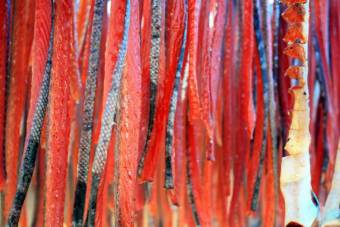
Yukon River salmon strips. (ADF&G photo)

In late June, summer chum salmon numbers in the Yukon River were the lowest on record. The chinook run is also extremely low, resulting in ongoing closures of salmon fishing on much of the Yukon River.

The loss is causing anxiety for more than 30 riverside communities that depend on chinook and chum as a main source of protein for the winter.
Ben Stevens is the Tanana Chiefs Conference tribal resources manager. Stevens is from Stevens Village on the upper Yukon and said he has never before seen such a total shutdown.

Below is a transcript of an interview with Lori Townsend on Alaska News Nightly, with minor edits for clarity

Ben Stevens: We’ve seen chinook crashes before in recent history. We were still okay with the idea because we had something else to fall back on. And that was the fall chum.

This year, it’s unprecedented because we don’t have the chinook or the fall chum, and that has disturbed our folks to a level I haven’t seen before.

Lori Townsend: Are there other river or tributary opportunities close enough that could help people get fish in other places? Or is it just not possible?

Ben Stevens: My family, when we go to fish camp, instead of setting the salmon net out there in the main stream, we’re starting to go into the back sloughs for whitefish and pike. That is another source of protein. I guess pound for pound, it’s a tremendous exertion of energy. But that’s what it is. And that’s what we’re going to do.

A lot of folks up and down the Yukon are doing similarly. If folks don’t get a moose — which, you know, is very difficult — they’re going to be staring into October with nothing in their freezers. I think that scares a lot of people.

Lori Townsend: As you’re talking to Yukon River community residents, what are you hearing about their concerns for winter protein and how they plan to try to help their families have enough to eat this winter?

Ben Stevens: Well, what we’re hearing is a lot of fear. And as an Alaska Native man, my job is to help feed the people, and that’s what I have grown up doing. But I think that there’s fear way down deeper inside folks than I have ever sensed in my life. I’ve been around, I’ve experienced some things, I’ve experienced fear before in our people. But nothing is so deep as this fear. I think that as we cannot harvest food from the land and the waters, it’s the fabric of our culture coming apart. That’s essentially what it is.

Lori Townsend: Meanwhile, as you’re probably aware, Bristol Bay is seeing the largest sockeye run in history right now. Is Tanana Chiefs Conference working to get fish from Bristol Bay or other areas for residents along the Yukon? Could that be part of at least the short-term solution for this winter?

Ben Stevens: Absolutely. We’re looking at all options in front of us. But you’re right: It is only a short-term solution. And it is not a solution that can be carried into the future. Because we should not be giving up our fish in Stevens Village to buy fish from the system out there in the marine environment. Does that make any sense? We should be able to take our families to the fish camps, have our kids pull that fishnet, have them process and that fillet goes straight on to the fire.

There’s something strong, there’s something very, very spiritual about that thing that our people survive on. It’s not just sustenance for your tummy, it’s sustenance for your soul. It’s family ties that are being strengthened.

When schools shut down in Alaska, these students went moose hunting

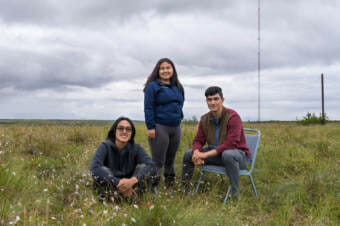
High schoolers Ethan Lincoln, Kaylee King and Jamin Crow’s podcast about their experiences subsistence hunting is a finalist in the NPR Student Podcast Challenge. The students are pictured here at the KYUK radio transmitter site in Bethel, Alaska. (Katie Basile/KYUK)

Jamin Crow waited silently for the bull moose to turn and face him. In the cold, the teen stood in an open meadow, his gun resting on a branch. He waited and waited and waited.

Then the moose turned, and his brother started to yell, “Shoot!” If Crow didn’t shoot, his brother would. So Crow took a deep breath and pulled the trigger.

“Your ears are ringing after the gunshot. And I look at my brother and he’s giving me the happiest look I’ve ever seen,” he says. “Everything is perfect at that moment …You know you succeeded in what your goal is.”

Crow lives in Bethel, in the remote Yukon Delta region of Alaska. For generations, his family has practiced subsistence hunting to get food on the table. The process hasn’t changed much, except that these days, the Crows use motor boats and snowmobiles to get to their moose camp, which serves as a home base while they’re on hunting trips.

“Food is very expensive here. You have to ship everything up,” Crow says. “We don’t go out just for the antlers. We’re not looking for trophies; we’re not hunting for something big. We’re looking for meat to feed our families.”

Crow is one of three Alaska Native students — along with Kaylee King and Ethan Lincoln — who made a podcast about their hunting tradition. The students are from different towns, but met as interns at NPR’s member station KYUK in their senior year of high school. Right before they graduated last spring, their podcast was chosen as a finalist in this year’s NPR Student Podcast Challenge.

Ethan Lincoln, Kaylee King and Jamin Crow. The three students say hunting helped them get through the isolation of the pandemic, when their schools and many other activities, like sports, were shut down because of COVID-19. (Katie Basile/KYUK)

The three students say hunting helped them get through the isolation of the pandemic, when their schools and many other activities, like sports, were shut down because of COVID-19.

In the podcast, Crow went hunting with his 17-year-old brother, Peter, but sometimes the whole family goes, including his father and grandmother. King and Lincoln — who are cousins — also go hunting with their families.

“Nowadays, you see everybody go out and hunt. Dads will take their daughters,” says Crow. “It doesn’t really matter what your gender is.”

COVID-19 did not hit Bethel until August of 2020 — when people started to travel to and from other cities. The virus quickly spread, closing schools through March of this year. Meanwhile, King’s village of about 250 people managed to make it through with very few cases, and she was allowed to finish out high school in person; she was the only graduating senior in her town this year.

The students explain that, as time goes by, fewer and fewer people are practicing subsistence hunting. King, especially, feels a pressure to keep the traditions alive.

“It makes me really sad because the way we used to do things is so different from how we do them now,” King says. “Even our language [Cup’ig] is slowly fading away.”

For the students, the practice of hunting allows them to connect with older generations.

“Whenever I go out hunting with my granny, I’m always hearing past stories about when my dad was a kid and he went hunting or my late grandpa [and] how he would just take the family up,” Crow says.

He sees peers like King practicing cultural dances, speaking the language and hunting, and he’s hopeful the traditions he grew up with will last. He already knows he wants to share the hunting experience with his own children some day.

“If we keep at this pace, I think our younger generation can pick it back up again because we have pride in our culture and we love where we are from and we don’t want to see it fade away.”

Sneha Dey is an intern on NPR’s Education Desk.

Copyright 2021 NPR. To see more, visit https://www.npr.org.

Consulate’s visit to Juneau delivers services for hundreds of Filipino Alaskans

Consul General of the Philippines Neil Frank Ferrer shakes hands with Alaska State Sen. Jesse Kiehl at Juneau’s Assembly Chambers during a meeting between the Philippine Consulate and local and regional representatives. (Photo by Pablo Arauz Peña/KTOO)

Several hundred Filipino Alaskans from around Southeast gathered at Centennial Hall in Juneau this week to get much-needed services from the Philippine Consulate. 

After two years and a pandemic-related delay, the consulate’s mission from San Francisco meant some Filipinos in Alaska could finally visit their families back home.

A line formed behind a table in the lobby of Centennial Hall, where Filipino Alaskans waited to get services to renew visas, passports and apply for dual citizenship. Masked volunteers took the temperatures of each person before they entered the main hall.

The Philippine Consulate’s regional office is based in San Francisco and serves most western states, from Colorado to Alaska. Typically, Filipinos who need services have to travel there to get them — but a visit like this saves them a lot of time and money.

Nora Carrillo is a volunteer and also applied for her dual citizenship in the Philippines with the consulate.

“It is nice for them to come over here and do dual citizenship instead of us going to San Francisco because it takes a lot of time,” she said. “Plus, it’s expensive. So we’re really thankful for them to come up here.”

Rebecca Carrillo is the Honorary Consul to the Philippines in Juneau. She says the consulate’s visit had been originally scheduled for last year, but the COVID-19 pandemic halted those plans. As a result, there was a backlog of people in need of consulate services. 

“For us here in Alaska, many Filipinos, Filipino-Americans, who would otherwise just be able to fly to San Francisco to receive services in person were unable to do so, thereby increasing the surge in the volume of calls at the Philippine Consulate,” she said.

Carrillo also says that travel restrictions to the Philippines meant that Filipinos in Alaska couldn’t visit their families back home. 

“There was a period when foreigners were not allowed to be issued visas to travel to the Philippines under certain type conditions, which includes if they are a parent of a Filipino child with disabilities, whether they’re serving on a humanitarian mission or their business,” she said.

Edric Carillo is president of the Juneau-based Filipino Community Incorporated. He says several hundred people from around Southeast Alaska were in need of the consulate’s services.

He says the consulate’s visit means that the Filipino community in Juneau is recognized alongside bigger communities in the country.

“That a small community of, you know, 30,000 plus people can, you know, rally together enough to get that level of recognition really, you know, is a testament to the community here and, and other communities in Alaska,” he said.

Consulate General Neil Frank Ferrer led the mission and says he’s happy with the turnout.

“The consulate, prior to the pandemic, has been making Alaska a priority for the outreach services. But now that the pandemic is more or less under control, I intend to come to Juneau and to Alaska every year,” he said.

The Philippine Consulate was in Juneau July 8-9 and in Fairbanks July 11-12. The consulate will be in Anchorage on August 26.

LISTEN: No Canada Day events for some, including Dawson City, after boarding school discoveries

Canada Day dawson city yukon RCMP parade
Royal Canadian Mounted Police officers lead the Canada Day Parade in Dawson City, Yukon Territory, July 1, 2006. (Creative Commons photo by G MacRae)

Communities across Canada decided not to celebrate Canada Day on Thursday, following the recent discoveries of hundreds of Indigenous children’s unmarked graves at residential schools in British Columbia and Saskatchewan.

That included Alaska’s neighbors in the Yukon communities of Haines Junction, Teslin, Carmacks and Dawson City. And Dawson City also announced it would donate its funds for Canada Day events to an investigation into residential schools in the territory.

Dawson City Mayor Wayne Potoroka says, in the wake of the boarding school revelations, it just didn’t feel right holding celebrations for the national holiday.

LISTEN:

Site notifications
Update notification options
Subscribe to notifications