Family

Alaska Medicaid must cover gender-affirming care following Homer woman’s lawsuit

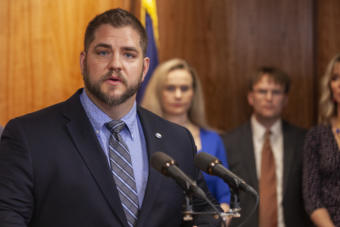
Adam Crum, Commissioner of Alaska’s Department of Health and Social Services, answers a question during a 2019 press conference. Crum was named in a class action lawsuit after Alaska Medicaid refused to cover costs related to hormone treatment in 2019. (Rashah McChesney/KTOO)

Starting this month, Alaska Medicaid can no longer deny coverage to transgender Alaskans undergoing gender-affirming treatment.
That’s following the January settlement of a class action lawsuit filed by Swan Being, a transgender woman from Homer who said Alaska Medicaid refused to cover costs related to hormone treatment in 2019.

Being sued the Alaska Department of Health and Social Services, which oversees Alaska’s Medicaid program, and department commissioner Adam Crum. She alleged the state’s policies discriminated against transgender Alaskans and violated the 14th Amendment, which grants all Americans equal treatment under the law.

Being was the first to file the case. Robin Black and Austin Reed, both of Anchorage, joined as plaintiffs in 2020.

Up until now, Alaska was one of 10 states that still explicitly denied Medicaid coverage for gender-affirming treatment, including surgery, hormone treatment and therapy. Similar lawsuits are currently in motion in West Virginia and Georgia, said Carl Charles, an attorney with Lambda Legal. He co-counseled the case alongside the Anchorage-based Northern Justice Project.

Charles said that kind of gender-affirming health care is life-saving for transgender people. And he said it’s particularly important to protect access to that health care when it’s contingent upon employment.

“When you consider the transgender people as a group, when you take into consideration that we are chronically underemployed as a result of anti-trans discrimination, that makes health care that much more difficult,” Charles said.

Being relied on Medicaid for her health care and was diagnosed by her doctor with gender dysphoria — a conflict between a person’s assigned gender and the gender with which they identify.

The American Medical Association identifies gender dysphoria as a “serious medical condition,” the lawsuit said, with dire health implications if left untreated. The association said gender-affirming care is linked to a lower rate of suicide attempts among transgender people and overall higher quality of mental health.

Being received hormone replacement therapy and, in 2019, planned to travel from Homer to Anchorage for further treatment.

Alaska Medicaid typically covers travel for medical expenses. But because it didn’t cover the hormone injections and lab work Being sought, it denied her doctor’s request to cover the trip.

The other plaintiffs both reported a lack of coverage for gender-affirming surgery and hormones, according to the lawsuit.

A spokesperson from the Department of Health and Social Services said the changes go into effect July 25. The spokesperson also said the settlement is a result of both the Affordable Care Act and a 2020 Supreme Court Case, Bostock v. Clayton County, that upheld gay and transgender workers are protected under existing civil rights legislation.

The state estimated the regulation change will cost the department an additional $28,000 each year, Charles said.

“Which, if I may say, is a real drop in the bucket,” he said.

He said that’s partly because there are not as many transgender people living in Alaska as in other states. Even fewer are Alaska Medicaid recipients.

“But it is going to be lifesaving,” Charles said. “It will cost the state very little to make these people’s lives really measurably improved.”

2015 survey of transgender Americans, including 84 Alaskans, found a third of transgender Alaskans had had issues in that past year with insurance coverage related to being transgender.

Nationwide, the American Medical Association found in 2019 about a quarter of transgender patients seeking coverage for hormones were denied in the year prior. That was true for over half of those who sought coverage for gender-affirming surgery.

Health care costs are compounded for people living in remote communities in Alaska. Goriune Dudukgian, an attorney with the Northern Justice Project, said that was just one manifestation of the discrimination challenged in the suit.

“For folks who are living in the off-the-road-system communities, or where they can’t get care within their own communities, the travel component is a really big deal,” he said.

When it comes to private insurance, however, there is no law barring insurers in Alaska and about half of all other states from excluding transgender-related health care coverage.

All the plaintiffs in the case will also receive $60,000 for damages, according to the settlement agreement.

At home in an avalanche path: Why Juneauites buy and keep homes in a hazard zone

The Behrends avalanche path seen from the 100 block of Behrends Ave., south of where the neighborhood crosses the path. (Rashah McChesney/KTOO)

Dozens of sought-after Juneau homes are built in an avalanche path. And decades of studies have pointed to the very real possibility of a big, destructive slide in the neighborhood’s future. But researchers and residents gauge risks differently, and a mix of personal choices and policy decisions keeps people in at-risk areas.
Janice and “Butch” Holst have owned the yellow house in the middle of their block since the late 1970s. Janice sits in an armchair in her cozy, slightly nautical-themed living room.

“We’re a landmark,” she said. “The Holsts on Behrends Avenue.”

At the time of purchase, they didn’t know the house where they planned to raise their children was in a zone that National Geographic Magazine once called the nation’s worst risk for a major avalanche disaster. 

Janice’s husband found out about the risk at work, from a colleague.

“He was bragging about having found a nice house right here. With the schools and having four kids, it was perfect. And this friend said, ‘Really? I don’t know why. It’s a big avalanche area. You’re not going to be safe there,'” Holst said.

“And and we’ve lived here happily ever since. But we have had some scary times.”

Behind their house, the 3,000-foot avalanche chute is bright green with new spring foliage that stands out from the darker, older forest on either side.

When avalanche danger climbed into the extreme range in their neighborhood last winter, the Holsts went and stayed with their grown son for a night. But Janice doesn’t have any plans to leave her home for much longer than that. The city has toyed with the idea of a home buyout program, but she says there’s almost no way they’d take it.

“Unless it was like, a million, trillion, zillion, billion dollars and a free maid and cooked meals every day. And a mink coat to keep me warm,” she said, whacking the arm of her chair for emphasis.

She says they have great neighbors, and the avalanches everyone’s talking about haven’t hurt them.

Lisa Ibias in front of her home on Behrends Avenue. (Claire Stremple/KTOO)

Lisa Ibias lives down the street from the Holsts. She and her husband didn’t know they were buying into an avalanche zone either. The seller, the realtor and even their lender did not mention the home was in a known avalanche path. She found out from a neighbor, after the papers were signed.

She raised six kids in the house, and says when there was avalanche risk, they slept against the uphill side wall in the basement. She says she’d take a home buyout if it was offered.

“If the city’s wants to buy the house, come on, bring it,” Ibias said. “I don’t know where I’d move. But not where there’s another avalanche.”

In harm’s way

In 2011, the city of Juneau contracted Swiss researchers to assess the risk to the Behrends neighborhood. The report said a major avalanche could run all the way to Gastineau Channel with enough force to destroy wood frame houses in its path.

“When you look at town, and you see these huge snowfields looming over neighborhoods — I mean, the gentlemen I brought in from Switzerland and France and other places in Europe look at me and say, ‘we can’t believe you built here,'” Tom Mattice said.

He runs the city’s avalanche program, and he co-authored a study that describes the risk to 60 homes, a hotel and a boat harbor in the Behrends avalanche path.

City code reveals how seriously the municipality takes avalanche risk. In severe avalanche zones, like the Behrends path, the city of Juneau doesn’t allow new construction. No additions, no in-law units, no new bedrooms. Nothing that would increase the human density of the area.

But Mattice says right after he took on his job in 2008, he floated the idea of home buyouts. He says the assembly at the time balked at the cost share the city would have to take on and decided not to spend the money. Mattice says it’s a hard sell because people who have moved in more recently knew about the risk when they bought — sellers have to disclose it.

Mattice says he wanted to build a wall to protect the houses and do controlled detonation of landslides, but that idea didn’t gain traction either. Swiss experts said a wall wouldn’t work. And the city can’t force people to evacuate their homes while Mattice’s crew sets off avalanches.

Juneau’s Emergency Programs Manager Tom Mattice in his office in April 2021. (Andres Camacho/KTOO)

Mattice says one way to get the city and residents to consider a buyout might be after an avalanche causes damage in the neighborhood.

“Because as soon as you get the insurance company involved because you damaged your house, that actually could be used as the cost share,” he said.

“So we could get some FEMA money to come in and buy that property, use that insurance money instead of government money to be that local cost share, make that homeowner whole, move them out of that residence and turn that into open park space for perpetuity.”

It might sound reckless to wait for a predictable disaster to happen rather than take action to get people out of the way. But Matisse tried that. For a buyout to happen now, he says the homeowner would have to take their case to the assembly for approval. He remembers less than half of residents were even interested in a buyout. Some people on Behrends think the studies overestimate the risk. One accused Mattice of fear mongering.

Home buyouts aren’t simple

Sherri Brokopp Binder is a community psychologist and an independent researcher based on the East Coast.

“I’m a disaster researcher; I think about disasters all the time. But for residents, disasters are just one point among many that make up you know, the complex reality of their lives,” she said.

She studied home buyouts in the wake of major storms like Hurricane Sandy. And she found that while municipalities see buyouts as a tool for prevention, people see them as a tool for recovery. That is, most homeowners don’t want to leave a perfectly good home in a dangerous place. But they are more likely to consider leaving a damaged home.

“I can look at pictures of a community that’s in the path of an avalanche and think, ‘Yep, those houses shouldn’t be there,’ right? That’s not a great place to build a community. But it’s not my house, right? It’s not my community that we’re talking about dissolving. And it’s not my life that we’re talking about upending.”

A discarded warning sign leans against a railing in the woods behind Behrends Avenue. (Photo by Claire Stremple/KTOO)

She says there are social consequences to a move — think of the Holsts who love their neighbors — and financial consequences. There’s no guarantee about getting the market value for a home. Juneau’s housing market is tight. If more than 30 households wanted to move at once, it would be tough.

Current city policy offers residents an avalanche warning system — someone to literally knock on their doors and ask them to get out of harm’s way. But while the city won’t add people to the area, it hasn’t invested in a plan to reduce the number of people who live in the hazard zone yet. For those residents, the only path out of harm’s way is to sell their homes, passing the risk to someone else.

Alaska’s Avalanche Capital

This story is part of a KTOO series about Juneau’s urban avalanche risk.

Vigil held in Juneau for children found at Kamloops boarding school

Drummers sing songs to honor the children found buried at a residential school in Kamloops, British Columbia. (Photo by Lyndsey Brollini/KTOO)
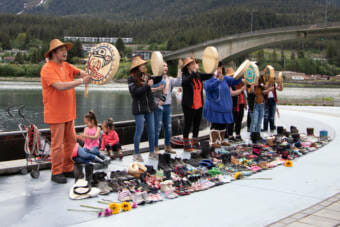
Drummers sing songs to honor the 215 children found buried at a residential school in Kamloops, British Columbia. People throughout Juneau donated shoes for the event, which are displayed to represent the 215 children. (Lyndsey Brollini/KTOO)

Last Saturday, the Alaska Native community and allies gathered at Overstreet Park in Juneau for a candlelight vigil honoring the 215 children found in unmarked graves at a residential school in Kamloops, British Columbia.

Indigenous people across Canada mourned when the news broke, but it wasn’t just a Canadian issue.

Jennifer Brown speaking at a candlelight vigil for the 215 children found buried at the Kamloops Indian Residential School in Kamloops, British Columbia.
Jennifer Brown speaking at a candlelight vigil she organized for the 215 children found buried at the Kamloops Indian Residential School. (Lyndsey Brollini/KTOO)

“The reason we sympathize with them is because the same thing that happened in Canada happened in Alaska. In Southeast,” Jennifer Brown said.

Brown is Tlingit from Sitka, and she organized the vigil held last Saturday. People burned sage and handed out orange ribbons and candles to everyone who showed up. Many came to the vigil dressed in orange, the color representing the missing children that never came home from residential and boarding schools, or red, the color representing Missing and Murdered Indigenous People.

Alaska Native children throughout the state were sent to boarding schools up until the 1980s with the goal of assimilating Native children. Some boarding schools were located right here in Southeast Alaska — Wrangell Institute in Wrangell and Sheldon Jackson College and Mt. Edgecumbe High School in Sitka.

In some cases, children were taken from their families and put into these schools, or  into foster homes.

Tlingit Elder Leona Santiago of the Kaagwaantaan clan is one of those children. She was taken from her family at age two and not returned until she was almost 15.

Leona Santiago at a vigil for the 215 children found buried at a residential school in Kamloops, British Columbia.
Leona Santiago speaking at a vigil for the 215 children found buried at a residential school in Kamloops, British Columbia. (Lyndsey Brollini/KTOO)

“And this loss of all, the discovery of all these children hurts. Because it makes us think. Makes me think of my pain, my tears, that I had to suffer,” Santiago said.

Santiago shared her personal experience to give people an idea of what it was like for a child to be taken away from their parents and put into government custody. And she said it was worse for the generations before her who went to boarding schools.

“I can’t even imagine the pain that they felt, my grandparents. They were told not to speak the language. They were disciplined, they were beaten with a ruler on their hand. Their mouths were washed out with soap,” Santiago said.

Yolanda Fulmer is Tlingit of the T’akdeintaan clan. She was another speaker at the vigil, and she said the discovery of the children in Kamloops only confirmed what Indigenous people already knew.

Yolanda Fulmer speaking at a vigil held for the 215 children found buried at the Kamloops Indian Residential School in Kamloops, British Columbia.
Yolanda Fulmer speaks at a vigil held for the 215 children found buried at the Kamloops Indian Residential School. (Lyndsey Brollini/KTOO)

“Kill the Indian. Save the man. These are all variants of the same sentiment that were passed throughout the U.S. and Canada. This was enacted through the genocide of boarding and residential schools,” Fulmer said.

The negative effects of boarding schools are not only felt by the children who attended, but by their families and communities as well.

“We see the residual damage, even into present day,” Fulmer said. “The painful stories we hold for our loved ones. The tears we try to catch. The heavy hearts and secrets we try to carry for them. They resonate throughout Indigenous country.”

People who attended boarding schools directly attribute alcohol and drug abuse, mental health struggles and trauma to the experience — as well as loss of culture, identity and language.

As a result of boarding schools, many people lost or stopped speaking their Indigenous language. Many Indigenous languages are now endangered because of it. But now that the history of boarding and residential schools is coming to light, people are starting to talk more about this past and begin the healing process.

Leona Santiago started the process in her twenties, and she says it’s not complete.

“So when we heal, we only don’t just heal ourselves. We heal what our ancestors had gone through,” Santiago said.

After the speeches, two songs were sung to honor and remember the children lost to residential schools.

On Monday June 21, there is a global memorial for the children found at the Kamloops Indian Residential School. And since more children have been found since the initial discovery in Kamloops, the memorial will honor them as well.

The memorial in Juneau will be held at 5pm at Overstreet Park.

‘It is our story as well’: After Kamloops, a Fairbanks vigil to mourn and raise awareness of boarding school trauma

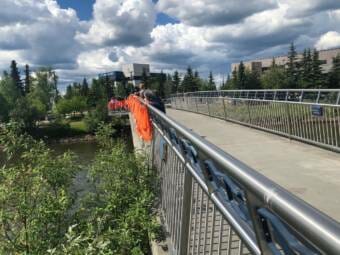
Two hundred and fifteen bandanas, one for each of the Native children whose bodies were found buried on the grounds of a former residential school in British Columbia, are hung from the Chena River footbridge in Fairbanks. (Dan Bross/KUAC)

A gathering was held in Fairbanks on June 13 to mourn and raise awareness about historic abuse, neglect and forced assimilation of Native children at government- and church-run residential schools in the United States and Canada. The Fairbanks event, and others like it in both countries, follows the discovery last month of the remains of 215 Indigenous children buried at a residential school in British Columbia, which closed in the late 1970s.

The event began with the tying of 215 orange bandanas to a clothesline, which was then strung along a footbridge over the Chena River in downtown Fairbanks. It was a symbolic gesture of acknowledgement and remembrance of the children found dead at the residential school in Kamloops, B.C.

Event organizer Sasha Housley addressed the gathering, emphasizing the generations of pain and loss residential schools have caused Native people in Canada and the United States.

“We acknowledge you,” she said. “He help carry your pain, we are your hope. We sing for you the songs you couldn’t sing at school. We will not forget your story or your history, for it is our story as well.”

Housley says her father was a boarding school survivor in Alaska, and although he never talked about his experience, she’s educated herself on residential schools.

“So when I found out the 215 children had been discovered in unmarked graves, it impacted me in a way I didn’t expect — well, deeper than I expected,” she said. “And I wanted to do something in memory of the children and to spread awareness.”

There were also songs, prayers, dancing and speakers, including Athabascan elder Fred John of Delta Junction. John attended residential schools in both Alaska and the Lower 48, including the Haskell Institute in Kansas, where he says many Native children died.

“Graveyard with tombstones, you know. And there were kids that died from 1884 at Haskell Institute,” John said. “Then one year my wife and I went to Carlisle Indian School, the first Indian boarding school that was made in the United States, and we visited the graves there — big graveyard, all Native kids from five years, four years on up. From all across the United States.”

John says his siblings also went to residential schools, and their experiences led to tragic outcomes.

“I had two sisters that, I’ll say, drank themselves to death. And all of them became alcoholic as a result of the boarding school,” he said.

Shirley May Holmberg has a background in behavioral health. She says she knows many people who were traumatized at residential schools.

“It was government’s effort to ‘take the savage out of the Indian,'” she said. “I have friends and family who have been affected by boarding schools. They experienced sexual abuse, physical abuse.”

Natasha Singh, with Tanana Chiefs Conference, said the only way to bring justice is to tell the stories of what happened at residential schools and pointed to the resilience of Native people to systematic oppression.

“The government sought to destroy our people though violence and genocide and cultural genocide,” she said. “It’s a beautiful day today because they failed, and we continue to thrive.”

The 215 bandanas, symbolic of the residential school children who died in British Columbia, will remain along the Chena River footbridge until the solstice, a span of 215 hours.

Demand is high as Alaska summer camps go back in session

Kids Enjoy a game of “nine square in the air” at Trailside Discovery Camp. (Matthew Faubion/Alaska Public Media)

It was a windy day near Little Campbell Lake in Anchorage last week.

Planes flew overhead. On the ground, a group of campers at Trailside Discovery Camp cheered each other on as they volleyed a ball back and forth.

“It’s just like four square,” explained 8-year-old Phoebe Van Wyck. “But it has nine squares, and they put the squares on stilts.”

Van Wyck is among thousands of Alaska kids headed back to camp after the pandemic shrank many programs last year or closed them completely.

Phoebe Van Wyck poses with friends from Trailside Discovery Camp at the fort they built nearLittle Campbell Lake. (Matthew Faubion/Alaska Public Media)

Camp directors say demand is high this summer, with COVID-19 vaccinations widely available, declining coronavirus cases and parents eager to send their kids to in-person programs after spending so much of the school year online.

“This week is Trailside’s largest week that we’ve ever had,” Director Victoria Long-Leather said. “We have over 300 campers across our sites.”

But holding summer camp this year isn’t without challenges: Many programs spent months writing and rewriting protocols to keep up with the evolving pandemic. And some, like the Salvation Army, are struggling with staffing.

“Usually, we have most of our staff come from out of state, and this year we have had a hard time recruiting,” said Captain Luke Betti, the Salvation Army Youth and Candidates’ Secretary in Alaska.

Camp Fire Alaska, the state’s largest child care provider, is feeling the strain too.

“Space is limited due to workforce shortages,” said Melanie Hooper, Camp Fire’s chief program officer. “So, you know, programs are full, and the need is high. But we still have not recovered as an industry to pre-COVID numbers.”

Kids at Camp Fire summer camp get ready for a hike. (Matthew Faubion/Alaska Public Media)

Hooper said Camp Fire’s day camp programs in Anchorage are running at roughly 50-60% capacity. She’s hopeful that as Camp Fire hires more workers, it will add more spots. She knows the need is there. The organization’s overnight camp, Camp K, sold out within 24 hours. The day camps have waitlists.

“We did have some families enroll for Camp K, and they signed their kids up for every camp session they could because their teenagers needed to get out of the house after a year,” Hooper said.

The demand, paired with financial strains from the pandemic, prompted Rasmuson Foundation and other organizations to launch a grant program for summer camps this year.

“We were very aware that kids were feeling cooped up, a lot of them missed out on their usual activities, whether it was just doing things with their family, organized camping experiences or programs,” said Diane Kaplan, Rasmuson’s president and chief executive. “And there was just a huge desire to get out and kind of be normal.”

The grants meant more camp spots and scholarships for Girl Scouts of Alaska’s summer programs, said chief executive Leslie Ridle.

“We never ever, ever want money to be the reason somebody didn’t go to camp,” she said.

Betti, with The Salvation Army, said the organization dropped prices to $10 per session at the overnight King’s Lake Camp.

“The goal of this discount is to give families who have struggled throughout the pandemic a break on camp fees,” he said.

In Southeast Alaska, the Sitka Fine Arts Camp is back on this summer. Executive Director Roger Schmidt said grants and donations kept the program afloat after last year’s canceled camp and events.

“Over two weeks, we lost a million dollars in revenue,” he said about 2020. “It took our breath away.”

Schmidt said staff spent a lot of time crafting COVID-19 protocols for this year’s camp.

“Our year-round staff have studied and read every available article and case study about camps and schools that we could get our hands on,” he said.

The camp serves roughly 1,000 kids who come from all over Alaska — and even from out of state.

Schmidt said the camp is requiring all staff get vaccinated, and is encouraging families with campers age 12 and up to also get the shots.

Kids at Trailside Discovery Camp help move a canoe for their lesson on boating. (Matthew Faubion/Alaska Public Media)

Everyone must wear masks indoors. Campers don’t seem to mind, he said.

“I’m looking out the window right now and watching kids just while they’re just getting out of class, and they’re just running across the lawn and smiling and playing and talking with one another,” he said. “It’s absolutely beautiful. And sorely missed.”

Back in Anchorage, at the lake, the Trailside day campers get their temperatures checked each day.

But they no longer have to wear face masks outside unless they’re close to non-campers, like while walking on the trail. Trailside just changed the mask rule last week in response to loosened federal health recommendations.

It’s pretty nice, said 8-year-old Nola Horn Rollins.

“At first, it was really weird though,” she said. “But then I really liked it. Seeing what my friends’ faces looked like and their facial expressions.”

So while 2021 summer camp is not quite like pre-pandemic times, it’s closer to it than last year. And, camper Van Wyck said, it’s a nice break from a very virtual 2020.

“I don’t have to do Zoom, don’t have to look at a screen, not move all day,” she said. “It’s way better.”

For small Kenai Peninsula towns, Pride Month is about visibility

The Pride in the Park march in 2019 drew around 100 people. Organizer Audre Hickey said the event has grown every year. (Jenny Neyman/KDLL)

June is Pride Month — a time for members of the LGBTQ+ community to celebrate love and identity and commemorate the 1969 Stonewall uprising, which helped catalyzed the gay liberation movement.

One of the cornerstones of Pride Month today is visibility. In a small town like Soldotna, that can mean a lot.

“Even just for kids to know they’re not alone,” said Joe Spady, who was born and raised on the Kenai Peninsula.

“Kids in a home that’s not safe for them to come out, at least they can look out and see that there is a community, both locally and globally, that will love and support them,” he said. “Because that’s exactly what I needed as a kid and I didn’t have.”

There are several Pride Month events planned on the peninsula this month and next. Audre Hickey is one of the organizers of Soldotna Pride in the Park, now in its fourth year.

“Each year our participation really increases,” she said.

She said this year’s event is scaled down because of COVID-19: There won’t be a drag show or a fair with booths.

Instead, people will walk together from the Soldotna Regional Sports Complex to Soldotna Creek Park this Saturday at noon.

“It is about showing our community members that we do have LBGTQ members here in our community, and that we are proud of them,” Hickey said. “And then it’s also a good way to show people that maybe don’t feel safe or comfortable coming out yet that they will be accepted when they do, and that our community will wrap their arms around them.”

Spady is also hosting a pride-themed supper club and picnic on that day.

Homer is having its own pride celebration on June 19. It’s overlapping with Juneteeth, the holiday celebrating the emancipation of enslaved people in the U.S.

Organizers said it’s important to connect conversations about race and sexuality. The Stonewall uprising in Manhattan was in large part an effort of Black trans women, a demographic that sees a high rate of fatal violence in the U.S. today.

Seward, too, is hosting a slew of events the last weekend of July. The Seward Pride Alliance moved its celebration after Pride Month in hopes it would be more COVID safe at a later date.

“We have all the different spectrums of the letters and the rainbow represented here and that’s really what we wanted to celebrate,” said Tony Baclaan, vice president of the Seward Pride Alliance.

This is Seward’s third year doing pride. They’re hosting several events, like a barbecue and a lip sync battle.

And in true Seward fashion, there will be a wildlife cruise. Baclaan said the 2019 pride cruise was really fun.

“We would listen to Beyonce, and we had a DJ on there, and it would be Beyonce, Beyonce, and then they would turn the music down and then they would see a whale or an otter,” he said, laughing.

He said visitors to Seward pride in 2019 told him they liked celebrating in a small town. A lot of pride events take place in large cities.

“Rather than a huge, large celebration, it was a really nice, quaint party,” he said.

All organizers agree — pride is about visibility. Spady said the queer community on the central Kenai Peninsula is much more visible today than when he was a kid.

“Everyone knows someone,” Spady said. “There are gay families raising their kids here. This is the community they’ve chosen to live in. It’s really exciting just to see how far our little community has come.”

Which is not to say it’s not without its obstacles. At the last in-person Pride in the Park, in 2019, marchers were met with a group of protesters.

Later that year, a gay Sterling woman reported being attacked at her home. That catalyzed a community reckoning about how the central peninsula can support members of its queer community.

“That was perpetrated by one hateful person,” Hickey said. “And the support that our community showed after that happened at our town hall was moving. There were hundreds of people there.”

Spady said he sees backlash coming from the Christian community. That’s one thing he’d like to see change.

“I always challenge all of my friends who claim the title of Christian to actively stand up against people who are un-Christ-like,” he said. “And I think it will really take people from within the church to make this change.”

Several pride events in Anchorage were canceled this year, after organizers chose a theme people deemed offensive. But there will still be a Pride Block Party and several other events in Anchorage later this month.

You can find information on a slate of statewide events at https://anchoragepride.org/events.

Site notifications
Update notification options
Subscribe to notifications