Family

At Sitka herring camp, an advocate passes down subsistence traditions

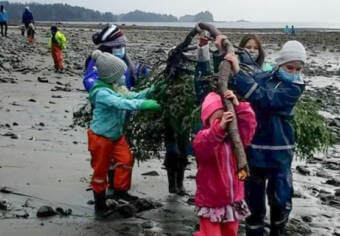
Students at Herring camp carefully carry a Hemlock branch across the beach. Gamble said he told students to treat the branch like they would their food, taking care to not let it drag in the sand. (Courtesy of Tom Gamble)

The beginning of the herring spawn in Sitka Sound signals the wind-down of commercial fishing and the start of the subsistence harvest: the millennia-old tradition of submerging hemlock branches along the shoreline, and waiting for herring to coat them in a thick layer of eggs.

Subsistence harvester and former Tribal Council member Tom Gamble is determined to see this tradition continue — by working to protect herring stocks and teaching kids how to harvest eggs. This spring, he shared some of his knowledge in a herring camp for kids.

“This was their first time seeing what subsistence herring eggs are all about,” Gamble said about his herring campers. “They’re really excited about it, they, they like to eat them, but they’re not really sure how to harvest them.”

Gamble said the camp created a lot of “aha” moments.

“There were a lot of those moments for these kids who had never seen anything like it before,” he said. “Giving them just the mental images for the first time, and being able to manipulate, you know, a branch and a twig and, and the hope that maybe they might get some eggs.”

The camp is an extension of his new business, the Alaska Native Indigenous Training Academy, or ANITA, named after Gamble’s late mother. Over the course of several hours one day in late March, he taught around 10 students and their chaperones the basics of harvesting herring eggs on branches, from the technical to the familial.

“So the very first activity they had to do was to go and find a rock together. And then they had to learn how to tie it together and to communicate what works and what didn’t,” he said. “Because if you’re out there and you’re harvesting, and you’re not talking with your family, then it’s just work. You might as well just get a job and call it work. It’s got to be fun.”

“Helping Tommy set the trap for the herring — it was fun,” said 8-year-old Lukas Schmidt, who participated in the class. “I liked doing it, and I got to learn something new,” he said.

Lukas’s mom Jeren said the camp was an important experience for her kids and her homeschool classroom.

“It’s important to carry on some of the Tlingit traditions and to learn about them,” she said. “My family and I are Iñupiaq, so this is all new to us, but it’s fun to learn about the traditions of the local Indigenous peoples.”

Lucas Schmidt holds a buoy (often an empty milk jug or water bottle) as Tom Gamble demonstrates how to set a branch along the shoreline. (Courtesy of  Jeren Schmidt)

Subsistence is a lifelong practice for Gamble. He is Kiks.ádi from the Clay house and his family uses the Herring Rock as their emblem, signifying strong cultural ties to Sitka herring for thousands of years. His advocacy for herring has become energized by what he’s seen on the water over the last couple of decades.

“As a subsistence harvester, we’re the frontline. We see a lot of changes,” said Gamble. “My involvement if you would, wasn’t chosen, where I wanted to draw a line in the sand and say ‘I want the commercial side to be over here and I want the subsistence guys to be over here,’” he said. “My involvement came because we realized if we didn’t stand up, there were never going to be any changes, and we were going to get run right out of our own way of life.”

The Sitka Tribe of Alaska sued the state in 2018, calling for changes to the management of the commercial fishery. The case is still being litigated but some incremental changes have been made. The state must further document its efforts to show they’re allowing “reasonable opportunity for subsistence.” But Gamble is concerned that the state’s modeling is far from perfect.

“Most recently, the indescribable coming back from a different harvesting trip, I had to stop in the middle of the ocean to watch the herring surface,” Gamble, thinking back on a day in mid-March. “This was on the day that science flew everywhere in the Sound and said that they didn’t see a single herring. So the traditional harvester had the herring come up under me. I’m telling you again that our traditions and our knowledge have proven over time. When we say that the herring are disappearing, that’s what we meant.”

Gamble understands that commercial seiners are just trying to earn a living, but he believes the fleet is too large and should be reduced through a permit buy-back program. And he’d like locals to have a larger role in managing the fishery through a stakeholders committee.

In the meantime, it’s important that the subsistence harvest of herring remains viable in Sitka Sound, so that it can be taught down through the generations. Gamble plans to continue teaching subsistence camps throughout the year. It’s a way to honor his mother, Anita, and a hedge against the day when he is an elder himself and may depend on others for this food.

“When I was growing up I never thought for the life of me that even my own kids would be so busy that I can’t get help harvesting. And I thought ‘Well maybe if I trained a couple of these youngsters around here, I can sit at home and one day they just bring me a deer or a seal,'” Gamble said. “I’m gonna train this next generation how to take care of Elders in their community by just taking care of themselves.”

Editor’s note: This story is part of a series sharing different perspectives on herring.

Domestic violence shelters face ‘terrible choices’ from looming federal cuts

Bethel’s annual Peace Walk, hosted by the Tundra Women’s Coalition, on Oct. 3, 2016. (Credit Katie Basile / KYUK)

Domestic violence shelters around the nation are preparing for a large decrease in federal funding that will take effect in a few months. Tundra Women’s Coalition in Bethel said that it will mean a 20% cut in its operating budget and could lead to a significant loss in services.

Federal funding for domestic violence and women’s shelters from the Victims of Crimes Act has been decreasing in recent years. The Council on Domestic Violence and Sexual Assault is an organization within the Alaska Department of Public Safety that directs federal funding to victim services programs within the state.

In a letter sent on  April 1, CDVSA Executive Director Diane Casto wrote that Victims of Crimes Act funding would decrease by 34.6% from the previous year. This would affect shelters like Tundra Women’s Coalition and the Emmonak Women’s Shelter in Fiscal Year 2022, which begins in July.

“Everyone was like ‘what is everybody going to do? What are the shelter programs going to do?’ It was devastating news,” said JoAnn Horn, director of Emmonak Women’s Shelter.

Bethel’s Tundra Women’s Coalition Executive Director Eileen Arnold explained how that decrease in federal funding would affect her organization’s bottom line.

“It’s like 20% of our full, annual operating budget. It’s deep, it’s significant,” Arnold said.

She said with that large of a funding cut, TWC will have to think about eliminating services.

“That amount of money would equal, like, the entire Children’s Advocacy Center, or it would be the entire shelter,” Arnold said. “These are terrible choices.”

Arnold said that TWC could also consider cutting part of every program.

“But that’s just as difficult because our staff are already under-resourced and overwhelmed with work,” Arnold said.

Horn said that if they can’t find more money, the Emmonak Women’s Shelter would likely have to cut the number of its advocates. Advocates answer crisis calls 24 hours a day for the 13 villages that Emmonak Women’s Shelter serves. They also arrange accommodations for women and children at the shelter and coordinate with law enforcement.

Arnold is hoping that the state can help fill the budget gap left by the decrease in federal funding. Arnold is asking people to call their state legislators to advocate on behalf of their shelters.

“I hope that TWC has helped people in this community. And for the people that it has helped, I hope that they would tell our legislators that,” Arnold said.

There is a House Finance Committee hearing on Friday, April 9 at 1:30 p.m. to share public testimony on the state’s operating budget.

Kids can’t get vaccinated yet, but Yukon-Kuskokwim Health Corp is getting ready by registering children age 12-15

YKHC staff members package vials of the Pfizer-BioNTech COVID-19 vaccine on Dec. 16, 2020. (Katie Basile/KYUK)

The Yukon-Kuskokwim Health Corporation is asking all parents and guardians of 12 to 15-year-olds to sign their child up for a COVID-19 vaccine. The vaccine is not yet authorized for this age group, but the health corporation wants to be able to quickly dispense the vaccine to these adolescents if the authorization comes.

Dr. Ellen Hodges, chief of staff at the Yukon-Kuskokwim Health Corporation, is anticipating that emergency use authorization from the U.S. Food and Drug Administration will arrive soon for the Pfizer-BioNTech COVID-19 vaccine.

“If you have kids in that age group, we want you to go ahead and complete our online form at YKHC.org so that we can start planning our vaccine clinics for when we can start vaccinating our adolescents,”  Hodges said.

On March 31, Pfizer announced results from its COVID-19 vaccine clinical trial in 12-to-15-year-olds. The company’s data shows the vaccine is 100% effective at preventing COVID-19 in this age group. In the trial, 1,131 adolescents received the vaccine and none developed symptoms of COVID-19; no serious side effects occurred. Results show the vaccine to be more effective in this age group than in adults. In total, 2,260 adolescents participated in the trial. Of the 1,129 children who received placebos, 18 developed COVID-19.

The company’s results have not been peer reviewed or published in a scientific journal. If the FDA authorizes the vaccine for this age group, parental or guardian permission will be required for vaccination. Following authorization, Hodges hopes to vaccinate every child aged 12 to 15 in the Yukon-Kuskokwim Delta.

“I think it’s a great way to keep our kids safe, and I know all of us are sort of desperate to get our kids back in school and get back to school sports. This is our way to get there by vaccinating that age group,” Hodges said.

Vaccinating this age group could also help keep students in the classroom. Under CDC guidelines, fully vaccinated people do not need to quarantine after exposure to someone who’s tested positive for the virus.

“Right now, if we have a kid in the school who tests positive, we have to quarantine anyone who’s been within 6 feet of that kid, so this will allow us to really keep the schools open and keep everything much safer,” Hodges said.

Hodges said that YKHC is working with school districts to create parental consent forms for 12 to 15-year-olds to be vaccinated in schools in case the vaccine is authorized for this age group before the semester ends. The vaccine clinic would be similar to flu vaccination clinics done in schools.

Some Juneau elementary school students are going back to school 4 days a week

Tanner Cooper eyes his lunch at Sayéik Gastineau Community School where he and his sister returned for in-person learning on Thursday, Jan. 14, 2021, in Juneau, Alaska. (Photo by Rashah McChesney/KTOO)

Some Juneau elementary school students are returning to a nearly normal school schedule starting as soon as Monday.

Most schools are just finishing a full week of distance learning as a precaution after spring break travel. So, it came as a surprise to some parents when the Juneau School District announced that it plans to have elementary students attend in-person classes four full days a week.

Auke Bay, Riverbend, Montessori Borealis, Juneau Community Charter School, Mendenhall River and Sayéik: Gastineau Community School will start the new schedule on April 5. Harborview Elementary students in second- through fifth-grade, all Tlingit Culture Language and Literacy students, and students at Sitʼ Eeti Shaanáx̱ Glacier Valley start on April 12.

Wednesday will continue to be an independent learning day.

For Sanjay Pyare, it’s welcome news. He said his kids have been tapped out on remote learning after a full year of distance learning.

“It’s going to be a lot more effective for the teacher,” Pyare said. “And for the teacher to go back and ask questions and zero in on students and whatnot, and how much they’re picking up.”

Pyare also said it will give his kids more of an opportunity to have a social life.

“Just being able to goof off and be kids in a normal environment is a healthy thing,” he said.

Superintendent Bridget Weiss said the decision is an important step toward students’ academic, social and emotional recovery.

She said the district will be flexible as families adjust to the change in the next few weeks. Distance learning will still be available for families who have decided not to return to in-person classes.

Kristin Bartlett with the school district said the minimal risk level in the community and recently updated guidelines from the Centers for Disease Control and Prevention contributed to the decision.

The district is going by the CDC’s recently updated guidelines to keep students at least three feet distanced, instead of six feet, throughout most of the day. Mitigation measures such as masking will continue to be implemented.

Federal dollars could be ‘game changer’ for Alaska families

Students in gym class at Dena’ina Elementary School in Wasilla on September 21, 2020. (Jeff Chen/Alaska Public Media)

Massive. Huge. Historic. That’s how journalists, economists and politicians are describing the most recent federal COVID-19 relief plan, a $1.9 trillion bill that Congress passed earlier this month.

One significant part of the bill that’s gotten a lot of attention is an expanded child tax credit.

“There’s a lot to be excited about,” said University of Alaska economist Mouhcine Guettabi.

The relief bill removes many typical barriers to aid, Guettabi said, and people will be eligible for a lot of money.

“My broad takeaway is: Massive injection,” Guettabi said. “We’ve never seen anything like this. [It’s] really well targeted towards lower income households, in terms of the impact. The fact that there are advanced payments, and it’s fully refundable, is a game changer.”

With the child tax credit, families could get as much as $300 per month per child, starting in July. Even people who don’t normally get the tax credit because they had no income last year could potentially qualify for these funds. And it’s a direct payment, no strings attached — much like the stimulus payments people are seeing pop up in their bank accounts.

Guettabi said that’s a big deal, too.

“That’s the part that potentially makes a dent in terms of people’s finances.”

While it’s a temporary stimulus, Guettabi said those extra funds will stretch, particularly for low-income people. There is clear research that even a one-time boost to a family’s income can totally change the trajectory of a person’s life, Guettabi said. Finally being able to buy a car, for example, could lead to a better job and more earnings over time.

It could also simply mean fewer trips to the food bank, said Trevor Storrs, CEO and president of Alaska’s Children’s Trust.

“When you have a family that struggles, not just day to day, but at times, hour by hour, $200 feels like winning the lottery,” said Trevor Storrs.

In addition to the child credit, Storrs said other components of the bill including more money for food stamps and child care will improve Alaska children’s well-being.

Stephanie Berglund is CEO of thread Alaska, which advocates on behalf of child care providers in the state. Berglund anticipates over $92 million in child care support and relief for Alaska from the most recent aid packages.

That’s enough money to boost the child care industry to function better than it did before the pandemic, Berglund said.

“There’s an opportunity so that child care can be more accessible and more affordable for families, early educators can be paid a livable wage, and we have a stronger, overall-transformed child care system,” Berglund said.

Other organizations are also thinking about the long-term impact of these short-term funds.

Clark Halvorson is CEO of the United Way of Anchorage. He said calls to the 2-1-1 help line are still 300% higher than normal, even a year into the pandemic.

People need help with child care, food and rent relief. The pandemic just made existing problems worse, Halvorson said. He hopes these federal funds will start to address the root of problems that have left so many Alaskans struggling in the last year.

“We often talk about, ‘When are we going to get back to normal?’ And we’re trying to kind of change that dialogue a little bit and say, we really want to create a new normal,” Halvorson said. “One where people have equal opportunity.”

Details about how funding will be distributed and individual eligibility requirements are still coming.

But most are in agreement: The funds will make a significant difference for families in Alaska, especially those that continue to struggle the most.

Gov. Dunleavy withdraws order to split Alaska’s health and social services into separate departments

Alaska Gov. Mike Dunleavy speaks at a news conference on COVID-19 in Anchorage, Thursday, March 26, 2020. Health and Social Services Commissioner Adam Crum spoke remotely and appeared on a TV screen to the governor’s right. (Creative Commons photo courtesy Alaska Governor’s Office)

Gov. Mike Dunleavy has withdrawn the executive order that would have split the state Department of Health and Social Services.

Dunleavy sent a one-sentence letter to Senate President Peter Micciche and House Speaker Louise Stutes on Thursday morning withdrawing the executive order.

Members of the Alaska House of Representatives had prepared a resolution that would have blocked the order, which would have led to two departments: a Department of Health and a Department of Family Services.

“There was a lot of uncertainty and not a lot of evidence or clarification for how this reorganization would work on the ground for Alaskans who are utilizing the services,” said Bethel Democratic Representative Tiffany Zulkosky.

Zulkosky noted tribal organizations and other stakeholders raised concerns that they weren’t included in planning for the split before Dunleavy announced it.

In December, Dunleavy and Department of Health and Social Services Commissioner Adam Crum said the department was too large and that splitting it would improve services.

Tribal organizations, advocates for foster children and the largest union for state workers had expressed concern about the plan. And a lawyer for the Legislature said portions of the executive order appeared to conflict with state law and faced potential legal challenges.

Anchorage Democratic Rep. Liz Snyder said she’s interested in hearing more ideas from the administration on potential changes to the Department of Health and Social Services. But she said the executive order was “a bit premature,” and that more time would have allowed the state to address legal and budget questions, and to engage stakeholders regarding the effect it would have on state programs.

“It is our biggest department. It has a very large budget,” Snyder said. “And, yes, there may be value in having smaller units to focus in.”

Wasilla Republican Representative Cathy Tilton says she hoped the executive order would have led to lower state spending.

“I think that some of the ideas for the reasoning behind breaking the department into two departments might have had some merit. But I can also understand that we are a less-government-is-better [party], and so I will look forward to seeing what the governor and the administration may come up with in the future.”

A joint session would have met to consider the executive order, and a simple majority of 31 combined senators and House members would have been able to block it.

This story has been updated to include lawmakers’ comments.

Site notifications
Update notification options
Subscribe to notifications