Family

For the fourth year in a row, Alaska’s population declined

Alaska flag
The Alaska flag. (File photo by Skip Gray/Gavel Alaska)

Alaska’s population dropped by nearly 4,000 people — or 0.5%– last year, according to estimates released from the state on Thursday.

It’s the fourth straight year of declines and the biggest drop since 1988. The estimate covers the period between July 2019 and July 2020.

Even though 5,000 more Alaskans were born in the state than the number of those who died, the net decline came from people moving away. Nearly 9,000 more people left the state than moved in. Also, Alaska lost roughly 46,000 jobs during this time.

Alaska’s estimated population was 728,903 in July, down from 740,637 four years earlier.

One group that saw an increase was Alaskans 65 and older. That group grew by 4%.

Of Alaska’s 30 boroughs and unorganized census areas, 23 had population declines, led by Anchorage. The Fairbanks North Star and Matanuska-Susitna boroughs had the largest increases.

Juneau’s population is 31,773 — down 286 people from the year before. There were 118 more births than deaths in the capital city, but 404 more people moved away than moved to town.

The numbers are estimates, because the numbers from the 2020 census haven’t been released yet.

As COVID-19 canceled live events, Anchorage residents went analog

A customer waits outside Anchorage House of Hobbies on Thursday, Dec. 31. (Abbey Collins/Alaska Public Media)

The pandemic has been devastating for many in Alaska’s small business community. But certain businesses unexpectedly filled a new niche: old-fashioned, pandemic-friendly analog entertainment. They ended up seeing growth in sales.

Anchorage House of Hobbies, in Spenard, has been very busy this year.

“I don’t know that I’ve ever had to work so hard,” store owner Ryan Raffuse said. “It’s been an exercise in flexibility.”

When the pandemic began to take hold in Anchorage, Raffuse sprang into action planning for a slow year.

“When I saw what was going to happen in March, I started planning what I was going to do with downtime. I had a list of all kinds of projects around the store that I was going to take care of. And when we did close, I took a couple days off,” Raffuse said. “But then we quickly found that people needed things to do, and they were constantly calling and messaging and emailing.”

It turned into the best year ever for sales. Raffuse said 2019 was already a record year, and now sales are up 10%.

Raffuse serves on the board of directors for the National Retail Hobby Stores Association. He said business has been booming at hobby shops across the county. He thinks it has to do with people being stuck at home. Those people who still have money to spend don’t have many places to spend it.

“My family didn’t go on a trip to Disneyland like we planned,” said Raffuse. “So that’s thousands of dollars we planned on spending that we didn’t spend. I know there are many, many families who had the same thing: They didn’t go places. They aren’t going to movies to spend little bits. They aren’t spending as much at restaurants. They aren’t doing all these other things. But they can stay at home and build models and play with RC Cars and planes.”
While it’s been a good year for the House of Hobbies, Raffuse recognizes that hasn’t been the case for others in Anchorage’s business community. This month he’s been doing what he can to support local restaurants, by buying his employees lunch from a different one each day.

“I and my family, we definitely believe in the community aspect of what we do, and how important it is for our neighbors to be doing well in order for us to do well,” said Raffuse. “We’re very much all connected.”

Down the road at Bosco’s, store manager Eric Helmik says sales have been surprisingly strong this year.

Once solely a comic book store, Bosco’s now sells many different products — board games, role play games and sports cards.

This year, Helmik says puzzles and games have been among the products selling particularly well.

“We had to kind of switch gears on a few things,” said Helmik. “Normally, we don’t go through a lot of puzzles. So we had to kind of scramble and check with a bunch of distributors and find out if they had extra puzzles and see what they could get us.”

The store also has an events room, but hasn’t been able to hold any during the pandemic.

“Pre-COVID, we would have, you know, all kinds of games going on there,” said Helmik. “Mondays we would have Pokemon or Star Wars. And then there would be Yu-Gi-Oh on Tuesday, and several days of Magic the Gathering.”

Now, Helmik said the events room is being used as extra retail space, to give shoppers more room in the store.

Helmik said he thinks at least some of the store’s success comes from people’s desire to escape the real world for a bit.

“A lot of people — they’re just wanting to escape reality,” said Helmik. “So they want comics to read, or graphic novels, or they want to play a role playing game just to get away from the real world for a few hours.”

Like Raffuse, Helmik said now more than ever, it’s important to support Alaska businesses and shop local.

Meet the first baby born at Juneau’s hospital in not-2020

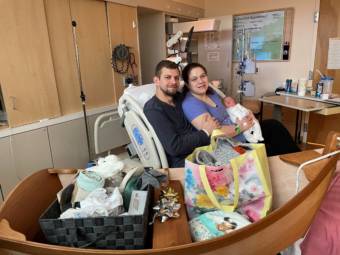
The first baby born at Bartlett Regional Hospital in 2021. Madelynn Rose was born to parents Kevin McCallister and Alexus Forehand on January 5, 2021, at 7:50 a.m. (Photo courtesy of Bartlett Regional Hospital)

The first baby of 2021 born at Bartlett Regional Hospital in Juneau came into the world at 7:50 on Tuesday morning: a nine and a half pound baby girl named Madelynn Rose McCallister.

Her parents, Alexus Forehand and Kevin McCallister, live in Skagway. They came to Juneau several weeks ago because they thought their baby was due on Dec. 6.

“Once we got here to Juneau, they realized there was a mistake,” said McCallister. “She was due a month later than previously thought.”

McCallister works at the Canadian border crossing in Skagway, and he didn’t have anyone who could sub for him at work. So he’s been traveling back and forth to Juneau on weekends since November. But even with that hassle and the extra month in the hospital, he’s still glad his daughter was born in 2021.
“I’m just glad 2020 is over,” he said. “In general.”

Subtract nine months from right now, and that puts us back at the end of March or beginning of April, which is when COVID-19 came to Alaska. Madelynn Rose is definitely a pandemic baby. But McCallister and Forehand were living in Georgia back then. They found out she was pregnant right as they were about to move to Skagway.

McCallister says he was relieved they moved when they did. Because there were very few cases of COVID-19 in Skagway until late in the year.

“Right around the time it was time to go to Juneau, we started getting our first cases,” he said. “So we just kind of stayed away from everybody.”

McCallister says he felt really safe at Bartlett. They got COVID tested when they were admitted to the hospital.

One of the perks of being born at Juneau’s hospital is that the first baby of the year gets a special keepsake. It’s a wooden cradle in the shape of a boat, made by the Emergency Department Director, Dr. Lindy Jones, who used to deliver babies at the hospital.

The first baby born at Bartlett Regional Hospital in 2021. Madelynn Rose was born to parents Kevin McCallister and Alexus Forehand on January 5, 2021, at 7:50 a.m. (Photo courtesy of Bartlett Regional Hospital)

McCallister didn’t know they were in the running for a prize.

“We didn’t know about it until the ladies brought it to the door,” he said. “It is absolutely awesome! It’s a work of art. It’s got all copper nails. Everything has been hand cut.”

The couple has two other small children at home in Skagway. A boy who’s two and girl who’s three.

“We won’t be home an hour, and they’re going to be sitting in this thing with their fishing poles,” he said. “They’re going to fall in love with this thing.”

Alaska fishermen cheer passage of the Young Fishermen’s Development Act through Congress

Crew members shovel pollock off the deck of a Bering Sea fishing boat earlier this year.
Crew members shovel pollock off the deck of a Bering Sea fishing boat earlier this year. (Photo by Nathaniel Herz / Alaska’s Energy Desk)

A new federal act will set aside funds annually to support fledgling fishermen, pending approval from President Donald Trump.

The Young Fishermen’s Development Act passed through both houses of Congress this month with strong support from all three Alaska legislators. If enacted, the act would fund training and mentorship opportunities for commercial fishermen who are just entering the industry.

It would be the first program of its kind for fishermen. The U.S. government already sponsors comparable professional development programs for young ranchers and farmers.

Grants and program funding would come from Congress. But it would be up to local communities to decide how to use funding.

“So local nonprofits or Native organizations can apply and propose projects that make sense for that year,” said Marissa Wilson, executive director of the Alaska Marine Conservation Council. The council is one of the nonprofits that brought the idea for the act to Rep. Don Young’s desk five years ago.

“Things are changing so much year to year that having this sort of bottom-up program focus, I think, is going to be a lot more effective than having some kind of program legislated at the federal level and then trickling down across the nation,” Wilson said.

Wilson is a fisherman herself, based out of Homer. She started fishing with her dad when she was 14. But she said those who aren’t born into fishing families can have a hard time getting started in the field.

As a result, Alaska’s fishermen are trending older. In 2016, the average age for a commercial fisherman in Alaska was over 50 — a decade older than it was the previous generation. That’s known as the “graying of the fleet.”

Researchers from the University of Alaska studying the fishing industries in Bristol Bay and Kodiak found that young people were deterred by high economic and social barriers to entry, not lack of interest.

Fisheries demand a complex skill set, said Linda Behnken, executive director of the Alaska Longline Fishermen’s Association. They have to be able to run a boat and a business and keep up with technology.

And the industry has become more competitive over the years. This year, Cook Inlet fishermen, in particular, had to grapple with low returns on harvests and the prospect of closed fishing areas.

All together, it can be daunting for those without experience or family ties.

Over the last several years, young Alaska fishermen took trips to Washington, D.C. to talk to legislators about the act. They joined forces with peers across the country under the umbrella of the Fishing Communities Coalition, a national association of commercial fishing groups.

Abby Turner-Franke, of Soldotna, fished with her family from the time she was eight years old. She’s now a project coordinator for the North Pacific Fisheries Association in Homer.

She went to D.C. to lobby twice. She said it was exciting that young fishermen were involved in pushing the act through.

“For them to participate in that process, to meet with delegations and with staffers and to see this progress, from being written and going through different iterations, and also having to explain themselves and why it is beneficial — I think is an incredible learning opportunity in itself for young fishermen,” she said.

The act does not exactly specify what age is considered “young,” but does say that term encompasses those who are either starting out or have worked on a commercial fishing vessel for no more than 10 cumulative years.

Wilson said fishermen had originally proposed the act be funded by the Asset Forfeiture Fund, the fines collected from fishermen who violate regulations.

The bills that passed in the House and Senate, however, show money coming from the regular Congressional appropriations process each fiscal year.

“It’s great that we now have this mechanism that will be in place as soon as it’s signed by the president. But it’s going to be something that we’ll need to continue advocating funding for moving forward,” Wilson said.

Funding will be allocated through Sea Grants, a partnership of the federal government and universities across the country. Eligible tribal groups, organizations and institutions will be able to propose projects for funding.

The Young Fishermen’s Development Act is awaiting approval by the president.

Moms couldn’t get baby formula in Russian Mission after the postmaster resigned, so they called in the National Guard

Russian Mission in 2018. (Dept. of Commerce, Community, and Economic Development)

Russian Mission’s post office has been closed on and off for nearly six months, and that’s made it hard for parents to feed their babies.

Before August, if you were a new mother in Russian Mission, you were probably getting your baby’s formula through WIC, a federal option that helps boost food security for mothers and kids under five. It would have come through the mail. You also could have bought formula at the store or ordered it online. Either way, it would arrive via the post office.

But ever since the postmaster resigned, mothers have been left to scramble for new options. Tribal Administrator Olga Changsak has been trying to get formula to Russian Mission for months.

“The mamas are getting very stressed out,” she said, “But they’re nice enough to share amongst each other.”

Changsak has two grandchildren on formula, so she did what any concerned grandmother and tribal administrator would do.

“I called and got a hold of National Guard and Homeland Security,” she said.

Changsak said she was working with those government entities to get formula up until two weeks ago, when they were called away to a different emergency: devastating landslides in Southeast Alaska. Luckily, other organizations stepped in.

Word about babies without formula spread to the state Department of Homeland Security and Emergency, who contacted the Salvation Army. They got in touch with Changsak and shipped 120 pounds of baby food and formula to Russian Mission via cargo plane. It was briefly lost in transit but finally arrived late last week.

While Changsak was waiting for the shipment, the tribe reached into its own bank account and purchased a small but costly emergency freight order of formula from the store in Aniak. Changsak hopes it arrives soon, before the Salvation Army formula runs out.

And the post office closure has delayed more than just baby formula. Residents have developed other temporary workarounds to access critical supplies. Some residents are receiving packages from private shipping company UPS. The regional tribal health corporation is sending prescriptions to the village clinic by small plane, rather than through the mail.

Occasionally, the village is able to borrow a postmaster from the downriver community of Mountain Village, who comes every few weeks and sorts through the heap of new mail. The village council president helps distribute it. But until Russian Mission gets a permanent postmaster, problems will remain. There are some things the tribe can only do through the mail.

“The thing that hurts us as a business is we have checks we have to send out for our bills and stuff. And with no post office, we’re gonna get penalized, you know?” Changsak said.

But all these solutions are temporary. What is Changsak really hoping for?

“I think I should write to Santa and ask him for a postmaster for Christmas,” she said.

Changsak said Russian Mission does have one applicant for the position of postmaster, but the hiring process is slow.

The United States Postal Service and Alaska’s U.S. Senators did not respond to our requests for comment for this story.

Correction: A previous version of this story said that FEMA contacted the Salvation Army about the shortage of baby formula in Russian Mission due to the town’s post office closure. That is incorrect. The Alaska Department of Homeland Security and Emergency management contacted The Salvation Army about the shortage.

Dogs in hotel rooms and goats in the aviary: Haines’ pets get care during disaster

Veterinarian Michelle Oakley hugs Nelson, a Jack Russell Terrier, on Tuesday, Dec. 8, 2020, in Haines, Alaska. Oakley and a local doctor performed emergency abdominal surgery on Nelson when swallowed a bone after his owners evacuated during flooding and landslides in early December. (Photo by Rashah McChesney/KTOO)

Mandy Reigle and Cori Stennett’s house was okay after mudslides tore through their neighborhood. Neighboring homes were destroyed and the debris flows covered the road and cut them off from town for three whole days. That’s when they were finally able to evacuate with their terrier, Nelson.

“And the truth is, is that Thursday night, we were busy getting packed up. And we just didn’t have a close of an eye on him. And he was very occupied. He was loving his bone,” Stennett said. “And that’s, that’s what happened.”

The next morning, they moved into relative safety with some friends in the Haines townsite.

But by evening, Nelson was writhing in pain. They didn’t know it at the time, but a sharp piece of his bone was working its way through his stomach and intestines. They called the working vet in town, Dr. Michelle Oakley, who is kind of a celebrity in town. She spends part of the year traveling to film her TV show “Yukon Vet.”

Within hours Dr. Oakley gathered enough resources for emergency surgery.

First, she took a fluid sample from Nelson’s stomach and it was full of blood.

“And at that point, I think we all just kind of looked at each other and thought that he was already bleeding out from the inside,” Stennett said. “And that’s that moment where, you know, I mean, you don’t really care how dirty of that floor is — you want to lay on the floor by your dog and cuddle them while he’s still here.”

Nelson wasn’t the only pet who needed attention. Dr. Oakley set up a makeshift clinic in the town’s rescue kennel. In the midst of the disaster, she was fielding about 20 calls or visits a day.

There was a case of inappropriate urination — “So, it’s peeing all over the place,” she said.

“We’ve got a bite wound, and that’s the third bite wound for today,” she said.

There was a dog so anxious and shaking that it couldn’t eat without vomiting.

“So, it’s kind of the whole gamut of, you know, anything from — it might just be anxiety, which is which is still something and nothing to ignore — to like the more serious of like, you know, big abscesses, bite wounds, things like that, that can really make an animal pretty sick.”

Oakley explained this is normal under the circumstances. Pet owners are distracted, animals are in new environments and everyone is under stress.

Cats went to friend’s homes. Dogs ended up in hotel rooms. Parrots ended up in hotel rooms. And a pair of pygmy goats found themselves in a vacant aviary.

Payton and Palymer’s owners had to evacuate their home under Mount Ripinsky. The Haines Bald Eagle Foundation is housing them empty barn space intended for birds on a farm near the townsite. Sidney Campbell, the Foundation’s raptor manager, is in charge of their care.

“I have like remarkably little information about these goats,” she said. “It was just like, in the frenzy of all of the…evacuations, people were looking for places to put them and we very suddenly had two goats to take care of.”

She drives up to the farm twice a day to refresh their food and water.

“Animal Care is doesn’t seem like it would be a super applicable skill in a setting like this, you know, everybody’s doing their best to help out and this is my skill. This is this is the thing I know. So this is what I can do to help I guess.”

Two rescued goats play in pens that the American Bald Eagle Foundation and Live Raptor Center owns on Tuesday, Dec. 8, 2020 in Haines, Alaska. The raptor center volunteered space for animals that needed a place to go after widespread flooding, landslides and evacuations in town.

At his follow-up appointment, Nelson the terrier is doing well. His weight is stable and Dr. Oakley says the bruising from surgery is already improving. Stennet says she’s grateful not to lose anything else.

“I don’t think we even knew how much he meant until we were here on the floor with him on Friday night, thinking that we were saying bye, and crying and just the thought of losing him,” she said. I mean, that just plunged us into something that we weren’t expecting on top of what I already had happened that we weren’t expecting to the community. And we love him. I mean, we love him so much.”

Nelson can walk to the truck, but he needs a lift to get inside. They’re headed back to their friends’ home–to pack. It’s in the part of town that’s been warned to prepare for evacuation, so they’re checking into a hotel just in case.

In a previous version of this story, the last quote from Cori Stennet had a transcription error. It has been corrected.

Site notifications
Update notification options
Subscribe to notifications