Family

‘Something pure and good’: Anchorage hospital workers step up to cuddle Alaska’s tiniest babies

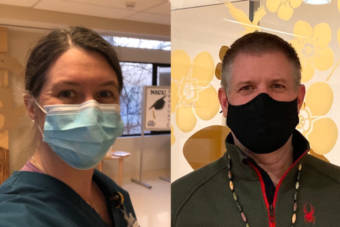
Kerry Clark (left) and Nathan Johnson both work at the Providence Alaska Medical Center. Clark is an occupational therapist and supervisor of the Adult Inpatient Therapy Department. Johnson is the regional director of Community Health Investment. Both are volunteering in the hospital’s newborn intensive care unit. (Kerry Clark, Nathan Johnson photo)

Alaska’s largest hospital has been enforcing visitor restrictions to prevent the spread of the coronavirus.

That means, starting almost a year ago, the Alaskans who make up Providence Alaska Medical Center’s Cuddle Corps could no longer come in to hold some of the hospital’s sickest newborns.

Then, Providence employees stepped in to help fill the need.

It’s a Saturday evening, and Nathan Johnson is trying to soothe a tiny baby girl at Providence Alaska Medical Center in Anchorage.

“Oh, sweetpea, what’s going on?” he coos, as she wails. “You’ll be okay.”

They’re in the newborn intensive care unit — the ICU for infants.

The baby Johnson is holding was born really early. She’s been in the hospital for more than two months, and only weighs about three or four pounds.

“When they’re swaddled, they’re like a compact little football,” said Johnson. “That’s about the size they are.”

Johnson has held the baby girl on almost half of the days she’s lived in the NICU. He watched when she was taken off oxygen. He’s watched her vital signs improve. He’s watched her grow.

But Johnson isn’t the baby’s dad, or even a relative: He works in administration at Providence. But he’s among a group of hospital employees who come in before or after work, or at lunch, or on the weekends, to hold some of Alaska’s tiniest and sickest babies.
“It’s been an incredibly difficult year for everyone. With all of the isolation — there’s just so much fear and political mistrust and so many things going on,” Johnson said. “Stepping into this just felt like something pure and good in the face of such a trying year. And it’s been remarkable.”

Nathan Johnson works in Providence’s administration. He’s sitting in the recliner where he volunteers to hold babies staying in the NICU. (Nathan Johnson photo)

Normally, a group of volunteer Alaskans called the Cuddle Corps dedicate hundreds of hours a month to holding the NICU babies, not Provide staff.

But, like so many things, the coronavirus barred the baby-holding volunteers from entry starting last spring.

So Providence looked internally. About 10 employees, including Johnson, stepped up to the task.

Ginny Shaffer, the NICU’s family-centered care coordinator, said holding and interacting with the babies is key for their development.

“When you see a baby being held skin-to-skin, you can watch that medical monitor, and you can see their heartbeat stabilize, their respiratory rate stabilize,” she said. “If you read all the science, you know that that baby’s brain is developing, just being held.”

At any one time, Providence has between 40 and 50 babies in its NICU.

Some stay for days, some for months.

Shaffer said the staff volunteers are focused on holding babies who don’t have family around.

That might be because the baby is headed to foster care, or because their parents had to return to work, or travel back to their hometowns. And because of pandemic restrictions, parents can’t ask a friend or relative to go hold the baby in their absence.

“It’s just really kind of hindered the care that a family typically could provide with friends or loved ones, you know, grandma, grandpa, your best friend that would be able to come in and help you,” Shaffer said.

It has made the volunteer cuddlers even more critical.

Nurses, she said, are happy to see them, too. It’s nice to know a baby is getting an added layer of attention when family can’t be there.

Kerry Clark is another employee who started volunteering to hold babies last year.

Kerry Clark is an occupational therapist at Providence Alaska Medical Center in Anchorage. She’s washing her hands and arms for two minutes before volunteering to hold a baby in the NICU. (Kerry Clark photo)

She’s an occupational therapist, and usually goes to the NICU three times a week, after her normal workday is over. She’ll spend an hour or two with an infant.

She says the routine isn’t only good for the babies, but for her, too.

It’s a balm at the end of a long day, and a welcome interaction during a time of isolation. Like some of the babies, Clark also has no family in town.

“So for me, in particular, where I could go like four or five months without getting a hug from anybody, this of course has been amazing,” she said. “I get to hold a baby. And if you like babies, there’s nothing like it.”

She likes to sing or talk to the baby she’s holding during her time in the NICU, Clark said.

Johnson said he’s even attended meetings by phone with a baby on his chest.

Sometimes, he’ll sit in silence, while the baby sleeps.

But most often, Johnson said, he just rambles on about all the baby will be able to see once they leave the hospital, often thinking of his 8-year-old son as he talks.

“It’s super exciting out here,” he tells one infant. “You could play with puppies, run in the snow, do all kinds of stuff.”

Pregnant women in Unalaska brave COVID-19 and a lapse in air service to get to the hospital — 800 miles away

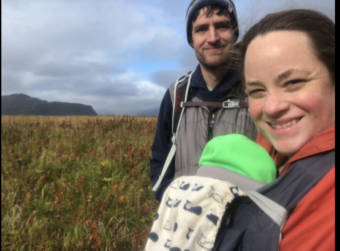
Megan and Cameron Dean in Unalaska with their daughter, Morwenna. (Courtesy of Megan Dean)

Alaska women who live in rural and remote communities usually travel to city centers to give birth — against incredible geographical odds. COVID-19 has made a hard trip even more daunting. A dramatic example of that is in Unalaska, where the only commuter airline went out of business during the pandemic. That is especially hard for pregnant women, who can’t postpone appointments.

Pregnant women don’t have the option to have a hospital birth in Unalaska. They’re referred out to hospitals on the mainland, usually about 800 miles away in Anchorage. They’re asked to leave at 36 weeks, but sometimes women wait too long.

“My call phone rang and dispatch said, ‘Hey, we’re just calling to tell you there’s a woman on our way to the clinic in labor,’” said Sara Spelsberg, a physician’s assistant at Iliuliuk Family Health Services Clinic in Unalaska.

She got the midnight call a few years ago, but the memory is fresh. She asked the dispatcher to send backup paramedics.

“I looked out the window and I saw a truck screaming into the parking lot,” she said.

“I’m in my pajamas, I don’t have gloves. I don’t have anything. I jumped into my flip flops. And I ran down the stairs outside. And I ran up to the car and I said, ‘Let me get a wheelchair and we’ll get you inside.’ And the mom said, ‘I don’t know if there’s time.’”

There wasn’t.

“It’s raining. It’s dark outside. It’s like 11 o’clock at night, and it’s cold. And this baby comes shooting out into my hands and his dad’s hands. We both caught him,” said Spelsberg.

The umbilical cord was wrapped around the baby’s neck. The baby was blue. Spelsberg described it as “Smurf” blue.

“I’ve been in medicine for a really long time. And I did not even know that people could be that shade of blue,” she said.

Bear in mind, even a medevac is a three-hour flight. It had been a decade since Spelsberg had delivered a baby

“I put his little feet in between my fingers, because I only have two hands, and I held him upside down and I used my other hand to unwrap the cord around his neck. And — I smacked him on the behind. And he started to cry. And he turned pink, and it was just the most beautiful cry sound I’ve ever heard in my life,” she said.

Paramedics showed up. Mom and baby were fine. That was before the pandemic.

COVID-19, and no regular air service

Health care professionals and moms say the threat of COVID-19 ratcheted up the anxiety factor of third trimester travel. Then Ravn Air, the airline that served the Aleutians with daily flights, went under in April. Providers were worried that type of scenario could play out again. (Ravn airlines resumed flights in November of 2020.)

“I had to just call moms and say, ‘I don’t know when we’re going to get you out. We’re working on it. We’ll keep you posted,’” said Jennifer Heller, a nurse midwife at the clinic.

To be clear, she says no one has gotten stuck giving birth on the island since that night.

“We did have some gaps in just regular, routine prenatal care and then getting women out for their routine but very important 20-week ultrasound, the women who were 20 weeks right about in those two months,” she said.

To get in and out, women had to charter flights. Heller says it took some explaining, but the clinic got the cost covered by Medicaid. It’s the source of coverage for more than half of women who give birth in Alaska. But everyone else has to pay for tickets. Heller says a charter flight will put you out $1,300 round trip, for one passenger. She spends a lot of time now writing to insurance companies on behalf of her patients to try and get charters covered.

And Medicaid will put you up in hospital housing, or a hotel if that’s not available. But if you want a kitchen or a little more space because Anchorage restaurants, stores, and other public spaces are shut down or restricted for COVID-19 — that will cost you.

“I mean, like, our savings are gone. Like, like that was it,” said Megan Dean.

She found out she was pregnant in December, just months before the pandemic really shook the nation. She was one of the moms whose prenatal care got delayed when RavnAir stopped flying. She ended up chartering a flight to her 20-week ultrasound.

“It’s always kind of like a crazy appointment anyway going in. And then it’s just like an additional anxiety going on,” said Dean.

Her baby was fine. She got to go home and wait until 36 weeks to return to Anchorage. But when she got there, she ended up staying in the city for 2 months. The baby was two weeks late, then they decided to hang around until after a first pediatric appointment rather than having to make the flight twice.

They had to charter another flight home — in a tiny plane, in a pandemic, through Bering Sea weather. With a newborn.

“So, you know, the plane’s tilting, and there’s like men on the plane screaming, and she’s just like, ‘this is awesome.’  She’s the best flyer,” Dean said.

“She’s kind of been, oddly, a rock through all this? Because she’s just phased by nothing.”

It’s a lot of miles and money and time. But this is the fix. The alternative is having babies outside — way outside — of a hospital setting. And Dean did have some complications in labor.  She ended up transferring from a birth center in the city to the hospital — an easy drive in Anchorage, but a high-stakes gamble from home.

She said her daughter, Morwenna, is fine. She’s still a rock.

‘Most mothers don’t have to deal with this’: COVID-19 makes medical travel for pregnant women even harder

The Carter family in Juneau after the birth of their youngest child. (Image courtesy of the family)

Alaska women who live in rural and remote communities usually travel to city centers to give birth — against incredible geographical odds. It hasn’t always been this way. And now, COVID-19 has made a hard trip even more daunting.

There is no road to the nearest hospital from Haines. It’s roughly 100 miles by small plane or ferry through glacier-strewn mountains. Pregnant women here need to move to Juneau or another city with a hospital a month before their due date.

Lori Carter was pregnant with her third child when COVID-19 hit. Pregnant women are considered at high risk for serious illness due to the coronavirus. She went to Juneau for her first ultrasound in mid-March.

“That’s kind of when everything started falling into place — or falling apart,” she said.

As then-President Trump started announcing travel bans, she wasn’t sure if she would make it home to Haines.

“I thought, well, they can’t shut down this airport yet, hopefully, until I make it home. Because my husband was home with the two little girls.”

She made it home, but she still had to plan to leave again, three weeks before her C-section appointment, just in case she went into labor early. That’s because at the local clinic there is no birth unit and no OB/GYN. The plan: take the ferry to Juneau and live in a rental home with her two daughters.

“I would just tell myself, most mothers don’t have to deal with this. So this is all extra,” Carter said.

It wasn’t always like this

Until the mid 80s, women gave birth in Haines. And if you lived here, Stan Jones was your doctor.

“We took our pets to him, we took our people to him,” said Sheri Loomis.

“Everything was done at the clinic. We didn’t have a vet, so even our animals got stitched up down there from time to time.”

Loomis and her husband Craig started their family in the 1970s. Dr. Jones saw Loomis throughout both her pregnancies. She describes her labors as quick — she was crowning with her second child when she arrived at the clinic.

The room wasn’t quite ready. A nurse put Loomis on a gurney in the open hallway by the parking lot.

“I’m like, almost totally naked. Well, people are coming to church. By this time, the Presbyterian Church is having everybody come from the services, and they’re wandering over to the car. What’s going on? Anyway, you know, I didn’t care at that point. I could care less what I looked like, who saw what — it didn’t matter,” she said.

They picked up steaks on the way home. She said the medical bill was about $400 — with inflation, that would be about $2000 today. The doctor came by the house to check on them for a few days after the delivery.

Now she’s a proud grandma. Her own daughter was in Juneau waiting to give birth when Loomis spoke to KHNS.

These days, a woman in labor in Haines would be likely to get a medevac. But back in the 70s, if things looked too complicated, Dr, Jones popped you on a ferry or a commuter plane to Juneau.

“Once or twice, a baby was born on the ferry,” said Dr. Jones.

He was sitting in his living room, in a creaky rocker. Out the window behind him is the small boat harbor, framed by jagged peaks and the longest, deepest fjord in North America.

“Once a baby was born mid-air and so, you know, it just depends and what the circumstances are, but it certainly is weather-dependent,” Dr. Jones said.

Dr. Jones was Haines’ physician from 1963 through 1989. He attended over 600 births in Haines. No operating room. No backup. Just forceps, his best judgement and sometimes another doctor from University of Washington on the telephone for advice.

“We did not lose any mothers. We lost very few babies. In general I felt our record was very, very good,” he said.

But in the mid-80s things started to change. Now, most women leave to give birth because the clinic tells them to. Women are asked to leave — move, essentially — in the third trimester, usually around 37 weeks.

Dr. Jones says it wasn’t danger that made women stop giving birth out here. He says it was money. He says he had to pay more for medical liability insurance than he made delivering babies.

“To me, it is kind of criminal that women are expected to leave their family and go to a place where there’s a hospital, three or four weeks before their anticipated delivery. Because that makes it difficult on the other children. It makes it difficult on the husband and the relationship,” he said.

Current nurses and doctors say it’s also a good idea to be within easy reach of blood products and an operating room, just in case.

It’s expensive to be out of town for a month — or longer, if the baby is late. It’s common for moms to do it alone, while their spouses work. That’s a month in hospital housing or a motel, eating takeout or hospital food. Waiting.

Togetherness in the age of COVID-19

Last spring, though, Lori Carter and her husband Mike had a plan. She would take their two young daughters to Juneau until her c-section. Then he would arrive and go to the hospital with her. Carter’s mom would come up from Kansas to watch the girls.

She decided to travel by ferry, so they could bring the family truck. They opted to stay in an Airbnb. COVID-safe choices that would allow them to isolate.

The hospital was buttoned up tight to protect patients from COVID-19

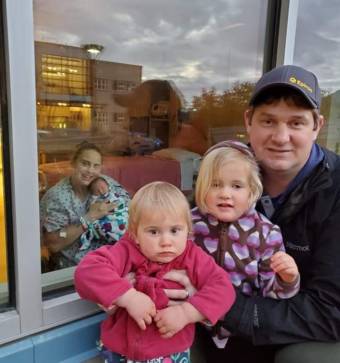
“Mike was the only one allowed in and out of the hospital But they had this wonderful setup so that the girls could get a picture outside from a window view of the new baby,” Carter said.

The hospital was buttoned up tight to protect patients from COVID-19, but the hospital let them arrange a family photo through a strategic window: the girls are outside with their dad, and Carter and the new baby are inside. This is togetherness in the age of COVID-19.

Carter’s mom and the girls headed back to Haines to wait for Carter and their new brother to be discharged from the hospital. But when they got home, the family had another surprise. Carter’s mom tested positive for the coronavirus. The whole family was home with a brand new baby and everyone was considered a close contact.

They got lucky: her mom was asymptomatic. She was isolated on the top floor of the house and talked to her granddaughters through the window.

“I had a lot of anxiety this first few days, but just like we’d done with every month and everything through this year, we said we can just take it one day at a time. We can do the best that we can,” she said.

There’s no solution to this struggle in the works, at least not on the policy level. And for Carter, it’s all relative.  She sent a video of the new baby boy, Orson. She’s tickling him in the mirror and they’re both laughing. She says she tells him about 2020 and how it was hard and sad. But it brought him into the world, so it wasn’t all bad.

This story was produced as a project for the USC Annenberg Center for Health Journalism’s 2020 National Fellowship.

Advocates see huge increase in severe child abuse cases in Alaska during the pandemic

A hallway that would normally be full of elementary school students is empty on the first day of school, August 20, 2020, as students begin the school year entirely online. Schools are the single largest source of child abuse reports, according to OCS. (Mayowa Aina/Alaska Public Media)

When Dr. Barbara Knox started to evaluate child abuse data from the past year she noticed an alarming change.

“The cases that are presenting, are presenting inpatient, and it’s the big and the bad,” Knox said. “A serious uptick in cases of abusive head trauma, serious physical abuse.”

Knox is the medical director of Alaska Child Abuse Response and Evaluation Services (Alaska CARES), a clinic at Providence Alaska Medical Center that focuses on children who have suffered from abuse.

Many kids in Alaska are just now starting to return to in-person learning after the pandemic forced school buildings to close nearly a year ago. And as students return, child welfare advocates are assessing the impact of the pandemic on child abuse.

The number of reports to the Office of Children’s Services decreased by as much as 30% in some months of 2020, and the overall number of evaluations that Alaska CARES completed also saw a slight decrease compared to 2019. But the number of times an Alaska CARES staff person visited a child who needed to be hospitalized for severe injuries as a result of suspected abuse skyrocketed by 220% in the last year.

“This absolutely reflects an increase in serious physical abuse and neglect cases,” Knox said.

The lower reporting rate and the spike in severe cases is likely due to a combination of factors, most of them exacerbated by the pandemic, Knox said.

Things like increased isolation, stress on families from financial instability, and school closures, which limited kid’s contact with adults who could help them.

Schools are the single largest source of child abuse reports, according to OCS.

Additionally, OCS is seeing the number of children in foster care balloon, and children are staying in foster care for longer periods of time.

Kim Guay, acting Director of OCS, said the pandemic “sent us for a loop.” Family courts closed, social workers’ ability to do home studies and home visits were disrupted, and the pandemic made it hard for the office to investigate suspected cases of abuse, especially in rural areas. The issues just compounded over time Guay said.

“How do we assess safety? We have requirements where you have to see the child that’s in foster care face-to-face every single month. Well, how do you do that when you don’t have PPEs to go to the home?” Guay said. That’s just one example of many logistical obstacles the pandemic created. There are also other factors to consider that have kept some children in the system.

“There’s so much stress going on families lives, is now the appropriate time to put the children back home?” Guay said.

It’s a multi-pronged issue that Guay said OCS is continuing to work through.

Now, as children are returning to school, Guay said she expects to see the number of child abuse reports go up as children interact more with school staff. But advocates stress that’s to be expected because reporting typically dips when students are away from school, such as during summer break, and rebounds when they return in the fall.

School staff, like counselors, across the state are preparing to support the transitions back to in-person learning, according to Elizabeth Congdon-McGee, the acting executive director of the Alaska School Counselor Association and counselor at Whaley School in Anchorage

“I do believe the mental health and the trauma is going to be coming in our doors full force,” Congdon-McGee said. “Because we don’t know what has been in our kids lives. We see them on a screen, but we don’t know what’s behind that screen.”

Knox said families who may be overwhelmed or struggling should reach out to their medical provider or the Office of Children’s Services to get help finding the resources they might need.

Concern about Alaska’s foster care future under Dunleavy plan to split state health department

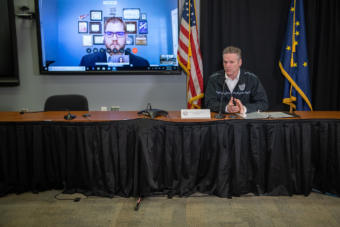
Alaska Department of Health and Social Services Commissioner Adam Crum, left, speaks at a news conference with Gov. Mike Dunleavy on April 9, 2020. In December, Dunleavy announced a plan to split the department into two. Some groups are concerned about the impact on the state’s foster care system. (Creative Commons photo by Alaska Governor’s Office)

Gov. Mike Dunleavy announced in December that his administration plans to split Alaska’s Department of Health and Social Services into two. Among many other impacts, that move would put the state’s foster care system in a new department. 

Tribal organizations, advocates for foster children and the largest state worker union are all voicing their concerns. 

The administration has emphasized that it’s aiming to improve outcomes for children and families by having two, more focused departments to provide oversight. The plan to separate a new Department of Family and Community Services from the Department of Health may also divide the Office of Children’s Services, which oversees foster care, into two offices. 

Several groups expressed concerns about the split to lawmakers at a mid-January hearing

Among these groups are Tribes that have been working with the state to implement a compact that gives Tribes more responsibility for child welfare. 

Richard Peterson is the president of the Central Council of the Tlingit and Haida Indian Tribes of Alaska, which has been working on the compact. 

“The time to find a new commissioner, directors and staff will be a challenge,” he said. “The state struggles to fill the vacancies currently, leaving many of our programs and families not receiving the attention they deserve.”

He said Tribes should have been consulted before the state rolled out the proposal, not after. He notes that most children in Alaska’s foster system are Alaska Native. 

“I think that will only get worse if we’re not involved,” he said.

Amanda Metivier advocates for foster children as the co-founder and director of the nonprofit Facing Foster Care in Alaska.  She said the state hasn’t provided evidence as to why children and families should have to deal with two offices. 

She said that the system is already confusing, and it’s hard to know which office will play what role. 

“And to then have to deal with multiple systems, I think could just be absolutely daunting,” she said.

Metivier said the plan wasn’t prepared in a spirit of collaboration with those involved in foster care. 

“There hasn’t been any effort to directly engage young people, the youth in that process,” she said.

A Department of Health and Social Services spokesperson said the idea for splitting the Office of Children’s Services into two offices “was brought forward as a potential way to build trust and begin to improve outcomes for the families and children” who receive state services.  

“The department is committed to working with our Tribal partners, community partners, advocacy groups, and those Alaskans that we serve directly to find solutions for improving our child welfare system in Alaska and better ways that we can assist and support families,” the department said in an email response to questions.

State officials have emphasized that they’re currently engaging with stakeholders and will consult with Tribes on potential changes to the Office of Children’s Services. They also said that splitting the department will not substantively change or impact the state-Tribal compact. 

Jake Metcalfe, executive director of the Alaska State Employees Association, said his union is concerned that the state is laying the groundwork for outsourcing children’s services jobs. 

“If this were to happen, this work would leave Alaska,” he said. “It would undoubtedly impact the quality of services, which are sensitive and nature and require local-based knowledge for the administration of services.”

Dunleavy could split the Department of Health and Social Services using an executive order. But an executive order can’t be used to privatize or outsource any state services. 

The executive order is expected  during the legislative session, with the goal of having it going into effect on July 1. 

Bethel couple’s pandemic dog sled wedding comes 12 years after meeting in Ohio Waffle House

(Gabby Salgado/KYUK)

It was a cold Thursday morning when Erin Newkirk and Larry “Toby” Tobias decided to finally tie the knot after 12 years together. Together with three guests, a pastor, and 12 dogs, they set out into the tundra for the ceremony.

It’s a love story years in the making. Erin and Toby first met in Lebanon, Ohio back in 2008.

“And after talking for about a month,” said Erin over a Zoom interview, “had a first date at a Waffle House in Lebanon, Ohio and met for coffee. I think we ended up having a pancake or something.”

Erin wasn’t shy about her first impressions.

“I thought he was a bit preppy for me,” she said.

Toby, on the other hand, liked her right away.

“Well, I liked her,” said Toby. “I didn’t realize that I was coming off as preppy. I was on my best behavior.”

In December 2020, Toby popped the question. This wasn’t the first time he had asked Erin to marry him.

“Well I gave her a diamond back around 2012,” reminisced Toby. “And Erin has never been married, and I’ve been married more than once. And that scared her, and probably scared me too.”

“He left out part of the story,” said Erin. “Between my two parents, there have been eight marriages. So I’ve had plenty of experience with marriage and divorce myself. And I’ve had a pretty pessimistic view of, you know, of what people say versus what they do.”

It wasn’t until the coronavirus pandemic hit that things began to change for Toby and Erin. Back in April, Erin was working as a nurse practitioner in Ohio. Due to the COVID-19 pandemic, Erin lost her job. Her job search brought her up to Alaska, and eventually to Bethel, but the distance was putting a strain on their relationship.

“Even though he’s been fully supportive of the job, and the move, and the plans,” Erin said. “I think once he got by himself it all hit home. It’s one thing to be, you know, stuck at home with somebody. It’s another thing to be stuck at home alone.”

For Toby, the distance and the separation gave him time to reflect on their relationship. He came to the realization that he’d been taking Erin for granted.

“You tend to take people for granted sometimes. And it really, it was a big wake-up call for me how much she really meant to me and how little I showed her how much she meant to me.”

With Erin working in Alaska and Toby living in Ohio, there seemed to be no end to the distance.

“So we’ve had several heart to hearts via Zoom or Google Meet. And, you know, I finally asked her to marry me again. She said yes,” Toby said with a smile.

With the pandemic still going and the courthouse closed, wedding planning took a different spin.

“So yeah, it definitely impacted his decision,” said Erin,” but also made him a little creative.”

Toby wanted to make his marriage memorable, and what is more memorable than getting married on a dog sled?

“It’s unique to Alaska,” noted Toby. “And I just, I just threw it out there to see what she’d say. And she said ‘Yeah, well, okay. If he, if he can pull that off.’”

Toby reached out to the KYUK News Director, Anna Rose McArthur, who contacted Kuskokwim 300 Race Manager Paul Basile.

“And then I emailed him and he was kind of, ‘Well, I don’t know whether anybody really wants to do that, but I’ll send your name out to a couple of people.’ And luckily, Victoria Hardwick was one of them.”

With a musher and team ready, Toby set out to Bethel to get married. On the morning of Dec. 24, together with three guests, a pastor, Victoria and her handler, and 12 dogs, Erin and Toby set out from Tundra Ridge subdivision in Bethel. After a 10-mile run, they stopped at Dry Lake. While Victoria took her dogs for a lap around the lake, Pastor Tad Lindley performed the ceremony.

With vows exchanged and dogs raring to go, Erin and Toby stepped back onto the sled and began their journey into marriage.

Erin had some advice to anyone thinking about marriage during the stress and uncertainty of the pandemic.

“It’s one thing to have doubts about the world and the situation that we’re in,” she said. “People are like, how can they bring children into the world the way it is now. Since the beginning of time, you can either make it better or you can make it worse. You just have to make a choice to make every era that you live in better. So we have a chance to make our lives better and more peaceful and, you know, share a bond that is going to make this time that we’re all going through a little better.”

Site notifications
Update notification options
Subscribe to notifications