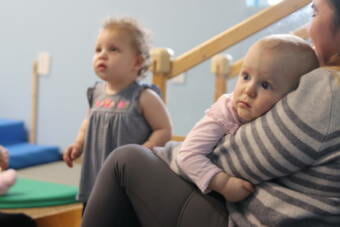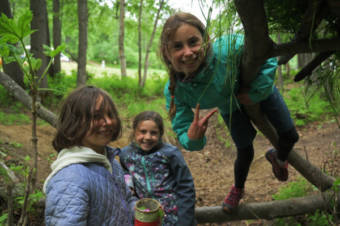
Sitka’s child care system was already in crisis, long before the pandemic hit and radically shifted everything. Now, as Alaska’s vaccination rates improve and more parents go back to work, they may not have a place to send their children. (KCAW/Katherine Rose)
“I think it was kind of scary in the beginning, because you weren’t sure where the money was going to come from,” Lolly Miller said in an interview last month. She directs the Sheldon Jackson Child Care Center. She said early in the pandemic, when health mandates forced centers to close, they didn’t know if they were going to make it.
“There’s not a lot of money in child care,” she said. “For some facilities, it’s a month to month kind of operation. There’s not a lot of extra money sitting around to carry you over for very long. That part was scary, you know, not knowing if we would have enough money, you know, to keep the doors open.”
But now Miller is running into a new problem. She’s only open at half-capacity. It’s been that way for months. And parents are desperate to get their kids in the door.
“I’ve had people cry in my waiting area,” she said. “It’s the worst part of this whole thing is carrying the burden of a lot of these people around you. I can’t even walk downtown. ‘Do you got room? Do you?’ I don’t even go downtown. You know, they’re desperate.”
With parents going back to work, she needs to open back up fully. But she’s short-staffed and said she’s on the verge of closing if she loses any more teachers.
“We do not have the staff to be able to operate and nobody is applying for jobs,” she said. “And we have tried, it’s been on social media. Mine’s been in the newspaper, every parent I talk with, who’s calling in looking for child care, I’m like, if you know anybody, send them our way.”
Just down the street, Erika Apathy runs the Betty Eliason Child Care Center, where they’ve had to cut back for the same reason.
“We actually had to very drastically decrease our program hours for our school age kids, because we don’t have staff,” she said. “And so I had to tell parents, ‘I’m sorry, I can only have your kids here from 7:30 to 12:30.’ Because if I have them here all day, it can impact our license, and we can get shut down because we’re not in compliance with it.”
Providers in Sitka aren’t the only ones that are reporting challenges as the state begins to emerge from the pandemic. In March, the state’s Child Care Program Office surveyed 420 child care providers, including home daycares. 87 percent said they were concerned about their operational status changing. Most said financial needs were the top concern, and while in Sitka there are waiting lists for child care, enrollment is actually down statewide.
Jenni Pollard works for thread Alaska, a statewide child care advocacy organization. She says the staffing problem isn’t new.
“You know, recruiting and retaining early, early childhood workforce has has been an issue prior to COVID and remains an issue today, especially in smaller communities,” she said. “This is a workforce that does valuable work, but has an average hourly salary of about $12 an hour, and many of them work without any insurance or benefits.” Pollard said the low pay is the biggest deterrent, but a competitive hiring market is making it harder than usual to find staff. But higher pay means increased tuition for parents, and tuition is alreadyhigh to cover operations. But most centerswant to pay their staff more.
“We’re hearing the primary support needed is for staff to help with wages and bonuses, incentives for recruitment and retention and even professional development,” Pollard said.
In their responses to the state survey,nearly 60 percent of child care providers said they needed funding for salary increases and bonuses in order to retain staff. 47% said they needed incentives for recruitment and retention. Some help is on its way. The state is now trying to determine how it will spend federal funds from the CARES and American Rescue Plan Acts — nearly $92 million dollars total — allocated for child care.
While it’s still not clear exactly how the money will be doled out, both Miller and Apathy are hopeful it will come through this fall and help carry them through the winter. But still, Miller said the funding is a stop-gap, so she hopes people will begin to advocate for more long-term solutions, locally.
“For our community right now, if they want their people working, and if they want a viable, you know, economy here in Sitka, somebody is gonna have to start brainstorming and helping us out on how we can get employees in our building,” she said.
Miller said child care is critical infrastructure, and only when Americans recognize it as that will the problems within the industry be solved.
In 2017, boxes of ancestral remains from Chirikof were shipped to the Kodiak state airport. While the Native American Graves Protection and Repatriation Act requires some museums and universities to work with Tribes to repatriate remains, the law does not require them to return the remains in any particular way. (Kayla Desroches/KMXT)
In Alaska, repatriated remains can range from an individual bone or skull up to hundreds of sets of remains.
Between 1910 and 1941, Czech anthropologist Aleš Hrdlička curated the U.S. Museum of Natural History.
In the 1930s, he removed the remains of more than 1,000 individuals and funerary objects from Larsen Bay and brought them to the Smithsonian Institute.
In the early 1990s, the Smithsonian Institute returned many of those remains to the community.
“It was the first time where our people really began to understand why it was so important to have control over our own cultural heritage and by extension, our ancestral remains,” former Larsen Bay resident and Alutiiq Museum executive director April Laktonen Counceller said. “It took years and lots of lawyers.”
That repatriation request process began in 1987, and hundreds of those ancestors were put to rest in 1991.
The Smithsonian repatriation isn’t covered under the Native American Graves Protection and Repatriation Act, or NAGPRA. Instead, the Smithsonian based its policy on a 1989 law that authorized the National Museum of the American Indian.
One of the criticisms of the Native American Graves Protection and Repatriation Act is that it puts a huge burden of proof on Tribes, which may not have access to the necessary records.
On top of that, the people who took those remains or other objects didn’t always keep the best records.
Sealaska Heritage Institute President Rosita Worl received her master’s and doctorate in anthropology from Harvard University.
Worl also worked in the Harvard Peabody Museum and served on and chaired a review committee that worked toward repatriation. She also initiated several repatriation claims, including repatriation of a totem pole taken from Southeast Alaska in 1899.
“We even had a repatriation claim from there with a big ceremony,” Worl said. “I think we repatriated one of the Harriman expedition totem poles. It was from Saxman.”
Worl has sat on both sides of the repatriation table.
“In my time on the review committee, I was in meetings across the country. And it was just heartbreaking, and you know, almost every meeting where we would have Tribal members begging for the return of their ancestral remains. And in NAGPRA we do have this term called culturally unidentifiable human remains,” Worl said. “According to the records, they couldn’t figure out where those these ancestral remains came from. And so Native Americans across the country would be just pleading, you know, please return our ancestors.”
Worl says that Tribes have to provide “the preponderance of the evidence.”
Tribes have to prove a claim using evidence like geographical information, kinship, linguistics and biological anthropology. Recently, repatriation committees began accepting oral traditions.
“I will tell you that initiating a repatriation claim is quite expensive — and especially if it should rise to a dispute,” Worl said. She had to recuse herself twice when the NAGPRA review committee she served on had to handle disputes. She says those disputes cost more than $100,000.
“A repatriation claim requires significant research because you have to prove with the documentation,” she said. “You can’t just say, you know, this is my grandfather’s clan hat. You have to prove through all the documentation that it belongs to a clan. So it’s really — it’s really imbalanced.”
And she says museums aren’t always forthright with sharing documentation.
Sometimes remains and objects are collected by federal and state agencies and then turned over to a university or museum.
Father Innocent Dresdow, descendents and museum staff welcome home repatriated ancestral remains from Chirikof Island in February, 2017. (Kayla Desroches/KMXT)
One of those repatriation priorities for the Alutiiq Museum was the return of ancestral remains from Chirikof Island, which is about 100 miles southwest of Kodiak.
Alutiiq Museum executive director April Laktonen Counceller — who is a Tribal member of the Sun’aq Tribe of Kodiak — says many of the remains were from a Russian Orthodox graveyard that eroded onto the beach.
Chirikof Island was managed by the U.S. Fish and Wildlife Service. Following excavation in the 1960s, the remains were taken to the University of Wisconsin.
“They were kind of shipped around and traded around with no surviving documentation and ended up at Indiana University at Bloomington, which was not incredibly cooperative,” Counceller said.
Counceller says the Alutiiq Museum sought the release of those ancestral remains for about 15 years before the Department of Interior’s legal division became involved.
“It was a difficult thing to be there for — the final part of that struggle to get those ancestors returned because we felt like we weren’t being heard,” Counceller said. “The archeologist who had possession of the remains seemed to feel that it was their life’s work or have some sort of ownership over the story of them. We asked for copies of all of the research, documentation on the remains and the catalog, which we knew they had, and they refused.”
That’s when the Army Corps of Engineers performed another cataloguing of the collection.
Even the bishop of the Russian Orthodox Church of America got involved. He sent a letter of support asking for the return of the remains so they could be reburied — and for the records to be released.
“That whole situation made me, as a Tribal member, feel a little bit traumatized because we see these people as our ancestors,” Counceller said. “We also had done research into the Russian Orthodox Church records and found the names of people who had been buried in that graveyard in the 1800s. Some of them had living descendants.”
Counceller says the repatriation process can begin a couple of ways.
“Sometimes we get notified by an organization or a museum or university that they’re putting something into the federal register,” Counceller said. “Sometimes we get contacted by our local Tribes for assistance, and in some cases it’s because they don’t really know exactly how to go through that entire process. We also keep a sort of a running list of places that we know of that have ancestral remains from our region. And so we kind of just keep an eye on it, in some cases in the past.”
The Alutiiq Museum isn’t a Tribal organization. It’s Tribally run and Tribally led, but it doesn’t have the Tribal standing to directly negotiate repatriation claims — unless they’re doing so on behalf of a Tribe.
But the museum does keep up-to-date on potential notices.
“As part of a project we’re working on right now, I’ve been looking through those notices and finding some that we weren’t even aware of,” said Amanda Lancaster, the museum’s collections curator.
The NAGPRA registry is available online and searchable by state or region or institution.
Shannon O’Loughlin is the executive director for the Association of American Indian Affairs. She says items can be categorized in a way that creates uncertainty of which Tribe or Tribes to reach out to.
“One of my criticisms of the law is the way it’s written is for summaries that the institution does not have to consult with Tribes to determine what is going to be in its summary,” O’Loughlin said. “That means before consultation, it’s determining what it thinks are sacred objects, objects of cultural patrimony and associated funerary objects.”
On the NAGPRA registry, Harvard’s Peabody Museum lists at least one instance in its collection of culturally unaffiliated remains — coming from the Aleutians West region.
In Alaska, remains are located at the medical examiner’s office, the Museum of the North on the University of Alaska Fairbanks campus and other locations.
But ancestral remains from Alaska are spread out from California to Connecticut.
NAGPRA and most U.S. laws don’t cover the remains that came from outside of what are now colonially imposed borders.
Nor do those laws cover remains and objects that were taken from the U.S. and moved internationally.
“The museums outside of the United States that may or may not have ancestral remains from our area are not subject to United States laws,” Alutiiq Museum’s April Counceller said.
The law also doesn’t require museums or universities to return items for repatriation in any specific way.
So remains of ancestors may be returned in a box — and in some cases, boxes separated into similar parts. A community may get a box of skulls, a box of femurs, et cetera.
One example, Alutiiq Museum director April Counceller says, was during the Chirikof repatriation.
“When people get the remains back, they’re not coming back in coffins. They’re not coming back in the way that we are accustomed in the modern day to see our dead be treated,” Counceller said. “I think that helped the broader community that knew about the situation — that helped them to understand, you know, you wouldn’t like to see your family member come back in individual cardboard boxes.”
And so communities try to give their Elders and ancestors rest in the most respectful way possible.
For Kodiak, the Alutiiq Museum worked with the city and local Tribes and Native corporations to create Ancestors Memorial Park.
Museum director Counceller says it’s less about interment and more about an honoring place.
Some Native communities don’t allow practices to handle ancestral remains — and so sometimes elect to allow a museum to store them in the meantime.
It’s complicated says Harvard professor Phil Deloria, who chairs the Peabody Museum NAGPRA Advisory Committee.
“There are certain things which are under control of the federal government, which are in our collections, and many things have been repatriated,” Deloria said. “Some human remains remain in our collection at the request of discretion of Tribes who have completed the process with us. And then there have been an interesting number of cultural objects, you know, in which there has been exchange.”
The Cape Fox Corporation donated a cedar tree as a gesture of appreciation, and the museum commissioned Tlingit master carver Nathan Jackson to carve the tree into a pole — the Kaats’ Xóots Kooteeya or Kaats’ and Brown Bear totem pole s a symbol of the Saanya Kwaan Teikweidi clan and history — but also the relationship between the Saanya Kwaan and the Peabody Museum.
“I take my students in to the museum and a lot of Native students, you know, it’s an uneasy experience for those students,” Deloria said. “We stop at the Nathan Jackson pole, though, and talk quite a bit about what collaboration means and the ways in which can be really productive for everybody who’s involved. But it feels to me like things have gone well with Alaska in the past and we look forward to doing more in the future.”
Repatriation hasn’t always been a collaborative process.
But as more universities and museums examine colonization’s dark history and its impact on Indigenous people, many make greater efforts to consult with Tribes in an effort to bring ancestral remains home.
This is the first of a three-part series. The series in its entirety and an extended audio podcast can be found at knba.org.
Smithsonian’s National Museum of Natural History director Kirk Johnson, left, participated in the 2017 reburial of remains excavated in 1931. The remains of 24 villagers were removed from the site of the now abandoned village of Kaskanak. Those ancestral remains were returned in 2017. (Photo by Avery Lill/KDLG)
In early 2021, the Harvard Peabody Museum issued a statement apologizing for its reluctance working with Tribes to return some remains and funerary objects. The social unrest of 2020 had reignited the conversation of returning ancestral remains and sacred objects to their people.
Since contact, Indigenous people and settlers have had a contentious relationship, particularly as settlers appropriated items from traditional Native homelands. These items included totem poles, funerary and cultural objects — even remains of Indigenous ancestors.
Examples include the Edward Harriman Expedition removing a Teikweidi memorial pole from Southeast Alaska in 1899. Or when anthropologist Aleš Hrdlička, an early 1900s Czech-born anthropologist known for unorthodox collection methods such as stripping decomposing flesh from bones, discarded the remains of an infant found in a cradleboard and sent it to the American Museum of Natural History.
“They didn’t have any shame, you know, taking even from graves,” said Rosita Worl, president of Sealaska Heritage Institute, a private non-profit cultural organization based in Juneau, Alaska.
Worl earned her master’s and doctorate in anthropology from Harvard University.
“They just came and took things off of graves,” said Worl, who carries the Tlingit names Yeidiklasókw and Kaaháni, and is Tlingit, Ch’áak’ (Eagle) moiety of the Shangukeidí (Thunderbird) Clan from the Kawdliyaayi Hít (House Lowered From the Sun) in Klukwan. “You think about Southeast, it was amazing that we even had anything left.”
Often remains would be removed from Tribes without consent or consultation and stored in university or museum collections — and even in international institutions.
“I mean, museums themselves are institutions of colonialism,” Worl said. “They came in, they expropriated cultural objects, human remains and more, often without the permission of Native American Tribes and others. What they saw as art, we saw as cultural objects.”
And the Indigenous peoples in the United States did not have much recourse until the early 1990s.
The Native American Graves Protection and Repatriation Act — NAGPRA for short — gave Tribes a legal avenue to pursue the return of remains and some funerary objects.
NAGPRA requires publicly funded universities and museums to document and report the remains and funerary objects within their collection. The summaries are searchable by institutions, states where the remains are held and states and general regions of origin.
After a year that saw growth of the Black Lives Matter movement and toppling of colonial monuments and statues, the Peabody Museum announced in January it had about 15 remains of African Americans or those of African descent who likely lived before 1865 and may have been enslaved.
According to museum director Jane Pickering, the museum pledged to try to return those remains to the appropriate communities.
“We felt that this was the moment that the university really needed to engage with this issue,” Pickering said during a interview via virtual teleconference. “There are other institutions that have been thinking along these lines as well, but that it was time for us to really face up to that history as a university, as an institution.”
The release stated that a steering committee would help direct a “multi-year, cross-departmental initiative” to assess its procedures.
The Harvard Peabody collection includes several Alaska Native cultural objects and at least one report of remains from the Aleutians West region.
In a statement, Harvard Peabody said it was working toward consultations with Tribes to return remains and funerary objects in compliance with NAGPRA. And it pledged to develop better policies to address its previous reluctance of turning over some objects.
But Tribes and Native-based organizations like the Association of American Indian Affairs pushed back, questioning the museum’s process.
Shannon O’Loughlin is a citizen of the Choctaw Nation of Oklahoma and the chief executive and attorney for the association, which formed in 1922 to serve Indian Country by protecting sovereignty and preserving culture.
“Harvard tends to cause delay, refuses to make decisions. And often causes extensive burden on Tribes by forcing them to produce evidence of cultural affiliation so they have a long history,” she said.
O’Loughlin says she’s concerned Harvard-educated students would go on to other institutions and perpetuate the same harmful repatriation practices and procedures.
“They have developed their inventories out of alignment with what NAGPRA requires,” she said. “They’ve done so by failing to consult with tribes before they completed their inventory process.”
O’Loughlin says that Harvard Peabody categorized some remains and items as culturally unidentifiable — which means Tribes must provide even more evidence to make a claim.
“That a people can have control and dominion over other peoples to the extent of outlawing their religions and cultures and taking away those things that support that culture’s identity and health is its thinking about that, you know, today that institutions still carry on that that racism,” O’Loughlin said. “Much of their collections may be obtained from the theft and violence of other peoples. We wouldn’t allow that [today].”
Phil Deloria (Standing Rock Sioux Tribe) is a history professor at Harvard University, where he teaches subjects like environmental history and the American West. Deloria says a 2010 amendment to NAGPRA was supposed to lay out other pathways to repatriate culturally unaffiliated — or unidentified — remains.
“In that early moment, museums, institutions were required to prepare inventories to consult with Tribes on these inventories with the goal of identifying as many kinds of remains and cultural objects that could be culturally affiliated with tribes,” said Deloria, who also currently chairs the Peabody’s NAGPRA faculty committee.
“And there’s a certain kind of set of standards of evidence that suggests and many, many things end up in this kind of bucket of the culturally unidentified,” he said.
The Association of American Indian Affairs sent a letter urging Harvard Peabody to change its practices — and O’Loughlin hopes that Tribes have greater opportunity to go through the disposition process.
More than 600 people and organizations signed on in support of the association’s efforts.
Deloria says he recognizes the amount of work a Tribe must go through to make a claim, but it’s an important part of the process.
“I have come to the perhaps odd view that the bureaucratic process, the administrative apparatus, the research, the collaborative things, is a really important part of doing a kind of form of justice and honor to the to the objects and to the human remains,” Deloria said. “It’s also the case that an institution needs to make sure that they repatriating to the right people.”
Harvard Peabody claims it has repatriated about 30% of its collection. The Association of American Indian Affairs says that number is closer to 15%, and the museum may be counting remains it’s coordinating with other museums.
But for Sealaska Heritage President Rosita Worl, who worked in the Harvard Peabody Museum, the overall impact is clear.
“To see that they had 5,000 human remains after 30 some years, you know, I was horrified when I saw that,” she said.
NAGPRA was intended to give Tribes a pathway to return and repatriate cultural objects and remains. But it isn’t without its problems – and Tribes still have a lot of work to continue fighting for repatriation.
This is the first of a three-part series. The series in its entirety and an extended audio podcast can be found at knba.org.
In 2020, Bartlett Regional Hospital braced for a surge of COVID-19 patients. It got a surge of mental health crises instead.
Bartlett behavioral health staff tie the surge in patients to spring break 2020. Students left the classroom for vacation and returned to a whole new reality. COVID-19 cases were increasing statewide and remote learning suddenly replaced their school day routines.
“We started to see kids and families and adults coming in struggling with the immediate changes that we as a community took on,” said Bradley Grigg, who leads the behavioral health arm of the regional hospital.
He says those social restrictions are causing spikes in anxiety, depression, substance use, and self-harm — for students, parents and just about everyone experiencing the disruption of the pandemic.
Bradley Grigg in his office on April 15, 2021. (Claire Stremple/KTOO)
Since last March, Grigg says patient visits have doubled to a thousand a month. And of those, he says more than 100 come to the emergency room. It works out to four people in crisis in Juneau per day.
“I hope that no one deals with what we’re seeing,” he said. “It’s a pandemic all within itself. And it’s creating more havoc — yes. COVID has created inconveniences for us. This is creating havoc.”
Juneau isn’t an outlier. Kristina Weltzin is a mental health clinician for the state’s health department.
“In all of our communities, the information that we’re getting is that absolutely, you know, behavioral health issues have increased dramatically,” Weltzin said.
In a state survey, most adults reported their mental health has worsened over the last year. More than half of parents reported that their child was more anxious or sad than usual.
Grigg says in the last year, he’s hired about 35 mental health staff to keep up with demand. He now manages a staff of 150. CARES money helps fund those new positions now, but Grigg says they will be permanent roles that reflect a new normal in Bartlett’s Behavioral Health program.
“When people are in crisis, whether it’s even if it’s just outpatient, we don’t want to waitlist them,” he said.
Even with increased staff, there’s still a waitlist for non-emergency patients.
The hospital started a Crisis Intervention Services team this spring. It provides follow-up support to patients after they are discharged from the emergency department. That team is available for in-home visits seven days a week and works with patients until they’re stable.
Grigg got emotional when he talked about how this affects kids. Prior to COVID-19, kids were only about a third of the patients in the behavioral health department. Now, children make up the majority of the hospital’s behavioral health patients and a quarter of the department’s emergency room traffic.
Hospital-recorded suicide attempts have quadrupled among teenagers. For children 13 and younger the hospital recorded one suicide attempt in 2019. In 2020, there were seven.
“The devastation that we’re seeing with kids, with families, when they can’t survive this because their anxiety or their depression or their substance use is so out of control … It’s an effect that, unless you’re seeing it every day, you don’t know how infiltrated it has been in our community,” Grigg said.
Restrictions have eased and more than 70% of Juneau’s eligible population has had its first dose of a COVID-19 vaccine. But Grigg said the patient load hasn’t decreased, it’s just leveled off. “It’s unrelenting,” he said. “It’s not stopping.”
If you or someone you know is struggling with thoughts of suicide or in need of care, help is available:
A newly refurbished ambulance decorated with art from Tlingit artists Mary Goddard and Crystal Worl drives through downtown Juneau on August 28, 2020. (Photo by Rashah McChesney/KTOO)
The Juneau Assembly has given its first round of approval for budgets to keep a proactive medical service going for another year and to subsidize child care businesses.
Capital City Fire/Rescue runs the medical service called CARES. It’s short for Community Assistance Response and Emergency Services. It started two years ago when CCFR took over a sleep-off service for intoxicated people that Bartlett Regional Hospital had run.
In response to COVID-19 last year, they started providing more general care and follow-up care in the field to reduce emergency room visits for non-emergency issues.
CCFR Chief Rich Etheridge told the Assembly it’s one of the most exciting programs he’s seen after almost 30 years in fire service.
“This is the first opportunity where we’re able to get proactive and head off problems for not just our agency, but other agencies and community members,” Etheridge said. “And get people the best level of care, and find out the root cause of why they’re needing these emergency services.”
This type of service is sometimes called a community health program or community paramedicine.
Etheridge said these teams often help manage psychiatric issues in the field. For example, he said one paramedic actively seeks out a particular person to administer medication to.
“So that they aren’t having to fight with the police department when the 911 call comes in, and we don’t have to transport them, and then they have to spend time at the hospital,” he said.
In general, Etheridge said of the team members, “They’re really good at de-escalating very agitated people that we meet on the streets and wake up. Overall, they’re kind of that stopgap that fills in holes in the EMS and the mental health system here in town.”
Assembly member Maria Gladziszewski said the approach is great and fits in with bigger conversations around policing.
Etheridge said they have also helped families with end-of-life care before they can get hospice care. That’s meant helping manage pain, or teaching families how to clear their loved one’s airways.
The committee also approved $625,000 for child care programs. Some of that is for training programs for child care workers. Most of it is for subsidies to child care providers, intended to make the economics of running a child care business in Juneau more feasible.
Joy Lyon is the executive director of the Southeast Alaska Association for the Education of Young Children. She shared some highlights that the funding made possible over the last year.
“We only lost one child care who never reopened this past year,” she said. “But other than that they all opened, and actually, three new child care programs opened during this pandemic. So, I think that is pretty remarkable.”
The Assembly’s decisions on these programs are not final. The Assembly plans to hold a public hearing and adopt the city’s overall spending plan and property tax rates for the upcoming fiscal year at its regular meeting on June 14.
Dr. Lisa Rabinowitz is a staff physician for Alaska’s public health division and serves on its COVID-19 task force. She says the announcement helps doctors make recommendations for pregnant women.
“We were very excited this week to have more concrete data that helps kind of, we feel more confident talking to women and help them make this decision,” she said.
Pregnant women and children are considered vulnerable populations and were not included in vaccine trials. But early data from the CDC’s Vaccine Pregnancy Registry shows “no evidence that antibodies from COVID-19 vaccination cause any problem with pregnancy, including problems with the placenta.”
In a White House briefing last Friday, CDC Director Dr. Rochelle Walensky said pregnant people who were vaccinated showed no unusual side effects in an agency study. Further, no safety concerns were observed for the more than 800 people who completed their pregnancies after getting the vaccine in the third trimester.
The CDC continues to advise women to make a decision in consultation with their doctors.
Close
Update notification options
Subscribe to notifications
Subscribe
Get notifications about news related to the topics you care about. You can unsubscribe anytime.