Family

Off-label vaccines for kids under 12? Not with us, say Juneau pediatricians

12-year-old Juliet O’Connor shows off her vaccinated arm on May 13, 2021. Dr. Kim Kilgore of Juneau says no parents of kids under 12 have tried to get a vaccine early from her, but she’d like to see more vaccination in those who are eligible. (Matt Faubion/Alaska Public Media)

With full Food and Drug Administration approval of the Pfizer COVID-19 vaccine, some parents are asking if pediatricians can vaccinate kids under 12 as an “off-label” use of the drug.

“Off-label” prescribing is when a doctor says you can take a drug for some reason other than its intended use. It’s fairly common.

But the FDA says that while it often happens, it shouldn’t when it comes to kids and the COVID-19 vaccine. Adults take a vaccine dosage that’s much higher than what’s being tested on children. Clinicians who try it risk liability if anything goes wrong.

The American Academy of Pediatrics has warned against it. And Juneau pediatricians say they won’t do it.
Dr. Amy Dressel says she’s told a few concerned parents that their kids who aren’t quite 12 will just have to wait. But she says most people are pretty diligent about waiting until their children are eligible.

Down the street, Dr. Kim Kilgore says no parents of kids under 12 have tried to get a vaccine early from her. But she’d like to see more vaccination in those who are eligible.

“This new variant is hitting children so much harder,” Dr. Kilgore said. “That it’s, to me, even more important that the 12 and up children do get their vaccines.”

She says as soon as Juneau masked up again, she saw a drop in all the other viruses. Until younger children are eligible, both pediatricians encourage continued distancing, masking, hand-washing — and patience.

Use these 6 expert tips to find the best masks for your kids

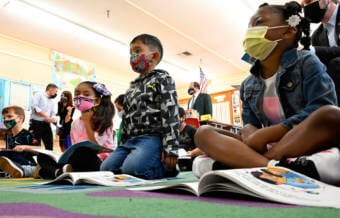
First-graders listen to the interim superintendent of the Los Angeles Unified School District, Megan Reilly, read a book at Normont Elementary School in Harbor City on Aug. 16, the first day of school. (Brittany Murray/MediaNews Group via Getty Images)

Which masks are best to keep kids safe? It’s a question on many parents’ minds as students return to in-person school amid a huge wave of coronavirus infections. Masking is a key safety measure in schools for all kids, especially for children too young to be eligible for any COVID-19 vaccine.

A recent study involving 100 school districts and 14 charter schools in North Carolina found that masks were effective at preventing in-school transmission of COVID-19 — even with physical distancing of less than 3 feet.

We asked several experts what parents should consider when it comes to masks for their kids. They all agreed that the most important thing is to choose one that a child will actually wear properly all day long.
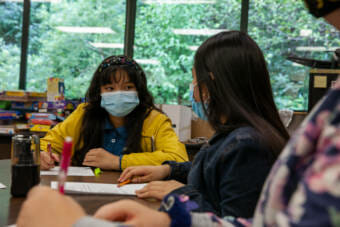
Here’s more of their advice:

1. Focus on comfort and fit

A mask is only protective if your child is actually wearing it. For younger kids especially, you want to choose a mask that is comfortable, so they won’t fiddle with it all day long, says Ibukun Kalu, an infectious disease pediatrician at Duke University.

“I would advise using the most comfortable mask, but at least ensure that it’s a double-layer cotton mask,” she says — and don’t use one with an exhaust valve. (A three-layer mask is a great option if can you find it.) Multiple studies have shown that tightly woven cotton fabrics do a surprisingly good job of filtering out particles, and their performance can actually improve under humid conditions, such as those created when you breathe.

Most importantly, pick a mask that fits closely over the nose and mouth and down to the chin — bonus if it has adjustable ear loops and/or an adjustable nose piece. Remember: A snug fit is key to having a protective mask, so make sure your kid’s mask doesn’t gape open along the edges.

2. Pack a spare for school

Kids tend to be messy, so it’s a good idea to throw an extra mask in their backpacks in case the one they’re wearing gets soiled or sweaty, says Tina Tan, a pediatric infectious disease physician at Lurie Children’s Hospital in Chicago. She says that’s one reason parents might want to choose cloth masks over disposable ones for their kids.

“If the mask gets a little bit wet and it’s very uncomfortable, they could go through two or three [masks] a day, so it could get more costly,” she says. “Whereas with the cloth mask, if you buy a couple of them, you could wash them in between.”

3. Skip the neck gaiters

Many kids like to wear gaiters because they’re easy to pull up and down and they don’t have any ear loops to fuss with. But while any mask is better than no mask, “I would really put [gaiters] way at the bottom of the list,” says Yvonne Maldonado, a pediatrics and infectious disease specialist at Stanford University who also serves as chair of the Committee on Infectious Diseases for the American Academy of Pediatrics.

“They might look kind of cute for some people, but they really aren’t doing too much because they stretch so much and the fabric is really porous,” she says. “Everything can just come right through.”

4. Consider adding a filter or double-masking

If your child can wear it comfortably, now would be the time to add a filter to the mask, says Linsey Marr, a researcher at Virginia Tech who studies how viruses transmit in the air. She’s also the mother of two children, one of whom is still too young to be vaccinated. “Right now I’m emphasizing [to them], ‘You have to have the filter in there. We need our best mask game right now,” Marr says.

Many masks are sold with a filter layer built in. If your cloth mask has a pocket for a filter, Marr suggests inserting a good-quality surgical mask, because they’re made of material that’s very efficient at filtering out particles. Cut the surgical mask to fit inside the pocket if need be. She says HEPA filters cut out from the filters used in portable air cleaners also work well (here’s her how-to video).

Double-masking is also an option, she says. Your child would wear a surgical mask closest to their face, with a snug-fitting cloth mask on top to eliminate any gaps. The goal is to “achieve good filtration and fit, which are both key to having a protective mask,” Marr says.

However, not everyone agrees that double-masking is necessary. So if your kid finds this uncomfortable, skip it.

5. What to make of KN95s for kids?

While child-size KN95 respirators do exist now, they’re not necessary, says Tan — and like double masking, they can be uncomfortable to wear for long periods of time.

Maldonado agrees that a KN95 isn’t needed, but she also understands that some people’s risk tolerance is a lot lower than others’. “If people feel more comfortable with a KN95 and their child can wear it, I don’t have a problem with it.”

Another important consideration with KN95s is fit. For these types of respirators to work as effectively as billed (blocking out at least 95% of small airborne particles), they have to fit really well. A poor-fitting KN95 might not be all that protective for your child and could give a false sense of security.

6. Practice good masking techniques at home

Kids are proving capable of learning to wear their masks correctly, which is key to their effectiveness. “I’ve been rather impressed by how well kids are able to keep on their mask. We’ve seen good compliance,” says Kalu, who was part of the research team that found masks worked to curb transmissions in North Carolina schools.

But not every child knows proper mask etiquette, she says, so it’s important for parents to model that behavior. That means making sure kids know how to put the mask on properly — with the adjustable nose piece worn on top of their nose bridge, not under their nostrils, for example, and without gaps around their face. It also means knowing not to touch the front of the mask, she says, lest they contaminate their fingers.

Copyright 2021 NPR. To see more, visit https://www.npr.org.

Juneau kids head back to school, but it’s different again this year

Thunder Mountain High School seniors Kafoa Maka and Ammon Kawakami watch students head to lunch on the first day of school on Monday, August 16, 2021, in Juneau, Alaska. (Photo by Rashah McChesney/KTOO)
Thunder Mountain High School seniors Kafoa Maka and Ammon Kawakami watch students head to lunch on the first day of school on Monday in Juneau. (Rashah McChesney/KTOO)

It’s the first week of school for hundreds of Juneau public school students. Students, teachers and administrators all said they were excited to see each other in person on Monday. 

As lunch period started at Thunder Mountain High School, Kafoa Maka and Ammon Kawakami watched a sea of masked students rush down the stairs. 

Maka, a senior, said he switched to learning at home last year when the COVID-19 pandemic hit, and he thinks being in-person will be better for him academically. 

“I took all online classes, and they were all pretty easy to get distracted in, but now that I’m back here in the real school, I think I’m going to be able to learn better and like — I don’t know — just learn more and be more focused on what I need to do,” he said.

Kawakami homeschooled last year. He said heading back to in-person classes feels normal. But the masks are complicating things for him. 

“I get, like, completely confused because I don’t want to approach [people] and call them by the wrong name and have them be a completely different person,” he said.

Rusel Rotano serves lunch on the first day of school at Thunder Mountain High School on Monday in Juneau. The Juneau School District is offering free lunch to all students this year. (Rashah McChesney/KTOO)

At lot of students headed through the lunch line at Thunder Mountain, though a few brought their own or headed outside.

Another change this year is that the district is offering free breakfast and lunch to all students at every school. And Juneau School District Chief of Staff Kristin Bartlett says a lot of students took them up on that offer. 

At Dzantik’i Heeni Middle School, registrar Maria Kappler said she is happy to be back — and the kids are too. The school feels alive, and Kappler said she’s excited for a return to normalcy. 

“Last year it was pretty lonely actually, especially the first part when it was all distanced,” she said. “And then even when they came in, there were so few students it just didn’t feel the same.”

Maddie Bass watches as Zara Ritter ties her shoe during an art class on the first day of school at Dzantik’i Heeni middle school on Monday in Juneau. (Rashah McChesney/KTOO)

Kids ran around and laughing and playing on their phones — it did feel normal. But there were a few things that stood out at the middle school. For example, students that filed into Miah Lager’s art class had to sit in very specific spots at each table. It took a few minutes for them to figure out the map and settle in. Lager apologized to the class but told them it’s important to know which kids are sitting next to each other. 

Kappler said that’s for contact tracing, in case anyone gets sick. 

“We’re trying to keep close tabs on that even though, you know, we had more students than expected because of budget cuts, so a little tight. But of course knowing where they’re sitting and sitting next to each other is essential,” she said.

Students at Dzantik’i Heeni middle school listen to Ray Imel talk about a Makerspace class on the first day of classes on Monday in Juneau. (Rashah McChesney/KTOO)

Next door to Lager’s art class, Ray Imel continually reminded kids to pull their masks up over their noses. He told them that it’s important so they can all continue to meet in person. 

The school district’s plan right now is for five full days a week of in-person learning. Everyone has to be masked when they’re inside, but they can remove those masks when they go outside. 

The district reported 300 more students than last year attended school on the first day, though they won’t have a full count until after Kindergarten starts on Thursday.

The pandemic forced these families to try new education formats. Now they want to stick with it.

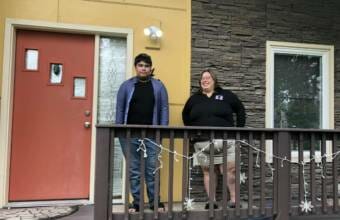
Patrick, 17, (left) stands next to his mother Tasha Hotch (right) in front of their Mountain View home in Anchorage on Tuesday, Aug 3. (Mayowa Aina/Alaska Public Media)

Tasha Hotch has always been a neighborhood mom, and a strong supporter of public schools.

“Sometimes I would volunteer in the classroom … or the office, or at picture day,” Hotch said. “The students know who you are, you’re another adult that they trust, and I just absolutely loved it.”

The longtime Mountain View resident even ran for the Anchorage school board in 2017 and 2018.

But, as her own son Patrick progressed through school in the district, Hotch noticed he was struggling — being pulled into special classes and getting failing grades.

By the time he got to his freshman year, Hotch worried Patrick wasn’t going to graduate if something didn’t change soon. She asked to put her son in an alternative program, but the school said no.

“The response was kind of, ‘You’re being premature in taking that course of action,’” said Hotch. “And that was really frustrating to me. And I went, ‘Well, we’re not going to do this next year.’”

But then the pandemic came during spring break of Patrick’s freshman year, and all of his classes moved online.

Suddenly the entire district was put in an alternative program. It was a bumpy transition, but Hotch said Patrick began to thrive. Instead of not being on track to graduate at all, he’s on track to graduate a year early.

Now a rising junior, Patrick plans to stay out of the traditional school system and take an even more individualized approach with homeschooling during the upcoming school year, which starts next week.

Like the Hotch’s, many families nationwide experienced a brand-new schooling format when the pandemic shut down in-person learning. The number of students enrolled in homeschool programs across the country doubled, according to a survey by the U.S. Census Bureau.

And Alaska had the largest increase in homeschool enrollment, from 9.6% of households to 27.5% during the data collection period.

“Homeschooling is a family affair,” said Chugiak mom Jennie Schroll about homeschooling her two school age children. For this science lesson, her kids did a dissection of a sheep heart with their high school cousin. (Photo courtesy of Jennie Schroll)

For some families, homeschooling was a short-term solution to the unpredictability of in-person learning and unfamiliarity of virtual instruction. Some of them hated it and are eager to return to classrooms.

But for others, like the Hotch’s, being thrust into a more flexible education option led to unexpected success. And they want to continue.

“Cafeteria-style education really is the future,” said Jessica Parker, principal at Family Partnership Charter School, a homeschool program in ASD. “Parents like being in the driver’s seat of choosing what they think is best for their child.”

Parker said her program doubled in size last year, reaching capacity at 1,500 students. She had to turn away 800 families.

This year, Parker said about 20% of families decided not to continue with Family Partnership for a number of reasons. But they were easily replaced by other people eager to get in.

“When we opened our doors this morning, there were parents waiting in a line to get in and turn in their enrollment application,” Parker said.

Parker expects the program will reach capacity again within the first week of registration.

ASD Deputy Superintendent Mark Stock said families are reaching out to learn more about what school options are available for the upcoming school year, too.

“What’s interesting with the pandemic is it literally put every student and family into some form of a hybrid or online learning format,” Stock said. “Suddenly, it was a necessity, and now they’re aware. Now they’re asking.”

The district is sending messaging to families about it’s different offerings, many of which already existed but people were unfamiliar with, said Stock. ASD is calling it ASD Flex.

A screenshot of the Anchorage School District’s flexible learning options for high school students.

Enrollment is constantly fluctuating so the district won’t know exactly where families have landed until the first day of school gets closer, Stock said.

The district is expecting about 75% of students who left to other programs will return for in-person learning this fall. Enrollment numbers are already increasing. By the end of last week, the district projected enrollment at roughly 44,000 students for the fall, up from almost 40,000 at the end of last school year.

Stock said the district expects a large majority of ASD families — about 80% — will choose the in-person learning option this fall. But a growing number are interested in customization that meets their needs.

“I think people are going to see schooling is more fluid than they thought,” Stock said. “People are really recognizing they have options … it’s not that they weren’t there, it’s just that a lot of families had never thought of it or been aware.”

Stock said families might not choose strictly homeschooling or all in-person, but maybe something in-between. More students might take classes online and only go to school buildings for activities on a schedule that allows them to work or take care of family obligations.

And for some, homeschooling is just easier.

Jennie Schroll turned to homeschooling at the start of the pandemic and plans to continue. She said she needed a stable schedule.

“The district kept flip-flopping and going back and forth and not knowing what they were going to do (at the start of the pandemic),” Schroll said. “I just could not deal with the inconsistency.”

But Schroll discovered other benefits too — not having to commute or rush her three kids out of the house each day has saved her family a lot of time.

Jennie Schroll’s youngest son isn’t old enough to homeschool yet, but sometimes he likes to participate and complete lessons alongside his sisters who are currently being homeschooled with the support of the Family Partnership homeschool program. (Photo courtesy of Jennie Schroll)

“If there’s an accident on the highway and traffic is backed up … and if we’re going to be late and all of that stuff (is gone),” said Schroll. “I never thought that homeschooling would end up being less stressful.”

For all of its benefits, homeschooling does require a lot of work and coordination.

Schroll started a business and works from home now, and grandma and grandpa watch her 3-year-old in the mornings.

Hotch also has a job that allows for remote work and she has extended family in the neighborhood that can help support her son.

But for these families and others like them, their educational experience is taking a different path toward the future.

Correction: An earlier version of this story described the Census homeschooling survey as a “March 2020 poll.” The survey collected data during two periods in 2020, one in the spring and one in the fall.

Advocacy centers, shelters in Yukon-Kuskokwim Delta relieved after federal funding gets restored

Tundra Women’s Coalition in Bethel, Alaska (Katie Basile/KYUK)

Victim advocacy centers in the region are breathing a sigh of relief after President Joe Biden signed the VOCA Fix Act on July 22. The act will reverse severe federal funding cuts sustained by shelters and advocacy centers earlier this year.

In April, the Yukon-Kuskokwim Delta’s two largest victim advocacy centers received news that they called devastating. Bethel’s Tundra Women’s Coalition and the Emmonak Women’s Shelter learned that they would lose about a third of their federal funding from the Victims of Crimes Act, known as VOCA. It was the most recent cut to the act following years of dwindling allocations.

Eileen Arnold, executive director of the Tundra Women’s Coalition, said that with the cuts, her organization would have to shut down the Children’s Advocacy Center, the overnight shelter, or make cuts to all their services.

“I spent so many stressful days, nights, months worrying about what that would mean, what the impact on victims and survivors would be on our staff and our agency,” Arnold said.

Arnold’s organization and many other shelters receive a large portion of their funding from the Victims of Crimes Act. VOCA takes money from federal criminal fines and other sources and redistributes it to victims and survivors of crime.

The U.S. Senate sought to restore the funding through a bill called the VOCA Fix Act that would reverse the funding cuts and provide a long-term funding solution for shelters. Sen. Lisa Murkowski was an early co-sponsor. Sen. Dan Sullivan also signed on.

“We know that the story in Alaska is not a good one when it comes to domestic violence, child sexual assault, and just the levels of abuse,” Murkowski said in an interview with KYUK. “So having these shelters, having provisions for victims services is absolutely key.”

The VOCA Fix Act passed the U.S. Senate with a 100-0 unanimous vote.

“I had so much relief when it passed and so much gratitude to everybody who took part in that passing, because there were a lot of people from our community who helped that out,” Arnold said.

Arnold said that she heard that more than 100 people from the Y-K Delta contacted their federal and state representatives telling them how important shelters like Tundra Women’s Coalition are to the community. The advocacy worked, and Arnold said that it serves as an example of the power of speaking up to influence lawmakers.

“I think it’s important to know that legislators listen,” Arnold said. “And that if a community makes something important and a priority, then, you know, the way that our democracy works is that legislators will, will do something about it.”

The VOCA Fix Act won’t fix the funding issue immediately. It’ll take a few years for the full amount of federal money to start flowing to shelters again. In the meantime, Arnold said that the State of Alaska has stepped in. The state will fill that funding gap until the VOCA Fix Act takes effect and provides a long-term solution.

Southeast Alaska State Fair wraps up after 4 days of festivities in Haines

Darrel Jerue with his two beadwork pieces which won Division Champion and First Place at the Southeast Alaska State Fair (Corinne Smith/KHNS)

The Southeast Alaska State Fair wrapped up its four-day run of festivities this weekend. Despite rising COVID-19 cases and border restrictions, people from across the region came together for a weekend of fun and community.

It was the first fair since the pandemic led to last year’s cancelation. Organizers recommended masking and social distancing, but very few people appeared to take those precautions. Attendees were also asked to jot down their names and phone numbers at the entrance in case contact tracers had to get in touch later.

The crowds were thinner on Sunday, the final day of the fair. But kids were back at the carnival games and rides, families flocked to the food court and high schoolers play a fast paced volleyball game.

At Harriet Hall, artists and makers of all ages from across Southeast Alaska and the Yukon displayed their work. Purple, blue and red ribbons adorned wall displays of photography, quilts, cases of jams and wearable art pieces some that went down the runway the day before.

Exhibitor Darrel Jerue of Klukwan won division champion and first place for two beadwork pieces — his first entries at Southeast’s fair.

“I’ve got a stargazer lily, about four by six (inches). It takes about six months to do each piece that large. And also have the wet raven. It has the sun, the moon and also the Earth in there,” he said.

Darrel Jerue’s piece, “Wet Raven.” (Corinne Smith/KHNS)

Jerue says he learned beading from his mother, Sally Burattin, who passed away last March.

“She taught me how to do all this,” he said.

He says the public reception at the fair has been overwhelmingly positive, but still, he’s missing her. So he’s unsure where his beadwork will go next.

“Right now, I put myself in a predicament where I can’t touch a needle until probably next year, after the one year mark on my mom’s death. It’s hard for me to start a project because she was always there for me, to say there, it’s good,” he said. “She was always a mentor for me.”

The raven piece will be incorporated into a traditional blanket that was started by his mother, which will be completed by several family members and then displayed at the Jilkaat Kwaan Heritage Center in Klukwan.

Outside the hall, the disc golf tournament wrapped up with awards and cash prizes. TeoLani Baker of Haines is seven months pregnant and won the women’s division for the second year in a row, while her husband Colton Baker won the men’s.

“The luck, I guess,” she said. “I think that’s what makes it the most fun. You can’t ever get too good that you might not lose.”

As the fair winds down, volunteers with Haines Friends of Recycling sorted compost and recyclables as part of the fair’s zero-waste effort. Food vendors were required to use compostable plates and utensils.

Haines Friends of Recycling chair Melissa Aronson says the initiative has had a huge impact in diverting waste and saving money at the dump. She says that each year she sees improvement.

“They used to bring a great big Conex in here and fill it up, you know, sometimes more than once over the course of the fair. This year they just brought one bear-proof canister,” she said. “So that seems to be really improving, people are paying attention.”

The last event of the fair weekend was a pie fight in Raven’s Arena. The fair’s theme this year was “Live Free, Pie Hard.”

The free-for-all pie fight was the finale to the fair weekend (Corinne Smith/KHNS)

Within minutes, kids and adults were covered in pie as a crowd cheered from the stands. And with that, the Southeast Alaska State Fair was over.

Organizers haven’t released the number of ticket sold this year. They estimate past years have reached 11,000 people, but this year saw a significantly smaller crowd.

Site notifications
Update notification options
Subscribe to notifications