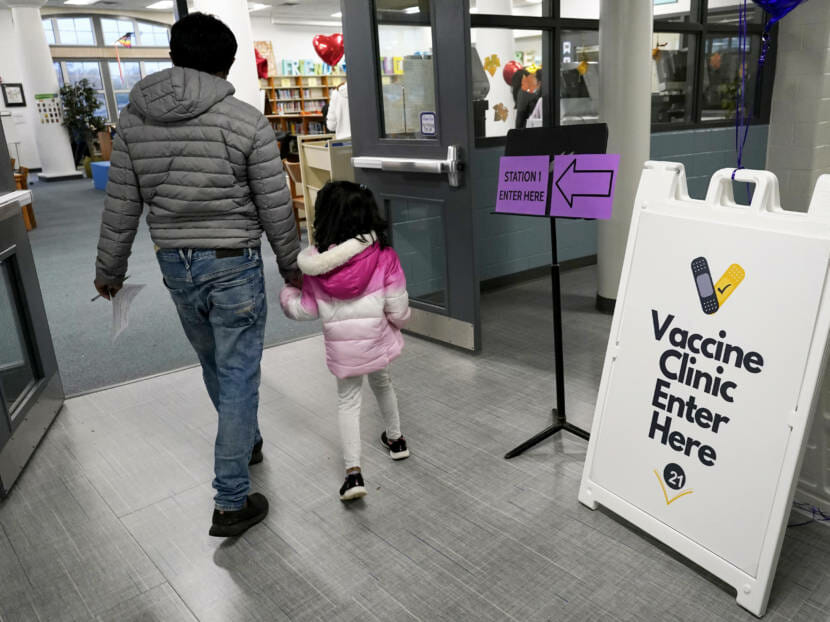
A child, with parent in tow, arrives to receive the Pfizer COVID-19 vaccine for children 5 to 11 years old at London Middle School in Wheeling, Ill., last month. (Nam Y. Huh/AP)
Pfizer-BioNTech announced Friday that they will expand ongoing clinical trials of their COVID-19 vaccine in children to include a third dose for participants as young as 6 months old.
Testing a third dose will cause a delay in submission of data to regulators to authorize use in the U.S. In the fall, Pfizer’s CEO said the company expected to have data for this age group by the end of 2021. Now, the company says that they would expect to file results in the “first half of 2022” if trials are successful.
The companies said two doses did not produce a robust immune response in kids 2 to 5 years old.
The companies, which produced the first vaccine against coronavirus infection authorized for use in the U.S., said they had made the decision “following a routine review by the external independent Data Monitoring Committee,” which acts as a watchdog over the clinical trials.
“The study will now include evaluating a third dose of 3 [micrograms] at least two months after the second dose of the two-dose series to provide high levels of protection in this young age group,” the companies said in a statement.
“No safety concerns were identified and the 3 [microgram] dose demonstrated a favorable safety profile in children 6 months to under 5 years of age,” they said.
So far, the Food and Drug Administration has only authorized the Pfizer-BioNTech vaccine for emergency use in children aged 5 and older.
Research has indicated that the Pfizer-BioNTech vaccine is less effective against rapidly spreading omicron variant than for previous strains of the virus. However, a booster dose has been shown to add significant protection. Earlier this week, Moderna announced similar results for its vaccine.
Last month, the FDA authorized a third booster dose of either vaccine for all U.S. adults.
“The data are illustrating the impact of a booster and that our vaccine works best as a primary regimen of three doses,” Pfizer’s chief scientific officer, Mikael Dolsten, said on a conference call, according to Reuters.
Pfizer also said it was developing a vaccine tailored to combat the omicron variant of the virus — which has spread rapidly around the globe in recent weeks. The company hopes to start clinical trials on the updated omicron-specific vaccine in January.
Pfizer also said 30 million of a planned 80 million treatment courses of its Paxlovid antiviral pill will be available in the first six months of 2022.
Copyright 2021 NPR. To see more, visit https://www.npr.org.
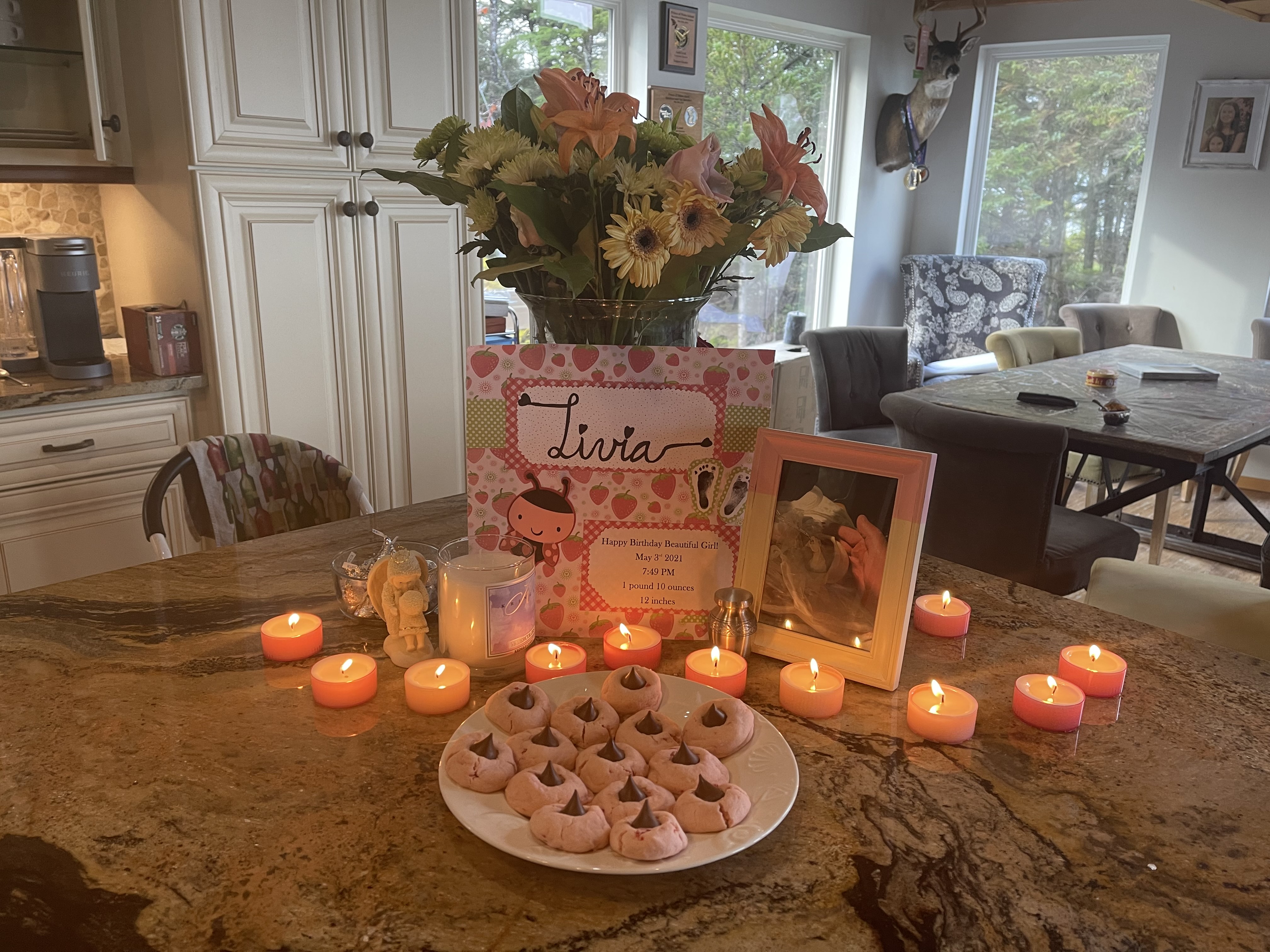
Misty Fitzpatrick created a display in memory of the baby she lost in 2021, Livia Jo Burgess. (Photo courtesy of Misty Fitzpatrick).
It’s impossible to know how many pregnancies end in miscarriage because it can happen before someone even knows they’re pregnant. The March of Dimes has been tracking this issue for generations and estimates it could be as high as 50%. That means that someone you know has probably experienced pregnancy loss.
But until this year, there was no official support group in Juneau for people who had experienced the loss of a pregnancy or an infant. Doctors who had treated patients for miscarriages or stillbirth would reach out to Sara Gress at Bartlett Regional Hospital, looking for help.
“They would often come to us to see if we had any ideas about where to go,” Gress said. “And for many, many years, we came up empty-handed with that.”
Gress teaches birth preparation classes at the hospital and facilitates groups for new parents. And even though she’s really experienced in creating space for people to talk about all aspects of having a baby, she knew the topic of loss and grief was out of her expertise.
So, she teamed up with Teri Forst, a licensed professional counselor and a grief recovery specialist, to help facilitate the group, which supports people who have had recent losses or even losses in years past.
“There’s no timeline on grief,” Forst said. “Grief is a process that does not have a definition of time, and we will accept and support anybody.”
And the group doesn’t distinguish between early term pregnancy loss known as miscarriage or later term loss known as stillbirth. There are also people in the group who have lost infants after birth or even people who have been unable to get pregnant who really wanted to have a baby.
“If that feels to you like it’s a loss —because it is — that’s somebody who’s welcome to attend [the] group as well,” said Gress.
Forst says that we are lacking in rituals for this kind of death.
“When we lose somebody, you know, a parent or a sibling, there’s memorials, there’s funerals, there’s feast and potlucks and obituaries,” she said. “And with pregnancy loss, there’s rarely those things.”
She says she wants to change the taboo around pregnancy loss. And that starts with being willing to talk about it.
“I am trying to think back in 12 years of doing this job [if] I have ever heard anyone say, ‘I don’t want anyone to bring up my loss’,” Forst said. “It’s more of a ‘I just want them to be talked about and remembered and I want my experience to be validated’.”
That brings us to the holidays. It’s a time of joy and getting together with family that can be awkward — or triggering — for people who have experienced loss.
“Everybody typically wants to help and wants to have good intentions, but doesn’t know what to do and is afraid of saying the wrong thing,” Forst said. “So, it can be really helpful to just tell them what you need and want from them.”
She has advice for people who are grieving.
“I always recommend to not have the holiday dinner be at your house so that you can leave early or you can choose not to go at all, if you [don’t] want to. Give yourself some options — some plan B — to be able to remove as much unnecessary stress as possible,” she said.
And for friends and family who are there to support people who are grieving, Forst says be open to listening. And it’s better to say nothing than to let your discomfort lead you to say something insensitive. She says there are some things you should avoid saying.
“We hear some of the most common ones are: ‘Well, at least you have other kids’ or ‘Now you know you can get pregnant, so I’m sure you will, again’ or ‘Luckily, it was just early in the pregnancy.’ Those types of statements that are really not helpful. They’re not validating that this person, that this family, experienced such an enormous loss,” Forst said.
Instead, she says, offer to bring over dinner or babysit the kids so the grieving parents can have some time together.
Heading into the holidays the group has been sharing ideas with each other for ways to honor their loss — things like lighting a candle or setting a place for the baby at Christmas dinner, taking a photo with a pair of baby shoes or writing a poem, which are all ways of acknowledging the loss in a real and tangible way.
The group meets on the last Wednesday of every month at 6 p.m. on Zoom. You don’t have to be in Juneau to participate, but one-time registration is required.
Note: An earlier version of this story had the incorrect meeting time for the group. It meets at 6 p.m. the last Wednesday of the month.
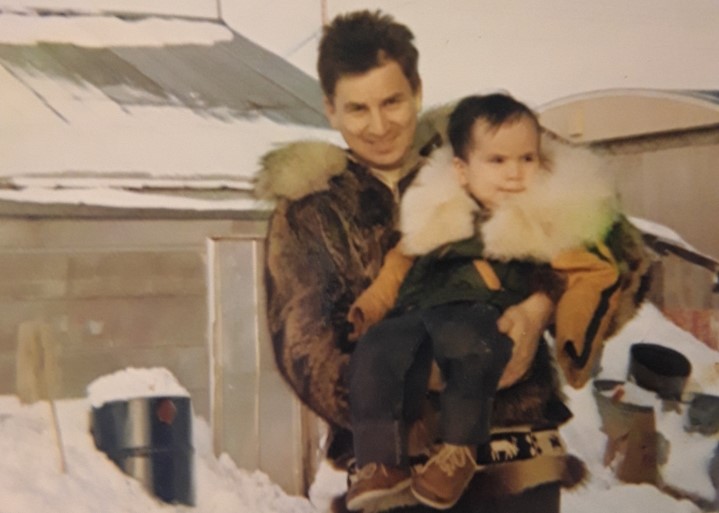
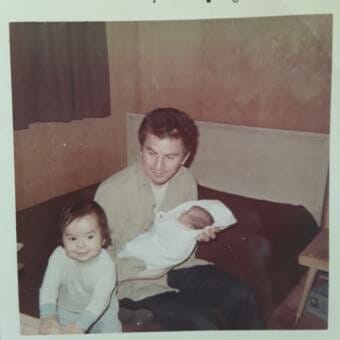
John Redmond Evans Sr. and his son John Redmond Evans Jr. in 1969 in Kotzebue. (Photo courtesy Suzanne Evans)
More than 800 Alaskans have died of COVID-19 since early 2020. We asked readers and listeners to tell us about the lives of some of those Alaskans, and they responded.
John Redmond Evans Sr. of Kotzebue, known to many of his friends and family as “Johnny Red,” died from COVID-19 on Aug. 2, 2020. He was 77 years old.
Born in Galena in 1943, Evans got an electrician’s degree in Kansas. That’s where he met his wife, Sophie, whom he married in 1965 and started a family with in Kotzebue.
Evans held many jobs around Alaska, including with the state Department of Transportation, and was an assistant chief at the Kotzebue Fire Department.
His youngest daughter, Suzanne, says his work ethic was matched by his care for his family — and that many of her favorite memories of him involve holiday gatherings.
Listen here:
The following transcript has been lightly edited for clarity.
Suzanna Evans: My dad, Jonathan Sr., was a kind, caring, loving, supportive father — very devoted to his children and his wife. I’m the youngest of the girls. I’m the middle child of the family, and he also raised a nephew that was like his son that lives up in Kotzebue with us.
John Redmond Evans Sr. and his daughters Johna and Suzanne Evans. (Photo courtesy Suzanne Evans)
He loved going to family gatherings and, most of all, spending time with his immediate family and his brothers and his sister. We always flew over to Galena, Alaska, to spend Thanksgiving and Christmases with my dad’s side of the family. That was very nice.
He was only working to provide for the family, to pay bills, to put bread and butter on the table, to buy stove oil and buy stuff for school and make sure that we had a warm house and things to eat every day. He was a very good provider.
When we went to Galena to visit the other kids, we’d always go back to the base and watch movies during Christmas time. And ride around on sno-gos and walk around town and go to the store and buy ice cream and then go back to my grandpa’s house or my uncle’s house and stay in and watch Christmas movies and look at presents under the tree and look at all the lights. We were happy kids, excited to be around my dad’s side of the family for the holidays.
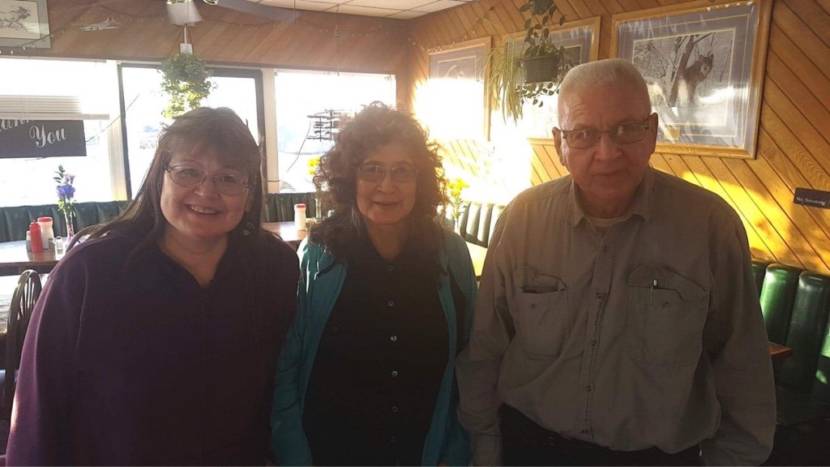
From left to right: Suzanne, Sophie and John Redmond Evans at Peggy’s Restaurant in Anchorage. (Tami Krukoff)
When we were living out in Muldoon, my dad had a fun thing of doing. He’d know I was sleeping in the bedroom, and then he’d pretend that he and mom were getting ready to leave, and they weren’t dressed up yet. And he’d say, “Well Sophie are you ready, OK, let’s go!” And he’d walk out into the living room with mom, and I’d be in my bed, and I’d hear them and pop up. And they’d be in the kitchen and I’d run out really fast. And then my dad would start smiling and say, “Sue, I was just trying to get you up! I know it’s early.”
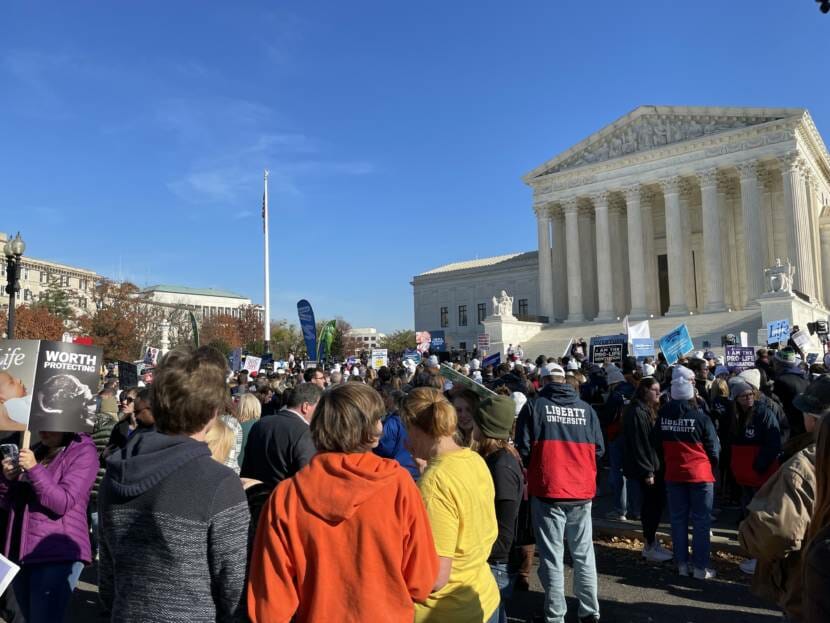
Thousands of protestors gathered outside the U.S. Supreme Court Dec. 1 during oral arguments in a Mississippi case that could diminish abortion rights nationwide. (Liz Ruskin/Alaska Public Media)
The U.S. Supreme Court could limit or even overturn the landmark abortion rights case Roe v. Wade in a decision expected next summer. That could leave the legality of abortion rights up to each state. And you might be wondering what that would mean for Alaska.
The following transcript has been lightly edited for clarity.
Casey Grove: Liz, it seems like the Legislature and Alaska voters have passed several laws to limit abortion over the years. Aren’t those still on the books?
Liz Ruskin: Casey, you’re right that they have passed a number of limits, like requiring parental notification before a minor’s abortion and prohibiting state-funded abortion. But these restrictions have been struck down by the Alaska Supreme Court, typically citing the state constitution’s right to privacy that voters adopted in the ’70s.
Casey Grove: So if Roe v. Wade is overturned, abortion rights would still be protected by the state constitution?
Liz Ruskin: That is how the state Supreme Court has seen it for a couple of decades. Roe v. Wade is built on an implied right to privacy in the U.S. Constitution. But in the Alaska Constitution, you don’t have to imply it. It’s on the page: ‘The right of the people to privacy is recognized and shall not be infringed.’
Casey Grove: Sowait, the Alaska Supreme Court says that privacy right covers the right to have an abortion?
Liz Ruskin: Yes, and Alaskans who want to ban abortion say that’s a bad interpretation. But it’s stood for 25 years now. I just talked to Loren Leman about it. He’s the former lieutenant governor and former Republican legislator. He has sponsored a number of abortion restrictions over the years. He describes it as an exciting time for his side on the national level, with the prospect that Roe might be overturned or reined in. But he says Alaska is a long way from being able to ban abortion.
Here’s how he put it:
Loren Leman: The big problem is the Alaska Supreme Court and how judges are are selected. And there’s a way to fix that. It’s long. It’s tedious. And it’s fraught with a lot of challenges. But it can be fixed.
Liz Ruskin: So Leman’s solutions — all but one — involve amending the state constitution. One way, he says, is an amendment that basically tells the state Supreme Court, ‘Nothing in this document is about abortion.’ And another is to give more power to the governor or the Legislature in judicial selection, to get a Supreme Court that’s more likely to accept an abortion ban. As Leman says, though, it’s not easy to amend the constitution.
Casey Grove: Did you say he had one other way to ban abortion and Alaska without amending the constitution?
Liz Ruskin: Well not ‘ban’ abortion, but he said there’s a way to ‘end’ abortion in Alaska without changing the constitution. And that’s just changing the hearts and minds of everyone who might have an abortion. And as you know, that is a never ending campaign.
Casey Grove: Well, Liz, what do abortion rights advocates say?
Liz Ruskin: They like the privacy clause in the constitution and they want to make sure the state Supreme Court continues to see it as protecting a right to abortion. They don’t want changes to the constitution on this score.
Casey Grove: Which I guess we could see at a state constitutional convention where delegates would propose changes to the state constitution. Isn’t that supposed to be on the ballot next year?
Liz Ruskin: Yes, voters will be asked on the 2022 ballot in November whether they want a constitutional convention. And a convention worries both sides of the abortion debate because you don’t really know how it would turn out. But there are definitely some in the anti-abortion camp who see it as a route to acquire an abortion ban.
Casey Grove: So bottom line, it sounds like Alaska is not one of those states that can easily ban abortion if Roe v. Wade is no more.
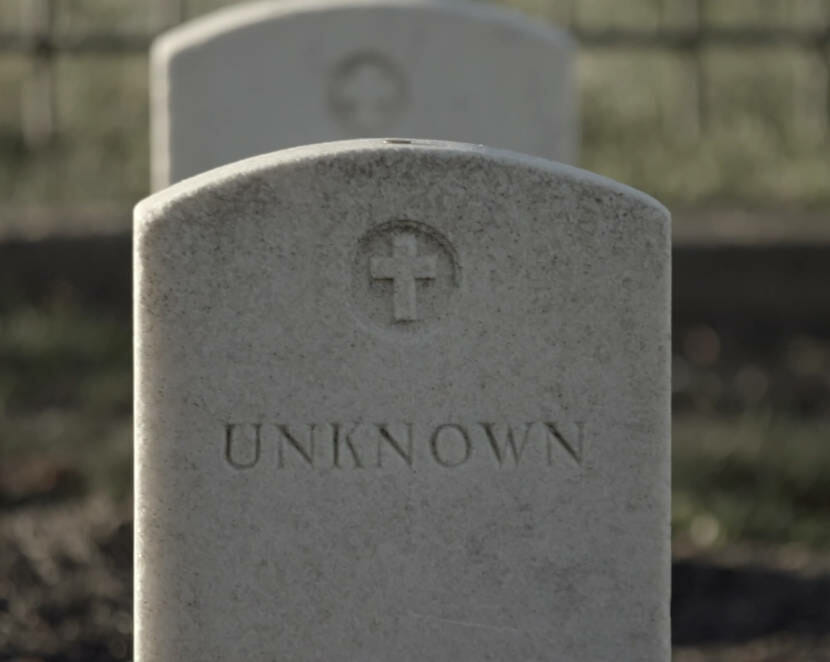
A gravestone at the Carlisle Indian School marking the grave of an unidentified Native child. (Production still from Al Jazeera’s “Fault Lines”)
The atrocities that occurred at Native American boarding schools in the United States will finally be investigated, at least in an official way, after U.S. Interior Department Secretary Deb Haaland announced the Federal Indian Boarding School Initiative earlier this year.
It’s a reckoning that Canada has faced more recently, including the discovery of hundreds of Indigenous children’s unmarked graves at residential schools.
A new half-hour documentary, “Buried Truths” on the Al Jazeera program “Fault Lines,” delves into that painful history in the U.S.
Kavitha Chekuru is senior producer of Fault Lines, which features the stories of two Alaska Native people, one who survived their time at a boarding school and one who didn’t.
Listen here:
The following transcript has been lightly edited for clarity.
Kavitha Chekuru: So in the documentary itself, we featured one survivor in particular, Jim LaBelle, who lives in Anchorage. But as part of the kind of research process of it, we did speak to other survivors. And even though they went to different schools and different years, there was a commonality, which was they were not allowed to speak their language, and they were subjected to pretty horrific abuse. But one of the things I think is important to remember is that, when people are learning about this boarding school policy, is that even though it started in the 19th Century, it continued for over a century. So it wasn’t that long ago, and there’s still survivors out there who were taken from their families.
Casey Grove: Like you said, Jim LaBelle was one of those that you spoke to, and he said a lot of things in that documentary that really drive home what was going on at these boarding schools. But there was one part of that documentary that really kind of just hit me: the way that he described the first night there at the boarding school. I thought I would play just that clip here quick.
Jim LaBelle [clip from documentary]: We got settled in for the night. That’s when some of them started to cry. It started off with little whimpers, little sniffles, but it caught on. All it took was for one little child to start crying, and then another one and another and another, to a point where the entire dorm room of little kids are just wailing into the night. And we all cried ourselves to sleep. Waking up the next day, our eyes were swollen shut, and the process was repeated over and over and over, until the middle of the school year, I don’t think any child cried anymore. Because no one’s gonna come and get me or hold me, tell them that they’re loved.
Kavitha Chekuru: Jim in particular, I think, he’s really amazing, because he’s willing to talk about, you know, what he went through. But talking about trauma is not something that is easy to do. And so we’re, in that sense, we’re really honored that he felt comfortable talking to us about that.
Casey Grove: Yeah, definitely. And, I wondered about why it was so common, I guess, and it seems to represent something, that there were graveyards around a lot of these schools? What ended up being unmarked or unnamed graves, right?
Kavitha Chekuru: So right now, following the discovery of the unmarked graves in Canada, earlier this year, the U.S. government announced that it would undertake their own investigation, looking into burial sites and how many children died. One of the only other times the government has done anything looking at the boarding schools was in the 1920s. And they released a report, and this government report didn’t mince words at all. They called the schools “grossly inadequate.” They said the children were malnourished, not properly fed, even at the best schools, the children’s health and diet was not good. And there was extreme overcrowding, so disease could just run free, in particular tuberculosis. They raised the issue of the fact that these children were having to do manual labor at the school. And, you know, ostensibly, that was under the guise of education, but it was actually really to keep the schools running. So yeah, the conditions were extremely harsh, and the idea that the government does not know and is only now undertaking an investigation to find out how many children died at these schools is really just, I don’t really have a word for it. It’s infuriating, to be honest, but it’s important that they’re doing this work now.
Casey Grove: Of the folks that have been doing research on this, some of them are relatives of people that went away to boarding schools, and one of them is Eleanor Hadden. She’s an Alaska Native woman who spent many years trying to figure out what happened to her great aunt, Mary Kininnook, who was taken to the Carlisle Indian School. What did Eleanor tell you about that journey, about her investigation and what she discovered?
Kavitha Chekuru: Yeah, so Eleanor’s great aunt went to Carlisle in 1903. And it was only in the 1960s that Eleanor’s mother learned about this aunt that she never knew. And she was the one that started this search. And so she spent decades trying to get this information. And I think one of the things that’s important to kind of take away from from this is that the information is just scattered, and that’s not uncommon. So that information about the students and what happened to them is kind of locked away, and you kind of have to work in pieces to get it, and that’s what Eleanor and her mother did. It’s just so much work that they did to try and find out what happened to this one child. And it’s something that the government is currently undertaking now as well.
Casey Grove: Yeah, you see it in this documentary where she has all these different documents that she’s had to find in all these different places out on the table. And it’s just, visually, you know, compelling how difficult it must have been to just get what today we would think of as pretty simple information about where somebody was or what happened to them. And, ultimately, what did she discover about what happened to Mary Kininnook?
Kavitha Chekuru: So she eventually discovered that Mary died in December of 1908. And when Eleanor first went to Carlisle, she went to the cemetery that’s there. And she looked for her name, and it wasn’t there. And so at Carlisle, they moved the cemetery, and in the process of that move, a lot of things seem to have gone awry, because there are over a dozen graves at Carlisle that are marked as “unknown.”
Casey Grove: Here’s Eleanor Hadden talking about that, about visiting Carlisle:
Eleanor Hadden [clip from documentary]: When I first went to Carlisle and went through all the names on the stones, I was overwhelmed with so many children. There was no Mary. Fourteen graves had markers “unknown” in the school cemetery. We figured she must be one of the unknowns. They moved the cemetery to where it is today, and the records were not good. They can’t keep track of children. That’s what I got my first anger about the people not knowing what we’ve gone through.
Casey Grove: So, Kavitha, what happens next? I mean, where do we go from here?
Kavitha Chekuru: I mean, it’s a good question. I think one of the things I took away from reporting on this was, you know, anytime friends or family would ask me what I was working on, I would tell them, and no one no one knew about this. And I think it’s just one of the reasons we call the documentary “Buried Truths” was not just, unfortunately, about the children who died at these schools, but the fact that this history itself is very buried. It’s been kind of pushed away and hidden. You know, I went to public school in Texas, and I never learned anything about federal policy toward tribes, let alone about the boarding school policy. And so I think this is infuriatingly common when it comes to U.S. history, but it’s one of the reasons that we really appreciate the interviewees talking, taking the time to film with us and open up to us about this, so that the stories are out there more and more, and hopefully with the Interior investigation, and maybe more people talking about it, unfortunately, in light of the discoveries in Canada, more people will start to recognize and learn about this dark chapter of U.S. history, but it’s a chapter nonetheless.
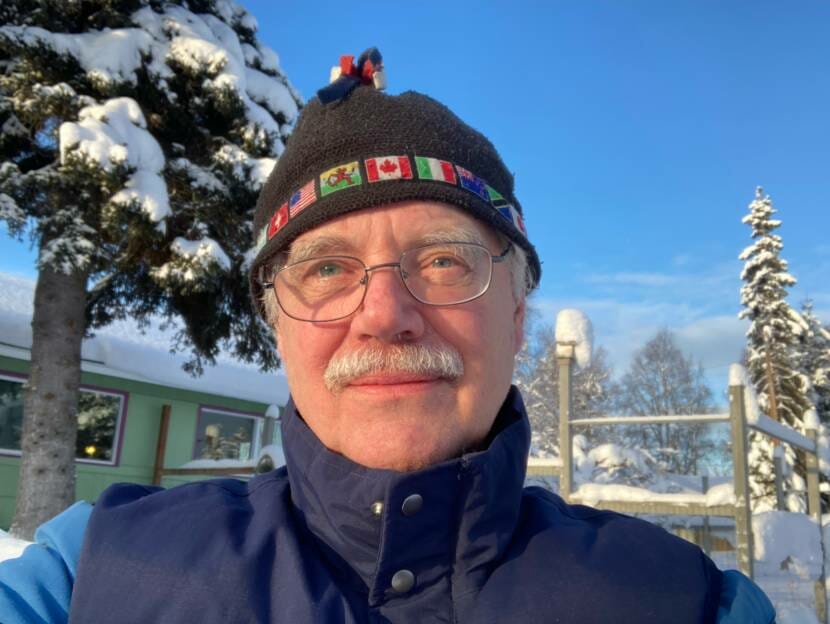
Bill Barnes outside his house in Anchorage. Barnes took in Romal Safi, a student from Afghanistan, years ago. Now, they are working to bring 17 members of Safi’s family to Alaska. (Bill Barnes)
Even before Taliban rule returned to Afghanistan this summer, one Anchorage medical student was scurrying to get 17 family members out. He’s had steadfast support from Anchorage resident Bill Barnes.
Barnes, who is “semi-retired” from the IT business, has invested his heart, soul and savings account to get Romal Safi’s family to the U.S. on a temporary legal status known as humanitarian parole.
Barnes first met Safi in 2009, when Safi was an East High exchange student and Barnes was hosting a different exchange student. Safi went back to Afghanistan, so Barnes told Alaska Public Media’s Liz Ruskin he was surprised to run into him in downtown Anchorage one day in 2011.
Listen to this story:
The following transcript has been lightly edited for clarity.
Bill Barnes: I was kind of smart alecky. I said, “So what are you doing, running from the Taliban?” And he said, “Well, that’s exactly right.”
So he studied at the University of Alaska. And, you know, when he ran out of money and was in danger of getting deported, I offered him a place to stay and helped him out with his tuition. And he graduated with a degree in biology about five years ago, six years ago now.
We applied for political asylum for him, and he’s now a green card holder. He’s on his way to becoming a U.S. citizen. And he’s always wanted to be a doctor, and he got into the WWAMI program here in Anchorage and he’s a first-year medical student now.
Liz Ruskin: And now he’s trying to get his family to Alaska?
Bill Barnes: Yes. In the spring, his dad started getting visits from Taliban agents at his dental surgery, which is just north of Bagram Air Base. And I think it was pretty alarming.
We hired — Romal hired — Margaret Stock of Cascadia Cross-Border Law, who has an office here in town. Margaret suggested that we apply for humanitarian parole for his families. She said, “Well, it’s a long shot. But, you know, that’s the only thing I can think of.” And she suggested, well, you can try five of them. It’s kind of expensive — $575 apiece to apply for parole.
It took Romal and I, you know, about less than a minute to decide we would just apply for all 17.
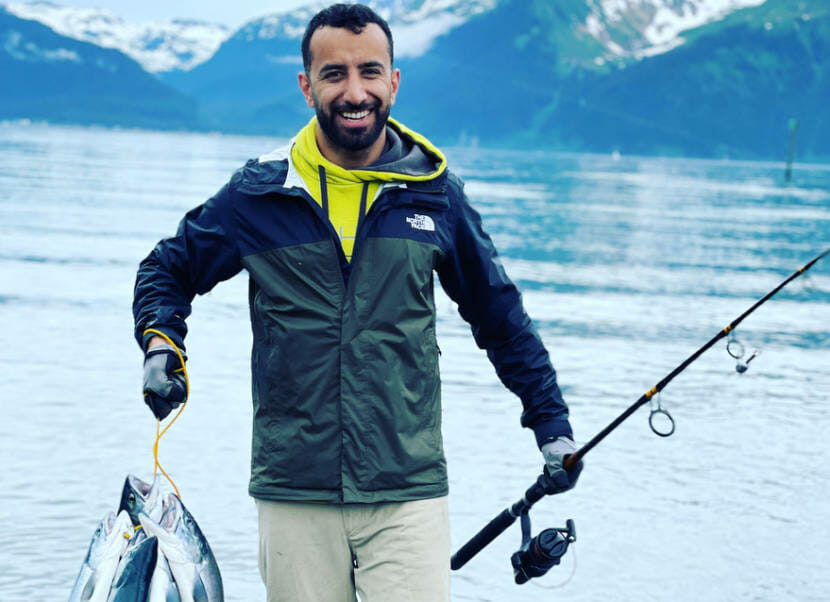
Romal Safi is a medical student who lives in Anchorage. (Bill Barnes)
Liz Ruskin: How would you choose?
Bill Barnes: Yeah, you can’t. It’s kind of like Sophie’s Choice. Like, what are we going to do? I’m choosing them all. So we chose them all. And lo and behold, the Humanitarian Affairs Branch of the USCIS granted all 17 of them paroles.
Liz Ruskin: Seventeen members of his family — are they all immediate family members?
Bill Barnes: Pretty much. It’s a mom, dad, sisters, brothers and in-laws, and three grandkids.
But the paroles came through about the 24th of August. So it was about 10 days after the Taliban had rolled into Kabul, and the U.S. Embassy had shut down.
The parole document stated: The embassy in Kabul is closed. So if you can make your way to a third country, let us know and we’ll conduct the interviews in this third country. And in this case, it’s Pakistan.
And so they managed cross into Pakistan through the normal road checkpoints about six weeks ago, something like that. But they’ve been unable to get interviews at the U.S. Embassy in Islamabad. And it’s been really, really difficult to find out why that is, whether they’re just overloaded and understaffed. And trying to talk to the USCIS or the U.S. State Department, it’s like talking to a wall.
Liz Ruskin: Where are they living now?
Bill Barnes: They are near Peshawar. They found a place out of town to rent. The good thing about them being in Pakistan is we can send them money. Whereas once the Taliban took over Kabul, you couldn’t send two nickels into Afghanistan.
In Pakistan, we’re able to send money. So they, basically, we think, are in a safe place. Now, we would just like the U.S. government to come through with what they said they would do — interview them so they can get their boarding documents, and I’ve got enough money to get them all here.
Liz Ruskin: It sounds like you’ve really put yourself out for Romal. It sounds like you’ve funded some of these efforts yourself. Why do you feel compelled to help Romal and now his family?
Bill Barnes: You know, I asked my dad one time, you know, why he joined the Marine Corps in World War II. And he said, “My country needed me. I was in a position to help and so I did.” And that’s about it.
It just seems like I can help. I want to help. I’m getting old enough. I know I can’t take it all with me. So why not?
Barnes said others have also stepped up to help Romal‘s family. He said Thursday that they finally heard back from the Humanitarian Branch of U.S. Citizenship and Immigration Service. The agency requested updated contact information.
Close
Update notification options
Subscribe to notifications
Subscribe
Get notifications about news related to the topics you care about. You can unsubscribe anytime.

9(MDEwMjQ0ODM1MDEzNDk4MTEzNjU3NTRhYg004))