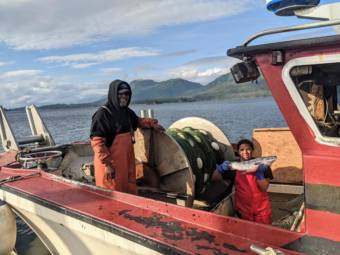
Eldon Atkinson, left, stands on his 32-foot gillnetter, the F/V Deja Vu. Atkinson recently pledged to give away a day’s catch once a week to the people of Metlakatla for the rest of the summer. (Photo: Johon Atkinson via Facebook)
A Southeast fisherman says he’s donating a day’s salmon catch every week to help feed his Annette Island community. Metlakatla fisherman Eldon Atkinson says it’s an effort to provide food security for Alaska’s only Native reservation.
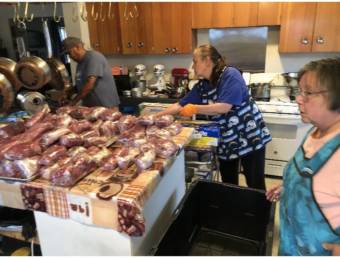
“So I’m going to be doing this over here in Metlakatla for the rest of the summer,” he said. “You know, every week, we’ll bring in one day’s full catch and just distribute it among the people over here.”
His son, Johon Atkinson, says he’s coordinating giveaways from his father and his cousin, Cameron Hollywood, through his cultural organization, Liwaayda. The organization also sponsors a dance group, serves dinners for elders and teaches traditional fishing and gathering methods.
“Liwaayda, in our Sm’algyax language, our traditional Tsimshian language, translates to ‘pull together.’ Because we always want to be able to work together, pull together, take care of one another,” the younger Atkinson said.
The elder Atkinson says that with salmon prices low, he estimates a day’s catch on his 32-foot gillnetter is worth a couple hundred dollars in cash. But he says to the community, that’s a small fortune.
“When I gave away almost 1,000 pounds of salmon, you know, I’d never seen so many smiling people and big smiles on their faces,” he said. “They keep on texting me saying they’re already preparing the salmon for their smokehouse or jarring it and so — just to see the smile on their face, that’s what makes me happy, you know?”
Alaska Department of Fish & Game Commissioner Doug Vincent-Lang says the state fundamentally supports subsistence activities, but it objects to how the subsistence board is following bedrock law — namely the Alaska National Interest Lands Conservation Act, which suggests the federal agency should cooperate with the state.
“In the last six months, we’ve seen a rapid diversion from that, actually going well beyond what we feel are their legal authorities,” Vincent-Lang said. “So, we thought it was the proper time to challenge those.”
This isn’t the first time the state has conflicted with the federal agency over whose hunting and fishing needs should be prioritized. The state contested a decades-long case regarding subsistence fishing rights along the Copper River.
As the pandemic played out, rural residents became increasingly concerned over disruptions to the food supply chain. The federal Office of Subsistence Management received at least six requests to hunt or fish out of season.
Vincent-Lang says the state had an agreement with the federal subsistence board. They were supposed to ask the State of Alaska if food shortages existed. A state emergency command unit determined that wasn’t an issue. However, the Office of Subsistence Management still granted Kake’s request.
Vincent-Lang thinks that wasn’t justified.
“We believe it’s time to allow the state to be the principal manager of subsistence in these areas,” he said.
Throughout the ordeal, tribal government leaders said the special action request wasn’t just about food scarcity. It was about the overall health of village elders and having access to traditional foods during a pandemic.
Kake was able to harvest up to two moose and five male Sitka black-tailed deer, which were distributed to the community.
The state is asking for the Office of Subsistence Management to immediately halt its first order and to no longer grant special hunting requests under these circumstances.
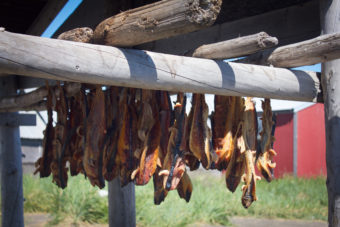
Salmon drying in Stebbins. (Photo by Emily Russell/KNOM)
Western Alaska communities have been restricting travel between villages to control the spread of the coronavirus. But in places like Stebbins, that also makes it harder to get groceries.
Stebbins residents typically have to drive to nearby St. Michael, which has an Alaska Commercial Company Store — called the “AC Store” — for groceries. A 12-mile road connects the communities in summer, but when both villages reported positive cases of COVID-19 last month, the road was closed.
Ward Walker is the incident commander for the Stebbins IRA and City of Stebbins.
“It was a little bit of a hardship while the road was closed, but I think we managed to get through it,” said Ward Walker.
The road was closed for about three weeks. After monitoring local spread of COVID-19, the community response teams decided to re-open the road at the start of August.
Walker says they certainly lost a variety of options, in particular their selection of fresh food. But he doesn’t think the community of Stebbins experienced a true food shortage.
“I actually set up that system so that people could purchase food in St. Michael for those three weeks and then have it delivered to the check-point,” said Ward Walker.
While the road was closed, Stebbins residents could go to the border between the two communities and pick up their food orders along the road. But as one Stebbins resident told KNOM, that’s only useful for people who are able to drive the nine miles to the checkpoint.
Shelley Pete, the general manager of the Stebbins Native Store, thinks the community would have had a food shortage without online shopping or the AC store in St. Michael. The only grocery store in Stebbins is operated by ANICA Inc., and Pete says many residents travel to St. Michael because the local Native store struggles to stay stocked. ANICA Inc. did not respond to KNOM’s request for an interview.
Pete said empty shelves were a common sight in Stebbins even before the coronavirus began.
“By the time I send in my order, usually come in four or six, maybe seven days,” he said. “But for my last order it’s been a week overdue, sometimes two weeks overdue until I put in another order.”
Pete isn’t sure if those delays are related to having fewer workers in the warehouses in Anchorage or Unalakleet.
Their food orders come in through all of the regional cargo air carriers, but earlier this spring, Stebbins also lost the service of RAVN Air as a source for cargo and passenger service. Even when they were serviced by many air carriers, Pete says the store still received shipments of moldy produce or food that had thawed out and gone rancid.
With empty food shelves and expensive prices in village stores, it’s difficult for regional residents to prepare for a two-week quarantine by relying on local goods. In Stebbins, resident John Rivers told KNOM that he isn’t relying on the grocery store if there’s another lockdown. Rivers has a freezer he keeps filled with subsistence food instead.
The situation in Stebbins isn’t exactly unique either. On the western side of the Seward Peninsula, many Teller residents travel the 72-mile Nome-Teller highway to purchase groceries and fuel in Nome. The community of less than a hundred is experiencing what Norton Sound Health Corporation considers a small outbreak of the coronavirus. So NSHC responded by sending in care packages as incentives for locals to get tested.
“Those included some grocery food supplies,” said Reba Lean, NSHC’s public relations manager. “Typical grocery items things like eggs, potatoes, peanut butter, snacks. Keeping everyone in the community is just a really good idea right now.”
Both Teller and Stebbins are communities without running water and have received shipments of hand sanitizer and cleaning supplies to deter spread of the virus. Lean said NSHC is prepared to help other Norton Sound communities that experience outbreaks of the virus or whose stores close if workers become sick.
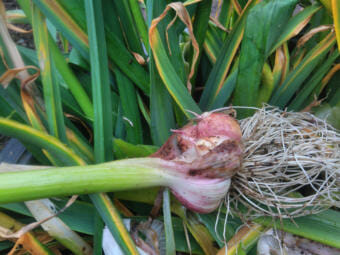
Freshly harvested garlic (Photo courtesy of Ed Buyarski)
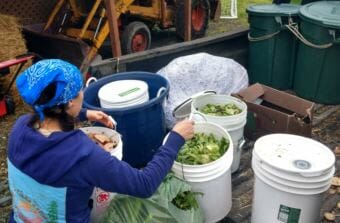
After nine months of patiently waiting, this is the moment many Southeast Alaska gardeners have been anticipating. Garlic is probably ready for harvest, right now.
Master Gardener Ed Buyarski with a bunch of freshly harvested garlic in front of a garlic planter. (Photo courtesy of Ed Buyarski)
Master Gardener Ed Buyarski reminds gardeners of the key signals for harvest — the unfurling of bulbous scapes and the yellowing of the lowest leaves of the garlic plant.
Carefully check if the garlic bulbs in the soil are big enough for harvest, with intact skins that are free of mold.
Moldy garlic (see photo below) should be removed immediately so that other garlic is not infected.
Plants with moldy garlic stems or skins should be cleaned and processed separately to avoid transmitting mold spores.
Dispose or throw out the moldy parts in the trash, not in your compost bin, where they will contaminate other organic matter.
For mold-free garlic, you can cut the stems to about 6 inches, remove the roots and use the leaves in soups and salads.
Clean off the dirt and then store and dry the garlic for about two weeks in a warm, dry place — like a furnace room — where temperatures may be 70 to 80 degrees.
But you don’t have to harvest everything right now.
“That is the game I’m playing,” says Buyarski.
He says he’s leaving other a few other garlic plants in the ground so they can get bigger in any warm and dry weather that comes over the next few weeks.
Garlic with white or gray mold (left) and healthy garlic (right). Gardeners should clean and process moldy garlic separately and dispose of the moldy skins and the stems in the trash, not in the compost. (Photo courtesy of Ed Buyarski)
Lisa Daugherty, owner of Juneau Composts!, unloads residential food scraps in 2017. (Photo by Jacob Resneck/KTOO)
Instead of dumping food waste into garbage cans that may be emptied in a landfill with a limited life span, many gardeners reduce their waste stream by composting food scraps and garden debris. The materials decompose or break down into basic nutrients that benefit a flower or vegetable garden.
Master Gardener Ed Buyarski says the bigger you can make your compost bin or pile, the better.
“Size matters,” Buyarski said.
Food scraps and dead leaves will get hotter and break down faster in a big compost bin, especially if you chop the organic matter up into very small pieces.
Adding horse, chicken or other livestock manure will generate the worms and microorganisms that will accelerate the decomposition process.
How do you know how much of a certain material to put into your compost pile? Buyarski says most gardeners follow a green-to-brown ratio of 30 to 1.
Greens are usually green leaves and grass that may be higher in nitrogen and moisture.
Browns are typically materials that are drier and higher in carbon like sawdust, paper, and dead leaves.
Buyarski cautions against using materials that may contaminate a compost bin. They include colored paper, wood or sawdust from treated lumber, and grass clippings from a lawn that has had weed-and-feed applied to it.
Also, do not compost any diseased or infested plants or invasive weeds. Just throw those out into the garbage.
Alaska state and local health officials are warning of dangerously high levels of toxins in shellfish, after a person died of paralytic shellfish poisoning from mussels and snails in the Aleutian Island community of Unalaska.
“Right now, the levels are high enough that just one mussel could kill someone,” said Sarah Spelsberg, a physician assistant at Iliuliuk Family and Health Services, Unalaska’s clinic.
The state health department announced the death in a prepared statement Wednesday. The person had underlying health conditions that contributed to the death, but the state medical examiner’s office confirmed that the primary cause was exposure to the toxins from seafood, the statement said.
This is the first known paralytic shellfish poisoning fatality in Alaska since 2010, although serious illnesses are reported more frequently, the state said. Dating back to 1993, the state has recorded four previous PSP deaths: in 1994, 1997 and two in 2010. There have also been more than 100 non-fatal cases of shellfish poisoning.
The person who died ate the mussels and snails collected from an Unalaska beach July 4. The shellfish were cooked, and the person developed symptoms some four hours after eating.
Blue mussel samples collected from the beach the same day were found to have extremely high toxin levels — more than 100 times higher than the safe limit, the state said. The snail samples also had elevated toxin levels, but not as high as the mussels.
The patient’s initial symptoms included tingling fingers, numbness, a floating sensation and vomiting, the state said. Several hours later, the patient reported numbness in their mouth, weakness in their hands and pain in their neck and back.
The patient was transferred to Unalaska’s clinic, and later was flown to an Anchorage hospital, where they died.
Two other people ate smaller amounts of the same shellfish but never developed symptoms, according to state health officials.
“When it comes to PSP, you have to medevac this person — that’s their only chance,” said Spelsberg, the physician assistant. “The problem with this is there’s no antidote, so the only thing we can do is be ready to breathe for you if you can’t breathe for yourself. And we can be ready to try to help your heart beat if you can’t keep your own heart beating. But there’s no antidote to this and sometimes there’s nothing we can do. You could land in the ICU at the best hospital in the world and they wouldn’t be able to save you.”
Officials have been monitoring local beaches for PSP since 2009, said Melissa Good, a marine advisory agent with Alaska Sea Grant in Unalaska.
She said there have been a few summers where toxin levels have exceeded the regulatory limit, which the U.S. Food and Drug Administration sets at 80 micrograms per 100 grams of tissue.
A recent report of some of the highest-ever recorded levels of PSP toxins in butter clams taken from the Alaska Peninsula community of King Cove last month prompted officials to test in Unalaska, too, Good said. Test results from Unalaska showed 11,200 micrograms of toxins per 100 grams, she added.
High levels of algal toxins that can cause PSP have also been found recently in shellfish from other Alaska communities.
Those include Craig, Hydaburg, Ketchikan, Kasaan, Juneau and Metlakatla in Southeast Alaska, as well as Kodiak and Chignik Lagoon along the Gulf of Alaska, the state said.
In recent years, communities across the state have reported spikes in toxin levels, possibly related to rising ocean temperatures, which create a better environment for the algae that produce the toxins – alexandrium catenella in Alaska — to grow year-round, as opposed to only in warmer months, according to some researchers.
Shellfish toxicity can vary by beach, harvest, and mussel bed, and Spelsberg said it’s important for people to understand that the toxins cannot be eliminated.
“It’s really important that people understand that you can’t freeze it out. You can’t cook it out. It’s a preformed toxin. And once you’ve ingested it, all we can do is try to keep you alive until you can flush the toxin out,” Spelsberg said.
If someone decides to harvest bivalves — that includes mussels, clams, cockles, scallops and rock jingle — in the region, officials highly recommended that they do not immediately consume their harvest. Instead, freeze it and send in a sample to the Alaska Department of Environmental Conservation’s lab, said Good.
Prior to sending in samples, contact Matthew Forester, bio-analysis section manager with the DEC’s Environmental Health Lab by phone at 375.8204, or by email at Matthew.Forester@Alaska.gov.
The state’s warnings apply only to non-commercially harvested shellfish, since commercial operations are required to regularly test for toxins.
Close
Update notification options
Subscribe to notifications
Subscribe
Get notifications about news related to the topics you care about. You can unsubscribe anytime.