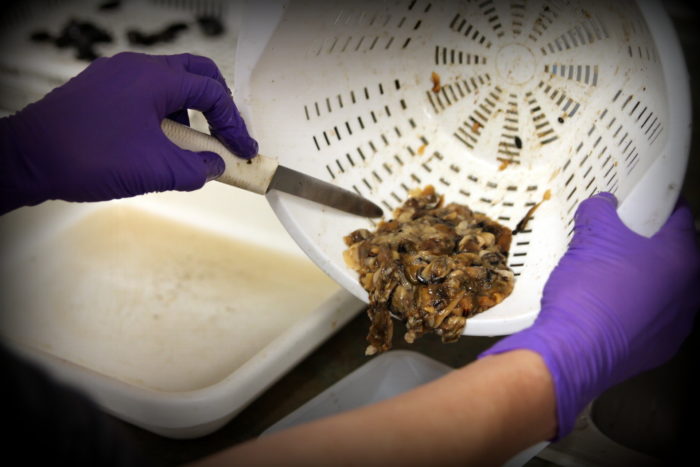
Sitka Tribe of Alaska fisheries biologist Jen Hamblen empties blue mussel meat into a blender. (Photo by Emily Russell/KCAW)
The person had underlying health conditions that contributed to the death, but the State Medical Examiner’s Office confirmed on Wednesday that the primary cause was exposure to the toxins from seafood.
This is the first known paralytic shellfish poisoning fatality in Alaska since 2010, although serious illnesses are reported more frequently.
The person who died ate blue mussels and snails collected from an Unalaska beach on July 4, 2020. The shellfish were cooked before consumption, and symptoms developed about four hours afterward.
The patient’s initial symptoms included tingling fingers, numbness, a floating sensation and vomiting. Several hours later, the patient reported numbness in their mouth, weakness in their hands and pain in their neck and back.
The patient was transferred to Unalaska’s clinic, then flown to an Anchorage hospital where they died.
Blue mussel samples collected from the beach the same day were found to have extremely high toxin levels — more than 100 times higher than the safe limit. The snail samples also had elevated toxin levels, but not as high as the mussels.
High levels of toxins that can cause paralytic shellfish poisoning have been found recently in shellfish from numerous Alaska communities.
Recent paralytic shellfish poisoning reports have found dangerous levels in butter clams and/or blue mussels from beaches in Craig, Chignik Lagoon, Hydaburg, Ketchikan, Kodiak, Kasaan, Juneau, Metlakatla and Unalaska, among others.
State warnings apply to non-commercially harvested shellfish, since commercial operations are required to regularly test for toxins.
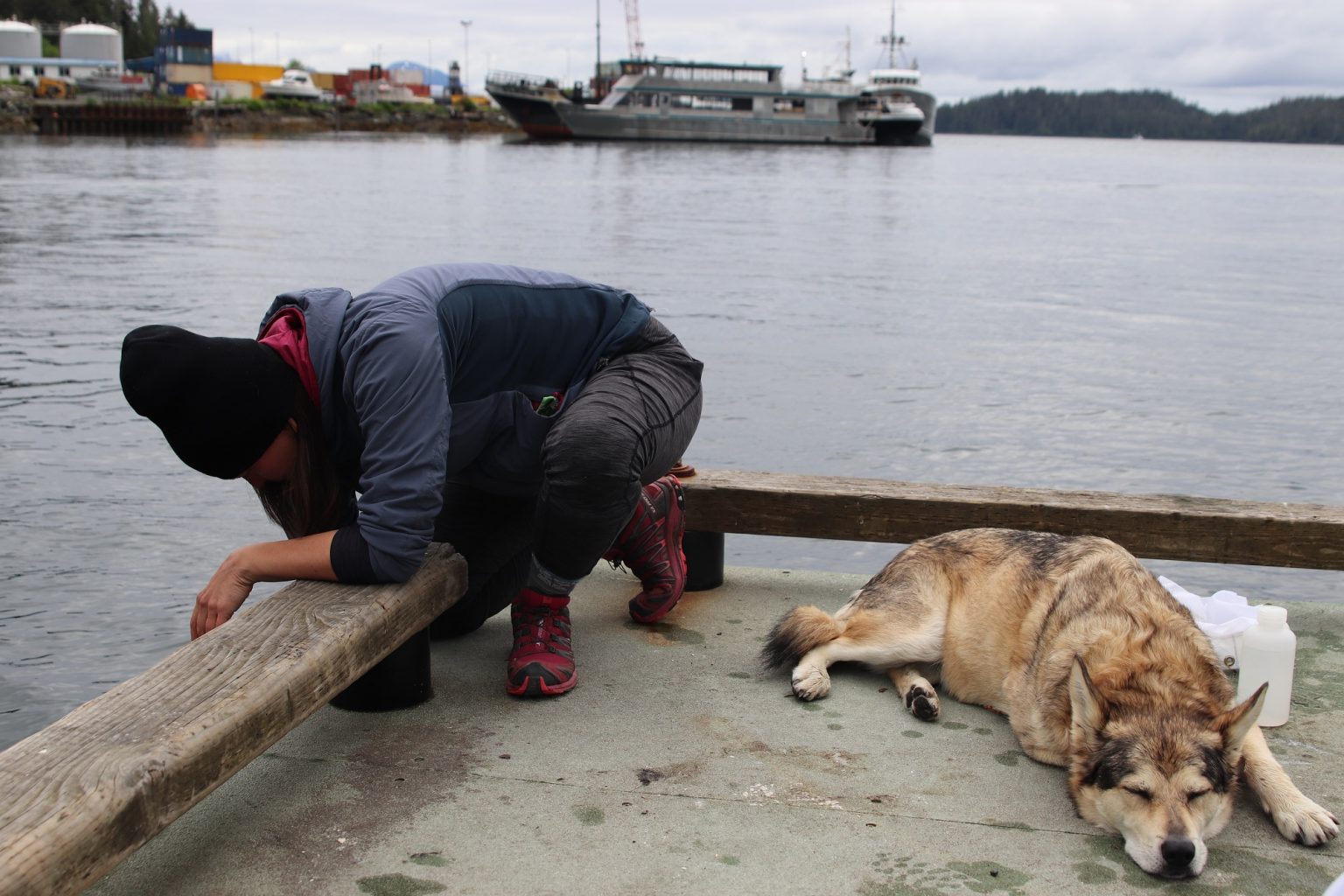
Sitka Tribe of Alaska Environmental Lab Specialist Naomi Bargmann conducts tests at the Starrigavan Dock while her dog Chickie sleeps beside her. (Erin McKinstry/KCAW)
Most coastal residents have heard about Paralytic Shellfish Poisoning and the dangers that it poses to humans. But it’s not just people that can get sick or even die from eating toxic mussels, clams or other shellfish. Pet owners need to watch out for their pups too.
Naomi Bargmann leans over the edge of the Starrigavan dock to dip a frosted plastic bottle attached to a net into the cold waters of Sitka Sound with her dog Chickie lounging on the dock beside her.
“Chickie’s not very good at helping,” she said.
She’s doing something called a plankton tow. Her lab conducts one once a week to get a snapshot of what’s going on with the water’s microscopic life.
“So, the most important thing is make sure you don’t lose the bottle,” she said. “Make sure it’s screwed on tightly. Throw it in the water. Try to get the water in the bottle until sinks. Do that again. Then one more time. And then we’re gonna let it go to its watery grave at the bottom.”
She then slowly drags the net through the water for three minutes.
Bargmann works as an environmental lab specialist for the Sitka Tribe of Alaska Environmental Research Lab. They opened a lab in 2016 in partnership with Southeast Alaska Tribal Ocean Research to monitor for harmful toxins that cause Paralytic Shellfish Poisoning or PSP. What Bargmann’s doing today helps track harmful algal blooms that can produce those toxins. Blooms can serve as an early warning sign for people who harvest shellfish or pet owners with shellfish-loving dogs.
“Fortunately, we haven’t seen the harmful algal species in high concentrations lately,” she said.
The lab also tests shellfish directly and has a free testing program for Sitkans. Bargmann said around 80 percent of the butter clams they’ve tested since September have been over the FDA limit.
“Butter clams, I like to say that they don’t know how to socially-distance themselves from PSP because once they get high levels of PSP, they tend to hang onto them for months to even years,” Bargmann said.
A dog was recently hospitalized after eating a clam at South Starrigavan Beach. Dr. Toccoa Wolf from Sitka Animal Hospital treated the sick puppy.
“Really the only thing you can do is the tincture of time, supporting them through the toxicity if it’s severe, sometimes that means giving them nausea medication, IV fluids, warming their temperature up. And monitoring their heart rate because it can cause a very fast heart rate,” Wolf said.
Dr. Wolf started practicing in Sitka last August. Since then, she’s heard of about four suspected cases from other vets in town. But this is the only one she’s treated here where the dog had a known history of eating shellfish. She says most dogs make a full recovery by the next day, including the one she treated.
Initial signs of PSP in a dog include unstable walking, excessive drooling, weakness and vomiting.
“I would say the most important thing is you know not to panic,” she said. “It doesn’t mean your dog can’t take a nice casual walk on the beach. It’s something to be aware of. If you see the signs, it’s good to get to a veterinarian.”
Because it could be something else that needs to be treated. And, even though it’s rare, dogs can die from PSP, just like people.
“But it can progress to muscle paralysis or respiratory depression and there have been reports of pets having to be put on a ventilator to see through it,” Wolf said.
After completing the plankton tow, Naomi Bargmann takes her pup for a walk along North Starrigavan Beach. Recently, the lab found high levels of PSP in a butter clam just south of here, on the other side of the creek: the same place where the dog Dr. Wolf treated got sick. As Chickie roams with her nose to the ground, Bargmann doesn’t keep too close of an eye. She’s not much of a shellfish eater.
“Fortunately for me, I’m not that worried. She eats other disgusting things instead,” she said.
But for dog owners whose pets are into digging up and munching shellfish, the best thing they can do is keep them on a leash at the beach and keep watch for local advisories.
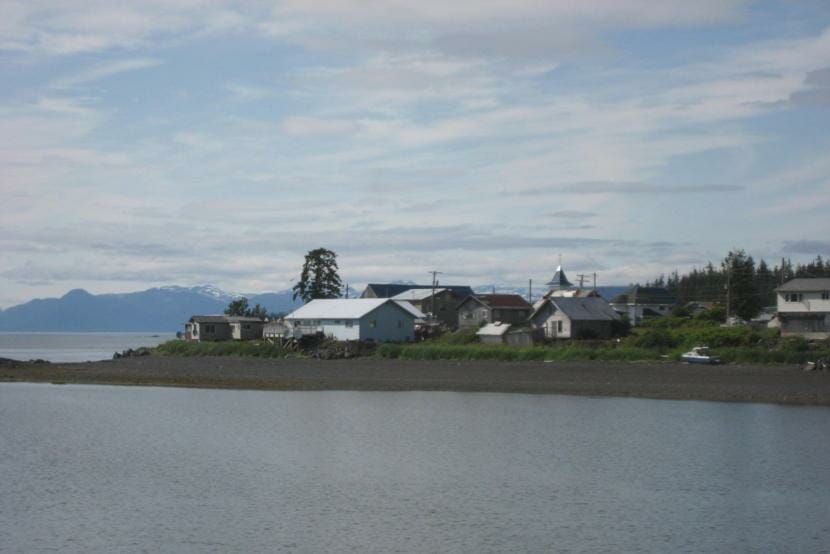
Kake photographed in 2012. (Department of Commerce, Community and Economic Development; Division of Community and Regional Affairs’ Community Photo Library.)
The federal subsistence board approved a special hunting request on Monday that permits the Organized Village of Kake to harvest deer or moose out of season.
The tribal government expressed concern at the beginning of the COVID-19 pandemic that grocery store shelves weren’t fully stocked with items like meat. Kake’s Tribal President also added he was worried about the health of village Elders.
Dave Schmid is the regional forester at the U.S. Forest Service Alaska region. He voted to approve the measure, which passed 7 to 1.
“I would say given the level of food insecurity that you heard from here facing this community, approving this special action — it’s the right thing to do,” he said.
Schmid said that he didn’t foresee any conservation issues related to wildlife population numbers in the vicinity of Kake.
The federal subsistence board has been handling multiple requests across the state. Some communities are worried about the impact of the pandemic on the food supply chain.
Earlier in the month, the agency tried to speed up that process by delegating local land managers to make the call. That process was stalled when a state emergency response group suggested there wasn’t a disruption in the food supply chain.
The Alaska Department of Fish & Game has yet to approve emergency hunting actions on state land.
Tribal governments and other communities in Alaska have been waiting for nearly two months for an answer to emergency hunting requests. The pandemic has caused some food supply disruption concerns, and so at least six small localities across the state have asked for special permission to hunt out of season.
That decision is typically granted by a federal board, but because everything about the pandemic is unprecedented, it hasn’t been simple.
Joel Jackson is the Organized Village of Kake’s Tribal President. When he first approached federal employees about opening the deer and moose season earlier than normal, he didn’t expect the process would take this long and the decision would be passed around to different levels of federal agencies.
“There’s still limitations from our one little store,” Jackson said.
It’s not just food scarcity Jackson is concerned with. Shipments of food are regularly arriving now, but it’s all processed meat slaughtered and packaged from the Lower 48. Jackson doesn’t think that’s as healthy or culturally nourishing for elders in the community — elders who could be especially vulnerable to complications from COVID-19.
Kake isn’t on lockdown anymore, and Jackson says people are traveling in and out of town. He thinks this is a crucial window when residents need to feel their best.
“If this virus ever makes it into our community, which I hope it never does, we need to have our people at the best health they can be by supplying them with the best food that we can give them,” Jackson said.
The federal Office of Subsistence Management is fielding multiple requests like Kake’s, and there isn’t an exact blueprint for how this should be done. The agency is used to responding to emergency hunting actions in the event of storms, but processing this during an ongoing pandemic presents a different set of challenges.
A records request filed by Alaska’s Energy Desk shows how the agency is trying to speed up that process. A U.S. Forest Service ranger district in Petersburg was delegated the authority on June 2 to grant emergency hunting actions for rural subsistence residents — like Kake. That negates some of the bureaucratic rigmarole, and it’s happening in other parts of Alaska, too. Still, there are certain caveats for final approval. One of them is that a state entity has to confirm the need.
Bryan Fisher is an Incident Commander at Alaska’s Unified Command: a central hub for various state agencies to respond to emergency situations, such as a pandemic.
“We just have not seen any supply chain disruptions or any loss of the ability to preserve previously gathered subsistence foods,” Fisher said.
The Unified Command has been helping restock food banks across the state, among other things. But the group has also been tasked by the Alaska Department of Fish & Game to make food need assessments in remote communities.
“They turned to us to do that validation of whether there was a real break down in that supply chain that would cause them to consider opening hunts on state land and working with the subsistence board to figure that out,” Fisher said.
Some clarification: The federal subsistence board approves special actions on federal lands, like emergency hunts. And the state of Alaska has its own process for state lands. In this case, the state Unified Command’s determination also weighs on the Peterburg ranger district’s ability to grant emergency hunts on federal land. In Kake’s situation, that decision was deferred back to the federal subsistence board. Essentially, Kake’s in a similar spot as they were back in April when they first requested the emergency hunting action.
Jackson is disappointed that a decision between a federally recognized tribal government and a federal agency is being delayed further because of input from the state. He says last season’s deer meat is running low in many people’s freezers. The community knows what’s best for them.
“We’ve always been conservationists,” Jackson said. “We’ve always been mindful: Never take too much.”
The federal subsistence board is expected to take this up in a public meeting on Monday, June 22. And Jackson hopes they account for all the ways a household with deer or moose on the dinner plate is a reflection of health during these uncertain times.
Editor’s Note: This story has been updated as new information has become available.
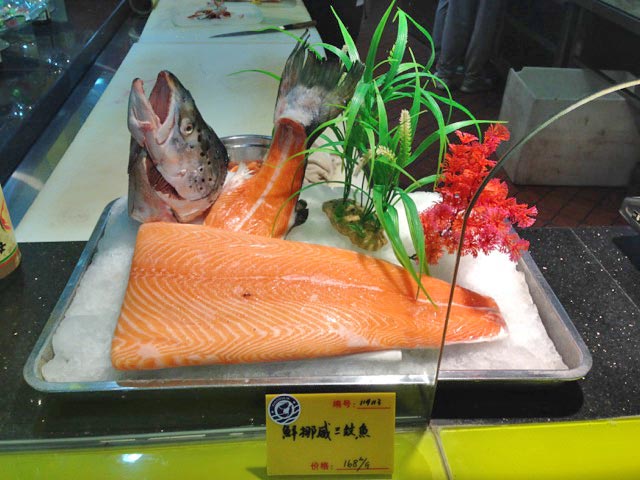
Salmon displayed in a seafood restaurant in China. (Photo courtesy of Alaska Sea Grant)
China has stopped imports from European salmon suppliers due to fears of a connection between salmon imports and coronavirus, according to a report by Reuters. State-run newspapers in China reported the coronavirus was discovered on chopping boards used for imported salmon at a market in Beijing. The initial cluster of infections came from the same market, and some fear the discovery of virus there indicates a second wave of the coronavirus in China.
Several fisheries organizations are pushing back against those reports. The National Fisheries Institute compiled statements on Tuesday from health professionals and agencies like the World Health Organization and the U.S. Food and Drug Administration saying there is no connection between seafood and COVID-19.
Fish marketing experts are assessing how the rumors could affect Alaska salmon’s image in the world. If people think eating salmon could put them at increased risk of contracting the virus — even if that information is incorrect — that could harm markets.
“Any time there’s information or misinformation, we have to wait and see how consumers respond to that,” said Andy Wink, executive director of the Bristol Bay Regional Seafood Development Association.
China made up roughly 6% of the market for Bristol Bay sockeye in 2019. It imported about 3,100 metric tons of the region’s reds. While that’s not a huge customer base, Wink says, it’s still important, especially in terms of the potential growth it represents. The market for salmon is expected to be weaker than it has been, because of coronavirus-related restaurant closures.
“You know, I think we’ll have to wait and see to what extent — if this impacts market demand outside of China, and, you know, if it impacts consumer demand in other markets in the U.S. and Europe and Japan where we have a much larger market share and many more consumers,” he said.
Wink says that if necessary, Bristol Bay Regional Seafood Development Association will work with other marketing groups to distribute accurate information to consumers.
In an email, Ashley Heimbigner with the Alaska Seafood Marketing Institute pointed out that multiple agencies have said there is no known link between seafood, food or food packaging and transmission of coronavirus. She also said Chinese officials issued a statement yesterday confirming that there was no evidence that salmon was the host or a carrier of COVID-19.
“While there was an immediate negative reaction in the imported salmon supply chain, a short term correction is expected following this official statement,” she said.
She said that Alaska’s largest challenge with the Chinese market continues to be the 32-40% final tariffs on most seafood, including salmon, when it’s imported into China for domestic consumption.
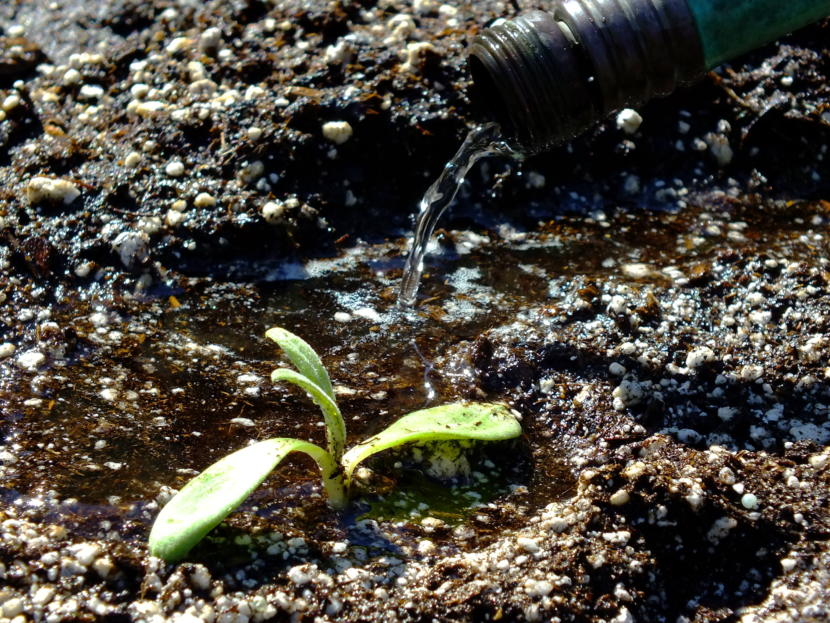
An artichoke seedling gets some water in a North Douglas garden in May 2020. (Photo by Matt Miller/KTOO)
Living in Southeast Alaska’s rainforest, it’s sometimes easy to forget when rainfall levels may be low. But even with the recent rainfall, this season could still shape up as similar to last summer’s dry conditions.
Master Gardener Ed Buyarski suggests gardeners continue checking the moisture levels of their trees, plants, and vegetables to make sure they get the water they need. He’s noticing that his primroses are wilting at the end of each day.
“If Mother Nature doesn’t provide, I guess we need to,” Buyarski said. “Or, we let the weaker ones get weeded out from the herd.”
How do you know if your plants need more water? Buyarski said it’s as simple as poking your finger down into the soil.
In pots or other containers, for example, dry soil may also pull away from the edges and start to crumble. Buyarski recommends spreading it out before watering or watering again to thoroughly moisturize the soil.
Constantly thirsty plants, like tomatoes, will noticeably wilt when they are not getting enough water.
You can water just about anytime of day, even during the height of the sun. But be careful about watering too late in the evening when little evaporation and cool temperatures can prompt fungus growth.
Buyarski also suggests looping soaker hoses around the drip line of trees and large bushes so their roots get adequate moisture.
Close
Update notification options
Subscribe to notifications
Subscribe
Get notifications about news related to the topics you care about. You can unsubscribe anytime.