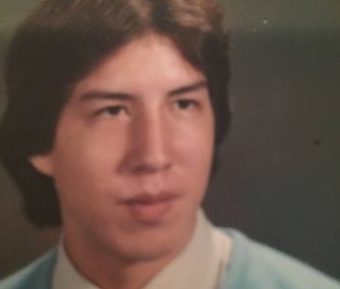
Anthony Choquette’s brother-in-law said the family did everything they could to help him before he committed suicide last month at the Alaska Federation of Natives convention in Anchorage.
Roger Holmberg said he and his wife first learned about last month’s suicide at the Dena’ina Center while watching TV. He said no one called him or the family to tell them it was Anthony Choquette.
“When we heard the news that someone had committed suicide at the AFN, immediately you think, ‘That’s tragic in a meeting like that.’” Holmberg said later that evening they learned through the news who it was. “It was like a spear went through me and I was numb.”
Anthony Choquette. (Courtesy of Roger Holmberg)
Other family members — many still live in Sand Point where Choquette is from — spoke highly of him on Facebook posts of news stories and in private messages, but wouldn’t say anything on the record. Holmberg was asked to speak on behalf of the family.
He wouldn’t say what kind of problems Choquette was facing, just that he and the family had done everything they could to help but he “walked away from it.” They’d gotten him into housing, but he left it and eventually ended up at the Brother Francis Shelter in downtown Anchorage.
“We still continued to try to work with him,” Holmberg said. “The response was not good.”
Friends who were near Choquette before he jumped said he wasn’t acting normal that day. Everything happened so fast, Holmberg said, that no one was able to stop him, though they tried.
“He was facing some major things in his life. When people reach the bottom, they’re desperate. There’s signals people send that we’re not sensitive enough to see sometimes,” he said.
The family came together and grieved. Holmberg got to thinking. There had to be something he could do.
“It’s the most traumatic because it’s so sudden, and it’s not normal,” he said. “You’re left with ‘What happened? Why did it happen? What was going through the person’s mind?’ We can’t answer those questions.”
As an Evangelist pastor, singer and songwriter, Holmberg travels frequently to places such as Guatemala and Haiti. He’d just returned from Honduras the morning of his brother-in-law’s death.
A few years ago, Holmberg said he had an idea to bring together members of the faith community to offer support to either those thinking about suicide or the family and friends who are ultimately left behind. He saw that while suicide prevention organizations were doing as much as they could, the spiritual aspect of suicide wasn’t addressed very much, and he wanted to change that.
But the idea fell by the wayside as his travels claimed more and more of his time.
After Choquette’s death, he decided to finally act and about a week later he met with a group of pastors and suicide prevention workers in Anchorage. He’s still looking to connect with people interested in the effort.
“It’s comforting to know that people care, but it can’t be a one-time thing,” Holmberg said.
Life is short, he said, and often our priorities are not what they should be. His priority today is to find a way to help families cope with the sudden loss of a loved one to suicide, and to offer spiritual guidance to those who may be considering it.
“You’ve got to have a priority list. People are important. You can go broke, but people are still important. Friends and relatives, you can’t replace them,” he said.
If Holmberg could turn back the clock and say anything to his brother, it would be this:
“I’d say life is valuable and when you lose that in life you’re walking on dangerous ground. We are connected together and anything like that would impact those who are left behind in a very, very, very bad way. I would say we need you to seek professional help.”
There are people to talk to if you or someone you know is thinking about suicide. The Alaska Careline can be reached at 877-266-HELP; you can also text 907-2LISTEN.
SEARHC also has a help line for residents of Southeast Alaska at 877-294-0074.
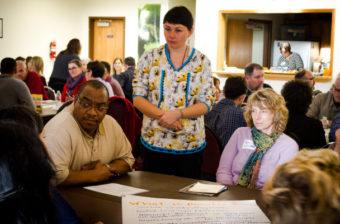
Darlene Trigg (standing) with the First Alaskans Institute listens in on a roundtable discussion with Alaska Dept. of Corrections Commissioner Ron Taylor and Kari van Delden with University of Alaska-Fairbanks’ Cooperative Extension Service. (Photo by Matthew F. Smith/KNOM)
The Alaska Mental Health Trust Authority visited Nome, Gambell, Stebbins and Unalakleet recently. They held discussions with providers and experts from around the region and across the state about what is and isn’t working when it comes to mental health, substance abuse, and intellectual disabilities.
The focus of the talks across the Norton Sound are broad, but discussions at Nome’s Pioneer Hall brought local providers face to face with the heads of major state agencies, forcing many to confront uncomfortable truths.
“Department of Corrections is the biggest mental health facility in our system. Something’s wrong with that picture,” said Ron Taylor, the commissioner for the Alaska Department of Corrections.
Amid discussions of strong families and youth, housing shortages, employment, and education, some participants called for fundamental and systemic changes to how Alaska approaches its jails and prisons, specifically, the disproportionate and disruptive impacts the systems have on rural Alaska Native communities.
Taylor said he was in Nome with an open mind and ready to talk about change.
“It’s obvious that we’ve done in the past hasn’t worked,” he said. “Coming to a rural community in Nome, and learning of the challenges that are here in Nome, a lack of housing, a lack of real community re-integration for our persons that are transitioning out, it makes us realize that, are we on the right track? Or do we need to be shift to something different?”
Just what the state, the Department of Corrections, and others looking for reform should shift to remained an open question.
“If we’re going to shift to something different, we have got to come to consensus on what the different looks like,” Taylor said.
Darlene Trigg, the social justice manager with the First Alaskans Institute, helped lead the conversation on what “something different” should look like. The ideas being offered ranged from broad goals down to specific changes. Trigg said the common ground was making cultural resources part of the solution.
“Integration of culture is something that I’ve heard throughout these conversations,” she said. “The challenging question of how we do that, and how we create space for that, is where the conversations are going … it’s amazing to hear the kind of dynamic solutions people are coming up with.”
Those conversations are continuing in a big way Wednesday night, with a public Community Conversation starting at 5:30 p.m. at Nome’s Pioneer Hall on Front Street.
Trigg stressed the importance of local voices being heard.
“The community conversation is a real opportunity for people to share their lived experience, and in sharing your lived experience it gives you an opportunity to reflect on the impact that it has on your life,” Trigg said. “It offers an opportunity for our communities to start acknowledging some of the traumatic events that happened even in our own community, and it really informs how systems will function inside our community.”
She added that “without the voice of the community, and without the voice of the community members, we may come back with a design that doesn’t work, and we’re back to square one. And that is not what we need right now.”
KNOM Exchange will also be hosting a similar conversation Thursday morning, with guests from the Alaska Mental Health Trust Authority and the Alaska Criminal Justice Commission, who will be listening to share thoughts—and experiences—on the issues of mental health and criminal justice from across the Norton Sound and Bering Strait.
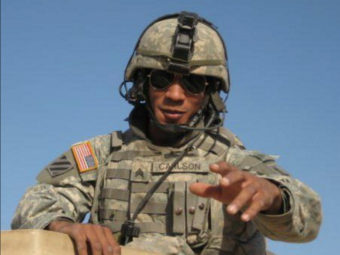
David Carlson served two tours in Iraq while in the military. Courtesy of David Carlson
At the county court in Waukesha, Wis., in September, Iraq veteran David Carlson sat before a judge hoping he hadn’t run out of second chances.
The judge read out his record: drugs, drunken driving, stealing booze while on parole, battery while in prison. Then the judge listed an almost equal number of previous opportunities he’d had at treatment or early release.
Carlson faced as much as six more years on lockdown — or the judge could give him time served and release him to a veterans treatment program instead.
The judge’s tone was not encouraging.
“This criminal justice system frankly has bent over backwards in an effort to maintain you in the community,” said Judge Donald Hassin Jr. “And frankly, sir, the response to all that has not been good.”
Carlson has spent most of the past five years locked up. Before that he did two tours in Iraq. His family says the second tour, in particular, scarred him, sending back a man they hardly knew. They attribute his criminal behavior to war trauma — and the Department of Veterans Affairs agrees: Carlson has debilitating post-traumatic stress disorder. Being locked up isn’t helping, he says.
“For my PTSD issues, jail is the least therapeutic atmosphere you could ever imagine. You come in one way and you leave three times worse,” Carlson says, by phone from jail.
Prison and war take some of the same survival skills, he says.
“Same as when I’d been on patrol in Iraq … Iraqis know, they know if you’re [an] aggressive unit, or if you’re a weak unit, if you’re a soft target, if you’re a hard target. It’s the same in prison,” Carlson says.
So Carlson made it known that he was a hard target. He mapped out the blind spots in the prison surveillance system. He had tricks like putting a slick of baby oil down at the door of his cell to slip up an attacker. And he got into plenty of fights, which is why he came up with his own version of prison basic training.
“In cell fighting, the No. 1 rule is take the initiative,” he says. “My training always geared around very good cardio, because I knew no matter how good a fighter was, as long as I could outlast him, I would win. I came up with all sorts of philosophies in my mind the same way I had in Iraq. We were always hypervigilant.”
Hypervigilance isn’t a bad thing if you’re in Iraq, or in prison. It’s not so good if you’re trying to recover from PTSD.
“Staying in that mode of contemplating violence, I feel there’s no way to work on PTSD,” he says.
Most treatment for PTSD involves winding down from the combat mind-set, and learning not to treat the world around you like a war zone. But behind bars, mental health treatment is rare and VA health care is suspended.
The VA doesn’t track the number of veterans incarcerated. The most recent government statistics are from 2004, but new numbers are expected to be released this month. A recent study did show that Iraq and Afghanistan vets in prison — like Carlson — have high rates of PTSD.
Being At War Behind Bars
Carlson says the only time he could see a therapist was if he threatened suicide. A couple of years in, Carlson said he started to lose it.
“I almost felt like I was delusional, but in my mind I was in combat with the jail, basically. I was at war, nonstop,” he says.
Carlson treated his war with the jail like the counterinsurgency he’d fought in Iraq. He even recruited other inmates to his cause. That got him thrown into solitary, and eventually he began to get his life under control. He started exercising to the extreme, doing thousands of pushups and long, CrossFit-style workouts.
He began reading the Bible every day, which he says gave him a more positive outlook.
Last year he retained a new lawyer. Tony Cotton worked much of the case pro bono.
Carlson, seen here in a photo from 2009, calls jail the “least therapeutic atmosphere” to help overcome his PTSD. Courtesy of David Carlson
“I think we owe every combat veteran who had those experiences not just our platitudes and thanks,” says Cotton. “We owe them opportunities within the criminal justice system because a lot of veterans find themselves within the criminal justice system. We owe them a different level of treatment … in my opinion.”
Cotton managed to persuade two judges in Wisconsin to agree, and clear away outstanding charges so Carlson would be able to leave prison and enroll in a veterans treatment court. Just one sentencing hearing stood between Carlson and the treatment he needed.
By happenstance, the week of David Carlson’s sentencing hearing, retired Judge Donald Hassin Jr. was filling in on the bench at Waukesha County court. Hassin graduated from West Point, class of 1971, and he has a son and daughter who are both in the Army.
As a fellow veteran, that might make the judge more sympathetic. Or it could mean he’s a stereotypical, strict Army officer, with none of the awe that civilians sometimes feel toward combat vets.
Carlson’s Sentencing
On the morning of the hearing, Carlson’s family and friends — including his Iraq buddies — filled the hallway outside the courtroom.
His Iraq pals were a mixed bunch. One had the shakes, because he quit booze for the whole day to come out and show support. Others are doing fine.
David Rock was with Carlson during his second Iraq deployment. He says he wouldn’t have come to court to support just anyone.
“When it came time to push, David was the guy to have out there. He’s the definition of a leader in terms of what you want to see in combat,” Rock says. “He had a mission, and it was to get everybody back.”
When the doors opened, Carlson was already sitting at a table with his lawyer. He got one glimpse of his family and friends before the bailiff told him to face the front, toward the judge.
The case would decide whether he should serve up to six years in state prison for operating under the influence — it’s his fourth offense in five years, which makes it a felony — and felony bail jumping.
Cotton called on a few character witnesses: a Vietnam vet who has been counseling Carlson in prison and his grandmother, who talked about how much Iraq had changed him. Cotton asked the judge to give Carlson time served for the two felonies and let him go home with his family.
The judge, though, seemed to have already made up his mind.
“I’m looking at a fine young man sitting in front of me today, that I’m going to end up putting in prison for a little bit. The reason I’m going to do that Mr. Carlson is ’cause you’re not ready. And I have an obligation above and beyond your rehabilitative needs, to protect the public,” said Hassin.
He then pronounced: “The sentence today is two years on each count.”
Carlson’s family gasped and his Iraq buddies stared at the judge in silence.
Then Hassin explained: The sentences are to be served concurrently. That effectively means it’s a total of two years. Plus, Carlson gets credit for all the time he has already served.
“That, by my estimation, will give you a few brief months to better prepare you for return to the community. Because the next time you come to the community all that we wish from you is your success,” Hassin told Carlson.
“I’m giving you the challenge, sir, of leaving the state prison system in a fairly short period of time,” Hassin continued. “The good news is you’re going to get out soon. The bad news is Mr. Carlson, that you’re going to have to face those circumstances of being back on the street again. But, you know what? You can do it. You’re very capable of it … These guys behind you believe you’re capable of it today as well or they wouldn’t be here. ”
Calling from jail the day after sentencing, Carlson says he’s pleased — not just with the sentence.
“I mean at the end he called me a fine young man,” Carlson says. “Honestly and it didn’t matter what sentence he gave me. That meant a lot to me … throughout all of this that’s what I’ve been looking for. Just for people to see that I meant well, and that I went down the wrong road.”
Carlson is trying to get on the right road. He says the PTSD is with him there in the cell, and every day he fights it. If he stays on that road, he’ll be out of prison before the new year.
This story is part of a project we’re calling “Back at Base.” NPR — along with seven public radio stations around the country — is chronicling the lives of America’s troops where they live.
Copyright 2015 NPR. To see more, visit http://www.npr.org/.
Read Original Article – Published NOVEMBER 05, 2015 4:38 PM ET
U.S. Secretary of Defense Ash Carter speaks with soldiers and airmen during a visit to Fort Wainwright, Alaska Oct. 30, 2015 as part of his Asia-Pacific theater trip. (Creative Commons photo by Senior Master Sgt. Adrian Cadiz)
The U.S. Secretary of Defense Ash Carter said Alaska is geographically important to meet growing threats in the Pacific theater.
The secretary stopped in Fairbanks on Friday on his way to Korea for security meetings. In Fairbanks, he met with personnel from Eielson Air Force Base and Fort Wainwright. Carter said funding cuts would likely reduce the level of armed forces stationed in Alaska.
In his brief address and meeting with select service members, Carter thanked them for their service, told them their work was important to the country and emphasized the strategic importance Alaska plays in global peacekeeping.
He took questions from the audience. One service member wanted to know if Alaska was strategically critical, why Army units were being cut. Carter partly blamed funding gridlock in Washington but also acknowledged priorities were shifting away from counterinsurgency wars, called COIN.
“Those of you in the Army know that the Army is reducing its size. A lot of that reduction has to do with the end of the COIN wars. The Army has decided it’s better, strategically, to use its funding elsewhere,” Carter said.
What Carter didn’t seem as prepared to address were questions from service members about sexual assault and suicide. He said sexual assault was fundamentally against the military’s code of honor and would not be tolerated. While acknowledging the rising number of suicides in the armed forces was disturbing, Carter broadened the context.
“I would be proud if we figured out suicide in a way that was not only helpful to our own members who are having that problem, but to society as a whole,” he said.
Carter said he admired the military’s ability to take on problems once they were identified.
The secretary was on to meetings in South Korea where he would take up China’s growing military presence in the South China Sea, among other topics.
Humor writer Jenny Lawson has never dealt with her mental health issues the traditional way.
As a small child, for example, she had a toy box. When she was feeling anxious, she would take all the toys out of the box and climb inside it.
“I would close it,” Lawson says, “and it was like a sensory deprivation chamber for poor people.”
Jenny Lawson Flat Iron Books
She saw her first therapist in college, and since then, Lawson says, she’s been diagnosed with depression, anxiety, mild self-harm issues, avoidant personality disorder, occasional depersonalization disorder, mild OCD and trichotillomania.
Dealing with all that has never been easy, but as she explains in her new book, Furiously Happy: A Funny Book About Horrible Things, it helps to have a sharp sense of the absurd. Humor helps her see through the dark.
There was the time that Lawson, who battles chronic insomnia, staged a 2 a.m. rodeo in her living room with Rory, her dead, stuffed raccoon, riding atop one of her house cats — Ferris Mewler. And the time she pulled up to the drive-thru window at her local drugstore just in time to see the pharmacist scarf down a handful of broken dog biscuits.
“I never found him again,” Lawson writes, “because I was worried that if I ever asked to see the dog-food-eating pharmacist, the other pharmacists would stop giving me drugs.”
When she began writing about her own mental health, Lawson fully expected people to run and hide.
“Instead,” she tells Shots, “I was shocked at how many people came out and said, ‘Oh my God, me too!’ Or, ‘I thought I was the only one.’ ”
We called Lawson to find out more about the new book and why she’s so keen to help bring mental health issues out of the shadows. Here’s an excerpt of our conversation, edited for length and clarity:
How did the idea for furiously happy come about?
I was in the middle of a very long depression. I had lost a couple of friends, and I was at a point where I had no emotions that I could feel except anger. I thought, I am going to be furiously happy out of spite as soon as this depression lifts. I thought it was only fair that, when I come out of it, I say yes to things that I wouldn’t normally say yes to. I’d do ridiculous, fun things — not as a cure for depression, because it’s not — but as a way to have a weapon to counter depression. So when I would have a depressive episode, I could think, “But remember the time where I rented those kangaroos to come to the house, wasn’t that fun? That was fun. I can have fun like that again.”
You started out blogging about your life as The Bloggess. Why did you decide to start writing about your own mental health?
Whenever I’m depressed, I have periods of time where I cannot do anything, just cannot get out of bed, cannot fully function. And definitely could not write funny things for a blog. I had all this stuff in my drafts folder — funny posts that I could save up and post on days or weeks when I was having a rough time. It felt like I was creating such a false history because I was lying on the couch, just forcing myself to breathe, and I would have these comments saying, “Oh, you’re so funny! What a great life you have!” I felt like such a liar. So I decided to go ahead and write about it.
Why do you want to write about a topic some still consider taboo?
I’ve always written about the stuff that really you’re not supposed to write about. When it comes to mental illness, on a very selfish level, it is so reassuring to me to have other people say, “You’re not alone.” I’m sometimes stuck at home and cannot force myself to leave the house, or I’m at a hotel room and I cannot leave the hotel room even to eat, and I know I can always go out on Twitter and say, “I’m stuck. I don’t know what I’m doing. I feel like a failure.” And a thousand people are going to say, “I’m right there with you. I’m hiding in the bathroom myself.”
What does depression feel like from the inside?
For me, a depression is not that I’m sad. It’s actually almost the opposite of that. I have absolutely no emotions. And it seems like that would be a very easy thing to deal with, and it’s not. It’s so incredibly uncomfortable, and you feel inhuman. If it just lasts for a day or two, I can usually push through and be fine. I continue to take my medication. I’ll see my therapist. I’ll do all the things I’m supposed to do. If it lasts for more than a few days, that’s when I have to really work against self-harm, because when I have no emotions at all, one of the only things that I can feel is pain.
What helps you dig out?
Not only having people with me and medications and all of that, but also just remembering that depression lies. Because, while I’m in the depression, it absolutely seems so true. Everything that my mind is telling me — that the world would be better off without me — seems absolutely reasonable. And I just have to continue to remind myself that before I went into this depression, I knew that that wasn’t true.
It seems like all the hubbub of a book tour might be tough for someone battling depression and anxiety. How do you handle it?
I write “Pretend you’re good at it” on my arm every time before I go out. If I pretend that I’m someone who’s good at this and good at walking out on stage and talking, then I can at least pretend until I get up to the stage. Once I get up there, I look out into the audience and I can see so many people out there who look just as terrified as I am. And then I feel like I need to be calm, just for them. But I know that at any point I can say, “You guys, I’m having a bad time. I need you guys to just talk amongst yourselves for 10 minutes. I have to hide under a table.” And everybody would get it.
Copyright 2015 NPR. To see more, visit http://www.npr.org/.
Read Original Article – Published NOVEMBER 01, 2015 6:20 AM ET
Staff Sgt. Eric James, an Army sniper who served two tours in Iraq, paused before he walked into a psychiatrist’s office at Fort Carson, Colo. It was April 3, 2014. James clicked record on his smartphone, and then tucked the phone and his car keys inside his cap as he walked through the door to the chair by the therapist’s desk.
As he sat there sharing his fears and telling the therapist he’d been thinking about suicide — all while secretly recording the entire session — James was inadvertently helping to bring a problem within the Army to light: As it tries to deal with thousands of soldiers who misbehave after returning from Iraq and Afghanistan and then being diagnosed with mental health disorders and traumatic brain injuries, the military sometimes moves to kick them out of the service rather than provide the treatment they need.
The Army tried to dismiss James in 2013, because he had been stopped for drunken driving two years earlier. This despite pledges by Army commanders and a 2009 congressional edict to make sure such misconduct is not the result of mental issues brought home from the wars.
Saying he wanted evidence to protect himself, James made secret recordings of more than 20 hours of sessions with therapists and officers at Fort Carson. In the recordings, counselors can be heard berating him for suggesting he has serious mental health problems. They try to convince him his experiences in Iraq were not too traumatic — and even seem to ignore him when he talks about wanting to commit suicide.
Eric James with his mother, Beverly Morris, and father, Robert James. Eric secretly recorded more than 20 hours of sessions he had with behavioral health specialists and Army officials. Michael de Yoanna/Colorado Public Radio
When Army leaders heard about the recordings, they ordered an investigation. It concluded that James had been mistreated, and two of his therapists were subsequently reprimanded.
But the general who runs the Army’s medical system said the investigation also reached another conclusion: The mistreatment of soldiers at Fort Carson was “not systemic.”
NPR and Colorado Public Radio also conducted an investigation, based on hours of secret recordings from James, hundreds of pages of confidential documents from Fort Carson, and interviews with dozens of sources both inside and outside the base. And that evidence suggests the Army failed to pursue key evidence in its investigation, ruling out claims of mistreatment from nine other war veterans without ever interviewing or even contacting the men.
And according to figures acquired by NPR and CPR under the Freedom of Information Act, the Army has been pushing out soldiers diagnosed with mental health problems not just at Fort Carson but at bases across the country.
The figures show that since January 2009, the Army has “separated” 22,000 soldiers for “misconduct” after they came back from Iraq and Afghanistan and were diagnosed with mental health problems or TBI. As a result, many of the dismissed soldiers have not received crucial retirement and health care benefits that soldiers receive with an honorable discharge.
The cases of the 10 soldiers we investigated raise a question: Why would commanders kick out soldiers for misconduct, instead of giving them more intensive treatment or a medical retirement on the grounds that they have persistent mental health problems? Sources both inside and outside Fort Carson suggested one possible answer: It takes less time and money to get rid of problem soldiers on the grounds of misconduct.
One of the Army’s top officials who oversees mental health, Lt. Col. Chris Ivany, tells NPR and CPR that the Army is not violating the spirit of the 2009 law by dismissing tens of thousands of soldiers for misconduct after they came back from the wars, even though they were diagnosed with TBI or mental health disorders.
For instance, he says the soldiers’ “functional impairment was not severe” enough in some cases to affect their judgment. In other cases, the soldiers’ disorders might have been serious when they were diagnosed, but their “condition subsequently improved” before they committed misconduct — so they can’t blame the war for causing them to misbehave.
And in other cases, Ivany says, soldiers’ medical records show they were diagnosed with a mental health disorder — but only because a medical worker wrote it down as “a preliminary best estimate, but on further evaluation, the diagnosis was clarified” and perhaps dropped. All this “clearly shows that there is no systemic attempt” to dismiss soldiers with mental problems on the grounds of misconduct, Ivany says.
Army officials would not discuss any of the current and former soldiers’ cases, on the grounds that they’re protecting the men’s privacy.
James says he never set out to “expose” Fort Carson or embarrass anybody. He says he started recording his meetings with officers and mental health staff to keep an accurate record of the conversations.
James’ two tours in Iraq occurred during some of the bloodiest fighting. He watched through his sniper scope as his targets died and he saw his buddies die, too. He suffered a traumatic brain injury when his Humvee flipped upside down, according to Army records.
James’ parents say he began to unravel after he returned to Fort Carson in 2009.
“It’s pretty hard as a parent to see your kid go the way he did,” says his father, Robert James. “He was happy-go-lucky. Now he’s depressed, and he’s always down and out.”
“This isn’t the boy, the young man, I raised,” says his mother, Beverly Morris. “He is totally a whole different person.”
James says after he came home from his last deployment, his life was in shambles.
“I was angry; I was getting in fights. I drank at least 12 beers every night, so I could pass out — that was the only way I could get any sleep. It’s like my mom said, she was the person I’d always call, and I would call her, you know, after I’d been drinking so much and it’s late at night and I’d tell her, ‘Mom, look, I need help. Every day I wish I was dead,’ ” James says.
Then one night in 2011, local police pulled James over for drunken driving in Colorado Springs. Two years later, officers at Fort Carson told him they were going to “chapter” him out of the Army for misconduct, as a result of that DUI. James says he knew that meant he might never get the retirement pay or health insurance that the Army promised when he enlisted. Getting forced to leave without an honorable discharge could also mean that he could have trouble finding a decent job.
We first reported in 2006 that Fort Carson was kicking out some soldiers who had mental health problems and committed “misconduct,” instead of helping them. Less than three years later, Congress passed the law to help stop the practice.
The law does not forbid the Army to dismiss troops with mental disorders who commit misconduct, but a spokesman for one of the key congressional committees that drafted the language says members of Congress “wanted to make sure the military was not putting people out that have service-related medical issues because the services have a responsibility to get them the care they need.”
Secret Recordings Lead To Investigation
James’ recordings veer from mundane conversations about scheduling appointments to sessions in which James despairs about his life.
In one, James tells a therapist that he feels angry and miserable most of the time. He doesn’t trust anybody, and he isolates himself.
“Like, remember I told you I’m like, I feel like I’m coming into a combat zone when I drive on the base,” he asks the counselor. And then he starts trying to talk about some of his scariest experiences in Iraq. “In, like, one month, there was over 1,000 IEDs and multiple ambushes.”
Evans Army Community Hospital, which stands on the Fort Carson military base, is a central part of the base’s behavioral health system. Courtesy of Evans Army Community Hospital/U.S. Army
Standard therapy textbooks say that counselors can help patients best when they are supportive, build trust and are empathetic. When patients feel safe enough to share their deepest fears, a therapist can then help them understand their problems and start to get better.
The therapist responds, interrupting him: “Yeah, it was a suck fest … big time. … But it was not an emotionally crippling experience,” she declares. “Because for the last six years, you’ve been able to get up and come to work. Have you had things that lingered and it affected you? Yes. But you’re not emotionally crippled. You’re not a in a corner rocking back and forth and drooling.”
In another session, James meets with one of the Army’s chief psychiatrists at Fort Carson. A few weeks before, James had filled out a survey used to help diagnose PTSD. James ranked many of his symptoms as “5s,” the most extreme symptoms, which potentially signals that the person is in crisis. But the Army psychiatrist doesn’t try to get James to open up and explain his answers. Instead, the psychiatrist challenges him.
“When I see ‘extreme,’ you should be in a hospital,” the psychiatrist says in a confrontational tone. “People that put that down, all those 5s, most of those people need to be in a hospital to be stabilized.”
The psychiatrist suggests that since James is able to report for duty at Fort Carson, he must be exaggerating his symptoms.
“Because right now, you shouldn’t be walking around, if that’s how bad you’re doing,” the psychiatrist says gruffly, after scolding James and repeatedly interrupting him.
In yet another session, with another Army psychiatrist at Fort Carson, James sounds like he’s close to the breaking point. He cries audibly as he tells the psychiatrist that he wanted to kill himself hours before.
“I can’t do it, Sir, I’m … losing my mind,” James says. “Like, last night I just wanted to … take all my pills and,” James pauses, his voice shaking, “couldn’t do it sir. This is killing me, physically and mentally.”
As James continues sniffling, the psychiatrist changes the topic. He speaks in a soothing voice, but he never asks James what he is feeling about committing suicide.
“I spent almost a week listening to all of Eric James’ recordings,” says Andrew Pogany, CEO of Uniformed Services Justice and Advocacy Group, a legal services nonprofit that Pogany and a colleague created to help soldiers in trouble. “It painted a picture that was mortifying. And horrifying.”
Andrew Pogany and Robert Alvarez, co-founders of the Uniformed Services Justice and Advocacy Group, alerted the Army’s surgeon general to 10 Fort Carson soldiers who were dismissed for “misconduct” instead of being given more intensive mental health treatment. Michael de Yoanna/Colorado Public Radio
Pogany used to be a soldier himself at Fort Carson. He fought back against the Army for mistreating him, and won. Pogany and his co-director, Robert Alvarez, sent some of James’ recordings to Charles Hoge, a psychiatrist and retired colonel who advises Lt. Gen. Patricia Horoho, the Army’s surgeon general.
“What no one fully appreciates is the serious nature of what transpired during clinical encounters with at least two mental health providers at Fort Carson,” Hoge warned one of the general’s top aides in an internal email. He wrote that some of what he heard “demonstrates unprofessionalism, hostility, and lack of empathy” and “potential for negligence leading to significant potential harm.”
Less than one month later, Horoho ordered an investigation of Fort Carson. She announced the results at a press conference in February.
“The investigation concluded that we had two providers that actually showed a lack of dignity and respect to one soldier,” Horoho told reporters. In other words, the investigation found that James was the only soldier at Fort Carson who had been mistreated.
“I thought the investigation was a very thorough investigation. I believed it gave the facts and certified that there wasn’t a systemic problem,” she said.
Lt. Gen. Patricia Horoho, the Army’s surgeon general, ordered an investigation at Fort Carson and concluded mistreatment of soldiers was “not systemic.” U.S. Army
Also, according to Horoho, two of the therapists who worked with James had been reprimanded.
Meanwhile, commanders at Fort Carson did a dramatic about-face: Instead of dismissing James from the Army, they sent him for treatment at the National Intrepid Center of Excellence in Bethesda, Md., the nation’s top military center for TBI and PTSD. The Army also gave James a medical retirement, with honor and full benefits.
Horoho also ordered staff at Fort Carson to get special training. According to an Army document, mental health employees took a few hours off work to discuss issues such as “dignity and respect during patient encounters.” The Army also made it easier for soldiers to appeal if they feel they have been mistreated.
But Horoho stressed the takeaway conclusion two more times at the press conference: “I have not seen anything that’s systemic in the way that our behavior health providers treat our patients,” she added.
Here’s what’s curious about Horoho’s declarations: Documents show that the Uniformed Services Justice and Advocacy Group told investigators under oath that commanders and mental health staff at Fort Carson have mistreated many soldiers — and thrown many out of the Army for misconduct after they came home from the wars with mental health problems. The advocates told investigators about nine current and former soldiers, in addition to James, who they said were typical cases.
NPR and CPR contacted all of those soldiers. They told us that Horoho’s investigators never contacted them.
“Every case has a slightly different flavor, there’s slightly different facts to it,” says Pogany. “But when you take a step back, it is all the same stuff. If [Army officials] honestly want to fix this problem, they need to understand what’s going on here and they need to admit that this is going on across the board.”
The Case Of Jason Holmer
Consider the case of Jason Holmer — one of the names on the list that investigators never called. Holmer deployed three times to Afghanistan and Iraq. The Army awarded him the Bronze Star, one of the service’s most prestigious medals.
One night, Holmer and his unit were ambushed. A mortar round landed about 10 meters from him “and it lifted us up off the ground,” Holmer says.
That was the first possible TBI documented in Holmer’s medical records.
The story of what happened after he came home echoes James’ transformation. Holmer says his wife told him he was a different person — and they divorced. His medical records show he suffered “major depression” and “feelings of hopelessness” and “high irritability.” He had trouble remembering things — a common TBI symptom — and he couldn’t sleep.
“I had one doctor saying, ‘Oh, you just got some anxiety, here’s some sleeping medication and antidepressants. You’ll be fine,’ ” Holmer says.
Instead, Holmer started drinking a lot. Then one night in 2012, police found him sleeping in his blue Dodge Ram pickup truck, parked along the side of the road. They charged him with driving under the influence. And three days later, the Army started the process of dismissing him for misconduct.
Commanders sent Holmer to a therapist at Fort Carson, in line with the 2009 law, to evaluate whether PTSD or TBI might have played a role in causing his behavior. His medical records show he had some classic symptoms.
But soon, Holmer received a curious email written by the therapist. The therapist had not intended Holmer to see it, but she sent her email to an officer who accidentally forwarded it to Holmer.
“At this time, while [Holmer] may have a significant [behavioral health] condition, I’ll be able to clear him,” the therapist wrote. “I believe it would be in our best interest to assist in expediting the process.” In military language, that means it would be in their best interest to kick Holmer out for misconduct.
The therapist signed her email with a smiley face.
The Case Of James Vanni
And consider the case of Sgt. James Vanni. He deployed to Iraq in 2004, and then was assigned to a base near Sadr City.
“Our Day 1, we got ambushed,” he says. “Day 1. We lost eight guys dead that day, and 60 more wounded.”
James Vanni, at his home in Colorado Springs, Colo. Theo Stroomer for NPR
Vanni and his wife say he still wakes up screaming from a recurring nightmare about the first victim he watched die that day.
After he returned home, he started unraveling — much like the other eight soldiers whom the Army’s investigators did not interview. His Army records list at least one TBI, and possibly more, and show that he reported getting frequent headaches and was forgetting things. An ambulance took him to the emergency room one morning because it looked like he was having a heart attack. It turned out to be a panic attack.
Vanni’s wife, Michelle, says he would also fly into rages, “screaming and yelling and throwing stuff” at her and their two children. “It’s like he hated to be around us,” she says.
He also kept threatening to kill himself.
Vanni and his wife, Michelle, in 2008. Courtesy of James Vanni
At 1 a.m. the day before Christmas, Vanni freaked out after he and Michelle had an argument. Vanni says he can’t remember much about what happened. “The whole incident is really blurry to me,” he says.
“He came in the house screaming and yelling, and he made absolutely no sense,” Michelle says. “I mean, he even turned and he was just talking to the wall, like he was talking to somebody. He was pointing the gun, but there was no magazine in it, you know I didn’t know that, so I tried to call 911, because he was scaring me. ”
Michelle says when the police arrived she told them he was depressed, suicidal and needed help.
“They told me they were taking him to a hospital,” she says.
Instead, the police took Vanni to jail.
Officers at Fort Carson then started the process of dismissing Vanni from the Army without benefits, on the grounds that he committed domestic violence. An Army psychiatrist evaluated Vanni, as the law requires.
His conclusion: “This service member does not suffer from any deployment related mental health issues,” the psychiatrist wrote. It was the same psychiatrist who was later reprimanded for mistreating James.
The dining room at the Vanni home. Theo Stroomer for NPR
Independent Adviser: Soldiers Deserve ‘Benefit Of The Doubt’
Horoho’s spokeswoman, Maria Tolleson, acknowledged that investigators did not get in touch with the nine soldiers whom soldiers’ rights advocates named as examples of how some troops at Fort Carson have been mistreated. She wrote in an email that Army staff reviewed soldiers’ files “for quality and standard of care in accordance with [the Army’s] regulatory guidance,” and the “review of these files did not reveal any provider misconduct.”
But NPR and CPR also obtained the soldiers’ records, with their permission, and we asked three independent psychiatrists to review them. Two of those psychiatrists served as top medical officers in the military. And all three say that based on the records they have seen, they would have advised the Army not to dismiss these soldiers for misconduct.
“Especially for our soldiers who are coming back not just with post-traumatic stress disorder, but with traumatic brain injury and other wounds, I really think that we as a society need to take that into account,” says Col. Elspeth Ritchie, who served as the Army’s top adviser on mental health during some of the worst fighting in Iraq and Afghanistan. “I think as a society, they deserve to have us do everything we can to support them. I absolutely would want them to get the benefit of the doubt.”
Some sources who work with Fort Carson say perhaps commanders used to dismiss soldiers unfairly, but things have changed.
Bottles of medicine at Vanni’s home. He says he still has nightmares from his time serving in Iraq. Theo Stroomer for NPR
“I’m encouraged by this. I think there’s been a shift,” says Miriam Blum, an independent psychologist in Colorado Springs. She estimates that she has treated hundreds of soldiers based at Fort Carson. “What I experience, what I hear from soldiers and what I see with soldiers, is that Fort Carson is doing many things to address the mental health issues of the soldiers before any kind of disciplinary procedure is even remotely considered. I see [that] soldiers who are seeking help are getting help.”
Peter Chiarelli, the Army’s vice chief of staff from 2008 to 2012, agrees that commanders at Fort Carson, and other bases across the country, are doing a far better job of identifying and helping soldiers in trouble. But he says NPR and CPR are making the issue of mental health and misconduct sound simpler than it really is.
“It would be wonderful if we could tell 100 percent of the time whether or not that misconduct is because an individual is, in fact, acting bad or it’s because they have some kind of a mental issue,” Chiarelli says. “But the fact of the matter is — and this is the important point for you to understand — is our diagnostics are so horrible we cannot always make that determination.”
Chiarelli says that given the uncertainties and the enormous pressures on the Army, it makes sense for commanders to push out soldiers who have mental health problems and commit misconduct.
“Does it make sense if they’re going to be nondeployable for a long period of time, and if we don’t have good diagnostics and good treatments, yes it does make sense. Because I need deployable soldiers inside my ranks,” he says. “The Army has a mission and that’s to fight and win our nation’s wars. When people have any kind of an illness and are not deployable, they’re not going to be available to do that.”
Actually, it turns out that some of the soldiers NPR and CPR followed did not get kicked out after all. That includes Vanni and Holmer. An Army official, speaking on background, says that demonstrates that commanders are willing to take a second look and reverse course and treat soldiers fairly.
The soldiers we interviewed say that commanders took that second look only after the soldiers’ rights advocates intervened and threatened to take their stories to Congress and the media.
The Case Of Larry Morrison
Larry Morrison is appealing the Army’s decision to dismiss him for misconduct. Michael de Yoanna/Colorado Public Radio
Meanwhile, our investigation found that Fort Carson has decided to dismiss yet another soldier to whom the Army awarded the Bronze Star — suggesting that Horoho’s actions have not fixed the problems.
Sgt. Larry Morrison, 42, has served 20 years in the Army. He led soldiers on three deployments in Afghanistan and Iraq. Army records show Morrison was scheduled for a medical retirement due to chronic PTSD, with honor and full benefits, on March 17 of this year. But at roughly 3 p.m. that day, Morrison’s commander handed him a document announcing that the Army was going to dismiss him for misconduct instead.
Officers who have served with Morrison told us he is one of the best leaders they have ever known. Capt.Tyson Walsh, who commanded Morrison in Afghanistan in 2010 and 2011, says Morrison was “phenomenal” and served as one of his platoon sergeants during a “brutal deployment.”
Walsh says Morrison was the mentor who held the unit together.
“The Sgt. Morrison I know stands for honesty and integrity,” he says. “I’ve had to put my life in his hands more than once. And every single time I did, it was the right answer.”
But Army documents list three justifications for kicking him out: Morrison pleaded guilty two years earlier to drunken and reckless driving, and, according to the Army, he belongs to a “criminal” motorcycle gang that a federal report links to shootings and drugs.
Morrison and other soldiers told us it’s not a gang but one of the most popular bike clubs for African-American troops.
Fort Carson’s decision to dismiss Morrison is not yet final. Because he has served so many years, the Department of the Army has to sign off, and he’s still waiting to hear the final decision. Meanwhile, he’s working part time as a security guard at a chain clothing store.
“I’ve given [the Army] all of my youthful years. I’m 42 years old now,” Morrison says, in a defeated-sounding monotone. “And now they want to put me out with no benefits, they want to give me an other-than-honorable discharge — so I can’t get a job, I can’t go to school — and take my retirement away. So they want to put me on the streets with nothing.”
Morrison says he struggles to get just a few hours of sleep each night before he wakes up from recurring nightmares about a buddy who was killed in Afghanistan. A doctor prescribed medication to help him sleep, but Morrison says he doesn’t always take it.
“Nightmares are bad but at the same time, they’re good, actually, because the nightmares help you remember the guys that are gone,” Morrison says. “And you know you can’t go see them, you can’t call them and you can’t go talk to them. So sometimes you want the nightmares — to help you to spend time with the guys that are actually gone.”
NPR and CPR sent more than half a dozen emails to Horoho, telling her that soldiers like Morrison are still getting kicked out of Fort Carson and asking to talk with her about the issues. We also asked to interview the top two generals in the Army, to find out what they make of the fact that the Army has pushed out tens of thousands of troops in recent years who came back from the wars with mental health disorders.
None of the generals would meet with us.
NPR’s Courtney Mabeus and Barbara Van Woerkom contributed to this report.
Copyright 2015 NPR. To see more, visit http://www.npr.org/.
Read Original Article – Published OCTOBER 28, 2015 3:54 PM ET