
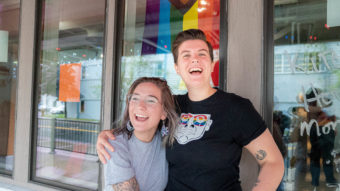
David Abad demonstrates pod mapping inside Black Moon Koven in Juneau on Oct. 13, 2022. (Photo courtesy of David Abad)
A workshop in Juneau later this month will help LGBTQ+ people learn an intentional approach to getting the support they need.

The strategy is called “pod mapping.” It involves visually drawing out your community so you’ll know where to go for different needs.
Organizer David Abad works for AWARE, Juneau’s domestic violence support organization. He says approaches like pod mapping can help in moments of crisis.
“When I’m experiencing trauma, or when I’m experiencing anything, who do I turn to?” he said. “And I just wanted to see who I turned to.”
AWARE is hosting the workshop with the National Alliance on Mental Illness Juneau. While Abad works in violence prevention, he says the workshop will address harm reduction, too. In other words, when something does happen, it’s important to know who you can turn to for help.
Abad says a pod — pod as in community — map can have friends, family or more official resources.
“Another aspect of this workshop is to identify local resources and or national resources, if that’s more comfortable,” he said.
But those resources may not be accessible for everyone in Juneau.
“Maybe it’s, ‘Oh, I don’t want to go to this local resource. I’ve done it, I’ve gone to it, it’s not a resource. I don’t feel safe,’” he said.
And for some people in Juneau, Abad says it can be hard to find the right resources at all.
“Juneau can sometimes be pretty limiting, and it gets compounded with other things,” he said. “Maybe they’re queer friendly, but they’re not maybe POC friendly. And then having those multiple identities can maybe impact someone’s experiences. ”
Abad says this pod mapping can help fill those gaps by giving a clearer sense of who in your community you can go to for support, before it’s needed.
The Mapping and Building Intentional Support Systems Workshop is scheduled for 6 p.m. on Oct. 25 at the Douglas Library.
North Star Residential Treatment Center in Anchorage on Tuesday, Sept. 27, 2022. (Photo by Bill Roth/ADN)
Earlier this year, young patients at North Star Behavioral Health System — a locked, for-profit psychiatric hospital for children and teenagers in Anchorage — staged a small mutiny.
In June, a patient hit the fire alarm, unlocking doors. Four patients fled the hospital. The group roamed Anchorage for hours. By the time they were tracked down and returned by police, one patient was so drunk they had to be taken to a different hospital.
The next day, a staff member described the events to a visiting federal investigator with the Centers for Medicare and Medicaid Services as a “riot.” A physician later described the days as “the (worst) weekend the facility has had in years.”
During two hospital inspections in April and June, federal investigators documented more than a dozen “deficiencies” at North Star Behavioral Health System’s Anchorage campuses, the only hospital in Alaska to be cited during that timeframe. Investigators found some problems at North Star to be so serious, like assaults, they were deemed “immediate jeopardy” situations at the time, meaning the health and safety of patients was at risk.
North Star CEO Anne Marie Lynch said she couldn’t say anything about the events documented by the federal investigators, citing patient privacy laws, when contacted this week by the Anchorage Daily News.
The same federal investigators visited in September and found “no deficiencies or recommendations,” she said. The hospital isn’t under any plan of correction with their powerful federal regulators, according to North Star.
“We continue to monitor our compliance with standards as well as the quality of our programs,” Lynch wrote. “When issues are identified we investigate thoroughly and create action plans to improve.“
The more than 150 pages of reports by federal investigators offer an official view of dysfunction that former patients and families of patients have long described at the East Anchorage hospital.
Among the findings:
Patients assaulted other patients, including an instance where two children were locked in a “quiet room” together accidentally. One attacked the other, leaving a child’s nose bloodied. The hospital didn’t investigate how the incident happened.
One patient was punched, slapped in the eye and kicked by peers but their parent wasn’t told, according to the investigation. “Mother stated she is really upset for not being notified when her child was attacked by another patient,” the child’s case notes read. She tried to discharge her child immediately, but ended up waiting overnight at the suggestion of staff.
A young patient at North Star psychiatric hospital in Anchorage spent 40 days in the locked facility without receiving a single therapy session.
The investigation’s findings are no surprise to Angel Gonzales, the board president of Facing Foster Care in Alaska, a nonprofit advocacy organization. Gonzales was in and out of foster care from ages 7 to 16 and now works at Covenant House as a permanency navigator. She’s been hearing stories about escapes, seclusion and assaults from kids sent to North Star for years now. She remembers almost being sent there herself because the Alaska Office of Children’s Services didn’t have another placement, she said. She said she was terrified by the prospect.
“All of the things this investigation is going to highlight have been happening for years and years,” said Gonzales. “Nothing is new.”
North Star operates three campuses in Anchorage and one in Palmer: a hospital at 2530 DeBarr Road, a residential treatment facility at 1500 DeBarr Circle and the Chris Kyle Patriots Hospital, for adults, on Bragaw Road. North Star also operates a home in Palmer, for children. The report is mostly focused on the DeBarr Road locations but found that the Chris Kyle Patriots Hospital lacked a process for reporting allegations of abuse against vulnerable adults by staff or volunteers.
The Centers for Medicare and Medicaid Services, the federal regulator, is charged with ensuring hospitals are meeting standards for patient safety and care. Hospitals that fail CMS inspections and don’t fix serious problems can be decertified, which means they would no longer be allowed to accept Medicaid or Medicare payments. That’s usually a death sentence for hospitals that rely on the ability to bill federal programs.
Complaints about North Star pour into the Disability Law Center of Alaska, a nonprofit legal organization with a federal mandate to investigate whether Alaskans with disabilities are treated fairly.
“We get complaints from parents, foster parents, other folks that are concerned about the quality of care,” said Patrick Stocks, an attorney with the Disability Law Center.
At the same time, Alaska has so few options for hospital-level or outpatient psychiatric care, especially for kids, that North Star represents one of the only places available to families and agencies, Stocks said. Often, it’s the only in-state option available.
“We also get the calls … from families who are desperately looking for a place to comply with the level of care they need, and they’re just not finding anything and it’s a pretty terrible situation,” he said.
North Star is owned by Universal Health Services, a Pennsylvania-based corporation listed on the Fortune 500. It owns and operates hundreds of health facilities, including many behavioral health hospitals, around the country. Annual revenues exceed $11 billion, according to the company.
Many of the kids who spent time in North Star were in state Office of Children’s Services custody.
Alaska child welfare authorities have been criticized for sending children to North Star because other placement couldn’t be found, not because their problems are severe enough to warrant a stay in a locked facility. A 2022 class action lawsuit filed on behalf of children in Alaska’s foster care system describes the Office of Children’s Services placing a child at North Star simply because they couldn’t find anywhere else. In 2021, the U.S. Department of Justice’s civil rights division opened an investigation into whether the state of Alaska “unnecessarily institutionalizes” children with behavioral problems. That investigation remains open.
Mateo Jaime was 16 and in OCS custody when he was sent to North Star for about two months back in 2018. He says there was no reason for him to go other than lack of another foster home placement. The problems described by the federal inspectors were familiar.
”That was the whole experience,” he said. “You have not gone to North Star unless you’ve seen a fight. Unless you’ve seen people escape. Unless you’ve been locked into a quiet room.”
Jaime said he became “like a zombie” to get through the days at North Star. When he was released, a sense of fear that he could be sent back at any time lingered. He’s now a student at the University of Alaska Anchorage pursuing dual music and legal studies degrees. He ages out of foster care in a month.
He’s also become an activist for change in the foster care system, in part because of his experience at North Star.
”It needs to be addressed,” he said. “A for-profit organization should not have the most control over youth mental health in Alaska.”
North Star remains a licensed facility, and OCS continues to send children to the hospital, said Brian Studstill, communications director for the Alaska Department of Family and Community Services. As of Monday, there were “less than 10″ children in North Star who were in state custody, he said.
“North Star is one of only two facilities in Alaska that can accept children and youth experiencing mental health crises and need acute care treatment,” Studstill wrote. “The lack of in-state acute care treatment for children continues to pose challenges for both parents in our communities and OCS.”
In North Star’s inspections from this year, many of the investigators’ critiques revolved around the hospital’s use of locked seclusion rooms for children and teens acting out. The investigators found instances in which children were left in the rooms without any documentation in their records, or were not properly monitored. In one case, a child slept in the room overnight. A patient under the age of 9 spent more than an hour locked in seclusion, against policy, investigators found.
Managers told the inspectors that short staffing was a major problem at North Star, the reports say.
That’s not an issue confined to North Star, Stocks said. Elsewhere in Alaska and around the country, psychiatric hospitals have struggled to find enough workers, a longstanding problem made worse by the coronavirus pandemic and a generally tight labor market. North Star has a “robust recruitment program” and has been hiring staff, said Lynch, the CEO.
“Our institutions up here are really struggling to staff,” Stocks said. “One thing that happens is when a psychiatric facility doesn’t have enough staffing is they’re going to take shortcuts at the expense of their patients.”
Gonzales, who spent time in OCS custody, said the experience of a stint inside North Star is a common one among kids in the foster care system. That’s even clearer now that she works at Covenant House, helping young people who are homeless or living in shelters find permanent housing.
“A lot of them know each other from North Star,” she said.
Chloey Cavanaugh (left) and Meryl Connelly-Chew (right) facilitate Spectrum for AWARE – an LGBTQ trauma support group in Juneau on Sept. 1, 2022 (Photo by Paige Sparks/KTOO)
LGBTQ people experience domestic and sexual violence at higher rates than heterosexual and cisgender people. On top of that, queer people of color, people with disabilities and bisexual and transgender people are more likely to experience violence of any kind in their lives.
One key difference is that they are less likely to recognize it as abuse.
“It doesn’t fit the stereotypical image of a cis-man physically abusing a cis-woman, which is often in people’s perception of what domestic violence looks like,” said Meryl Connelly-Chew from Juneau’s domestic violence support organization, AWARE.
That’s why AWARE is hosting Spectrum – the only queer-specific support group that serves people in Juneau who’ve experienced trauma.

Connelly-Chew says the group discussion focuses on the effects of trauma – not the traumatic experiences themselves.
“[We] do this because we’re queer people who have experienced, you know, various traumas in our own lives,” Connelly-Chew said. “I think it’s what makes it work so well.”
“We’re kind of discussing it together and learning with people and learning from people in a way that isn’t necessarily giving advice, but it’s just sharing our different lived experiences, and what that’s been like being in this community,” said Chloey Cavanaugh, the other facilitator of the group.
Connelly-Chew said some of the most common hang-ups new group members have are about belonging.
“I often get asked like, ‘am I queer enough for this queer space? Is my trauma, like, bad enough for this trauma support group?’,” they said. “I get asked that, almost, from everyone who calls.”
Cavanaugh says Spectrum prioritizes confidentiality and safety because Juneau is a small city.
“You’re going into a space where we’re all committed to confidentiality, and uplifting each other, and you know who’s gonna be there,” she said.
Spectrum is a free, in-person program that lasts 12 weeks, starting Sept. 29.
For more information, call 907-586-4902 or email Connelly-Chew at merylc@awareak.org.
Only when the caller cannot or will not collaborate on a safety plan and the counselor feels the caller will harm themselves imminently should emergency services be called, according to the hotline’s policy. (Photo by d3sign/Getty Images)
When the 988 Suicide & Crisis Lifeline launched last month, many mental health providers, researchers and advocates celebrated. Although a national suicide hotline had existed for years, finally there was an easy-to-remember three-digit number for people to call, they said. The shorter number would serve as an alternative to 911 for mental health emergencies.
But not everyone felt the same way. Some advocates and people who had experiences with the mental health system took to social media to voice concerns about 988 and warn people not to call it.
One Instagram post said, “988 is not friendly. Don’t call it, don’t post it, don’t share it, without knowing the risks.” The post, which had garnered nearly a quarter of a million likes as of early August, went on to list the risks as police involvement, involuntary treatment at emergency rooms or psychiatric hospitals, and the emotional and financial toll of those experiences.
Other posts on Instagram and Twitter conveyed similar concerns, saying that the hotline sends law enforcement officers to check on people at risk of suicide without their consent and that people, especially from LGBTQ+ communities and communities of color, may be forced into treatment.
So is 988 a critical mental health resource or a cause for concern? We decided to dig into these questions, figure out how 988 works, and explain what you need to know before dialing.
Why are some people saying not to call 988?
We reached out to the creators of some of the social media posts to ask them directly.
Liz Winston, who authored the Instagram post calling 988 “not friendly,” said she wanted people to understand all the potential outcomes of calling so they wouldn’t be blindsided by the “traumatizing system” that she experienced.
Last summer, Winston was having suicidal thoughts and visited a hospital in New York. She hoped to speak with a psychiatrist but instead was involuntarily detained in the psychiatric wing of the emergency room. She said that she did not receive any counseling during the 24 hours she spent there and that the experience was “extremely traumatic.”
Winston hadn’t called the hotline, but she said those who do can end up in a similar situation. It’s true that when police respond to calls about people in mental health crises, they often take them to an emergency room or psychiatric hospital.
“I realize there is an urge to rescue people in crisis, but the reality is the services that exist make the problem much, much worse,” said Winston, who works in mental health peer support and has started an online support group for people recovering from involuntary treatment.
Research shows suicide rates increasedrastically in the months after people are discharged from psychiatric hospitals. Those who were sent involuntarily are more likely to attempt suicide than those who chose to go, and involuntary commitments can make young people less likely to disclose their suicidal feelings in the future. Some people also get stuck with large bills for treatment they didn’t want.
Emily Krebs, a suicide researcher and assistant professor joining Fordham University this fall, said that involuntary treatment is viewed as a necessary part of suicide prevention in the U.S., but that other countries don’t see it that way. The United Nations has called forced mental health treatment a human rights abuse and asked countries to ban it.
Like Winston, Krebs wanted people to be fully informed before deciding to call 988. That’s why she wrote on Twitter that 988 can and will “send police if they deem it necessary.”
That can be dangerous, she said, given that 1 in 5 fatal police shootings in 2019 involved a person with mental illness. Some years, the share has been even higher.
What does 988 say about how it handles crisis situations?
Officials from 988 say they recognize the risks of having law enforcement officers involved in mental health emergencies. That’s why 988 was created as an alternative to 911, said John Draper, executive director of the hotline and a vice president at Vibrant Emotional Health, the company tasked with administering it.
“We know the best way for a person to remain safe from harm is for them to be empowered and to choose to be safe from harm,” Draper said. Dispatching police is a last resort, he said.
Counselors who answer the phones or respond to texts and online chats for 988 are supposed to be trained to actively listen, discuss the callers’ concerns and wishes, and collaborate with them to find solutions. Most calls about suicide are de-escalated without law enforcement, Draper said. Instead, counselors talk through people’s reasons for dying and reasons for living; have callers connect with supportive family, friends, religious leaders or others in their community; refer callers to outpatient treatment; or set up follow-up calls with 988.
Only when the caller cannot or will not collaborate on a safety plan and the counselor feels the caller will harm themselves imminently should emergency services be called, according to the hotline’s policy.
At that point, Draper said, “we have the choice of just letting [harm] happen or doing whatever we can to keep them safe.”
In previous years, before the 988 number launched, emergency services were dispatched in 2% of the hotline’s interactions, the service reported. With about 2.4 million calls a year, that means emergency services were initiated for roughly 48,000 calls. Those services can be mobile crisis teams, consisting of people trained in mental health and de-escalation, but in many rural and suburban communities, it is often police.
Contrary to some information circulating on social media, 988 cannot geolocate callers, Draper said. When emergency services are called, 988 call centers share with 911 operators information they have about the location of the person who contacted the hotline — typically a caller’s phone number, with area code, or a chat user’s IP address — to help first responders find the individual.
Starting this fall, Draper said, 988 will update its policies to require supervisors to review all calls that result in the use of emergency services. Counselors for 988 nationwide will also receive additional training on the alternatives to involving law enforcement and the consequences callers can face when police respond.
So should I use 988 or not?
We know it’s not satisfying, but the honest answer is: It depends.
The 988 hotline is the nation’s most comprehensive mental health crisis service and can provide crucial help to those in emotional distress. If you’re thinking about suicide but not taking steps to act on it, 988 is unlikely to call law enforcement without your consent. Instead, 988 counselors can provide resources, referrals and a kind ear. However, if you’re at imminent risk and could act on a plan to kill yourself, police may be called, and you could be taken to a hospital involuntarily.
Sonyia Richardson, a licensed clinical social worker who owns a counseling agency that serves mostly Black and brown clients in Charlotte, N.C., said she didn’t immediately tell her clients about 988 when it launched. Even though she’s a member of her state’s 988 planning committee, she said she needed time to develop trust in the service herself. When she learned at a recent committee meeting that fewer than 5% of 988 calls in North Carolina led to a law enforcement response, she felt reassured.
“There are going to be issues perhaps with 988, but it might be one of the safer options for us,” Richardson said. With suicide rates increasing among Black Americans, the community needs more ways to save lives, she added.
If I don’t want to call 988, do I have other options?
Although the U.S. doesn’t have a national, government-run mental health hotline that pledges not to call police without callers’ consent, several alternatives that are smaller than 988 aim to decrease law enforcement involvement.
“Warm” lines are one option. They’re typically staffed by “peers,” people who have experienced mental health challenges. They focus less on crisis intervention and more on emotional support to prevent crises. You can find a directory of warm lines by state here.
Below are other hotlines and resources. This is not a comprehensive list, and some resources may limit their services geographically.
Blackline is a hotline geared toward the Black, Black LGBTQ+, brown, Native, and Muslim communities
Kiva Centers offers daily online peer support groups
Trans Lifeline is a hotline for trans and questioning individuals
Wildflower Alliance has a peer support line and online support groups focused on suicide prevention
KHN (Kaiser Health News) is a national newsroom that produces in-depth journalism about health issues. It is an editorially independent operating program of KFF (Kaiser Family Foundation).
Copyright 2022 Kaiser Health News. To see more, visit Kaiser Health News.
The three-digit number for suicide prevention and mental health crisis support is operational in Alaska and across the nation as of July 16, 2022. (Photo by Lisa Phu/Alaska Beacon)
Alaskans who find themselves in a mental health crisis can now call or text 988 to access a trained crisis counselor. Support is available 24 hours a day, seven days a week to individuals of all ages.
The three-digit number for suicide prevention and mental health crisis support became operational in Alaska and across the nation on July 16.
Leah Van Kirk, statewide suicide prevention coordinator with the Alaska Division of Behavioral Health, said 988 “provides an easy to remember three-digit number for someone to use when they’re in crisis or when they’re in emotional distress.”
“It’s for anyone that’s experiencing emotional distress, mental health crisis, substance use crisis, thoughts of suicide, and also for someone who maybe has a friend or a loved one who they’re worried about and they want to get help,” she said. “So it’s to support those in crisis and those who are maybe trying to help someone in crisis and aren’t sure how.”
Callers in Alaska using the three-digit number from a 907 area code will be connected to Careline Alaska based in Fairbanks. Counselors are trained to respond to a crisis, provide emotional support and connect callers with local resources. Confidential support is available to anyone in crisis, including non-English speakers and those who are deaf or hard of hearing.
“The Careline and 988 are answered by Alaskans for Alaskans because we know what it’s like here,” Van Kirk said. “Having a call center here run by Alaskans is really important.”
In 2020, the suicide rate in Alaska was 28.1 per 100,000 people, more than twice the national average, according to Van Kirk. That same year, suicide was the second leading cause of death overall for youth and young adults ages 15 to 34 in Alaska. It’s also preventable.
“Sometimes when people call they just need someone to talk to. One of the things that we know about our crisis call center is that it decreases suicidality. So being able to reach out and talk to somebody helps reduce risk,” Van Kirk said.
Between 2017 and 2020, Careline Alaska received over 20,000 calls each year. Van Kirk expects that to go up with the implementation of 988. The state has allocated $1.3 million to support increases in staffing, technology and a small media campaign targeting youth and young adults. The money comes from COVID-19 Supplemental and American Rescue Plan Act Mental Health Block grant funding.
Part of transitioning to 988 also involves coordination with 911 dispatchers who can transfer calls that don’t involve a medical, fire or police emergency.
“It just reduces need for a law enforcement response when somebody is struggling with a mental health crisis,” Van Kirk said.
Those in Alaska calling 988 from an area code other than 907 will be connected to that state’s crisis center network. Nationally, the 988 Suicide and Crisis Lifeline is a network of more than 200 crisis centers. There’s also an option to chat online with a crisis counselor at 988lifeline.org/chat.
The numbers for the National Suicide Prevention Lifeline – 800-273-8255 – and Careline Alaska – 877-266-HELP – still work.
Angel Muñoz sits in his apartment in Juneau, Alaska on April 28, 2022. He was able to secure the apartment through a reentry program run by JAMHI Health & Wellness. (Photo by Lyndsey Brollini/KTOO)
A Juneau mental health organization is helping people formerly involved in the justice system get housing, and the program is working.
Nathan Block is a reentry case manager with JAMHI Health & Wellness. He works with people before they are released from incarceration to develop a plan once they are out so they can reenter society successfully.
One of the big challenges is housing. People don’t want to rent to them because of their background.
One way to increase housing for justice-involved people is to create housing specifically for them. And there are currently some places in Juneau that do that.
But Block said that also has its problems sometimes. Some former inmates have a stigma with those houses and don’t want to stay in a place where they think people aren’t trying to work on themselves.
When it comes to employment, there are fidelity bonds available — those lower the risks and financial burden on employers. Block would like to see a similar program for housing too.
“So then landlords who in the past haven’t wanted to be a part of the voucher programs will see that they’re insured,” Block said. “So that if there ever is a situation, they don’t have to spend a lot of their own personal money updating the facility or the apartment, etcetera for the next person.”
When people are released, Block said that sometimes a person will have a big family in town who they can rely on, but that’s not common. Sometimes they are put up in hotels, which he said doesn’t really solve anything.
And they can’t just look on Facebook or Craigslist for a place; it’s next to impossible for them to find housing that way.
Block said that solving the housing problem for justice-involved people is going to require effort not just from those people, but from the community too.
“Most people who are involved in the justice system don’t just wake up in the morning and say, ‘Oh, what crimes can I commit today?’” Block said. “It’s a result of untreated trauma. It’s a result of a history of colonialism. And it’s also really a result of a community who doesn’t want to help them.”
Block has personal experience with incarceration, mental health and substance use. But he went through a program that helps people in his situation go to college, and it changed his life.
He got his bachelor’s and master’s, and now he’s helping other justice-involved people better their own lives, like Angel Muñoz.
After doing 7 1/2 years at Lemon Creek Correctional Center in Juneau, Muñoz was living in a situation he didn’t want to be in. He heard about the reentry program when he was going to see his parole officer and decided to check it out.
At first, progress felt slow, like nothing was happening.
“But you gotta want to help yourself before they can help you, you know what I mean?” Muñoz said. “So they’re not going to do all the work for you, they want you to do some of the work.”
And he did the work; going to counseling, AA and working two jobs.
And then they secured him a spot at the Breakwater Inn. But the funding for it ran out, and Muñoz started panicking.
“I didn’t know what to do. I felt like I was hopeless. I didn’t have control of my life,” Muñoz said. “And I go, ‘What?’ I’m doing this just to get to back where I was starting? I go, ‘No.’”
Eventually, he got housing at St. Vincent de Paul. The reentry program paid for a few months there so he could save his paychecks up for a deposit on an apartment. And now he has an apartment he’s been in for about four months now.
He did the work to make life better for his son, so he could start fresh and have a place for him.
“Because I do love him, and I need to show him I love him by doing all this,” Muñoz said. “Because, you know, if I tell him I love him, and I’m going back to jail, that’s not showing him I love him. That’s telling him I really don’t care, you know.”
Muñoz said that people who were in his position should all go through the reentry program. He said it isn’t easy, but if they put the work in and do everything honestly, something will work out.
He said he’s grateful for all the people who helped him get where he is today and didn’t give up on him – people who saw him as a person who deserved a second chance.
Close
Update notification options
Subscribe to notifications
Subscribe
Get notifications about news related to the topics you care about. You can unsubscribe anytime.