Military

Nearly 50 years after it was shut down, Army releases plan to get rid of Alaska’s first and only nuclear power plant

Some of the SM-1A’s radioactive components that were not removed are sealed and entombed in the cylindrically shaped vapor containment tower at left. (KUAC file photo)

The Army Corps of Engineers has issued a document that outlines plans to decommission and dismantle Alaska’s first and only nuclear power plant — the old SM-1A at Fort Greely. The Corps has scheduled two meetings for next week to talk about the draft environmental assessment, and it’s encouraging the public to comment on it.

Army officials shut down the SM-1A in 1972 after 10 years of operation and partially dismantled and mothballed the facility until they could figure out what to do with it. The Corps of Engineers now proposes to remove what’s left of the old power plant in a draft environmental assessment released last week that the agency will share with the public on Tuesday in Fairbanks and Thursday in Delta Junction.

“We wanted to make sure that we were hosting the meetings in Fairbanks and in Delta, in order to try to encourage more public participation,” said project manager Brenda Barber.

The draft environmental assessment examines the impacts of dismantling the facility, a complex project that will take years to complete, according to Barber, who heads up a team from the Corps’ Baltimore office that’s been studying whether and how to dismantle and remove the remainder of the nuclear power plant.

“We are targeting a mobilization to the site in the April of 2023 timeframe, with a target completion date of 2028,” she said in an interview last week.

Before the SM-1A can be dismantled and removed, components of Fort Greely’s operational steam-heat system must be disconnected from the old facility at the north end of Building 606 and relocated to the south end. Inset in upper right shows locations of wells 11 and 12, from which water was drawn to cool the reactor, and well 13, where treated reactor cooling water was dumped. All three wells are now deactivated.
(Photo courtesy of Army Corps of Engineers)

The SM-1A was a field prototype of a medium-sized nuclear reactor the Army was developing during the Cold War for use at remote military installations. It generated 20 megawatts of thermal energy for steam heat and 1.8 megawatts of electricity. Some components were removed from the plant after it was shut down, as explained by Brian Hearty, the Corps of Engineers’ Deactivated Nuclear Power Plant Program manager, in a 2018 interview.

“All of the fuel in the reactor core was removed,” Hearty said. “Any of the highly activated control and absorber rods were also removed. All of the solid waste around the reactor was packaged up and shipped down to waste-disposal facilities in the Lower 48.”

Hearty said some of the plant’s primary system components, including the reactor and its pressure vessel and coolant pumps, were entombed inside the facility.

“Those were either kept in place, or they were cut off and laid down in the bottom of the tall vapor containment building there, and then they were grouted and concreted in place,” he said.

Hearty said those procedures reduced the amount of radiation emitted by those components to a level that’s considered safe. And he said the site has been continuously monitored ever since.

Those safeguards protect the workers at the heat and power plant that now runs on diesel-fired boilers. Barber said before the radioactive components can be removed, the contractor that’ll eventually be hired for the project must disconnect the steam-heat system from the SM-1A.

“This is a very large and unique project, and so we really do want that participation,” she said. “We want comments from the public.”

Barber said people may attend next week’s meetings in-person, at the Westmark Hotel in Fairbanks or Delta Junction Community Center. Or they can find out how to participate online by going to Fort Greely’s Facebook page.

8 months later, family of Kodiak man killed at naval base is still seeking answers

Jayson Vinberg with his wife Becky and sons Eaen and Duncan in September 2018. (Photo by Tony Furio)

Kodiak resident Jayson Vinberg was fatally shot last summer by a naval special forces guard at the Naval Special Warfare Detachment Kodiak. It’s known locally as the “SEAL base” because it trains the U.S. Navy’s elite commandos.

The facility is at the end of a wooded peninsula just outside of town. In the 1990s, before the facility was gated off, local kids used to ride their bikes there to buy sodas from the base’s vending machine.

“That’s before it became top secret,” said Tony Furio, Vinberg’s father.

Vinberg, 30, entered the base after 10 p.m. on June 30, 2020. His family says they still don’t know why he went there.

All that’s officially known comes from two short statements — one from the military and one from the state. The statement from the military says Vinberg tried to enter one of the compound buildings before he was confronted by a naval special forces member and “events led to the service member using deadly force.”

Alaska State Troopers offered a few more details. They said Vinberg had been tapping on the building’s windows with a knife. His stepmother, Esther Furio, says troopers told them their son had challenged the guard before he was fatally shot.

“That’s kind of the short version, but it is all on film,” she said.

Nobody from the family has seen the video — if it exists. The Naval Criminal Investigative Service is leading the investigation and won’t comment until it’s completed. A spokesperson says its findings could be released under the Freedom of Information Act.

Jayson Vinberg on a fishing trip on Kodiak Island in 2018. (Photo by Tony Furio)

Family members say they’re confused by what they’ve been told. Vinberg spent much of that day painting his aunt’s deck and nobody knows why he would have been prowling around with a knife about an hour before sundown.

“He was very non-violent,” his stepmother said. “He’s never been aggressive or anything like that. It just totally sounds out of character for Jayson.”

The family says they never received any of his personal effects — including the knife he reportedly brandished.

Esther Furio says he wasn’t carrying a wallet or any identification. They learned of his death nearly 24 hours later. The call came from Vinberg’s wife in Utah, mother of his two sons — who were 5 and 11 at the time.

“He has his son’s name tattooed on his forearm, and that’s how they finally identified him,” she said.

Vinberg’s death certificate says he was shot an unspecified number of times in the arms and torso. That piece of paper, along with their son’s cremated remains, are the only things the family has received. The state medical examiner’s report, which includes details from the autopsy, remains sealed pending the outcome of the investigation.

Vinberg’s next of kin is his wife of 12 years. Through the family, she declined to speak about her husband’s death.

His stepmother recalls that when naval investigators visited Kodiak, they asked questions about a possible a motive for their son’s trespassing. They asked if their son had problems with the military or authority in general.

“And I said, ‘No, I have a son that’s in the Army. Tony was a Marine, he’s never had any issues with authority or anything like that,’” she said. “We’re very supportive of the military.”

Like many long-time Kodiak residents, Esther Furio has fond memories of the now sealed-off area. Kodiak Island has a lot of steep cliffs. But Spruce Cape has easy access to the water. She was a grade school teacher in Kodiak for 27 years and used to take classes there to go tide pooling. But after 9/11 it was fortified and made off-limits to civilians. The school field trips ceased.

His father says he wonders whether his son’s Alaska Native appearance could’ve been a factor in the guard’s decision to open fire. Jayson Vinberg’s mother is Alutiiq.

“He’s Native, he has curly hair and stuff,” he said. “He looked like a minority.”

It’s hard to answer the broader question of whether Vinberg’s Native appearance played a role.

University of Alaska Anchorage criminologist Troy Payne told CoastAlaska that “Alaska Natives are generally over-represented in all stages of the criminal justice system, including victimization.”

That means Alaska Natives are disproportionately killed by law enforcement.

The state university’s Alaska Justice Information Center is studying lethal force used by police in Alaska. He says its report would be published later this year.

“I think that Jayson’s family is asking fair questions about how their son was killed, why deadly force was used,” said Alex Cleghorn, legal and policy director of the Alaska Native Justice Center in Anchorage.

Cleghorn has cultural ties to Kodiak and was asked by the family to look into the case. He says the fact that the shooting occurred on a federal military base may be slowing things down.

“I think that what is challenging is how long it takes for families to get answers,” Cleghorn added.

A cursory look into Jayson Vinberg’s past shows some small stuff from his teens. But it’s kid stuff: driving off the road, a count for underaged drinking, buying tobacco. His father says his son spent a year at McLaughlin Youth Center, a state facility for at-risk youth in Anchorage. And the young man had bouts of drug addiction. In his 20s, Vinberg was arrested for property crimes in Utah.

“Everybody has their struggles, and we’re not saying our son is perfect,” his stepmother said.

But she and her husband say nothing in his past pointed to violence or threats. He was a devoted husband and father who she said hoped to bring his family to live on Kodiak Island.

“He loved the ocean, that’s one of the reasons he wanted to come back and just to have that feeling around him,” she said.

Jayson Vinberg with his father and stepmother Tony and Esther Furio in 2018. (Photo courtesy of Furio family)

The family is willing to accept the truth — however unpleasant. But they want to know what happened that night.

“We’ve always said that the truth will set you free,” she said. “We have prayed that at one time, the truth about what really happened to Jayson will come out — there’s so many questions.”

CoastAlaska contacted the federal prosecutors with a list of questions. Later that same afternoon, Tony and Esther Furio got a phone call from the U.S. Attorney’s office in Anchorage. The family says that federal prosecutors want to meet early next month to discuss the case. They’re tentatively set to sit down inside the Kodiak police station.

The U.S. Attorney’s Office declined to comment.

As military concerns move to warming Arctic, Army starts annual cold weather training exercise

Paratroopers with Third Battalion, 509th parachute infantry regiment, 4th Infantry Brigade Combat Team (Airborne), prepare to erect a cold-weather tent Sunday at Donnelly Training Area south of Fort Greely. The paratroopers and other soldiers will spend about 10 days in the cold training for combat in extreme conditions, beginning with an airborne operation to secure an airfield. (Alex Skripnichuk/4th BCT, 25th Infantry Division public affairs)

U.S. Army Alaska began a new annual combat training exercise Monday on ranges around Fort Greely.

The 11-day training exercise called Arctic Warrior mainly involves the 4th Infantry Brigade Combat Team Airborne out of Joint Base Elmendorf-Richardson. It’ll be supported by Air Force personnel and aircraft based at JBER, and units from Fort Wainwright and the Canadian Air Force.

“We’ll have probably more than 1,200 soldiers, all told, between the line units – the infantry, the artillery, and all the support units that have to come in to back those guys up,”  U.S. Army Alaska spokesman John Pennell said Friday.

Pennell said the exercise will give soldiers a chance to train in cold weather and test their readiness, and their equipment, to operate in extreme cold.

“You have to be specially trained to deal with the cold and everything that comes with it,” he said.

This is the first Arctic Warrior exercise. Pennell said the Army has always conducted smaller-scale winter training in Alaska, but nothing as big as Arctic Warrior, nor Northern Edge, the bigger biennial exercise conducted by the Alaskan Command, which also is based at JBER.

“We plan on doing it annually from now on, always as a winter exercise, and hopefully growing in scale,” he said.

Pennell said Arctic Warrior reflects the Army’s renewed emphasis on operating at high latitudes, after 20 years of primarily focusing on fighting terrorists elsewhere in the world.

“With the global war on terror, the Army kind of shifted our focus away from the Arctic, and more into being prepared to rotate forces into Iraq or Afghanistan, or wherever they’re needed,” he said. “And so, some of our Arctic training has atrophied.”

Pennell said greater readiness is needed because of Alaska’s strategic location, which enables the U.S. military to project power globally. And there’s more activity in the Arctic region now that it’s more accessible since climate change has sharply reduced sea ice and opened up shipping lanes.

“With the warming Arctic, we’re seeing a lot more traffic in the waters off Alaska,” he said. “We’re seeing all the Arctic nations are now having to reconsider defending their northern border.”

Pennell said preparations for this year’s exercise includes preparation for a different kind of adversary – the coronavirus. He said COVID-19 precautions include frequent testing and maintaining separation between units as much as possible.

New Coast Guard cutter named for sailor buried in Unalaska

The U.S. Coast Guard Cutter Charles Moulthrope was commissioned into service in Portsmouth, Virginia in late January. (Photo courtesy of U.S. Coast Guard)

Near the base of Mount Newhall in Unalaska, among several weathered Russian Orthodox crosses, a tall stone marks the grave of seaman Charles Moulthrope.

Moulthrope was buried in Unalaska in 1896, at the age of 23, after he died during service in nearby waters. But 125 years later, his name lives on, as a recently commissioned U.S. Coast Guard cutter now carries the name Charles Moulthrope.

This will be the first modern Coast Guard cutter named for an enlisted member of the Revenue Cutter Service. The ship is meant to bring recognition to the sacrifices made by Moulthrope and other sailors who served in this precursor of the U.S. Coast Guard, according to Senior Chief Petty Officer Sara Muir.

“The first ten revenue cutters were ten oceangoing cutters,” Muir said. “We’re talking about wooden vessels with sails that were built at the behest of the United States Congress in the early 1790s, largely to crack down on smuggling.”

Moulthrope is recognized for heroically saving his crewmates, while they were serving off the Oregon coast.

“They encountered a storm and several shipmates went overboard,” Muir said. “And he saved them almost single-handedly, diving over the side of the ship with a rope, while his shipmates on the vessel towed them back aboard.”

Not long after this heroic act, Moulthrope died near Unalaska, after he fell from the rigging of the ship to the deck, while trying to unfoul a flag.

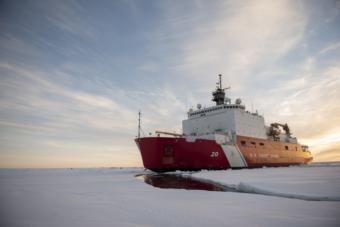
The cutter named for him is part of a group of Sentinel-class 154-foot fast response cutters, Muir said. It is the first of six of these ships that will be homeported in Bahrain to support the U.S. Naval Forces Central Command, and which will replace older, smaller cutters.

“It’s designed for multi-missions, including drug and migrant interdiction ports and waterways, coastal security, fisheries patrol, search and rescue and national defense,” Muir said. “We are acquiring these to replace the 1980s-era, Island-class, 110-foot patrol boats.”

Charles Moulthrope was buried in Unalaska in 1896, at the age of 23, after he died during service in nearby waters. (Photo by Maggie Nelson/KUCB)

According to Muir, when those vessels are decommissioned, they can be used for a variety of things.

“Some of them have been used as artificial reefs,” Muir said. “Some of them have been used as training vessels or have been transferred to other U.S. government agencies and some have been sold through the Excess Defense Articles Act through the State Department to navies and coast guards of other nations.”

There are currently 40 fast response cutters, like the cutter Charles Moulthrope, in service, two of which have homeports in Alaska.

Muir said the Cutter Charles Moulthrope will be escorted to Bahrain with its sister ship, the Robert Goldman, which will be commissioned next month in Florida.

Alaska National Guard members head to Washington, D.C., to help with security for Biden inauguration

Forty-seven soldiers and airmen from the Alaska National Guard arrive at Joint Base Andrews in Washington, D.C., after a flight from Joint Base Elmendorf-Richardson aboard a 168th Wing KC-135 Stratotanker. The security forces and military police personnel volunteered to support the presidential inauguration on Wednesday, Jan. 20, 2021. (Photo by Frank Marquez/D.C. National Guard)

An air tanker and crew based at Eielson Air Force Base flew out Sunday with 47 members of the Alaska National Guard who’ve volunteered to support Wednesday’s presidential inauguration in Washington, D.C.

An Alaska Guard news release says the Eielson-based 168th Wing refueling tanker flew directly from Joint Base Elemendorf Richardson to Joint Base Andrews, Maryland, just outside of D.C.

“When we initially put out the request to soldiers and airmen if they want to do this, we had a very big response from our membership,” said the Alaska Guard’s Major Brian Fuchs. “They absolutely want – especially my security forces and my military police – they want to get out there and they want to do their job.”

The Guard members aboard the tanker were security personnel with the 168th Wing. They joined their counterparts with the 176th Wing, based at JBER, and members of the Alaska Guard’s 297th Regional Support Group.

Fuchs said they’re helping manage security and logistics and other tasks at the inauguration, such as “supporting law enforcement, and checkpoints, and helping move people through the National Mall and the parade route.”

Fuchs told a Guard public affairs officer at JBER that the 80 Guard members who volunteered for the mission came from all around Alaska including “soldiers and airmen from Fairbanks, from the Mat-Su Valley, from Fort Greely area – just, all over.”

Alaska’s volunteers will join some 25,000 other Guard members from other states for the 58th presidential inauguration, which is scheduled to begin at noon Wednesday.

Rep. Don Young joins Democrats to nix Trump’s veto of defense bill

Rep. Don Young in his Washington, D.C. office. (Liz Ruskin/Alaska Public Media)

The U.S. House has voted to override President Trump’s veto of the annual defense bill. Alaska’s lone House member Don Young voted with Democrats on the override.

“Mr. Speaker, as the member designated by Mr. Young of Alaska …. I inform the House that Mr. Young will vote yes on passing H.R. 6395 over the objection of the president,” said Rep. Don Beyer, D-Va., delivering Young’s vote by proxy.

The final tally was overwhelming: 322-87. Scores of House members voted by proxy.

The Senate is likely to override as well, turning the bill into law. If so, it will be the first time Congress has overridden a Trump veto. Both of Alaska’s senators have said they will vote to override.

The annual defense bill is considered must-pass legislation to keep military programs going. It has a pay raise for the troops and allows the purchase of new equipment, including six polar icebreakers.

Trump wanted the bill to allow more lawsuits against social media companies. And he objected to a provision telling the Pentagon to rename military installations that commemorate Confederate generals.

Democrats in the House also voted today to give most Americans $2,000 in COVID relief — the amount President Trump preferred, compared to the $600 Congress passed in a bill before Christmas. Trump called that bill a disgrace but reluctantly signed it Sunday night.

Young was not among the 44 Republicans who voted for the larger checks. He did not vote on the measure at all.

“The congressman sincerely appreciates the president’s desire to maximize direct aid to Americans, but also recognizes that this vote was simply political theater and that the bill will likely die in the Senate,” said Young spokesman Zack Brown.

Young said in June that he opposed House Speaker Nancy Pelosi’s rule allowing absentee voting on the House floor. He called it “a flagrantly unconstitutional proxy voting scheme.”

Site notifications
Update notification options
Subscribe to notifications