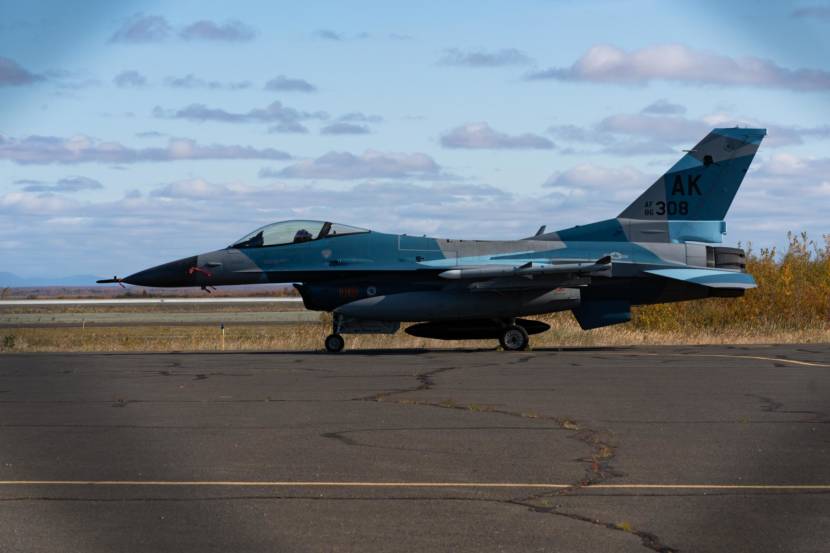
Bethel buzzed with excitement after two F-16 fighter jets made an emergency landing at the airport on the night of Sept. 22.
Steve Carr was checking on a few airplanes parked next to the Bethel air traffic tower when he heard the distinctive sound of fighter jets approaching. Carr then saw them dip low toward the runway.
“One guy landed, and then the, the other one stayed in formation during the landing. He kept going, flew basically right over the tower, and he put himself in a holding pattern over the airstrip. And that’s what everybody in town heard — him just circling in that holding pattern,” Carr said.
Carr said he just happened to have a handheld aviation radio on him and tuned in to listen to the air controller direct the surprise F-16s along with several other aircrafts trying to come in.
“That time of day, they’re just coming in from every direction. So he had all these guys, put them in the holding patterns for this emergency,” Carr said.
That meant several planes flew in circles above the tundra as they waited for their turns to land.
An Air Force spokesperson said the F-16s belonged to the 354th Fighter Wing stationed at Eielson Air Force Base near Fairbanks, and that one of the F-16s made an emergency landing in Bethel due to a mechanical problem. The issue popped up in flight while returning from a military exercise in the Asia-Pacific region. None of the pilots were injured.
Carr said Bethel residents lined up in their cars or drove down Tower Road to check out the F-16s.
“When leaving the airstrip coming down [Chief Eddie] Hoffman Highway, I saw about a dozen cars pulled off at the end of the north end of the airstrip where you can look off the highway right down the airstrip there,” Carr said.
The Eielson Air Force Base spokesperson said mechanics were on their way to Bethel to repair the jets.
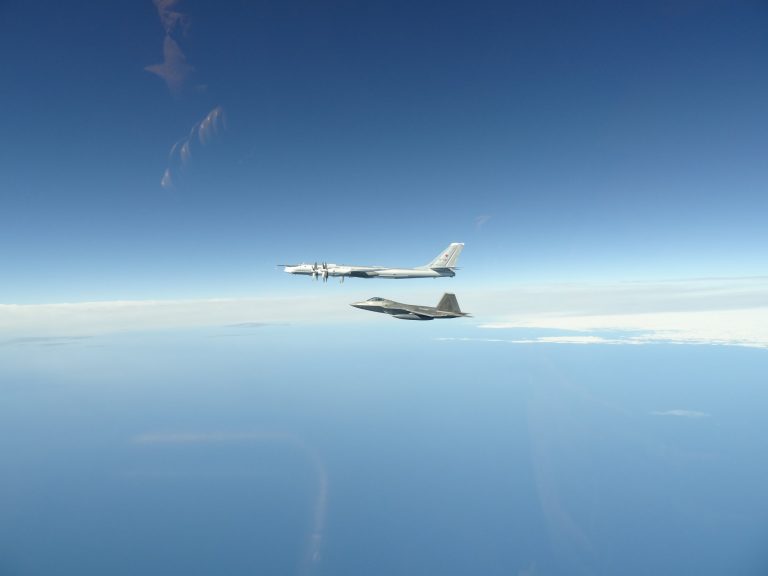
North American Aerospace Defense Command F-22 Raptors, supported by KC-135 Stratotankers and an E-3 Airborne Warning and Control System, completed two intercepts of Russian bomber aircraft formations entering the Alaskan Air Defense Identification Zone on June 16. (NORAD Photo)
U.S. jet fighters have scrambled at least a dozen times so far this year to intercept Russian military aircraft that fly into airspace off Alaska’s coasts. The North American Aerospace Defense Command says that’s the highest number of intercepts that NORAD has responded to in recent years. And Sen. Dan Sullivan says it’s part of Russia’s policy of expanding its influence and military presence in the Arctic.
The U.S. Air Force has for decades played an aerial game of cat-and-mouse with Russian pilots flying military aircraft near Alaska’s coasts. But NORAD Commander Gen. Glen VanHerck says the increased number of Russian aircraft interceptions this year following years of military buildup on their side of the Bering Sea suggests they’re trying to probe for weakness in U.S. defenses.
Sen. Dan Sullivan says last month’s interception of three aircraft formations all approaching Alaska from three directions at once proves the general’s point.
“I think it’s a ratcheting-up that we might see more regularly,” he said, “and we need to be able to confront it, and protect our interests here.”
Sullivan says a large Russian naval exercise that was going on in the western Bering Sea at the same time as the triple aircraft intercept demonstrates that the Arctic has become a flashpoint where two major military powers bump up against each other.
“The Russians are very open and transparent about what they see as this sphere of influence for them, how they see it (as) critical not only to their national security but also their economic security,” he said Monday in an online forum sponsored by the Wilson Center’s Polar Institute.
The senator said the Pentagon’s most recent National Defense Strategy, issued in 2018, foresaw the rivalry in the Arctic as part of what it called the rise of so-called “great power competition” between the United States and its so-called “near-peer rivals.” Namely Russia, but also China, which calls itself a “near-Arctic state” because it wants access to the region’s natural resources and trans-polar shipping routes that have become increasingly free of sea ice due to the warming climate.
“There’s no doubt in my mind that the great-power competition that is predicted has arrived in the Arctic,” Sullivan said.
He says the U.S. military is beefing up its presence in Alaska in response to the Russian buildup with, among other things, two new squadrons of advanced F-35 stealth fighters at Eielson Air Force Base. He says the F-35s, along with other so-called “fifth-generation” F-22 fighters at Joint Base Elmendorf Richardson, will enable the U.S. to project power far beyond the Arctic.
“With the F-35s coming to Eielson and the F-22s at J-BER … we’ll have over a hundred fifth-generation fighters located in Alaska,” he said.
Sullivan says the buildup in Alaska’s defenses also includes more Coast Guard personnel and equipment, including the construction of the service’s first heavy icebreaker in more than 40 years. He says he hopes that icebreaker or one of the five others that have been proposed will be based out of an Alaska port – perhaps the new deep-water port that’s been proposed for the Bering Sea.
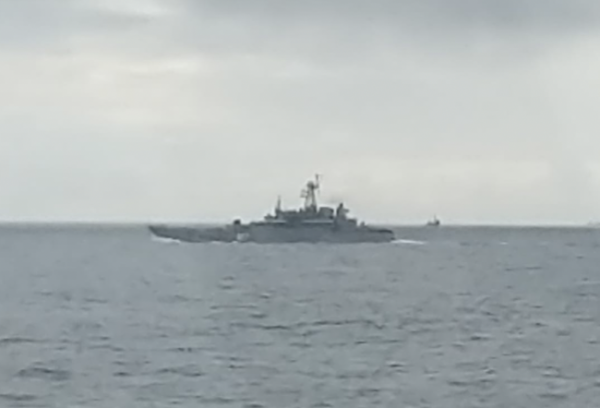
A Russian vessel participating in military exercises on the Bering Sea steams past the pollock trawler Vesteraalen on Wednesday. (Courtesy Steve Elliott)
Steve Elliott’s trawler, the Vesteraalen, was fishing for Bering Sea pollock Wednesday afternoon when he and his crew started hearing voices speaking Russian on their ship’s radio — an unusual development, given they were 80 miles from the U.S.-Russian maritime boundary.
Soon after, though, the voices switched to English, with a stern message to Elliott’s boat and the dozen others fishing within a few miles: Move.
“Three warships and two support vessels of theirs were coming and would not turn,” Elliott said, in an interview over the Vesteraalen’s satellite phone. “And they came marching right through the fleet.”
Other vessels reported getting buzzed by Russian aircraft and ordered out of the area on a specific heading. The incident has now drawn the attention of both of Alaska’s U.S. senators as well as an investigation by three federal agencies into what they’re calling reports of “unprofessional interactions” by the Russian military.
The altercation interrupted fishing for several boats, and some industry players say they’re worried about continuing impacts of exercises that, according to a federal notice, could run into September. This year’s summer pollock season has already been challenging, with slower fishing and added precautions due to the COVID-19 pandemic, and vessels only have until Nov. 1 to catch their limit.
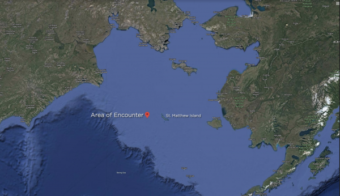
A map of the close encounter between American fishing boats and Russian military vessels on the Bering Sea on Wednesday, August 26, 2020. (Valerie Kern/Alaska Public Media
“We were caught by surprise,” said Stephanie Madsen, executive director of the At-Sea Processors Association, a trade group of 13 large vessels that catch Bering Sea pollock and process it in onboard factories. “It caused a disruption in our fishing operations for at least the 24- to 36-hour period where we were trying to get the facts about what was happening. And then it’s unclear what impacts could continue through the time that the Russians have given us notice the exercises will be underway.”
Elliott said that in three decades of fishing, he’s never seen anything like what he experienced Wednesday. But experts say this is unlikely to be the last encounter between Russian and American vessels in the Bering Sea, as the warming Arctic becomes an area of increasing military and economic focus for global powers.
“Welcome to the future,” said Heather Conley, an Arctic expert at the Center for Strategic and International Studies. “Unfortunately, I think we’re going to see more of this type of exercising and significant military presence in the Arctic — we just haven’t seen it for a long time.”
The pollock trawlers were operating within the U.S. “exclusive economic zone” — an area that reserves fishing rights for American boats but doesn’t block international vessels from entering or operating, said Kip Wadlow, a Juneau-based U.S. Coast Guard spokesman.
While the Coast Guard called the exercises “pre-planned” and said that a notice about them was published earlier this month, fishing industry representatives argued that it was useless to them because it was issued through a system they don’t regularly monitor.
In interviews, Bering Sea fishermen and executives described a chaotic and unsettling run-in with the military assets, which the Russian government now describes as part of “massive drills” happening for the first time ever in the region, with missiles, submarines and dozens of warships and planes.
The Blue North, which was fishing for cod to the northeast of the trawl fleet, was buzzed six times by a Russian aircraft that, by radio, ordered the ship out of the area on a specific course at “maximum speed,” according to Mike Fitzgerald, a crew member.
“I won’t say we were fearful, because we’re Bering Sea fishermen. But this goes beyond anything when you really know what happened,” Fitzgerald said. “We had Russian military aircraft threatening us: ‘Danger area. Missile area. Proceed out of here.’ That’s unheard of, and it’s really wrong that we haven’t gotten more protection out here.”
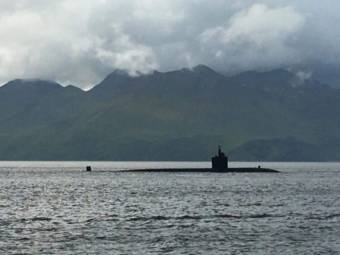
Fitzgerald also provided a photo, sent by another fishing vessel, that appeared to show what fishermen thought was a Russian submarine surfaced close to the shore of St. Matthew Island, which is part of the United States. But one defense analyst on Twitter, H.I. Sutton, said the photo actually showed a U.S. naval submarine, not a Russian one.
Republican U.S. Sen. Dan Sullivan said in a prepared statement that the exercises are a “stark reminder of why we need a strong U.S. military presence in the Arctic.”
This photo shows a submarine surfaced not far from the shore of U.S.-owned St. Matthew Island, in the Bering Sea. Fishermen thought the submarine was Russian, but defense analysts say it’s a U.S. naval vessel. (Courtesy Mike Fitzgerald)
“In recent months, Russian provocation has only increased. Our commercial fishing fleet encountered a frightening situation, with huge safety implications,” the statement quoted Sullivan as saying. “Clearly, there was a communications breakdown among our military agencies, and we are working to get to the bottom of it — so that this type of incident, which caught our fishermen off guard, does not happen again.”
Republican U.S. Sen. Lisa Murkowski also released a statement saying she’d been briefed by Coast Guard and NORAD officials in an effort to understand what happened, and to ensure that maritime interactions are conducted “lawfully, peacefully and with due regard for the safety of those at sea.”
On Thursday, military officials said only that they were monitoring the situation, and that the Russian military exercises were taking place in international waters “well outside the U.S. territorial sea.”
But on Friday, the Trump administration released a sharper statement, saying that the three federal agencies are investigating reports of “unprofessional interactions by Russian military forces with U.S. fishing vessels in the Bering Sea.”
“Initial indications are that these interactions stem from a Russian naval exercise,” said Larry Pixa, a spokesman for the U.S. Department of State, which is working with the U.S. Coast Guard.
Experts say that the incident comes as the U.S. — not just Russia — has also become more assertive in the Arctic. Conley said there’s been increasing American naval and air activity in the Barents Sea, near Norway, and that the two nations are “signaling to one another” about the strategic and military importance of the Arctic.
The fishing boats’ experience in the Bering Sea highlights the need for enhanced systems of communication as the Arctic becomes more crowded, and it should serve as a learning experience, said Mike Sfraga, director of the Wilson Center’s Polar Institute and a former vice chancellor at University of Alaska Fairbanks.
The Russian military wasn’t operating outside “international norms” in conducting its Bering Sea drills, and neither were the American fishermen, Sfraga said. But though it appears that certain parts of the U.S. government were made aware of the exercises in advance, that message didn’t get passed along to the pollock fleet, he added.
“This is what most of us worry about,” he said. “It seems to beckon for a higher, government-to-government level discussion about how we engage in the future, because this will not be the last time.”
National Public Radio diplomatic correspondent Michele Kelemen contributed reporting from Washington, D.C.
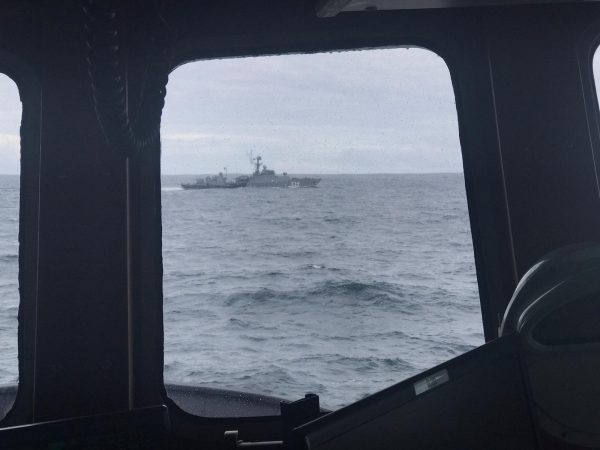
This photo of a Russian military vessel on the Bering Sea was provided to the head of a fishing industry trade group by one of his member companies. (Courtesy Brent Paine)
Bering Sea pollock fishermen had a close encounter Wednesday with Russian military vessels conducting pre-planned exercises, according to industry officials and a U.S. Coast Guard spokesman.
“They are telling American fishing vessels to move out of the way,” said Brent Paine, executive director of United Catcher Boats, an industry trade group. “They’ve got some submarines and destroyers and nobody knows anything about it.”
The Coast Guard was notified of the encounters Wednesday, checked with Alaska Command at Anchorage’s Joint Base Elmendorf-Richardson and learned that the Russian military assets were doing “pre-scheduled military operations,” said Kip Wadlow, a Juneau-based Coast Guard spokesman.
The pollock boats were operating within the U.S. exclusive economic zone, which reserves fishing rights for American boats but doesn’t block international vessels from entering, according to Wadlow.
“We appreciate the concern of the fishermen — they saw something that they had concerns about and they notified us,” Wadlow said. “And we were able to reach out to our counterparts at Alaska Command and confirm this was something that was known about.”
In a tweet early Thursday, the Russian Ministry of Defense posted a video of what it says were exercises by its Pacific Fleet. It said a missile cruiser ship called the Varyag and a nuclear submarine called the Omsk conducted joint missile firing at targets in the Bering Sea.
Photos of the encounters spread quickly on social media late Wednesday. Paine’s members told him their vessels saw five Russian warships and possibly two submarines — which made a quick impression.
“If you’ve got a net in the water and a submarine’s coming through,” Paine said, “you’re going to lose the battle.”
Close up of the Juneau Police Department badge. (KTOO file photo)
U.S. Sen. Lisa Murkowski is against defunding the police, but she wouldn’t mind disarming them of weapons of war.
Murkowski is co-sponsoring an amendment that would ban the Pentagon from transferring certain surplus military weapons to police departments. Murkowski, in a written statement, said local law enforcement agencies don’t need things like grenade launchers, armored drones or bayonets.
“Police should be there to serve the community, and there is no need for military-grade combat equipment to be on the streets of our cities in order to do that,” she said.
The program that puts military equipment in the hands of law enforcement personnel has long been controversial, and opposition has grown since police used tear gas or similar chemical agents on citizens protesting police brutality this spring.
Protestors have called for defunding police departments. Sen. Murkowski told constituents last week she’s against that.
“I do not believe that the answer is to defund our police,” she said in a telephonic town hall meeting Thursday. “I think we recognize that we need law enforcement to keep our communities safe.”
Police departments in Alaska have made limited use of the Pentagon surplus equipment program over the years. The list of transferred equipment includes about 60 rifles. They went primarily to the Alaska Department of Public Safety and also to Juneau Police.
The Fairbanks Police Department obtained a mine-resistant vehicle worth nearly $700,000.
Among the items the Anchorage Police Department got were unmanned vehicles, bomb disposal kits and several dozen pairs of mittens.
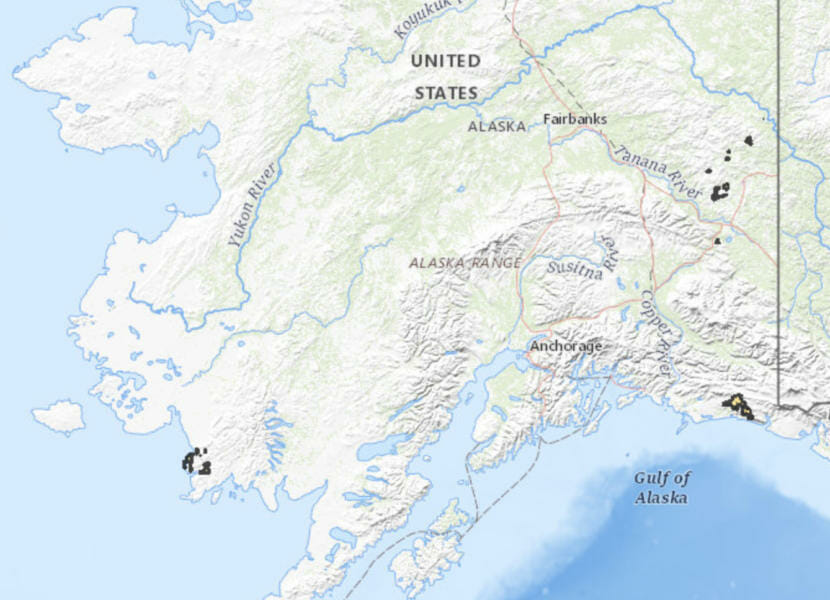
Public domain map from the Bureau of Land Management denoting areas currently available for land allotments for Alaska Native veterans who served in the Vietnam War.
The Bureau of Land Management is trying to reach some 2,200 Alaska Native veterans to let them know they can lay claim to 160 acres apiece.
That’s because Congress approved a new Native allotment filing period for veterans who served during the Vietnam War era
“We believe many of the veterans have passed,” said BLM Deputy Director of Policy and Programs William Perry Pendley. “But their heirs are eligible for this, their spouses, and many of them are in the Lower 48. So we’re eager to get the word out.”
The Native Allotment program began in 1906, to give Indigenous people title to land they used or lived on. Congress ended the program in 1971, with the Alaska Native Claims Settlement Act.
For years, Alaska’s congressman and senators have tried to reopen the program. They argue that thousands of veterans missed the opportunity to apply because they were serving in the military.
Vietnam-era vets got another crack at an allotment in 1998. That filing period didn’t work as intended.
“Members of Congress were very disappointed as a low number of those who applied,” Pendley said.
So this time, Congress opened the door wider. Now veterans don’t need to have any connection to the land they select.
Environmentalists have warned the program is a pretext for getting public lands in private hands. They predicted developers would push vets to select parcels with commercial potential. But so far, BLM’s map of available land shows only small clusters in three distant parts of the state – the Fortymile area in the Interior; in the west, near Goodnews Bay; and nestled between glaciers near Yakutat.
Pendley says BLM is trying to unlock more land by clearing claims the state of Alaska made years ago that have languished.
“And we believe that will release an additional 13 million acres. And The Fish and Wildlife Service is looking at an additional 26 million acres,” Pendley said.
The BLM says it will update the map as the pool of available land grows. The agency is about to publish the draft rules of the program. Pendley says the government will also send letters in an attempt to notify all eligible vets and their heirs. The application window will be open for five years.
Editor’s note: The image in this story has been updated to show a more accurate depiction of the areas currently being offered by the Bureau of Land Management to Alaska Natives who are veterans of the Vietnam War.
Close
Update notification options
Subscribe to notifications
Subscribe
Get notifications about news related to the topics you care about. You can unsubscribe anytime.