Military

Trump’s defense veto could sink Sitka’s Coast Guard dock

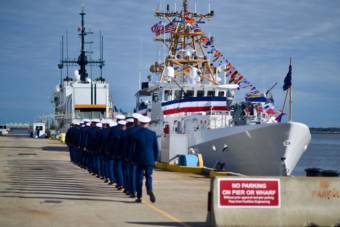
The U.S. Coast Guard will deploy six fast-response cutters in Southeast Alaska, including one in Sitka. The National Defense Authorization Act included $30 million in upgrades to Sitka’s Coast Guard dock to accommodate the ship, and $30 million for new housing in Kodiak for ship’s personnel and families. (USCG photo)

President Trump’s veto of the National Defense Authorization Act has put Sitka’s plans for a new Coast Guard fast-response cutter on the rocks.

Sitka was selected as a homeport for one of the six vessels. And while the ship itself doesn’t appear in jeopardy, there might not be anyplace to put it if the veto stands.

Alaska Sen. Dan Sullivan met with reporters before the Christmas holiday to share his frustration over the president’s veto of the bill, which appropriates around $400 million for a long list of capital projects to reinforce the Coast Guard’s presence in the Arctic, including a new dock in Sitka.

“There is significant more funding for infrastructure, particularly in Southeast, with regard to Sitka,” Sullivan said. “Almost $30 million for the pier replacement because they’re getting a fast response cutter.”

Sullivan’s frustration is shared by many senators who worked together pre-conferencing the bill — in other words, sitting down with members of both parties and with members of the US House of Representatives — hammering out something that a clear majority could agree to.

But Sullivan’s frustration may be especially acute because the Coast Guard technically isn’t part of the Defense Department. It’s within the Department of Homeland Security. He’s been working to link the Coast Guard Authorization with the National Defense Authorization Act because the NDAA has been a sure thing for the last six decades.

“And the big development there was that we combined the Coast Guard bill and the Defense bill together,” Sullivan said. “That’s actually been a goal of mine since I got to the senate. That’s the first time that’s happened. It’s a great thing for our Coast Guard because the Defense bill moves every year. Sixty years in a row that bill’s moved. The Coast Guard bill often gets overlooked, forgotten, maybe reauthorized every two years.”

It was exactly two years ago that President Trump shut down the government in a standoff with Congress but maintained Defense spending. The 42,000 members of the US Coast Guard, however, worked without pay over the holidays and through most of January.

Alaska’s senior senator, Lisa Murkowski, is also unhappy with Trump’s veto.

“It’s incredible that the President chose to veto the annual National Defense Authorization Act, particularly because his reason for doing so is an issue not related to national defense,” she wrote in a news release on Christmas Eve.

Earlier in the fall, the president threatened to veto the bill because it did not include a repeal of the so-called “Section 230,” which shields internet companies from liability for statements posted on their websites by third parties.

More recently, President Trump has called the National Defense Authorization Act a “gift to China.”

The Senate could meet as early as Tuesday, Dec. 29 to consider an override vote — but only if the House of Representatives has already done so.

KFSK’s Joe Viechnicki contributed to this story.

Trump administration may hire private ship to fill Arctic ‘icebreaker gap’ by year’s end

The Aiviq anchored in Unalaska in August 2016. (Sarah Hansen/KUCB)

The Trump White House is racing to lease an icebreaker, and one of the candidates is a ship with a notorious Alaska past owned by a Republican mega-donor.

Sen. Dan Sullivan said he spoke to the White House national security advisor and learned the administration is considering leasing a medium-weight icebreaker for the Coast Guard to use. It may happen soon, Sullivan said at a Senate hearing last week, “like hopefully as early as the end of this month.”

After a fire damaged the icebreaker U.S.S. Healy this summer, the U.S. is down to one working icebreaker. The Coast Guard has another being built, but it isn’t expected to be finished until 2024.

Sullivan likes the idea of leasing to fill the “icebreaker gap.” He said the U.S. needs a persistent presence in the Arctic to hold off adversaries.

The White House is considering ships in Finland, Sullivan said at the hearing, or “there’s another icebreaker that’s in Florida, I guess. Not really sure what it’s really doing in Florida.”

That could only describe one ship: The Aiviq, owned by Edison Chouest Offshore. It’s the only privately owned medium-weight icebreaker in the U.S., by the Coast Guard’s listing. Vessel-tracking websites show it’s docked in Tampa.

That name may sound familiar. In 2012, the Aiviq was the vessel towing an offshore drilling rig for Shell that went aground near Kodiak.

Louisiana-based shipbuilders Edison Chouest built the Aiviq specifically for Shell’s offshore Arctic drilling project. When Shell pulled the plug on the program, the $200-million Aiviq was suddenly unemployed. Chouest pitched it to the Obama administration and to the Canadian Coast Guard to no avail.

The company’s owner and president, Gary Chouest, is a prolific campaign contributor. He and his wife have given millions to candidates — mostly Republican — and to the Republican Party.

Alaska Congressman Don Young is among the beneficiaries of that largesse. Young has received about $300,000 from the Chouest family and company executives over the years.

At a 2016 hearing, Young aggressively pushed the Coast Guard to hire the Aiviq. The Coast Guard’s second-in-command at the time insisted it wouldn’t work.

“Sir, our current opinion is that ship is not suitable for military service without substantial refit,” Coast Guard Admiral Charles Michel told Young, twice.

Young called that answer “Bull—-.”

“Military service?” Young bellowed at the hearing. “I’m talking about moving ice!”

But that was in 2016. A lot can change in four years.

Michel’s successor, Coast Guard Admiral Charles Ray, told Sen. Sullivan at Tuesday’s hearing that the Coast Guard studied the concept, following a directive from President Trump. Ray agreed with Sullivan that a leased icebreaker might serve temporary duty.

Coast Guard Vice Commandant Charles Ray testifies at a U.S. Senate hearing Dec. 8, 2020. (Alaska Public Media)

“Any leasing arrangement would not be in lieu of building our own icebreakers. This would be in addition to,” the admiral said.

“I fully agree,” Sullivan said. “In addition to, as a bridge. Couldn’t agree more.”

Sullivan did not promote any particular ship at the hearing. Sullivan spokeswoman Amanda Coyne said he had “no idea” which ship in Florida the White House was considering when he mentioned it, nor who owned it.

The Chouest family and company executives have contributed to all members of Alaska’s congressional delegation. They gave Sullivan $30,000 in 2016.

At the hearing, Sullivan also made the case that icebreakers, leased or government-owned, should be homeported in Alaska.

Russian intimidation of Bering Sea fishermen shows gap in Arctic investment, Sen. Sullivan says

This photo from August 2020 appears to show a Russian submarine surfaced not far from Alaska’s St. Matthew Island, in the Bering Sea. (Photo courtesy of Mike Fitzgerald)

The second-in-command of the U.S. Coast Guard shouldered some of the blame on Tuesday for incidents in August in which the Russian military intimidated Bering Sea fishermen out of American waters.

Admiral Charles Ray told a U.S. Senate panel the Coast Guard knew Russia was conducting a military exercise in the area and failed to tell the Bering Sea fishing industry.

“This was not our best day, with regards to doing our role to look after American fishermen — the U.S. Coast Guard,” Ray said. “I’ll just be quite frank: We own some of this.”

Coast Guard Vice Commandant Charles Ray testifies at a U.S. Senate hearing Dec. 8, 2020. (U.S. Senate)

At-sea Processors Association Director Stephanie Madsen said fishermen fear being caught in the crossfire as Russia and the U.S. vie for dominance in the Arctic.

Madsen described for the Senate Commerce Subcommittee on Security a harrowing scene on the fishing grounds.

“In the first such incident, the Northern Jaeger was harassed by members of the Russian military over the course of five hours,” she said. “A Russian warplane flew overhead for two hours, issuing warnings and threats via radio in broken English.”

A nearby Russian warship then issued a series of escalating threats until, Madsen said, the captain of the Northern Jaeger felt he had no choice but to comply and sail five hours south.

In the second instance, Russian planes repeatedly buzzed two American vessels and warned of live missile fire. Those ships, too, left the area. One captain had to cut loose his fishing gear to flee faster. Madsen said the financial loss to the companies that own the ships is in the millions.

Sen. Dan Sullivan said the Arctic is the next arena of great military power competition, and Russia has built up a lot more infrastructure on its side.

“Without further investment in our polar capabilities, our adversaries’ influence will grow,” warned Sullivan, who chaired the hearing. “And if that happens, we risk our ability to protect U.S. vessels conducting commerce, to enforce international law, and to defeat threats to our national security.”

Sullivan said Congress is already advancing Arctic projects to catch up. These include a deep-draft port at Nome, which Sullivan said should be the first in a series. Congress has also funded one new icebreaker, with plans for five more.

Admiral Ray said the Coast Guard now holds regular meetings with the Bering Sea fishing industry to avoid dropping the ball on communications again.

Coast Guard newbies stepped up when mission was threatened by quarantine

USCGC Munro at RIMPAC 2020
An MH-60S Seahawk Helicopter assigned to Helicopter Sea Combat Squadron 21 conducts “touch and go” drills aboard U.S. Coast Guard cutter Munro during the 2020 Rim of the Pacific exercise. Ten nations, 22 ships, one submarine, and more than 5,300 personnel participated in the exercise from August 17 to 31, 2020 at sea around the Hawaiian Islands. (U.S. Navy photo by Mass Communication Specialist 3rd Class Madysson Anne Ritter)

This summer, the COVID-19 pandemic threatened to scuttle the Alaska patrol of a U.S. Coast Guard cutter when over 10% of the crew was put in quarantine. But the ship’s mission was saved when a large group of cadets — the youngest, newest and most-inexperienced members of the Coast Guard — was called on to help.

To use a very old nautical phrase, Captain Blake Novak was caught between the devil and the deep blue sea.

Captain Blake Novak
Captain Blake Novak, commanding officer of the U.S. Coast Guard cutter Munro, wears some of his favorite off-duty attire as he explains the training provided for cadets who served aboard his ship in summer 2020. He’s explaining how they briefed cadets on some of the dangers, including what happens when a 4-inch diameter mooring line for a 4,000 ton ship suddenly parts while under tension. (Photo by Matt Miller/KTOO)

Novak is commanding officer of the cutter Munro, one of the biggest vessels in the Coast Guard fleet at 418 feet.

The Munro was in Dutch Harbor this summer when Novak got word of a big storm heading their way. The weather forecast was so bad that Novak was advised to stay in port for the next four days. It would’ve been dangerous to get underway as the storm passed through the area.

“We were going to encounter 18-plus-foot seas off the beam,” Novak said.

If they stayed in port as advised, they would miss a planned military exercise off Hawaii. As Novak saw it, they had to leave.

But many of his crew were ashore for a barbecue celebration that included having a few beers.

“We call it the bottle-to-throttle policy, which says that you need to stop drinking 12 hours prior to getting the ship underway,” Novak said.

The Munro normally has 150 crew members. But many couldn’t help prepare the ship for departure because they had been drinking. So Novak turned to 16 cadets fresh from the U.S. Coast Guard Academy.

First Class cadet group
First Class Cadet Jordan Park (far right) with four other First Class cadets aboard USCGC Munro. (Photo courtesy Jordan Park)

“The majority of our cadets were underage,” Novak said. “So, right away they were filling shoes and able to step in immediately to assist and assume those roles to help out with the crew.”

Novak says the cadets handled the ship’s lines so they could leave Dutch Harbor as soon as possible.

First Class Cadet Jordan Park says that turned out to be a long day.

“It was really great to be relied on in that way,” Park said. “I think it was a little bit tough because we had been up since pretty early that morning pulling in, and we expected to stay overnight. And then, not staying overnight and getting underway that night was a little bit challenging. But that’s how the Coast Guard is and it was cool to experience that.”

Novak says they then steamed at high speed for 48 hours to beat the weather and eventually get to Hawaii on time.

So many cadets serving aboard a Coast Guard ship is very unusual. But it’s an unusual year.

Munro's Third Class cadets
Third Class Cadet Branyelle Carillo (center) with other Third Class cadets. (Photo courtesy Branyelle Carillo)

The Munro’s mission in the Bering Sea this summer included fisheries enforcement, search and rescue and patrolling the maritime boundary with Russia. But just before the ship left, Novak says they had an asymptomatic crewmember who tested positive for COVID-19. The crewmember and their close contacts, 18 people total, had to stay in quarantine.

So, Novak asked the Coast Guard Academy in New London, Connecticut for help. Many cadets were just returning from a summer break.

“In the military, we would say they were ‘voluntold,’” Novak said.

Novak says the arriving cadets were excited but understandably very nervous.

These cadets are essentially officers in training. And for two months, they filled roles normally held by enlisted service members just out of boot camp. Senior enlisted personnel trained the cadets to handle the lines for the ship, work in the mess, serve as lookouts and steer the ship.

3/c Branyelle Carillo
Third Class Cadet Branyelle Carillo aboard USCGC Munro. (Photo courtesy Branyelle Carillo)

Third Class Cadet Branyelle Carillo says she expected to be working hard.

“But we knew that it was going to be a great learning environment for the future and understanding what the fleet is actually about compared to us being here at school,” Carillo said.

And Carillo says they learned the importance of working as a team.

“You have to use other people that are around you in order to get what needs to be done,” Carillo said.

“So, that was like a biggest lesson of a lot of things that we did on (the) Munro.”

Novak, who considers his ship as a floating schoolhouse, says their experiences are important for any future leader, whether in the Coast Guard or elsewhere.

“These young men and women, in the future, are going to be put in positions where they’re managing our enlisted personnel,” Novak said. “So, for them to get a true feeling of what it’s like to walk and spend a day — in this case to spend two months — in the same shoes as our enlisted personnel, it’s very important from a leadership development standpoint.”

Not only did all the cadets have a unique experience, they also received a Meritorious Team Commendation that is usually only awarded to regular Coast Guard personnel. The Coast Guard Academy says it’s rare for these cadets, some a little over a year out of high school, to wear such a red ribbon on their uniform before they even graduate from the Academy.

Permit for Navy activities allows over 16,000 ‘behavioral disturbances’ to Southeast marine mammals

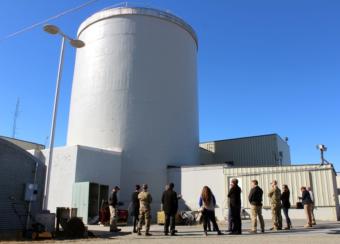
The Southeast Alaska Acoustic Measurement Facility in the Behm Canal, near Ketchikan. (Photo courtesy Jennifer Kelso via KRBD)

The U.S. Navy has received a green light from federal agencies for seven more years of training and testing up and down the West Coast.

NOAA Fisheries published a final permit Nov. 12 for the Navy’s testing and maneuvers from northern California to Southeast Alaska. In Alaska, the permit includes permission to behaviorally harass marine mammals more than 16,000 times over the next seven years.

Naval operations in Southeast Alaska consist mostly of acoustic measurement activities at the Southeast Alaska Acoustic Measurement Facility in the Behm Canal near Ketchikan.

Environmental groups have expressed concern that the Navy does not do enough to mitigate its impact on marine life — from larger marine mammals like whales and porpoises, down to fisheries and zooplankton.

Under the Marine Mammal Protection Act, the Navy must submit an environmental impact statement for its Northwest Training and Testing Area. The EIS includes projected impacts to marine life and some mitigation efforts. The Navy released the final supplement to its EIS in late September.

The federal agencies tasked with protecting marine mammals then evaluate the EIS and approve a permit for harm. The Navy is not permitted to physically harm or kill any marine mammals in Southeast Alaska over the next seven years, but is permitted thousands of what it calls behavioral disturbances. This can include disruption to feeding, interacting or traveling from place to place.

Calculation of disturbances to marine mammals and other ocean-dwellers is theoretical. The Navy does not keep track of actual harm done to marine mammals during the course of training exercises, instead using the number of training and testing activities as a proxy to estimate marine impacts.

Both the Marine Mammal Commission and NOAA Fisheries declined to comment, directing questions back to the Navy.

Alaska’s oldest WWII veteran prepares for her 104th Birthday

Hallie Dixon was the grand marshal of the 2019 Fourth of July parade in Anchorage. (courtesy of Naida McGee)

Alaska’s oldest World War II veteran, 103-year-old Hallie Dixon, decoded and encrypted messages for the Navy as a telegrapher during the war. And that wasn’t even her greatest adventure.

“My father heard the call to come to the Last Frontier to make his way as a young man out of the service, back in the days when Alaska was offering homestead land, especially for veterans,” said Niada McGee, Hallie’s daughter.

“And so he came as an aircraft mechanic and worked on Merrill Field, and she came and joined him in January of 1951, in a ground blizzard at 30 below zero with three little children and pregnant with number four. And she went on to raise 11 children in the far away isolation of Alaska.”

Eight years before Alaska became a state, Hallie and Paul Dixon settled in Anchorage. They also spent 14 years in St. Mary’s in the Yukon Delta, where Paul was the village corporation manager.

Hallie’s now living in an eldercare facility in Kenai, where she can see her daughter, Rita Lindow of Kenai, every day. Hallie’s health is deteriorating and she wasn’t up for speaking on the phone Wednesday.

McGee, who lives in Anchorage, said her mom enlisted when she was 25.

“She was working in downtown Detroit and in those days, on loudspeakers, throughout the city, they were making calls for young men and women to join the service and serve their country,” she said. “And she listened to the loudspeakers and decided to do it one day.”

Hallie was stationed in Sanford, Florida as a telegrapher. She was one of thousands of women who did so as part of the Navy WAVES, the woman’s branch of the U.S. Naval Reserve. Lindow said she was isolated in the barracks because she dealt with top-secret naval commands.

“And she did keep that top secret all the way through. We couldn’t get any of it out of her, even 10 years ago, what those messages were,” Lindow said.

Paul, who was Hallie’s boyfriend at the time, was deployed with the U.S. Army Air Corp in England. Lindow says he was a romantic.

“When he got to Gander, Newfoundland, he sent her a message on her teletype machine and he wrote, ‘I’ll see you at the light of the new moon.’ And her teletype machine was on the other side of her office,” she said. “And so one of the girls got the message and swooned of course and read the note to mom. Their relationship was quite captivating to everybody in the office.”Hallie Dixon was part of the Navy Women Accepted for Volunteer Emergency Service, or WAVES, during World War II.

Hallie and Paul married right before the war ended.

Shortly after statehood, Paul became the manager of all public airports in Alaska and frequently traveled to remote villages to negotiate contracts. So Hallie was often taking care of all 11 children by herself at their home off Delaney Park Strip.

“You had to be adventurous to make it through raising all those children in such an isolated place,” McGee said. “She got to speak to her own parents once a year when a telephone call would cost 40 or 50 dollars and last 10 minutes long. And writing letters. That was her communication with her family far, far away.”

Lindow said she still has her sense of adventure.

“Matter of fact, I just talked to my mom yesterday,” ehs said. “I could tell she was dreaming, I got up near and I said, ‘Mom? Want to go fishing?’ ‘Oh? Can we?’ At almost 104, you know?”

Most of the Dixon’s children still live in Alaska, along with a gaggle of grandchildren and great-children. Paul died in 2012.

Lindow said her mom doesn’t talk about the war much. But she has been publicly recognized for her service. She and other Alaska veterans took an honor flight in 2013 to Washington, D.C., where she saw the WWII monument and visited the National Cryptologic Museum in Maryland. In 2019, she was the grand marshall of the Fourth of July parade in Anchorage.

On her birthday in two weeks, Hallie will be 104.

Site notifications
Update notification options
Subscribe to notifications