Science & Tech

Predator reduction efforts have not increased moose harvests, study says

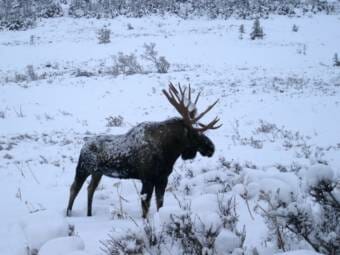
A large bull moose standing in a snowy field
Alaska moose in winter in 2019. (Photo courtesy of Paul Twardock)

A new scientific paper looks at predator reduction efforts in a large area of the Interior and South-Central Alaska and finds they have not increased hunter moose harvest over several decades.

The recently published research looked for longterm correlation between predator control and moose harvest in Game Management Unit 13. One of the study’s authors, retired Alaska Department of Fish and Game wildlife biologist Sterling Miller, says the study’s finding runs counter to a widely held perspective.

“There’s a lot of support in the legislature, and indeed the Alaska public and particularly the Board of Game, in the concept that killing more predators results in killing more moose,” he said. “And what our paper sets out to do is examine whether or not that’s true or not, and we decide based on our kind of analysis that it isn’t.”

Miller says the study used about 40 years of state harvest data for Unit 13 to analyze the efficacy of using wolf and bear reduction to increase moose hunter success.
“What we can infer from our data is that the historical harvest of predators has not resulted in increased harvest of moose,” he said.

The study used about 40 years of state harvest data for Unit 13 to analyze the efficacy of using wolf and bear reduction to increase moose hunter success. (Alaska Department of Fish & Game map)

The analysis undermines the premise of bear and wolf reduction programs authorized under the state’s Intensive Management Law by the Board of Game, including in Unit 13. Current state biologist Tom Paragi, who is in the process of evaluating the state’s intensive management programs, says that predator reduction appears to have been successful in Unit 13 over a shorter timeframe.

“The fact is the moose harvest did increase substantially, almost doubling from about 2003 to 2015, coincident with the implementation of wolf control and simultaneously brown bears had been reduced because of liberalized harvest regulations,” he said.

But Miller says the moose harvest fell back again post-2015 despite ongoing predator control. He underscores the value of taking a long-term perspective.

“If you look at short time periods, you may see some things that look like there’s a relationship, but that’s cherry picking the data,” he said.

Miller authored the study with fellow retired Fish and Game biologist David Person and retired University of Alaska Fairbanks professor Terry Bowyer. Their article, titled “Efficacy of Killing Large Carnivores to Enhance Moose Harvests: New Insights from a Long-Term View,” is published in the peer reviewed open access journal Diversity.

Cable ship finishes undersea fiber optic link to Southeast’s Prince of Wales Island

A large, blue-and-white ship seen through trees on the shore
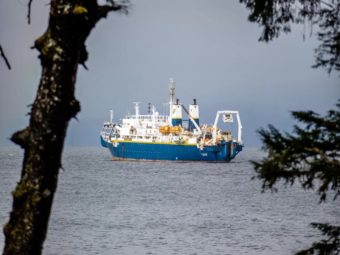
The ship IT Intrepid, which laid the SEALink cable, is seen through trees from Coffman Cove. (Photo courtesy of AP&T)

Prince of Wales Island now has its first direct fiber optic connection with the North American mainland. Alaska Power and Telephone announced this month it had completed the undersea cable known as SEALink about two years ahead of schedule. It runs from the Prince of Wales Island community of Coffman Cove to Juneau, with a short land-based stretch near Petersburg.

Plans for the 214-mile cable were unveiled in 2020 when the U.S. Department of Agriculture announced $21.5 million in funding for the project as part of its ReConnect program. AP&T chipped in $7 million of its own money for the cable.

AP&T Vice President Jason Custer says it’s a step towards modernizing internet infrastructure on the remote island. SEALink will eventually replace a network of mountaintop microwave towers that currently serve as the telecom company’s backbone.

“The project will dramatically increase people’s internet speeds, reliability and also will improve pricing significantly to bring folks up to a standard that’s similar to what they would expect in a larger city like Seattle or Anchorage,” Custer said in a phone interview Monday.

Now that the undersea cable is complete, technicians are slated to begin installing fiber optic service to homes in Coffman Cove and Kasaan. Custer says that’ll start next year — and he says residents should get in touch with the company’s customer service desk to make sure they’re on the list for installation.

In its grant application, AP&T said its plans would start with 10 megabit per second download speeds for $49.95 a month — a big upgrade from the one megabit service currently available in Kasaan. Coffman Cove currently has no broadband service. A 25 megabit connection — which Custer says is enough to handle multiple simultaneous videoconferences and distance learning — would be $79.95.

The fastest plans would be $229.95 per month and provide 250-megabit-per-second downloads.

The fiber network is expected to continue to expand across Prince of Wales Island in the coming years. AP&T was awarded another nearly $30 million from the ReConnect program in July to expand the island’s fiber optic network to Craig, Klawock and Hollis. Connecting those communities is expected to take another three years once construction gets underway in 2024. And Custer says they’re looking to expand further.

“Just a couple of days ago, we applied for additional funds to build fiber to the home in Hydaburg, Whale Pass and also Thorne Bay, including the South Side subdivision, which is a hard place to reach,” Custer said. “We’re hopeful — we want to get all of the communities on Prince of Wales up to the same very high standard.”

AP&T says it’s expecting to hear back from USDA early next year on the new grant.

Elsewhere in the region, Custer says AP&T is leveraging grant funding to expand fiber service to outlying communities in Upper Lynn Canal, including Klukwan and Dyea. Construction there could start as early as next year, and the project is expected to be completed by 2028.

In busy month, HAARP will do everything from making video art to bouncing a signal off the moon

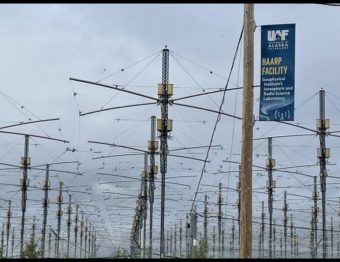
A University of Alaska banner on a pole in a the HAARP antenna field
The upper atmosphere-heating facility named HAARP is located on about 5,000 acres between the small Alaska towns of Glennallen and Tok. (Photo by Ned Rozell.)

The University of Alaska Fairbanks is operating the High Frequency Active Auroral Research Program facility, or HAARP, for 13 projects this month. The projects are the latest made possible by federal support for the ionospheric research facility in Gakona.

In 2021, the University of Alaska Fairbanks received a five-year, $9 million grant to establish and operate the Subauroral Geophysical Observatory for Space Physics and Radio Science at HAARP.

HAARP research support services lead Evans Callis says this month’s research campaign is funded by the National Science Foundation.

“They help us with the funding aspect to make the program happen, and we work directly with the scientists to make their work happen,” Callis said.

Callis calls the 10-day campaign, which runs through Oct. 28, unprecedented.

“The most experiments that we’ve had under our NSF grant that we’re currently operating under,” he said. “Also, the most diverse set of experiments that we’ve had.”

And it’s not all hard science. Among the projects is part two of an endeavor that uses HAARP’s high-power radio transmitter for art. It involves transmitting a signal into the ionosphere which can be picked by ham radio operators around the world and decoded into low-resolution TV images.

“Narrow band television video art — it also includes spoken word and sound art,” Callis said. “It’s kind of a collaborative work between the artist and the amateur radio community to kind of make the artwork happen.”

Canadian artist Amanda Dawn Christie first transmitted art via HAARP in 2019. The other dozen projects being conducted using the HAARP facility are scientific, including a NASA experiment that involves bouncing a signal off the moon.

“Very similar to ground penetrating radar actually,” Callis said. “You know we use that here on earth, but we’re applying it to figuring out the composition of asteroids, the moon, things like that.”

Another HAARP experiment aims to better understand a low-altitude, aurora-like atmospheric glow known as Strong Thermal Emission Velocity Enhancement, or STEVE. Callis says the experiment uses HAARP’s transmitter to send out so-called hot electrons thought to cause STEVE.
“And if we see that air glow and it matches the wavelength of light that we see from naturally occurring STEVE, that would give us indication that the hot electrons are playing some role in the formation of STEVE,” he said.

HAARP was built to conduct experiments in the earth’s ionosphere, but another project happening this month employs it to probe a similar electrically charged region over Jupiter, the giant gaseous planet 374 million miles away.

“This is a first-of-its-kind experiment (which) at least to my knowledge has never been attempted before,” Callis said. “We transmit several different frequencies from HAARP directed at Jupiter. We listen for the echo that returns, and that should be able to tell us something about electromagnetic conditions around Jupiter.”

The wide array of projects underscores the enduring scientific research value of HAARP, which began in 1993.

Callis says it remains the most powerful and flexible instrument of its kind in the world, and attributes this month’s research campaign to the NSF funding which provides for maintenance and prolonged viability of the facility.

“And the sense of security that brings helps scientists feel more comfortable coming up with a proposal to make use of the facility,” he said.

Scientists with NASA, the Naval Research Laboratory and Los Alamos National Lab, as well as numerous universities, are involved in this month’s HAARP research campaign.

Scientists are using microphones to measure how fast glaciers are melting

A photo of a tidewater glacier's terminus
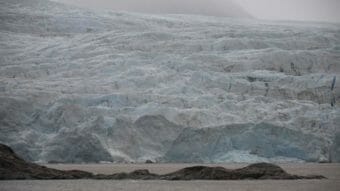
A view of Nordenskiold glacier melting and collapsing in the ocean in September 2021 in Svalbard, a northern Norwegian archipelago. (Photo by Olivier Morin/AFP via Getty Images)

Rising global temperatures are melting our planet’s glaciers, but how fast?

Scientists traditionally have relied on photography or satellite imagery to determine the rate at which glaciers are vanishing, but those methods don’t tell us what’s going on beneath the surface. To determine that, scientists have begun listening to glaciers using underwater microphones called hydrophones.

So, what do melting glaciers sound like?

“You hear something that sounds a lot like firecrackers going off or bacon frying. It’s a very impulsive popping noise, and each of those pops is generated by a bubble bursting out into the water,” oceanographer Grant Deane told Morning Edition.

Deane, a research oceanographer at the Scripps Institution of Oceanography who says he was inspired by a 2008 paper co-authored by renowned oceanographer Wolfgang Berger, hopes that listening and understanding these glacial noises will help him and his colleagues predict sea level rise.

“If we can count the bubbles being released into the water from the noises that they make, and if we know how many bubbles are in the ice, we can figure out how quickly the ice is melting. We need to know how quickly the ice is melting because that tells us how quickly the glaciers are going to retreat. We need to understand these things if we’re going to predict sea level rise accurately,” Deane says.

And predicting sea level rise is crucial, as hundreds of millions of people are at risk around the world — including the 87 million Americans who live near the coastline. Deane says that even a modest rise in sea levels could have devastating impacts on those communities.

Copyright 2022 NPR. To see more, visit https://www.npr.org.

Transcript

RACHEL MARTIN, HOST:

We know a lot about the effects of climate change, and we can see the impact it’s having. But what does climate change sound like? Some scientists who study glaciers have been listening.

A MARTINEZ, HOST:

They use underwater microphones known as hydrophones. Grant Deane, a research oceanographer at the Scripps Institution of Oceanography, says that gives them a deeper insight into how fast the glaciers are melting.

GRANT DEANE: I think the audio offers advantages that are difficult to get elsewhere. Pictures won’t tell you what’s going on under the water.

MARTIN: What does a glacier sound like? This is the Hans Glacier in southwestern Spitsberg, between Norway and Greenland.

(SOUNDBITE OF WATER FLOWING AND ICE CRACKING)

DEANE: When you put a hydrophone in the water, you hear all kinds of things. You hear the ice melting, sure. You also hear ice breaking off the ice drift. And our very first job was to catalog those different sources, understand their properties and make sure that we can distinguish one source from another.

MARTINEZ: So what does that rapid drip sound to scientists about glacier melt? Here’s Oregon State University glaciologist Erin Pettit.

ERIN PETTIT: I can listen to these sounds and actually get a feel for what the glacier is doing just from listening. And if we listen enough and we know something about the glacier behavior, we can link that together and think of it as a whole system and how the sound can give us clues to changes before our eyes might notice.

MARTIN: And deciphering those audio clues could mean getting more accurate forecasts of sea level rise, says Grant Deane.

DEANE: If we can count the bubbles being released into the water from the noises that they make, we can figure out how quickly the ice is melting. We need to understand these things if we’re going to predict sea level rise accurately.

MARTINEZ: Sea level rise presents a serious problem. Deane says even a small increase will make that problem worse. At least we know the scientists are listening. Transcript provided by NPR, Copyright NPR.

Yes, that was an earthquake near Ketchikan on Sunday night. Here’s why it didn’t show up online

A map showing Sunday night’s M4.1 earthquake (orange circle) and nearby seismic stations (triangles and gray circles). (Screenshot of Alaska Earthquake Center website)

Ketchikan Mayor Dave Kiffer was about ready to call it a night on Sunday when he felt something familiar.

“I was laying in bed reading, and I felt the entire house just sort of shimmy a little bit, and I went, ‘Oh, I know what that is! I’ve felt that before,’” Kiffer recalled on Monday.

So he did what anyone in the 49th State does right after a little shake: checked the Alaska Earthquake Center’s website.

“Zippo, nada, nothing,” he said.

A little while later, there were a few earthquakes listed in other parts of the state, but still nothing near Ketchikan.

So Kiffer decided to check in with some seismologists to the south.

“What happened last night was a moderate sized earthquake, magnitude 4.2,” said Honn Kao, a research scientist at the Geological Survey of Canada. His agency pinpointed the epicenter about 50 miles southeast of Ketchikan — 10 kilometers beneath the Misty Fjords, just barely on the U.S. side of the border.

“Its location is right around the border between Alaska panhandle and BC,” he said.

A magnitude 4.2 isn’t a huge earthquake by any stretch. But Kiffer says he was a little peeved when he woke up the next morning and state seismologists still hadn’t noted the earthquake.

“Seriously, what are we, chopped liver?” Kiffer said with a laugh.

Between 9:57 p.m. Sunday, when the earthquake struck near Ketchikan, and 6 a.m. the next morning, the state’s automated seismic stations recorded 11 earthquakes all over the state ranging in magnitude from 1.1 to 3.5. But there was still nothing listed near Ketchikan on the websites of the U.S. Geological Survey or the Alaska Earthquake Center.

“Usually the state does a real good job — I never have any complaints for them,” he said. “It’s kind of puzzling. It’s like, maybe they thought we were part of Canada.”

It wasn’t until Monday afternoon that Alaska authorities acknowledged the earthquake, estimating the magnitude at 4.1. Alaska Earthquake Center Senior Scientist Natalia Ruppert chalks up the miss to inadequate seismic sensor coverage.

“Unfortunately, our network in that region is not as comprehensive,” she said. “So at the moment, last night, we actually missed detecting that earthquake, but this morning, we actually went back and looked at our data and reanalyzed the data, and we were able to report on that earthquake as well.”

And while she says the Alaska Earthquake Center does its best to include as much data from Canadian earthquake sensors as possible, she says Alaska earthquake monitors weren’t receiving data from nearby Canadian stations on Sunday night.

“We try to exchange data, but the networks change, and sometimes they update things and those updates don’t propagate all the way into our system,” she said.

Honn Kao, from the Canadian earthquake agency, says stations in Prince Rupert and Haida Gwaii picked up the shaking. But he says it’s unlikely that a larger earthquake would go unnoticed.

“If we have a relatively big event, then all the stations, far and near, can detect a signal and therefore, it can be located by any agencies,” he said. “But for events that are smaller than magnitude 5, usually only local stations can detect the event better.”

Kiffer, the Ketchikan mayor, says he’s not especially concerned that domestic agencies missed the quake.

“It’s just humorous to me, more than anything else,” he said. “I mean, I we don’t get these very often. It’s nice to show up statewide and be counted.”

Southeast Alaska wolves eat over 60 prey species, study finds — including sea otter

A black wolf carrying what's left of a sea otter in its mouth
An image of a wolf dragging a sea otter carcass is captured on an Alaska Department of Fish and Game game camera.

Southeast Alaska’s wolves tend to favor deer and moose at mealtime, but in a pinch they won’t say no to black bear – or even sea otter. A study – now in its eighth year – has found a remarkably diverse diet among the region’s wolf population.  Although scientists use GPS collaring and other technology in their work, many of their conclusions are drawn from a large and growing collection of scat.

Petersburg has had a small pack of wolves hanging around the outskirts of town this year. Several residents have zoomed in with their cell phones to capture individual wolves here and there. The pack is part of a gray wolf subspecies known as the Alexander Archipelago wolf. They’re specific to Southeast Alaska and tend to be smaller and darker in color than their mainland counterparts.

Five wolves walking along a snowy shoreline.
An image of a wolf pack in Southeast Alaska is caught on an Alaska Department of Fish and Game game camera.

Biologists hope this close-to-town pack is an opportunity to learn more about local wolves. They’ve seen them on game cameras and think it’s a pair with three yearling pups. They’ve also successfully collared a black male in the pack and hope to get others.

Frank Robbins, the area management biologist for the Alaska Department of Fish and Game, says they use padded spring traps that capture the wolf by the foot.

“We’ll have signs up anywhere where we would put a trap,” Robbins said. “Of course, we wouldn’t put a trap anywhere where folks are out walking their dogs or where people are likely to encounter a set.”

Two people kneeling in the woods, studying something on the ground
Alaska Department of Fish and Game wolf research biologist, Gretchen Roffler (left) and employee Alex Lewis study a wolf kill site. (Photo by Sean Neilson)

The collaring project near Petersburg is part of a much larger study in Southeast, led by wolf biologist Gretchen Roffler. She’s been studying wolves in the region for eight years to find out their eating habits and range.

“Southeast Alaska is a very large and diverse landscape with different prey combinations available on these island groups and on the mainland,” Roffler said. “So for example, some islands have deer as the primary prey, whereas others have both deer and goats or deer and moose.”

To gather data, they’ve collared wolves from five different wolf packs.

A person stands over a moose skeleton in the woods
Alaska Department of Fish and Game wolf research biologist Gretchen Roffler investigates a wolf kill site. (Photo by Sean Neilson)

In the process, they collect information like age, weight, and if the wolf is one of the reproductive pair of the pack. They also take blood and hair samples for studying genetics and diseases. Then they wait. If the wolves hang out in a certain location for more than a few hours, it could be a kill site. And then the scientists move in.

“So we’re traveling to these sites by all possible means, by hiking on foot by skiff by kayak. Sometimes we use helicopters to get close to the site and then hike in,” Roffler said. “And once we’re there, we scour the ground to look for prey carcasses, or parts of the carcasses.”

They’ve studied over 200 sites so far and learned that heavy snowfall is good for wolves — it slows down prey and the wolves scavenge moose that have starved. Wolves also eat seasonally, sometimes focusing on salmon in streams during the summer. But hooved animals are their favorite.

“Wolves really tend to focus on the ungulates that they have available in their area, you know, be it deer or moose or goats,” said Roffler.

And they’ve found that Southeast wolves have dozens of “alternate prey” species.

A black-and-white game camera photo of a wolf eating a salmon in the dark
In the early morning hours, a wolf eats a salmon at a rendezvous site (a place where wolves keep their pups during the mid-summer). The image was caught on an Alaska Department of Fish and Game game camera.

Roffler and her helpers are also collecting wolf scat — lots of it, over 2,000 samples — which they’ve used to identify over 60 different prey species. Combining those findings with the kill sites, they’ve learned that wolves eat beaver, porcupine, marmot, adult black bear, brown bear cubs, even invertebrates off the beach. This alternate prey varies by location.

“So in places like Prince of Wales wolves consumed beaver and black bear,” Roffler said. “On Kuiu Island, wolves also consumed black bear. And then places like Gustavus and Pleasant Island that are close to protected areas like Glacier Bay National Park, they are consuming sea otters.”

That’s right… sea otters.

“So far, I have found 31 sea otter carcasses killed by wolves,” Roffler said.

Roffler is working on publishing a paper based on these sea otter hunts, which she’s personally observed.

The Southeast wolves have been surrounded by debate in recent years, with some environmental groups seeking federal protection of the subspecies while some local hunters seek larger harvests, claiming the wolves are eating too many deer.

Roffler says she tries to stay away from the controversy and is just interested in the science.

Here is information on Roffler’s diet study focusing on scat from 2010-2018.

Here are more photos from her earlier scat study.

Here is information on Roffler’s wolf study focusing on range from 2012-2016.

Site notifications
Update notification options
Subscribe to notifications